2012: a Martian Curiosity

Update, Monday August 6th: Curiosity arrived on Mars, on time and on target, the start of what promises to be a remarkable mission of exploration. Mars was good, and allowed the rover to pass images over to Mars Odyssey for transmission to Earth. Read my report.

Later today – or in the early hours of the morning of Monday 6th August if you live on the East Coast of the USA or in Europe, something very, very remarkable will take place above the magnificent vistas of Mars: NASA’s latest mission to the Red Planet will arrive in a quite spectacular manner.

The Mars Science Laboratory (MSL) mission is the biggest single payload yet sent to Mars. It comprises a rover vehicle called Curiosity, weighing-in at almost a tonne, carrying  a sophisticated science laboratory that gives the mission its name. The latter is designed to study the Martian climate and to analyse soil and rock samples to assess what the Martian environment was like in the past in terms of its potential to have been the abode of life. To contribute to thee goals, MSL has six primary mission objectives:

  1. Determine the mineralogical composition of the Martian surface and near-surface geological materials.
  2. Attempt to detect chemical building blocks of life (biosignatures).
  3. Interpret the processes that have formed and modified rocks and soils.
  4. Assess long-timescale (i.e., 4-billion-year) Martian atmospheric evolution processes.
  5. Determine present state, distribution, and cycling of water and carbon dioxide.
  6. Characterize the broad spectrum of surface radiation, including galactic radiation, cosmic radiation, solar proton events and secondary neutrons.

In addition, and while en-route to Mars, the mission has been measuring the radiation exposure experienced by the interior of the vehicle while in interplanetary space in order to better understand that medium in preparation for manned deep-space missions into the solar system.

The Rover

While some to the media descriptions have been prone to exaggeration where Curiosity is concerned (comments like “the size of an SUV” leading people to visualise something the size of a Range Rover or Jeep Cherokee), one should not doubt that, comparatively speaking, the rover is big. At around 3 metres (approx 10ft) in length, Curiosity is almost twice the length of the Mars Exploration Rovers (MER) Opportunity and Spirit already on Mars, while at 900kg (1984 pounds), it is almost two-and-a-half times heavier than their combined weight.
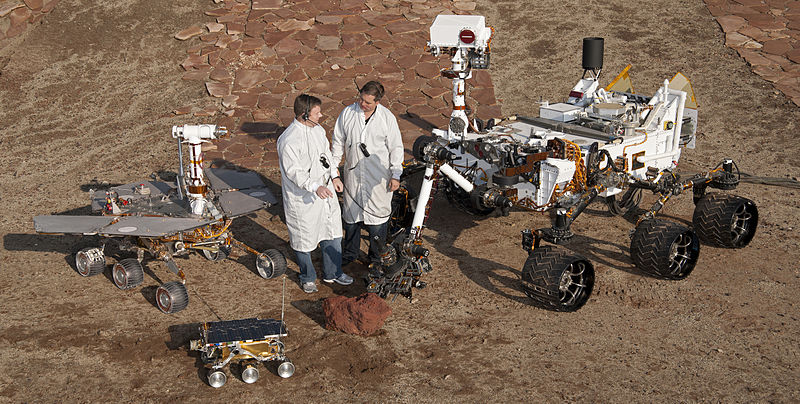
Comparative rover sizes. Foreground: Mars Pathfinder (1997); left: Mars Exploration Rover (2003-present); right: MSL (credit: NASA)

The MERs, which arrived on Mars in 2003, were both solar-powered, as was NASA’s first mission to put a rover on Mars – the tiny Sojourner, which formed a part of the Mars Pathfinder mission of 1997. As such, the MERs were expected to only operate for some 90 days apiece – even though Opportunity is still functioning today (over 3,100 days into the mission). One of the reasons for the 90-day limit placed on the MER missions was the expectation that the rovers solar arrays would become less and less effective as the mission progressed due to the accumulation of Martian dust on their flat surfaces, reducing the amount of sunlight they could convert into power for the rovers’ battery systems. This actually did occur, but so did a series of (initially unexpected) “cleaning events”, which saw the Martian wind periodically remove dust from the arrays, restoring some of their ability to harness sunlight.

MSL is expected to operate for far longer than the MERs – a full Martian year (just under 687 days) being the planned initial mission period. It also carries far more science and other equipment on-board. As such, solar power for the vehicle is impractical. Instead, it will be powered by a radioisotope thermoelectric generator (RTG), which utilises heat from the radioactive decay of plutonium-238. This produces around 110 watts of electrical power, generating around 2.5 kilowatt hours per day (compared to the 0.6 kilowatt hours per day generated by the MERs). In addition, the heat generated by the radioactive decay is used to warm fluids which are circulated through the rover keep electronics and other systems at acceptable operating temperatures during the harsher periods of the Martian / seasons.

MSL is not the first time RTGs have been flown to Mars by the United States; both of the Viking Landers of the 1970s were RTG-powered, and both of them, like Spirit and Opportunity, functioned well beyond their original mission times, with Viking Lander 1 operating for over six years and Viking Lander 2 for just over three-and-a-half years.

The late Carl Sagan and a full-size model of the Viking Lander from the 1970s (the Lander was similar in size and mass to the MSL)

Once on the surface, Curiosity will be able to traverse the terrain at a maximum speed of some 90 metres (300ft)  per hour, with average traverse speeds of around 30m (100ft) per hour. This compares to the MERs traversing around 100 metres per day, and means that over the course of the initial mission period, the rover should cover a minimum of some 19 kilometres (12 miles) during the initial mission period (Opportunity has, to date, travelled some 34.6 kilometres (21.5 miles). The rover will be able to calculate the distance it has travelled by means of the unique pattern the wheel treads will leave in the Martian sand; included in the thread pattern is the Morse code pattern for JPL (·— ·–· ·-··), which will be imprinted on the Martian soil once every revolution (JPL standing for “Jet Propulsion Laboratory, MSL’s “home”).  In addition, Curiosity will be able to roll over obstacles approaching 75 cm (30 in) in height.

Curiosity’s wheel treads include the Morse code pattern for JPL (·— ·–· ·-··) to help the rover calculate the distance it has travelled (credit: JPL)

Science Instruments

Some 80 Kg of Curiosty’s mass comprises the camera systems, scientific instruments, experiments and operating systems themselves. These include two on-board computer systems responsible for managing all of the rover’s operations. Both of these are radiation-hardened, with one forming the back-up to the other in case of unexpected failure. Each computer has just over 2Gb of memory and a RAD750 CPU.  For navigation, the computers are supported by an Inertial Measurement Unit (IMU) that provides 3-axis information on its position.

MSL includes a suite of camera systems, which will be used for a range of functions, including autonomous navigation, hazard avoidance cameras (using pairs of black-and-white cameras mounted at each corner of the rover), a “Mars Hand” camera mounted on the rover’s robotic arm (which has a reach of some 2 metres) capable of taking microscopic images of rock and soil, a “ChemCam” which uses an infra-red laser to vaporise rock and soil samples and then collecting a spectrum of the light emitted.

MSL science instruments and cameras (credit: JPL)

From a public perspective, however, the two most interesting camera systems aboard the rover are liable to be the Mars Descent Imager (MARDI) and the MastCam. MARDI will be used during the final moments of MSL’s Martian arrival (dubbed, with good reason, the “seven minutes of terror” – see below). This is designed to start operating when the MSL and its decent unit are some 3.7 km above the surface of Mars and continue through until the vehicle is some 5 metres above the surface. It will take images at 1600×1200 pixel resolution with a 1.3 millisecond exposure time and at a rate of some 5 frame per second.

The MastCam sits (as the name suggests) atop the rover’s mast, some 1.97m above the bottom of the rover’s wheels. This system provides multiple spectra and true color imaging with two cameras. The cameras can take true color images at 1600×1200 pixels and up to 10 frames per second hardware-compressed, high-definition video at 720p (1280×720). As such, it is liable to be images and film from this camera that will capture the imagination of people from around the globe, with the two cameras in the system given between 1.25 and 3.67 higher spatial resolution than the panoramic cameras carried by the MERs when operating at its highest (black and white) resolution of 1024×1024 pixels.

NASA JPL provides a comprehensive overview of the complete science package for those who are interested.

Use the page numbers below left to continue reading

Mesh content creation: morph targets proposal

The Content Creation Improvement Informal User Group has started work on putting together an exploratory proposal for consideration by Linden Lab on the subject of morph targets.

Morph targets (also known as shape targets, per-vertex animation, blend shapes, shape interpolation in some 3D applications) are generally used for complex animations that would otherwise be hard to accomplish with skeletal animation – such as facial animation and avatar customisation. In this latter respect, the SL viewer already uses morph targets to a degree.  The proposal being drafted is aimed at the implementation of a more widespread use of morph targets, for use in such areas as:

  • Complex facial animations on rigged meshes
  • Additional ways for a user to customize the appearance of their avatar
  • Animating the surface of a prim without the need to use a custom skeleton
  • Fine grained control for content creators over how their clothing and avatars deform
Morph targets: animating facial features

It is with regards to this last bullet-point that morph targets are particularly interesting to content creators, as they are seen to have significant potential advantages for clothing deformation than might otherwise be offered by either the parametric deformer, or RedPoly’s alternative approach.

The proposal outlines some of the drawbacks in the latter two approaches, and covers some of the advantages and issues in adopting morph targets. One advantage in using morph targets is that they would allow a content creator to “sculpt” how a morph target should appear, directly within their 3D application of choice, thus giving them the ability to directly control over how a mesh deforms around an avatar (or how a rigged mesh replacement avatar deforms around the base avatar). A potential issue with the approach is that morph targets require additional information to be encoded either within a mesh, or within a texture. This means that additional bandwidth will be required to transmit any mesh which uses morph targets.

Morph targets: a better means of getting mesh clothing to deform?

As it stands, the proposal is in its early phase, although the intention is to complete it and submit it to LL for consideration and feedback as soon as it is felt enough information has been put together. Geenz Spad, co-chair of the CCIIUG, is aware that at the moment, much more input is required in order to get to that stage.

“There could be more input with regards to the content creator’s and the technical perspectives,” he commented to me in discussing the proposal, “The biggest bottleneck is just getting enough input to finish the proposal at this stage.” Of the two perspectives, Geenz feels that it is the technical side of things that is perhaps the more lacking of the two and he would like to see more input from those of a technical mind in terms of potential feature implementation, advantages, disadvantages, possible issues, and so on.

If you are in a position to provide input to the proposal itself, your views would be most welcome, as would your presence at the weekly CCIIUG meetings, which take place every Tuesday, from 15:00SLT at the Hippotropolis Auditorium.

Related Links

Birdland returns to SL

There have been many jazz clubs and jazz lounges in Second Life, so much so that those of us who frequent them all tend to have our favourites. There are a number I have permanently landmarks in my inventory, all of which I have enjoyed spending time at over the years.

But there is only one that has ever stolen my heart – as it did for just about everyone who ever visited it. That club was Birdland. Part of the reason many of us fell in love with it was down to the music: a wonderful mix of jazz and the Great American Songbook, spun into a wonderful and romantic fusion by Alma Fushikizoh, the club’s creator and resident DJ.

But it was not just the music that made Birdland special; the build itself was simply stunning: a true labour of love beautifully crafted to create the perfect ambience for romance and long evenings of dancing and conversation. As Alma once told me back in 2009, “Birdland is a Romantic Lounge; a place to dance with your loved one – a place to flirt, a place to meet extraordinary people”.

The original Birdland, circa 2009

There was also the fact that Alma and her partner (both in SL and in RL), Blysse Biondi, regarded everyone who frequented Birdland as being part of their extended family in SL; imbuing the club with a very special atmosphere that, for most of the clubs “regulars”, made it a genuine home-from-home in Second Life.

Sadly, Birdland vanished from the grid when Alma and Blysse had to retire from Second Life due to personal reasons – and its absence was sorely missed. For my part, I’ve never come across another club that combines the same measure of look, ambience, romance, friendliness and fun.

I was therefore surprised when I logged-in to SL back in June to find Alma and Blysse both on-line and to get a bright, sunny, “We’re back!” IM from Alma. Just having two long-time friends back was reason to celebrate – so it was with a sense of stunned surprise that I accepted an invite from Alma to be one of the first to see that not only were they both once more settled in SL – but also that Birdland itself is back as well and is being readied for a Grand Re-opening!

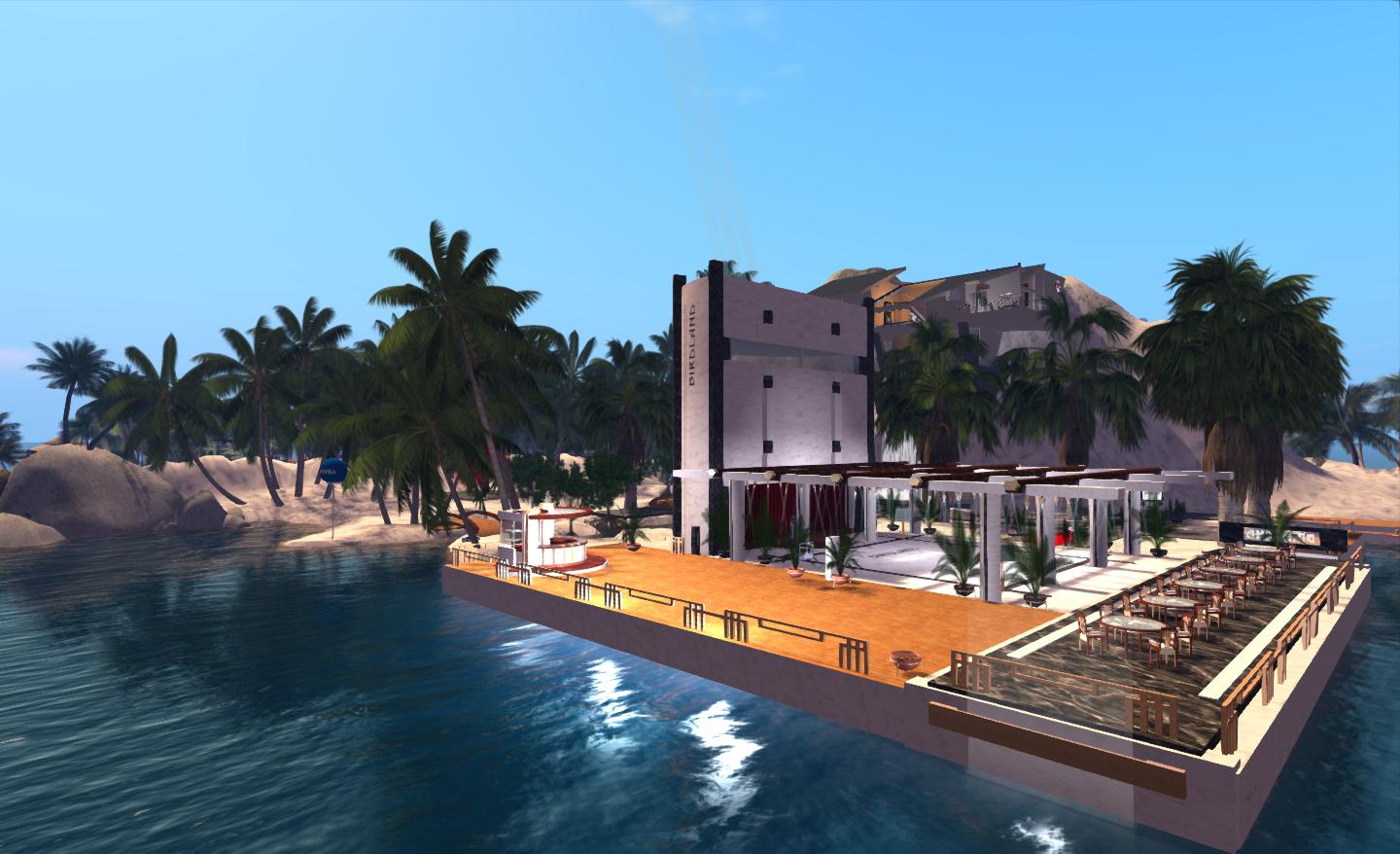
Birdland today

Birdland today is exactly as it was on the last day I saw it before Alma and Blysse had to depart SL; only the setting has changed. Seeing it brought back a wealth of memories; this was a place I’d spent some of the most satisfying evening of my entire Second Life, simply relaxing with the music and enjoying the company of friends in a manner that no other club has, in all honesty, managed to match for me.

Here is a place you can dance under the moonlight (the club is specifically designed for viewers with the time set to sunset or midnight), or sit and chat with friends, watch the sunset from the broad wooden deck, or sit on the beach and cuddle while being serenaded by some of the finest songs every recorded by some of the world’s greatest voices.

Touring the club in its new location with Alma and Blysse, I couldn’t help but feel I’d somehow come home again. Looking at the familiar marble-finished dance floor with the inlaid logo, lit by the rafter-fitted spotlights, wandering the deck overlooking the sea and passing among the tables and chairs overlooking both the dance floor and the sea, I felt the years melt away. With some people only too willing to spread doom and gloom about regions closing and stores vanishing in SL, I couldn’t help but feel something precious has returned to Second Life.

The dance floor and stage at sunset

There is still some work to be done before the club formally opens its doors; and Alma and Blysse are wisely not rushing things; the formal opening will take place in September, giving them more than enough time to finish-off the details here and there.

In the meantime, the club informally opened on August 2nd, and will feature a range of weekend events between now and the end of August to start warming things up. Alma will again be putting together sets for each weekend and will be mixing them with requests from patrons and guests at the following times:

  • Fridays: 17:00 SLT
  • Saturdays: 11:00 and 17:00 SLT
  • Sundays: 11:00 and 17:00 SLT

Live entertainment will very much be a part of the new Birdland as well, and updates on performers and performances as well as DJ sets from Alma will be available through the Birdland in-world group.

I’m certainly looking forward to spending evenings there with friends old and new, dancing to some of the greatest music ever written and listening to some of Second Life’s finest entertainers. I hope to see some of you there are well.

Please note that Birdland does operate a formal / smart dress code with gowns and tuxedos preferred.

Related Links

Housecleaning & an apology

I’ve been going through the blog and trying to rationalise things like categories and tags, and fix broken links (the result of websites elsewhere vanishing / blog posts on other sites being moved, etc.).

While I was predominantly using the WordPress “quick edit” tool, WP still took it upon itself to send out random notifications via RSS denoting old articles as being new posts. If you were one of the people who received such false updates, my sincere apologies.

Anyway, the core work is done: hopefully there won’t be any more spurious messages, and with the overall rationalisation, things should now be easier to search via both categories and tags.

SL Marketplace Issues: July update

On July 31st, The Commerce Team issued the most recent update in the ongoing saga of SL Marketplace issues. The update reads in full:

UPDATE: July 31, 2012

We continue to work on testing the next Marketplace update, which includes a required upgrade (for the Marketplace, not for Residents). One benefit of this work is that we are seeing performance increases with page load and purchase completion during our testing. We are working to get this update completed as soon as possible.

Last week, fixes to help with WEB-4600 were deployed with viewer 3.3.4. We have also been working with Third Party Viewers to make sure they are handling the Merchant Outbox correctly going forward. In addition, some Third Party Viewers now support the Merchant Outbox on Linux. Please see the following Third Party Viewers if you would like to use the Merchant Outbox on Linux:

If your Third Party Viewer is not on this list, and it supports the Merchant Outbox on Linux, please send a notecard to CommerceTeam Linden. Please include a link to the download location, and it will be added to the above list.

Below is the updated set of outstanding issues with Direct Delivery and the Marketplace.

Direct Delivery

Here are the outstanding Direct Delivery issues:

  • WEB-4600 (Merchant Outbox failures): There are still outstanding issues with the Merchant Outbox, in addition to the issues addressed above. We continue to investigate and address these issues as they come up.
  • WEB-4554 (Test delivery permissions incorrect): This is on hold while we work on other issues.
  • Limited Quantity Support (Merchant does not have rights to copy the items for sale): This is currently being worked on. Magic Box migration will not be required until this is supported. (Note that Merchants can sell items that have next owner rights set to “No Copy”.)

Overall Marketplace

There are also several issues that occurred around the time of the Direct Delivery launch that we are still working to address, but are not issues with Direct Delivery.

  • WEB-4587 (listings with the wrong images): This will be addressed after the next Marketplace update.
  • WEB-4441 (Orders stuck in “Being Delivered” state): We have been able decrease the number of orders getting stuck and continue to work on preventing all orders from getting stuck.
  • WEB-4592 (Orders marked as “Delivery Partially Failed” on success): This issue is currently being worked on.
  • WEB-4138 (Confirmation emails failing to deliver): We are currently working on a solution to this issue.
  • WEB-2974 (Listing enhancement stuck in “Charging, cannot edit right now” state): This issue is on hold while we work on the other items on this list.
  • WEB-4696 (Deleted listings appearing in search results): This issue is on hold while we work on the other items on this list.
  • WEB-4567 (Bulk delete fails for some merchants): We will evaluate the priority of this once we have completed the above Direct Delivery fixes and features.

In the meantime, the due date for Magic Box migration has again been extended (as of July 26th) to October 1st, 2012.

Housecleaning

I’m going to be working on the blog over the next few days. Hopefully, most of this should be transparent; however I’m aware that when I did some work last month, WordPress sent out “new post” notifications for at least two post from 2009 as a result of my changing the tags on them.

If you are a subscriber to the blog and you receive notifications in the next day or so for “new” posts that prove to be articles from the past, my apologies.

Update August 3rd 17:45 BST: I’m about half-way there sorting through stuff. Hopefully after this categories and tags will be easier to use, and related posts easier to find (allowing for the vagaries of the WordPress search, which is perhaps worse than SL’s!).