In the wake of the arrival of mesh, and in the hope of alleviating confusion / making things a little more understandable, there are changes coming down the road for Viewer 3. Some of these will undoubtedly make their way into TPVs as well, so here’s a quick overview.
The changes described below can be seen in the latest Mesh Development Viewer from Linden Lab (3.0.5 (240741)+), which can be obtained from the alternate viewer wiki download page. note that as this is a development Viewer, some elements may change in relation to descriptions provided here.
Prim Equivalence and Land Impact
For a general user perspective, this is probably going to be the most obvious change.
Prim Equivalence, or PE has been an issue on many levels, not the least of which, for consumers, is that it tends to be bracketed with a prim count value – and is frequently greater than the associated prim count (although there are items where the reverse is true). People therefore get confused as to which is the key value: prim count (which everyone is familiar with) or PE.
In order to try to solve these issues, the terms “Prim Equivalence” and “prim count” are set to be replaced by a single value: “Land Impact”. How this will work takes a little explaining on two fronts, as it relates to a couple of changes within the Viewer and how we need to view things. So bear with me while I attempt to explain.
The first of these changes is that land will no longer be referred to in terms of prim counts and usage, but rather in terms of its “capacity”. Essentially, this means that:
- Full sims have a “capacity” of 15,000
- Homestead sims have a “capacity” of 3,750
- OpenSpace sims have a “capacity” of 1,875.
Land parcels will also be referred to in terms of their “capacity”:

This might all sound like unnecessary semantics – but it does have a point in that it allows everything to be thought of equally, regardless of its origin – as we’ll see below.
Note as well, that nothing is physically being “lost” from your land. A 4096 sq m parcel that had a prim count of 937 prims before the arrival of the new Viewer will simply have a “capacity” of 937 after the new Viewer has entered general use, as shown by the figures highlighted in green in the above images.
To align with this, objects need no longer be through of in terms of their prim count or their PE – but simply in terms of their Land Impact – that is, how much of the available “capacity” on a sim / parcel they take up. This is reflected in changes being made to the Build menu floater:

As can be seen, the prim count / PE values are being replaced with two simple figures:
- The impact the rezzed object has on the land
- The remaining capacity that is available for rezzing further objects.
So if an object has a Land Impact of 15, it will reduce the land capacity by 15; if it has an impact of 150, it will reduce the land capacity by 150, regardless as to whether the object itself is made of prims or is a mesh object.
For people who want more detail on individual objects, the new Build menu also includes a MORE INFO link. This opens an additional floater which provides:
- Information on the object itself (including the prim count for those missing it!)
- If the object is a mesh creation, the “weights” applied to it in terms of the bandwidth required to download it, the server resources it uses, its physics weight, etc.
- The overall land impact: impact of the object itself, impact of all objects rezzed, remaining free capacity and total capacity for the land itself.

There will also be a WHAT IS ALL THIS? link which will open a Help page that explains the various figures.
Replacing both prim count and PE with a single, easily understood value (Land Impact) makes sense, and at a stroke makes the impact of rezzing any object in-world easy to understand, removing any confusion between prim count and PE.
Of course, there are going to be voices that proclaim the change is about further “hiding” the “real” cost of mesh objects from the user, with the underlying implication that the users are somehow being hoodwinked by Linden Lab. But, c’est la vie. People are wont to make waves come what may.
It will be interesting to see how merchants react to the change – given that all vendors, etc., refer to prim counts right now, and getting wording changed to “Land Impact” (or simply dropping the word “prim” from displays) is a nontrivial issue for many. Some may even opt to retain the use of “prim count” in their vendors for this reason.
And when considering merchants – one hopes that Linden Lab will actually remember to update the Marketplace so that listings also reflect the use of “Land Impact” (i.e rename Prim Count!).
Avatar Rendering Cost and Avatar Draw Weight
Alongside the changes around PE and Land Impact, the Viewer will also be losing another measure that has always caused controversy and angst: Avatar Rendering Cost, or ARC.
Always intended to be an indicative figure for the amount of potential Viewer-side lag avatars create, ARC quickly became viewed by some as the figure for determining whether or not an avatar was “creating lag”, which in turn lead to a lot of drama in some quarters – up to and including people being banned from venues / sims on the basis of their ARC count.

From 3.0.5, things will be totally revamped. ARC as a term is vanishing from the Viewer to be replaced by Draw Weight for Avatars (DWA). Furthermore, how DWA is calculated is radically different to how ARC has been calculated, as Nyx Linden explains.
DWA should be far more accurate than the old ARC system; and therein, one cannot help but feel, lies the rub.
If the figure is indeed more accurate, it is likely to be pounced upon within even greater zeal by those already obsessed with ARC. As such, I can’t help but hope this is one value that Linden Lab don’t make a song-and-dance about when these changes to the Viewer are formally released for general use.
Mesh Uploader
Another source of irritation for content creators has been the mesh upload floater. At SLCC 2011, Charlar Linden himself admitted the current floater is isn’t overly user-friendly. As such, it is also being overhauled, as can again be seen in the current Mesh Development Viewer.
The current upload floater presents a basic set of modifiers that can be applied to a mesh object prior to uploading in order to optimise it. These tend to encourage a lot of trial and error / guesswork on the part of the creator in order to arrive at a desired result.
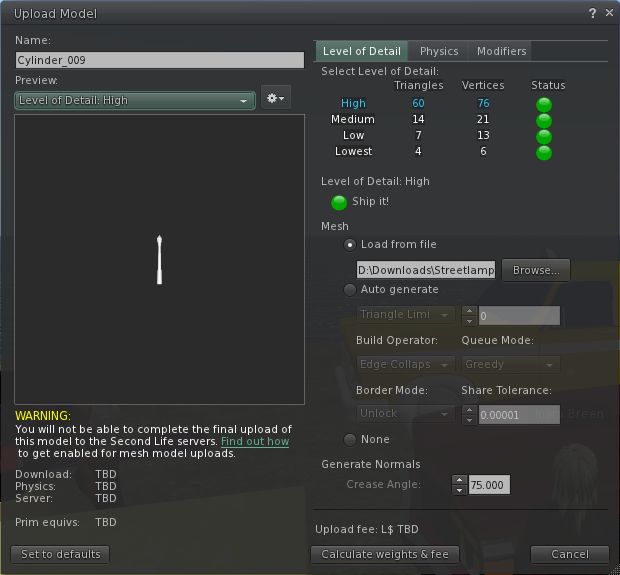
The new upload floater offers a greater range of modifiers and the ability to better define the model itself in terms of what it represents (avatar shape, avatar attachment, moving vehicle, etc – see the drop down in the image below), which presumably apply suitable algorithms that help optimise the object and calculate its overall weight.
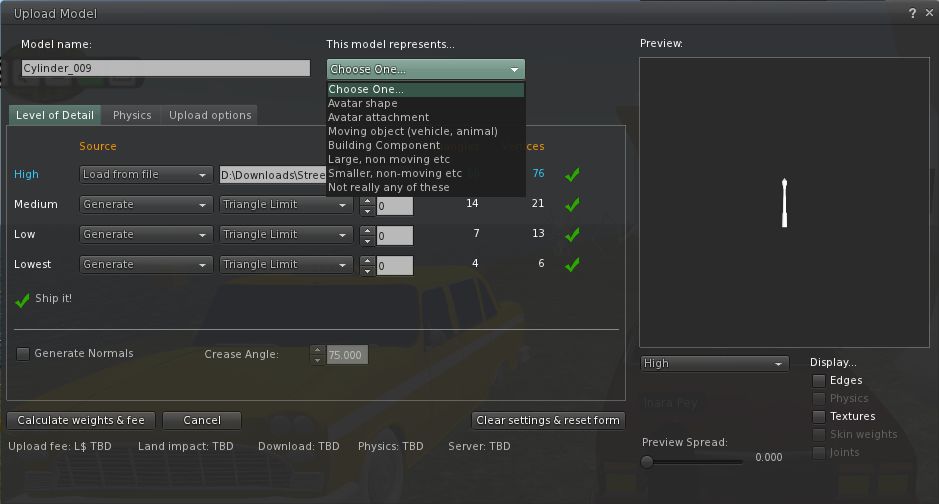
I understand that several of the changes in the new upload floater are as a result of consultations with / requests from mesh content creators, so hopefully they will go some way to easing the process of importing objects into Second Life.
More to Come
These are by no means the only changes coming to Second Life and the Viewer as a result of the arrival of mesh object support. For one thing, more needs to be done in the area of mesh clothing in order to make it easier to adjust clothing to fit the avatar, rather than the other way around as is currently largely the case. Therefore we can expect to see further changes in relation to this in the future (indeed, those interested in the issue should check Maxwell Graf’s JIRA relating to a parametric deformer).
In the meantime, the above should hopefully give insight into what is waiting just around the corner.

 Inara Pey: Living in a Modemworld
*shrug* Until SH-2240 is resolved, V3/Mesh is a moot point for a lot of folks.
-ls/cm
LikeLike
Linden Lab will launch their latest PR campaign with great fanfare in the midst of this issue. They will fix the issue only after the new residents they have enticed discover the viewer is about as stable as Charlie Sheen and log out never to return again.
LikeLike
You write: “…the change is about further “hiding” the “real” cost of mesh objects from the user..” I would be more inclined to think that it would not be about hiding the real cost of mesh and more a smoke screen over the fact that regular prim counts will increase if you scale them up over the normal size, or that adding certain scripts to a mesh item or linking to other prim types will cause those numbers not to just rise, but to do so exponentially. In the end, maybe it will all be so confusing that the main message is lost in the translation and we wont be able to fully understand just how the resource cost of making things is going up! The unlimited use days of the sculpty are coming to an end, ladies and gentlemen. Welcome to the highly optimized world of second life, please use your polygons wisely.
It’s called disinformation, and if you would like a clearer example of this, spend a few minutes here: http://wiki.secondlife.com/wiki/Mesh/Mesh_Asset_Format. Once your eyes start to cross, close the window and clear your head, and go back to whatever it was you were doing before. That is how disinformation works, and its being handled brilliantly by them so far to hide the fact that the free ride on using your prim allowance any way you want to is about to be over. Make no mistake, mesh is designed to kill sculpties, to kill off third party viewers and to kill off V1.X! Shya!
*puts on tinfoil hat*
LikeLike
I’m not sure I see it that way entirely – although I appreciate your point. Does it not in part, however, come down to LL for once making the effort to explain things clearly and succintly to people, rather than leaving them to fumble around in the dark?
That mesh objects have issues around linking and resizing cannot be denied. Nor can the issue around resizing clothing and avatar attachments – as you’re very familiar with through your attempts to get LL to implement a means of comprehensively adjusting size and fit of such.
Similarly, if mesh comes as single-item building blocks (a-la sculpty stairs, etc.), then there is an issue; I’ve little doubt Land Impact will increase the same way as PE currently inflates – and as such, confusion on that level isn’t going away, and will need to be dealt with.
“Killing off” sculpties comes across as a bit strong; “Attempting to limit the future use of sculpties” might be closer to the mark – but even then, sculpites are in widespread use (they’re a part of the Build menu (should I add, “for the time being” 😉 )).
So it would be a major issue were LL to try a stop their use completely, regardless of what appears “good” for the grid. If people believe that they have use cases in which scuplties provide them with better value / option for use – then they are going to demand them, and content creators are going to continue to supply them. Ergo, the only way of stopping their use would be for LL to take drastic action – which would likely hurt them as much as anyone else.
As to the free ride being over? Again, that comes down to user choice, surely? We still have prims and the ability to build in-world, and no-one is forcing people to rush out and buy mesh objects. The bottom line is, if people don’t like what they see, either through experimenting with the purchase of mesh items for themselves, or through the belief that mesh is somehow universally “bad” for them – then they simply aren’t going to buy into it in any major way, and the entire mesh argument becomes moot very quickly. Unless LL shut down the ability to use prims entirely – and that would potentially be akin to them putting a loaded gun to their collective temple and pulling the trigger.
LikeLike
Max-
Based on Charlar’s tone on the MetaReality Podcast, yeah, there’s a distinct anti-Sculpty attitude.
But the thing is, how would they phase them out without destroying the majority of builds out there that use them? The economy that depends on them? The customer-base that’s already cash-strapped and would take their content to other less-expensive grids instead of adding to their SL land holdings to handle increased need for prim count/land impact?
Bandwidth prices are going DOWN.
Hardware resource prices are going DOWN.
With automation, administration costs should be going DOWN.
But this kind of move, in effect, drives the cost of the service/product UP.
Doesn’t make any sense. Something off.
-ls/cm
LikeLike
There is something afoot, and it would be extremely naive to believe this is being done for our own good. LL doesn’t ever work like that, there is always a hidden agenda.
LikeLike
Naive?
No. Simply reviewing the changes being made in the Viewer (as they are at present in the Mesh Development branch); although I freely admit I sometimes give Linden Lab the benefit of the doubt more than others!
LikeLike
The new mesh upload window is far more intuitive and finally I got my head around Lod, although as I was playing with buildings I set my lod to the same level for all four levels so they don’t go out of focus too quickly, this will have land impact implications i’m sure but builders are likely to do this as you want to see a building from a distance.
mesh remains odd though, I had a land impact of six with three objects, joined them and then had a land impact of 4, rounding up and down I’d imagine is the issue.
Changing even prims from convex hull to prim and vice versa changes the land impact number, fun on the beta grid though.
LikeLike
Yes, mesh objects use rounding in the calculations.
If you hand-make a low LOD Mesh for a building component, you can probably cut back on the modeled detail without obvious appearance changes, and you might be able to use that Mesh for the physics, so people can walk through the doors.
LikeLike
Please note my last sentence, that of putting on my tinfoil hat. What I wrote here was meant to be taken largely as sarcasm, but with an underlying tone of general mistrust for whatever it is this miasma of “meshinformation” (im registering that term, its got such possibility) is designed to accomplish. It is clear that things are rarely done for our benefit, though they have managed to actually get mesh working at all, which is pretty significant considering that most of the people who would have worked on this (Qarl, why o why did they make you leave us?) are no longer around. The implementation of mesh, and its fine tuning, are what concerns me the most, as there is a very narrow window of viable use for it at the moment and that window can only be opened by a patient few who are masochistic enough to endure the process of optimizing a model for SL usage.
While its pretty certain they wont kill off sculpty, they would love for us to stop using them and have stated as much. While they wont kill off TPV’s, with the ability to upload mesh being restricted to the official viewers by way of the nifty HAVOK licensing issue, it is clear that TPV’s wont be able to do anything more than view mesh. While they may not actually kill off V1.X viewers, its pretty clear that the use of them will become more and more restrictive…they’ve stated that they would love to see V1 die.
So, while im not a true proponent of conspiracy theories, I do like how the tinfoil hats look on me. That is to say, I dont think the Lab is out to get us, but I dont think they are working day and night to do us any favors either. If something happens to be of benefit to the average user or creator here, you can bet your arse that the benefits to them far outweigh it. They are a for profit company, though I think a more apt descriptor would be Benevolent Dictatorship.
Excelsior!
LikeLike
TBH… I was confused on the tinfoil hat comment – did you mean the entire post, or just the comments relating to TPVs? Although no harm done in offering a different perspective :).
As to uploads – I’m not convinced a workaround won’t be found. Lets face it, some OpenSim grids have mesh capability of some description, and there are other physics engines that are available that might provide code that can be made fit-for-purpose. Over and above that, there is a limited Havok licence that is available – would that provide a solution? Kirstenlee Cinquetti’s S21 Build 9 certainly had mesh upload. Finally, from what I’ve seen by way of comments, I gather Firestom and others are pressuring LL to be someone forthcoming on the upload code that has been provided.
So, the one thing I have learned where Viewers are concerned is to never say never :).
And in fairness to LL, they haven’t said they’d like to see V1.x Viewers die – that is more a case of how their words have been interpreted. While they’ve ceased work on 1.x development themselves and it many potentially get harder for 1.x devs to keep pace with changes to the 2.x code (as Oz warned), 1.x Viewers are proving remarkably resilient. Againm if we look at mesh object rendering, the first TPV to have it was Kirstenlee’s Viewer S21, then two V1.x TPVs – Astra 1.5.10 and Cool Viewer 1.26.1, and then Firestorm 3 and Dolphin 3 – so in that regard, 1.x TPVs are managing to stay slightly ahead of the curve. :).
As to the rest -believe me, I do agree with you. Tinfoil hats and all :).
LikeLike