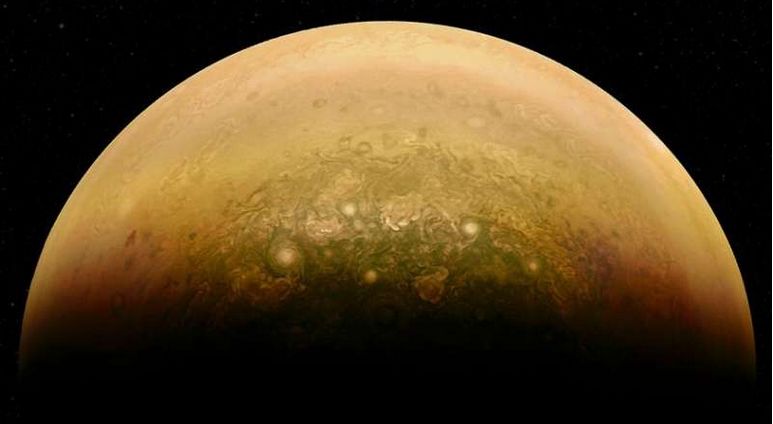
A colour-enhanced image of Jupiter’s south pole, created by “citizen scientist” Alex Mai, as a part of the public JunoCam project. Credit: NASA/JPL / SwRI / MSSS / Alex Mai – see later in this article for an update on the Juno mission
On Wednesday, October 19th, 2016, the European Space Agency (ESA) attempted, for them, a double first: placing a vehicle successfully in orbit around Mars (the Trace Gas Orbiter, or TGO) and landing a vehicle on the planet’s surface (the Schiaparelli demonstrator).
Launched in March 2016, TGO is the second European orbiter mission to Mars, the first being Mars Express, which has been operating around the red planet for 12 years. TGO’s mission is to perform detailed, remote observations of the Martian atmosphere, searching for evidence of gases which may be possible biological importance, such as methane and its degradation products. At the same time, it will to image Mars, and act as a communications for Europe’s planned 2020 Mar rover vehicle.
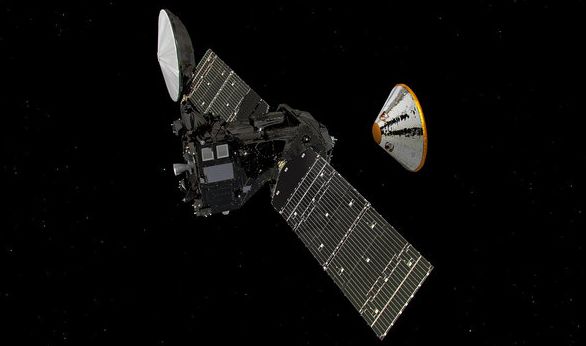
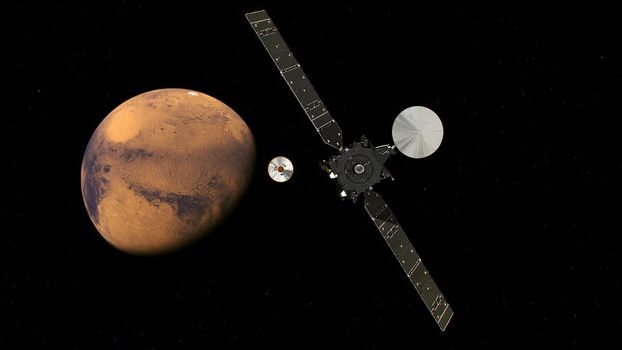
October 16th, 2016: the Schiaparelli EDM separates from ESA’s TGO, en-route for what had been hoped would be a safe landing on Mars. Credit: ESA
TGO’s primary mission won’t actually start until late 2017. However, October 19th marked the point at which the vehicle entered its preliminary orbit around Mars. Orbital insertion was achieved following a 139-minute engine burn which slowed the vehicle sufficiently to place it in a highly elliptical, four-day orbit around Mars. Early next year, the spacecraft will begin shifting to its final science orbit, a circular path with an altitude of 400 km (250 mi), ready to start its main science mission.
On Sunday, October 16th, prior to orbital insertion, TGO had bid farewell to the 2-metre diameter Schiaparelli Entry, Descent and Landing Demonstrator Module (EDM), which it had carried to Mars. The EDM was specifically designed to gather data on entry into, and passage through, the Martian atmosphere and test landing systems in preparation for ESA’s 2020 rover mission landing.
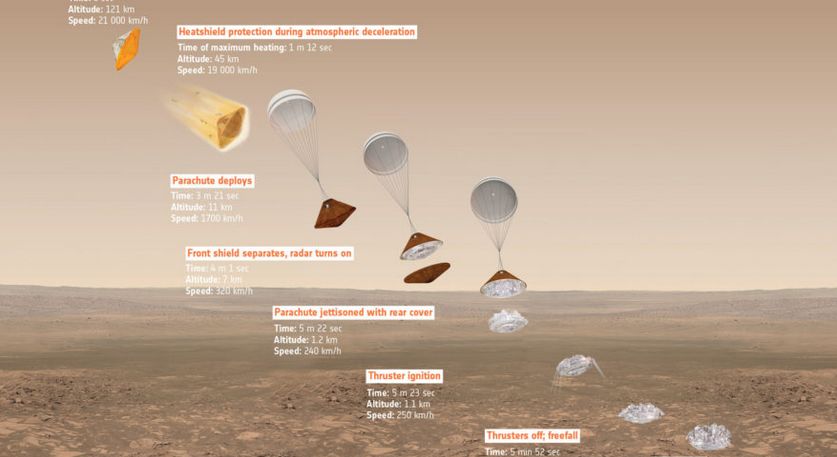
Schiaparelli’s route to the surface of Mars (click for full size). Credit: ESA
Once separated from TGO, Schiaparelli travelled ahead of the orbiter, entering the Martian atmosphere at a speed of 21,000 km/h (13,000 mph; 5.8 km/s / 3.6 mi/s), at 14:42 UT on October 19th. After using the upper reaches of the Martian atmosphere to reduce much of its velocity, Schiaparelli should have proceeded to the surface of Mars using a mix of parachute and propulsive descent, ending with a short drop to the ground, cushioned by a crushable structure designed to deform and absorb the final touchdown impact. Initially, everything appeared to go according to plan. Data confirmed Schiaparelli had successfully entered the Martian atmosphere and dropped low enough for the parachute system to deploy. Then things went awry.
Analysis of the telemetry suggests Schiaparelli prematurely separated from its parachute, entering a period of free fall before the descent motors fired very briefly, at too high an altitude and while the lander was moving too fast. Shortly after this, data was lost. While attempts were made to contact the EDM using ESA’s Mars Express and NASA’s Mars Reconnaissance Orbiter (MRO) it was not until October 20th that Schiaparelli’s fate became clear.
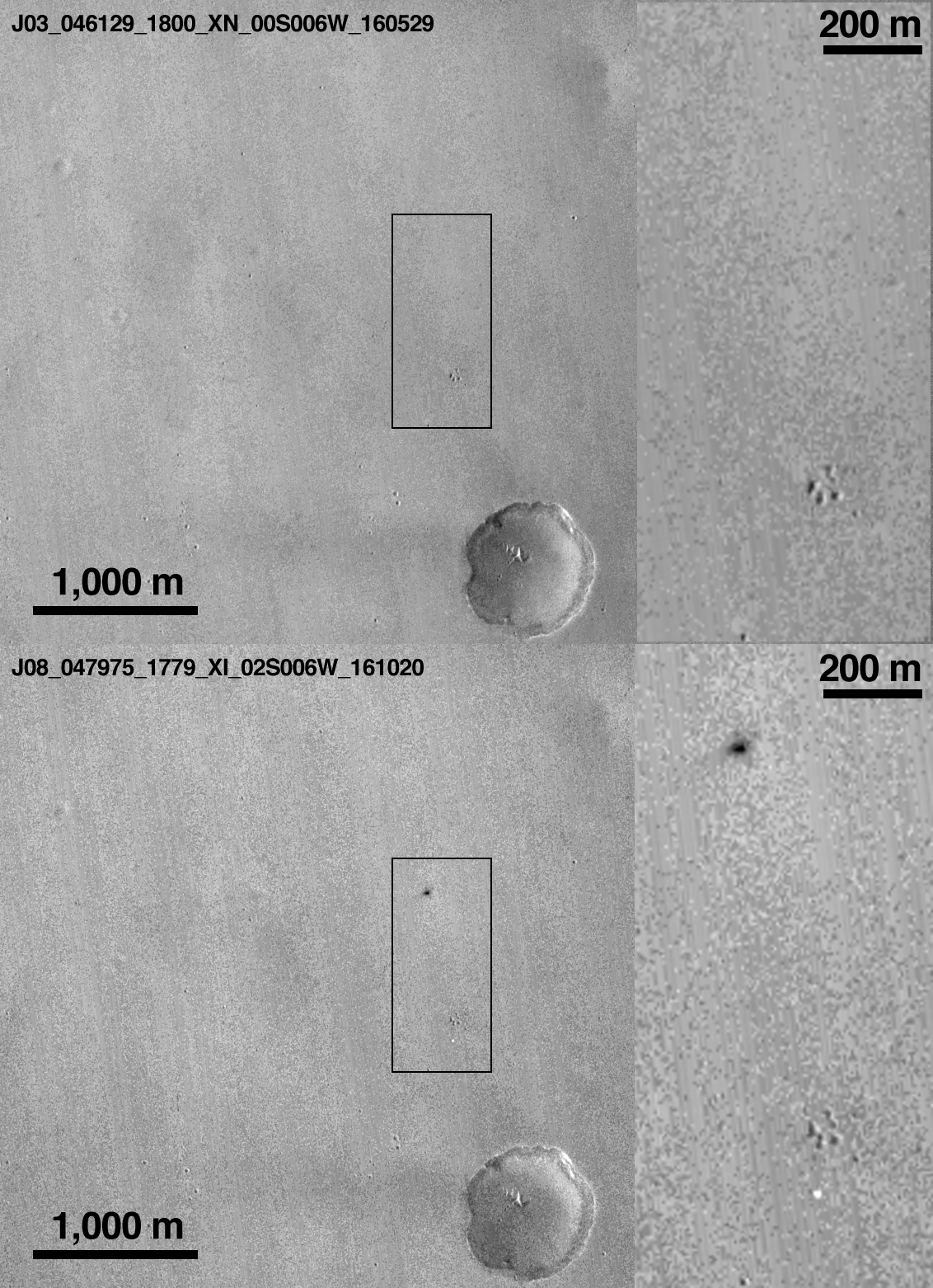
Images taken by MRO of Schiaparelli’s landing zone revealed a new 15x40m (49x130ft) impact crater, together with a new bright object about 1 kilometre south of it. The crater is thought to be Schiaparelli’s impact point, and the latter the lander’s parachute and aeroshell.
In releasing the NASA images on October 21st, the European Space Agency stated,”Estimates are that Schiaparelli dropped from a height of between 2 and 4 km (1.4-2.4 mi), impacting at a speed greater than 300 km/h (186 mph). It is also possible that the lander exploded on impact, as its thruster propellant tanks were likely still full.”
Point of impact: on the left, images of Schiaparelli’s landing zone taken in May 2016 and on October 20th, 2016, superimposed on one another. The October 20th image clearly shows an impact feature with a bright object to the south, thought to be Schiaparelli’s parachute canopy. On the right, an enlarged view of the same two images. Credit: NASA/JPL / MSSS
While the lander carried a small suite of science instruments which would have been used to monitor the environment around it for a few days following the landing, the major part of the mission was to gather data atmospheric entry and the use of parachute and propulsive descent capabilities. ESA believe this part of the mission to have been a success, even with minimal data gathered on the propulsive element of the descent.
In the meantime, TGO is currently on a 101,000 km x 3691 km orbit (with respect to the centre of the planet). It is fully functional, and will undertake instrument calibration operations in November, prior to commencing the gentle aerobraking manoeuvres designed to reduce and circularise its orbit around Mars.
An artist’s impression of ESA’s Trace Gas Orbiter approaching Mars on October 16, 2016, having just released the Schiaparelli lander demonstrator. Credit: ESA
Sunday, October 16th, 2016, marked the first in two important dates during the month for the European Space Agency. It was at 14:42 UT that the SchiaparelliEntry, Descent and Landing Demonstrator Module (EDM) separated from its parent orbiter, the Mars Trace Gas Orbiter (TGO) as the two entered the final three days of their approach to Mars.
TGO / Schiaparelliform the first part of the European Space Agency’s ExoMars mission, which represents an ambitious expansion of European studies of Mars by placing TGO in orbit around Mars where it will study the atmosphere, then following it in 2020 with a rover mission, for which Schiaparelli is a pre-cursor.
It’s been a mission a long time in the making – in the case of the still-to-fly rover mission, more than a decade has already passed since its inception, was a certain amount of the delay due to NASA. Originally, both TGO and rover were to launch aboard Russian vehicles, but a 2009 agreement with the US space agency resulted in a comprehensive re-design of both missions, which were to fly aboard / as part of US vehicles / missions (the TGO science was to have flown on NASA’s Mars Science Orbiter (MSO) mission, for example). However, NASA unilaterally cancelled the agreement at the start of 2012 due to cost overruns with the James Webb Space Telescope, forcing a further complete redesign of both TGO and rover vehicle.
Schiaparelli should touch down in the Meridiani Planum during the dust storm season
October 16th was an important milestone for the mission, as it saw TGO release the Schiaparelli demonstrator in what was a textbook operation, watched via telemetry at mission control, with a nine-and-a-half-minute time delay separating events from receipt of data. It was a single line of that data that indicated separation had been successful.
Schiaparelli will not proceed ahead of TGO, their paths slowly diverging, until Wednesday, October 19th, when TGO will enter its preliminary orbit around Mars. Over the course of the next year, that orbit will be further and further refined until the vehicle is correctly positioned to commence its 5-year primary mission. For this, TGO will perform detailed, remote observations of the Martian atmosphere, searching for evidence of gases which may be possible biological importance, such as methane and its degradation products. At the same time, TGO will continue to image Mars, and act as a communications for both Schiaparelli and for the 2020 rover vehicle.
At the same time as TGO enters that preliminary orbit, Schiaparelli will commence a much more hazardous journey to the surface of Mars. This will commence with the 2.4 metre (8ft) diameter EDM slamming into the Martian atmosphere at 21,000 km/h (13,000 mph; 5.8 km/s / 3.6 mi/s), where it will use a heat shield and atmospheric friction to rapidly decelerate.
Once through the upper reaches of the Martian atmosphere, the EDM will jettison the heat shield and deploy a parachute system from its protective aeroshell. This will carry it down to an altitude of several dozen metres above the surface, before the lander drops clear of the aeroshell. Rocket motors on the lander will then fire, slowly bringing it to around 2 metres (6.6ft) above the ground, where they’ll shut down, allowing Schiaparelli to drop to the surface, the impact cushioned by a crushable structure designed to deform and absorb the final touchdown impact. The entry, descent and landing should take around 6 minutes.
Throughout the descent, Schiaparelliwill record a number of atmospheric parameters and lander performance, with a camera system recording its descent. Once on the surface, it will measure the wind speed and direction, humidity, pressure and surface temperature, and determine the transparency of the atmosphere. It will also make the first measurements of electrical fields at the planet’s surface.
The EDM will only operate for a short time on the surface of Mars – between 2 and 8 sols (Martian days) is the estimate. Its small size, coupled with the limited amount of space within it, means it is not equipped with solar arrays to re-charge its battery systems. However, the core aim of the mission is to better characterise the Martian atmosphere and test critical descent and landing systems needed for future missions, rather than carrying out long-term surface studies.
The Schiaparelli EDM and science instruments which will analyse the environment on the surface of Mars – wind speed, atmospheric pressure and temperature, humidity, dust content, atmospheric transparency, and local electric fields
The planned landing point for Schiaparelliis Meridiani Planum, the region NASA’s Opportunity rover has been exploring since 2004. The EDM will be arriving during the dust storm season, which will provide a unique chance to characterize a dust-loaded atmosphere during entry and descent, and to conduct surface measurements associated with a dust-rich environment.
I’ll have more on TGO and Schiaparelliin my next Space Sunday update.
A comparison of sunsets on Earth (l) and simulated on a watery Proxima b as it orbits Proxima Cantauri (r). While the latter is approximately one-seventh the diameter of our Sun, it appears much larger in Proxima-b’s sky, because the planet is just 7.5 million miles from its sun. Credit: PHL Arecibo
In August 2016, I wrote about the discovery of a Earth-size planet orbiting the Sun’s nearest stellar neighbour, Proxima Centauri, a “mere” 4.25 light years away.
The planet, Proxima b, has a mass roughly 1.3 times that of Earth and orbits its dwarf star parent once every 11.2 terrestrial days at a distance of just 7.5 million km (4.7 million miles). It is of particular interest to astronomers because it lies within Proxima Centauri’s habitable zone – the region around a star where it is neither too hot nor too cold for liquid water to exist on the surface of a planet, and where conditions might be conducive for life to arise.
The Earth-sized Proxima b and its parent star. Credit: AFP
Which is not to say life does exist on the planet. Proxima Centauri is a red dwarf star, just 1.5 times bigger than Jupiter, and stars of that size are subject to massive stellar flares which could easily strip away a planet’s atmosphere, or at least leave it awash in ultra-violet radiation, which is not entirely agreeable for life to arise. What’s more, the planet is liable to be tidally locked with Proxima Centauri, leaving one side baked in perpetual daylight and the other in a frozen night. None of this makes it terribly amenable for life gaining a toe hold.
One of the big questions concerning the planet is how much liquid water it may have. Normally this can be determined by using the planet’s size and mass, and working from there. But while we have an estimate of Proixma b’s mass, there is no definite measurement of its size. Normally, this is done by measuring how much light a planet blocks out, from Earth’s perspective, when it pass in front of its host star. So far, this hasn’t been possible with Proxima b.
In the video above, by the Planetary Habitability Laboratory, Arecibo, the star and orbit are to scale, but the planet was enlarged (x30) for visibility. The planet is represented here as a mostly desert-like, tidally-locked world with shallow oceans and a strong atmospheric circulation allowing heat exchange between the light and dark hemispheres.
Instead, a team at France’s CNRS research institute has been working on simulations based on the “best guess” estimates gathered from the data which is available on Proxima-B, and their findings are intriguing. This data suggests the planet could be between 0.94 and 1.4 times the size of Earth, depending on its internal structure.
At the lower end of this scale (planetary radius = 5,990 km / 3,743.75 mi), the CNRS simulations indicate that the planet likely comprises a metallic core surrounded by a rocky mantle, with 0.05% of that mass accounted for by liquid water. While this might not sound a lot, it is worth pointing out that Earth, with a radius of 6,371 km / 3,982 mi has just 0.02% of its mass made up of liquid water. At the upper end of the scale (planetary radius = 8,000-9,000 km / 5,000 – 5,600 mi), the planet likely has a rocky centre surrounded by an ocean up to 200 km (125 mi) deep.
Any significant amount of free water on the planet could mean that the atmosphere is being renewed against loss from solar activity. However, the fact that the planet may well be tidally locked could mean that there is a strong atmospheric circulation between the “dark” and “light” sides of the planet due to the temperature differential between the two, giving rise to massive, hurricane-like storms. A further aspect of tidal locking is that if there is a significant amount of liquid water on the planet, it will have long-since frozen out into ice on the dark side.
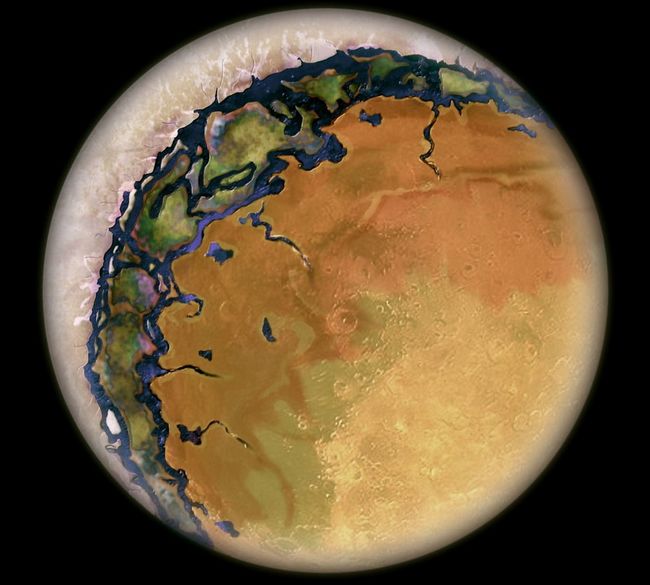
Could Proxima-b be an “eyeball” world, staring at its parent star? Credit: Beau, Rare Earth Wiki
This in turn leaves us with the equally intriguing possibility that Proxima-b is a potential “eyeball” world “staring” at its parent star.
“Eyeball” worlds are thought to be tidally locked planets where the hemisphere facing the parent sun is thought to be baked dry under the unrelenting light of their sun, forming a “pupil”. Around this, close to the the day / night terminator, is an iris-like temperate region of land and water which extends back to the terminator between the day and night sides of the planet, where the water is frozen out into ice, forming the “white” of the “eye”.
None of these most recent findings point to Proxima-b being potentially habitable, and again, it’s worth remembering that even with water and warmth, Proxima b isn’t the most amiable environment in which life might gain a toe-hold. But what they do suggest is that even without life scurrying or swimming about on / in them, exoplanets could be remarkably exotic places, even by our own solar system’s standards.
New Shepard: One Step Closer to Tourist Flights
Blue Origin, the private space company launched by Amazon founder Jeff Bezos achieved another milestone on the road to starting their sub-orbital flights into space for tourists.
On Wednesday, October 5th the company launched another test flight of its New Shephard system of capsule unit and “propulsion module” in order to test the launch abort system of the capsule unit during flight. This system is designed to safely separate the New Shepherd crew capsule from the rocket booster in the event of an anomaly during flight, protecting a future crew and passengers.
The test saw the booster and capsule climb to 4,893 metres (16,053 ft) where, 45 seconds into the flight, the “full-envelope escape system” activated, separating the capsule from the booster, allowing its escape motors on the capsule to fire, accelerating it away from the booster at 400 mph in a 2-second burn. The capsule continued to rise to 7,092 metres (23,269 ft), before it started its decent, the parachute landing system deploying and bringing it to a safe touch-down.
It had been expected that the 70,000 pounds of off-axis thrust delivered by the capsule’s motors would seriously deflect the booster from its flight track and result in its complete loss. However, in a move that surprised many watching, the booster continued upwards to an altitude of 93,713 metres (307,458 ft) where, some 7.5 minutes into its flight, it re-ignited its motor to execute a controlled vertical descent back to the launch pad and a safe landing.
If all goes according to plan, Blue Origin plans to launch its first passengers on a sub-orbital hop in which they get to enjoy around four minutes of weightlessness, in 2018. The price of tickets has yet to be confirmed. However, competitors Virgin Galactic and XCOR Aersopace are looking to charge US $250,000 and $150,000 respectively, when they commence operations.
Euorpa’s icy, mineral-stained surface as imaged by NASA’s Galileo mission – see below (credit: NASA / JPL)
NASA have been teasing the press and pundits with news that they have a “surprising” announcement to make about Europa, one of Jupiter’s four Galilean moons (so-called as they were first recorded by Galileo Galilei).
Slightly smaller than our own Moon, Europa is covered by shell of water ice, much of it discoloured by mineral deposits and by deep cracks. This icy surface might only be relative thin, on the order of a handful of kilometres in extent, or it might be tens of kilometres thick, and sits over an ocean which is mostly likely liquid water, although some argue it might actually be an icy slush, perhaps extending to 100 km (62.5 miles) in depth.
The ocean is made possible by tidal flexing enacted by the massive gravity of Jupiter as well as from the other large Galilean moons. This generates heat within Europa, and this heat stops the water from freezing solid.
An artist’s impression of how a huge plume of water, over 200km (125 mi) high, which erupted from Europa in 2012 and was “seen” by the Hubble Space Telescope, might have looked like if witnessed from the vicinity of Europa. Credit: NASA / ESA / M. Kornmesser.
Exactly how much heat is generated as a result of this flexing isn’t known, but it has been suggested that the ocean floor could be home to volcanic activity with hydrothermal vents and fumeroles responsible for pumping huge amounts of minerals into the water, as well as supplying energy, potentially marking Europa’s ocean as a place where basic microbial life might arise.
The discovery of life on Europa isn’t going to be the subject of the NASA press conference. It will instead reveal the findings of a Europa observation campaign using the Hubble Space Telescope linked to the potential for a liquid water ocean being present under the moon’s ice. I’ll likely have more next week.
Nor is Europa likely to be alone in harbouring a subsurface ocean among the Galilean moons of Jupiter. In 2015 data from the Hubble Space Telescope confirmed that Jupiter’s largest moon, Ganymede, has an underground ocean that contains more water than all of Earth’s combined. Hubble was used to carry out a spectrographic observation of Ganymede’s aurorae, displays of light in the atmosphere. Because aurorae are controlled by a moon or planet’s magnetic field, observing changes in how they behave offers insights into what is happening beneath the surface of the planet or moon. In Ganymede’s case, the aurorae allowed scientists to confirm a long-suspected subsurface salt water there.
Pluto’s Liquid Heart
A global mosaic of Pluto captured by New Horizons from a distance of 450,000 km (280,00 mi) from Pluto byt New Horizons on July 14th, 2015, coloured from data received by the RALPH instrument on the spacecraft, reveals the planet’s heart-shaped mark, the left “lobe” of which is formed by the massive depression dubbed “Sputnik Planum”. Credit: NASA/JPL / JHU/APL / SwRI
In June, I wrote about a paper proposing Pluto harbouring a liquid water ocean beneath its surface. The paper, by Planetary Science Institute Senior Scientist Amy C. Barr and Noah P. Hammond of Brown University, reached its conclusion after a prolonged study of Pluto’s geological features, including “Sputnik Planum”, a massive depression on the planetoid which forms one “lobe” of Pluto’s distinctive “heart”.
Barr and Hammond’s work focused on the lack of ice II on Pluto – a place where ice II should be expected to form. Had it done so, it would have caused volume contraction, resulting in the formation of compressional tectonic features on the surface of the planet. However, Barr and Hammond found no evidence for such features on Pluto in all of the images returned by the New Horizons spacecraft which flew past Pluto and its twin, Charon, in July 2015. This led them to conclude that Pluto’s interior is warmer than might be expected, which would both prevent ice II from forming and potentially give rise to a liquid ocean beneath Pluto’s frozen crust.
Now, a second paper has been published in Geophysical Research Letters, offering a suggestion as to how deep that ocean is, and its potential composition. Another research team at Brown University have been investigating the dynamics between Pluto and Charon, and the likely formation and development of the “Sputnik Planum” depression, which is thought to have been initially created by the impact of an object some 200 km (125 mi) across at some point in Pluto’s formative years.
Pluto and Charon are tidally locked with each other, so they always show each other the same face as they rotate. “Sputnik Planum” sits directly on the tidal axis linking the two worlds. This suggests the basin has what’s called a positive mass anomaly — it has more mass than average for Pluto’s icy crust. As Charon’s gravity pulls on Pluto, it would pull proportionally more on areas of higher mass, which would tilt the planet until “Sputnik Planum” became aligned with the tidal axis.
The surface ice on “Sputnik Planum” is constantly being renewed both by atmospheric deposition from above, and convection action from below, suggesting a source of heat beneath the ice, which in turn could be keeping any subsurface ocean liquid. Credit: NASA/JPL / JHU/APL / SwRI
But why would a crater – essentially a hole in the ground – be a positive mass anomaly? Part of the answer probably lies in the huge amount of nitrogen ice which has accumulated in the basin over the aeons, adding mass to the basin.
But the ice isn’t thick enough on its own to create the amount of mass needed to make “Sputnik Planum” have positive mass. Water, however, could have sufficient mass.
An impact creates a dent on a planet’s surface, followed by a rebound. That rebound pulls material upward from deep in the planet’s interior. If that material is denser than what was blasted away by the impact, the crater ends up with the same mass as it had before the impact happened. Any material added to it after the impact and rebound would therefore add mass to it, creating a positive mass anomaly.
The moment of destruction: the SpaceX Falcon 9 explodes on Launch Complex 40 at Kennedy Space Centre, Florida
SpaceX Look to Resume Falcon Flights in November 2016
SpaceX President Gwynne Shotwell has indicated the company hopes to resume Falcon 9 launches from November 2016, despite the September 1st loss of the launch vehicle and its US $200 million Amos 6 Israeli-built communications satellite during the preparations for a full static fire test of the rocket’s main engines.
It’s an ambitious aim, given that the cause of the loss is still unknown – and until it is known, it is highly unlikely the Falcon 9 will be cleared for flight by the FAA. However, the comments might suggest company feel that the cause of the loss may not have been with the booster itself, but may have been triggered by an external event, in which case such a target might be possible.
Launch Complex 40, Canaveral Air Force Station, after the Loss of the Falcon 9 booster and payload on September 1st, 2016. Credit: Ken Kremer
The static fire test is a part of pre-launch preparations unique to SpaceX. Basically a full dress rehearsal of a launch, it includes fuelling the booster and briefly firing the main engines with the rocket locked-down on the pad. It was during fuelling operations, eight minutes before the rocket motors were to be fired, the that a series of explosion occurred, destroying the booster and its payload.
Video footage seems to suggest the point of origin for the explosions was outside of the vehicle, in what SpaceX has called a “fast fire”, which started at, or near, the liquid oxygen fuelling umbilical. As well as the complete loss of the vehicle, the explosions and fireball caused extensive damage to Space Launch Complex (SLC) 40 at Canaveral Air Force Station, which had been leased to SpaceX for Falcon 9 launches.
It is the second lost of a Falcon 9 rocket in 15 months. In June 2015, the vehicle carrying the Dragon CRS-7 cargo resupply vehicle to the International Space Station disintegrated a little over two minutes after lift-off, following the failure of an internal strut.
In order to resume launches and meet obligations, SpaceX are planning on pivoting Falcon 9 launches to Kennedy Space Centre’s Pad 39A until such time as SLC 40 can be repaired. SpaceX leased the pad – a part of the complex used to launch the Saturn IB, Saturn V and space shuttles – in 2014 in a 20-year deal. It is currently being refurbished at the company’s expense to launch crewed Dragon 2 flights to the International Space Station, and commercial missions using their new Falcon Heavy launcher. Currently, there is still much work to be completed at the launch complex – previously used to launch the space shuttle, and before that, the mighty Saturn V rocket, although SpaceX plan to have the work completed by November.
Launch Complex 39A at Kennedy Space Centre undergoing refurbishment by SpaceX in preparation for Falcon Heavy and crewed Falcon 9 launches. The Rotating Service Structure, seen on the left and used for space shuttle launches, is due for demolition
Whether or not the root cause of the September 1st accident will be known by then, and the Falcon 9 cleared for flight is a major unknown. The investigations into the June 2015 loss took six months to complete and – due to it being caused by a failure within the vehicle – the rocket had to undergo several engineering changes.
Blue Origin Announces the New Glenn Booster Family
Blue Origin, the company founded by Amazon founder Jeff Bezos, revealed its plans for a family of reusable boosters for both orbital and deep space launches. Called New Glenn, the vehicles are a significant step forward for the company.
The New Glenn family. Credit: Blue Origin
Although more widely known for their efforts in the sub-orbital space tourism field, with their New Shephard reusable system, Blue Origin has long indicated it has wider aspirations, whilst remaining somewhat tight-lipped about exactly what it is developing.
Like the smaller New Shephard sub-orbital launch vehicle, New Glenn is to comprise a reusable first stage – referred to as the “propulsion module” on New Shepard. The vehicle has been under development for about 4 years, and the plan is for the first launch to take place in 2020.
Seven metres (23ft) in diameter, the New Glenn first stage will be powered by seven of the company’s new BE-4 engines. These are the same engines United Launch Alliance have selected as the primary propulsion unit for their own upcoming new Vulcan launch vehicle, which will enter service in 2019 to replace the expensive Atlas V booster.
This core stage of the new Blue Origin rocket – which is named for John Glenn, the first American to orbit the Earth, just as New Shephard is named after Alan Shephard, the country’s first astronaut to fly in space – will be topped by either a second stage for launches to low-Earth orbit, or a combination of a second stage and third stage system capable of a broader range of launch options. In both variants, the second stage will be powered by a single BE-4 engine, while the third stage will be powered by an uprated version of the BE-3 engine, currently used by the New Shephard. Neither the second nor third stages will be recoverable. It is anticipated that New Glenn will be capable of lifting between 35 to 70 tonnes to low Earth orbit, placing it in the same class of launch vehicle as SpaceX’s Falcon Heavy – and thus competing directly with it.
When it enters service, the new booster will be launched from America’s Space Coast, from the historic Space Launch Complex 36 at Canaveral Air Force Station, which Blue Origin took over in September 2015 in a deal with the USAF’s 45th Space Wing.
New Glenn compared to other current launch vehicles. The two-stage variant will be 85 metres (270ft) tall, and the 3-stage variant 95m (313 ft) tall. Both will have a 7m (23 ft) diameter. Credit: Blue Origin
In its time, SLC 36 was was used to launch the Mariner missions, the first US interplanetary probes to visit over worlds, Pioneer 10 and Surveyor-1, the first US vehicle to soft-land on the Moon. It was largely demolished in 2010, leaving just a single pad. Blue Origin are expected to construct a rocket fabrication and assembly facility there, as well as a new launch complex. Currently, it is not clear how the first stage of the booster will be recovered, but the company have hinted at an automated at-sea landing in the style of SpaceX might be used.
China Launches Tiangong-2
On Thursday, September 15th, 2016, and as expected, China launched the Tiangong-2 (“Heavenly Palace 2”) orbital laboratory from their Jiuquan Satellite Launch Centre in Gansu Province, and on the edge of the Gobi Desert in northern China. The Long March 2F booster (and not a long March 7, as incorrectly reported in some space news outlets) lifted-off at 14:04 UTC, making for a night launch, local time.
The Long March 2F carrying the Tiangong-2 orbital laboratory, lifts-off from China’s Jiuquan Satellite Launch Centre in Gansu Province at 14:04 UTC on Thursday, September 15th
Tiangong-2 is the second phase of China’s goal to establish a permanently crewed space station in the early to mid 2020s. This work started in 2011 with the launch of the Tiangong-1 facility, which was briefly visited by two crews in 2012 and 2013. It will culminate in the on-orbit construction of a large space station, starting with the launch of the Tianhe (“Harmony of the Heavens”, and formerly Tiangong-3) space station core module in 2022.
an artist’s impression of Tiangong-2 (centre right) with the Tianzhou resupply vehicle docked (left), together with the Shenzhou-12 crew vehicle at the laboratory’s far docking port. Credit: CCTV
It is expected that at least two crews will visit the facility. The first 2-person crew will fly to the laboratory in October aboard Shenzhou-11. They will commence the first round of a fairly extensive science programme, remaining at the lab for around 30 days.
After this, the facility will be left dormant until April 2017, when a Long March 7 booster is due to deliver the Tianzhou (“Heavenly Ship”) uncrewed resupply vehicle to orbit. This craft will then perform an automated docking with Tiangong-2, providing it with additional fuel, water and other consumables and also use its engine to boost the laboratory into a higher orbit to await the arrival of the second crew.
The second crew, comprising 3 personnel, should fly to the facility in mid-2017 Shenzhou-12. They are expected to say for less than 30 days, but while there carry out a number of tasks connected to developing a full space station, including performing an EVA. Whether further crews will visit the station after this has yet to be determined.
A Billion Stars – A Map to Our Galactic Neighbourhood
The first one billion: a billion stars in our galaxy mapped by distance and brightest – with a few extra-galactic objects shown for good measure. Credit: ESA/Gaia/DPAC
The above image might not look like much, but it is the largest all-sky survey of celestial objects published to date, pinning down the precise position on the sky and the brightness of 1142 million stars in our galaxy.
It is the product of the European Space Agency’s (ESA) Gaia Project, which is approaching the mid-point in its 5-year mission. Launched in December 2013, and orbiting the L2 Lagrange point, Gaia commenced its mapping operation in July 2014 – and it will continue doing so through until 2017. This map, released by the European Space Agency on September 14th, covers the data gathered from July 2014 through to September 2015. A further map, which includes data through to August 2016, is currently in development.
An artist’s impression of the Gaia vehicle at the L2 position relative to the Earth and Sun
The intention is to create a precise three-dimensional map of astronomical objects throughout the Milky Way, mapping their motions, which reflect the origin and subsequent evolution of the galaxy. Spectrophotometric measurements by the craft will provide a detailed survey of all observed stars, characterising their luminosity, effective temperature, gravity and elemental composition. The data gathered will provide the basic observational data to tackle a wide range of important questions related to the origin, structure, and evolutionary history of our galaxy.
It is the second such survey to be undertaken. The first was ESA’s Hipparcos mission, almost two decades ago, which surveyed around 200 million stars. One aspect of the Gaia survey will be to compare its findings with those of Hipparcos, so it will hopefully be possible to start disentangling the effects of “parallax”, a small motion in the apparent position of a star caused by Earth’s yearly revolution around the Sun, and the “proper motion” of the star’s physical movement through the galaxy.
The Gaia map includes globular clusters without our own galaxy, and images of clusters and galaxies beyond our own. Credit: ESA/Gaia/DPAC
The Gaia map means it is now possible to measure the distances and motions of stars in about 400 clusters up to 4,800 light-years away, and includes 3194 variable stars, which rhythmically swell and shrink in size, leading to periodic brightness changes. Many of these are located in the Large Magellanic Cloud, one of our galactic neighbours, a region that was scanned repeatedly during the first month of observations, allowing accurate measurement of their changing brightness. During the first phase of the mission, Gaia also discovered its first supernova in another galaxy, and the science and engineering team had to overcome a “stray light” issue where fibres used in the vehicle’s sun shield protrude beyond the edges of the shield and into the field of view. In doing so, they reflect unwanted light, resulting a degradation in science performance when mapping the faintest of stars in Gaia‘s view.
The Birth of a Black Hole?
Black holes; the boogie-men of the cosmos. Deep wells of gravity so intense that not even light can directly escape after passing the event horizon. They are formed in one of two ways, during the death of super-massive stars.
In the first, the star gobbles up the last of its fusionable fuel, causing the core to suddenly and violently contract, in turn triggering a violent explosion – a supernova – completely shedding the star’s outer shell of mass, and leaving behind a super-dense neutron star. Generally only 10 or so kilometres across, this have a greater mass than our Sun. It is thought that if this mass is too great, the neutron star also collapses in on itself, forming a black hole. In the second, the star doesn’t go supernova, but experiences a “failed supernova” brightening for a very brief period as some matter is lost, but then continuing to collapse in on itself until a black hole is formed. In both cases, the star vanishes from the visible spectrum, leaving behind tell-tale signs in the infra-red and in x-rays.
The Large Binocular Telescope, one of three instruments so far used in gathering data on N6946-BH1. Credit: NASA
A team of astronomers now believe they have captured the birth of a black hole through this second process.
They were studying data relating to N6946-BH1, a red giant thought to be coming to the end of its life, when they noticed something odd. In 2009 the star, roughly 25 times bigger than our Sun and 20 million light years away, could be seen in the visible light wavelengths. By 2015, however, it had vanished, leaving only an infra-red afterglow. A subsequent check on Hubble Space Telescope data revealed the same: in 2007 the star was visible, in 2015, it wasn’t.
Intrigued, the team checked data on the star from the Palomar Transit Factory (PTF). This revealed that in 2009, N6946-BH1 blossomed briefly in luminosity, with a massive burst of neutrinos occurring at the same time – events both consistent with the star collapsing, but not going supernova. Add these to the infra-red tell-tale, and it would seem N6946-BH1 might have formed a black hole.
If so, it should now be a source of x-rays emitted in a particular spectrum as local matter fails into it. The team are now hoping that the Chandra X-ray Observatory in Earth orbit will be able to take a look at N6946-BH1 in the next two months or so to see if those x-rays can be detected. Should it be determined that N6946-BH1 has collapsed into a black Hole – even one now 20 million years old – studying it could help describe the beginning of the life cycle of a black hole, and better inform us on how black holes form, potentially why some super-massive stars form a neutron star rather than collapsing all the way to a black hole.
A dramatic look back: in the foreground is the lower slope of one of the “Murray Buttes”, in the far distance the tall peaks of Gale Crater’s huge rim. One of a series of images taken by NASA’s Curiosity rover on Thursday, September 8th, the rover’s 1,454 sol on Mars. Credit: NASA/JPL / MSSS
NASA’s Mars Science Laboratory rover, Curiosity, has said “farewell” to “Murray Buttes” in a stunning series of images, as it continues its climb up the slopes of “Mount Sharp”, a massive mound of deposited material located at the central impact peak of Gale Crater.
The mesas of “Murray Buttes” mark the upper extend of the transitional “Murray Formation”, where the material deposited during the earliest centuries of “Mount Sharp’s” formation merge with the rock comprising the crater floor. Curiosity has been passing by the area of the buttes for a little over a month now, carrying out examinations of the rock surface and gathering samples of mudstone for analysis.
“Murray Buttes” with the faint outlines of Gale Crater beyond, as images on Thursday, September 8th 2016, by NASA’s Curiosity rover during its 1,454 sol on Mars. Credit: NASA/JPL / MSSS
Believed to be the eroded remnants of ancient sandstone that originated when winds deposited sand after lower “Mount Sharp” had formed, the buttes rival anything of a similar nature found on Earth in terms of dramatic looks and structure. So much so that while we’re hardly likely to see Clint Eastwood ride his horse around the base of one, they would nevertheless fit neatly into a Sergio Leone western.
Several of the pictures – mosaics of images captured by the rover which have been white-balanced to match typical Earth daylight lighting conditions and then stitched together to offer complete scenes – reveal the deeply layered nature of the sandstone, sandwiched in what is referred to as “cross-bedding”. This indicates that the formations are the result of both wind deposition of material and then wind erosion, further confirming the idea that “Mount Sharp” was initially formed as a formed as a result of Gale Crater once being home to a great lake, before the waters receded and wind action took over.
A closer view of the layered nature of the sandstone deposits forming “Murray Buttes”, showing the “cross bedding” of the layers, indicative of the role that wind played in their deposition / formation. This picture comprises a mosaic of images captured by Curiosity rover on Thursday, September 8th, 2016 during its 1,454 sol on Mars. Credit: NASA/JPL / MSSS
The images were taken as Curiosity traversed the base of the final butte, where it gathered a final drilling sample on September 9th. On completion of the sample-gathering, the rover will continue farther south and higher up Mount Sharp, leaving these spectacular formations behind.
Curiosity’s route up the slopes of “Mount Sharp” – click for full size. Credit: T.Reyes / NASA/JPL
The Sand Dunes of Shangri-La
On September 7th, NASA issued a video showing the latest radar images captured by the Cassini probe of the surface of Saturn’s largest moon, mighty Titan. The data was gathered as the probe swept by the huge moon – which is blanketed by a thick atmosphere and is known to have lakes and rivers of liquid hydrocarbons on its surface – at a distance of some 976 km (607 mi) on July 25th, 2016 – one of the closest passes over the moon the vehicle has ever made.
Because of the moon’s thick atmosphere, conventional camera systems cannot be used to probe Titan’s mysteries, so Cassini uses a radar system to “map” surface features in black-and-white. Of particular interest to mission scientists during the July 25th flyby was a dark patch along Titan’s equator, previously images by the radar system at much greater distances and dubbed “Shangri-La”. And area which revealed itself to be – in part – a region of linear dunes, mostly likely comprised of grains derived from hydrocarbons that have settled out of Titan’s atmosphere, and which have been sculpted by Titan’s surface winds. Scientists can use the dunes to learn about winds, the sands they’re composed of, and highs and lows in the landscape.
Also captured by the radar is an arena dubbed “Xanadu annex”, believed to be an out-thrust of chaotic terrain from a region dubbed “Xanadu” just to the north of “Shangri-La”. First imaged by the Hubble Space Telescope in 1994, just before the Cassini / Huygens mission was launched, “Xanadu” and its annex are thought to be remnants of the moon’s icy crust before it was covered by organic sediments from the atmosphere.
OSIRIS-REx Lifts-off as an Asteroid Sweeps By Earth
On Thursday, September 8th, NASA successfully launched OSIRIS-REx on a 7-year trek to reach asteroid Bennu, where it will gather surface samples and return them to Earth for analysis. The mission, which I previewed in my last Space Sunday report, lifted-off flawlessly from Space Launch Complex 41 at Cape Canaveral Air Force Station at 19:05 EDT, atop its Atlas V booster at the start of a journey which will carry it a total of 7.2 billion kilometres (4.5 billion miles).
The Atlas V booster carrying OSIRIS-REx shortly after lift-off on Thursday, September 8th. Credit: Ken Kremer
Witnessing the launch was principal investigator Dante Lauretta, from the University of Arizona. “I can’t tell you how thrilled I was this evening, thinking of the people who played a part in this,” he said following the launch.
“This represents the hopes and dreams and blood, sweat and tears of thousands of people who have been working on this for years.”
The mission will gather samples from the surface of the asteroid – a remnant from the formation of the solar system – and will also map Bennu’s orbit around the Sun and the influences affecting it.
This is because the asteroid is a near-Earth object (NEO): an asteroid which periodically passes across Earth’s orbit around the Sun, and can come very close to our planet whilst doing so. So close, in fact, that some estimates of Bennu’s future orbit suggest it will collide with Earth towards the end of the next century.






 Inara Pey: Living in a Modemworld