Space update: Charon’s ocean, Virgin’s spaceplane and your art in space

new-horizonThe Pluto – Charon system is, as I’ve reported through various Space Sunday reports, turning out to be far more remarkable a place than scientists ever imagined. While NASA’s New Horizons space vehicle, which zapped past both Pluto and Charon during its closest approach to both on July 14th, 2015.

On February 18th, NASA revealed the most recent surprise to be revealed by New Horizons: Charon may have once had a subsurface ocean that has long since frozen and expanded, pushing outward and causing the moon’s surface to stretch and fracture on a massive scale.

The side of Charon imaged by NASA’s probe is characterised by a system of “pull apart” tectonic faults, which are expressed as ridges, scarps and valleys—the latter sometimes reaching more than 6.5 kilometres (4 miles) deep. Charon’s tectonic landscape shows that, somehow, the moon expanded in its past, fracturing as it stretched.

The outer layer of Charon is primarily water ice. This layer was kept warm when the tiny world / moon was young by heat provided through the decay of radioactive elements, as well as Charon’s own internal heat of formation. Scientists say Charon could have been warm enough to cause the water ice to melt deep down, creating a subsurface ocean. However, as it cooled over time, this ocean would have frozen and expanded (as happens when water freezes), lifting the outermost layers of the moon and producing the massive chasms we see today.

A close-up of the canyons on Charon, Pluto's big moon, taken by New Horizons during its close approach to the Pluto system last July. Multiple views taken by New Horizons as it passed by Charon allow stereo measurements of topography, shown in the color-coded version of the image. The scale bar indicates relative elevation. Credits: NASA/JHUAPL/SwRI
A close-up of the canyons on Charon taken by New Horizons from a distance of 78,700 km (48,00 mi) and around 1 hour and 40 minutes before the spacecraft reach the point of its closest approach to Charon on July 14th, 2015. Multiple views taken by New Horizons as it passed by Charon allow stereo measurements of topography, shown in the colour-coded version of the image. The scale bar indicates relative elevation (image: NASA / JHU/ APL / SwRI

In an image gathered by the Long-Range Reconnaissance Imager (LORRI) in July 2015 and release by NASA on February 18th, reveals a vast equatorial belt of chasms on Charon. This network is around 1,800 km (1,100 mi) long and in places is 7.5 km (4.5 mi) deep. By comparison, the Grand Canyon is 446 km (277 mi) long and around 1.6 km (1 mile) deep.

The inset images on the picture show one section of the network of chasms, informally named “Serenity Chasma”, with a matching colour-coded topography map.  Measurements of “Serenity Chasma” strongly suggest Charon’s water ice layer may have been at least partially liquid in its early history, and has since refrozen.

SpaceShipTwo Unveiled

SpaceShipTwo VSS Unity, rolled-out on February 19th, 2016
SpaceShipTwo VSS Unity, rolled-out on February 19th, 2016 (image: Virgin Galactic)

Virgin Galactic, Sir Richard Branson’s private venture company which is aiming to become the world’s first commercial space line, offering fare-paying passengers sub-orbital flights into space. rolled out it new SpaceshipTwo vehicle on Friday February 19th.

The event came more than a year after the loss of the first SpaceShipTwo craft, the VSS Enterprise, in a tragic accident in which the craft broke up in mid-air on October 31st, 2014, killing co-pilot Michael Alsbury, and seriously injuring pilot Peter Siebold. At the time of the accident, several other figures involved in private sector space efforts were quick to point to Virgin Galactic’s use of nitrous-oxide as a vehicle propellant and to suggest corner-cutting by the company as causes of the accident.

However, after investigating the incident, the US National Safety Transportation Board (NTSB) drew the conclusion that the incident was largely the result of pilot error: the “feathering” mechanism designed to be used at the edge of space to allow the vehicle to gently re-enter the denser layers of Earth’s atmosphere was inadvertently deployed by co-pilot Alsbury, resulting in the immediate aerodynamic destabilisation and break-up of the vehicle. As a result of these findings, and as a part of a series of improvements made to the vehicle, the new SpaceShipTwo  includes a locking mechanism designed to prevent the feathering system being deployed in error.

VSS Unity is rolled out in a ceremony which saw it christened by Professor Stephen Hawking and Sir Richard Branson's year-old granddaughter
VSS Unity is rolled out in a ceremony which saw it christened by Professor Stephen Hawking and Sir Richard Branson’s year-old granddaughter (image: Virgin Galactic)

The new vehicle, christened VSS Unity by Professional Stephen Hawking (assisted by Branson’s year-old granddaughter), was rolled-out at a special media event held at  Virgin Galactic’s operations and flight facilities in the Mojave Desert, California. It marks the start of a long programme to get the vehicle to a point where it is ready to undertake its first powered flight.

This programme will include a series of ground tests of various vehicle systems, followed by taxi tests on the runway at the Mojave Air and Space Port. after these will come “captive carry” flights, where SpaceShipTwo remains attached to its WhiteKnightTwo carrier aircraft, then unpowered glide flights before the first in a series of powered test flights. While this test programme is not expected to be as protracted as the flight evaluation programme undertaken by VSS Enterprise prior to its crash, iy does mean that the company is not ready to provide any suggested dates by which fare-paying flights might commence.

Continue reading “Space update: Charon’s ocean, Virgin’s spaceplane and your art in space”

Space Sunday: of Einstein, waves, landers and honours

The LIGO observatory, Hanford, Washington State
The LIGO observatory, Hanford, Washington State (source: LIGO)

Thursday, February 11th saw the announcement of the first direct detection of gravitational waves (not to be confused with “gravity waves”, as some in the media initially took to calling them, but which are something else entirely*), which are ripples in the fabric of space-time whose existence was first proposed by Albert Einstein, in 1916.

The detection came about partly as happenstance, in that the Large Interferometer Gravitational Wave Observatory (LIGO), a world-wide operation established in 1992 and involving 900 scientists from 80 institutions in 15 countries. However, the detectors in use up until recently had failed to provide direct evidence of gravitational waves.

Albert Einstein in 1916, when he was formulating his General Theory of Relativity
Albert Einstein in 1916, when he was formulating his General Theory of Relativity (source: Wikipedia)

Enter the National Science Foundation in the United States.  Over the last five years, they have funded the development and construction of two “Advanced LIGO” detectors, themselves massive feats of technology and engineering, located 3,000 km apart in the United States. One resides Livingston, Louisiana, and the other in Hanford, Washington State.

These detectors started running in February2015, in what was called an “engineering mode”. However, in September 2015 work started on running them up to full operational status when, and completely unexpectedly and within milliseconds of one another, both appeared to detect gravitational passing through them.

The odds of such an event occurring almost precisely at the time when the detectors were starting to do the work for which they have been designed would seem to be – and no pun intended – astronomical. As a result the LIGO investigators wanted to be sure of what had just happened and verify what they had apparently detected; hence why the news was only released on February 11th, 2016, several months after the actual detection had been made.

Since the initial detection, the LIGO teams have deduced the gravitational waves were created by two black holes, each barely 150km across,  but each travelling at around half the speed of light and massing around 30 times as much as our on Sun, spinning around one another and merging together some 1.3 billion light years away. As such, the detection marked two things: the first direct proof of gravitational waves and the conformation of a another theory: that black holes can meet and coalesce to create much larger black holes.

But what are “gravitational waves”, and why are they important?

Predicted over a century ago by Einstein in his theory of general relativity, gravitational waves are at their most basic, ripples in spacetime, generated by the acceleration or deceleration of massive objects in the cosmos. So, for example, if a star goes supernova or two black holes collide or if two super-massive neutron stars orbit closely about one another, they will distort spacetime, creating ripples which propagate outwards from their source, like ripples across the surface of a pond. The problem has been that these ripples are incredibly hard to detect, although the proof that they may well exist has been available since 1974.

It was in that year, two decades after Einstein’s passing, that astronomers at the Arecibo Radio Observatory in Puerto Rico discovered a binary pulsar (two rapidly rotating neutron stars orbiting one another). Over the ensuing years, astronomers measured how the period of the stars’ orbits changed over time. By 1982 it had been determined the stars were getting closer to each other at exactly the rate Einstein’s  of general theory relativity predicted would be required for the generation of gravitational waves. In the 40 years since its discovery, the system has continued to fit so precisely with the theory, and astronomers have had little doubt it is emitting gravitational waves.

The moment of detection: September 14th, 2015
The moment of detection: September 14th, 2015 (source: BBC News)

The LIGO detection however, provides the first direct  evidence of gravitational waves, and with it comes the ability to see the universe in a totally new way.

“It’s like Galileo pointing the telescope for the first time at the sky,” LIGO team member Vassiliki  Kalogera, a professor of physics and astronomy at Northwestern University in Illinois, said. “You’re opening your eyes — in this case, our ears — to a new set of signals from the universe that our previous technologies did not allow us to receive, study and learn from.”

Just as we’re able to study the universe in various wavelengths of light, using them to reveal things we otherwise would not be able to see, so gravitational waves will allow us to see the more of the dynamics in cosmic events which have so far remained hidden from us. We would in theory be able to see precisely what is happening in the heart of a supernova for example, and be able to detect the collisions and mergers of black holes, and more. So gravitational waves offer us a further means to increase our understanding of the cosmos.

(*In case you were wondering, gravity waves are physical perturbations driven by the restoring force of gravity in a planetary environment; that is, they are specific to planetary atmospheres and bodies of water, not cosmological events.)

Continue reading “Space Sunday: of Einstein, waves, landers and honours”

Space Sunday: Juno, Orion and getting to Mars

An artist's impression of Juno orbiting Jupiter (Nasa JPL)
An artist’s impression of Juno orbiting Jupiter (Nasa JPL)

Juno is the name of the NASA deep space vehicle due to rendezvous with Jupiter in July 2016. Launched August 5th, 2011, from Cape Canaveral Air Force Station, the mission is designed to study Jupiter’s composition, gravity field, magnetic field, and polar magnetosphere, as well as seeking evidence and clues on how the planet formed, including whether it has a solid core, the amount of water present within the deep atmosphere, how its mass is distributed, and its deep winds, which can reach speeds of 618 kilometres per hour (384 mph).

Unlike most vehicles designed to operate beyond the orbit of Mars, which tend to utilise radioisotope thermoelectric generators (RTGs) to produce their electrical power, Juno uses three massive solar arrays, the largest ever deployed on a planetary probe, which play an integral role in stabilising the spacecraft.

On arrival at Jupiter on July 4th, 2016, Juno will enter a 14-day polar orbit around the planet, where it will remain through the duration of the mission, which should last until February 2018, when the vehicle, fuel for its manoeuvring systems almost depleted, will be commanded to perform a de-orbit manoeuvre and burn-up in Jupiter’s upper atmosphere.

Juno's journey
Juno’s journey (image: NASA)

Currently travelling at some 25 kilometres per second relative to the Earth and 7.6 kilometres per second relative to the Sun, Juno has used a 5-year gravity assist mission to reach its destination.

The first part of this saw the craft launched into an extended orbit about Earth which carried it beyond the orbit of Mars (2012), before swinging back to make a close flyby of Earth in 2013 which both used Earth’s gravity well to accelerate the craft and as a “slingshot” to curve it onto a trajectory that would carry it to Jupiter.

By the time Juno enters orbit around Jupiter, it will have travelled some 2.8 billion kilometres (1.74 billion miles, or 18.7 AU).

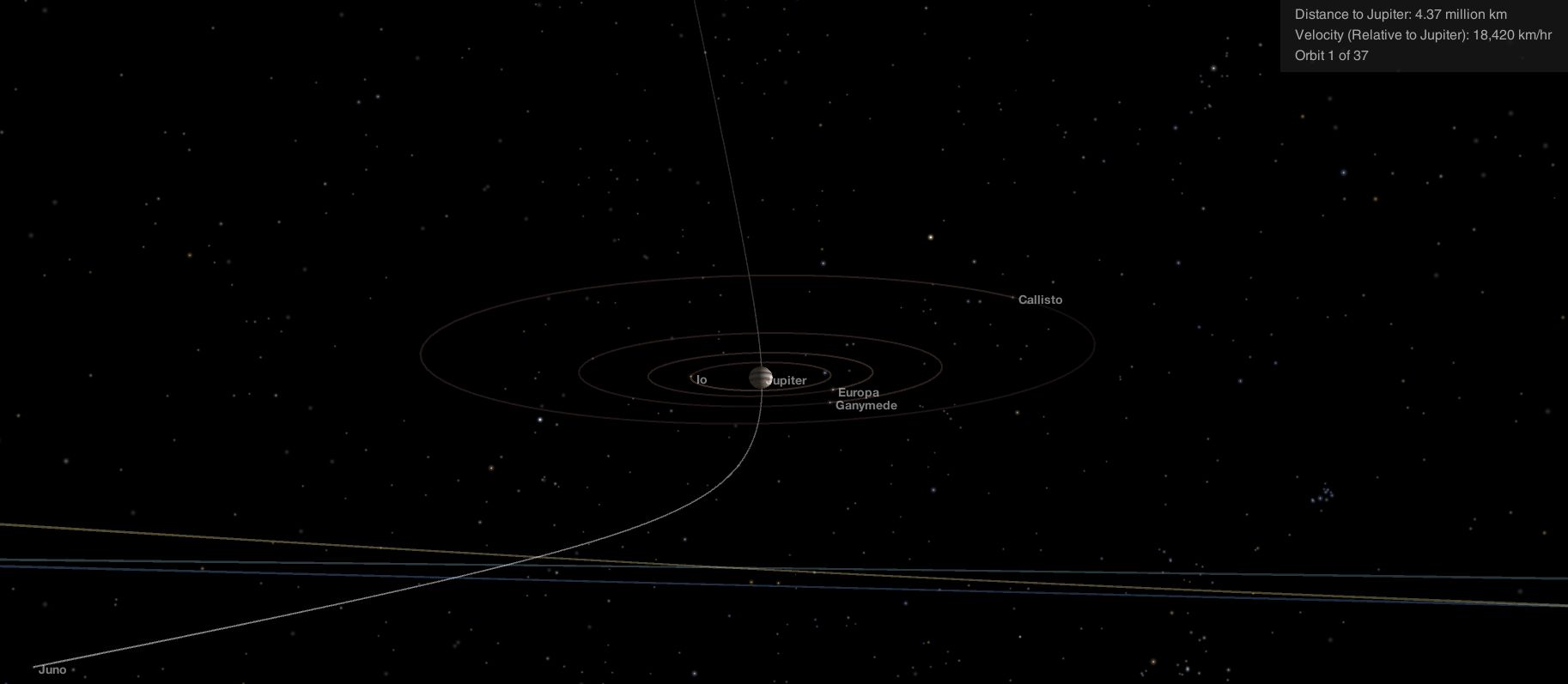
Juno’s planned polar orbit is highly elliptical and takes it to within 4,300 kilometres (2,672 mi) of either pole at its closest approach to the planet, while at its furthest point from Jupiter, it will be beyond the orbit of Callisto, hence the 14–day orbital period. This extreme orbit allows Juno to avoid any long-term contact with Jupiter’s powerful radiation belts, which might otherwise cause significant damage to the vehicle’s solar power arrays and electronics. Overall, Juno will receive much lower levels of radiation exposure than the Galileo mission. But even allowing for this, there is no guarantee the exposed science instruments on the vehicle will last the full duration of the mission. Scientists and engineers are hoping the JunoCam and Jovian Infra-red Auroral Mapper (JIRAM), will last at least eight of the mission’s 37 orbits of Juptier, and that the microwave radiometer will survive for at least eleven orbits.On Wednesday February 3rd, 2016, the vehicle completed the first of two final manoeuvres designed to correctly align it with its intended point of orbital insertion around Jupiter. The second such manoeuvre will take just before Juno is due to arrive at Jupiter.   The spacecraft’s name comes from Greco-Roman mythology. The god Jupiter drew a veil of clouds around himself to hide his mischief, but his wife, the goddess Juno, was able to peer through the clouds and see Jupiter’s true nature – just as it is hoped the mission will probe deep into the planet’s atmosphere and reveal its true nature and origins.

Orion at Kennedy Space Centre

Now set for launch in September 2018 on a circumlunar mission lasting 20 days, the second Orion space vehicle arrived at Kennedy Space Centre, Florida, on Wednesday, February 3rd, 2016. The vehicle, sans its outer skin and massing 1.22 tonnes, arrived from NASA’s assembly facility iin Louisiana by air aboard the agency’s “Super Guppy” transporter, which has been transporting space vehicle components since the Apollo era.

Further construction activities and a variety of tests will be performed at KSC and NASA’s Glenn Research Centre in Ohio to prepare the craft for its mission, officially titled Exploration Mission 1 (EM-1). This will see the uncrewed Orion launched for the first time with and operational, European-built Service Module atop its dedicated Space Launch System (SLS) rocket.

A European Orion Service Module having the launch payload fairings attached to it. The Orion vehicle is attached to the circular part of the Service module visible at the top. This was a structure flight test article used in Orion's first test flight in December 2014 (image: Airbus / ESA)
A European Orion Service Module having the launch payload fairings attached to it. The Orion vehicle is attached to the circular part of the Service module visible at the top. This was a structure flight test article used in Orion’s first test flight in December 2014 (image: ESA / NASA)

“This mission is pretty exciting to us,” Scott Wilson, NASA’s Orion production manager, said as the capsule arrived at KSC. “It is the first time we will have the operational human-rated version of Orion on top of the SLS rocket. It’s a lot of work, but a very exciting time for us.”

The flight will see the Orion system launched into Earth orbit, where a purpose-built upper stage propulsion unit will power the craft onto a flight towards the Moon.

Orion will use the relatively low lunar gravity to both accelerate it and throw it into an elliptical orbit, carrying it a further 70,000 kilometres beyond the Moon – almost half a million kilometres (312,500 miles) from Earth – further than any space vehicle designed to carry humans has yet flown.

Following this, the vehicle will swing back towards Earth, passing the Moon once more before the Command Module separates from the Service Module to make a controlled entry into Earth’s atmosphere and a splashdown in the Pacific Ocean.

The flight will be a comprehensive test of the European-built Service Module, which is vital for providing power and propulsion to the Orion capsule, and which is being built using  the expertise Europe gained in building and operating the Automated Transfer Vehicle, which remains the largest ISS resupply vehicle so far used in space.  The Service Module includes four post-launch deployable solar panels for electrical power, and provides power, heat rejection, the in-space propulsion capability for orbital transfer, attitude control and high-altitude ascent aborts. It also houses water, oxygen and nitrogen for deep space missions.

Like the Apollo Command and Service modules vehicles, the Orion capsule sits on top of the Service Module at launch, covered by the launch abort system shroud, the service Module protected by special payload fairings and mated to the SLS upper stage propulsion unit. The launch abort system and the fairings are jettisoned once the Orion has reached low Earth obit and has separated from the rest of the SLS booster. The Service Module solar panels are then deployed, and the upper stage of the booster re-fires, sending Orion on its way.

The 2018 mission will be followed in 2023 by a similar flight, this time carrying a crew of four further into space than any humans have ever previously been. Together, Orion and the SLS are intended to be the backbone of America’s return to the moon and for human missions to Mars.

Continue reading “Space Sunday: Juno, Orion and getting to Mars”

Space Sunday: day of remembrance, seeing Mars and flying over Ceres

This week marked a sombre period in the annals of NASA’s history. In a period of just 7 days – albeit spread across 50 years – America lost 17 astronauts in just three space flight related tragedies. Every year, the US space agency marks this loss of life – the results of the Apollo 1, Challenger and Columbia accidents – with a special Day of Remembrance on the 27th January. This year’s event was particularly poignant in that 2016 marks the 30th anniversary of the Challenger disaster.

It was on January 27th, 1967, that NASA suffered the first of these tragedies when, during a pre-launch rehearsal of what was intended to be the first manned flight of the Apollo Command and Service modules, a fire broke out inside the Command Module as the vehicle sat on the pad of Cape Kennedy Air Force Station Launch Complex 34. A combination of a pure oxygen atmosphere at a high internal PSI, and highly flammable materials used in the vehicle’s interior construction resulted in the deaths of Command Pilot Virgil I. “Gus” Grissom, Senior Pilot Edward H. White II, and Pilot Roger B. Chaffee in just 16 seconds.

Apollo 1: (l-to-r) Virgil I. "Gus" Grissom, Edward H. White II, and Roger B. Chaffee standing before the Apollo 1 launch vehicle, on January 17th, 1961
Apollo 1: (l-to-r) Virgil I. “Gus” Grissom, Edward H. White II, and Roger B. Chaffee standing before the Apollo 1 launch vehicle, on January 17th, 1961

Nineteen years later, on January 28th, 1986, NASA suffered its largest loss of life in a space mission up until that point in time. It occurred when Space Launch System mission 51L, the 25th flight in the space shuttle programme and the 10th flight of the shuttle orbiter vehicle Challenger – regarded as the veteran of the fleet, having flown more orbital missions than the other three orbiter vehicles at that time – exploded 73 seconds after launch, resulting in the loss of all seven crew.

The Challenger 7: (l-to-r) Sharon Christa McAuliffe, Gregory Jarvis, Judith Resnik, Francis "Dick" Scobee, Ronald McNair, Michael Smith and Elison Onizuka, during a countdown training exercise on January 9th, 1986
The Challenger Seven: (l-to-r) Sharon Christa McAuliffe, Gregory Jarvis, Judith Resnik, Francis “Dick” Scobee, Ronald McNair, Michael J. Smith and Ellison Onizuka, during a countdown training exercise on January 9th, 1986

Tragedy struck the space shuttle programme again on February 1st, 2003, when the space shuttle Columbia broke-up following re-entry into the Earth’s atmosphere at the end of mission STS-107, killing all seven crew. On board were Commander Rick Husband, Pilot William McCool, Payload Commander Michael Anderson, Mission Specialists Laurel Blair Salton Clark, Kalpana Chawla, David M. Brown, and Payload Specialist  Ilan Ramon, a colonel in the Israeli Air Force and the first Israeli astronaut.

The official STS-107 crew photo (l-to-r): Brown, Husband, Clark, Chawla, Anderson, McCool, Ramon
The official STS-107 crew photo (l-to-r): David M. Brown, Rick Husband, Laurel Blair Salton Clark, Kalpana Chawla, Michael P Anderson, William C. McCool, and Ilan Ramon

There have of course been other lives lost within the fraternity of astronauts and cosmonauts over the decades. However, these three tragedies perhaps stand larger than others because NASA has always undertaken its missions in the full glare of the public and media spotlight. Apollo 1, for example, was the headline mission for America meeting President Kennedy’s requirement for “landing a man on the Moon and returning him safely to the Earth” before the end of the decade. Similarly, STS-51L, the Challenger mission, had been specifically engineered to be in the public eye, featuring as it did the first teacher in space, Sharon Christa McAuliffe.

McAuliffe had been selected from more than 11,000 applicants to participate in NASA’s Teacher in Space Project, initiated by US Present Ronald Reagan and intended by NASA to rejuvenate public interest in the space programme, which has been declining steadily since the first space shuttle flight in 1981. The gamble paid off and McAuliffe, became a media sensation, attracting world-wide public interest in STS-51L; so much so that it has been estimated that around 17% of Americans watched Challenger’s lift-off live on television as a direct result of McAuliffe’s presence on the mission, and that around 85% heard about the disaster within an hour of it occurring (and if that doesn’t sound unusual, remember 1986 was well before the Internet and media revolution what has placed information and news at our fingertips wherever we are).

It could be argued – particularly with regards to Challenger, and also with Apollo 1, that the disaster could have been avoided. Warnings about the precise type of failure which caused the loss of Challenger date back as far as 1971, which tests carried out in 1977 revealing the risk of what because known as an O-ring failure being inherent in the design of the shuttle’s solid rocket boosters.

Things are less clear in the case of the Columbia tragedy; while it has been suggested that a rescue mission might have been mounted using the shuttle orbiter Atlantis, which was being prepared for a mission due to lift-off at the start of March, 2003. However, in order to get the vehicle flight ready for a launch ahead of the February 15th deadline (the point at which lithium hydroxide, a critical part of the systems used to remove carbon dioxide from the air in a space vehicle, would run out aboard Columbia), was itself fraught with risks.

But whether they could be avoided or not, these three disasters remind us that the cost of becoming a space faring civilisation – something which could be vital to our survival – is not without risk. Which is why I’ll close this part of Space Sunday with the words of Francis R. Scobee, the Commander of STS-51L, written shortly before his death aboard the Challenger:

Continue reading “Space Sunday: day of remembrance, seeing Mars and flying over Ceres”

Space update: seeking planet X, examining comets and sifting sand

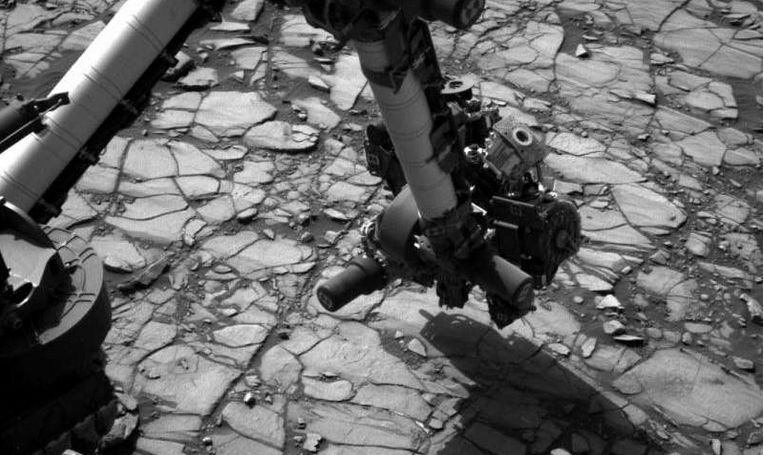
CuriosityNASA’s Curiosity rover has been sampling the sands of the “Namib Dune” the vehicle has been studying / circumnavigating for the last few weeks as it studies an extensive dune field which is slowly making its way down the slopes of “Mount Sharp” on Mars at the rate of about a metre per year.

“Mount Sharp”, more formally called Aeolis Mons, is the huge mound of material gathered against the central impact peak of Gale Crater. It forms the rover’s primary mission target in its quest to better understand conditions on Mars down through the ages, and to look for areas which at some point in the planet’s past, may have had all the right conditions – minerals, chemicals, water, heat, shelter, etc., – which might have allows life to arise.

The dune field on the north-east flank of “Mount Sharp” is of considerable interest to scientist, as it is the first genuine dune field to be studied on another world, and obtaining a clearer understanding of how the Martian wind moves sand could lead to a clearer picture of how big a role the wind plays in depositing concentrations of minerals often associated with water across the planet, and by extension, the behaviour and disposition of liquid water across Mars.

Tracks on a sand dune: this image from Curiosity's front Hazard Avoidance Camera (Hazcam) shows the rover's tracks on the same of "Namib Dune" as it starts sample gathering
Tracks on a sand dune: this image from Curiosity’s front Hazard Avoidance Camera (Hazcam) shows the rover’s tracks on the same of “Namib Dune” as it starts sample gathering

On January 12th, the rover reached a target area for sample gathering dubbed “Gobabeb”, and even this presented a challenge. Curiosity had to manoeuvre up onto the dune, and then turn in place in order to start sample gathering operations. This meant a cautious approach to the location, initially “scuffing” the sand to obtain and indication of its depth and composition (loose firm material). After this the rover gently edged onto the sand and deployed the robot arm to use its small scoop in only its second major sample gathering exercise, which took place on January 14th.

The sand gathered by the operations well be sorted within the CHIMRA system inside the robot arm, which uses a series of sieves to divide the sand grains by coarseness. Once sorted, the samples are delivered to the rover on-board chemical and analysis systems  – ChemMin, the Chemical and Mineralogical laboratory and SAM, the Sample Analysis at Mars suite – for examination.

A second sample of sand was gathered on January 19th, and is currently awaiting processing.

CHIMRA
CHIMRA – the Collection and Handling for In-Situ Martian Rock Analysis device attached to the turret at the end of Curiosity’s robotic arm, processes samples acquired from the built-in scoop (red) and the drill, which is not shown but is also part of the turret. CHIMRA also delivers samples to the analytical lab instruments inside the rover. Two paths to get material into CHIMRA are shown (the scoop delivers material to the location marked at the bottom, and the drill deposits material to the sample transfer tube shown at top). Also marked are the location of the vibration mechanism used to shake the turret and cause the sample to move inside CHIMRA, and the portion box (yellow) from which the material processed through a sieve is delivered to the analytical lab instruments.

Europe Joins Dream Chaser

In my last Space Sunday report, I covered the news that Sierra Nevada Corporation (SNC) will be joining SpaceX and Orbital ATK in supporting US work to delivery supplies to, and remove waste from, the International Space Station.

As a part of a new contract which commences in 2019 and runs until 2024, the expected end of ISS operations, SNC will utilise an unmanned cargo version of its Dream Chaser “mini shuttle”, which is based on a lifting body design, to carry up to 5 tonnes of material to the space station. Now Europe has officially joined SNC as a strategic partner.

The Drem Chaser Cargo, bult by SNC, and the International Berth and Docking Mechanism, to be supplied to SNC for Dream Chaser flights by the European Space Agency
The Dream Chaser Cargo, built by SNC, and the International Berth and Docking Mechanism, to be supplied to SNC for Dream Chaser flights by the European Space Agency

SNC and Europe have been looking at options for Dream Chaser development since SNC lost out to SpaceX and Boeing to supply the crewed version of Dream Chaser to NASA for ferrying crews back and forth between the ISS and US soil. Confirmation that NASA will be using Dream Chaser for the resupply flights means that ESA can nor push ahead with developing an International Berthing and Docking Mechanism (IBDM) for Dream Chaser.

Continue reading “Space update: seeking planet X, examining comets and sifting sand”

Space Sunday: Dream Chasers Falcons, and spacewalks

The Dream chaser alongside NASA's space shuttle Atlantis
The Dream Chaser flight test article alongside NASA’s space shuttle Atlantis in 2010 (image: NASA / SNC)

NASA has announced a renewal to the current US private sector contracts to provide uncrewed resupply missions to the International Space Station (ISS) – and it came with something of a surprise.

SpaceX and Orbital ATK are the two US companies currently flying cargo resupply missions to the ISS, operating alongside Russian Progress vehicles and the Japanese H-II “Kounotori” Transfer Vehicle. Europe, which previously operated the largest cargo vehicle, the Automated Transfer Vehicle, ended ISS resupply missions in February 2015, and is now focused on supplying NASA with the Orion Service Module.

Both SpaceX, who can both launch and return up to 3.3 tonnes of cargo and trash to / from the space station using their Dragon cargo vehicle, and Orbital ATK,who can transport up to 3.5 tonnes of cargo / trash aboard their Cygnus vehicle (which burns-up on re-entering Earth’s atmosphere) have their resupply contracts renewed from 2019 through 2024, matching the extended lifetime of ISS operations. While this had been expected, the inclusion of a third vehicle, the Dream Chaser vehicle being developed by Sierra Nevada Corporation SNC surprised some.

Dream Chaser was unique among the commercial crew transportation proposals as it was based on a "lifting body" design , allowing to re-enter the Earth's atmosphere and glide to a landing on a conventional runway - aspects which still make it a very flexible vehicle
Dream Chaser was unique among the commercial crew transportation proposals as it was based on a “lifting body” design rather than a capsule system. Although launched atop a conventional rocket, the design allows it to re-enter the Earth’s atmosphere and glide to a landing on a conventional runway, making it an exceptionally versatile craft (image: SNC)

Dream Chaser was originally designed as part of NASA’s Commercial Crew Development (CCDev) programme aimed at having private sector companies provide the means of carrying crews back and forth between the space station and US soil. One of four proposals put to NASA under the programme, it was ruled out of the final selection in September 2014, with SpaceX and Boeing being chosen by NASA despite the fact that on paper, Dream Chaser offered potentially a better deal than Boeing’s CT-100 capsule.

While SNC lodged a complaint with the US Government Accountability Office (GAO) as a result of the decision, citing interference in the selection process by William Gerstenmaier, NASA’s top human exploration official, the GAO upheld the selection of SpaceX and Boeing for the crewed transport vehicles. However, NASA continued to work with SNC on various ideas for Dream Chaser, alongside of SNC looking at other options for the vehicle’s crew carrying capabilities to be put to use.

An artist's concept of the Dream Chaser Cargo docked with the ISS during a resupply flight
An artist’s concept of the Dream Chaser Cargo docked with the ISS during a resupply flight (image: SNC)

The new resupply contract will see SNC provide NASA with the uncrewed “Dream Chaser Cargo” variant of the vehicle, capable of flying up to 5 tonnes of cargo to / from orbit, As with the original crewed variant, the Dream Chaser Cargo will launch atop a rocket, but return to earth to make a conventional runway landing.

How many missions each of the three resupply vehicle types will fly is unknown; vehicles will be selected on the basis of flight / payload requirements and cost. The total cost of the contract, spilt between the three companies, is expected to be US $14 billion over the 5 years.

The Ice Volcanoes of Pluto

Scientists with NASA’s New Horizons mission have assembled the highest-resolution colour view of one of two potential cryovolcanoes spotted on the surface of Pluto, as the spacecraft hurtled by the little world in July 2015.

Informally called “Wright Mons”, the feature is about 150-160 kilometres (90-100 miles) across at its base, and about 4 km (2.5 miles) high. If it is in fact a volcano, it will be the largest such feature discovered in the outer solar system.

The feature has members of the New Horizons science team intrigued on two counts. The first is that there is a very sparse distribution of red material on its flanks. The second is that it apparently only has a single impact crater. This latter point suggests “Wright Mons” is relatively new surface feature on Pluto, while the former might suggest it is active, with ice ejected by eruptions covering the red material over time.

"Wright Mons" (the large dimple in the image on the right) and as seen in context with the rest of Pluto, may be one of two enormous cryovolcanoes on the tiny world (image: NASA/JPL / JHU/APL / SwRI)
“Wright Mons” (the large dimple in the image on the right) and as seen in context with the rest of Pluto, may be one of two enormous cryovolcanoes on the tiny world (image: NASA/JPL / JHU/APL / SwRI)

The images of “Wright Mons” were returned to Earth from New Horizons in November 2015. Since then, data from the Ralph instrument suite aboard the spacecraft has been used to add the colour details to the images, which have been composed into a new mosaic of the feature. If it and “Piccard Mons” are cryovolancoes, then they present further evidence that Pluto was (and might still be) geologically active.

Continue reading “Space Sunday: Dream Chasers Falcons, and spacewalks”