Logos representative only and should not be seen as an endorsement / preference / recommendation
Updates for the week ending Sunday, December 16th
This summary is generally published every Monday, and is a list of SL viewer / client releases (official and TPV) made during the previous week. When reading it, please note:
It is based on my Current Viewer Releases Page, a list of all Second Life viewers and clients that are in popular use (and of which I am aware), and which are recognised as adhering to the TPV Policy. This page includes comprehensive links to download pages, blog notes, release notes, etc., as well as links to any / all reviews of specific viewers / clients made within this blog.
By its nature, this summary presented here will always be in arrears, please refer to the Current Viewer Release Page for more up-to-date information.
Note that test viewers, preview / beta viewers / nightly builds are not recorded in these summaries.
Official LL Viewers
Current Release version 6.0.1.522263, dated December 5th, promoted December 13th. Formerly the Spotykach Maintenance RC viewer – NEW.
Occupying a quarter region, Nevgilde Forest is a cosy corner of Second Life co-owned by Neaira Rose Allegiere (Neaira Aszkenaze) and Sarge Red. It offers a very outdoors setting, complete with an element of shabby chic.
Although it contains “forest” in the name, this is not actually a densely wooded setting; outside of the landing point in the north-east corner of the parcel, which is hemmed in by trees and shrubs, the land is mostly open, affording good views out over the sea to the west and south.
The woodland hides not only the landing point, where the local group joiner can be found together with a donations box and information giver, but also a little camp site nestled under an old hut raised on wooden legs to resemble a ramshackle tree house, backed into the surrounding trees and shrubs, some of which have found their way through the loose boards of the walls to invade the interior.
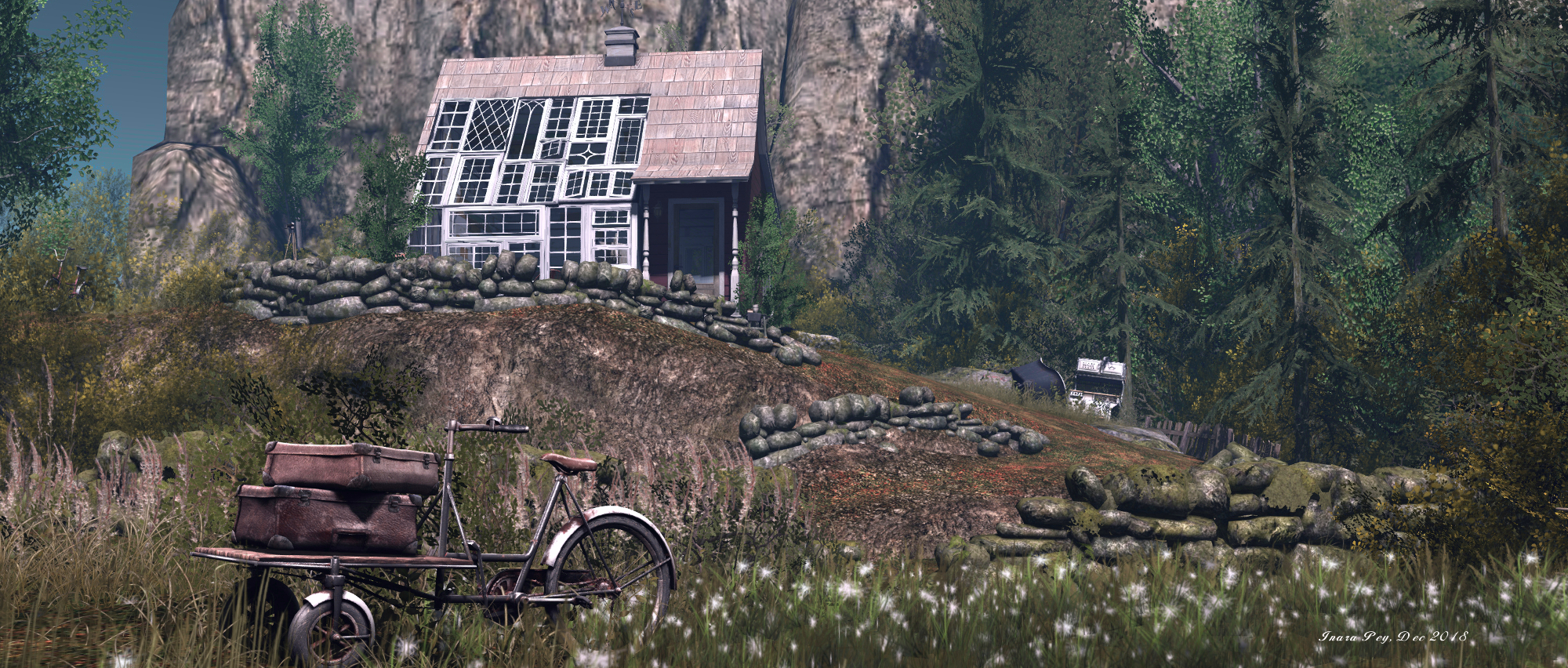
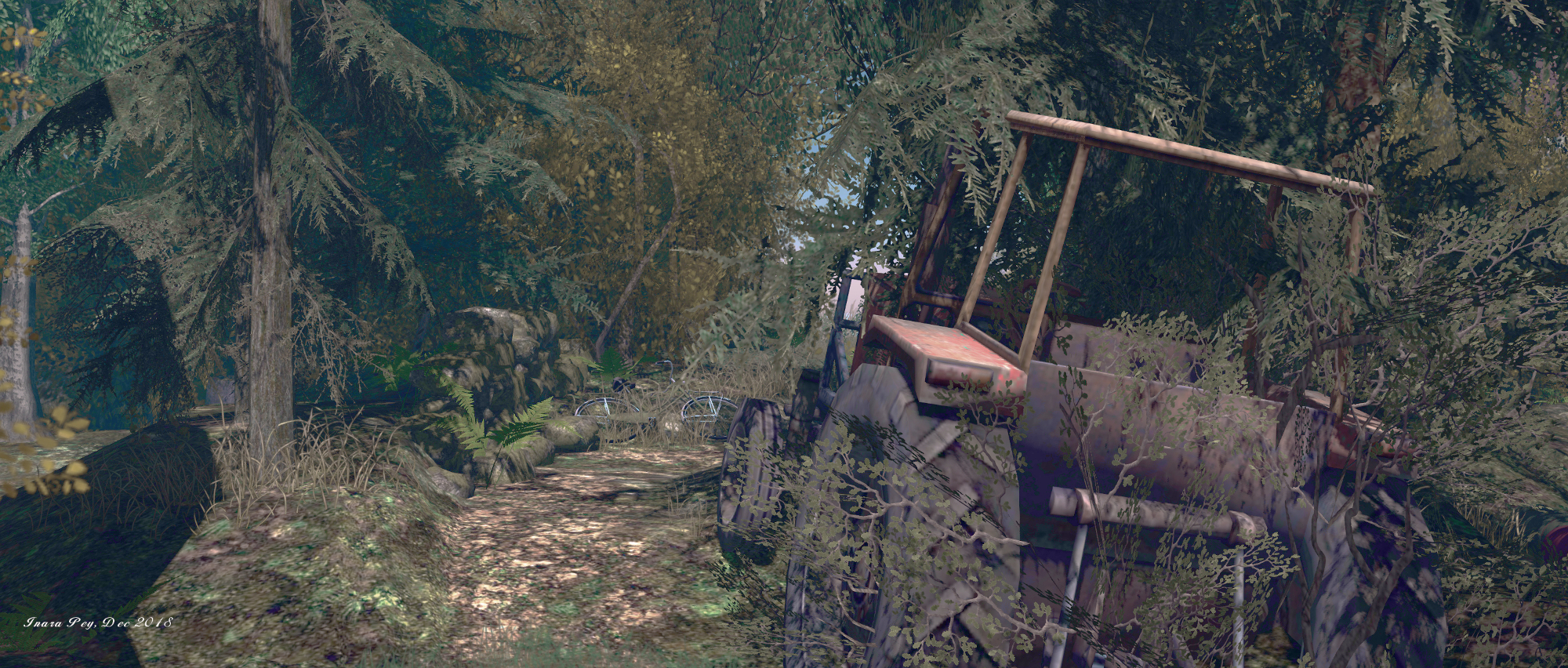
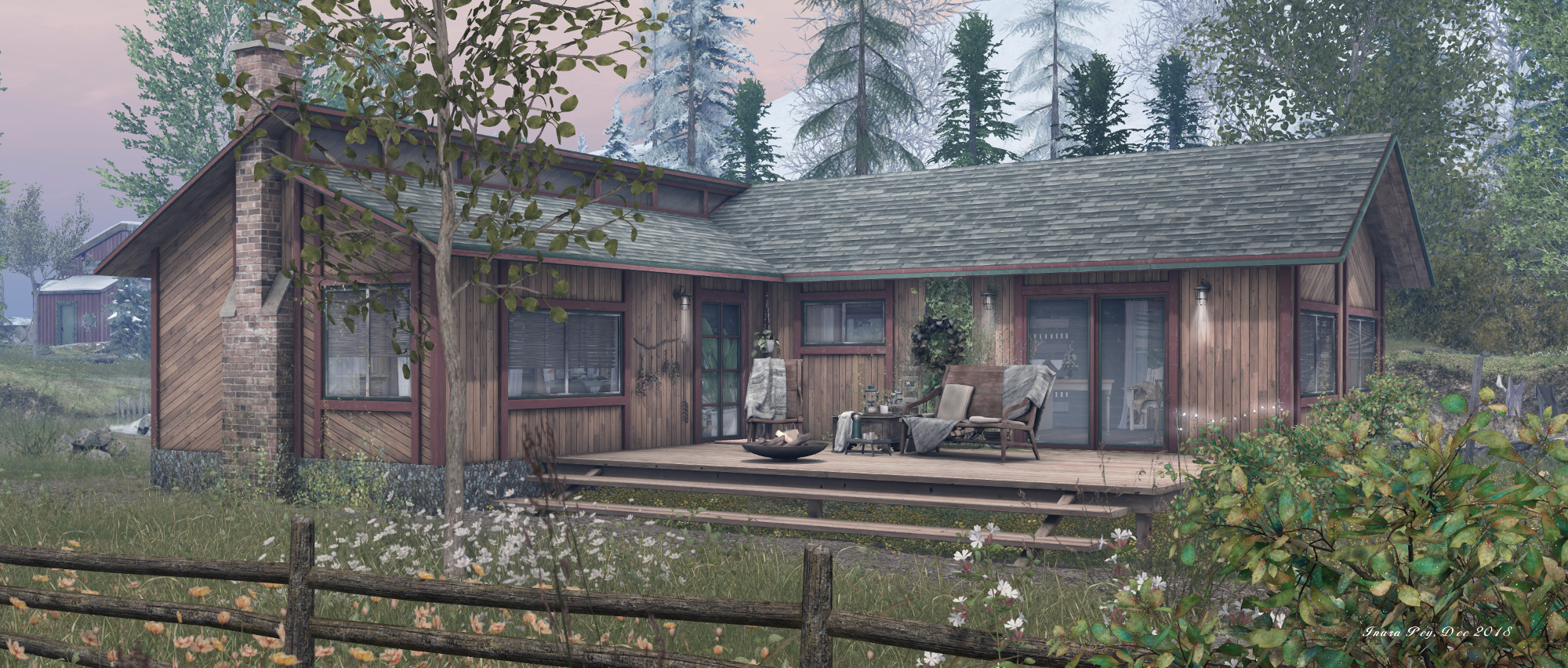
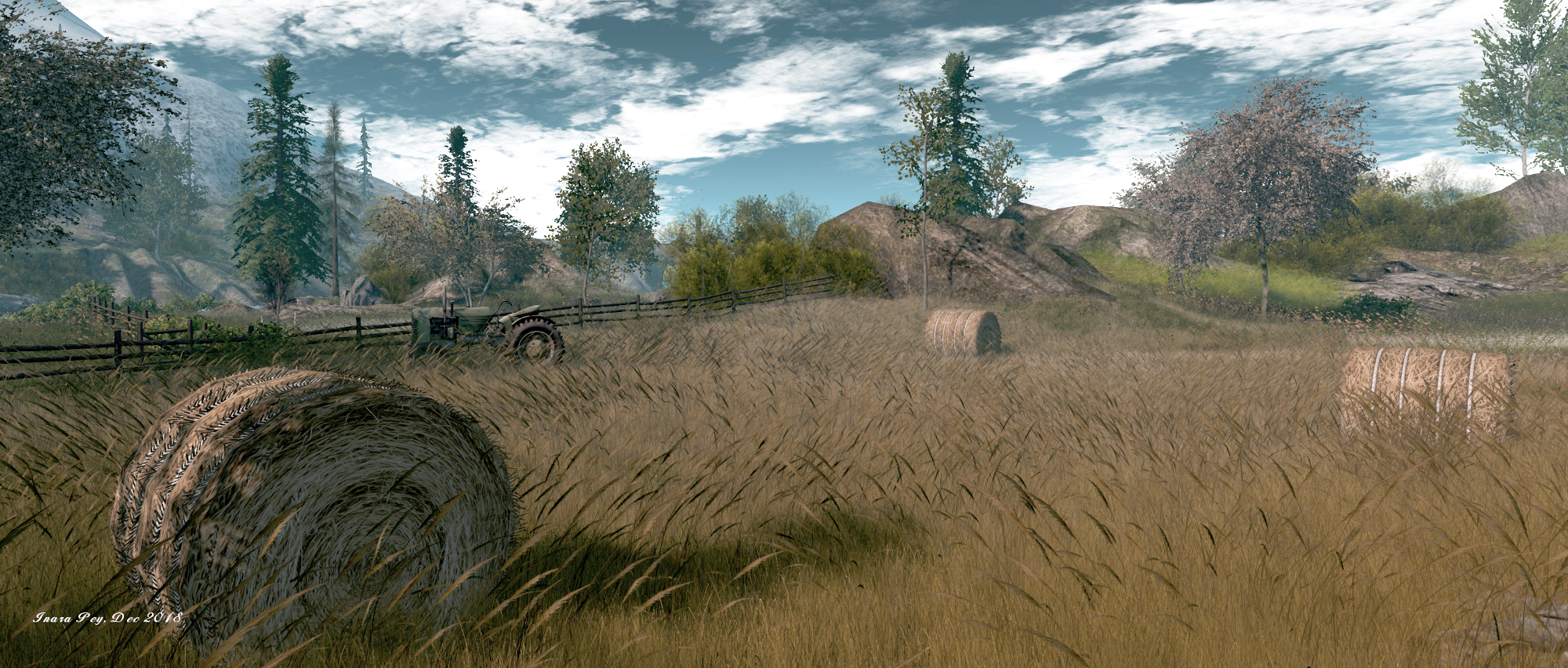
Between the camp site, with its circle on places to sit or sleep ringed around the fire setting, and the landing point sit an old tractor. It points its blunt snout along a track that winds between the trees to the more open landscape. Short in length, the trail exits the trees at the foot of a rocky, moss-and-grass coated hillock on which sits the most curious little cabin.
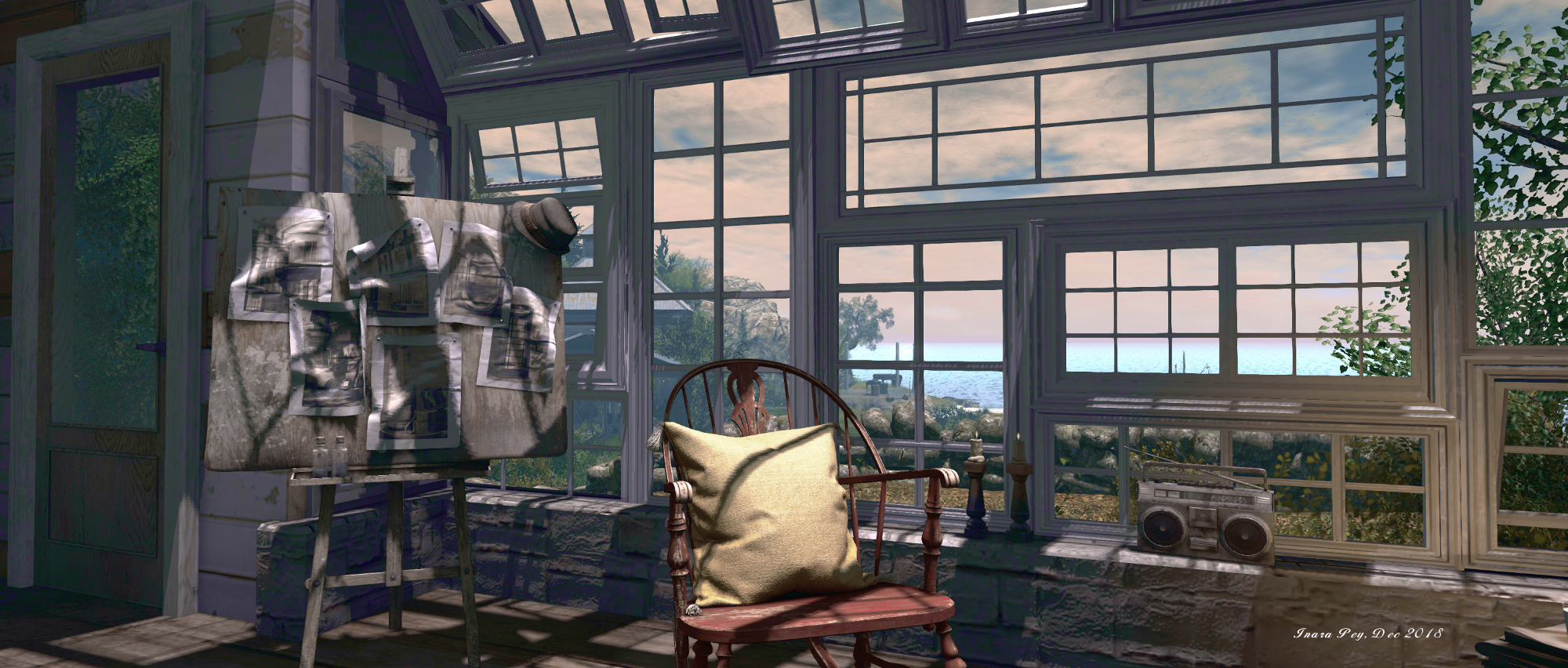
A single room in size and based on Cory Edo’s Garden Bard Abode), this presents a strange façade to the world: one side of it made up of a variety of wooden window frames, all glazed and joined together to form a wall and part of the roof. Single- and double-hung window frames sit with sash and casement, while picture and skylight join them in a mosaic of plan glass and wood; a strangely attractive hodgepodge design that just … works.
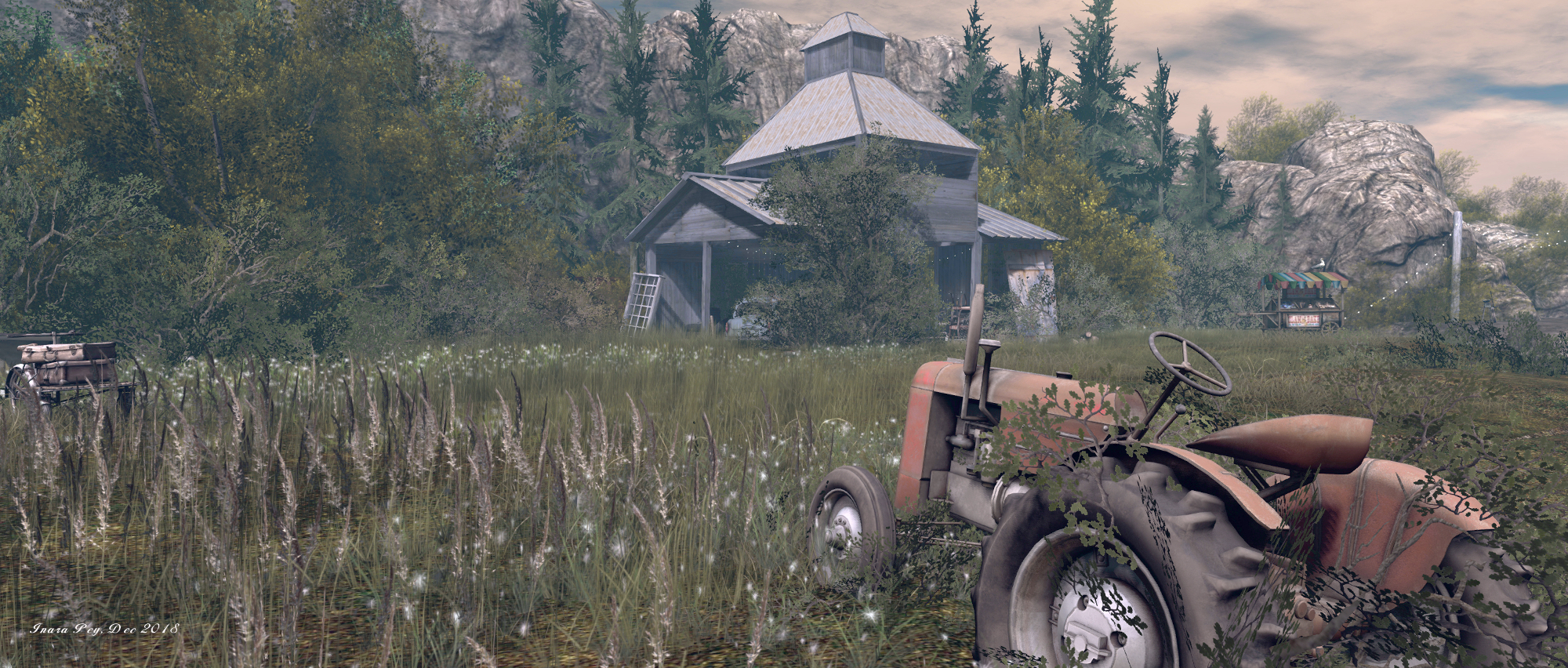
The cabin looks from north to south across the open landscape of grass and shrub, separated from it by both elevation and by two dry stone walls that seem to curve protectively around it. A large barn looks back towards the cabin from the eastern tree-line, whilst also keeping watch on the sea. It offers a further cosy setting for sitting and chatting (the cabin itself has wine on offer as well as music and chairs and stools).
Southwards, the parcel ends in a low, flat table of rock and a pocket of sandy beach. The rocky table offers music, both via a DJ’s deck and also via a careworn grand piano, with the beach presenting plenty of room for dancing, with baked clams available close by, together with multiple places to sit and / or cuddle. This area will apparently be the location for local events, due to start in January 2019, and those interested in attending are invited to join the local group to receive updates and news.
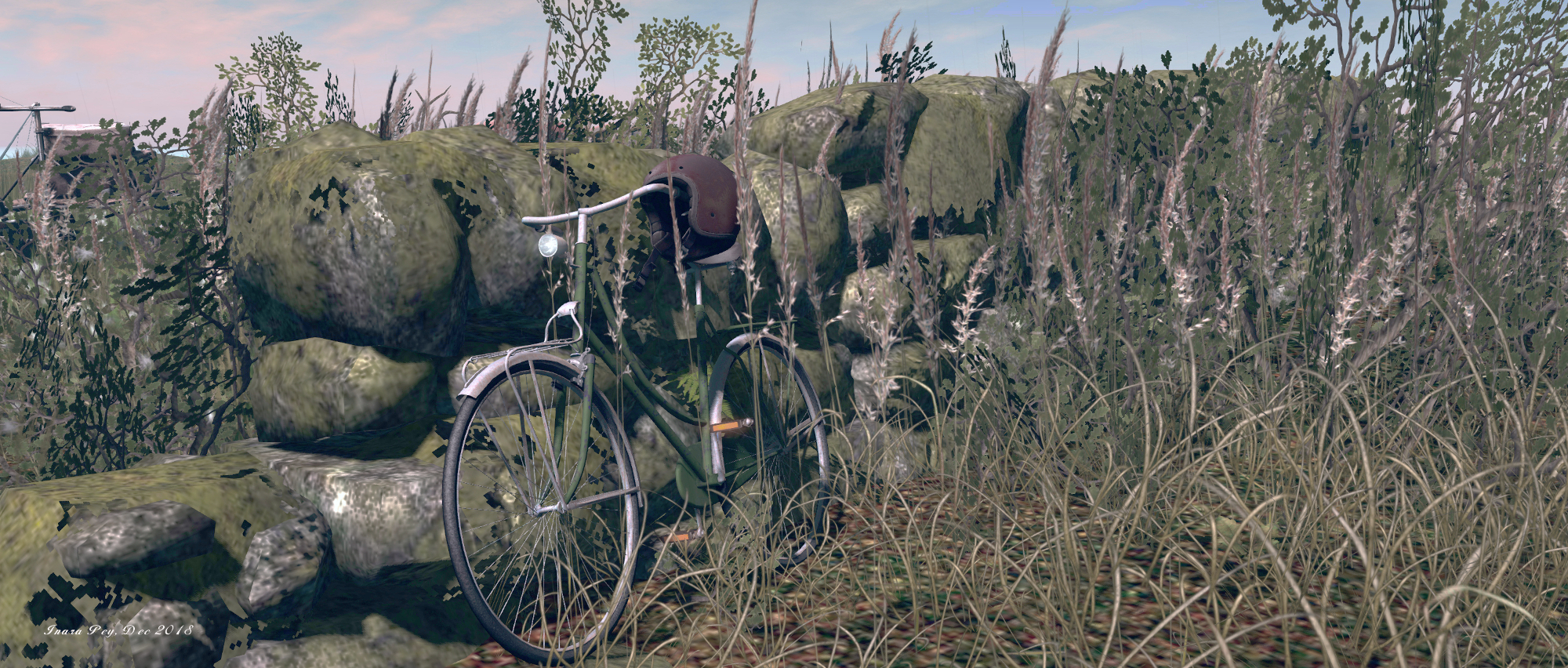
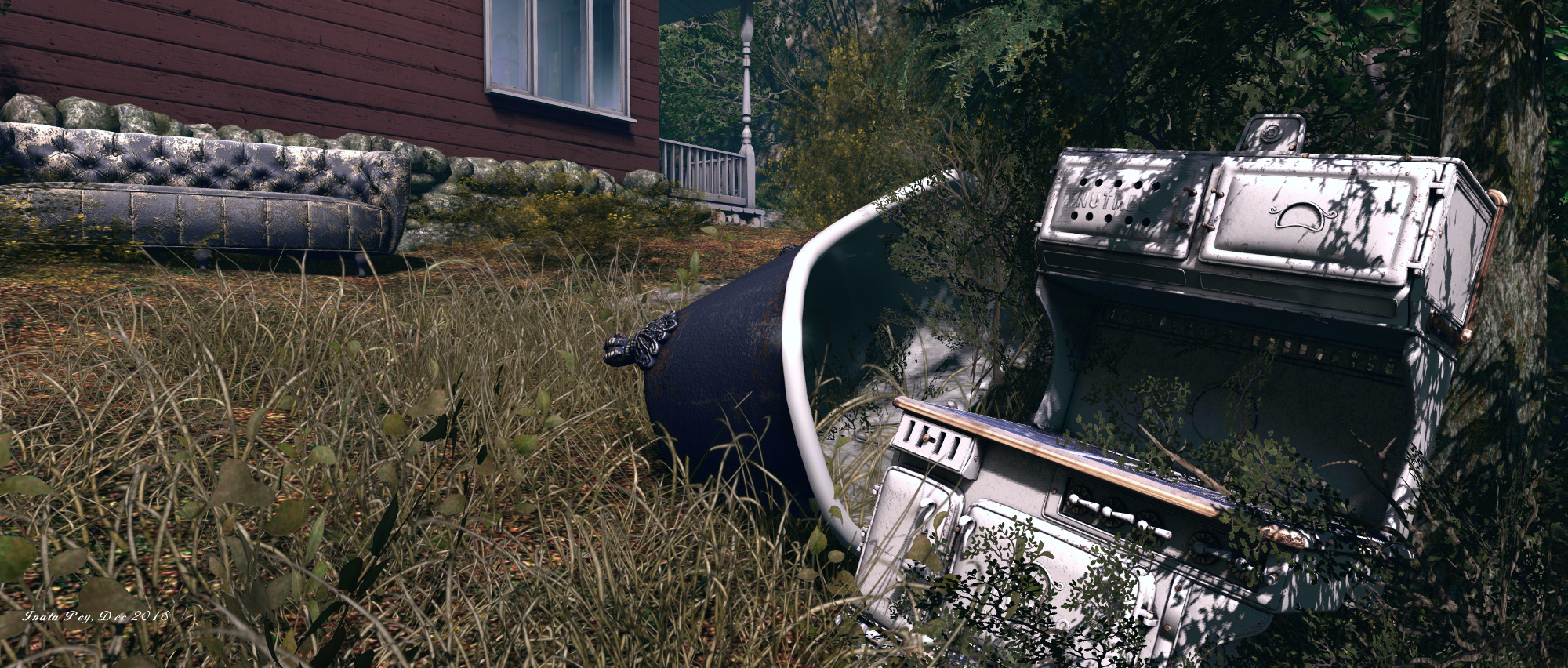
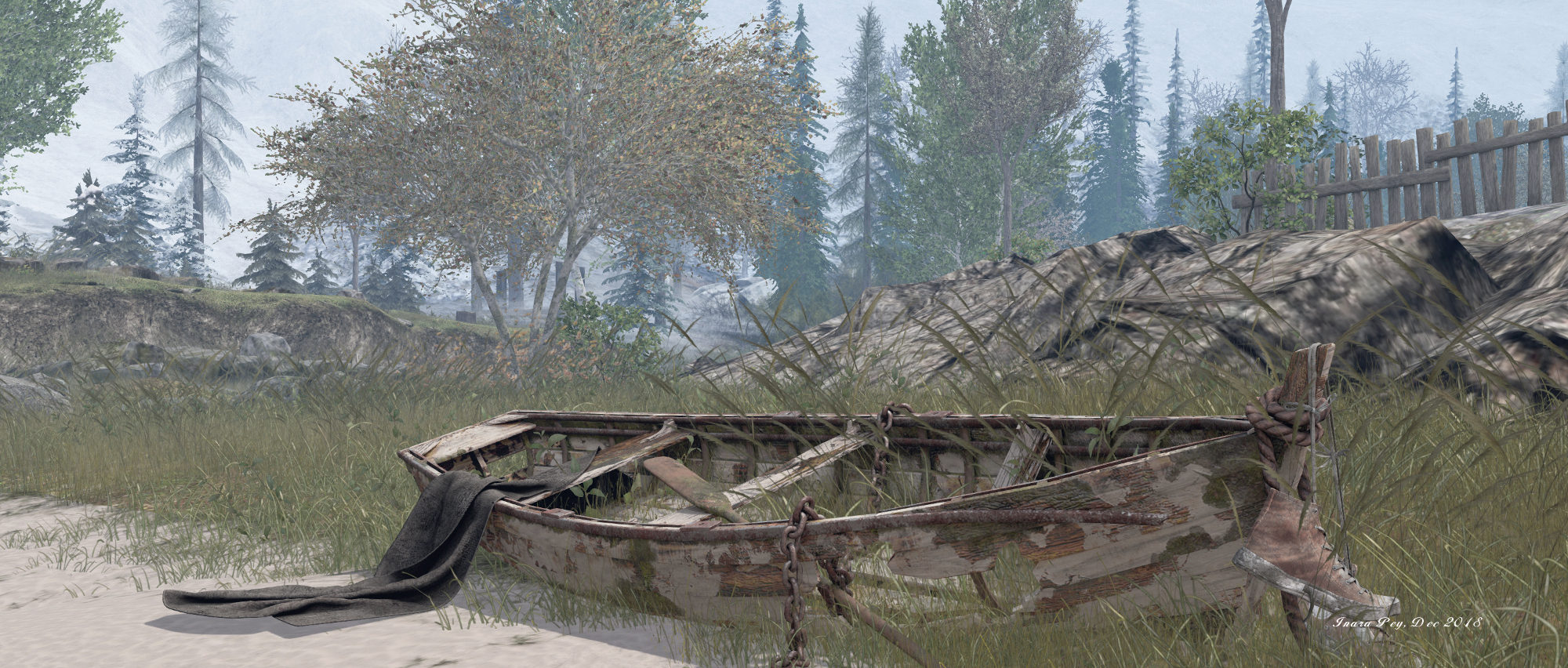
The shabby-chic element to the region comes in all the little “untidy” touches: the bicycles lying or propped around as if abandoned; the overturned cart; the carcass of the old tractor (a second tractor appears to have been almost reversed over a step of rock that might have put an end to its useful career); the bathtub and old cooking range seemingly tossed out of the cabin; and so on. While these might all at first appear to be the abandoned detritus of human habitation, they actually add a certain, well, charm to the setting; their presence adds an air of this place being lived in, rather than simply another little set piece.
This is a place where socialising and spending time is welcome, be it at the camp site, in the cabin (or alongside it) or in the barn or on the sand or grassland. The group description emphasises this, as does the introductory note card available via the giver at the landing point (click to receive; it won’t spam you). Photography is welcome, and picture can be shred via the Flickr group.
All told, a nice little retreat, well put together and photogenic. Just as a final note, while Nevgilde Forest is on an Adult rated region, the owners request that visitors kindly treat it as a Moderate setting. My thanks (as always) to Shakespeare for the pointer!
On Sunday December 16th, 2018, the Firestorm team issued Firestorm 6.0.1, which includes Animesh support.
Note that this update is being classified as a “public beta”, because further Firestorm-specific Animesh optimisations are being planned. This means there will be a further “full release” is being planned for January 2019.
However, while Firestorm 6.0.1.56538 may be classed as a”beta”, it should be considered as stable and as bug-free as any previous release.
In keeping with my usual approach to Firestorm releases, what follows is an overview of the release, highlighting some of the more significant changes I feel will be of most interest to users.
Please use the table of contents on the right to jump to any specific topic of interest. Full details of all changes, and contributor credits can be found in the official release notes.
There is no need to perform a clean install with this release if you do not wish to.
Do, however, make sure you back-up all your settings safely so you can restore them after installing 6.0.1.
Note that as a beta release, Firestorm 6.0.1.56538 will not overwrite any existing release version of Firestorm you may have installed, but will be installed into a separate folder / location. However, note that swapping back and forth between this beta and another version of Firestorm will wipe your cache each time.
Lab Derived Updates
Core Updates
This version brings Firestorm up to parity with Linden Lab release viewers through to version 6.0.0.520636 (Animesh), including the recent Rakomelo, Quinquina and Hear No Evil, Speak No Evil Maintenance viewers, and incorporates Vivox Version 4.9.0002.30313 (Mac and Windows).
Animesh
For those who may be unaware of it (!), Animesh allows the avatar skeleton to be applied to any suitable rigged mesh object. This, together with suitable animations and scripts placed within the contents of the object, allow it to be animated in much the same way as the Second Life avatar. This opens up a whole range of opportunities for content creators and animators to provide things like independently moveable pets / creatures, and animated scenery features.
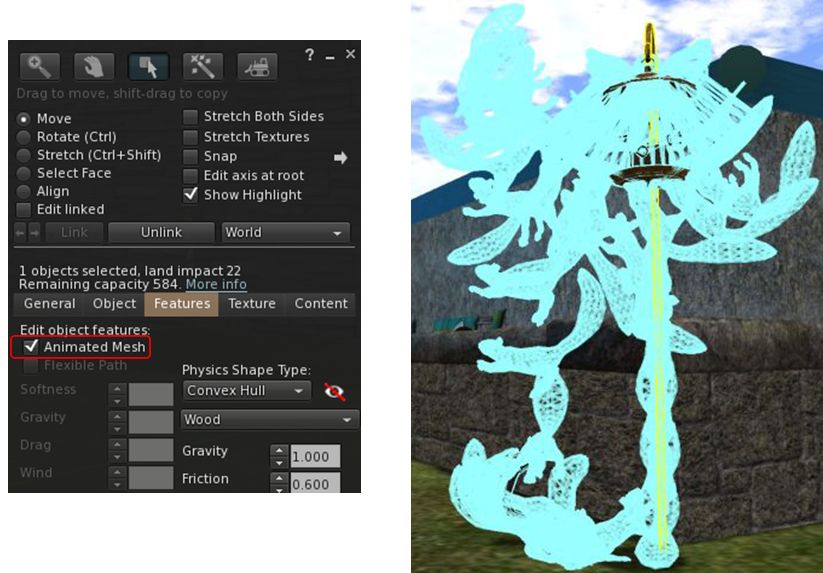
While Animesh is likely to primarily be used by content creators, it has been designed so that any suitable rigged mesh can be converted to Animesh directly from the Build / Edit floater (see below, left). Do be aware, however that simply converting an object will not cause it to start animating – you’ll need suitable animations and a script to run them.
Like any other object utilising animation, this is done by adding the animations and scripts via the Edit > Contents tab for your converted object.
Left: any suitable rigged mesh object can be converted into Animesh by adding animation scripts and toggling the Animesh check-box in the viewer. Right: one possible outcome of Animesh is that over time, it might discourage the use of alpha-flipping to simulate animation. This involves creating multiple versions of something like an animal (or parts of an animal) and then using a script to reveal them in turn, while keeping the other hidden with alpha masks. While it results in simulated animation (such as a squirrel climbing a bird feeder), alpha flipping is very performance / rendering intensive (r)
How To Get Started With Animesh
The best way to get started with Animesh is to use the available resources. These include:
Derender Animesh: Despite the hoped-for performance improvements Animesh might allow when compared to alpha flipping, these will be the potential for performance impacts in regions / parcels with a large number of Animesh objects moving around.
To help mitigate this, Firestorm 6.0.1 includes an option to derender all Animesh in a scene (Developer menu > Rendering > Derender All Animesh).
Note: Derendered Animesh will reappear after a teleport or re-logging.
Also, Firestorm includes a number of other Animesh tweaks:
Auto-scaling amortisation of the new Animesh dynamic bounding box calculations. This fix limits the overhead of the new dynamic bounding box calculations to AvatarExtentRefreshMaxPerBatch per AvatarExtentRefreshPeriodBatch frames. The default is 5 avatars per 4 frames, so in a busy region, 25 avatars would take 20 frames to refresh the bounding boxes.
Performance tweaks by reducing Matrix operations per render pass.
More JointMatrix Palette caching tweaks:
The cache has been moved to drawable for more benefit (reduces CPU overhead when rendering shadows and materials by caching the jointmatrixpallette).
Sacrifices some potential cache locality but savings seem to outweigh this.
Other Lab-Derived Updates
Additional Lab updates worth noting are:
BUG-216339 – Add a Click to: action to the Build / Edit floater to disable clicking objects that can be set per-object in a linkset – see Left-Click None Option, below, for more.
BUG-216416 – Add a transparency indicator for invisiprims. When “Highlight Transparent” (CTRL+ALT+T) is used, invisiprims will now be highlighted in green.
BUG-225670 – Include the full Windows 10 build number in Help > About Second Life and logs
TextureLoadFullRes setting no longer persistent, to avoid issues with accidentally setting it on systems which cannot handle the memory load.
The CTRL key must be held when dragging inventory folders into in-world objects. This change was primarily made to address accidental inventory “loss” by dragging a folder of no copy items into an in-world object.
Fix for your avatar not standing up after pressing Shift+Alt+S keyboard short-cut.
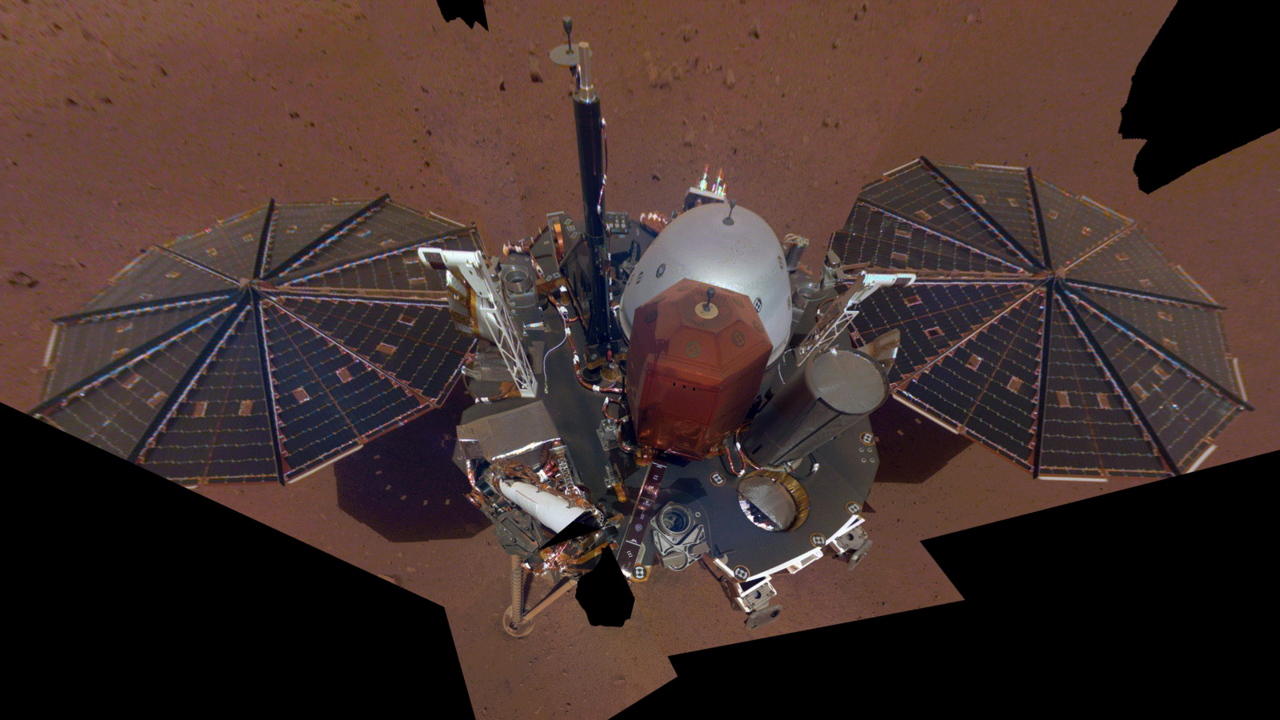
InSight’s first full selfie on Mars, captured on December 6th, 2018 (Sol 10) and released on December 11th. It displays the lander’s solar panels and deck. On top of the deck are its science instruments, weather sensor booms and UHF antenna. Credit: NASA/JPL.
It’s been a further busy week for NASA’s InSight Lander as it starts to get down to business. In particular, the rover has been further exercising its robot arm and preparing for the start of operations – work that has involved surveying its local surroundings.
The week started with NASA releasing InSight’s first “selfie”, a mosaic of 11 images captured by the Instrument Deployment Camera (IDC), located on the elbow of the lander’s robotic arm. Clearly visible in the completed image is the copper-coloured seismometer that will be placed on the surface of Mars to listen to the planet’s interior with its silver protective dome just behind it. Also visible is the black boom of the robot arm rising mast-like.
The IDC is one of two camera systems on InSight, but the only one that is fully mobile. It will be used in conjunction with the Instrument Context Camera (ICC), fixed to the lander’s hull, to correctly place the surface instruments of the SEIS seismometer and the HP3 drilling mechanism on Mars.
The static nature of the ICC means that placement of the surface instruments is limited to an arc directly in front of the lander, and as well as taking selfies, InSight has been using the IDC to survey this area from above.
A mosaic 52 individual images captured by the IDC of the ground directly in front of the lander. It shows the area where the spacecraft will eventually set its science instruments, with the lavender line marking the preferred area for placing SEIS and HP3. Credit: NASA/JPL
Deployment of these two instruments will take time. While operations will start in the coming week, they will likely take around two months to complete. The SEIS will be deployed first. This will be a complex task, placing the unit on the surface first, followed by its protective cover, designed to prevent the Martian wind and atmospheric changes affecting the readings the seismometer takes of the planet’s interior.
If all goes according to plan, the HP3 will be deployed in around mid-January. It will commence operations as soon as possible after deployment. However, it will be an extended process before the instrument starts to deliver on its science goals. This is because the self-hammering heat probe within HP3 – nicknamed the mole – has to “drill” its way some 5 metres (16ft) below the Martian surface. However, it will take time because the probe must pause periodically to release a burst of heat that will help it determine the nature of the material around it and possible hazards below it.
They were speaking about the seven minutes of terror on landing, now I’m saying we have two months of terror in front of us when we penetrate into the surface. The drilling mechanism relies on pushing aside dirt. Smaller rocks it can either push aside or burrow around, but a large rock – 1 metre [3ft] in diameter or so – would stymie the probe’s drilling mechanism.
– Tilman Spohn, of the German space agency DLR, and HP3’s principal investigator
In particular, the effectiveness of HP3 depends on how deeply it penetrates the regolith.
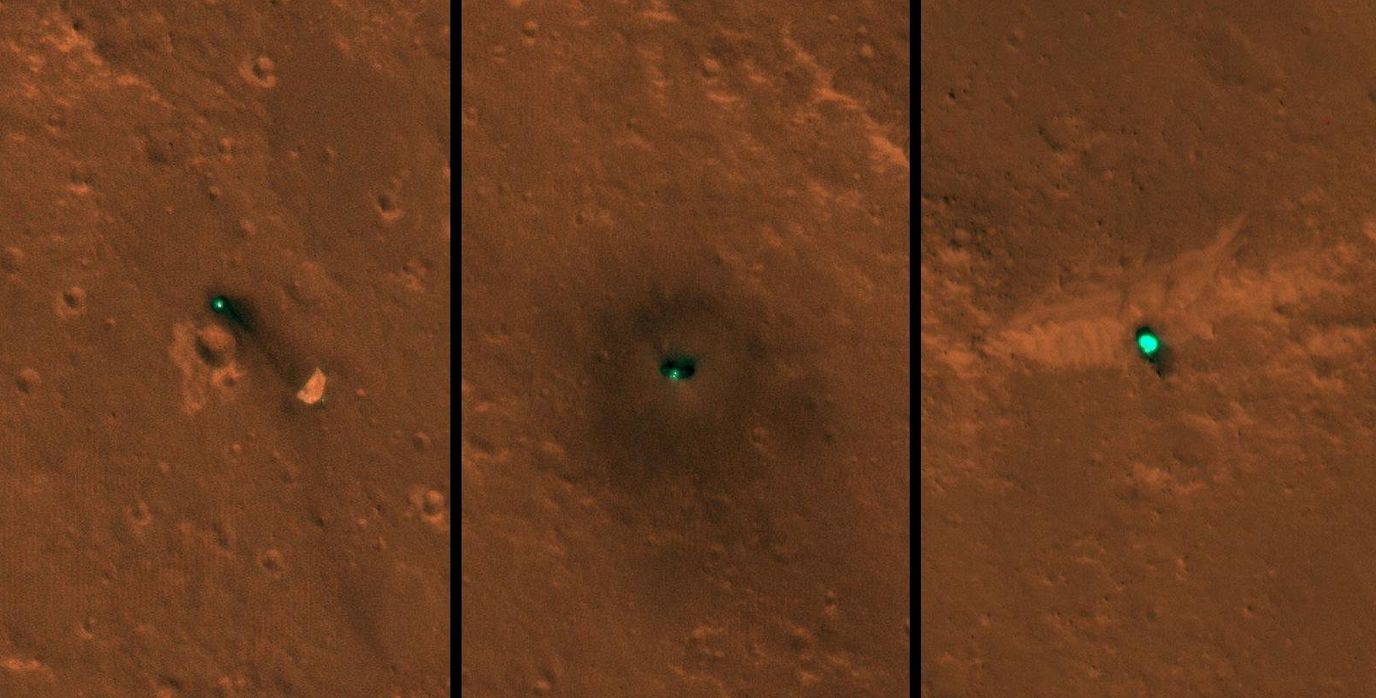
Three images captured by the HiRISE camera on NASA’s Mars Reconnaissance Orbiter, released on December 13th, 2018. Left: the lander’s aeroshell and parachute. Right: the heat shield, discarded after EDL and ahead of parachute deployment on November 26th, 2018. Centre: InSight itself with a surrounding ring of regolith blasted by the lander’s landing motors. The teal colour is not genuine, but the result of sunlight being reflected off of the lander and its parts saturating the HiRSE imaging system. Credit: NASA/JPL
The less we penetrate, the worse it will be. If it’s just 1 m (3 ft) or so deep, the team will need to rely on more intensive modelling. But if it reaches 3 m (10 ft), which should occur around mid February, the team will be pleased — and if it can reach the full depth of 5 m (16 ft) around March 10th or so, all the better.
– Tilman Spohn
The survey of the landing site has helped confirmed that despite early misgivings when InSight first touched-down, the area occupied by the lander is about as free from rocks and possible surface hazards for SEIS and HP3 as might have been possible to find.
Virgin Galactic Reaches Space with VSS Unity
On December 13th, 2018, Virgin Galactic carried out a supersonic flight test that carried VSS Unity into space for the first time – at least according the NASA’s and the US Air Force’s reckoning. The success of the flight takes Virgin Galactic closer to taking paying customers on the six-passenger rocketplane, which is about the size of an executive jet, on sub-orbital flights into space.
Virgin Galactic’s WhiteKnightTwo carrier aircraft VMS Eve, with VSS Unity slung beneath it, takes to the air from the Mojave Air and Space Port in the early hours of the morning, local time, on December 13th, 2018. Credit: Virgin Galactic
Unity, also referred to as SpaceShipTwo, was carried aloft by its mothership, WhiteKnightTwo from the Mojave Space Port to an altitude of 13,100 metres (43,000 feet). It was then dropped from the carrier jet, allowing the crew of two, Mark “Forger” Stucky and former NASA astronaut Rick “CJ” Sturckow, to ignite the single rocket motor. Burning for 60 seconds, the motor allowed Unity to start a rapid climb and achieved Mach 2.9, nearly three times the speed of sound.
After engine cut-out, the vehicle continued to climb for a further minute, reaching an altitude of 82 km (51 miles) – enough to put it across the line NASA and the US air Force consider to be the edge of space relative to Earth (80 km / 50 mi above sea level).
A dramatic shot of Unity, having been released by Eve, igniting its rocket motor at the start of a climb from 13 km to 82 km in just 2 minutes.
Once Unity reached apogee, the two pilots were afforded some brief moments of microgravity. They then “feathered” the tail booms, causing the vehicle to gently fall back into the denser atmosphere like a shuttlecock. Once air density was sufficient, the tail sections returned to their “regular” position, allowing the vehicle to achieve unpowered aerodynamic flight, landing back at Mojave Air and Space Port at 08:14 local time (16.14 UTC), with the flight from the drop to the landing lasting 14 minutes in total.
While NASA and the US Air Force view the edge of space being at 80 km, the Fédération Aéronautique Internationale (FAI), the international standard-setting and record-keeping body for aeronautics and astronautics, officially place the boundary between atmosphere and space – called the Kármán line – at 100 km (62 mi; 330,000 ft). Nevertheless, the flight is enough for Stucky to gain his astronaut wings, and for Virgin Galactic to talk in terms of commencing passenger-carrying operations in the near future.
The view from the cockpit at 82 km above the Earth. Credit: Virgin Galactic
“Welcome to Wild Edge. A calm and relaxing wilderness for you to enjoy, explore and escape” – thus reads the About Land description for the latest Homestead region design by the (still) delightfully named Funky Banana (FunkyBananas), and to which Shakespeare directed my attention at the weekend.
Wild Edge is another largely rural setting, this one suggestive of a rugged, coastal region, perhaps in high latitudes where ice and snow sided mountains roll down to a cold blue sea. A rocky headland sits caught between the mountains and the sea, sitting just below a fir-tree buffer between it and the snowy slopes, cut by a deep finger of water.
Two cabins sit on this curve of lowland. The first is low-slung and built around a wooden deck, it has a very “male” appearance to it, both outside and in, somewhat suggestive of single occupancy. With the deep bay sitting close by, it might be a fishing lodge / hunting lodge, a suggestion added to by the rods and other equipment set-out on a deck at the water’s edge and, across the water, by the presence of an old hut in which can be found the paraphernalia of the hunter.
However, a closer look around the cabin reveals a dining table is set for a meal for eight, while two Christmas stockings hang from the fireplace mantle. Thus it would seem the cabin is perhaps occupied by the couple, and that they are expecting company.
A single track runs west from the cabin, paralleling the channel to the left and a field of wild grass to the right. It leads the way to where an unsurfaced airstrip runs south-to-north. This is perhaps not the easiest strip to get in and out of, given the rocks, hills and tress that threaten to encroach on it. However, it is very much a working airstrip – as can be see by the presence of a small biplane and a mechanic’s shed, although the gasoline truck parked close by probably hasn’t been used in a good while.
Facing the airstrip from across the region is a Christmas tree farm shop, nestled at the foot of the eastward mountain slopes. It seems a little incongruous given the lack of potential customers. Perhaps they come by boat from further up / down the coast.
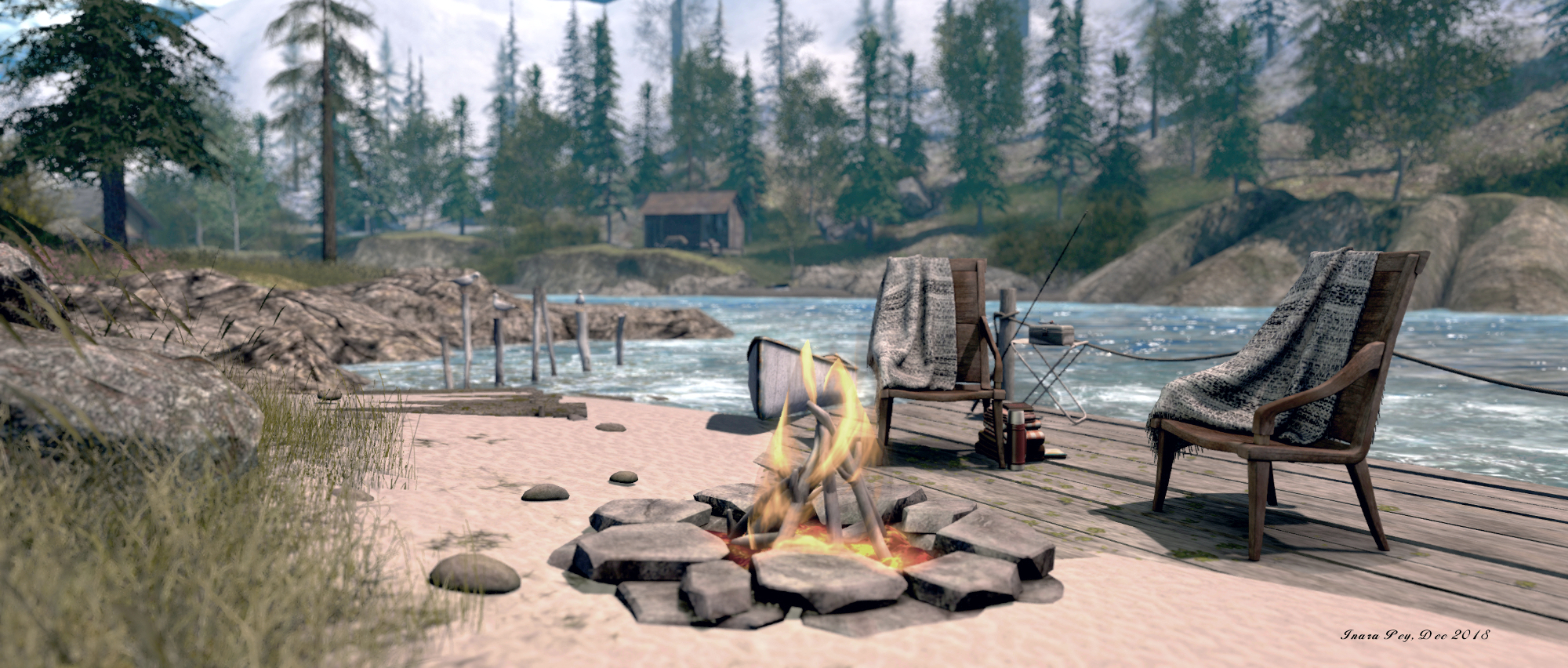
Three stretches of sand also sit within the region, two of them offering places to sit. One of them is the fishing deck mentioned above, which also has the advantaged of being warmed by an open fire blazing on the sand. I also mentioned that there were two cabins on the region. The second can be found above the northern coast, a ramshackle, single-room affair that seems to be a place of study rather than a place to live, the kitchenette within it notwithstanding.
A Wild, open setting, largely free from snow (outside of the mountains to the east and south), Wild Edge is another eye-catching region by Funky that offers a pleasing alternative to the more snowy themes that abound right now without being entirely divorced from winter. For those who take photos, the Funky Banana Flickr group is available as a means to share them.
Currently running through until the first of January 2019 is the Survivors of Suicide (SOS) Second Life group Christmas Fair, aimed at both celebrating the group’s tenth anniversary and to raise money for the group’s work.
For those unfamiliar with their work, Survivors of Suicide is a suicide prevention and peer support group for anyone affected by mental health issues. It comprises mentors and members who support one another, and those who reach out to them in their time of need through one on one chats, and via support meetings at the group’s in-world location and via group chat.
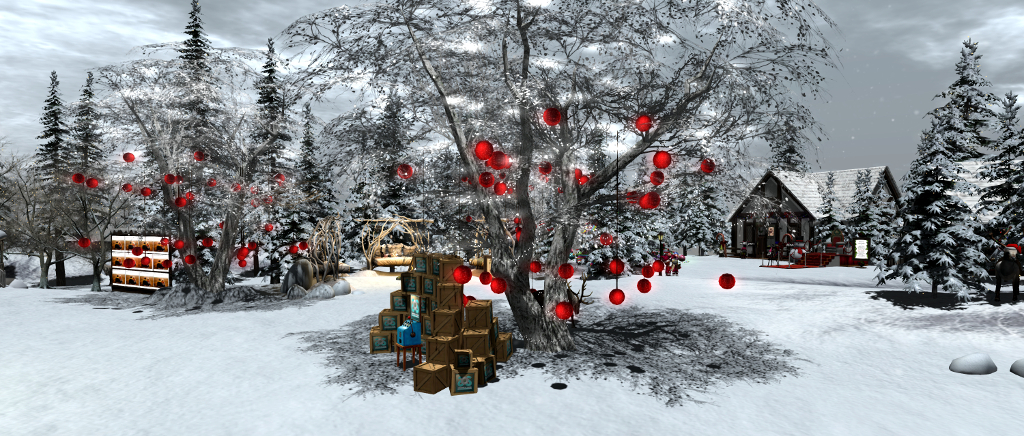
For the Christmas Fair, SOS have set-up a sky platform featuring stalls from creators and merchants, details of whom can be found on the Sponsors web page. There is also a raffle featuring a range of prizes (entry: L$100 per ticket, all proceeds to SOS). There is also a photography contest with the subject of Support – details for entry can be found via the info giver alongside the in-world display board featuring entries. The winner(s) to be decided by voting on entries.
There is also daily entertainment – including visits by Santa! – however, I was unable to find details of performers / performances or times.
While the fair is already underway, the organisers are still taking Gacha item donations and DJs, musical acts and / or spoken word artist – the information card provided on arrival details how those interested can donate / apply.
The organisers additionally note:
If you or a friend or family member are feeling the holiday blues, or you are worried for yourself or someone else, we are here for you. Grab any information that would be helpful at our information booth and if you need to talk to someone, check our Holiday Cuddle Corner, where mentors and members will be standing by to help with those Holiday Blues. If no one is available on site, join our group, there is always someone in chat to talk to.
Support is always welcome – and given. So whether you would like to support SOS in their work or do have a need to talk to someone, do pop along to the SOS Christmas Fair.







 Inara Pey: Living in a Modemworld