Tales of a Winter Sun in Second Life

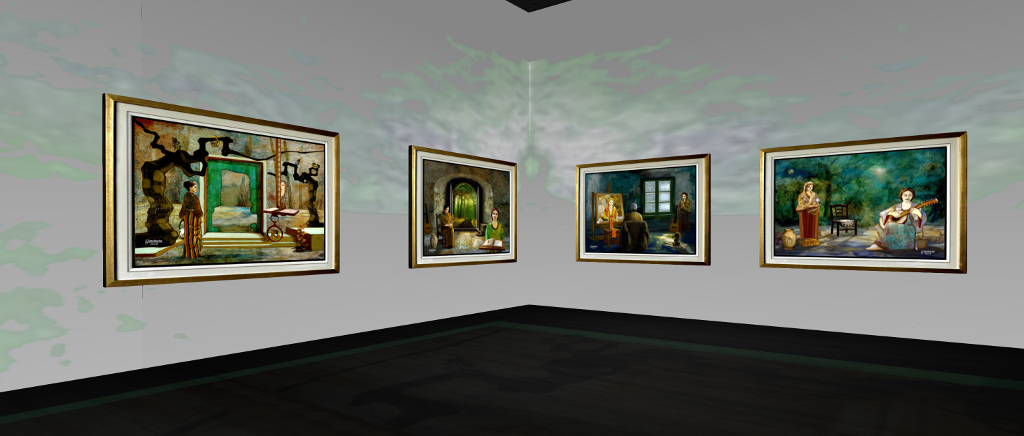
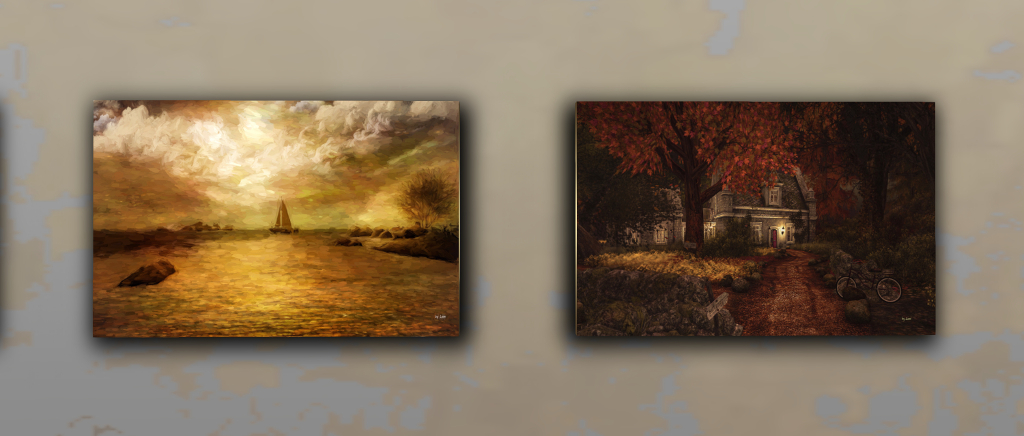
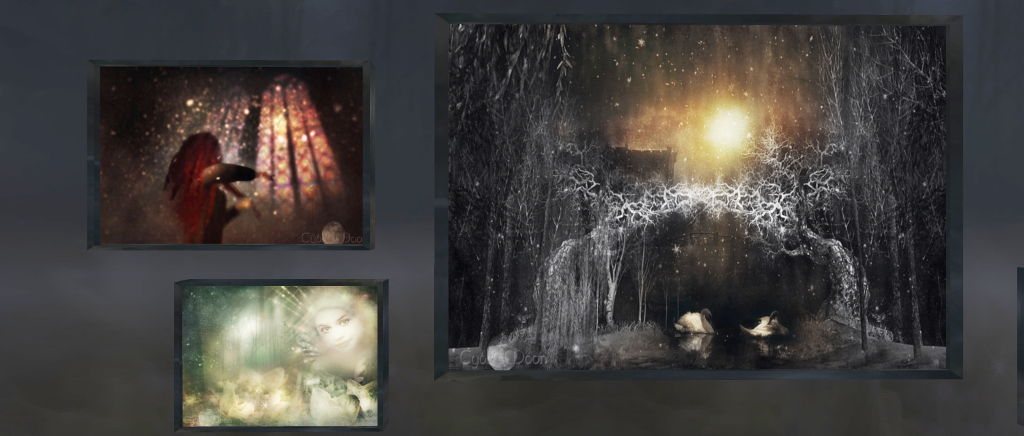
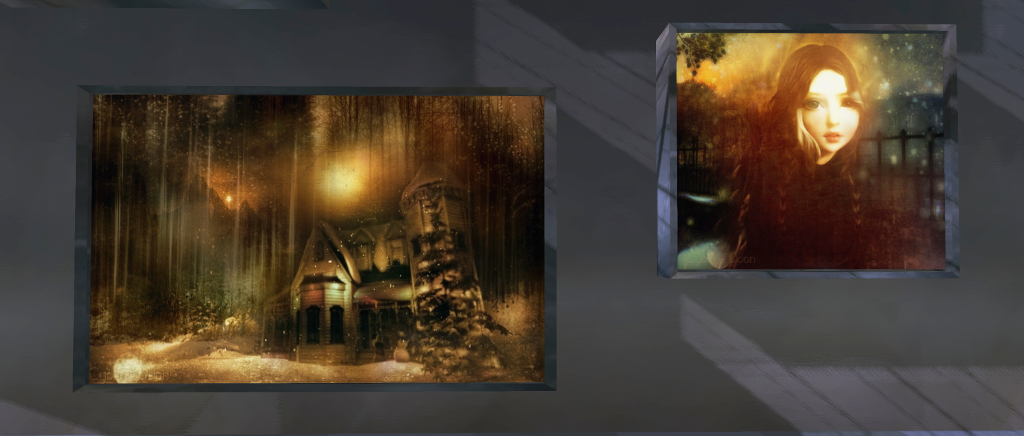
Paris Metro Art Gallery: CybeleMoon – Tales of a Winter Sun

CybeleMoon (Hana Hoobinoo) is without doubt one of the most expressive fantasy artists in Second Life. Her art has a unique beauty that I consider to be unsurpassed in its depth and narrative; pieces that are hauntingly fascinating, encapsulating worlds of wonder and mystery or reflecting wonderment and innocence through portrait and study.

You can witness for yourself just how evocative and engaging her art is by visiting Tales of A Winter Sun, which officially opens at 12:00 noon SLT on Saturday, December 14th, 2018  at the Paris Metro Art Gallery. I was able to visit the exhibition ahead of the opening, and it truly is a delight.

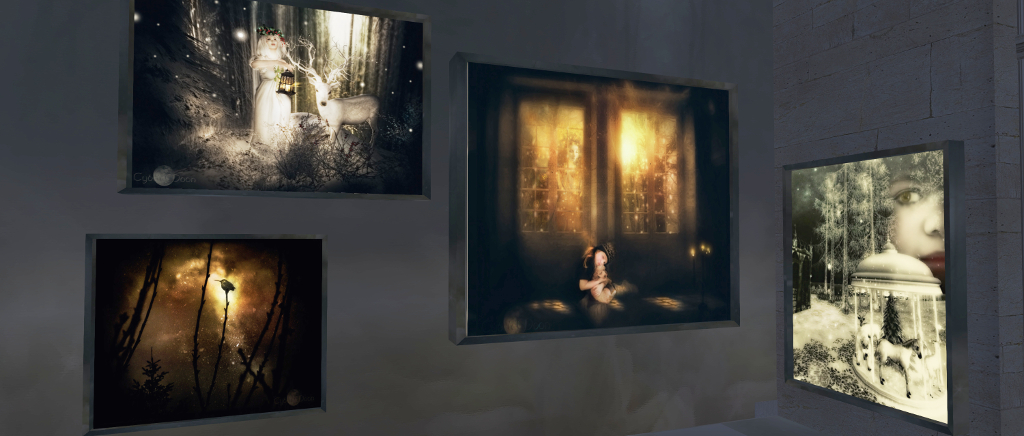
Tales of a Winter Sun is actually something of a three-part exhibition. There is Cybele’s art, 20 images and a central mural type display; then there is a poem by Cybele, reflective of the art and of the season (available by clicking the information board at the lading point), and also a blog post she provides on her website.
Paris Metro Art Gallery: CybeleMoon – Tales of a Winter Sun

There is a time in the hushed solitudes of falling winter,
while the dreaming earth stirs softly beneath her frosted blanket,
where for a moment, we remember innocence and magic, and the incredible awe of being,
where hope is renewed in the lighting of candles and a star leads the way to Bethlehem,
Where grievances are put aside as we open our wounded hearts to receive the seeds of rebirth
Where my own dreams flow to the sacred music of haunted woodlands and enchanted children.
and old tales are retold with feasting and friends
where the lost are found and the poor are blessed
and where angels walk among us

– CybeleMoon

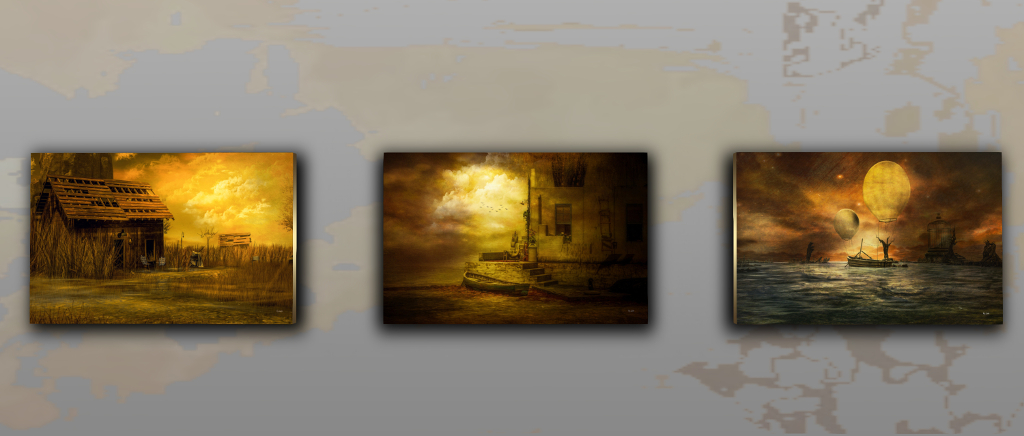
Reflective of the theme and the season, the 20 images offer us 20 twenty stories – some quite literally so, should you touch them – each beautifully encapsulated in a single moment.
Paris Metro Art Gallery: CybeleMoon – Tales of a Winter Sun

It is this feeling of capturing a moment that is particularly attractive about Cybele’s work. Her pieces are incredibly intricate in form and construction, the balance of light, colour, focus and theme utterly sublime; where looking at her art, I cannot help but see them in terms of an orchestra, different elements and layers, skilfully woven into a whole under the guiding hands of the conductor – or in this case the artist.

Yet, at the same time, there is a marvellous sense that each piece, far from being composed, has been captured in a fleeing moment, as if the mind has taken a snapshot of a dream or the eye a single moment of time played out before us in a world where wonder, innocence and beauty define all we see, and perhaps say and do.

Some might accuse me of waxing lyrical or of using hyperbole in writing like this – but unless you’ve seen Cybele’s work first-hand, it is hard to grasp just how rich, resonant and alive her art really is. As such, I urge you to go and witness Tales of a Winter Sun for yourself – you will not be disappointed.

In the meantime, and as she references it in her own blog post, I’ll leave you with an astonishing rendition of Leonard Cohen’s Hallelujah by Rhema Marvanne, and recorded when she was just eight years old, and which sits as a perfect companion to the art Cybele presents in both the exhibition and her blog post.

SLurl Details

RFL of SL: updates, changes and events at year-end

via slrelayinfo.com

With the year drawing to a close, so to do the 2018 fund-raising efforts for the American Cancer Society (ACS) through Relay for Life of Second Life (RFL).

As I write this, the annual Xmas Expo has closed, having raised US $20,495 in  just 10 days. Currently, the RFL of SL SciFi Mini Expo is running, having opened its doors on December 14th – more on that below.

One of the criticisms of RFL of SL / ACS is that it is “US centric”, a claim that isn’t entirely accurate. ACS works on a global basis in cancer treatment and care, and for 2018, this has been demonstrated through RFL of SL adopting the Kenyatta National Hospital Hope Hostel, Kenya, part of the ACS’s initiative to expand its Hope Lodge project around the world, providing free accommodation for cancer patients and their caregivers during treatment, who might not otherwise be able to receive treatment away from home due to difficulties in meeting the costs of accommodation, etc.

The Kenyatta National Hospital Hope Hostel project represents the first international expansion of the Hope Lodge project because cancer is a leading cause of death within Kenya, where death rates from the disease among the populace have remained almost unchanged in 30 years. For 2018, the project was adopted by Fantasy Faire, which raised US $48,019 for the project. Further support for KNH will be provided via the proceeds from the Xmas Expo, some / all of which will be put towards funding two Patient Navigators to work with the more than 1500 cancer patients at the Kenyatta National Hospital in Nairobi.

Artist rendering of the Hope Hostel from the Kenyatta National Hospital website

You can read more about the KNH Hope Hostel here, and about the ACS Patient Navigation programme here.

Also in 2018, RFL of SL saw a broadening of the Making Strides Against Breast Cancer season, while the RFL of SL team also took a hard look at how to better position itself for fund-raising and community engagement in 2019 and beyond. The latter included outlining a new volunteer structure, and planned adjustments to the RFL season within Second Life.

As with all things however, there are inevitable bumps in the road that can result in things having to change somewhat. And such is the case with RFL of SL.

On November 29th, 2018, and very quietly so as not to cause upset, Stingray Raymaker, who has helmed the liaison between AC and RFL of SL since 2008, announced he would be departing ACS in December 2018. In a touching letter on the RFL of SL website, he reviews his nine years as the ACS staff partner with RFL volunteers in Second Life. As he notes in that letter:

This does not mean that the American Cancer Society has chosen to end its presence in Second Life, but it does mean that our new vision for the future will need to be adjusted. While I fully expect that the American Cancer Society will assign a new staff partner to work with our volunteers in Second Life, this kind of transition will be easiest if we all focus on the essential tasks to provide quality cancer patient/survivor/caregiver support and Relay For Life/Making Strides Against Breast Cancer events.

Our ACS support outreach and advocacy team of Nikki Mathieson, Trager Alter, and MamaP Alter will continue to advocate for and support our Season Team and our 24-Hour Team.

– Stingray Raymaker

As a demonstration that RFL work will continue, with the 2019 RFL of SL website already published, and which will open for early registrations on Sunday, January 20th, 2019. In addition:

  • The ACS support outreach and advocacy team of Nikki Mathieson, Trager Alter, and MamaP Alter will continue to advocate for and support the Season Team and 24-Hour Team.
  • The Leads for the Season Team and the 24-Hour Team will continue to plan and execute the 2019 Relay for Life.
  • The Fundraising Tools will be unaffected.

However, the transitional period does mean that the planned ACS / RFL Community Gateway project has been put on hold, as has the 5-Days of Relay.

There will doubtless be further updates on all of this via the SL Relay Info website, and I’ll obviously aim to try to keep abreast of the news and report it here.

In the meantime, I’d like to take a belated opportunity to thank Stingray, someone I’ve only recently come to know, more’s the pity, for all of his work over the last nine years and for his enthusiasm for Second Life and its community; in particular, I’d like to publicly acknowledge his support and encouragement when I was having to face the threat of cancer myself at the start of 2018.

RFL of SL SciFi Mini Expo

SciFi Mini Expo

For those wishing to give further end-of-year support for RFL of SL fund-raising work, then as noted above, the SciFi Mini Expo is currently underway, and is being hosted on the ground level at Solaris Space Station, a Second life Role-Play Community. The event will run through until  Sunday, December 23rd, 2018.

The setting has a suitably wintry feel to it, but overall, details are a little scant. You can check the event calendar for entertainment at the Expo (ignore the title of the calendar – it does in fact refer to 2018!), but the best way to see what is available is obviously to pay a visit.

There is a fair selection of booths for role-play groups etc, plus a ski / sled run is available, alongside of a zipline ride, while ice skating can be found down on the ground.. The theatre is nicely arranged as the bridge of the original Enterprise NCC-1701 (with additional seating) – although the advertised film showings were at the time of my visit (and not a little amusingly) for The Orville.

Playing with Star Trek starships at the SciFi Mini Expo – which offers a Constitution class cruiser (l) and a Klingon D7 to play with

Alongside the Expo region is a second (reached via the maglev style car circling both regions) is a broader events area. Not specifically Expo themed, it does have RFL kiosks scattered around it, and offers various activities. These include a Warbugs air combat airstrip with ‘plane rezzer and – for those wishing to keep in the sci-fi spirit, a starship rezzer specifically for the Expo, offering a choice of classic Star Trek Constitution class cruiser or snazzy classic Klingon D7.  I confess, I found flying these around a lot of fun 🙂 . Should you opt for the latter, please consider a donation to RFL of SL at the nearby kiosk.


Isla Pey: year-end changes

Isla Pey

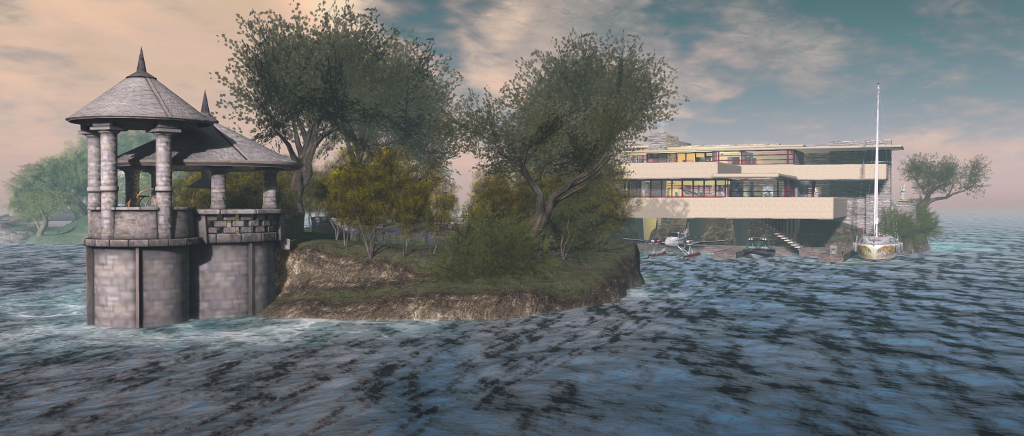
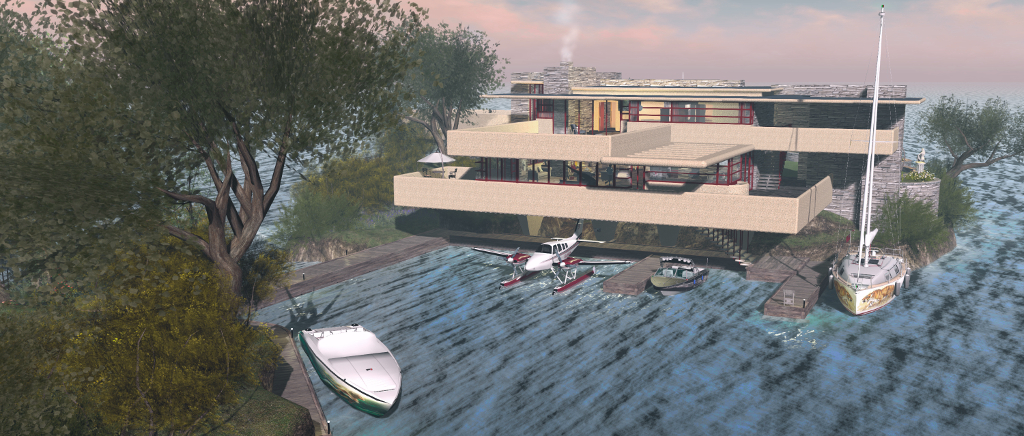
Back in April 2018, I returned Fallingwater – albeit somewhat modified to better suit our needs – to Second Life, redesigning Isla Pey around it in the process. Since then, we’ve been very settled, and the need to fiddle around with things hasn’t really come up.

However, in facing north and out over the “edge” of the grid, we may well see nothing but open seas, but we also miss a lot of the passing surface traffic; something that can be attractive to watch. Making a big move with the house wasn’t something I particularly wanted to contemplate (and not something the shape of the land would really tolerate). But, it did occur to me that by swinging the house through 180-degrees and cutting the island in two, something might be done…

Isla Pey

And so as Caitlyn reached for the hard hats, I started playing. Again.

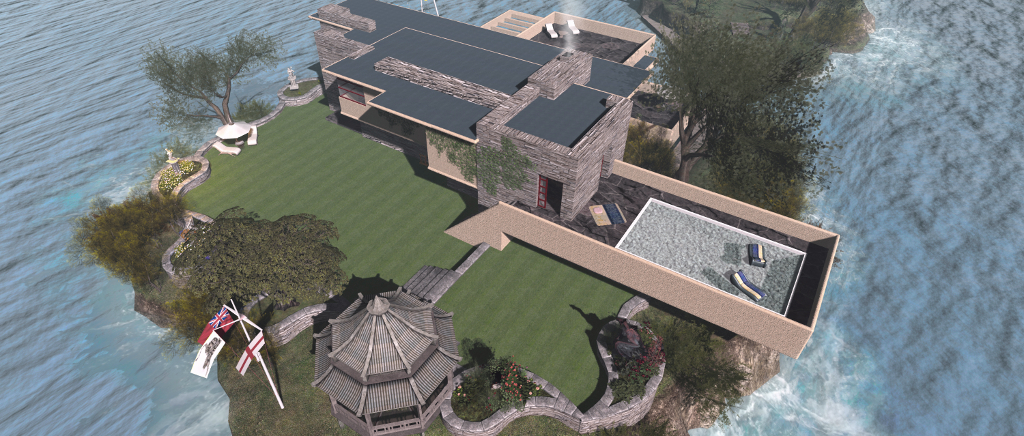
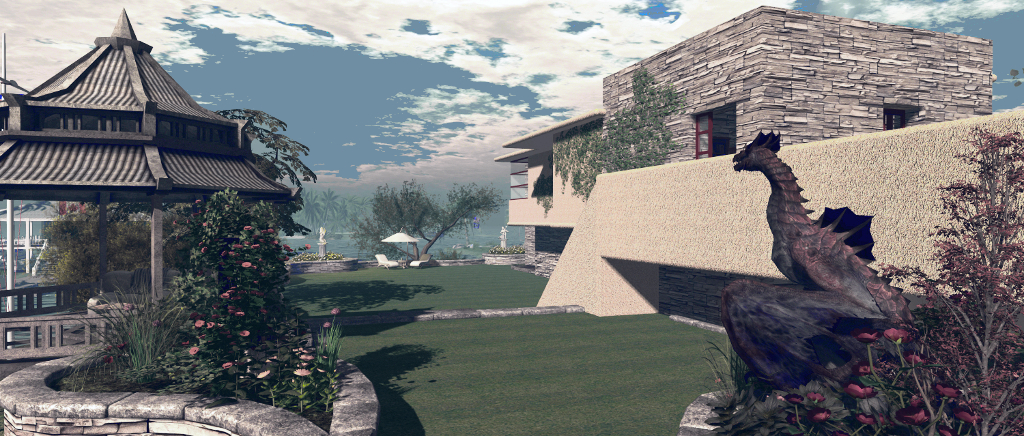
As the parcel holding Isla Pey is rather long and slender, and given we already had a “north” and “south” end, linked by a large pond, stream and waterfall, cutting the land in two was easy enough. Out went the water, the falls and the surrounding mesh landforms creating the basic landmass was created.  Then, by swinging the house around and moving it southwards, there was room to add a fair-sized back garden – the landscaping made easier (again) by the re-use of the lawn design from the “old” island design.

Isla Pey

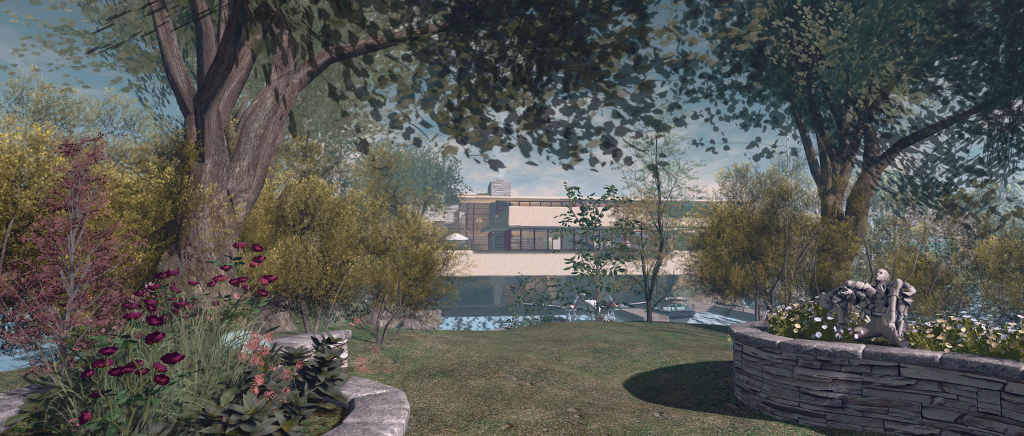
This, expanded with the use of Alex Bader’s superb Tiered Garden Wall Building Set, providing room for the art from Ciottolina Xue and pieces from Morgan Sim Designs that have long been features of our garden, while the JIAN Koi Pond Gazebo I’d modified for use with the “original” garden pond helped fill-out the space in the garden.

The southern end of the parcel, now an island in its own right, needed no real changes. It’s still home to our little folly from Trompe Loeil (actually the Amelie pavilion), just a section of HPMD cliffs needed to be added.

Isla Pey

This little island, also home to our sculptures from Silas Merlin, affords the house retain some privacy (one of the reasons I’ve tended to site houses at the north end of the island rather than the south is to help give a sense of privacy whilst being able to see passing ships). But, we needed a way to reach it.

The easiest way to do this was to extend the boat moorings under the house (actually the Botanical Edged Brick Park Path with a little re-texturing), using them as a kind of footbridge while also offering more room for boat / seaplane rezzing in our own little bay. The added room meant I could also add a couple of favourites to our vehicle rezzer that had been missed, the bay offering the perfect area in which to rez them.

Isla Pey

Fiddling with the island home is fun. But with the April changes (which I have nicely stored in a rezzing system 🙂 ) and now this reorganisation, means we probably won’t be making massive changes in the future, unless we opt to move elsewhere.

Just don’t hold me to that statement 😀 .

December 2018 at La Maison d’Aneli

La Maison d’Aneli: Lam Erin

Now open at La Maison d’Aneli Gallery, curated by Aneli Abeyante, is a new ensemble art exhibition, one which offers a rich mix of virtual and physical art and photography in what is an eclectic but engaging display. On offer are pieces by  Lam Erin, Renoir Adder, Bump Squeegee, Layachi Ihnen, Chapichapo Delvalle and the inimitable Moya Patrick (Moya Janus).

For those unfamiliar with Moya (Patrick Moya in the physical world), he has been a part of the artistic movement Ecole de Nice, and throughout his career has been as the forefront of artistic expression through all forms of media and technology, including virtual spaces. He is an early pioneer of video art, and was quickly drawn to the potential of virtual spaces like Second Life, in which he has been involved since 2007 and where he continues to maintain his Moya estate of four regions. He was also one of the first artists to actively promote Second Life in the physical world, with Rinascimento Virtuale, hosted by the museum of Anthropology of Florence, in 2009.

La Maison d’Aneli: Moya Patrick

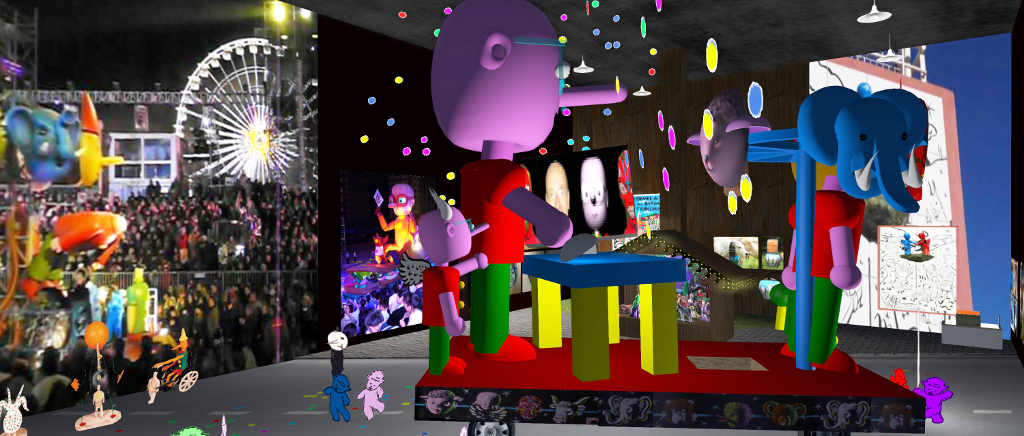
Entitled Carnaval et fêtes populaires (literally “Carnival and popular festivals”, but given the English title “Carnival and popular traditions” in English), it is a typical piece from Moya, full of vitality, reflecting elements of his physical world art. Within it is – as one would expect – his alter-ego of Moya, familiar by his Pinocchio-like nose, and little Dolly, inspired by the cloned sheep of the same name. Frivolous, engaging, with some subtle motifs, Carnaval et fêtes populaires is a colourful piece, well in keeping with the time of the year.

Below it, on the lower floor of the gallery are three exhibition spaces presenting the physical world art of three very different artists: Renoir Adder, Layachi Ihnen and Bump Squeegee.

La Maison d’Aneli: Renoir Adder

I confess to being unfamiliar with Layachi’s art, which is offered here as the largest of the three displays. A profession of mathematics, Layachi started painting in 1969, and since 1999 has focused on mixed media, combining digital painting on computer with traditional techniques. For this exhibition, he presents pieces that reflect this mixing – notes the faces in many of the paintings -, all offered in a unique and distinctive style.

As an artist, Renoir Adder straddles genres. Within his pieces can be found elements of post-impressionism, potentially influenced by the like of Van Gogh; suggestions of Picasso; and impressionist leanings.

La Maison d’Aneli: Renoir Adder

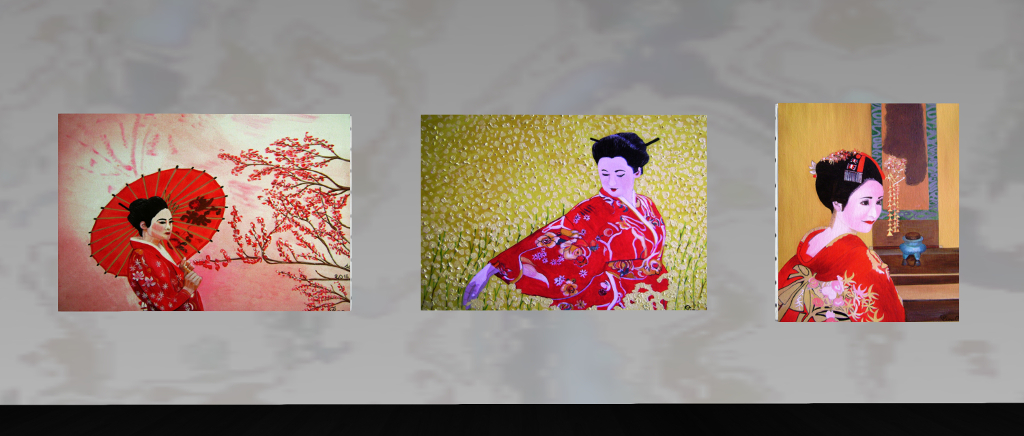
Much of this is in evidence in the 15 pieces displayed at La Maison d’Aneli, in the midst of which are, to my eyes, three absorbing painting of Geishas which exhibit a unique and eye-catching style that focuses the attention marvellously, encouraging the observer to work outwards from them and take in the rest of the paintings in turn.

Bump Squeegee’s collage art is, for those familiar with it, instantly recognisable. Rich in colour and style, the dozen pieces here are a marvellous selection of Bump’s work. By their very nature, these are pieces for which description is meaningless; they deserve to be seen first-hand in order to appreciate them fully.

La Maison d’Aneli: Layachi Ihnen

Back on the upper level of the gallery is a selection of physical world photography by Chapichapo Delvalle. Another artists with whom I was unfamiliar, Chapichao’s work focuses on nature and natural settings, varying from full landscape pieces to focusing down to things like a small branch of pine cones set on the stonework of a footpath, offered as a series of studies in colour and style.

Colour is a major element in these images, and might be said to be a physical reflection of Chapichao’s vibrant view of Second Life.

La Maison d’Aneli: Lam Erin

Lam Erin, in providing full disclosure, is one of my favourite Second Life landscape artists, although I only discovered his work less than two years ago. As a virtual artist, Lam takes images captured within Second Life and transforms them into the most fantastic digital works of art, so rich in detail, you feel as if you can see the individual brush strokes in an original piece of art.

One of the hallmarks of Lam’s work is his presentation of cloudscapes. These cast a dramatic, even foreboding, look to the skies of his art that brings an added depth of realism and narrative to his paintings that is utterly remarkable. It is this attention to his clouds and skies that also makes his art redolent of some of the great masters of landscape painting.

As always from Aneli  and La Maison d’Aneli, an engaging exhibition of works by talented artists, and not one to be missed.

SLurl Details

Sansar 2018 Product Meetings #50

The following notes were taken from the Sansar Product Meeting held on Thursday, December 13th, the last such Product Meeting for 2018. As usual, Eliot, the Sansar Community Manager hosted the meeting, with Ebbe, Landon, Aleks, Leslie, Kelly and Julia from the Lab.

High-Level Outlook for 2019

Plans are still being finalised for 2019 and Sansar, so there is some reluctance to talk in-depth about what is likely to be coming and when, however, some high-level bullet points for the platform mentioned in the meeting were:

  • Avatar improvements (e.g. face sliders, custom skins).
  • World (experience) creation easier.
  • Making it easier for people to collaborate and group themselves around “things”.
  • Improving the ability to make interactive content and games.
  • See Sansar be more event-driven.
  • Continue to ship updates at a high rate (the average for 2018 being one update per month).
  • Accelerate the rate of change that is being made with updates, as per that last three releases of 2018.
  • Continue to be responsive to feedback to updates and changes.

A major review of plans is taking place over the final working week of 2018, so early 2019 should see the Lab in a better position to offer some insight into what the year may be bringing to Sansar.

Attending Events

Sansar recently hosted its first ticketed event (sadly at a time far too late for most of us in Europe – hint, hint, Linden Lab) – Comedy Gladiators, hosted by Steven Hofstetter (read more here).  The event apparently went well, with the audience spawning multiple instances and able to see the activities on stage. However, one problem did arise in that people wishing to attend the same instance of the event at times found they couldn’t. The Lab is aware of this and looking to make changes that will allow people access the same instance of a popular event like this, and enjoy it together.

One idea is a “party up” system, that allows a party of named individuals access an instance together. This could be extended to things like team-based games / puzzles / activities, where you need to work as a group and / or work best with limited numbers – so each party of players accessing the game / experience would be delivered to a different instance, thus avoiding interfering with others who already have a game in progress.

In Brief

  • Sansar / Steam Desktop mode issue: there is an issue running Sansar via Steam in Desktop Mode that leaves the audio sliders in Settings non-responsive. This is being investigated by the Lab.
  • Improved camera(s) for 2019? a frequent request through 2018 has been better camera options for filming in Sansar. Idea put forwards include a true “flycam” mode that allows for free filming and avatar movement of the part of the person filming; the ability to create multiple (scripted) camera objects within a scene for filming (and the ability to cut between them when recording); having “flyable” scripted cameras, etc. Such ideas are being discussed by the Lab with no commitment (at present) on what might be delivered or when.
  • Freecamming when using a Sit Point: it is not currently possible to freecam (F4) when seated using the Sit point capability introduced with R28. This will be fixed.
  • “Bigger” Experiences: currently, the upper limit on experiences is 4km on a side (the equivalent area to 256 SL regions). There are currently no plans to expand beyond this, as it is the limit at which the physics aspects of the engine start to break down, and the Lab does not want to get into a Second Life scenario with having to work out how to stitch scenes / experiences together and cater for physically crossing being them.
    • Even working to the 4km upper limit is questionable at present, as Sansar does not have any means of LOD (level of detail) handling within it.
  • Finding Sticky Grab: the new “sticky grab” option introduced with R28 to prevent people picking up guns and then throwing them, rather than firing them (left mouse click), is currently a little obscure when setting it in Edit mode, so it is liable to be better surfaced in an upcoming release.
  • Improved Moderation: an upcoming point release (possibly to appear before Christmas) should allow user-to-user blocking (so not only can a troublemaker be muted, they can be blocked and vanish from your view  – and you vanish from their view).
  • In-client Store Improvements: it is hoped that 2019 will see the in-client Sansar Store achieve parity with the web version of the store (filters and filter options, etc).
  • Steam “Fall-off”: A lot has been made about the fall-off in incoming numbers of users from Steam. This was in some way expected, as at the launch on Steam, Sansar was featured on the Early Access home page (actually how I saw it had been launched), and also on the Steam VR section home page. Since the launch, Sansar is no longer front-and-centre on either page.
  • Avatar Rig: this will likely see changes in 2019. Work is already in hand to try to simplify it; other improvements will be made over time.


2018 SL UG updates 50/2: Content Creation Summary

Soul2Soul Highlands; Inara Pey, November 2018, on FlickrSoul2Soul Highlandsblog post

The majority of the following notes are taken from the Content Creation User Group (CCUG) meeting, held on Thursday, December 13th, 2018 at 13:00 SLT. These meetings are chaired by Vir Linden, and agenda notes, meeting SLurl, etc, are usually available on the Content Creation User Group wiki page.

SL Viewer Updates

The Spotykach Maintenance RC viewer, version 6.0.1.522263, was promoted to release status on December 13th.

New Project Work

Vir Linden is now looking at a number of areas that might spin-out into a new project, although it is currently not clear what that project might be. The areas he is reviewing are:

  • Animesh follow-on – this may include avatar shape support  (which would allow more fully-rounded NPCs), and also more attachment-like behaviour for Animesh attachments.
    • Shapes are viewed as potentially being the easier of the two to handle, although will require additional work on the appearance messaging.
  • Mesh uploader improvements.
  • General viewer bugs.

Beq Janus has also been examining the mesh uploader and making improvements tied to the upcoming Firestorm Animesh release, and Vir is interested in the potential for some or all of these to be contributed to Linden Lab.

Beq’s updates to the mesh uploader include a better (and resizeable) preview window, a new costs breakdown panel, and more.

Bakes On Mesh

Project Summary

Extending the current avatar baking service to allow wearable textures (skins, tattoos, clothing) to be applied directly to mesh bodies as well as system avatars. This involves viewer and server-side changes, including updating the baking service to support 1024×1024 textures, and may in time lead to a reduction in the complexity of mesh avatar bodies and heads.

This work does not include normal or specular map support, as these are not part of the existing Bake Service, nor are they recognised as system wearables. Adding materials support may be considered in the future.

Resources

Current Status

As per my Current Viewer Releases page, the project viewer was merged with the Animesh release viewer (and at the time of writing was at release 6.0.1.522127, dated December 7th, 2018).

Anchor is currently engaged in investigating the hover height issue that can leave avatars of “non-normal height” (notably, but not exclusively, small avatars) floating 0.2 to 0.3 metres off the ground if non-height related changes are made after hover height has been set. This appears to have been introduced as  a result of a simulator update (See BUG-225893 “Hover height on assets has changed somehow” for more).

Left Channels

There appears to be some confusion over the left texture channels introduced with Bakes On Mesh. Essentially, these are unassigned channels, designed to work as the creator wants them to work. The assumption is that they would be used in a manner consistent with the use of the right arm / foot channels, but they are not populated by default. There has been a request to auto-populate them with the standard skin textures, but this is viewed as a possible update for any follow-on to the current Bakes on Mesh work.

Documentation

A wiki page explaining Bakes on Mesh is under construction, but not yet ready for public consumption.

Future Work

Nothing has been decided upon in regards to any Bakes on Mesh follow-on. Requests have been made to allow UUID based texture application via the Bake Service (to enable support for existing clothing layers designed to be applied via a scripted applier system). It’s not been determined if this will be done, or whether an alternative route will be taken, such as defining a new class of wearable. There should, however, be a LSL change to allow textures to be identified and used by name (although this may not have been deployed at the time of writing).

Environmental Enhancement Project (EEP)

Project Summary

A set of environmental enhancements allowing the environment (sky, sun, moon, clouds, water settings) to be set region or parcel level, with support for up to 7 days per cycle and sky environments set by altitude. It uses a new set of inventory assets (Sky, Water, Day),  and which include the ability to use custom Sun, Moon and cloud textures. These can be stored in inventory and traded through the Marketplace / exchanged with others, and can additionally be used in experiences.

The project also includes a new set of render shaders to support atmospheric effects such as rainbows, crepuscular rays (“God rays”), better horizon haze and fogging (but will not include rain / snow).

Resources

Current Status

Rider finalising work on the last of the SL functions for EEP support: llSetAgentEnvironment. This allows the environment parameters as applied to individual agents (avatars) within an experience (so if part of the experience requires the environment to be foggy at a certain point, avatars in the experience will have their view become foggy – but visitors who have not allowed the experience to control their avatar (e.g. because they are just observing) will not be similarly affected).

This support will hopefully be in the next set of simulator updates (currently still only available on the Snack RC channel). Once this work has been completed, Rider will be focusing on the viewer once more. The other anticipated aspect of simulator work – crepuscular rays – is “still coming”.

Complexity Calculations, Project ARCTan

There have been rumours that there may be a new function added to the Bake Service to handle complexity calculations. Vir indicated that while there has been some discussion on how and where to run the calculations (which will all be revised as a part of Project ARCTan), no decision has been made as to whether there will be changes to where the calculations are performed.

In Brief

  • The Firestorm Animesh release is currently with the preview group (I’ve been using it for the last couple of weeks in different iterations), and may go to a broader “public beta” release before being formally issued. If the “public beta” happens, the fully release for the update will likely occur early in 2019.
  • In my previous CCUG update, I reference the changes made to the rate to updates made to the rate of rendering cost calculations. This was due to Animesh having unintended consequences (such as repeatedly showing the complexity alert dialogue (e.g “You may not be visible to X %age of avatars”). During the Firestorm 6.0.1 beta testing, this change resulted in complaints from content creators, leading to a decision to back it out of the upcoming Firestorm release.