2019 SL User Groups 15/1: SUG; teleport disconnects

Sol Farm; Inara Pey, February 2019, on FlickrSol Farm blog post

Update, April 10th: as per Bugsly Linden’s forum comment, the RC regions are receiving a maintenance update – 19#19.04.09.526122, which contains additional logging to help capture data on the region crossing issues.

Server Deployments

As always, please refer to the server deployment thread for updates and news.

  • On Tuesday, April 9th the SLS (Main) channel was updated to server maintenance package 19#19.03.28.525781, comprising the simulator operating system update and EEP.
  • RC deployments – at the time of writing, there was a degree of conflict here:
    • The deployment thread states there is no planned deployment to the three main RC channels, and all three should remain on server maintenance package 19#19.03.28.525781.
    • At the Simulator User Group meeting, Simon Linden indicated there will likely be two deployments, stating:

We’re doing last-minute discussions but will likely have updates out tomorrow in the RC channels. One won’t have any visible changes, but has some logging that might help sort out the region change issue [teleport disconnect?].

The other is a maintenance release, the most interesting thing there is some additions to llGetObjectDetails() that give Animesh information.

    • I’ll update should the deployment thread be refreshed with new information.

UDP  Asset Messaging Deprecation

It was indicated in the week #14 deployment notes that 19#19.03.28.525781 would contain the removal of UDP Asset message handling from the simulator code, meaning that anyone using very old viewers still reliant on UDP messaging for assets will not be able to receive any updates for the following: animations, body parts, clothing, gestures, landmarks, meshes and sounds.

However, testing after the deployment of this package suggests that UDP messaging is still being handled through older viewers (notably the SL Linux Spur and Obsolete Platforms viewers) and on regions on any of the RC channels or the SLS (Main) channel. Whether this is due to a back-end issue (a stale cache?) or something else, is unclear. Commenting on the situation, Simon Linden noted:

I’m not sure what’s going on … it was _supposed_ to be disabled with the update that went to the full grid today.

SL Viewer

There have been no updates to the current SL viewer pipelines, leaving things as follows:

  • Current Release version 6.1.1.525446, formerly the Love Me Render RC viewer, dated March 26th, promoted April 2nd.
  • Release channel cohorts (please see my notes on manually installing RC viewer versions if you wish to install any release candidate(s) yourself):
    • Estate Access Management (EAM) RC viewer, version 6.2.0.525891, April 4th.
    • EEP RC viewer version 6.2.0.525808, April 1st.
    • Bakes on Mesh RC viewer, version 6.1.1.525409, March 26th.
    • Teranino Maintenance RC viewer version 6.1.1.525401, March 20th.
  • Project viewers:
  • Linux Spur viewer, version 5.0.9.329906, dated November 17th, 2017 and promoted to release status 29th November, 2017 – offered pending a Linux version of the Alex Ivy viewer code.
  • Obsolete platform viewer, version 3.7.28.300847, May 8th, 2015 – provided for users on Windows XP and OS X versions below 10.7. This viewer will remain available for as long as reasonable, but will not be updated with new features or bug fixes.

Teleport Disconnects

Teleport disconnects continue to be a problem, and the Lab is continuing to investigate, having issued a blog post on the matter on April 8th. Commenting on the situation at the Simulator User Group meeting, Simon Linden said:

Currently we know that the 2nd region and the viewer aren’t communicating as they should when it fails … it seems like you get transferred to the 2nd region OK, but the viewer just doesn’t get connected properly … The first region thinks all is well and it’s done, the 2nd gets the TP data but never starts talking right with the viewer.

Following the Simulator User Group meeting, a stress test was attempted, with groups of people teleporting between a group of three regions, with mixed results (some reported disconnects, others had no issues).

15-minute Disconnects

Older viewers have additionally been suffering with “regular” disconnects roughly every 15-minutes, which may be related to the deployment of the latest simulator operating system updates, and might be getting conflated with the teleport disconnects to some degree. However, for Singularity users, there are fixes in the works, and the suggestion is that, if possible, people try installing one of the more recent nightly builds.

Second Life: teleport / region crossing disconnects

As I’ve been reporting in my weekly Simulator User Group meeting summaries and my Third-Party Viewer Developer meeting updates, there have been widespread issues with disconnects during region crossings – both via teleport and physical region crossings (e.g. via boat or aircraft or on foot).

Various theories have popped up over the weeks as to why the problem is occurring  – with fingers most often being pointed at the server-side deployment of the Environment Enhancement Project (EEP). Whether or not EEP is responsible or not is hard to judge.

As I noted in my March 30th TPVD meeting notes, one of the problems with the issues is that they appear to strike randomly, and cannot be reproduced with any consistency; were a single cause behind them, it’s not unreasonable to assume that investigations would lead to a point where some degree of reproduction could be manifested.

It has been suggested by some users that de-rendering the sky (CTRL-ALT-SHIFT-6) before a teleport attempt can apparently ease the issue – although this is hardly a fix (and certainly no help to aviators and sailors), nor does it appear to work in all cases.

As trying to get to the root cause(s) of the problem is taking time, on Monday, April 8th, Linden Lab issued a blog post of their own on the matter, which reads in full:

Many Residents have noted that in the last few weeks we have had an increase in disconnects during a teleport. These occur when an avatar attempts to teleport to a new Region (or cross a Region boundary, which is handled similarly internally) and the teleport or Region crossing takes longer than usual.  Instead of arriving at the expected destination, the viewer disconnects with a message like:

Darn. You have been logged out of Second Life.

You have been disconnected from the region you were in.

We do not currently believe that this is specific to any viewer, and it can affect any pair of Regions (it seems to be a timing-sensitive failure in the hand-off between one simulator and the next).  There is no known workaround – please continue logging back in to get where you were going in the meantime.

We are very much aware of the problem, and have a crack team trying to track it down and correct it. They’re putting in long hours and exploring all the possibilities. Quite unfortunately, this problem dodged our usual monitors of the behaviour of simulators in the Release Channels, and as a result we’re also enhancing those monitors to prevent similar problems getting past us in the future.

We’re sorry about this – we empathise with how disruptive it has been.

As noted, updates are being provided as available, through the various related User Group meetings, and I’ll continue to endeavour to reflect these through my relevant User Group meeting updates.

Amrum in Second Life

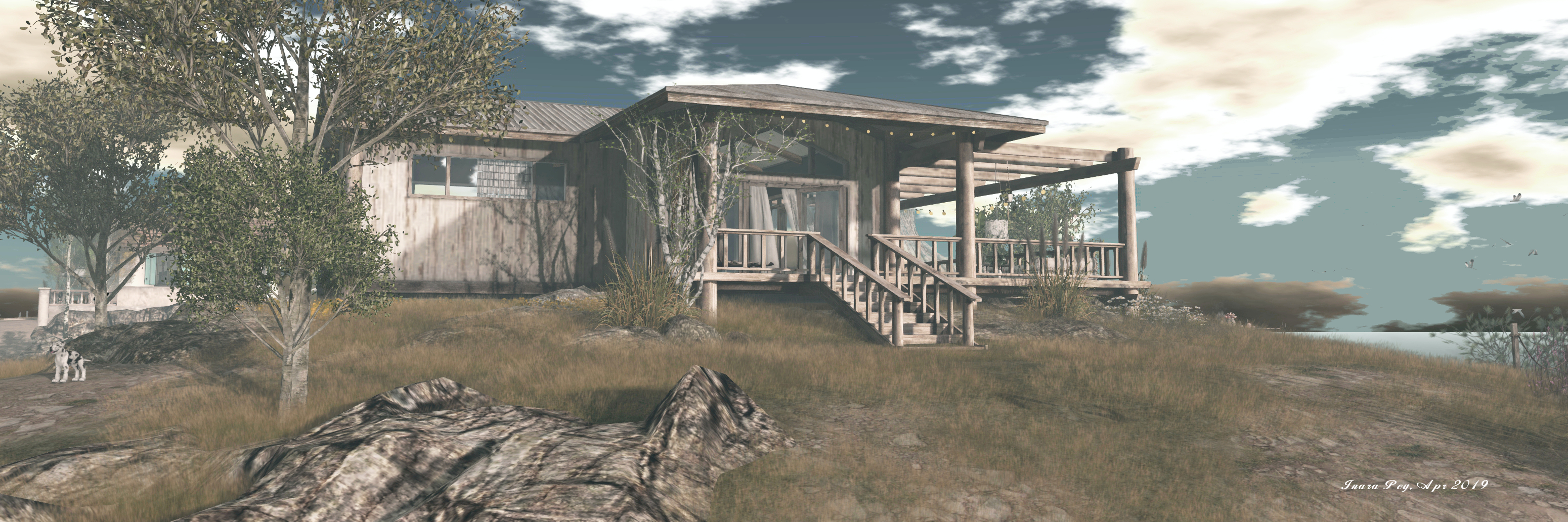
Amrum; Inara Pey, April 2019, on FlickrAmrum – click any image for full size

In March, Shakespeare suggested we visit Amrum, a Homestead region designed by Sunrise Avalanche and Jacky Macpherson. Things being what they were at the time, it took us a couple of weekend to get there – but the visit proved more than worthwhile.

An adult-rated region, this is a place where D/s might be found – although from appearances any such activities are confined to the buildings within the region, so those wandering outside shouldn’t be confronted with more than the occasional flash of nudity. The About Land description is certainly inviting enough:

A peaceful place to relax, to sit on the shore, to meditate, to give space to the thoughts, to gallop on the beach, to listen to the waves. 

Amrum; Inara Pey, April 2019, on FlickrAmrum

In fact, such is the greeting, when returning to take photos, I opted to do just what it suggested: take my horse for a gallop along the beach!

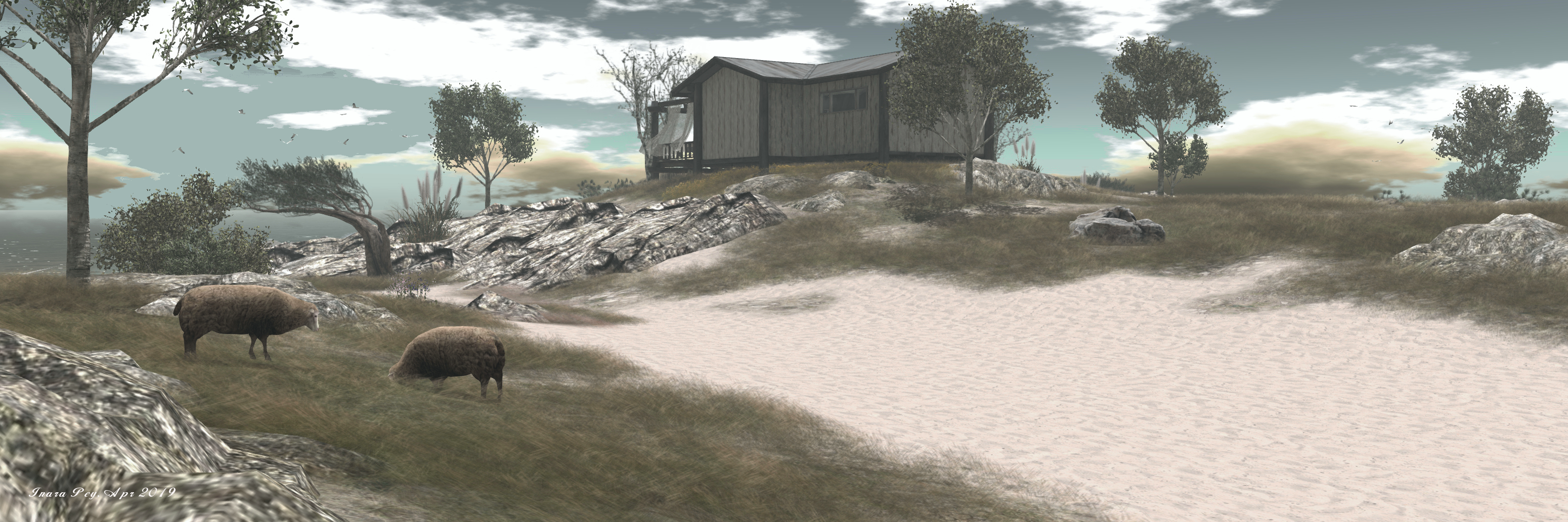
And beach is very much the focus of this region, which presents itself as a low-lying sandy island against which the surf breaks and much of the sand is held in place by scrub grass and stunted trees. Given the German origins for the region, I imagined it might be a smaller island among the North Frisian Islands or perhaps the neighbouring Wadden Sea islands of Denmark.

Three buildings can be found on the uplands of the lands – low hills that march from north to south along the eastern side of the region to form a low spine. These buildings comprise two wooden cabins and a more substantial ranch-style single-storey house to the north. All three look across the western sands and beach, while behind them, the land drops quickly but gently to the eastern shore, a curving shoulder of rock sitting between the sea and the ranch-style house.

Amrum; Inara Pey, April 2019, on FlickrAmrum

With a sailing boat sitting just off-shore to the west, the entire island has the feel of being a holiday retreat for those who can reach it – although, as noted above, a more accurate description might be a private offshore community setting for like-minded individuals. Each of the buildings is delicately furnished, with – by-and-large few of the trappings that might be associated with a D/s / BDSM location; only the pictures on the walls offer a clear indication of the underlying theme.

Out on the beach there is a party / dance deck and numerous places to sit and cuddle while sheep and horses graze on the scrub grass and seagulls wheel overhead. There are a few items indoors and out that are gently floating off the floor or the deck and sand that can be a little disconcerting when first seen, but nothing that really spoils the overall look and feel of the setting.

Amrum; Inara Pey, April 2019, on FlickrAmrum

Photogenic under both the default windlight supplied as a part of the setting, or with also whatever you prefer to apply, Amrum is a simple, elegant setting welcoming to visitors and easy to explore and appreciate.

SLurl Details

  • Amrum (Amazonia, rated: Adult)

2019 viewer release summaries week #14

Logos representative only and should not be seen as an endorsement / preference / recommendation

Updates for the week ending Sunday, April 7th

This summary is generally published every Monday, and is a list of SL viewer / client releases (official and TPV) made during the previous week. When reading it, please note:

  • It is based on my Current Viewer Releases Page, a list of all Second Life viewers and clients that are in popular use (and of which I am aware), and which are recognised as adhering to the TPV Policy. This page includes comprehensive links to download pages, blog notes, release notes, etc., as well as links to any / all reviews of specific viewers / clients made within this blog.
  • By its nature, this summary presented here will always be in arrears, please refer to the Current Viewer Release Page for more up-to-date information.
  • Note that for purposes of length, TPV test viewers, preview / beta viewers / nightly builds are generally not recorded in these summaries.

Official LL Viewers

  • Current Release version 6.1.1.525446, formerly the Love Me Render RC viewer, dated March 26th, promoted April 2nd NEW.
  • Release channel cohorts:
    • Estate Access Management (EAM) RC viewer updated to version 6.2.0.525891 on April 4th.
    • EEP RC viewer updated to version 6.2.0.525808 on April 1st.
  • Project viewers:
    • No updates.

LL Viewer Resources

Third-party Viewers

V5/V6-style

  • No updates.

V1-style

Mobile / Other Clients

Additional TPV Resources

Related Links

Art and motion at La Maison d’Aneli in Second Life

La Maison d’Aneli: Calypso Applewhyte

La Maison d’Aneli, curated by Aneli Abeyante, has opened the doors to its April 2019 ensemble exhibition, and once again brings together the work of several artists to offer a rich mix of art and artistic expression, featuring 2D and 3D art and a marvellous journey into machinima.

This exhibition starts at the gallery’s ground level, with a most unusual motor show by Willem Koba, which juxtapositions a shiny, pristine parking garage with SL cars and vehicles that have, to put it mildly, seen better days. I’m not sure of the purpose of this element of the exhibition, but it does make an interesting and unusual gateway to the teleport up to the gallery proper.

La Maison d’Aneli: Magda Schmidtzau

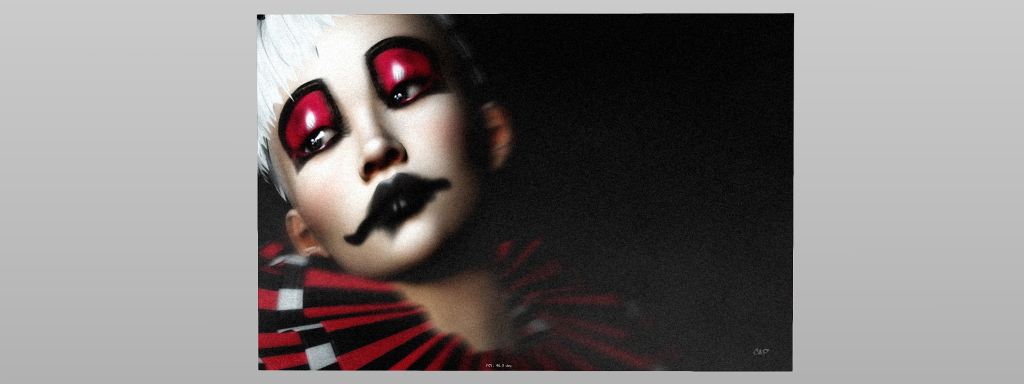
It is here that the rest of the artists within the exhibition display their work. Calypso Applewhyte and Magda Schmidtzau between them present two very different, yet at the same time somewhat reflective of one another.  Magda – or Maddy – has the more extensive portfolio of the two on display, and it demonstrates the breadth of her avatar work, from portraiture, through nudes and fantasy to richly artistic pieces.

Located on he upper floor of the gallery, Calypso – or Caly – offers a more focused selection of work, which leans into fantasy and science fiction elements. Like Maddy’s selection there is a mix of colour and monochrome to the set, but I admit that – as much as I admire Maddy’s work – I was drawn more to Caly’s exhibition, simply because of its captivating “minimalism”. This can be seen in both the images and in the use of the display space around them. This latter point in particular allows the eye to more readily focus on each piece individually, without the distraction of neighbouring works intruding into the eye and mind. This minimalism also presents a rich vein of narrative within each piece, which for me is fabulously exemplified in the wonderful Ma tristesse, seen at the top of this article.

La Maison d’Aneli: RazorZ

Also split between the gallery’s upper are lower floors are RazorZ and Bachi Cheng – both of whose art I don’t believe I’ve previously encountered in Second Life. RazorZ’s digital work is presented in both 2D and 3D, and is a glorious use of shape, colour and form; his sculptures wonderfully alive and vibrant, while his (apparently physical world) photographs are given a marvellous digital  / alien life through the use of colour filtering / layering.

Bachi also presents some of her physical world art on the upper level of the gallery. These are raw, intense and emotive drawings, with Bachi noting, “I love to paint Moments. Moments of life, Moments of Love, Moments so deep that you never want to forget them, Moments at the edge of orgasm or despair, just life; like we ought to live it, plainly.”

La Maison d’Aneli: Bachi Cheng

Rounding-out the exhibition is a display of Aneli’s own 2D and 3D art, and a joint presentation by Iono Allen and Theda Tammas.

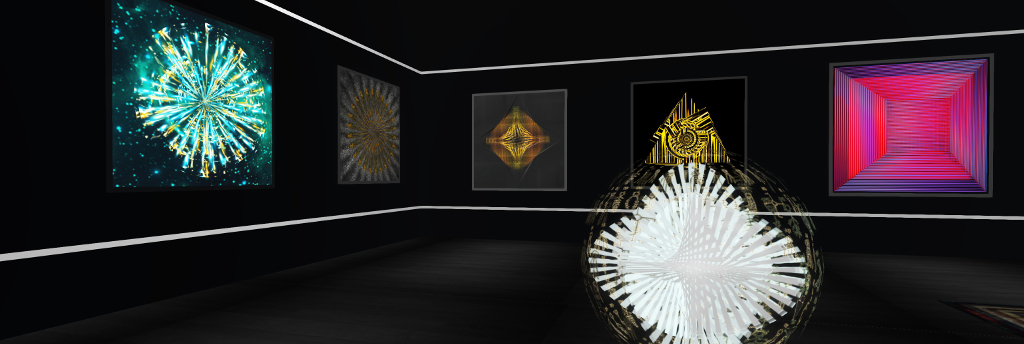
The majority of Aneli’s pieces are beautifully animated and make use of geometric expression to captivate the eye. Colour and monochrome, these are pieces that tend to draw the eye into them, casting an almost hypnotic calming influence through their gentle motion.

La Maison d’Aneli: Aneli Abeyante

Iono and Theda present Samuari, a machinima short film, reached via a walk along an avenue of Torii gates set within a midnight landscape. Filmed by Iona, it utilises elements of Theda’s art (and Theda herself), within an  extraordinary piece, worthy of the best of classical Japanese film-making. The story unfolds entirely visually and sans dialogue, supported only by the use of sounds and music. It is a film that, frankly, should not be missed.

SLurl Details

Space Sunday: Starliners, Martian “eclipses” and dates

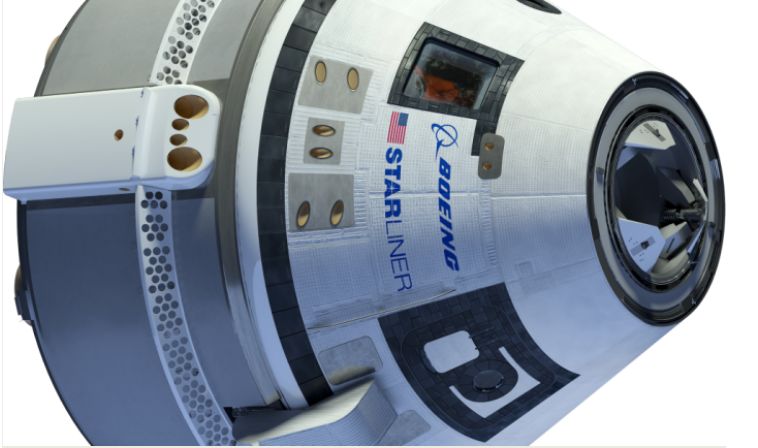
The CST-100 Starliner: further delays, with the crewed test flight potentially being extended into an “operational” flight – something NASA discussed with Boeing in 2016. Credit: NASA / Boeing

Boeing has opted to delay the first launch of its CST-100 Starliner, designed to fly crews to and from the International Space Station. The uncrewed launch, referred to as the Orbital Flight Test, has been pushed back from April to August 2019, with the company citing a tight schedule and conflicts with another launch – that of the Advanced Extremely High Frequency (AEHF) 5 military communications satellite due in June 2019 – as the reasons for the delay.

The “tight schedule” meant that the launch would likely slip into May – but the AEHF-5 launch would mean that the Starliner would only have a 2-day launch window before its own Atlas 5 booster would have to be removed from the launch complex in order to make way for the classified military launch.

Our Starliner team continues to press toward a launch readiness date later this spring,” the company said, which also included the completion of a final set of testing milestones. In order to avoid unnecessary schedule pressure, not interfere with a critical national security payload, and allow appropriate schedule margin to ensure the Boeing, United Launch Alliance and NASA teams are able to perform a successful first launch of Starliner, we made the most responsible decision available to us and will be ready for the next launch pad availability in August.

– Boeing statement

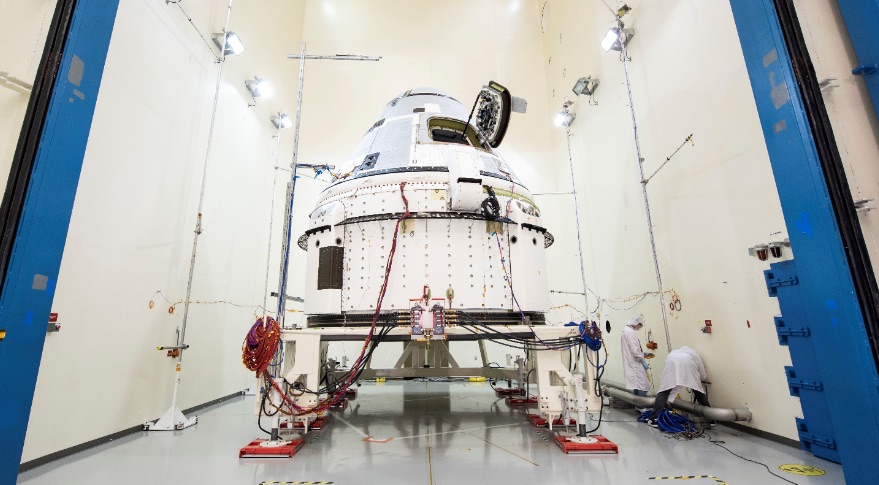
The CST-100 due to make the first crewed flight, at Boeing’s CST-100 processing facility. Credit: Boeing

The delay means that the second test flight of the vehicle, due to fly a crew of two NASA astronauts, Nicole Mann and Mike Fincke, together with Boeing test pilot Chris Ferguson, to the International Space Station, will also be delayed. That flight had been due to take place no earlier than August, but Boeing now state it will take place “later in the year”, with industry experts suggesting it will not proceed any earlier than November 2019.

Following the announcement, NASA indicated that the crewed flight for Starliner will include an extended stay at the International Space Station, lasting several months (the extract length of the stay still to be determined). This extension will effectively allow NASA to turn the mission from a test flight into a crew rotation mission – an idea that had been first mooted in 2016. All three of the crew have been training for ISS operations, and the move could offset the need for an extended use of Soyuz vehicles. As it is, in February, 2019, NASA issued a procurement notice to purchase two additional Soyuz seats from the Russian state space corporation Roscosmos, seats that the Russians didn’t plan to use for their own cosmonauts in order to help ease potential problems were either SpaceX or Boeing to encounter programme issues with their respective vehicles, the Crew Dragon and the CST-100.

While we have already made substantial progress this year, this shift gives us the time to continue building a safe, quality spacecraft capable of carrying crews over and over again after a successful uncrewed test, without adding unnecessary schedule pressure.

– John Mulholland, VP and Program Manager, Boeing CST-100 programme

Mars: of “Eclipses”, and Evidence of Ancient Life?

In March 2019, NASA’s Mars Science Laboratory rover Curiosity was able to record a “double eclipse” as the two Martian moons, Phobos and Deimos passed between the rover and the Sun; although while the media referred to them as “eclipses”, such is the size differential between the tiny moons and the Sun, they are technically transits.

The first transit took place on March 17th when Deimos, the more distant of Mars’ two captured moons, passed across the face of the Sun, its passage recorded by Curiosity’s Mastcam. The second event took place on Mars 26th, when the much larger – and closer – Phobos (11.5 km across) passed in front of the Sun, again filmed by Curiosity’s Mastcam. This event was the more dramatic of the two, not only because of the larger apparent size of Phobos, but because the Moon actually cast a visible shadow, which was captured by the rover’s navigation cameras. Images of all of the events were subsequently strung together to make a short video (below).

However, movie making isn’t the primary objective in observing the transits. Each set of these types of observations – which have also been made by the now-defunct Mars Exploration Rovers, help scientists further refine each moon’s orbit of Mars. When observations of Deimos commenced from the surface of Mars, for example, estimates for where it should be were about 40 km off.

According to NASA, scientists are in agreement present-day Mars is without life. However, whether there might once have been life there is open to debate, and a team from Hungary believe they have found organic material embedded in a Martian meteorite found here on Earth in the late 1970s.

Officially named ALH-77005, the Martian meteorite was found in the Antarctica’s Allan Hills during the Japanese National Institute of Polar Research mission of 1977 / 78. If the reference “ALH” and “Allan Hills” sounds familiar, it might be due to a furore that occurred around another Martian meteorite fragment in the late 1990s.

ALH-84001 caused a lot of controversy – not helped by the media – in the late 1990s

That fragment – ALH-84001, found in Allan Hills in 1984 – is one of the oldest fragments of Mars rock to have fallen to Earth, being dated at 4 billion years of age. When studying the fragment, a US team thought it might contain evidence for microscopic fossils of Martian bacteria within it.

From the start, the claims were considered controversial – although the way the White House and the media over-reacted at the time didn’t help. However, extensive and international study of shavings from the fragment revealed that all of the unusual features discovered within the meteorite could be explained without requiring the intervention of microbial life, and the wider scientific community rejected the hypothesis that the fragment offered evidence of past life. Nevertheless, the events surrounding ALH-84001 pushed the science of astrobiology firmly into thee public domain.

In their report on ALH-77005, Hungarian scientists Ildiko Gyollai, Marta Polgari and Szaniszlo Berczi state they have been able to determine the presence of mineralised organic matter within the rock, such as different forms of bacteria within the meteorite, suggesting that life could once have existed on the Red Planet.

Our work is important to a broad audience because it integrates planetary, earth, biological, chemical, and environmental sciences and will be of interest to many researchers in those fields. The research will also be of interest to planetologists, experts of meteorite and astrobiology as well as researchers of the origin of life, and to the general public since it offers an example of a novel aspect of microbial mediation in stone meteorites.

– Ildiko Gyollai from HAS Research Centre for Astronomy and Earth Sciences in Budapest

While the work will require independent study and review, and the lessons of ALH-84001 could result in some remaining sceptical of the Hungarians’ findings. Nevertheless, there report could change the examination of meteorites in the future. In light of their discovery, the authors posit that solar system materials should be studied to establish whether there is evidence of microbial forms within space rocks as well.

Continue reading “Space Sunday: Starliners, Martian “eclipses” and dates”