Awesome Fallen at the Itakos Project in Second Life

Itakos Project: Simply Dreaming

In 2017, Akim Alonzo launched the Itakos Project as a Linden Endowment for the Arts installation with the aim of presenting the work of SL photographers who, through their images, engage upon story-telling or presenting the ideas of stories, or who seek to present beauty and emotion through their study of the avatar and the worlds around it (see The Itakos Project in Second Life). However, I confess I lost track of the gallery after its 6-month LEA run came to an end. So an invitation to view a new exhibition at the gallery – now in its own location – offered the perfect reason to resume my acquaintance with it.

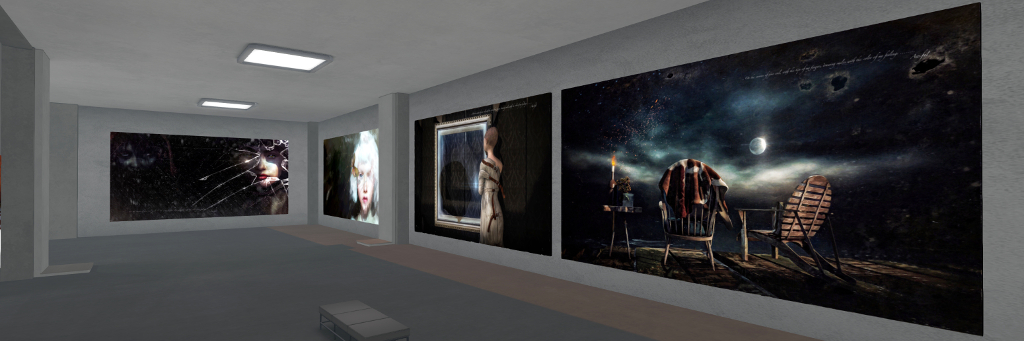
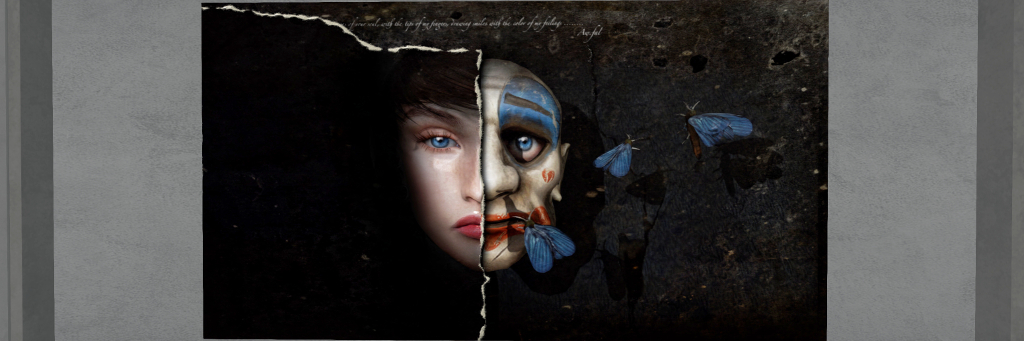
Simply Dreaming is a remarkable selection of pieces by Awesome Fallen, an SL artist whose work I’ve always been drawn to for her richness of narrative and opening of the imagination. With this exhibit, she presents twelve images on the subject of dreams and dreaming, located in the gallery’s entrance level Grey Pavilion. Surreal, marked by the use of heavy and dark colours and tones, these are perhaps images of the darker side of dreams and dreaming.

Itakos Project: Simply Dreaming

Each is  – and I use this term deliberately, despite the dark tones and subject presented – a beautiful representation of an instance of a dream; the moment of recollection we can all have when awakening from a period of REM sleep, a single frame of our dreaming thought processes captured in the lens or the mind, or which is retained and held subconsciously and returns to us at the first moment of waking in the morning.

In this, the surrealist nature of the images is entirely fitting on at least two levels. The first is that dreams are always linear or logical; as the brain processes its way through our sleep, cataloguing, filing, recalling – or doing whatever really is going on in our dream state – we can become observers to those processes without really being aware of what if going on or why. Thus the mental images that we regard as dreams can be both vivid and ethereal; images lying one over the other, some clear and fresh or vibrant in their emotion (if not necessarily in their colour), others faded and faint. Within their mixing we oft encounter surreal views and disjointed images or flashes of thought that are sharded and broken or at least confused.
Itakos Project: Simply Dreaming

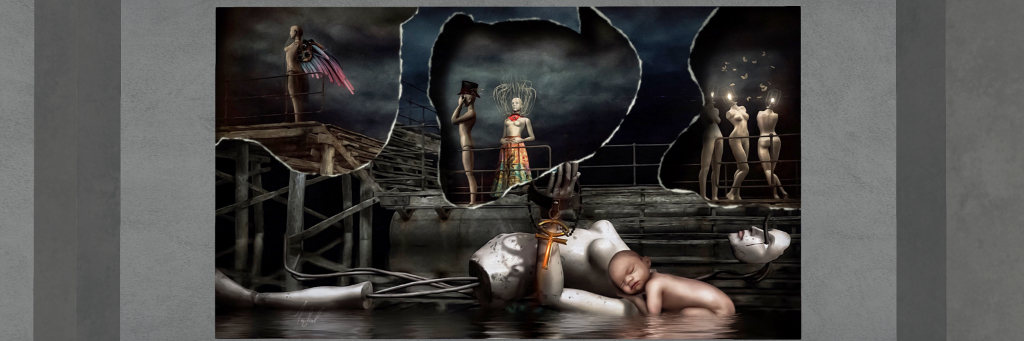
So it is with this images that were are presented with contrasts and juxtapositions: faces split; images that offer a clear view of a subject and a shadowed reflection in the darkness; figures of menace; faces lost; scenes that might be from the day’s activities but turned by the churn of mental processes into scenes that aren’t quite right; negative thoughts and feeling that have become personified. A tumult  of emotions and thoughts given form to become surreal stories without clear narrative except the emotional response they create.

The surrealism approach is also fitting when one considers the origins of this form of art – that of developing painting techniques that allowed the unconscious to express itself. The surrealist movement embraced Freud’s work with free association, dream analysis, and the unconscious. Thus, by presenting these images in a surrealist form, Awesome not only maintains the movement’s idealism, she actually offers a visual treatise on the nature of the movement itself, literally taking the art back to its roots through the presentation of dreams as scenes.
Itakos Project: Simply Dreaming

There is more layering to be found within these images. Take for example the stanza-like line repeated in each of them: On the canvas of your soul, with the tips of my fingers, drawing smiles with the colour of my feelings… Not only does this provide a thread that draws all twelve images into a tapestry; it also suggests that through these images Awesome is offering us windows into her dreams – and into our own. In this latter regard, it is perhaps tempting to see these images as perhaps autobiographical, the capturing of personal dreams; this may be the intent, but equally all twelve pieces speak to our own psyches, offering a means for our subconscious to respond. Hence why, perhaps, on seeing these works we might all feel an odd sense of familiarity and recognition as we look upon them.

A fascinating and absorbing collection.

SLurl Details

2019 SL User Groups 15/2: Content Creation summary

Maderia Springs; Inara Pey, February 2019, on FlickrMaderia Springsblog post

The following notes are taken from the Content Creation User Group (CCUG) meeting, held on Thursday, April 11th 2019 at 13:00 SLT. These meetings are chaired by Vir Linden, and agenda notes, meeting SLurl, etc, are usually available on the Content Creation User Group wiki page.

Environment Enhancement Project

Project Summary

A set of environmental enhancements allowing the environment (sky, sun, moon, clouds, water settings) to be set region or parcel level, with support for up to 7 days per cycle and sky environments set by altitude. It uses a new set of inventory assets (Sky, Water, Day),  and includes the ability to use custom Sun, Moon and cloud textures. The assets can be stored in inventory and traded through the Marketplace / exchanged with others, and can additionally be used in experiences.

Due to performance issues, the initial implementation of EEP will not include certain atmospherics such as crepuscular rays (“God rays”).

Resources

Current Status

The EEP RC viewer updated to version 6.2.0.526104 on Thursday, April 11th. A significant addition to the viewer with this release is the Personal Lighting floater.

When opened, this floater takes a “snap” of the current shared environment (parcel or region / estate) you are in, and present you with a number of controls that allow you to make quick modifications to the environment that only you can see in your viewer, including Sun and Moon positions, ambient lighting cloud and sky colours, etc. These changes will persist until you log out or select World > Environment > Use Shared Environment, so you can close the floater once adjustments have been made.

The new EEP Personal Lighting floater, designed with SL photographers and machinima makers in mind.

This floater has been added in response to concerns raised that where No Modify EEP asset settings are applied to a location, photographers cannot alter the environment lighting, etc., in a manner to suit their needs, and as they’ve been accustomed to being able to do with windlight tools such as Phototools.

Rider notes that this is a first pass at providing photographers / machinima makers with a suite of options that do not claim an unreasonable amount of screen real estate and fulfil the above requirement. However, if there are specific options photographers feel are needed, and which cannot be otherwise tweaked for EEP settings that are No Modify, please submit them as feature requests.

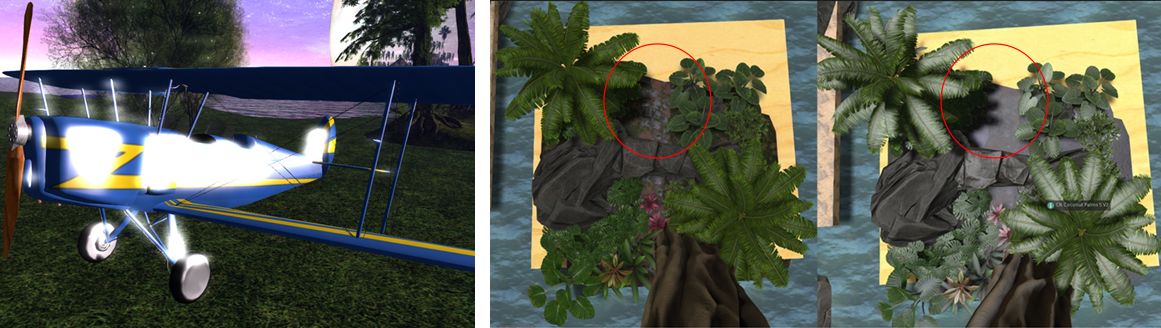
Specularity Issues: the most recent versions of the viewer (nightly builds and the new RC update) contain an unwanted level of specularity, across objects and on Linden Water. Reports have / are being filed on this.

The latest EEP RC has some issues with specularity rendering on objects (l) and circled right (compared with the same terrain mesh seen on the default viewer, centre).

Bugs: Graham Linden continues to try to deal with the remaining shader bugs and clear them.

Bakes On Mesh

Project Summary

Extending the current avatar baking service to allow wearable textures (skins, tattoos, clothing) to be applied directly to mesh bodies as well as system avatars. This involves viewer and server-side changes, including updating the baking service to support 1024×1024 textures, but does not include normal or specular map support, as these are not part of the existing Bake Service, nor are they recognised as system wearables. Adding materials support may be considered in the future.

Resources

Current Status

Anchor Linden is attempting to characterise a couple of viewer bugs that might also require back-end updates as well. The viewer is also awaiting a merge with the latest release viewer (formerly the Love Me Render RC viewer).

Materials and BOM: Bakes on Mesh does not naturally support materials, as the basking service does not support materials, per the project outline above). However it is possible:

  • To manually apply materials directly to the mesh face in additional to BOM applying a worn composite.
  • To apply materials to a mesh via a scripted means. This involves using a script to take the UUID for one of the new universal bake channels (e.g. AUX_1), and pointing it to a normal map, then wearing a universal wearable that uses the same bake channel (e.g. AUX-1). This results in the normal map then being applied to the universal. It’s also not an approach the Lab recommend, and probably won’t be treated as a supported technique.

Animesh Follow-On

Vir has been working on impostor extents see BUG-226359). When impostors are enabled, they can get oddly cropped due to their bounding box size.

The obvious fix is to increase the bounding box size for impostors; however, doing so comes at a performance cost when the viewer renders them – thus potentially negating their purpose (to reduce the render cost / performance hit in rendering complex avatars / Animesh). This likely means that any fix is going to be something of a balance between “padding” (enlarging) impostor bounding box sizes and allowing some truncation to avoid too big a viewer performance impact (fps) when rendering them.

High Fidelity changes direction: the reality of VR worlds today (& tomorrow?)

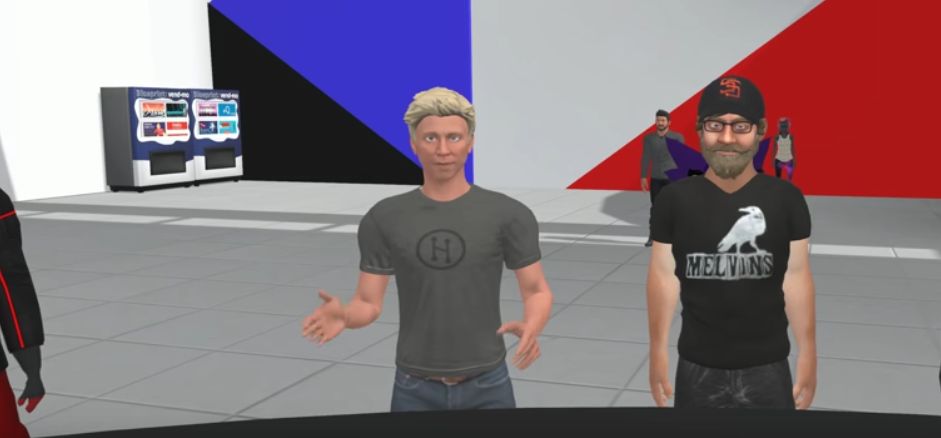
Philip Rosedale, High Fidelity founder and CEO (centre left) addresses the weekly General Assembly meeting in High Fidelity, Friday, April 5th, 2019. Credit: High Fidelity

On Friday, April 5th, Philip Rosedale stunned attendees at High Fildelity’s weekly General Assembly meeting (see the video here and embedded at the end of the article), when he announced that the company would no longer be sitting within the content creation / public space provisioning area with its platform, and that forthwith all public spaces hosted by the company, together with the large-scale events they have been hosting would cease as the company switches tracks to focus sole on software / platform development.

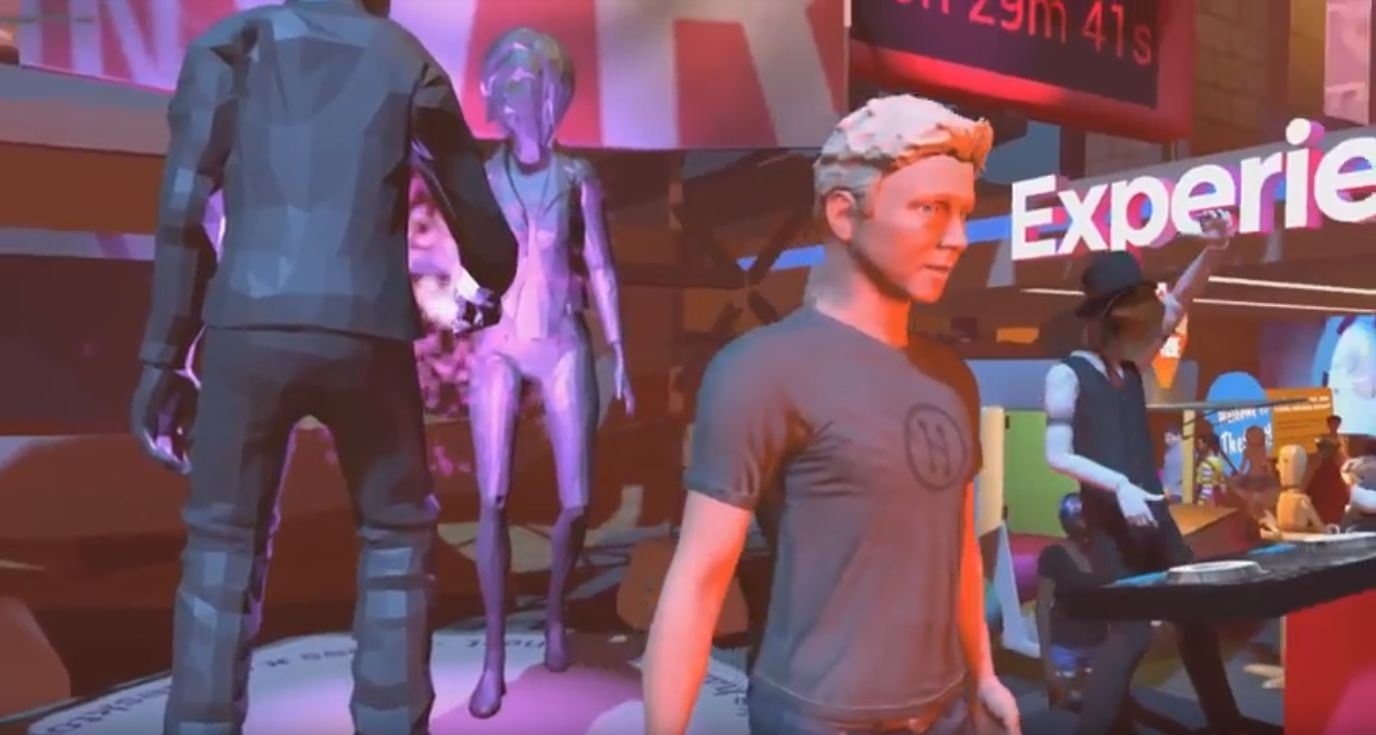
The news was greeted with a sense of shock by High Fidelity users, and the company certainly moved very quickly to follow through on the announcement, shutting down all of the public spaces it has hosted, included social spaces and their flagship Avatar Island, which opened just over a year ago as a means of showcase virtual commerce, shopping and the power of the platform’s micro payments capabilities (see Commerce in High Fidelity, this blog, February 2018).

One of the driving forces behind the decision is that High Fidelity is currently unable to gain major traction – and this despite major pushes to do so with some large-scale events pushed out to the media for promotion, and the former monthly stress tests of the system, trying to push concurrency rates up to determine just how well High Fidelity domains can handle multiple hundreds of avatars. Which is not to say all events are coming to an end: the platform’s popular bingo sessions are set to continue and – taking a leaf from Sansar’s book – High Fidelity is promoting coverage of the first operational launch of the SpaceX Falcon Heavy rocket with an in-world event on Thursday, April 11th.

High Fidelity have, until now, straddled themselves across the software development, content creation and event hosting environments in both trying to generate an audience for their platform and develop the platform itself. Going forward, they plan to focus solely on the latter

However, moving away from large-scale event hosting and hosting domains and environments to try to encourage user growth and instead turning to users and (I assume) suitable partners for audience-generating content, means the company will no longer be pulling against itself trying to both develop the software and platform and provide engaging content and events intended to acquire an audience and encourage their retention.

Which, when you think about it, is pretty much what Linden Lab have, for the most part, been trying to do with Sansar. While the company have provided various social spaces, for the most part they have left content development to users, or have facilitated content creation on behalf of partner organisations (Intel, HTC, the Smithsonian, OpTic Gaming, Roddenberry Entertainment to name a handful) through Sansar Studios – and it has recently been indicated that we’ll be seeing more of this in the future.

One potential benefit of the move for High Fidelity domain creators is the move will hopefully spur more interest in their environments, as Rosedale noted:

By shutting down our public servers, I actually make the prediction that there will be… more people concurrent across the servers that you guys run than us. So I’m not saying that we’re giving up on the servers, I’m saying that I want you to run them.

– Philip Rosedale, April 5th, 2019

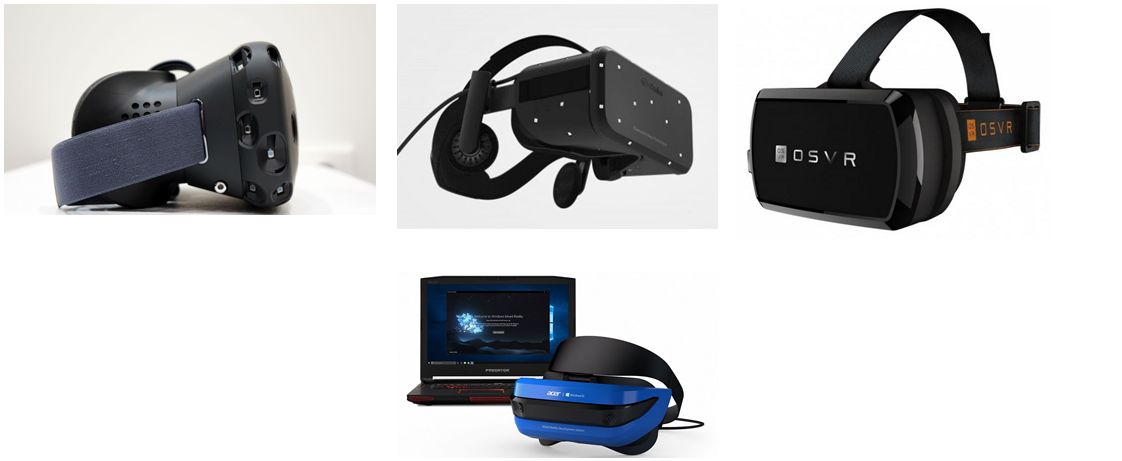
Another aspect of the decision is the slow growth of VR in the broader public marketplace. In this, High Fidelity is possibly more vulnerable than other platforms, in that while it has a Desktop option, it has largely marketed itself as “the” VR virtual spaces company. All of their major event activities; for example, the monthly One Billion in VR events, the FutVRe Lands festival, etc. (bold emphasis my own), have all been VR-centric in their titles, potentially spurring a feeling among a broader audience that High Fidelity isn’t for them due to the lack of any personal HMD.

One of the factors influence High Fidelity’s decision is the slow take-up of consumer VR

Which is not so say others platform built to try to ride the wave of VR don’t also face issues building an audience. For example, much is made of the “success” of VRChat (which can be played both in VR and via desktop), yet the fact is, its average and peak hourly concurrency is only roughly one tenth that of Second Life. But, having said that, the take up is likely to come in time. In fact, as I’ve noted in other articles on VR, right now there are clear niche markets / environments where VR can have a significant impact  – if someone can leverage them correctly: education; training / simulation; architecture / design / prototyping; healthcare; visualisation and computer modelling, etc. And in the future, as VR / AR (or more particularly MR / XR)  do start to gain a broader consumer audience traction, then opportunities for broader virtual environments will arise.

There is perhaps a broader take-way from the High Fidelity announcement: and that is, companies like High Fidelity, Linden Lab, Altspace VR, etc, are likely to face something of an uphill battle to gain an audience for their emerging platforms, even when VR does gain a firmer consumer foothold.

This is not Second Life in 2004. Second Life actually took off like a rocket, once it got working. Even though it had tons and tons of problems… but it took off like an absolute rocket. And the reason that it did, I think, was that this experience of bringing a lot of people together and letting them build things together live, well, in the time frame when we built Second Life, it had never, ever been seen by anyone …

The problem we have today is that that’s just not true. The internet affords us many, many, many, many different ways to be together as people, for example, or just to chat. And so one of the things we are up against here is that there is not as much of a genesis moment … Coming on-line you just don’t have the kind of meme in the sense of a grand or cultural meme kind of written out there like Second Life did. That doesn’t mean that we’re not going to make it. It simply means that we have to be more clever and the strategy that we use to get people in here has to be somewhat different.

– Philip Rosedale, April 5th, 2019

In other words, Second Life has been successful because, at the time of its birth and in the years of its initial growth, it was largely unique on all fronts in the way it captured people’s imaginations*, and its broadness of scope and its ability to embrace people’s imaginations and desires meant it could gather an audience to its shores long before anything came along to seriously challenge it.

This is no longer the case. Today, the digital realms we have at our fingertips are limitless, be they for gaming, socialising, sharing, entire virtual environments, and so on. Whatever we might be seeking, the chances are there is already something there to sate appetites. Even creators can build and mod for a range of games and environments and – through the likes of Unity and Unreal and so on – build environments, all without necessarily getting too hung up on arcane tools built-in to platforms.

Thus, and even if / when VR does become far more consumer mainstream, any attempt to build a world-girdling, audience-rich metaverse is going to face something of a challenge without a significant fiscal weight behind it. Not just in terms of developing the technology, but also into the marketing and PR and – most importantly – the licensing of content. To put this last point another way: were OASIS real, would all the models, characters, and so on from major franchises / brands seen within it really be user-built, or would they more likely be the result of hefty licensing deals that brings the content to the platform whilst protecting the rights (and royalties) of the licensors?

But this is looking further down the road. Right now, High Fidelity’s decision is worth marking; how much of a wider impact it has is a matter yet to be seen.

* Revised, from the original after Will Burns correctly reminded me Active Worlds predated SL.

NOLA in Fairhaven and beyond in Second Life

NOLA @ Fairhaven; Inara Pey, April 2019, on FlickrNOLA @ Fairhaven – click any image for full size

Update: NOLA @ Fairhaven appears to have closed. SLurls have therefore been removed from this article.

We recently received an invitation to visit NOLA @ Fairhaven. Described as  “an homage to New Orleans, Louisiana”, the estate comprises three regions – two Full and one Homestead, with one of the Full regions providing the homage to New Orleans, and the other a pair of settings I’ll discuss a little later.

Designed by Tatianna (TatiannaDiamond) and Jus Strat (jus4strat), all three regions are an impression combination – but given the amount packed into all three mesh, sculpt and texture-wise, can also be a little heavy going if your viewer is running with any significant bells and whistles (such as shadows) enabled.

NOLA @ Fairhaven; Inara Pey, April 2019, on FlickrNOLA @ Fairhaven

There is no enforced landing point within the regions, and the SLurl supplied by Jus dropped us neatly in the north-east corner of the Full region representing New Orleans (and which is the one I’ve used in this article), with the bridge to the other regions leading away eastwards, the town itself lad out to the west and south of us.

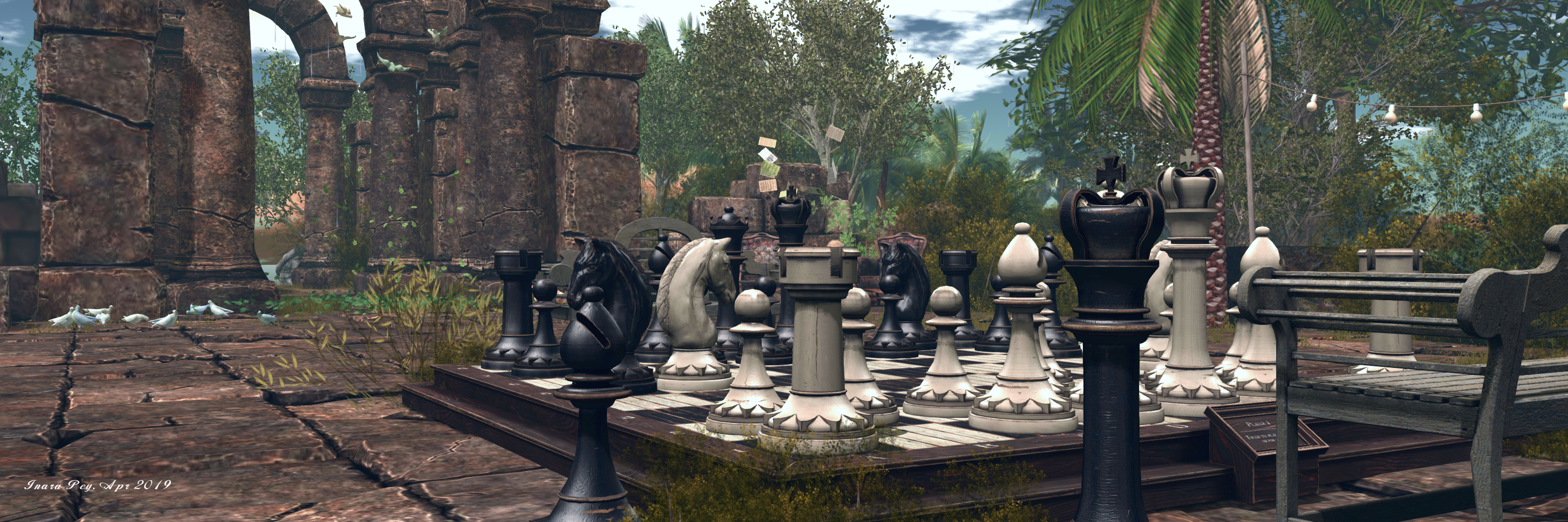
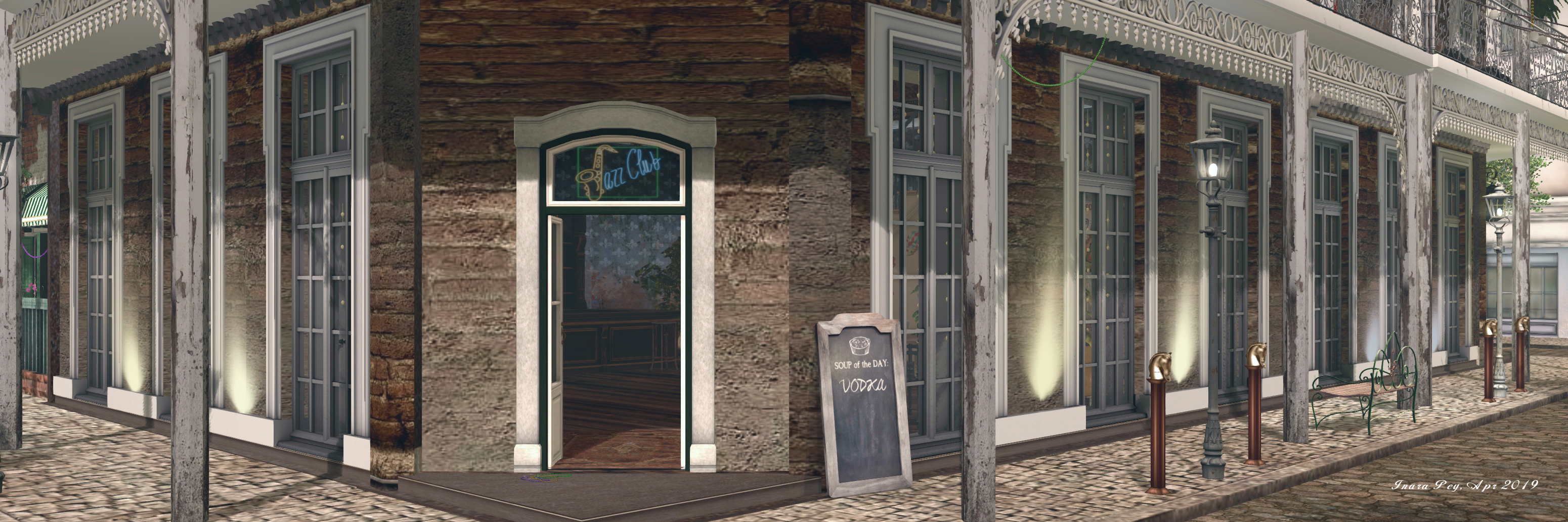
The latter is something of an image of New Orleans perhaps familiar to many from film and television: cobbled roads, balconied establishments whose interiors offer relief from the heat of the day. Cafés rub shoulders with jazz clubs, barbers shops, boutique stores and hotels. Grand houses can be found by wandering through the streets, while squares and formal gardens offer breaks from the urban tightness. To the north-west, the town gives way to a more bayou like setting, with mangroves and swampy-looking grass, while the graveyard betwixt town and bayou offers another “traditional” reflection of New Orleans and its oft-presented ties to voodoo and mysticism.

NOLA @ Fairhaven; Inara Pey, April 2019, on FlickrNOLA @ Fairhaven

The attention to detail within the town is impressive: many of the buildings have interior décor and furnishings, making them attractive points for exploration; several of the roads are lined with ornate, horse-headed bollards, reminding one of the city’s long history, while another reminder lines in the “river” separating the town from the eastern regions of the estate: a stern-wheeled paddle boat (the fabulous Dixie Belle by Analyse Dean), a rickety brow connecting her to an aged wharf where an old mill sits.

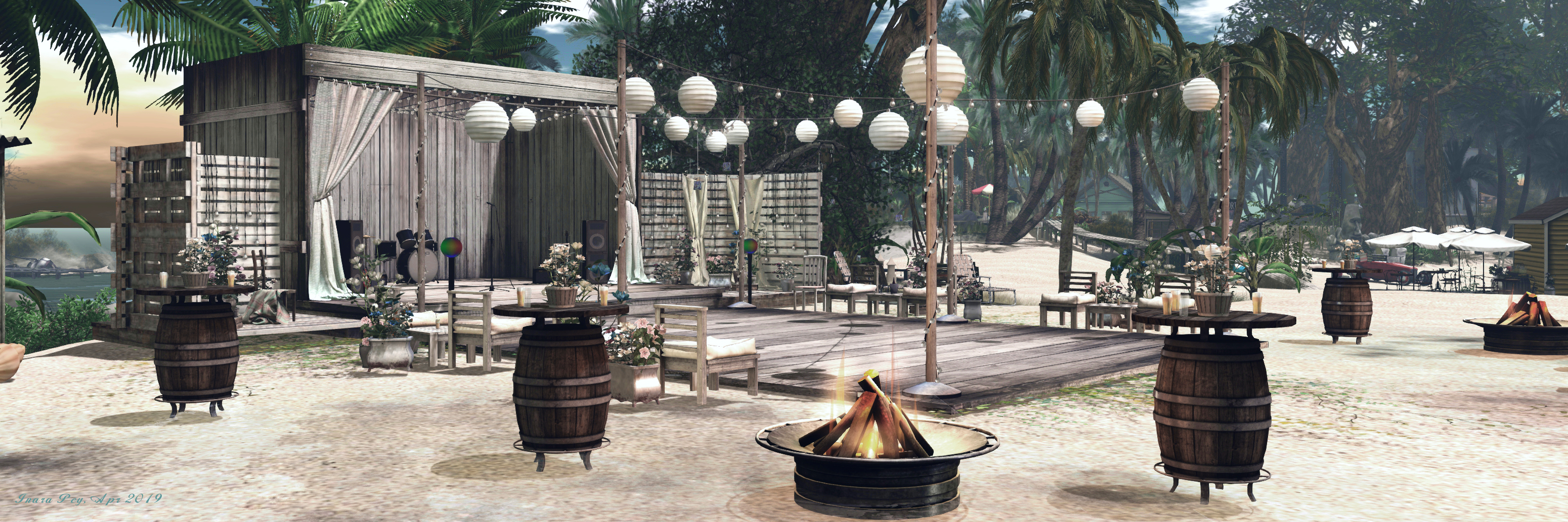
Across the water from the town, in the remaining two regions, things take a turn toward a more equatorial tropical feel, with the ground level of both regions styled into the undulating form of a surfer’s paradise. A rocky plateau, reached via the bridge mentioned above, provides a good vantage point as it looks eastwards over the sand and dunes, which in turn gradually narrow into a crooked finger curled around a bay into which white-capped waves roll.

NOLA @ Fairhaven; Inara Pey, April 2019, on FlickrNOLA @ Fairhaven

The uplands here are home to a lush area of trees, grass and plants, where an ancient ruins stands and a winding paths disappears through the trees. Touches of fantasy reside here, perhaps most notably in the form of the gondola held aloft by balloons, perhaps as much at home in the air as it might be on a river or canal. Further to the east, the beaches are naturally divided by trees and by raised board walks, with beach houses, shaded spots, lookout points and more scattered throughout.

Nor is this all; find the teleport boards (hard to miss out on the sands!) and you can be carried aloft to where the City of Fairhaven resides in the sky, another venue for music, exploration and photography. Here can be found an amusement park surrounded by trees, and what  – for me at least – is the biggest drive-in cinema screen I’ve come across in Second Life.

NOLA @ Fairhaven; Inara Pey, April 2019, on FlickrNOLA @ Fairhaven

As noted above, there is a lot going on across all three of these regions in terms of mesh, sculpties and textures, which can take its toll on a viewer’s performance (I had to disable shadows to walk comfortably, and even then, in places my viewer still had some issues). However, if you show patience and give things a chance, there is a lot worth seeing here.

Our thanks to Jus for the invitation to visit and explore.

NOLA @ Fairhaven; Inara Pey, April 2019, on FlickrNOLA @ Fairhaven

SLurl Details

  • NOLA and Fairhaven (Stratography, Stratography West and Stratography East, all rated Adult)


Fantasy Faire 2019: nominations for king, queen and chancellor

via Fantasy Faire

One of the fun elements introduced to Fantasy Faire in 2015 was the opportunity to nominate and then vote for the King and Queen of the Fairelands and their (strictly non-human) Chancellor. Nominations came from across all realms of fantasy, with the top five for the positions of king and queen (human or human-looking nominations only) and chancellor, went forward for a public vote-off during the course of the Faire.

The event has since become a staple of the Faire, and it is once again back for 2019, with nominations now open. It’s important to note that this has nothing to do with avatars or people per se, but is a fun election purely for characters from works of fantasy, with the “winners” announced at the end of the Faire.

Nominees can be from written fantasy, graphical novels, cartoons, films, television or radio series, and from genres such as fairy tales, high fantasy, magical stories, urban fantasy, vampire sagas or steampunk, etc. The only major requirements are that nominations for king and queen must be human (or human-type) characters, whilst nominations for chancellor are restricted to non-human (or non-human type) characters, and that the winners from the previous year are no eligible for re-election.

How It Works

  • Nominations are made between now and the end of Saturday, April 20th, 2019 (23:59 SLT), using the form below.
  • The top five nominees for each role – king, queen and chancellor – will be selected for a final vote-off.
  • During the Faire, people will have the opportunity to vote for their favourites.
    • There is a fee payable for voting, but all money raised will go to Relay for Life.
  • The winners will be announced at the Fantasy Faire Live Auction on Sunday, April 28th, 2019.

Past Winners

  • 2018: king: Gandalf; queen: Galadriel; chancellor: Totoro (these three are not eligible for nomination again in 2019).
  • 2017: king: Severus Snape, queen: Leia Organa;  chancellor: Rhiow the Wizard Cat.
  • 2016: king: The Goblin King; queen: October Daye; chancellor: The Last Unicorn.
  • 2015: king: Havelock Vetinari; queen: Granny Weatherwax; chancellor: Greebo the Cat.

Additional Links

Theatre: a story in pictures in Second Life

Diotima Leisure and Culture Gallery: Ana Oceanida

Opened on April 7th, 2019 at the Diotima Leisure and Culture Gallery, is a new installation by Spanish artist Ana Oceanida, featuring 2D images presented in a 3D space that forms a part of the overall statement for the installation, which has the simple title of Theatre.

I often discuss the idea of narrative within these reviews, the stories that so often exist with in the images presented by photographers and artists. With Theatre, the story very much is the installation, told through the images displayed, and via the broader setting itself. It is the story of the life – and ending? – of traditional theatre as a medium for teaching and telling stories; and it is a story told through the camera lens of a photographer – the images themselves taken at locations around Second Life.

Diotima Leisure and Culture Gallery: Ana Oceanida

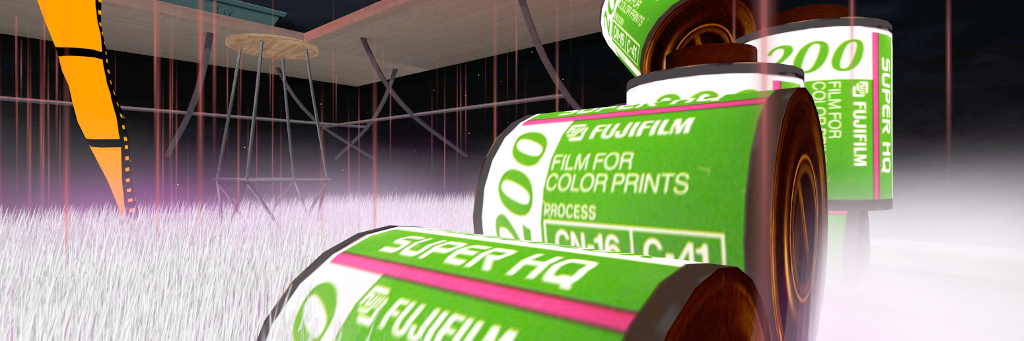
Best enjoyed with local time set to midnight and with the viewer’s Advanced Lighting Model option enabled (Preferences > Graphics), Theatre can be very loosely split into two intertwined elements. The first is the setting itself, that of the photographer’s developing studio. It contains the paraphernalia of the photographer’s art: the chemical developers, the trays in which photographs seem to miraculously appear in their baths of chemicals, a cropping board, packs of developer’s paper, rolls of film awaiting use, scattered plastic containers of used film, and more, all bathed in the red glow of the developer’s bulb and the photographer stands before a bench carrying out her artistry.

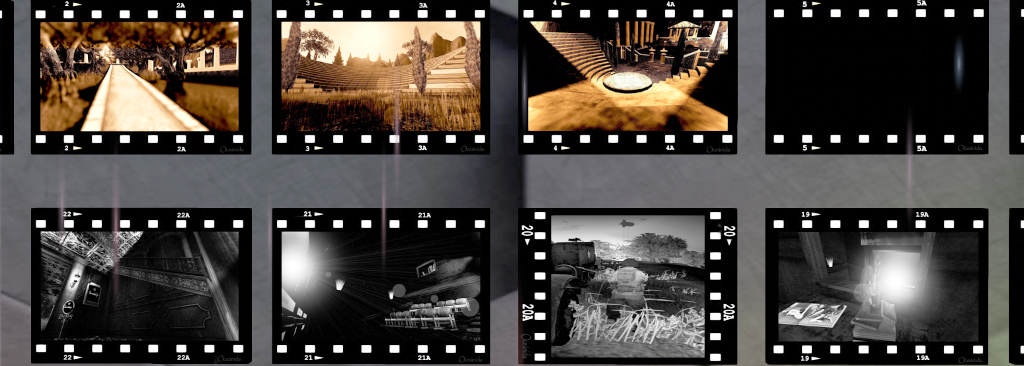
On the walls and floor of this setting are the results of this work: a series of images that might be regarded as unframed slides, more than 40 of them, some in colour, some in black-and white. Offered sequentially, starting with 1-1A in the corner of the room above the photographer’s right shoulder and proceeding to the right, these offer an unfolding story about the theatre that winds back and forth across two walls of the studio, before dropping to the floor to finish their tale there.

Diotima Leisure and Culture Gallery: Ana Oceanida

The story perhaps isn’t easy to grasp. However, there are grab bags within the installation which contain, among other items, note cards outlining the tale.

I remember that moment, that time when, in the heat of fire started to tell stories , Stories of gods, Stories of monsters, stories of heroes, was such a fascination that I woke up among people that the cold nights became warm to the stories. Little by little you gave me a body, my first body was cold, hard, wide spaces and open-air stands but with your stories became laughed, suffering… and people. My childhood was happy.

In this, the story of the rise and fall and rise (or rebirth) of theatre down through the ages, I was reminded of Jaques‘ soliloquy and lament from As You Like It, “All the world’s a stage, And all the men and women merely players;…” in that we are both observers of this installation and the actors within it; we play our role here in witnessing the story, and thus give theatre another breath of life.

Diotima Leisure and Culture Gallery: Ana Oceanida

And like Jacques’ view of the seven ages of man, so to is this story ultimately a lament: the passage of time has meant theatre has grown and changed over time, only to perhaps now in the digital age to face its final passing, the permanence of physical structure through bricks and mortar, of floorboards and seats, now giving way to the ephemeral flow of bits and bytes that give rise to impermanence and passing. Hence, perhaps the tear-like rain in the installation.

I’m not sure I agree with the conclusion of the piece – digital environment could be a boon to theatre – but, this is a story after wall, and the tale has its own telling and conclusion. As to the images offered, I can only say that they are fascinating studies, each one of which stands on its own, whether or not one follows the broader story, offering a unique perspective on the places Ana visited in preparing this installation.

SLurl Details