The following notes were taken from the Tuesday, July 6th, 2021 Simulator User Group (SUG) meeting. The meeting was recorded by Pantera Północy, and the video is embedded at the end of this summary.
Server Deployments
See the server deployment thread for any most recent updates / changes.
Tuesday, July 6th saw the SL Main channel servers updated with simulator release 560819. This includes internal fixes, a fix for BUG-202864 – “Change Mesh Uploader to preserve Scene File object names when a full linkset is uploaded”. and a fix for BUG230881 – “llHttpRequest(): HTTP_CUSTOM_HEADER flag is ignored”.
Wednesday, July 7th will not see any planned deployment to the RC channels.
SL Viewer
There have been no official viewer updates to mark the start of the week, leaving the official pipelines as:
Release viewer: Project UI RC viewer, version 6.4.20.560520, dated June 14, promoted June 23 – No change.
Release channel cohorts:
Fernet Maintenance RC, version 6.4.20.560398, dated June 22.
Project viewers:
Legacy Profiles viewer, version 6.4.11.550519, dated October 26.
Copy / Paste viewer, version 6.3.5.533365, dated December 9, 2019.
Project Muscadine (Animesh follow-on) project viewer, version 6.4.0.532999, dated November 22, 2019.
360 Snapshot project viewer, version 6.2.4.529111, dated July 16, 2019.
Region Crossings
During region crossings, vehicles and avatars are packaged and transferred separately to one another, before being unpacked and put back together by the receiving region. Due to the fact that vehicles are generally less complex than avatars, then tend to arrive first, and this can cause issues as the scripts on the vehicle resume and make calls (animations, etc.), on avatars that have yet to “arrive”, which can result in vehicle errors.
While there is an event flag – CHANGED_REGION – triggered when the vehicle has correctly arrived in the new region, allowing its scripts to resume, there is no equivalent flag for arriving avatars. So user Animats has suggested the creation of such an additional event flag: CHANGED_REGION_COMPLETE.
This would be sent once the receiving simulator has unpacked and seated the avatars using the vehicle. Should this additional event flag not be received, then it is indicative that something has gone wrong, allowing vehicle scripters to use it to determine how they’d like to handle the situation.
See BUG-230934 “Add event bit flag CHANGED_REGION_COMPLETE to “changed” script event” for more.
It has also been suggested that LL give thought to a way in which vehicles can detect upcoming parcel settings. A major issue of vehicular travel is encountering parcels where object entry is disabled – resulting in the vehicle being auto-returned to the owner and all those aboard violently unseated.
A means for the viewer to be forewarned of the access settings for a parcel would potentially allow vehicles to be scripted so they can respond to “unfriendly” parcel such as stopping at the parcel border (presumably with a test notification to the driver) in a similar manner to when they encounter ban lines, thus potentially preventing vehicle return and avatar dumping.
There are again complexities to this idea (e.g. what happens when the parcel(s) being checked are in the next region, and thus on a different simulator to the one the checking script is currently running on?). However, LL have requested the idea be filed via Jira to allow proper assessment and discussion.
Nitroglobus Roof Gallery: Mihailsk’s Baptism of Fire
Sometimes the best art exhibits come from a chance encounter. Dido Haas, owner and curator of Nitroglobus Roof Gallery (and a talented photographer in her own right), bumped into Mihailsk while he was visiting Nitroglobus in March. A couple of days after that first encounter, he posted an image taken at the gallery, which was then displaying Daantje Bons’ work (see here for a review of that exhibition) – and this image led to Dido looking through Mihailsk’s Flickr steam and then approaching him to exhibit at Nitroglobus.
Even so, he took a little persuading. Despite being active in SL for several years, Mihailsk has only recently entered the world of SL photography and artistic creation, as he explains:
Even though I am in SL since 2014, I feel my second life started the day I decided to dedicate a large part of my time in this virtual world to photography. It was [in] January 2020 when I started this beautiful journey in light, colours and emotions; a journey to fantastic places and loved persons, trying to capture special moments in eternity. Sometimes with a smile, sometimes with pain.
– Mihailsk describing his journey into SL art
Nitroglobus Roof Gallery: Mihailsk’s Baptism of Fire
Given this, Dido’s invitation marked the first time he has been asked to display his art in-world – which can be a daunting prospect for an artist-photographer, even when well-established on a site like Flickr. Hence the title for this exhibition: Baptism of Fire.
Mihailsk’s work is probably best defined as avatar-focused; a term I use in preference to the more usual “avatar study”, because while a fair portion of his work does focus in on an avatar (either his or that of a friend) in order to frame a story, he also frequently sets his canvas much more broadly, framing an image that blends avatar and surroundings into a richly layered composition that is utterly captivating – as can be seen time and again throughout his Flickr stream.
Nitroglobus Roof Gallery: Mihailsk’s Baptism of Fire
He is also an artist who uses a variety of styles to express his work, from full colour, to gentle tonal work through to monochrome, with techniques that touch upon sepia colouring, chiaroscuro, post-processing and digital layering. The result of all this being pieces of great visual depth.
Given this, there might be a temptation to pull together a multiplicity of styles and display them together; instead, Mihailsk has focused on presenting pieces that focus on black-and-white / monochrome, and which also fold into them elements of silhouette art, chiaroscuro and minimalism that very much help to focus on his use of emotion in his art. In this he also differs from many other SL artists, who often construct their images to frame what amounts to a pre-determined emotion that they wish to convey to their audience. Instead, Mihailsk frames his pieces in a manner more designed to convey the emotion he felt within a scene or setting; thus they become windows into his feelings and outlook.
Nitroglobus Roof Gallery: Mihailsk’s Baptism of Fire
The above all said, given the sheer depth and beauty of Mihailsk’s art, I admit I would have perhaps liked to perhaps see some of his colour art included here, simply because it is equally emotive. But make no mistake, what is shown within Baptism of Fire is utterly engaging and a more than worthy display of art from an exceptionally talented individual. and as well as visiting, I encourage you to also take the time to peruse his Flickr stream; you will not be disappointed.
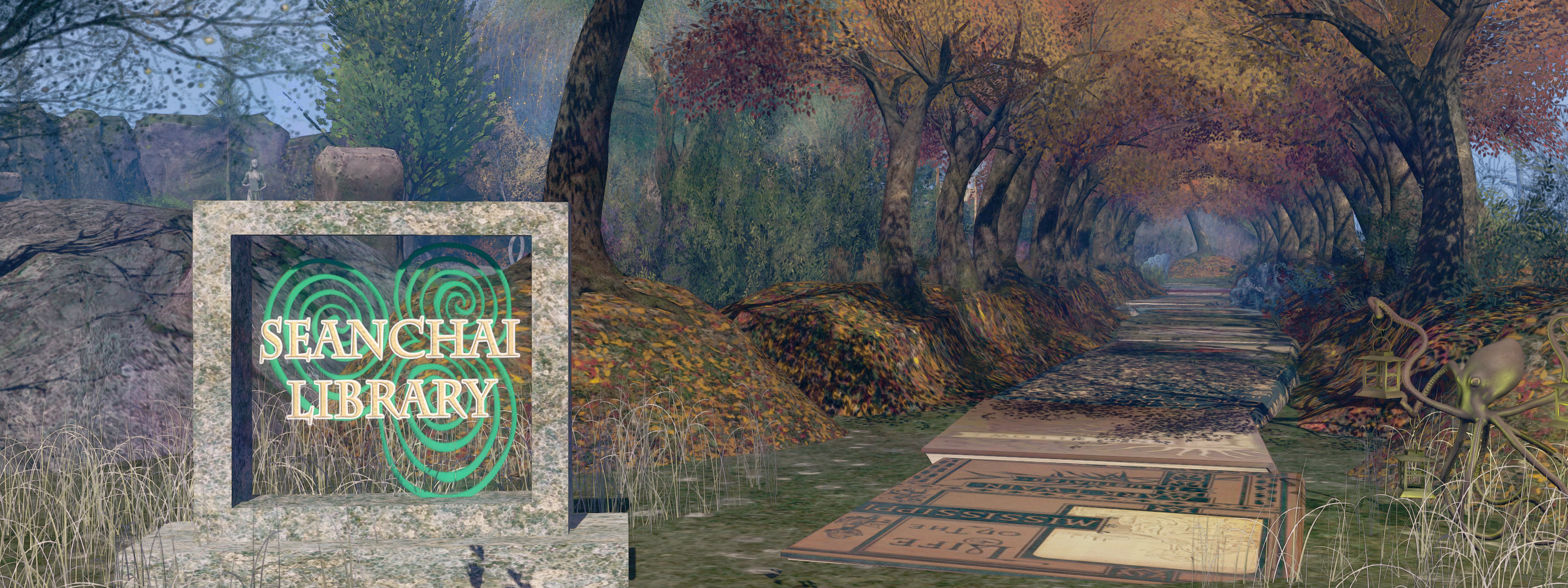
It’s time to highlight another week of storytelling in Voice by the staff and volunteers at the Seanchai Library. As always, all times SLT, and events are held at the Library’s home in Nowhereville, unless otherwise indicated. Note that the schedule below may be subject to change during the week, please refer to the Seanchai Library website for the latest information through the week.
Monday, July 5th 19:00: The Weigher
A world ruled by sentiment big cats where the rule of law is enforced by the Weighers, a combination of judge, peacemaker and … accountant … through a brutal code of honour and combat. Without their violent intervention in things, all-out war and anarchy would ensue.
When two human explorers – fragile, weak and potentially easy prey – arrive on that world, Slasher, a Weigher of skill and talent in physical combat, finds herself defending them. In doing so, she finds herself a disgraced outcast.
Join Gyro Muggins as he read the story by Eric Vinicoff and Marcia Martin.
Since its publication in 2017, Robert MacFarlane’s The Lost Words has enchanted readers with its poetry and illustrations of the natural world. Now, The Lost Spells, a book kindred in spirit and tone, continues to re-wild the lives of children and adults.
Now, The Lost Spells evokes the wonder of everyday nature, conjuring up red foxes, birch trees, jackdaws, and more in poems and illustrations that flow between the pages and into readers’ minds. Robert Macfarlane’s spell-poems and Jackie Morris’s watercolour illustrations are musical and magical: these are summoning spells, words of recollection, charms of protection. To read The Lost Spells is to see anew the natural world within our grasp and to be reminded of what happens when we allow it to slip away.
With Caledonia Skytower.
Wednesday, July 7th, 19:00 Hogwarts An Incomplete and Unreliable Guide
a collection of J.K. Rowling’s writing from the Pottermore archives: short reads originally featured on pottermore.com. These eBooks, with writing curated by Pottermore, will take you beyond the Harry Potter stories as J.K. Rowling reveals her inspiration, intricate details of characters’ lives and surprises from the wizarding world.
Hogwarts An Incomplete and Unreliable Guide takes you on a journey to Hogwarts School of Witchcraft and Wizardry. You’ll venture into the Hogwarts grounds, become better acquainted with its more permanent residents, learn more about lessons and discover secrets of the castle . . . all at the turn of a page.
With Caledonia Skytower.
Thursday, July 8th, 19:00: Time Capsel
With Shandon Loring.
Friday, July 9th, 14:30: Terry Pratchett’s Unseen Academicals
Football in Ankh-Morpork is not as we might know it. Rather than being comprised of rules and played within a recognisable ground, it is far more akin to the somewhat violent mob football of medieval Europe.
Not that this is a concern for the elderly, mostly indolent and (some might be tempted to think) somewhat inept old wizards making up the faculty staff at the city’s school of wizardry, the Unseen University. Until, that is, their very handsome annual endowment becomes subject to their playing the game themselves.
Thus, Archchancellor Mustrum Ridcully sets out a two-pronged strategy: to ensure the city’s version of football is restructured with proper (and favourable?) rules, and to put team preparations at the university in the hands of the talented candle dribbler, Mr. Nutt and his assistant, Trevor Likely, the son of the city’s most famous (if deceased – did I mention the game can be violent?) player, who are in turn supported by Glenda Sugarbean, who runs the university’s night kitchen and her assistant Juliet Stollop.
Except Mr. Nutt soon discovers he has problems of his own to deal with, and Trevor has promised his Mum he’ll never get involved in the game. Meanwhile, Glenda has the daily responsibility of baking the Discworld’s best pies, and Juliet is about to find herself whisked towards the heights of fame as a fashion model, thus potentially leaving the team a little short on practical advice…
Join Caledonia Skytower as she presents the 37th novel in the Discworld series, and possibly one of its greatest satirical undetakings encompassing football, academia, traditions, the fashion industry, politics, love, fandom, and which mixes in more serious themes of identity, crab mentality and self-worth.
Logos representative only and should not be seen as an endorsement / preference / recommendation
Updates from the week ending Sunday, July 4th
This summary is generally published every Monday, and is a list of SL viewer / client releases (official and TPV) made during the previous week. When reading it, please note:
It is based on my Current Viewer Releases Page, a list of all Second Life viewers and clients that are in popular use (and of which I am aware), and which are recognised as adhering to the TPV Policy. This page includes comprehensive links to download pages, blog notes, release notes, etc., as well as links to any / all reviews of specific viewers / clients made within this blog.
By its nature, this summary presented here will always be in arrears, please refer to the Current Viewer Release Page for more up-to-date information.
Note that for purposes of length, TPV test viewers, preview / beta viewers / nightly builds are generally not recorded in these summaries.
Official LL Viewers
Release viewer: Project UI RC viewer, version 6.4.20.560520, dated June 14th, promoted June 23rd – No change.
Neverending: The Dark Tower, July 2021- click any image for full size
I was off back to Neverending, the Homestead designed by Jayden Mercury and Valarie (Zalindah), to see it in its latest iteration: The Dark Tower.
I’ve no idea if the region’s name is a reference to Stephen King’s series of of eight novels genre-crossing (dark fantasy, science fantasy, horror, and westerns) series of novels regarded as his magnum opus (or indeed the 2017 film they in turn inspired, or the 1952 narrative poem Childe Roland to the Dark Tower Came by Robert Browning said to have been King’s inspiration). Nor do I know if the likes of Tolkien’s Barad-dûr may also have influenced the naming of the region in this iteration; however, there are faint echoes towards both King and Tolkien writings to be found within the setting.
Neverending: The Dark Tower
The focus of the setting is a high tower towards which we are encouraged to travel just as King’s protagonist, Roland Deschain, is also drawn (essentially following in the footsteps – metaphorically speaking – of Browning’s Childe Roland); although in his case, the Dark Tower is both physical and metaphorical, whereas here the tower is very much physical.
Rising from a domed island, the tower within the region may not be the centre of the universe, as per the tower of the film, but it does sit as the hub around which most of the rest of the setting has been built. It is ringed by a series of stone and wood bridges that sit wheel-like around it, with stone causeways connecting them both to it like the spokes of a wheel, and which extend outward to reach other points of interest.
Neverending: The Dark Tower
One of the latter offers the Tolkien reference: a tall volcano that issues forth lava and billowing smoke just as Orodruin did as it stood apart from Mordor’s Barad-dûr. A second outlier tops a pinnacle of rock to provide a lover’s hideaway within the hollowed trunk of an aged tree, whilst a third presents a walk through rain and dancing leaves that pirouette around frozen umbrellas periodically lit by lightning, to where a grand piano sits. Beyond this, across the water and within a curtain ring of stone and trees, sits a house on its own, a private residence.
From the low-lying landing point with its warning about AFKing whilst there, its Torii gate and off-shore orca that play in the shallows, it is possible to climb to the first of the high causeways as it leads to the tower. From either side of this causeway, the ring of stone and wooden / rope bridges spans outward from either side for those who wish to follow it (but be warned; some of these may not be as stable as they might first appear to be!).
Neverending: The Dark Tower
In keeping with King’s novels and the film they spawned, the tower appears to be a place of mystery and power for those who dare explore (there is even a “door” that will return visitors to their beginning – or at least in this case, the landing point). A dragon guards the entrance to the tower, although it appears willing to allow visitors passage through the great gate and doors and explore within. It is not the only such creature standing guard – a point to which I will return in a moment.
While the great hall to the rear of the tower might at first appear to be little more than a place nature is attempting to reclaim, careful eyes and hands might find a secret route by which the tower might be further explored, from top of highest tower through hidden room, and more as noted above. Others might simply content themselves with finding their way to the upper room, where sits the Book of Magic.
Neverending: The Dark Tower
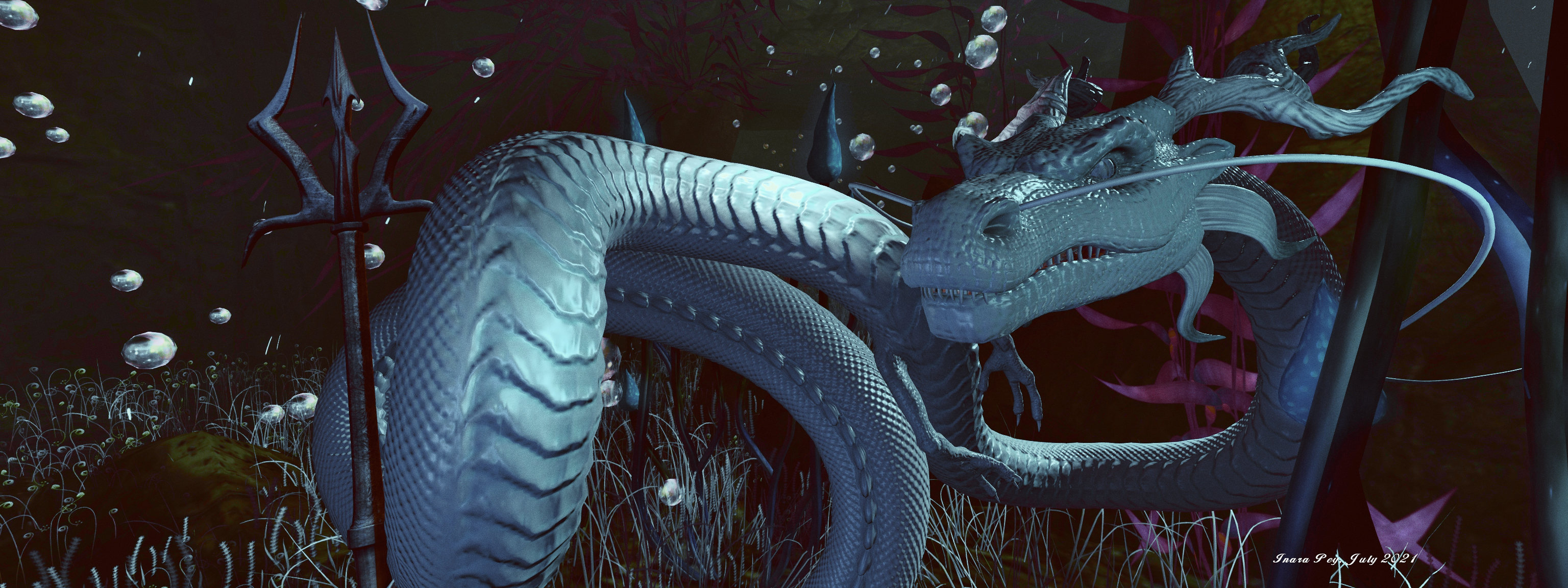
Not all of the regions secrets await discovery above ground, either. Those who explore carefully enough should find their way to a garden where creatures of the sea swim and play, and tunnels lead to where a water dragon awaits those wishing to sit and converse with it.
Like the iteration before it, Sakura Tales (see here for more), this version of Neverending continues a narrative that first started with Jayden Mad Wonderland build (see here): the tale of an artist, with chapters of the story awaiting discovery throughout the setting as they lie as pages waiting to be found. When discovered an clicked upon, these pages will present their part of the story to you on a private channel, and (perhaps) offer a clue as to what is to come next.
Neverending: The Dark Tower
Rich in detail (although the default EEP settings can make this difficult to appreciate – I actually opted for Bryn Oh’s Bluniverse, which comes as standard with EEP, so that I could appreciate the setting better without going too far from the intended environment), with lots of opportunities for photography, discovery and simply appreciating the creativity of Jayden and Valarie whilst following the third instalment of Jayden’s tale, The Dark Tower is an atmospheric and engaging visit.
SpaceX: the orbital launch facilities under construction at Starbase, Boca Chica, Texas, as the 7th section of the launch support tower is hoisted into place. Credit: Bocachicagal / NASASpaceFlight.com
SpaceX are driving ahead with preparations for their first starship / Super Heavy orbital flight – although whether the company will achieve the goal of making the launch prior to the end of July 2021, as recently re-stated by company president and COO Gwynne Shotwell – seems unlikely at this point in time.
Following the successful flight of starship SN15 on May 5th, 2021, the company has taken a step back from medium and high-altitude test flights to focus on tasks that are core to that first orbital attempt, with the on-going construction of the orbital launch facilities and fabrication of both starship prototype SN20 that will attempt the flight, and the Super Heavy booster that will lift it into the sky.
However, the booster to make the flight will not be the unit – Booster 3 – everyone had been watching so keenly through its assembly at the company’s Starbase facilities at Boca Chica, Texas. That honour will now go to Booster 4, still under construction.
A comparison between the sea-level Raptor engine (l) and the vacuum Raptor with its much larger exhaust bell (r). Three of each will be used to power orbital Starships, and 12 sea-level and sixteen vacuum motors will initially power Super Heavy boosters, rising to 16 of each as booster development progresses. Credit: SpaceX
Instead, Booster 3 is to be used for further ground tests designed to inform the internal design of Booster 4; a move that means having the latter booster ready to fly any time in the next month even more unlikely.
As I reported in Space Sunday: Selfies, Missions, Budgets and Rockets, a smaller section of a Super Heavy, designated BN2.1 has already completed cryogenic and hydraulic pressure tests designed to test thrust puck / tank integrity, and the tests with Booster 3 will expand on these. To this end, following the BN2.1 test mount was relocated to Orbital Test Stand A, one of the two launch stands previously used for starship flight tests. Then, on July 1st, and with the rig in place and ready to receive it, Booster 3 was rolled out of the fabrication facility and driven the two(ish) kilometres down the road to the launch area and then lifted onto the stand.
In the coming weeks, the booster – currently without any Raptor engines mounted on it – will likely be put through various proof tests using both liquid nitrogen and actual fuel loads to check the overall structural integrity of the entire design. Some have suggested that these tests might see the booster fitted with a group of sea-level Raptor engines (the test stand doesn’t allow for mounting the vacuum engines) for a static fire test. However, if Booster 4 is to be substantially different to Booster 3, then such a test could be of questionable value; thus, others have speculated that Booster 3 might actually be pressure tested to destruction using liquid nitrogen, as was seen during early tank tests with partial builds of the starship.
The 65-metre tall Booster 3 test article being moved from the Boca Chica fabrication facilities to the test and launch facilities, July 1st, 2021. Credit: NASASpaceFlight.com
Another reason for any launch attempt in the near future being unlikely is the simple fact the launch facilities are far from complete. The last several weeks have seen significant progress on the launch support tower, but the table on which a booster / starship stack will sit is far from complete.
Similarly, all the infrastructure needed to support launch operations – like propellant and consumable storage tanks and their associated piping are also far from complete. Thus far only four of the 7-8 required tanks have been installed and only one of those intended to store super cold liquid gases has received its insultation sleeve.
SpaceX orbital launch facilities construction: left – The base of the launch support tower with the angled ring of the launch table support structure just in front of it. Centre: the square foundations of the staging platforms for Super Heavy (uppermost) and starship. Lower right: the fuel tank farm – the metal tanks are for housing liquid oxygen and liquid methane, the grey tank behind them is a fuel tank sheathed by an insulation tank designed to contain liquid nitrogen to help keep the fuel stocks in a liquid state, while the large grey tank to the left is the water tank for the launch sound suppression system. Credit: RGV Aerial Photography
One aspect of the facilities starting to come on-stream is the generator farm that will be used to produce liquid oxygen for launches directly from the air around them. With five of the 10 massive (and themselves environmentally unfriendly) generators now commissioned, this farm will eventually power a process called air liquefaction, a process that splits air into nitrogen, argon and oxygen, cooling them to liquid states. The liquid oxygen will then be pumped to the nearby tank farm to be used to fuel starships and their boosters, and the liquid nitrogen will be used to cool the liquid oxygen and liquid a methane stored with the tank farm and keep them in their liquid state.
Virgin and Blue Origin Updates
Virgin Orbit has completed its first commercial air-launch, delivering a payload of seven small satellites successfully to orbit. Entitled “Tubular Bells Part One”, in recognition of the 1973 album by Sir Mike Oldfield and which arguably launched what would become the Virgin empire.
The company’s 747 carrier aircraft Cosmic Girl took off from Mojave Air and Space Port at 13:50 UTC on Wednesday, June 30th to climb to an altitude of 50km, heading out over the Pacific Ocean. On reaching a point some 80km south of the Channel Islands, the aircraft released the LauncherOne rocket, allowing it to drop clear before igniting its motor and accelerating to orbit.
Virgin Orbit’s Cosmic Girl with the Tubular Bells Part One LauncherOne rocket mounted under its wing, being prepared for flight in the early hours of June 30th Credit: Virgin Orbit
On board the rocket was a combined payload of four R&D CubeSats for the US Department of Defence, two optical satellites for SatRevolution, and the Royal Netherlands Air Force’s first military satellite, all of which were successfully deployed from the rocket some two hours after Cosmic Girl took off.
The wonderful thing about Virgin Orbit is that it literally can help transform people’s lives around the world. It can put satellites up to monitor illegal fishing, check on climate change, check on the ozone layer, connect the three billion people who are not connected. And the fact we can do it from anywhere in the world … to any orbit, is unique.
– Sir Richard Branson
Following that success, on July 1st, Virgin Galactic announced that July 11th will see the first test flight for SpaceShipTwo since the company was granted an update to the vehicle’s FAA licence allowing them to start flying fare-paying passengers later in the year, a flight will see the vehicle fly with both crew and four passengers – three members of the Virgin Galactic team, and company founder Sir Richard Branson.
Whilst not carrying fare-paying passengers, as will be the case with the upcoming Blue Origin sub-orbital flight on July 20th, the Virgin Galactic flight will mean that Branson will beat Blue Origin’s Jeff Bezos in making a sub-orbital flight and gaining his astronaut wings.
Once lifted to around 15-16 km attitude by its mothership, the MSS Eve, the VSS Unity will be released to power itself up to around 80-85 km altitude in a 10-minute flight during which those on board will experience between 2 and 3 minutes of micro-gravity before the vehicle makes an unpowered return to Earth to land like a conventional aircraft.
The crew of the July 11th Virgin Galactic test flight. From left: Chief Pilot Dave Mackay, Lead Operations Engineer Colin Bennett, Chief Astronaut Instructor Beth Moses, Founder of Virgin Galactic Richard Branson, Vice President of Government Affairs and Research Operations Sirisha Bandla and pilot Michael Masucci. Credit: Virgin Galactic
This 10-minute element of the flight by VSS Unity mirrors the overall flight time for the Blue Origin New Shepherd booster and capsule that will lift Bezos, his brother and an unnamed passenger who paid US $28 million to be the first fare-paying passenger flown by the company.
Also aboard that flight, which will take place on July 20th, will be a very special guest passenger: one other than “Wally” Funk.
Born in 1939, as Mary Wallace Funk, “Wally” is a remarkable woman. Obtaining her pilot’s licence when just 20 years of age, she was the first female civilian flight instructor training military pilots, the first female Federal Aviation Agency inspector, and the first female air safety investigator for the National Transportation Safety Board. Most particularly in this instance, she was one of the Mercury 13 group – more formally, the “Women in Space” Programme founded in 1960 by William Randolph Lovelace, a former NASA flight surgeon.
1995: seven of the “Mercury 13” were guests of Elieen Collins, the first woman to pilot a space shuttle, at the launch of that mission, STS-63. From left to right: Gene Nora Jessen, Wally Funk, Jerrie Cobb, Jerri Truhill, Sarah Rutley, Myrtle Cagle and Bernice Steadman. Credit: NASA via AP
Whilst lacking official government funding, but supported by NASA, the programme saw 25 women between the ages of 25 and 40 including Funk – despite the fact she was below the minimum age for consideration) – invited to take part in astronaut training. Of the 19 who enrolled, 13 graduated, with Funk the third best in the group and actually out-performing John Glenn, the first American to orbit the Earth, in some of the tests.
Although the term “Mercury 13” is often credited with being applied by the press at the time, the 13 women were actually known as FLATS – First Lady Astronaut Trainees (FLATS), although none actually ever flew into space. The term “Mercury 13” itself was first used by Hollywood producer James Cross in 1995 when comparing the 13 to the original Mercury Seven.
Wally Funk qualified as a pilot at the age of 20. She went on to become a civilian instructor of US military pilots, and gained more that 1,000 hours as an instructor on a range of aircraft. She earned her Airline Transport Rating in 1968, and became the first female FAA field examiner in 1971. Credit: unknown, via Blue Origin
Although she never flew into space as a part of any US programme, Funk has remained highly supportive of NASA and actually purchased a ticket to fly with Virgin Galactic when they start fare-paying flights later this year. However, in what might well have been a deliberate poke at Branson and his company, Bezos invited Funk to join his July 20th flight as his “honoured guest”.
“I’ll love every second of it. Whoooo! Ha-ha. I can hardly wait! Nothing has ever gotten in my way. They said, ‘Well, you’re a girl, you can’t do that.’ I said, ‘Guess what, doesn’t matter what you are. You can still do it if you want to do it and I like to do things that nobody has ever done.
– Wally Funk
While she will not orbit the Earth, in making the trip aboard New Shepherd, Funk will nevertheless become the oldest person to date to fly in space beating – again – John Glenn, who was 77 when he flew on the shuttle Discovery in 1988.
Hubble Update: NASA taking a “Careful and Deliberate” Approach
NASA is taking a slow and deliberate approach to restoring science operations on the Hubble Space Telescope, which has been out of service since mid-June when a payload computer malfunctioned.
As I noted in my previous Space Sunday update, attempts to find the source of the issue were shifting away from the payload computer itself and towards two other components in the telescope – the Command Unit/Science Data Formatter (CU/SDF) and the primary power regulator circuits.
Further testing of both units during the week has led NASA to the decision to switch either or both the CU/SDF and the power regulator to their back-ups – but they will do so slowly. over the course of the next week or so.
The first part of this work will be a review of the procedures for making the switch-overs will be reviewed to determine if any updates need to be made in respect of the telescope’s age and changes it has seen over the years. Once reviewed, the procedures will then be tested on a “high-fidelity simulator” to ensure their suitability for active use. Then as a final step, a decision will be made one switching over one or both of the CU/SDF and power regulators, and the procedures implemented.
I have given the team very clear direction that returning Hubble safely to service and not unintentionally doing any harm to the system is the highest priority, not speed. They’re being very deliberate in their analysis and their choices of what they do. There’s two layers of review of all the procedures they come up [with]. Although we’re all impatient to have Hubble back taking science, the highest priority is to be very careful and deliberate and not rush.
– Paul Hertz, director of NASA’s astrophysics division








 Inara Pey: Living in a Modemworld