The art of Milly Sharple at Holly Kai Park

Holly Kai Park: Milly Sharple

I have long been an admirer of Milly Sharple’s art, and so I’m absolutely delighted to be welcoming her to Holly Kai Park Gallery for an extensive exhibition of her work starting at 15:00 SLT on Sunday, October 28th, 2018 and running through until Saturday, November 24th, 2018.

Milly is perhaps best known for her fractal art, beautiful pieces she produces using Apophysis, software she prefers to use as it allows the creation of soft, flowing, liquid effects that can allow her work to stand well apart from other, more rigidly geometric fractal art in Second Life. What may not be so well-known is that Milly was perhaps one of the pioneers in bringing fractal art into Second Life – although her initial attempts to do so met with some resistance.

I had no idea there was an art community here. But when I discovered it, I became really excited about it! Naturally, my thoughts turned to showing my own work in Second Life, and I made some enquiries only to be met with negative responses, that such are was not “suitable” for SL and was even told fractal art was not “real” art…

– Milly Sharple, discussing her art and Second Life

Holly Kai Gallery: Milly Sharple

Fortunately Milly who has seen her “not real art” fractals used on book covers, CD cover art and even on the cards issued by an Indonesian bank to their customers, as well as selling privately around the globe – did not take the negative feedback to heart. Instead, she established her own modest gallery on her own land, and within 12 months she had received multiple invitations to exhibition her work across Second Life, such was the positive response people had to seeing her work.

Becoming more deeply immersed in the Second Life art community, Milly sought to support that community by establishing Timamoon Arts, a place where artists – especially those new to art in SL or who were using the platform to express themselves through art – could find a gallery home and like minds. Over four years, through until 2017, Milly grew Timamoon into a successful and popular art communities, hosting a rich diversity of artists and exhibitions.

Holly Kai Gallery: Milly Sharple

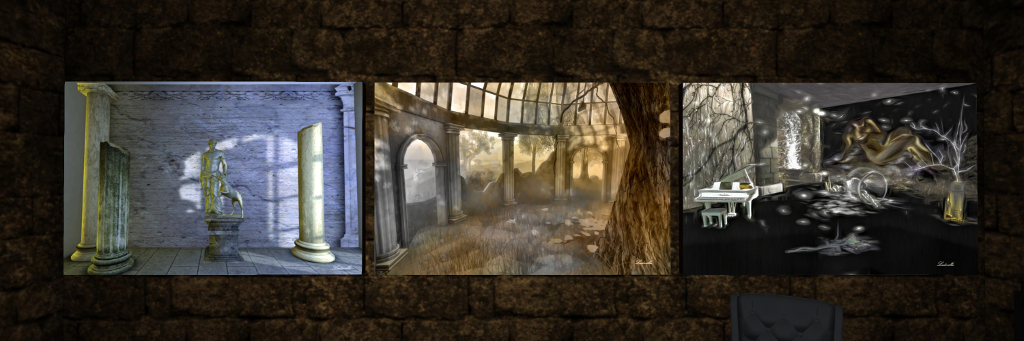
While her fractal art is perhaps the most well-known, it is not the only art Milly produces; she also works with mixed media, creating art that is both incredibly intricate and stunningly beautiful. The use of colour, coupled with the almost etching-like finish to many of the pieces brings them to life in a remarkable way. Whether floral representations, animal studies or pieces with a more fantasy edge, or presenting an image such as a portrait through the use of fractals, these pieces are utterly captivating.

Second Life has also allowed Milly to turn her hand to 3D art, producing pieces that are both practical as well as art forms, such as her hand chairs; or which is exquisite artistic statements, as with her Humanitree pieces. We’re pleased to have examples of both included within the exhibition at Holly Kai. Nor does it end there; Milly has also justly won praise for her region landscaping, notably with her winter-themed Let It Snow! designs, which she is hoping to continue in 2018.

Holly Park Gallery: Milly Sharple

Multi-talented, with a photographer’s eye for art and design, Milly presents art that is always visually captivating, and it is both an honour and delight that she accepted our invitation to exhibit at Holly Kai Gallery. To mark the opening, we will be hosting an event at the rooftop area of the Holly Kai Gallery from 15:00 SLT on Sunday, October 28th, 2018, with music provided by Joy Canadeo, and warmly invite friends of Milly, the Park and this blog, as well as all lovers of art, to attend. Formal / semi-formal dress preferred.

SLurl Details

Holly Kai Estates is rated Moderate.

Purple Leonis: Witch at DiXmiX

DiXmiX Gallery: Witch

Opening at 12:00 noon on Saturday, October 27th at DiXmiX Gallery is a special exhibition of art by Purple Leonis ONeill (Nel4481). Entitled Witch, it celebrates the mystery and mysticism of Halloween as a time of witchcraft and dark magic by recalling the story of a woman whose fate is very much tied to black magic and dark arts.

Welcome,

My name is Madeleine and I’m a witch …. well …. I was … here is my story.

Thus we are introduced to the protagonist of the story, a woman who went against her times to seek out the forbidden, to communicate with the dead, and to join with other women of like mind to found a coven.

DiXmiX Gallery: Witch

Though brief, the story colours her life sufficiently for us to track it from that first evening of temptation through until her death at the hands of local villagers. It is a story reflected in the  images arranged into the lower and upper floors of the gallery’s Grey Hall, itself decorated to presented a suitably haunting look.

The images are striking both in their richness of character, and in the manner in which they both illustrate and add subtext to Madeleine’s tale. Some show her awakening through subtle means: a seemingly gentle evening game with a cat (felines – albeit generally black ones – being the usual familiar for witches) or the innocent-looking brush of fingers over a Bible. Others are more direct: caught in a Ouija board induced trace, naked dancing around a night-time fire in the depths of a forest and – ultimately, trapped at the stake as the flames rise.

One night, everything has changed. Village men came to capture me. That night sounded my end….
Beaten, maltreated, tied up by the villagers, I was tied to the pyre of those condemned for witchcraft.

DiXmiX Gallery: Witch

With – again appropriately  – 13 images in total, the exhibition sits as both a display of art and – in a sense – a graphic novel telling Maeleine’s tale. My one small quibble with the story is the date on the tale: 1890, a time long after he period when women would be burned for the perception of their witchcraft.

Music for the opening will be provided by Miss Dee Hannaha, and given the nature of the event  – although it is not openly stated – suitable dress may will be appreciated.

SLurl Details

A taste of Andalusia in Second Life

La Frontera; Inara Pey, October 2018, on FlickrLa Frontera – click any image for full size

La Frontera, a homestead region designed by Zaffy Bailey (zaffin) and Pete (PeteSunny), opened its doors to the public recently, offering an opportunity for visitors to spend a little time in a setting inspired by Spain’s autonomous region of Andalusia.

Focusing on a terraced village setting among the steps of high, sandy hills, the region presents a simple, elegant setting visitors are invited to explore and photograph – there is an invitation to upload images to the region’s Flickr group – and to enjoy the general relaxed ambience of the village and the beach below.

La Frontera; Inara Pey, October 2018, on FlickrLa Frontera

The little village is split into two by the steps of the hill, with the landing point set in the terraza of the large part. As befitting the location, the building here are adobe-fronted, with some offering a nod towards Moorish architecture again in keeping with the inspiration for the region, while others are perhaps a little more Tuscan in styling. Bicycles are racked to one side of the fountained square, but to be honest, the cobbled and stone-stepped paths winding between and down from the village’s buildings are better followed on foot.

There are several of these paths, ranging from simple dirt tracks cut into a hill, others ancient stone steps, carefully cut and placed and suggestive that there may once have been something far older than the current houses sitting upon the hill, and still others rough stones loosely planted in the sandy soil. Each offers a route of exploration, either up or down from the terraza, making any exploration a matter of following where your muse leads.

La Frontera; Inara Pey, October 2018, on FlickrLa Frontera

Nor are the paths alone in finding a path down the hillside; a stream, rising up above the village, tumbles by way of falls, channel and sloping path down to where the sea awaits (a second waterfall drops more directly to the sea on the north side of the island). With its rushing, turbulent water crossed here and there by bridge and steps, the fast-placed stream may have, over time, played a role in helping to separate a low-lying sandbank from the rest of the land.

The home of scrub grass, a scattering of trees, wild flowers and tall reeds, the semi-circular sandbar offers a beach where a tan can be gained, and the skin cooled by either a dip is the sea or in the pools to be found on the sun-dried earth of the bank.  It is connected to the rest of the land by two humpbacked bridges that stand almost guard-like, one either flank of what might have once been a walled orangery. This appears to have once been a part of a larger formal garden, although only the flagstones of a terrace and a central water feature now remains.

La Frontera; Inara Pey, October 2018, on FlickrLa Frontera

A wooden board walk also spans the arc of water separating the sand bar from the rest of the land. Follow this and it will take you to the near-hidden secret of the region: and underground music venue. Located inside a high-ceilinged cavern, this offers plenty of space for those wishing to dance. Zaffy tells me the plan is to make this the venue Whether this will be a “formal” venue for dancing / music is unclear to me; during my visit, Zaffy was either engaged in building or AFK, as my enquiry went unanswered.

Throughout the region are plenty of opportunities to sit and appreciate the setting, from the beach, through the gardens up to the village – including up on some of the roof tops and verandahs, all the way to the highest peaks (or higher still in the case of the windmill standing well above the land to the north-east). There is also a subtle sound scape to add aural depth to the region as one wanders the paths and trails.

La Frontera; Inara Pey, October 2018, on FlickrLa Frontera

Offering uncluttered charm, plenty of opportunities for photography and perfectly suited to being seen under a variety of warmer windlight settings, La Frontera is a delight to visit, and a reminder to those of us sitting on the cusp of winter that warmer days and days in the Sun really aren’t that far away.

SLurl Details

With thanks to Shakespeare for the pointer!

Loss and life in Second Life

Nitroglobus Roof Gallery: How Isolde Got Lost

Opening on October 25th, 2018 at Nitroglobus Roof Gallery is How Isolde Got Lost, by Arete of Cyrene (AretevanCyrene). It is a complex piece, a story in 14 part;, a story in images dealing with the complex subject of love, loss and healing.

Narrative in art is not unusual; I’ve often referenced it when writing about exhibitions in these pages. But with this particular exhibition, the story is presented through the chronological order in which the pieces are presented, the start indicated by the sign The Story Begins Here, located on one of the inside walls of the gallery space, then progressing from there in a clockwise direction.

As Arete states in her liner notes, mourning is a deeply personal experience, influenced by a number of factors: our closeness to the lost one; their place within our circle of family and friends and how they react to the loss; religious and social factors, and so on. In her book On Death and DyingElisabeth Kübler-Ross outlined what she saw as the five stages of grief: denial, anger, bargaining, depression and acceptance. A sixth was later added, in the form of shock, preceding the other five. But as Arete also notes from her own experience the stages of loss can be more complex and can extend beyond just six stages.

Nitroglobus Roof Gallery: How Isolde Got Lost

In particular, the images here have not only been specifically created for the exhibition, they chart Arete’s on experience with loss (one of which also touches on Dido’s story, notably in She Found a New Home….). Nevertheless, the story here in one that is going to resonate with anyone who has suffered loss and grief.  Through them, we travel not only through the six acknowledged stages of grief, but also through the situations and actions that can both move us through them – or return us to one of them.

In this, Arete presents a simple, but forgotten fact of mourning: by labelling loss in terms of 6 “stages”, we tend to look at them as a linear progression: a series of steps from shock to acceptance by way of the other stages, all neatly in order. But the reality is, beyond shock, while we may well initially travel through the remaining stages in the order they are offered, we might also travel back to different stages of grieving. This can be as a result of a number of factors; perhaps as a result of finally packing possessions away, or clearing a closet of clothes that will no longer be worn, or simply witnessing something unexpected through the course of everyday life.

Nitroglobus Roof Gallery: How Isolde Got Lost

The healing process can also be found within the images, the return to “everyday” life; the support of family and friends; the taking up of new activities and filling the void as best we can. Given the personal nature of the images, and the nature of loss, singling out individual pieces in the series isn’t easy. However, it is the smaller, personal aspects of the story – such as Boxes – or the need to talk to the one now gone (which can be a vital part of the healing process: acknowledging that while a loved one might be physically gone, we can still keep them with us through memory as an integral part of us), that particularly struck a chord with me.

Love, listen.

To understand death, she so often talked with him to find spiritual acceptance.

Her words send to address unknown:

“Love listen, I must go on…but when I laugh, I feel guilty. When I forget you in a moment, I feel guilty. Please, try to understand, I love you and miss you so much but I have to let go of that guilt. Love listen, walk with me each day and we make that day together. Sleep with me each dark hour and share my dreams till we walk on the same soil.”

– Arete of Cyrene, How Isolde Got Lost

Nitroglobus Roof Gallery: How Isolde Got Lost

There is more here as well; the images are not only unique to this story and exhibition, they are wonderfully constructed in 3D. To see the intricate layering of this, I recommend enabling Advanced Lighting Model and setting graphics to at least High. Also, do make note that the story can also be followed through a website created by Arete, and accessed by clicking the first image in the series for a link.

An exhibition of enormous depth and message, How Isolde Got Lost is a must see. And please note that while individual image are available for sale, all proceeds will go to The Catboat in Amsterdam, the only animal sanctuary that literally floats, sited on a canal. A tip jar for the charity is also available in the gallery.

SLurl Details

The natural beauty of Cold Ash in Second Life

Cold Ash; Inara Pey, October 2018, on FlickrCold Ash – click any image for full size

Leaf (Peyton Darmoset) and Julz (Juliette Rainfall) are among my favourite region designers. Their region designs of Erebos Harbor (read more here), Cloudbreak (read more here) and Ash Falls (read more here) is among the best natural settings to be found in Second Life. So when I received an invitation to pay a visit to their latest creation, I made sure I had the opportunity to spend a fair about of time visiting, and hopped over to take a look.

Cold Ash is the in-world home for the Cold Ash brand of menswear, and the latest iteration of the region has been fabulously designed by Leaf and Julz as both the home of the store and a photogenic place to visit and appreciate.

Cold Ash; Inara Pey, October 2018, on FlickrCold Ash

Visitors arrive, appropriately, at the store itself, located towards the north-east corner of the region. This sits on a large plateau that is typical of the rugged nature of the island and resembles a large, converted warehouse. A railway track runs past the front of the store, separated from it can a broad gravel road that narrows into a winding footpath. Both the path and the railway track form an integral part of the region’s design.

Running from a tunnel on the northern extreme of the island, the tracks to where a metal framed truss bridge spans a watery gulf to reach a southern island. The gravel path gently curves its way down the slope alongside the bridge to also span the water, this time via a low-sided cement bridge, before curling up the slope of the second island, passing under the railway bridge as it does so.

Cold Ash; Inara Pey, October 2018, on FlickrCold Ash

Both track and path lead the way to a lumber yard that takes up the larger part of the second island, the land falling gently on the north side, where the trunks of felled trees lie, already stripped of their branches. Wooden steps run down the slope as well, offering a way down to the single beach running along the coast. This arcs back to another set of steps leading back up to the gravel footpath, offering a small loop around this part of the island.

Which is not to say this is all there is to see on the island. The lumber yard includes a workshop where the logs from cut trees can be cut and worked, prior to being loaded onto rail cars outside. A car workshop sits alongside the lumber shed, looking perhaps a little incongruous given there are no open roads here, but it does actually work within the setting, lending further character to the region.

Cold Ash; Inara Pey, October 2018, on FlickrCold Ash

The main island also offers routes down to the coast. The first is another winding path reached via a crossing over the railway tracks close to the store.

Two more are to be found to the water’s edge, both wooden walkways. The first commences close to the rail bridge and passes under it to reach the eastern coast. The second is hidden from view up-slope from the tracks. However, while it offers a way down to the western waters and provides a view back along the channel between the two island, it also leads to a private residence. Be aware the security orb guarding the house is on a short fuse, so keeping a distance is recommended.

Cold Ash; Inara Pey, October 2018, on FlickrCold Ash

Walk along the eastern coast of the main island, and you’ll find a little hideaway made from a converted railcar doubling as a little warehouse, a wooden porch offering a place to sit.

Carefully married with its sim surround, with a balanced soundscape and a subtle use of wildlife – such as the gulls flying between the two islands – this is another marvellous setting, richly photogenic. With the look of a coastal headland thanks to the way it joins with the surround peaks, Cold Ash is another truly eye-catching design by Leaf and Julz, one that should be visited and appreciated, whether or not you’re looking for apparel; and for the men, it offers the perfect excuse to try out new clothes while enjoying a walk around the islands.

Cold Ash; Inara Pey, October 2018, on FlickrCold Ash

SLurl Details

Blip Mumfuzz at Black Label in Second Life

Blip Mumfuzz: Photographs

Now open at the Black Label gallery is a new exhibition of art by Blip Mumfuzz.  Located in a sky gallery area reached via teleport from the gallery’s landing point, the exhibition can be found both indoors and out, within a large warehouse-like building in keeping with the gallery’s ground level facilities, on its outside walls and across the street. Also note that one of the “backdrops” to the setting is also one of Blip’s pieces.

Blip’s photography started as a means of recording her travels through Second Life in order to help her revisit them through memory. However, as she states in her liner notes for the exhibition, the focus of Blip’s images gradually shifted from capturing settings to capturing individual scenes or objects. In doing so, she started looking at potential subject from a variety of angles – and even as spaces between them to discover the stories they might offer.

Blip Mumfuzz: Photographs

I found that once I found saw something interesting I’d start moving the camera around. Looking over and under, behind and between. I began looking less at the things themselves…but at the visual and spatial relationships between things.

I am an improviser by nature…in life and in my art. My images are typically the result of an unplanned, spontaneous interaction with my environment. Some of the images in this exhibit, however, are more narrative.

– Blip Mumfuzz discussing her art

Blip Mumfuzz: Photographs

All of this is reflected throughout this exhibition, which Blip has opted to simply call Photographs.  Several are what might be called “conventional” images of places Blip has been: Ashemi Reprise, Keleland, Takeuti Town; while others are beautiful abstraction on locations, such as Kekeland Abstract 9, The Last Forever, BL Abstract and Drapes, to name but three.

It is these latter style of image, coupled with Blip’s vibrant use of colour, that perhaps tend to grab the observer’s attention, drawing the eye into them through the richness of colour and unusual perspective.  These show their location through an unusual perspective or offer a remarkable perception of space through their panoramic presentation, marking them as attention-taking pieces. However, among the bright paintings are a number that are more muted, their softer tones contrasting strongly with the bolder pieces. This gives the exhibition an added layering of effect; it is as if the brighter images are the loud extroverts at a gathering, demanding their presence is witnessed and their story heard. Meanwhile the softer toned images scattered among them come across as the introverts; they try to pass unnoticed, content to allow the other make all the noise – but their story is no less compelling when heard.

Blip Mumfuzz: Photographs

I’m not actually clear on when the exhibition closes; I assume it will be around mid-November, given it opened on October 13th. However, I do recommend taking the time to see it before then.

SLurl Details

Blip Mumfuzz at Black Label Gallery (Eternal Posession, rated; Moderate)