A November ensemble at La Maison d’Aneli

La Maison d’Aneli: Cybele Moon

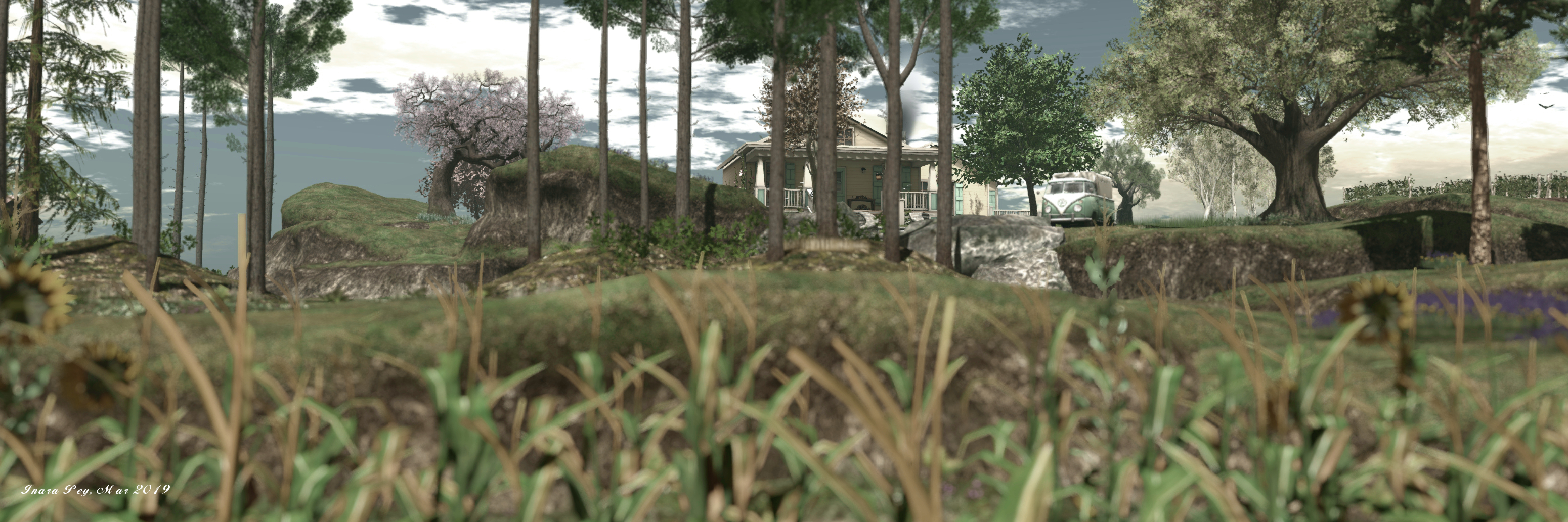
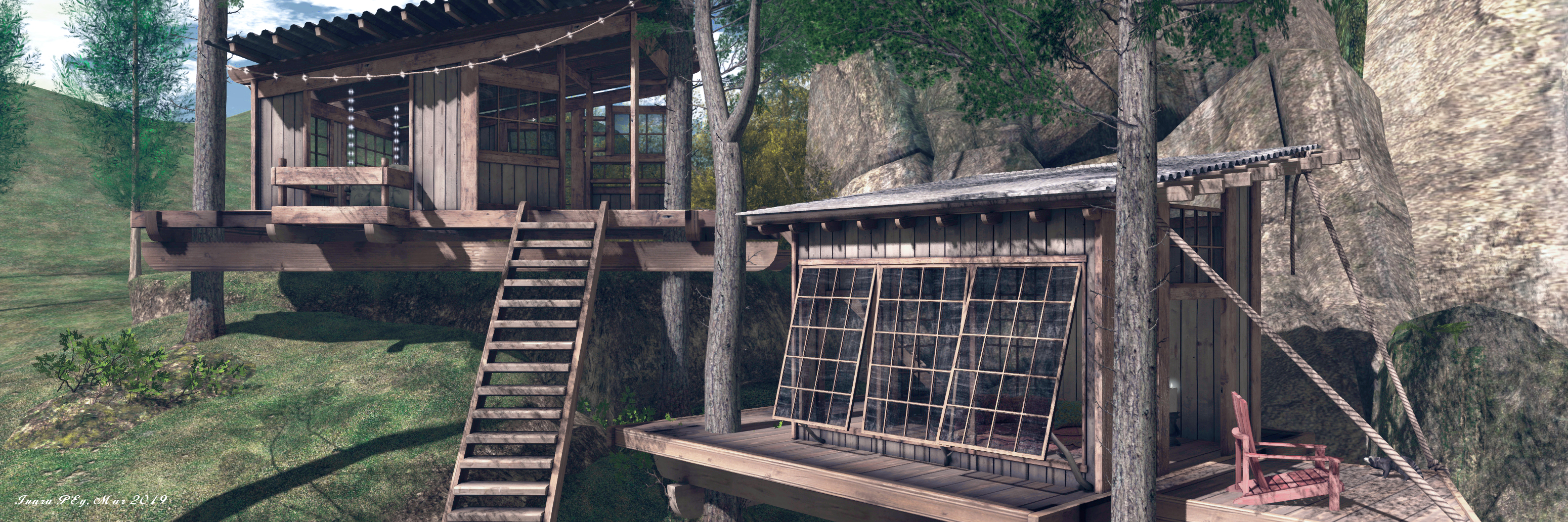
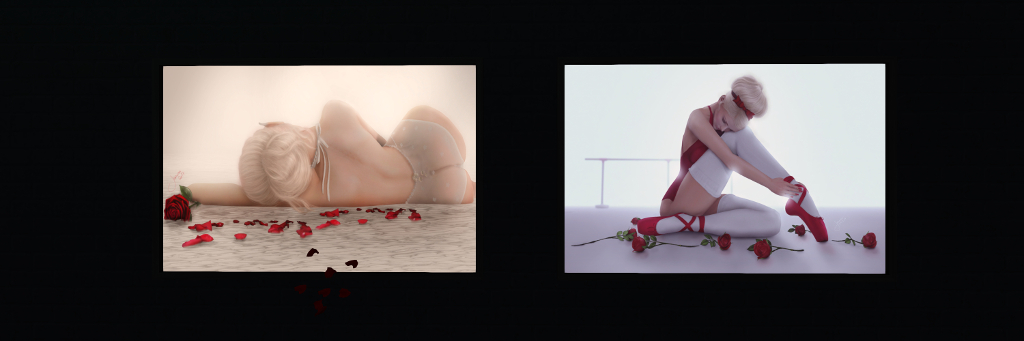
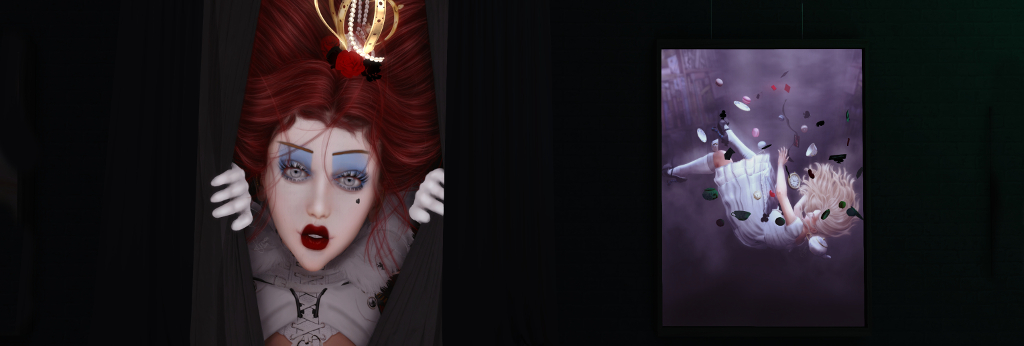
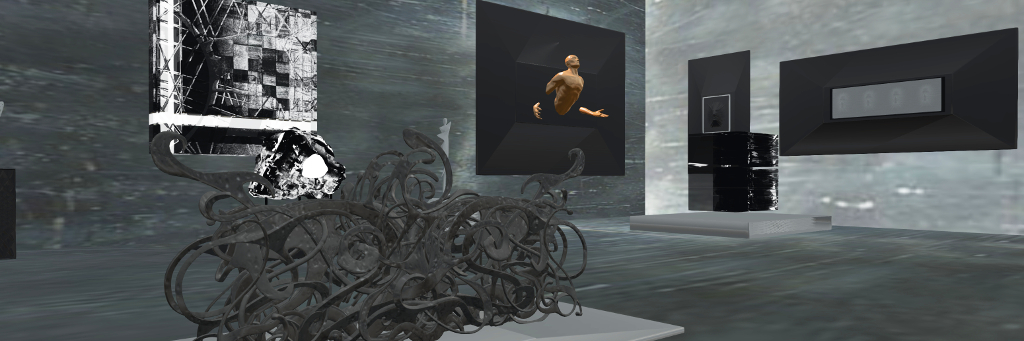
Currently open at La Maison d’Aneli Gallery, curated by Aneli Abeyante, is a new ensemble art exhibition featuring 2D artists Cybele Moon (Hana Hoobinoo), Violaine (Anadonne) and Barret Darkfold, together with 3D artists Nevereux and Rikku Yalin. This is an eclectic mix of artists, resulting in a diverse set of exhibitions, reached by taking the teleport from the gallery’s ground level lobby area.

Cybele Moon’s art should need no introduction; she is a doyenne of fantasy art / photography in Second Life, producing marvellous images that are richly ethereal, fabulously produced and each rich in its own story.  Her art within Second Life is very a reflection of her photography in the physical world, where she captures landscapes – sometimes using an infra-red camera – and produces mythical scenes of extraordinary depth and life.

La Maison d’Aneli: Cybele Moon

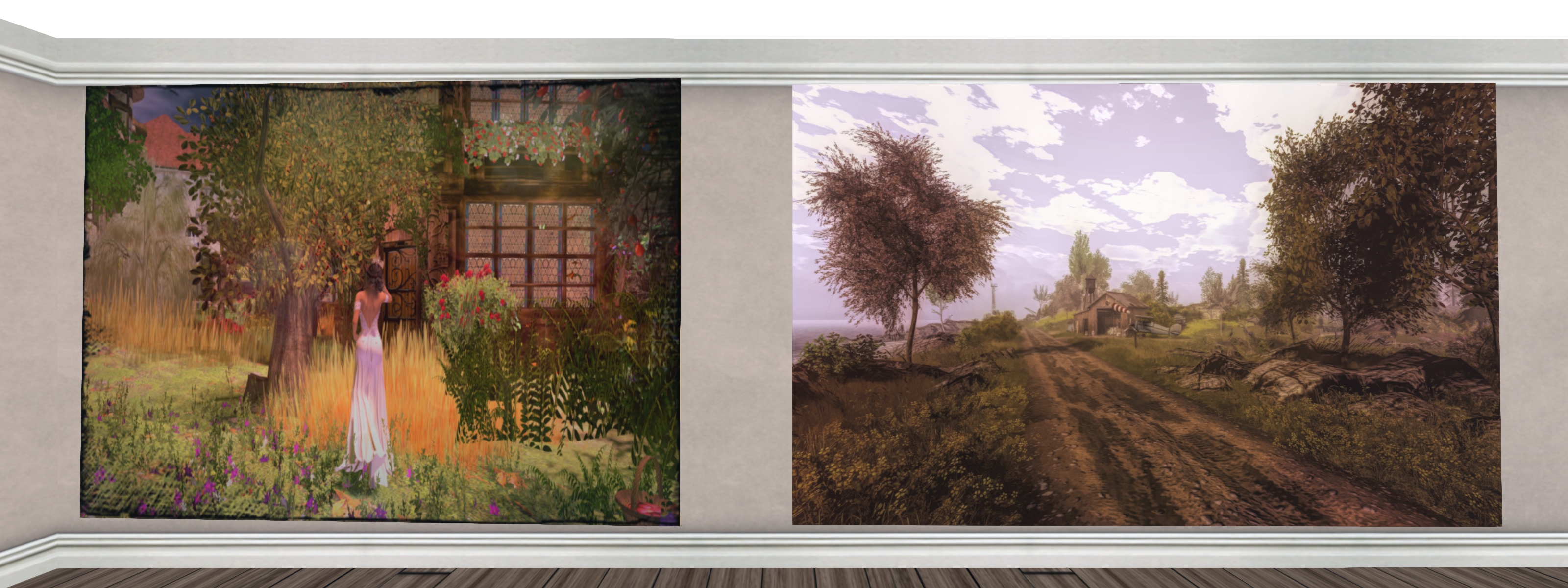
Many of the pieces she displays in-world combine the physical and virtual worlds to create wonderfully layered pictures which offer not so much a windows into narrative, but doorways into entire realms; stories often captured in words and pictures on her website, Cybele Shine. She says of her work, “I’m a time traveller who loves exploring old stones and tomes and forest groves. My dreams are filled with enchanted children and haunted woodlands,” and this is perfectly reflected in the selection of images she is displaying a La Maison d’Aneli.

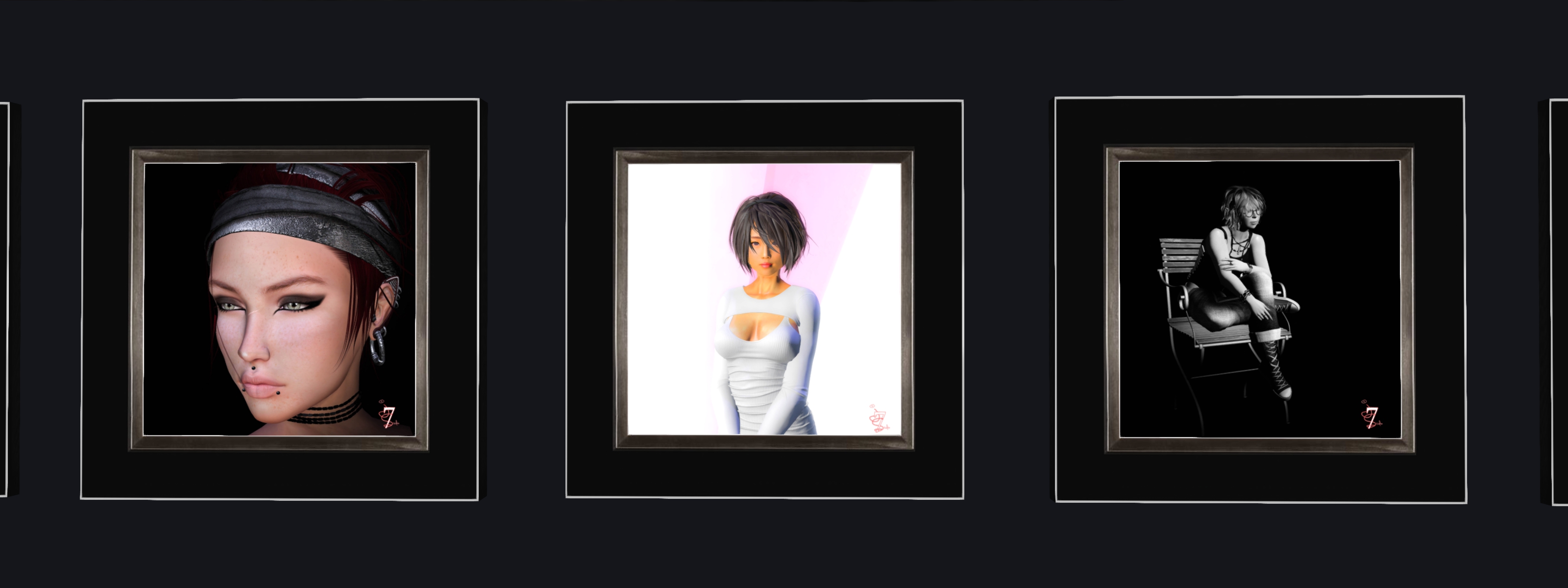
On the lower floor of the gallery are exhibitions of physical world art by Violaine and Barret, two artists I’ve not encountered before, but each with a distinctive style.

La Maison d’Aneli: Violaine

Violaine presents a mix of art and photograph (some of which touches on NSFW) grouped in deliberate sets of four, from abstracts (as with the set entitled Instants), through to deeply intimate moments (as captured within the set entitled Neighbours). Each set has its own unique attraction, be it a recollection of Warhol through Angelina, or an echo of L.S. Lowry seen in Houses.

Barret’s work is wholly abstract, featuring pieces of swirling  motion or carrying hints of linear geometry. The majority are presented a warm colours: yellow and orange with a hint of red in places, or with earthly browns and greens, although some are more earthen in colour, encompassing paler shades and tans. All hold a common bond, one with another, something than gives this exhibition an almost narrative flow as the eye pass from one images to the next and from upper row to lower.

La Maison d’Aneli: Barret Darkfold

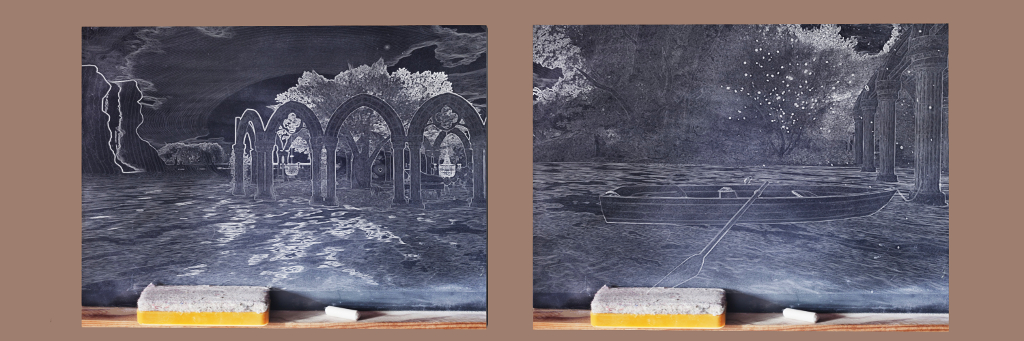
For her 3D installation, Nevereux presents Assembly Line, a piece that places the visitor inside a 3D drawing, asking a series of pointed questions as it does so. These questions, asked within a blank verse statement, encompass the nature of identity and the content of life. The art within the piece serves as an illustration of life: two-dimensional aspects: a house, a street a place of work, a children’s playground, rendered as 3D (our digital life of 0s and 1s referenced in the blank verse) by the movement, of a pencil across white surfaces (“what if we’re analogue?”).

It’s a curious piece, a little difficult to grasp, but also – perhaps – with a touch of self-effacing humour (“You can align yourself to me instructions … or you can use binoculars + an aspirin and go explore”).

La Maison d’Aneli: Nevereux

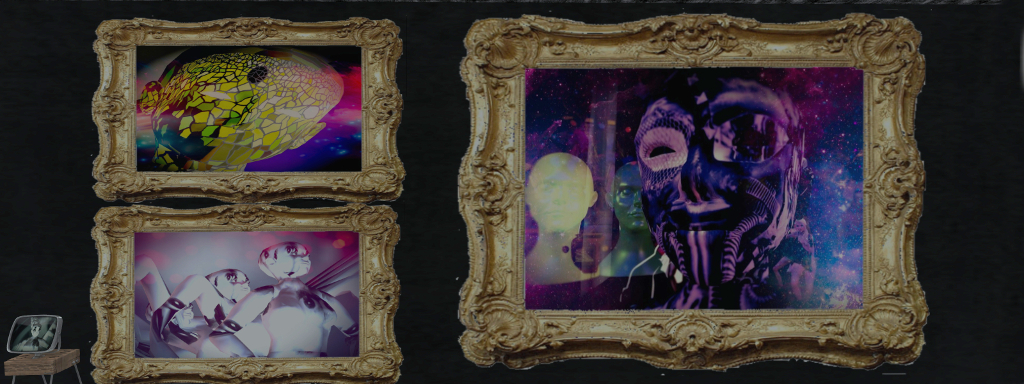
Rikku Yalin offers another curio of an installation, largely focused on 3D pieces of a decidedly mechanical bent – including a giant robot, a mechanical cat, smaller robots – all gathered around wooden couple standing as ringmaster and wife. 2D art on the walls in part continue the mechanical theme.

However, for me, the most striking piece, for all the quirkiness of the rest, is a stunning portrait of the late actor Charles Bronson. It’s a stunning piece which, aside from the moustache, could have been painted while he was on the set of Sergio Leone’s celebrated western, Once Upon A Time in the West.

La Maison d’Aneli: Rikku Yalin

Five very different displays offering five unique perspectives of art and narrative, all of which add up to one intriguing exhibition.

SLurl Details

Of Retrospect and a tango in Second Life

Ocho Tango Place; Inara Pey, October 2018, on FlickrOcho Tango Place – click any image for full size

I last wrote about Ocho Tango Place in 2015, as a part of a visit to artist Mistero Hifeng’s gallery space and store. The club and Mistero have long shared a Homestead region, and they still do; but while I’ve written about Mistero’s gallery in the intervening years, I’ve not been back to visit Ocho Tango Place since 2015.

Focusing on the tango, Ocho Tango Place is billed as a location for milonga and romance. At the time of my 2015 it sat atop a plateau above the rest of the region hosting it and Mistero’s gallery. However, whether this continued to be the case after September 2015, when both Mistero and Ocho Tango Place relocated to their current home is unclear.

Ocho Tango Place; Inara Pey, October 2018, on FlickrOcho Tango Place

What is clear is that today, both club and gallery now share a more integrated space. The latter has always used water in its design, and this continues through to the half of the region used by Ocho Tango Place, as designed by Megan Prumier and Sheerpetal Roussel, who owns the club.

Located to the east of the land, the club sits as an island of brick and stone – a former railway station – watched over by the tall figures of steel pylons silently carrying power lines. A terrace before the building offers outdoor seating, a wooden walkway reaching out over the shallow water to the landing point. A locomotive with tender and rail cars can be found at the rear of the club, venting steam as it sits on a single track.

Ocho Tango Place; Inara Pey, October 2018, on FlickrOcho Tango Place

Trees – most of them slender and birch-like – and grass mixes with the water across the rest of the setting, form  moist islands stretching to the horizon. The are broken into small groups by both clear water channels and the parallel lines of rail track as they curl around the parcel to arrive at buffers, the iron fingers of street lamps marking their route.

In the midst of this, a lone sandy hump rises bearing a denuded tree. Draped with blankets and with blankets and cushions beneath, it is one of several places people can sit and pass the time, along with the club’s terrace and upper floor. More can be found scattered across the parcel (and even higher up – check the power lines!). Further to the west is an outdoor events area lies over another low-lying sandbank offering a place for those seeking a little romantic privacy whilst dancing.

Ocho Tango Place; Inara Pey, October 2018, on FlickrOcho Tango Place

Wildlife in the area takes the form of origami flamingoes standing in the water or circling overhead, presenting a slightly surreal, but fitting aspect to the setting for those who fancy exploring it. They are balanced by a family of ducks enjoying the freedom to swim on the waters beyond the club to the east.

I’m not sure on when events are held at Ocho Tango – there is no events board available, and while there is a dedicated group for the club, it didn’t have any details of past events when I checked to offer some frame of reference. However, the audio stream carries music in keeping with the theme of the club, allowing those wishing to enjoy a dance to drop in and pass the time whenever they wish.

Ocho Tango Place; Inara Pey, October 2018, on FlickrOcho Tango Place

Coupled with Mistero’s gallery space alongside it (with TP to his store), a visit to Retrospect and Ocho Tango makes for an engaging visit, mixing art and dance together in a visually striking setting.

SLurl Details

Previewing Men in Focus in Second Life

Men In Focus

Men in Focus is a new gallery opening on Thursday, November 1st, 2018. Owned and sponsored by Men in Motion, a team of male choreographers and dancers promoting men’s mental and physical health in cooperation with the Movember Foundation. The gallery is curated by JMB Balogh, who invited me to preview the first exhibition at the gallery.

“The gallery features photography and 3D artworks of men at work or play in SL by male artists,” Jo informed me, adding, “There are hundreds of art galleries in Second Life but few, if any, that focus exclusively on the art of men.”

Men In Focus: Slayer Tanaka

The primary aim of the gallery is to showcase 2D art; however for the opening exhibition Jo has brought together both 2D and 3D artists, with works displayed across the multi-level gallery space that offers plenty of room for it to be appreciated. Those participating in this inaugural exhibition comprise:

Men In Focus: Jⓞhan Lionheart (Gemini sculpture) and Slayer Tanaka

The opening of the exhibition, set for 18:00 SLT on Thursday, November 1st, 2018, will be the kick-off event for the 2018 11-day Movember fund-raiser hosted by Men in Motion, and which will culminate in a spectacular dance show highlighting their choreography skills.

The schedule of events for the November fund-raiser comprises (at the time of writing and all time SLT):

  • Thursday, November 1st, 18:00: Men In Focus gallery opening, with music by DJ Ame
  • Friday, November 2nd: 20:00: Ladies Night with M@N
  • Saturday, November 3rd:
    • 09:00-11:00 – DJ Hanku
    • 12:00 noon-13:00 – Men In Motion dancer auction
    • 14:00-16:00 – DJ Chopper
    • 20:00-22:00 – DJ Aryanna Draken
  • Saturday, November 10th, 15:00-16:30 – Men In Motion Show
  • Sunday, November 11th, 13:00-15:00 – closing with DJ Cara.

All funds raised during the event will be donated to the Movember Foundation.

Men In Focus: Alex Avion and Kavika Lowgun

About the Movember Foundation

The Movember Foundation is a multinational charity raising awareness of, and money for, men’s health and welfare, with a focus on cancer, mental health and suicide prevention. Its titular and widely known campaign is Movember, which encourages men to grow moustaches during the month of November. The foundation partners annually with the Distinguished Gentleman’s Ride to also raise money for men’s health.

Founded in 2003, in Melbourne, Australia by Adam Garone, Travis Garone, Luke Slattery, and Justin Coghlan, the organisation attained registered charity status in 2006, and as of 2014, has raised over US $580m in charitable donations used to fund more than 800 programmes focusing on prostate cancer, testicular cancer, poor mental health, men’s health awareness and healthy lifestyles. It is active in 21 countries and has a global workforce of 130 people. In addition, Movember coincides with International Men’s Day (November 19th), which among its aims, shares the goal of promoting the health and well-being of men and boys.

SLurl and URLs

Return to a Meadow Rose in Second Life

Meadow Rose; Inara Pey, October 2018, on FlickrMeadow Rose – click any image for full size

It’s been almost 18 months since my last visit to Meadow Rose, the evocative region designed by Rye Falmer. A lot has happened since then, so a return visit has been on the cards for some time.

The biggest change is that Meadow Rose has relocated. Rye had time away from SL, so the move may have been necessitated by that, but it has given him the opportunity to expand the estate with a second Homestead region directly adjoining it, which he calls Meadow Rose Glen. Surrounded by tall off-sim mountains, and with sandy roads and tracks, both Meadow Rose and Meadow Rose Glen offer a charming, beautifully landscaped setting that will easily please the eye and camera and offer the heart a touch of romance.

Meadow Rose; Inara Pey, October 2018, on FlickrMeadow Rose

There is much about the “new” Meadow Rose that draws upon previous incarnations that make a return visit as much a delight as a first-time discovery. Like returning to a place in which happy times were once spent, the region includes elements from past builds that stir memories and give a warm feeling of familiarity, even while the overall layout of the expanded estate offers much more than was previously the case.

This is perhaps most noticeable with the main dwellings within the region. Taking a distinct Tudor lean, they perhaps initially suggest a period setting. However – as I noted when writing about my previous visit to Meadow Rose, there is more than enough evidence surrounding them to make it clear that while the buildings are period, the setting is modern.

Meadow Rose; Inara Pey, October 2018, on FlickrMeadow Rose

Meadow Rose is also a place that is distinctly Adult in theme. D/s / BDSM is part of the estate’s offerings, although by-and-large this is not so in-yer-face as to put the sensitive off. Rather the reverse, in fact: with one or two exceptions, most of the Adult aspects of social interaction here and safely tucked out-of-sight, such as in the cellars beneath the manor house.

There are other elements here that remind those who recall Meadow Rose in its previous incarnation: the deer roaming among the wild flowers, the chapel, the castle ruins, the Romany cap and the stables. Although it should be pointed out that the latter now are part of the more adult nature of the region, offering a place where equestrian activities can be enjoyed without the use of ponies of the four-legged variety.

Meadow Rose; Inara Pey, October 2018, on FlickrMeadow Rose

Water played a significant role with prior designs for Meadow Rose, and this is perfectly reflected – and expanded upon here, with both Meadow Rose and Meadow Rose Glen encompassing natural inland water features whilst Meadow Rose  also includes a little coastal mooring area and boatyard. Meadow Rose Glen, meanwhile offers a counter to the old castle ruins, an intact castle setting (which again has some D/s / BDSM undertones).

Exploring the estate really is a case of arriving and then following the dusty roads and seeing where they lead. There’s no risk of getting lost, and the roadways are laid out in such a way as to carry the visitor right around and through the estate, revealing all the little touches, all the settings, all the places for sitting, dancing and romancing along the way.

Meadow Rose; Inara Pey, October 2018, on FlickrMeadow Rose

Back when I last wrote about Meadow Rose, I mentioned that one of the most striking aspects of the design was that it felt like a visit to one of the grand estates managed by the National Trust here in the UK, noting:

That is, lands held for generations by a family, bearing all the hallmarks of their long ownership during which the passing of time gave rise to different forms of house – castle to manor, for example – but which are now maintained for the wider appreciation of the general public, their gates and doors open to visitors to enjoy them in their natural splendour.

With the estate now expanded across two regions, this is perhaps even more true with it today; there is very much as feeling that This is the setting long occupied by a landed family that may have started life here in what are now the ruins of an old castle guarding the waters leading into the bay in which the island sits before moving eastwards to the slightly higher ground where the more imposing bulk of the intact castle lies, before moving back to the centre of the land to build the grand manor house – and then spreading outward from there as the generations passed.

Meadow Rose; Inara Pey, October 2018, on FlickrMeadow Rose

Impressive in its design, appealing in its beauty, expansive in its size, Meadow Rose is a treasure to visit. Should you enjoy your visit as much as I did, please consider making a donation towards the estate’s continuance in Second Life, and perhaps also consider contributing photos to the estate’s Flickr group.

SLurl Details

In a KÖMA in Second Life

KÖMA

JadeYu Fhang has a reputation for being one of the most visually evocative artists in Second Life, her installations often plumb the depths of the human consciousness and psyche (examples: Roots and War, Everywhere and Nowhere and OpeRaAxiEty), and this is certainly the case with her latest installation, KÖMA (coma).

Billed as a “limited-time multimedia art installation”, KÖMA is at once intricate, dark, confusing, and  – perhaps ultimately – revealing.

The intricacy of the installation is apparent on arrival, as is the confusion. Panels around the sides of the region, one of them flashing and flickering slowly with individual screen-like patterns, towering high above the visitor and imparting a sense of insignificance. Clouds scurry across a void like sky, a basso rumbling filling the air. Alongside the landing point rises a strange structure, looking to be one part exotic lighting rig, two parts science-fiction drone. Screens at the base offer information on how to view the installation (in short: there’s no route or TP – you walk around the base level and level up to the upper level), while at the top is an armless female torso supporting another computer screen as its head.

KÖMA

Behind this, within the region are a set of surreal scenes. Two giant heads rise from the mirror-smooth base of the installation, a swirling mass of what appears to be rose petals caught in a frozen swirl around them to rise towards the upper platform of the installation. Supported by another of the strange devices, this platform is home to a tableau of female figures, sitting and standing amidst flicking, ghostly projections and with most facing a large screen. What appears to be filaments of lightning flashes from their eyes and arcs around some of their bodies. Below them, peculiar female forms, arms replaced by insect legs and heads by computer monitors, are arrayed while screens on the supporting device flicker with images that might be medical in nature or represent memories, while all around this scene is a further rolling booming of sound and a voice echoing a single word köma.

Central to the installation is a golden female form, apparently frozen in the act of being struck down. She is also surrounded by a pattern of rose petals, caught with filigrees of white lightning-like light, also in stasis, and few of which – perhaps tellingly – either commence or terminate in her head. On the mirror surface around her, patterns of vein-line lines drift endlessly outwards, while a close by a “rain” of flicking gold leaves falls, each one of which reveals itself to be a tiny, flicking screen when examined.

KÖMA

With the exception of the rose petals and the golden “leaves”, the majority of the installation in monochrome in nature, giving it – along with the foretelling deep booms and rumbling – giving the installation its dark edge. It is also a scene reflected in the mirror-like base I mentioned, which around the kneeling figure is disturbed by drifting patterns of red lines looking like veins of blood.

But what do we make of all this? I think the clue is in the title. Comas are a medical condition filled with a certain mystique. We know what the external physical characteristics of a coma are – but what is actually going on within the victim’s head when they are within a comatose state – so often those surviving a coma and regaining their faculties suffer from post-traumatic amnesia (PTA) which affects their recall of memories – including anything their brains may have experienced whilst comatose.

KÖMA

In this light, many elements of the installation fall into place: the figures, the flashing images of figures and faces are perhaps the flicking memories or experiences the brain plays to itself whilst otherwise seemingly unresponsive to external stimuli; the strange devices become medical tech; the rose petals become blood corpuscles, vital in their role in carrying oxygen to the brain to keep it functioning and to life as a whole; the lightening-like filaments perhaps represent the flash of electrical links between synapses, and so on. So to does the figure falling to her knees perhaps represent the victim of a sudden event – a stroke or similar – collapsing, her situation triggering a comatose state as the rest of the strange figures and the echoing rumble and boom suggest the distant intrusion of medical on the comatose mind.

When interpreted in this way, the dark tones of the installation roll back, and we find ourselves immersed in an environment intended to evoke what it might be like to step into another’s coma and witness first-hand what is going on deep within the subconscious, well away from the accepted signs of neural activity and responsiveness.

KÖMA

But that is only my interpretation. You may find KÖMA speaks to you differently. It awaits your discovery.

SLurl Details

  • KÖMA (LEA 22, rated: moderate)

Glenrosa’s tranquillity in Second Life

{ Glenrosa }; Inara Pey, October 2018, on Flickr{ Glenrosa } – click any image for full size

Update: {Glenroas} has closed. SLurl have therefore been removed from this article.

The Destination Guide led me to { Glenrosa }, a stunning Homestead region designed by Brandi Monroe and her SL partner Gabriel (gabriel4botto) which – at the time of writing – deservedly sits within the Editor’s Picks section of the DG.

It is a place specifically designed to encourage exploration; a countryside location caught in the early bloom of morning, where the rising mist drifting across unpaved paths and between wooded hills gives a siren call for us to eat a warm breakfast, don thick coats and hiking boots and set forth before the Sun gets too high above the horizon. The region description adds to this call, inviting visitors to “set off down the winding road or take the shoreline,” and noting that whichever route is taken, surprises await discovery.

{ Glenrosa }; Inara Pey, October 2018, on Flickr{ Glenrosa }

The winding road in question lies close to the region’s given landing point, located just above the shoreline on the north coast. Two dry stone walls cup the landing point within their arc, the shingle coastline presenting a view of the broad, flat sea watched over by a squat off-shore lighthouse just away to the east, framed by the rising Sun.

The two dry stone walls are prevented from touching one another by the tall pillars that between them support wrought iron gates guarding the road. The stone stags atop the pillars, together with the region’s name, give the impression this is some landed estate, with the overall ambience of the setting giving me the feeling I could be somewhere in the remoter parts of Scotland – although admittedly, banyan trees aren’t typically found in Scotland.

{ Glenrosa }; Inara Pey, October 2018, on Flickr{ Glenrosa }

This feeling was heightened during my wanderings by the discovery of a single-track railway line running the short distance from a tunnel to a set of buffers, passing a small country station along the way. Clearly a spur line, it is not hard to imagine a small regional train – perhaps a privately owned steamer – pulling into the station with one or two vintage rail cars, so that visitors might alight and explore before the train reverses its way back down the track.

The feeling that this is – or once was – a private estate is further heightened by the presence of a grand hunting lodge at the end of the road leading up from the landing point. Furnished throughout, the Lodge shares the setting with a small chapel a short distance away, atop a  rocky hill. No longer used as a place of worship, the chapel is surrounded by gravestones, giving the impression it may have once been a family chapel and burial plot.

{ Glenrosa }; Inara Pey, October 2018, on Flickr{ Glenrosa }

The house can also be reached along the coast, following the shingle beach towards the Sun and where it broadens alongside the lighthouse before turning south. Along the way, it passes steps leading up to the chapel and one of the surprises in the region: a grand piano sitting under the banyan tree; one of several places where time can be spent in quiet contemplation.

More such places can be found scattered across the landscape, from a little deck built out over the cold-looking waters close to the lodge, to up over the train tunnel, where a little vagabond camp has been set up. This is reached by way of a small house overlooking the railway line on one side, and out across the fir trees and rocky hills of the estate on the other. Down the slope from this little house, possibly once cared for by whoever many have at one time lived in it, is an orchard, still very much being cultivated, although the house itself no longer appears to be a working home.

{ Glenrosa }; Inara Pey, October 2018, on Flickr{ Glenrosa }

A cinder track continues beyond the beach behind the main house, arcing slightly up and away from the coast before dropping back to rejoin the shingles. It leads the way to where part of the land has been flooded to form a natural inlet, its narrow neck spanned by an old bridge. Here the setting, with reeds and trees growing from the water and the wooden shack to one side, is perhaps more mindful of a Louisiana swamp than a place sitting somewhere on the Scottish  coast – but it still feels very much a part of the overall landscape, and it offers more places to sit and spend time in the region.

Caught by the rising Sun, { Glenrosa } also lends itself to other daytime windlights – although for once I’ve tended to keep to the default in the images here. Those who do take photos are invited to add them to the region’s Flickr group, and there is more than enough here to keep anyone’s camera busy.

{ Glenrosa }; Inara Pey, October 2018, on Flickr{ Glenrosa }

Although sitting within a sim surround, I confess I found the rolling, rocky landscape dominated by fir trees, to be more attractive with it derendered to present a more coast-like setting (although just having one side of the region open to water would have really done the trick). Nevertheless, with its gently undulating landscape, this is a place of beauty rounded-out by a gentle soundscape and is definitely not a destination to be missed.