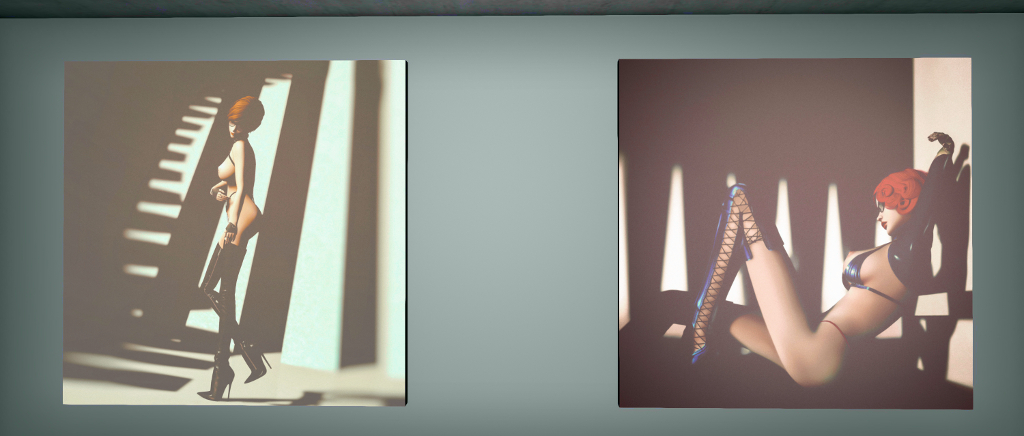
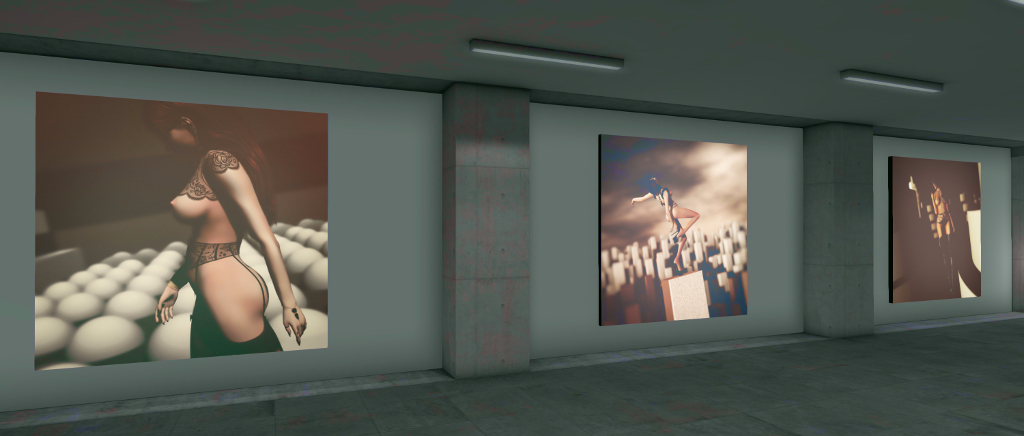
Megan Prumier has been a presence at DiXmiX Gallery since it opened. She is responsible for the galleries’ overall look, some of her work has often been a subtle presence in the gallery. However for December 2018, she takes centre stage at the gallery with a major exhibition of her photography.
Moments of Intimacy is located in the Gallery’s lower floor Black exhibition hall. It is somewhat NSFW exhibition featuring nudity, but this should not overshadow the fact that it is captivating in tone and presentation.
Some 17 images are present, all self-studies. Each presents a combination of a moment, a mood, an emotion, and / or a feeling – or some combination of these elements. In using just a single character in each piece, Megan presents a series of great personal depth; we are not so much viewing images as sharing in a particular moment of intimacy – be it happy, sad, introverted or extroverted. In this, the nudity / potential erotic nature of any given image runs somewhat secondary to the story it has to tell.
Taken on its own, this is a remarkable exhibit, one that draws the viewer into the pieces on offer with great subtleness. When taken with Kimeu Korg’s Osmosis De Un Sueño, displayed on the mezzanine level (and which you can read about here), Moments of Intimacy has perhaps the perfect partnership.
While the two artists are very different in tone and style, and yet they complement one another perfectly in the way in which both resonate at the emotional / mood level. As such, and even if you’ve previously seen Kimeu’s exhibition, I strongly recommend taking the time to see both side-by-side whilst they are both on display.
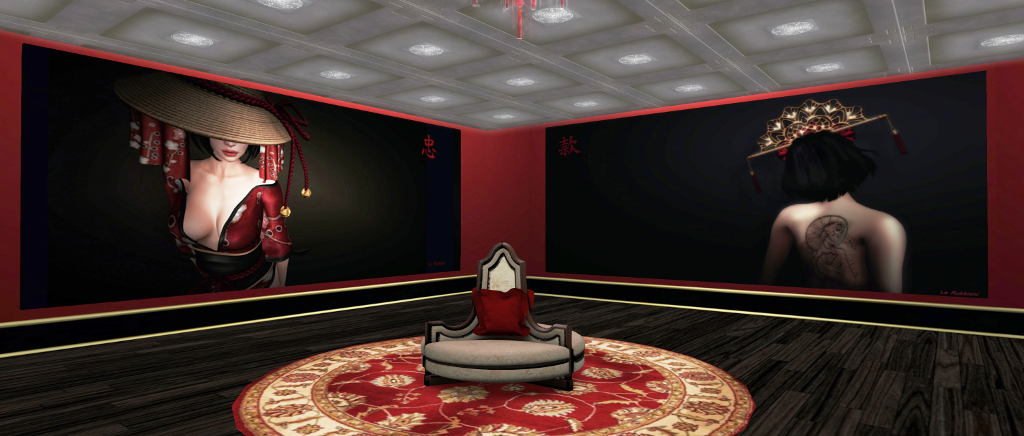
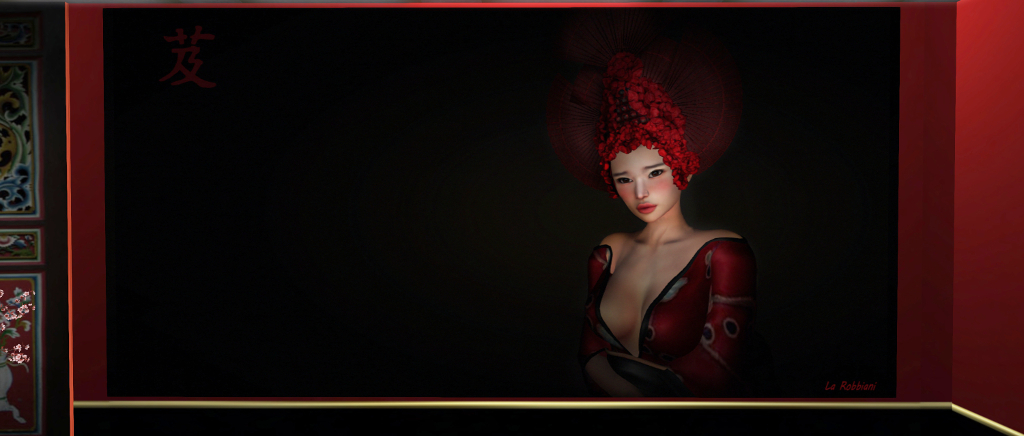
Now open at Club LA and Gallery, curated by Fuyuko ‘冬子’ Amano (Wintergeist), are two small exhibitions by Eviana (eviana Robbiani) – under the name La Robbinani – and Wintergeist herself.
For her exhibition, La Robbiani uses the theme of Shoshin (初心) – the idea of separating yourself from all preconceptions when studying a subject -, and of being open to all ideas in an attempt to avoid becoming trapped in a closed loop of thinking and missing everything a lesson my have to teach us.
It’s a concept that has its basis in Zen Buddhism and Japanese martial arts – although it can be applied to almost any subject. For her exhibition, La Robbiani uses it to encourage the observer to come to each of the six images she displays with fresh eyes and to avoid any preconceptions about their nature clouding our ability to see them as they are.
This actually makes reviewing this exhibition, beautifully presented within and Oriental structure (perhaps more Chinese than Japanese), a little hard: anything I say here is liable to result n readers visiting the exhibit to enter it with at least some preconception. But – that’s why it is important to keep the idea of Shoshin at the forefront of any thoughts about the exhibition on entering.
What I will say is that each of the six studies are beautifully presented, each with its own theme – but again more Chinese in nature that Japanese. A couple of them should perhaps be considered as NSFW as they contain a degree of nudity, but all six should be considered both individually and in the context of its title.
Also located on the ground floor of the gallery is Wintergeist’s own exhibition.
Comprising twelve images, both easels and wall mounted, this is an exhibition that demonstrates the full beauty of her work; they cover landscape images and avatar studies presented in both colour and black and white. Some have admittedly been previously exhibited, but this doesn’t lessen the fact that all of them speak to the art and craft of a gifted photographer and artist.
Taken with the exhibition by oYo (Oyona), which continues on the gallery’s mezzanine level (and which you can read about here), these make for a further engaging visit to Club LA and Gallery.
In September 2018, I wrote about the Rainbow Painters Art Gallery. Curated by Timo Dumpling and Patience Dumpling (patience Roxley), the gallery offers free space to artists both new to exhibiting their work in Second Life and those who are established on the exhibition circuit.
The open nature of the gallery means that it presents a broad range of art, both from within Second Life and from the physical world, with the Second Life art encompassing both 2D and 3D work.
At the time of my second visit, the gallery featured another broad spectrum of art, including 3D work of reycharles, the physical world art of Moya Patrick (Moya Janus – actually French artist Patrick Moya), the physical world photography of Black Rose, the marvellous mixed-media portraiture of Cybele Moon (hana Hoobinoo), the fabulous nature photography of Anibrm Jung, the surreal art of Tani Thor, and Monroe Snook, displaying some of her fractal art.
These artists alone make a trip to the gallery, however, they are also joined by a number of artists I’ve not previously encountered, and their work adds further depth to a visit.
There is the fascinating physical world art of Pure Lovee, for example, or the line drawings of Viktor Savior (which includes a stunning portrait of David Bowie), to name but two of the talents on display. Of them all, I confess to being particularly drawn to the two pieces offered by Siobhán Muintir (Qorell); taken from within Second Life, they are in a world, beautiful.
Those wishing to add their art to that being displayed at Rainbow Painters should contact either Timo or Patience in-world. As I noted in September, the gallery shares a quarter-region with an open-air games area (table games and 10-pin bowling) and dance / events space. Join the local Rainbow Painters group for details of local events.
Saturday, November 24th saw the opening of a new exhibition at DiXmiX Gallery, curated by Dixmix Source. Osmosis De Un Sueño: The Return sees Kimeu Korg return for the second part of an exhibition first witnessed in June 2018 (read here for more), moving to the White Gallery at DiXmiX this time around.
Kimeu is perhaps Second Life’s artist most rooted in surrealism in the presentation of his work, which can easily equal the likes of Max Ernst and René Magritte. Sometimes blending in-world images with elements from the physical world, for this part of Osmosis De Un Sueño, he presents pieces firmly produced in-world, several of which include his sense of whimsy, others of which present a more pointed expression.
This part of the exhibition offers a baker’s dozen of images to b appreciated. I don’t usually ascribe an order in which to view an exhibition unless the artist has indicated one, but with Osmosis De Un Sueño: The Return, I would recommend starting a visit by taking the steps closest to the gallery’s main entrance up to the mezzanine level White Gallery.
Doing so will take you past Look and Retrato Equestre (Equestrian Portrait) into the core of Kimeu’s exhibition, allowing the full richest of his surrealist approach come to the fore, peppered in places with his sense of humour – and his ability to question norms, as with the subtle Prisoner, beautifully layered in potential meaning as it is, despite Kimeu’s disarming claim about his work.
Given the preponderance of skeletons in the pieces, one might think there is a little touch of post-Halloween in the exhibit, but to me these are in some way a lead up to what I consider to be the last piece in the exhibition – or at least, the one I would recommend coming to last of all, sitting above the entrance to the gallery’s events venue, The Atom.
Entitled Blind Obedience, it is a sobering piece, one which in the toxic political environment prevalent in parts of the world today, perhaps bears a special meaning and / or warning. Such is the imagery used, it sits well apart from the rest as it makes an extraordinarily strong statement, one given added impact by viewing it last of all (and the reason I’m not reproducing it here – it should be seen first-hand).
Another remarkable exhibition by one of Second Life’s most remarkable artists, and one that should not be missed as it remains open through until at least late December 2018.
They do so by bringing together artists, galleries, event organisers, musicians and speakers in a multi-faceted, art-centric season intended to focus on the levels of physical, sexual and psychological violence that are specifically directed towards women and girls around the globe, and raise awareness of the need to put an end to what is one of the most widespread, persistent and devastating human rights violations in our world today.
Some of the facts surrounding violence against women are horrifying:
1 in 3 women and girls experience physical or sexual violence in their lifetime, most frequently by an intimate partner.
1 in 2 women killed worldwide were killed by their partners or family in 2012; while only 1 out of 20 men were killed under similar circumstances.
Only 52% of women married or in a union freely make their own decisions about sexual relations, contraceptive use and health care.
Worldwide, almost 750 million women and girls alive today were married before their 18th birthday, and often in force / arranged marriages, including in countries such as the United States where between 2000 and 2010, more than 167,000 children — almost all of them girls, some as young 12 — were married in 38 states, mostly to men 18 or older
While 200 million women and girls have undergone female genital mutilation (FGM).
71% of all human trafficking victims worldwide are women and girls, and 3 out of 4 of these women and girls are sexually exploited.
For 2018, 2Lei is presenting No Violence, an installation that brings together some 73 artists from across Second Life, as well as offering a range of daily presentations and music events, details of which can be found on the 2Lei blog, or via the note cards provided at the installation’s central landing point.
As with the 2017 event, No Violence is one of the more involved art installations I’ve visited in Second Life. The core of the installation is spread across three levels, starting at ground level in the region and connected by spiral staircases. In addition, teleport stones at the landing point provided access to My Name is #25 / A Wrong Party, by Storie’s Helendale (glitterprincess.destiny). Others may also involve teleport elements, so careful exploration is recommended.
Such is the size of this installation, and the message it contains, a single visit is perhaps not the most ideal way in which to appreciate all that is presented by No Violence. Simply put, there is a real risk of visual and / or emotional overload that could leave one numbed to the core message.
Hence the use of daily events, both presentations and musical. These allow visitors to break up time within the region over numerous days – not necessarily back-to-back – and perhaps focus their attention on two or three of the individual displays and installations at a time. And even if you’re not drawn the any of the live events, breaking your visit down in a similar manner may still help both with appreciation of the art offered within No Violence and it’s central, and important message.
Installations vary in form: some are static, some are interactive, several – such as My Name is #25 / A Wrong Party – are narrative in nature. Information plaques are placed with each, offering background and depth to pieces, as well as providing information on the artist responsible. Some, as with Betty Tureaud’s The Book Keeper Says, offer links to practical advice for those who may be the victims of violence and abuse (in this installation’s case, domestic violence / abuse).
No Violence will remain open through until the end of 2018, with the list of supporting events for December still apparently in development at the time of writing this review, so be sure to keep an eye on the 2Lei website, in-world group and other resources.
Monroe Snook has a new home for her art, courtesy of Milly Sharple. Called the Art Bistro, it offers an impressive insight into Monroe’s art, both from the physical world and from within SL.
Art expression for me is in the experience of the creative process. The thrill of a piece as it unveils itself as I work. The process can be slow and tedious or a quick snap. The work is in command – I am but its servant.
Monroe’s physical art is a fascinating blend of nature and abstract; wonderful plant-like creations, some mindful of sea anemones or even triffids, others organic forms of fractal images. There is a rich vibrancy on the use of colours in these images that adds depth to the feeling they are each alive, whether plant-like in form or more crustacean in shape and feel.
Within her photography, Monroe demonstrates an equally rich ability to present mood or narrative – so much so, that I actually regretted finding three example of her photographic work on display in the gallery space.
Art expression for the viewer is in the interaction with the completed work. Spend time to get to know a work. Make [it] yours. Listen to its song.
This is a selection of pieces that also demonstrate the richness of Monroe’s approach to her art: and approach that encompasses paints and brushes, scans of objects, original sketches, digital art tools such as fractal generation programs and tools like Photoshop.
All told, a welcome return to exhibiting her art from a talented artist.