Just how bad is a 650-region loss?

Last week an article appeared in New World Notes (NWN) which seemed intent on giving the impression that Second Life is in a state of terminal decline. The headline proclaimed: “Second Life Has Lost Over 650 Sims & $1 Million in Yearly Revenue in 2011; This is Why SL Can’t Survive as a Niche”, followed by a comment that, “The only future for Second Life is several millions of users, or none at all”.

Provocative reading perhaps; but how reasonable is it to make such assertions?

Well, first and foremost, I don’t dispute the figures in terms of region losses or potential revenue drop. They’ve been taken from Tyche Shepherd’s excellent Grid Surveys, which week-by-week look at the overall status of the grid in terms of regions, private and mainland. Rather, I tend to find the conclusions the author draws from Tyche’s figures to be somewhat questionable.

The Ebb and Flow of the Statistical Tide

Let’s try to put things in a little perspective, starting with two points in particular:

  • 650 regions is around 2.6% of the total land mass
  • Linden Lab has an inward flow of revenue of some $75 million a year. As such, $1 million amounts to a 1.3% drop in that revenue. All things considered (economic climate, etc.), that’s not an horrendous drop.

Now let’s take a look back at private regions in SL over the last three years (a not unreasonable time-frame in business terms).

  • 2009:
    • Jan-May SL suffered a loss of 1095 private estates during the first 5 months (from 22406 to 21311); no doubt fuelled in part by the OpenSpace fiasco
    • June-December: SL grew to 24033 private estates, an increase of 1627 regions over the start-of-year
  • In 2010:
    • SL grew by 6% overall in terms of regions
    • 44% of this growth lay in private regions, representing an overall growth of  3% for private regions
  • In 2011:
    • Jan-Aug: 2.6% loss of private estates
    • A potential 3.9% loss by year-end.

In other words, in 2009, private regions on the Grid grew by some 7.26% over the start-of-year figure, despite an initial loss of some 4.88%. In 2010 it grew by a further 3% in private regions.

So while a current 2.6% drop is cause for some concern – it’s not yet drastic. Even if the shrinkage continues through to the year-end (as seems likely, given Tyche’s latest figures), and yields a potential 3.9% drop in private regions, the situation still would not be terminal.

Recession does Nasty Things

There is another factor to consider here. Right now, we’re in the midst of a prolonged global economic downturn. The longer it goes on, the deeper it bites into people’s disposable income. A prudent observer of the current decline in private regions in SL would consider it possible – likely, even – that the recession is responsible for at least some of the shrinkage we are currently seeing. One sees little sign of this in the NWN article.

But downturns don’t last forever (or if this one does, we’ll all have a lot more to worry about than Second Life). Therefore (and while past performance may not always be indicative of future growth), it is no unreasonable to suggest that once the economy does start to improve, people will again have more disposable income they can put towards Second Life, and this is likely to result in an improved demand for land as a result and at least slow – if not reverse – the current trend in private region losses.

Alternatives

Nor do Linden Lab need to convert anywhere near 400,000 users to Premium membership in order to recoup falling land tier income (even should this be necessary), as the NWN article also dramatically suggests.

Right now, Linden Lab generates some 20% of its income – $15 million – through non-land related activities. As such, it only needs to increase that $15 million revenue by some 10% to help offset the losses experienced to date – a not impossible figure.

There have already been a couple of small moves in this direction; we’ve seen the introduction of upload fees charged for mesh imports and a push to generate more Premium memberships. While the former might not have a significant impact in the scheme of things, the same is not necessarily true of the latter. Were Linden Lab to offer a Premium membership package that gave clear and significant benefits to those already engaged in Second Life (rather than just new users, as seems to be the case with the current offering), then the potential uptake could be significant – and relatively rapid.

Beyond this is the fact that Linden Lab doesn’t necessarily have to look at Second Life to recoup “lost” revenue. The company is shortly to launch new products into the marketplace. While details have yet to be released, it is unlikely Linden Lab will do so without the means to leverage them into revenue.

True, the results may not be immediate (depending on how these new products are to be monetized and how they are received by the world at large). However, that the company is launching new products means that it will be less dependent solely on Second Life for revenue. An optimist might even speculate that as a result, Linden Lab might have a greater degree of freedom to better restructure / improve the Second Life platform.

Nor should these products be classified (/dismissed?) as some form of “SL Light”, again as New World Notes suggested.* To quote Rod Humble himself in reference to this idea: “I never said a lite version. I said and I mean new products which are in the area of shared creative spaces. or social creative tools or user-created virtual worlds/places if you prefer”.

Where is Everybody?

Truth be told, there is one figure that gives continued cause for concern for many within Second Life – and it is not region counts; it’s user concurrency. This has been in a steady state of decline for the last three years. In her end-of-year summary in 2010, Tyche Shepherd estimated that SL’s average concurrency levels equated to just 1.57 avatars per region. That’s an awful lot of empty space.

Now to be fair, the New World Notes article I refer to at the top of this piece does indicate that Linden Lab needs to do more to get people involved in Second Life – even if it does over-egg things by putting the figure in the “millions”. And keeping on the side of fairness, Linden Lab have themselves indicated that they are working on the means to get people directly involved in in-world activities (i.e. content creation, engaging in the economy as consumers, etc.) a lot sooner than is currently the case. However, one has to admit that it would be nice to see some practical outworking of these ideas before the year’s end. Even a gentle increase in user concurrency that can be sustained for more than a few months would be good news for just about everyone involved in SL.

Niche isn’t Bad

Finally, and in turning to the claim that SL cannot survive as a niche, one has to ask, “Why not?”. The fact is that Second Life has survived for some 10 years as niche product, and has managed to generate a tidy revenue stream for Linden Lab that has made them “Very profitable”, to use Rod Humble’s words, in the process. Get the flow of people into SL right and the mechanisms of engagement in place, and there is no reason why it cannot continue to do so and enjoy practical growth.

This is not to say that things won’t have to change in time; the reality is that Second Life and Linden Lab will be facing challenges in the coming years that may yet force significant changes to aspects of how things are run (such as, ironically, land tier). However, these needn’t necessarily be negative – although they will need to be planned for and carefully executed.

And what is so bad about being niche anyway? Many a company and product have enjoyed long and fiscally healthy times being precisely that.

—–

*Hamlet has pointed out that his article drew the distinction between any new products and SL; as such, I’ve amended this piece and apologise for any upset caused.
The simple guide to Age Verification

Update July 10, 2012: This article is now out-of-date as a result of Linden Lab changing the Age Verification Process. For updated information, please refer to this blog post. 

Back in July of this year, I reported on Linden Lab’s overhaul of the Age Verification process (and the small part I may have played in the thinking around it – pardon the horn toot).

It would appear that either people are continuing to avoid verifying themselves (hardly surprising given Linden Lab didn’t actually, well, tell anyone about the changes) or are unaware of any reason why they might want to verify themselves. As a result, Linden Lab are, some time in the next two weeks, going to be e-mailing all those using SL who are over the age of 18 to advise them of the Age Verification process and what it means.

If you’ve not already age verified and wish to gain access to all of Second Life (assuming you are over 18) and get ahead of Linden lab’s mail-out. Here’s how:

  • Log on to http://www.secondlife.com. This will display your Dashboard
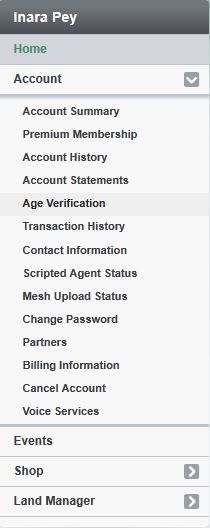
  • On the left of the Dashboard is a panel with your name at the top. In this panel are a number of options: ACCOUNT, EVENT, etc.
  • Click on ACCOUNT. This will expand a list of account-related options
  • Locate the AGE VERIFICATION option on the drop-down list (highlighted, right) and click on it
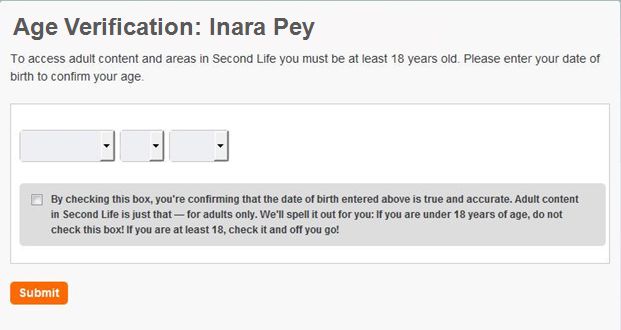
  • You will be taken to the age verification page.

The Age Verification page will display a form requesting that you confirm your date of birth (as given when you signed-up for Second Life. If, for any reason your date of birth is incorrect or doesn’t display, you can select the month, day, year by clicking the appropriate arrow button and making a selection for each from a drop-down list.

To confirm your age, make sure you click on the confirmatory check box, then click on SUBMIT. That’s it.

You’ll be taken to a page confirming you’ve been age verified with the message, “You now have access to Adult-rated areas in Second Life! time to explore. Have a great time!”, together with information on how to update your Viewer’s maturity preferences and a link to the Destination Guide.

Maturity settings are generally found under the GENERAL tab of a Viewer’s preferences, and should be set to General, Moderate, Adult (Viewer 3.x & TPVs) or PG, Mature, Adult (Viewer 1.x TPVs) to get the full benefit from Search.

New season of Designing Worlds

Today at 14:00 SLT, Saffia Widdershins and Elrik Merlin return to Treet TV with a new season of Designing Worlds.

Says Elrik: “We have a great line-up of shows for you this season…we have some exciting new destinations lined up”.

Saffia adds, “We’re going to be visiting some old friends to see how their places have changed and expanded since we were last there”.

So make a date for Designing Worlds, Mondays at 14:00 SLT on Treet TV.

New movement option for SL

Nalates Urriah keeps her finger on the pulse of what is happening on the technical side of Second Life, reporting on a range of weekly User Group and other meetings held in-world.

This week, she reports on an interesting new scripting function Falcon Linden is working on.

llSetKeyframedAnimation() is designed to allow objects to be moved through a non-physical link set. The function should allow a range of objects to achieve smooth movement, and will allow avatars to stand / sit on objects as they move. As such, the function should be ideal for the likes of trains and elevators to run smoothly along their tracks / up and down elevator shafts.

Going up? Smoother elevators on their way (among other things!)

There are some animation issues, however – notably when walking on an object using the function, an avatar’s animation will get a little messy. The function also must use the Prim Equivalency system and come in at under a physics weight of 64.

Nalates reports that the new function should soon be working on two regions on the Beta grid and that Falcon will post to the wiki page (linked to above) when the regions are supporting it. Those testing the function are asked to include the function name in the title of any JIRA they raise.

With thanks to Nalates Urriah

SL “Showstopper” bug: Updating worn attachments breaks content

The server roll-out of the 13th September introduced a new and unexpected bug into the grid, as defined in JIRA SVC-7283:

“Attempting to issue llRemoteLoadScriptPin() on a non-full perm script to a worn/attached object fails with “Unable to add item” error message. If there was an existing script with the same name in the destination object, that script is deleted, often resulting in the items being made completely useless.

“A similar error occurs when using llGiveInventory() on a no-transfer item to a worn/attached object. In this case, the error message is “Unable to give inventory: ‘Destination did not accept'”.”

Simply put, this means that at present, attempting to update worn objects runs the risk of breaking them completely.

The JIRA is currently assigned to WorkingOnIt Linden, which means it is being investigated – indeed, Maestro Linden has commented on the JIRA, and has confirmed the bugs. He’s even offered some well-meaning advice:

“The workaround for updaters that affect attachments such as HUDs is to first drop the attachment or detach it and rez it on the ground before using the updater.”

However, this doesn’t help in all cases – particularly those using RLV items which they may not be able to remove; there are also those update systems that rely on the object being worn.

What is more worrying, however, is the seemingly casual response from Linden Lab to the issue. There has been no official indication to content creators that there is a potentially major bug impacting their items – people are being left to hear about things via word-of mouth.

Nor does the Lab – via Oskar Linden – seem all that concerned about getting a fix for the problem out sooner rather than later. Commenting on the JIRA, Oskar Linden states:

“We have traced the cause of SVC-7283 to a security fix around permissions. Due to the urgency of the security issue, we deployed the fix to all channels of the grid at once. Unfortunately, we cannot ‘roll back’ the change at this point, since doing so would compromise permissions across the grid. We are working on a fix for SVC-7283 – we hope to deploy the fix to an RC channel next week. We apologize for the inconvenience and problems with update scripts which are caused by this bug.”

So a potentially significant bug has been introduced right across the grid – and Linden Lab hope to get a fix out to 10% of the grid next week. Does this mean that if successful, the fix will be held over a further week prior to being rolled out to the remaining RC channels and the rest of the grid?

If so, it is wholly unacceptable.

The bug was apparently introduced as a result of a fix being pushed out without sufficient regression testing. Fair enough; however, if this can be done with a security fix – and given Linden Lab have successfully recreated the bugs through Maestro Linden’s tests  – then frankly the normal release cycle should be foreshortened as far as possible:

  • The fix should be coded
  • The code should be tested for potential impact
  • The code should be *immediately* release to an RC channel and baked for 24 hours on that channel
  • If no significant impacts / bugs found as a result of the RC test, the code should immediately be rolled out to the rest of the grid.

And I sincerely hope that this is what Linden Lab will be aiming for. If they are – then we need a clearer statement of intent than Oskar is giving.

In the meantime, one would hope Linden Lab would at least take the issue by the horns and for once communicate the problem with their users, rather than leaving it to people to stumble upon it through either word-of-mouth or through actually encountering an update failure.

Updates

15th September

Maestro Linden reports on SVC-7283:

“We have a fix for this bug that looks promising, which is currently on Aditi (the ‘Beta grid’). The fix version right now is thermonuclear 11.09.14.240803. You can find this version on a handful of Aditi regions; I’ve been testing in the region ‘Pixelpark’, which has a large sandbox area.

“With this fixed version, llGiveInventory() and llRemoteLoadScriptPin() should be able to deliver (no-copy or no-trans) items to worn attachments as long as the attachment’s owner permissions (in terms of copy and transfer) don’t exceed the owner permissions of the item.

“The following 2 cases are still blocked, however, for security reasons:

  • “Adding a no-transfer item to a worn attachment which is transferable
  • “Adding a no-copy item to a worn attachment which is copyable

“These cases might be fixed in a future project, but first the server will need to support dynamic updating of worn attachments’ permissions.”

17th September

The fix developed by Maestro Linden is receiving some positive feedback from those testing it on the Beta grid; as such, it is to be rolled out to an RC channel (no details on which as yet) on Wednesday 21st September.

This probably means that the fix will not be implemented across the entire Grid for a further week.

Additionally, a further issue was uncovered relating to permissions restrictions that impact content creators (but not necessarily their customers), wherein NO TRANS items cannot be moved between root and child prims in a full permissions item. Maestro Linden has opened a JIRA related specifically to this issue, SVC-7294.

19th September: The bug fix is confirmed for a roll-out on an RC channel this Wednesday (21st Sept). Those wishing to have their regions included int eh release should submit region names to JIRA SVC-7291.

21st September: The bug fix was apparently rolled out to all RC channels today (it seems the release notes for the RC channels don’t expressly refer to the JIRA), and appears to have corrected a part of the problem for some content creators impacted by the issue, but not for others. Further updates expected.

In addition, there are still issues beyond this JIRA that need addressing – hopefully through SVC-7294, although no roll-out date is available for this yet.

27th September: SVC-7283 rolled out to main grid.

SL Marketplace consternation

Yesterday Linden Lab rolled out an update to the SL Marketplace – and in the process managed to break several things:

  • When editing any listed item, merchants found themselves faced with both the item’s list name and all permissions set for it being wiped from listing details, thus requiring the info to be added again
  • Loss of information appearing in Merchant’s Transaction Histories following sales (such as the actual customer’s name…)
  • Loss of data from the Automatic Notification of Sale (ANS) e-mail merchants receive when a sale is made (such the actual amounts involved, pre- and post-LL’s commission).

This has understandably lead to a lot of consternation and anger both on the commerce forum and on individuals blogs. Various assurances have been given over aspects of the above errors, together with excuses made (such as the zeroing of balances in ANS being “A bug that was missed” in testing) – but the fact remains that issues have still not been fixed, nor have the changes been rolled back until such time as the code can be made fit-for-purpose. As a result, merchants are still – quite rightly – feeling hurt and betrayed.

I do not classify myself as a merchant in the same was as Darrius Gothly, Dartagan Shepherd or Pamela Galli – but I do feel their pain. Second Life is promoted on a number of unique attributes – one of which is the ability for people to “make real money”. If this is to be true, then the systems Linden Lab put before their customers to enable them to do so must be robust and capable of providing information people need in order not to fall afoul of legal requirements vis-a-vis earnings, etc.

But in reality, they’re not – not through and direct flaw in the software, but simply as a result of how things are being managed. This is perhaps where the philosophy of “put it out, test, polish, test, polish”, as described by Rodvik at SLCC 2011, falls down. Simply put, such a philosophy cannot work well where it impacts in people’s ability to generate income. As Blaze Nielsen comments:

“Brooke et al, I believe the great frustration we feel as merchants here is the methodology of using us as beta testers for your “upgrades”. Many of us have our livelihoods on the line. The money we use to buy food and gas and pay mortgages. For many this is far far [sic] more than a hobby. We see again and again and again sloppy code disrupting our businesses here while the bugs are ironed out. From the server, the client and the marketplace you obviously feel your tinkering can be done with the general population instead of in an isolated testing environment. This needs to be discussed at the highest level of management and the policy changed.”

An added issue here is that Linden Lab are introducing a new Direct Delivery system which could be exceptionally beneficial to merchants and customers alike. But this latest situation does little to inspire merchants with any sense of trust in LL’s ability to do so without causing further confusion and upset.

Update, September 16

Darrius Gothly reports that the majority of the issues encountered in the Marketplace update og the 13th have noew been fixed. He also gives considered thought on what went wrong – and is in all probability pretty close to the mark – and what needs to be done in the future to avoid similar cock-ups. It’s a recommended read for all those involved in content creation and sale, whether for business or as a hobby.