CastAR announce US $15 million funding

The CastAR banner
The castAR website banner

CastAR, formerly Technical Illusions, the company behind the augmented reality castAR headset with a VR capability and which I’ve been covering in this blog, has announced the completion of a US $15 million round of funding.

Former Valve employees  Jeri Ellsworth and Rick Johnson founded the company in 2013 after being let go by Valve – and given the blessings of Gabe Newell, Valve’s founder and Managing Director, to take the IP used within castAR with them.

Since then, they’ve been developing the headset with the aim of producing a low-cost, self-contained AR system initially aimed at games and entertainment, but with a wide range of other potential applications – including VR, through the addition of a clip-on that allows for wide field-of-view VR experiences.

The Development Kit / Kickstarter version of the CastAR headset
The Development Kit / Kickstarter version of the castAR headset (image via Engadget)

The early stages of the company’s work was largely funded by a Kickstarter campaign in late 2013 which raised just over US $1 million. This provided sufficient capital to get the company running, albeit on the small scale, and in October 2014, they were able to start shipping the first of the Developer / Kickstarter backer kits whilst also relocating from Seattle, Washington, to Mountain View, California, a move overseen by the newly hired CEO, David Henkel-Wallace.

However, fulfilling the obligations of the Kickstarter campaign has been difficult – so far the company has only been able to produce and ship around 1/3 of the pledged headsets. The Series A round of funding, which has been chiefly backed by Playground Global, co-founded by Andy Rubin of Android Inc. fame, will enable the company to take on staff, complete its Kickstarter obligations and lay the foundations for the future.

The news of the investment round was announced to Kickstarter backers in a personal note from Jeri and Rick, which reaffirms their commitment to their original supporters, reading in part:

What does this mean for Kickstarter? Delivery! We remain committed, as we always have, to giving our Kickstarter backers a high quality product and experience. Of course with only nine people and an ambitious engineering plan, it clearly has taken us longer than we had planned, but among other things, this investment will make sure we complete the Kickstarter in the next several months.

We recognise every day that we would not be where we are at without the support of you, our backers. You believed in us when we put together a video showing a product of 90% hot glue, some friends using it, and some crude software. That support reassured us that we weren’t crazy, and it helped send investors the message that there is significant excitement for castAR.

The conceptualised castAR production headset and VR clip-on system (image: Technical Illusions)
The conceptualised castAR production headset and VR clip-on system (image: CastAR)

The slightly ungainly – at least in its development form – headset uses projectors mounted on it to bounce light of a retro-reflective surface in an effect Ellsworth came across by accident, setting her with the initial idea for the system. The light from the projectors is delivered back to the wearer’s eyes through active-shutter glasses which also track the user’s position, allowing the projection to be updated in real-time.

Projections seen when wearing the headset appear as holographic elements directly in front of the user’s field of vision, which can then be manipulated via a “wand” hand controller.  Because the retro-reflective material bounces light back to its origin, multiple users can use the same surface simultaneously without experiencing any interference from other headset, allowing multiple headsets to be used in the same physical space for game play or other activities.

A key aim of the headset is to be affordable, ease-to-use system which users of all ages can immediate grasp conceptually and use with ease.

“When we say a consumer product, we mean a consumer price point,”  Henkel-Wallce told GamesIndustry.biz when discussing the funding announcement. “The Oculus headset is only a few hundred dollars but then you need a $1000 PC to run your games. That’s not a consumer product, that’s not something you’re giving to your kids.

Making CastAR fun, affordable and self-contained is key to the unit's success
Daivd Henkel-Wallace: Making CastAR fun, affordable and self-contained seen as key to the unit’s success

“Our vision is that Christmas day Grandma has bought these for the kids, they tear open the paper, they open the box, they’re eight and ten years old, they put down the game board and within a minute they’re playing. That’s where we want to get to.”

It was this approach which attracted Playground Global’s interest, with Rubin stating, “I was really intrigued by [their] approach to tackling the problem of how to drive mainstream adoption of AR. They’re the only company I found to be simplifying the utility and application of augmented and virtual reality technology into a fun, accessible, and portable system that will wow kids and adults alike.”

The company’s change in name was also announced alongside of the funding news, and is seen as a natural step for the fledgling company, as Rick Johnson explained when writing to Kickstarter backers:

One observation we’ve made along the way is that people kept calling us “castAR” as a company name. We used the financing as an excuse to change our official company name to castAR.

The Series a funding round comes on top of an undisclosed seed round of funding for the company. Together these demonstrate that castAR is a viable investment concern, opening the door to additional round of investment in the future, if / when needed. As Henkel-Wallace informed Gamesindustry.biz, “This money really marks an inflection point from being just a raw start-up to actually allowing us to become a really fully functioning company.”

Congrats to Jeri, Rick, David and the team.

Sources

High Fidelity: into the solar system and STEM grant recipients

HF-logoI’m rather into space and astronomy – that much should be obvious from my Space Sunday reports, and coverage of mission like the Curiosity rover, astronomical events like the transit of Venus and so on.

So when High Fidelity posted news on the 2015 summer intern project, and the words “solar system” featured in it, my attention was grabbed. The post opens:

Hello! I’m Bridget, and I’ve been interning at High Fidelity this summer, working to build some JavaScript content in HF. As a math and computer science major, I had the opportunity to hone my programming skill set, learning from Hifi’s superb team of software engineers and design-minded innovators.

So here’s the culmination of my work this summer: a virtual orbital physics simulation that provides an immersive, interactive look at our solar system.

Bridget's solar system model correctly simulates the movement of planetary bodies around a stellar object , utilsing both Newton's and Kepler's laws, thus producing a dynamic teaching model for orbital mechanics and gravity
Bridget’s solar system model correctly simulates the movement of planetary bodies around a stellar object , utilising both Newton’s and Kepler’s laws, thus producing a dynamic teaching model for orbital mechanics and gravity – with a potential application for teaching aspect of physical cosmology

The goal of Bridget’s project is to demonstrate what can be built using JavaScript (and some C++), with a particular emphasis on building educational content in High Fidelity, and by using the solar system, she has come up with a highly innovative approach to teaching orbital mechanics – and more besides.

Essentially, she has created a model of the solar system which uses “real” gravitational physics to simulate the motion of the planets around the Sun. The planets themselves occupy orbits scaled relative to Earth, and fixed reference values are used for the orbital period, large and small body masses, and gravity. Then, a little Newtonian physics is thrown into the mix, together with a sprinkling of Kepler’s Laws of planetary motion. Thus, the scripting ensures that the planets maintain a stable orbit, while updates correct mimic each planet’s orbital trajectory around the Sun.

This generates a model that is interesting enough in itself, if somewhat simplified in nature, as Bridget notes, whilst also pointing to its potential for further use:

While the simulation exploits a somewhat simplified model, namely neglecting the elliptical nature of the planets’ orbits, it can easily be modified to account for additional factors such as the n-body problem.

In other words, there is the potential here to both refine the model in terms of orbital mechanics and planetary motion as a part of the teaching / learning process, and perhaps even dip a toe into physical cosmology.

the simulation
the simulation includes a UI which allows users to perform a number of tasks, including playing a little game and being able to zoom into the planets.

Bridget also notes:

Another fun aspect of the project was implementing UI to create possibilities for exploration and experimentation within the simulation. A panel with icons lets you:

  • Pause the simulation and show labels above each planet revealing its name and current speed
  • Zoom in on each planet
  • Play a “Satellite Game” (think Lunar Lander, but with a satellite around the earth), where you attempt to fling a satellite into stable orbit
  • Adjust gravity and/or the “reference” period, and see what happens!

Bridget’s work marks the second time a summer intern has reported on working at High Fidelity during the summer hiatus. In 2014, Chris Collins chatted to the (then) 17-year-old Paloma Palmer, a high School student also honing her coding skills. She focused on coding voxels to respond directly to volume inputs over a microphone in real-time. You can see her discussion with Chris on the HiFi YouTube channel.

Staying with education, and following on from my coverage of High Fidelity’s STEM VR challenge, Ryan Kampf announced the first of the grant recipients on Friday, August 14th.

The VR challenge invited educators, be they individuals or groups, to take up the STEM VR Challenge, to submit proposals for educational content in High Fidelity which meets the criteria set-out in the Challenge website, namely that the content is:

  • HMD (e.g. Oculus Rift) featured
  • High school age appropriate
  • STEM focused
  • Social (can be experienced by >3 people together).

On offer were up to three grants of US $5,000 each for recipients to further develop their ideas.

In his  announcement Ryan indicated that two recipients for grants had been selected from submissions: the TCaRs VR Challenge and Planet Drop VR.

Both use game mechanics, with TCaRs (Teaching Coding – a Racing simulation) enabling users get to interact with and customise their racing cars using JavaScript, while Planet Drop places players into an alien planet environment which they must explore through “cooperative asymmetrical gaming”. Each has highly specialised information, based on their chosen STEM field and provided to them via a game HUD, and the aim is for them to work together, sharing the information they receive as quickly and effectively as possible to allow the team to solve challenges and advance through a story arc of increasingly impressive accomplishments.

Conceptual illustration of the "Mech Pods" the players in Planet Drop will use to explore their alien environment
Conceptual illustration of the “Mech Pods” the players in Planet Drop will use to explore their alien environment

Congratulations to Bridget on her summer intern project (the script is available for those wishing to use it), and to the STEM VR challenge recipients.

Space Sunday: images of meteors, aurorae and comets

A composite image of the Perseids by Jeff Sullivan
A composite image of the Perseids by Jeff Sullivan showing roughly half of the meteors he captured on film in a 3-hour period over the Mojave Desert, California, on August 13th

Visually, it’s been a stunning week for astronomy and space science. We’ve had amazing images of the Perseids reaching this year’s peak as the Earth ploughs through the heart of the debris cloud left by comet Swift-Tuttle; there have been amazing shots of the Northern Lights Tweeted to Earth from the International Space Station; and another comet – 67P/Churyumov–Gerasimenko has shown us just how active a place it came become under the influence of the sun.

As I noted last Sunday, the Perseids meteor shower promised to be quite a spectacle this year, once again coinciding with a new moon which would leave the night skies particularly dark – ideal circumstances with which to see the meteor display for those able to get away from more Earthbound light pollution.

Gary Pearson caught this incredible meteor trail over Brancaster, Norfolk, UK on August 12th - a stunning display from an already vaporised particle of dust
Gary Pearson caught this incredible meteor trail over Brancaster, Norfolk, UK on August 12th – a stunning display from an already vaporised particle of dust

The Perseids – so-called because they appear to originate from the constellation of Perseus – are always a popular astronomical event; during the peak period, it is possible to see between 60 and 100 meteors per hour. They are the result of the Earth travelling through a cloud of dust and debris particles left by  Comet 109p/Swift-Tuttle’s routine passage around the Sun once every 133 years.

As the comet last passed through the inner solar system in 1992, the debris left by the outgassing of material as it was heated by the Sun is extensive, hence the brilliance of the Perseids displays. As noted, with the peak of the Earth’s passage through the debris (which lasts about a month overall from mid-July through mid-August, so there is still time to see them) occurring at a time when there would be a new moon, 2015 promised to offer spectacular opportunities for seeing meteors – and duly delivered.

Amateur astronomers Stojan Stojanovski, Kristijan Gjoreski and Igor Nastoski of the Ohrid Astronomy Association in Ohrid, Macedonia
Amateur astronomers Stojan Stojanovski, Kristijan Gjoreski and Igor Nastoski of the Ohrid Astronomy Association in Ohrid, Macedonia, captured this meteor as the Sun set on August 13th

Across the northern hemisphere between August 12th and August 14th, 2015, the Perseids put on some of the most spectacular displays seen in our skies in recent years – and people were out with their cameras to capture the event.

The highest concentration of meteors was visible after 03:00 local time around the world, although by far the best position to witness the event was in the northern hemisphere, with things getting under way as the skies darkened from about 23:00 onwards in most places.

It is not uncommon for the shower to coincide with a new moon (2012, for example was the same). However, this year’s display has been particularly impressive for those fortunate enough to have clear skies overhead.  “I have been outside for about 3 hours” Ruslan Merzlyako reported on August 13th. “And the results are bloody fantastic! Lots of Perseids and Northern Lights had just exploded in the sky right over my home town. For now, I am not going to argue with Danish weather, because I am 200 percent happy!”

A composite image by Danish photographer Ruslan Merzlyakov, who also caught the background glow of the Northern Lights in the skies of Denmark

You can find more images of this year’s Perseids event on Flickr.

Aurora From Space

Staying with the Northern Lights – more formally referred to as the Aurora Borealis –  the current commander of the International Space Station, Scott Kelly, captured some stunning images of the event, some of which he shared via his Twitter feed,  during the 141st day of his current mission – the joint US / Russian Year In Space – aboard the station.

“Aurora trailing a colourful veil over Earth this morning. Good morning from @spacestation!” he tweeted at the start of the series, which included a remarkable time-lapse video. With a further image, he commented, “Another pass through #Aurora. The sun is very active today, apparently.”

Continue reading “Space Sunday: images of meteors, aurorae and comets”

OpenSimulator: Justin Clark-Casey steps back

Maria Korolov on Hypergrid Business covers the news that Justin Clark-Casey is significantly scaling-back his involvement in OpenSimulator development.

Justin Clark-Casey
Justin Clark-Casey

For those deeply entrenched in Second Life, his name may well pass unnoticed. However, since 2007, Justin has been deeply involved in OpenSimulator, as both a core developers and as a founding member and first president of the Overte Foundation, a non-profit organisation that manages contribution agreements for the OpenSimulator project.

Just how big a role he has played can in part be seen through the 11,631 code commits he has personally made to the project over eight years  – that averages out to just under four commits every single day.

Justin announced his decision to step back from what has been a central role within the OpenSimulator in a blog post, where he emphasised that he’s doing so in part because he’s shifting career, although he makes it clear he is not leaving OpenSimulator entirely; it just won’t be a primary focus in his life in the foreseeable future:

OpenSimulator (and the Metaverse in general) has been an amazing journey but, as they say, we have grown apart. For whatever reason the area doesn’t fascinate me as it did. For better or for worse, that’s crucial for me to feel happy in my work.

I’m not disappearing completely but very likely for the immediate future my involvement will be at a low ebb (mainly answering mailing list questions and the occasional bug fix). My new field is quite a bit different (data warehousing for genetics and synthetic biology) but I will always have a soft spot for virtual worlds and the idea of the Metaverse.

Justin Clark-Casey's code commits to OpenSimulator amount to 11,631 over eight years, work that has involved him in laying many of the foundations for the project and in re-factoring much of the code-base in 2011/12 (source: Black Duck’s Open Hub open source project tracker, via Hypergrid Business)
Justin Clark-Casey’s code commits to OpenSimulator amount to 11,631 over eight years, work that has involved him in laying many of the foundations for the project and in re-factoring much of the code-base in 2011/12 (source: Black Duck Open Hub open source project tracker, via Hypergrid Business)

As well as his own code contributions, Clark-Casey has been noted for carrying out a significant portion of the work required integrate patches submitted by others, and has also taken on many of the organisational duties and activities which have perhaps been seen as somewhat onerous by other developers.

His popularity and import to the OpenSimulator community can be measures by the outpouring of personal thanks and testimonials which followed his own blog post and featured in Maria’s Hypergrid Business article.

According to Maria, Justin’s announcement has led to some concerns as to the future of the project. While there has never been a single de facto leader for the platform and its very diverse and global community, Clark-Casey has very much been the public face of the platform, hence some of the concerns raised.

However, as others central to the platform’s development have been quick to point out, this is not the first time a key figure has opted to set back from the platform. As it is, the team of core developers has changed over the years and remains strong. Similarly, OpenSimulator itself enjoys broad-based support and engagement from individuals, groups, education and academia and business. As such, there is little need to doubt its foreseeable future.

“Open source development has a high churn of people, for many reasons, and many times people who have been there for a long time simply decide to leave and do something else,” Crista Lopes, creator of the Hypergrid, told is quoted as saying in Hypergrid Business. “The good thing about open source projects is that, if people find them useful or interesting, the projects survive any one particular developer’s absence. That will happen with OpenSim too.”

I only had cause to talk to Justin twice over the years, and was certainly not in any way acquainted with him. However, as a very occasional OpenSimulator visitor (notably via Kitely, OSGid and InWorldz), I offer my own thanks to him for all of his contributions to the OpenSim community, and best wishes as he enters a new stage in his career.

Related Links


Space Sunday: active Ceres, open Mars, and shooting stars

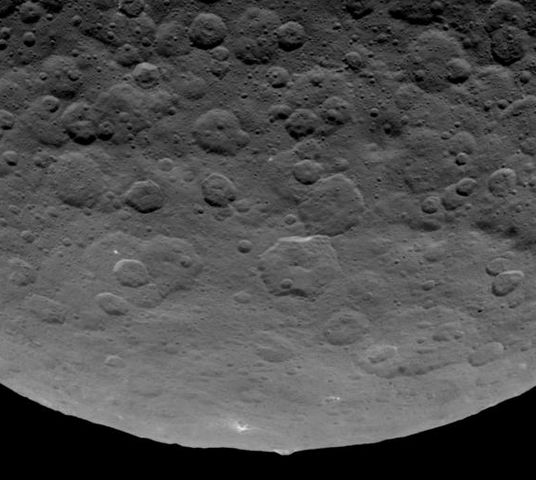
Dawn mission patch (NASA / JPL)Dawn, the NASA / ESA joint mission to explore two of the solar system’s three “protoplanets” located in the asteroid belt between the orbits of Mars and Jupiter, continues to intrigue scientists as it studies Ceres, the second of its primary targets.

As I reported in June 2015, Dawn is part of a broader effort to better understand the origins of the solar system and how the planets actually formed; all of which might give us greater understanding of how life arose here on Earth.

Launched in September 2007, Dawn arrived at Ceres in March 2015, after a 2.5 year transit flight from Vesta, its first destination, which it had been studying for 14 months following its arrival in July 2011. Because of their relative size – Ceres accounts for around one-third of the total mass of the asteroid belt – both of these airless, rocky bodies are regarded as dwarf planets, rather than “simple” asteroids. However, Ceres is proving to be quite the conundrum.

At the start of July, Dawn completed the first part of its high-altitude survey of Ceres and fired its low-thrust ion drive to start a series of gentle manoeuvres to reduce its orbit around from 4,400 kilometres (2,700 miles) to 1,450 kilometres (900 miles). It’s now hoped that from this lower orbit, the space craft will be able to discover more about some of Ceres’ more mysterious features.

One in particular has been the subject of much debate. It started when Dawn imaged a series of bright spots within the crater Occator as it made its initial loop around Ceres to enter orbit. Since that time, it has repeatedly images the bright spots, and their presence has also been confirmed by the Hubble Space Telescope.

A June 6th image of the bright spots within a crater on Ceres, captured by Dawn on June 6th, 2015, from a distance of
A Dawn spacecraft image of the bright spots within a crater on Ceres, captured on June 6th, 2015. With the vehicle now entering a much lower altitude mapping mission, it is hoped that even more detail on the spots  – and the faint haze discovered within the crater – will be obtained

Currently, it is believed the bright marks might either be salt deposits or water ice (the European  Herschel Space Observatory had previously found evidence of water vapour on Ceres).  However, while the science team aren’t leaning either way, their mission briefing on July 21st, leant some weight to the bright spots perhaps being water ice. This came in the form of an announcement that he 92 kilometre (57 mile) wide Occator has its own, very localised atmosphere focused around the bright areas.

The evidence for this comes from images of the crater taken from certain angles which reveal a thin haze covering around half of the cater, but not extending beyond its walls. Th thinking is that this haze is perhaps the result of the ice in the bright area – if they are ice – sublimating out.

However, if this is the case, it actually raises a further mystery: why the haze? Generally, such sublimation would lead to the resulting gases dissipating very quickly, without forming a haze. One hypothesis is that Ceres’ gravity, which is somewhat higher than might be expected for a body of its size) may be and influencing factor.

The 5 km high "pyramid" mountain pokes up above the limb of Ceres. Flat-topped, it has streaks of bight mateiral on its flanks giving the impression something has been flowing down it.
The 5 km high “pyramid” mountain pokes up above the limb of Ceres. Flat-topped, it has streaks of bright material on its flanks giving the impression something has been flowing down it.

The bright spots aren’t the only curious feature on Ceres. Dawn has also spotted numerous long, linear features whose cause is unknown, as well as one big mountain that mission team members have dubbed “The Pyramid.” This massif, about 5 km (3 mi) in height, and around 30 km (19 mi) across at its base, is oddly flat-topped and has streaks of bright material on one of it flanks, as if something has been cascading down the slope. What this might indicate has planetary scientists scratching their heads at this point.

With all the mysteries thrown up by New Horizon’s recently flyby of Pluto, and Dawn’s discovery of mysterious features on Ceres, it really is becoming a case that the tiny worlds of our solar system are perhaps the most perplexing.

Three years ago, in August 2012, NASA’s Mars Science Laboratory rover, Curiosity, arrived in Gale Crater, Mars. Since that time, the rover has made some remarkable discoveries, as reported in this blog over the years.

To mark the anniversary of the landing, NASA has launched two new on-line tools designed to open the mysterious terrain of the Red Planet to anyone with an interest in planetary exploration.

Experience Curiosity allows users to journey along with the one-tonne rover on its Martian expeditions. The program simulates Mars in 3-D, using actual data returned by the rover and NASA’s Mars Reconnaissance Orbiter (MRO). It also uses a  game-ready rover model based entirely on real mechanisms.

Experience Curiosity allows you to learn about the rover using a 3D model which can be manipulated and driven, using a WebGL application

User are able to drive the rover, examine it, call up data on key components, witness the driving view from different cameras on the rover, and operated the robot arm. Activities are a little basic, but as this appears to be a part of NASA’s Eyes On project, capabilities may grow over time.

Mars Trek is a much more expansive tool – one which is actually being used in the planning for the Mars 2020 rover mission. It features interactive maps, which include the ability to overlay a range of data sets generated from instruments aboard spacecraft orbiting Mars, and analysis tools for measuring surface features. Standard keyboard gaming controls are used to manoeuvre the user across Mars’ surface, and topographic data can be exported to 3D printers to allow the printing of physical models of surface features.

The map view and be manipulated in 2D or 3D, data on various surface missions is provided, compete with the ability to zoom into the surface locations for these missions, making for a visually impressive model.

Continue reading “Space Sunday: active Ceres, open Mars, and shooting stars”

Quartz offers a gem on Sansar, VR and Second Life

“come with me!” – in , Could the Oculus Rift help give Second Life a second life? Alice Truoung examines the promise of avatar-based virtual spaces

There has been another recent spate of articles on Linden Lab, Project Sansar, Second Life and the potential for avatar-based virtual spaces with the upcoming advent of VR. Even Moviepilot, whom I took to task in 2014, has been busy looking at what’s going on, while Gamasutra rushed out what is essentially a nutshell version of Eric Johnson’s excellent Re/code article examining the question of the metaverse, which I looked at here.

However, the pick of the latest crop has to be Alice Truong’s article published in Quartz: Could the Oculus Rift help give Second Life a second life?  While the title might sound Second-Life centric and suggestive of a piece looking at how it will faire under the Rift (“not very well”), it is anything but.

What is actually presented is a well-rounded piece on the future of avatar-based virtual spaces which uses Second Life as the measure of their mark and launchpad for their future. Within it, Second Life is examined from a number of angles and Sansar is explored, together with a nodding look towards High Fidelity.

Alic Troung: thought on virtual spaces and avatars in Quartz (image credit: Quartz.com)
Alice Truong: thought on virtual spaces and avatars in Quartz (image credit: Quartz.com)

As with most of the pieces which had appeared over the last month or so, little real news on Sansar (or SL’s development for that matter) is given out. This is hardly surprising, as the Lab does like to hold its cards close to its chest – the relative newness (and thus the difficulty in highlighting specific tablets-of-stone facts) of Sansar notwithstanding.

What makes this article a joy, is that it provides a solid framing for the subject of the Lab and virtual worlds, reaching back to 1999 and the original efforts with The Rig. This is nicely packaged and offers a solid foundation from which Ms. Truong expertly weave her piece. Some of the path she takes will be familiar, particularly where SL and Sansar is concerned. We get to hear about SL’s growth, revenue, the US $60 million collectively cashed-out of the platform by many of its users, etc.

We also get fair mention of the decline in the number of active users on the platform, but again, this is properly framed. At its peak, SL had around 1.1 million active users; eight-ish years later, that number stands at around 900,000. A decline, yes. but as Ebbe Altberg points out hardly any kind of “mass exodus”; and certainly nowhere near the dire haemorrhaging of users we tend to hear proclaimed to be happening every time the Lab makes what is perceived as an irksome decision.

For Sansar, similarly familiar ground is covered – the revenue model (and the comparison with SL’s model and its weakness), the promise of VR, the opportunity to grow a platform for “tens, if not hundreds” of millions of users, the aspect of much broader “discoverabiilty” / ease of access for Sansar in order to help generate more appeal, and so on.

Mention is made of the Lab planning to “commercially release” Sansar by the end of 2016. Given what has been said by the Lab to date concerning time frames for future work, and allowing for Ebbe’s comments of perhaps having something worthy of a “version 1.0” label by the close of 2016, I’m taking the comment to be more of a misunderstanding on Ms. Truong’s part than any revelation as to Sansar’s roadmap.

Hunter Walk (l), the Lab's former
Hunter Walk (l), the Lab’s former “Director of Everything Non-Engineering” as well as a founder of the company, and now a VC in his own right, and Bernard Drax, aka Draxtor Despres (r) offer thoughts on Sansar

Another enjoyable element of this article is that Ms. Truong casts her net wide for input; thus she captures both Hunter Walk and Draxtor Despres. Their comments serve to both offer the means by which ideas can be further explored in the piece, and serve to offer a measure of counterpoint to the assumed mass appeal spaces like Sansar and High Fidelity will have.

Hunter Walk, for example, underlines the most critical problem in growing users Second Life has faced throughout its lifetime – that of accessibility and use. As he states, “ultimately, the work you had to put in was, for most people, more than the fun you got out.”  Not only does this underline the essential truth about SL’s longest-running issue (it’s as true today for many as 2003/4), it lays the foundation for an exploration of some of Sansar’s fundamental differences to SL later in the article.

Hunter also passes comment on the idea of these spaces finding many millions of users, pointing out that “tens of millions” was always an unrealised dream at the Lab for Second Life; perhaps a cautionary warning about focusing on user numbers. He also seems to offer something of a warning on investment returns in such ventures as well, again referencing Second Life, although if intended as a warning, it is more relevant to High Fidelity (which has received around US $16.5 million in investment to date).

Draxtor similarly questions whether user numbers should necessarily be the focus / rationale for building these kind of virtual spaces. Like him, I’m far from convinced Sansar will have the kind of broad-ranging reach to draw in “hundreds of millions” (or, if I’m honest, even more than  the low tens of millions). I’ve explained some of the reason why I think in my review of Eric Johnson’s piece linked to towards the top of this article, so I won’t repeat them here.

Could the promise of 2mixed reality
Could the promise of 2mixed reality” technologies which combine VR, AR and physical world activities yet serve to keep avatar-based virtual spaces a niche endeavour? (image: Magic Leap, via the New York Times)

If I’m honest, my only regret is that while Ms Truong’s tone is (rightly) sceptical in places, there is no outright challenge to the idea that people will embrace avatar-based interactions on a massive scale just because VR is on our doorstep.

Right now, there is a lot going on in the world of technology: VR, AR, the potential to fuse the two; faster communications capabilities, much better mobile connectivity, and so on. All of these could serve to dramatically marginalise any need to persistently engage in avatar-based interactions outside of very defined areas. As such, the inescapable whiff of “will we build it, they will use it” (to utterly mangle an already oft-misquoted line from a certain film) which seems to pervade the talk of high Fidelity and Sansar does perhaps deserve a degree of challenge.

Perhaps I should drop a line to Peter Gray suggesting an interview on those lines…

In the meantime – go read Alice Truong.

Related Links