 NASA’s Mars Science Laboratory (MSL) rover Curiosity chalked-up another milestone on October 30th, 2013, when the laser which comprises part of the Chemistry and Camera instrument (ChemCam) system mounted at the top of the rover’s mast, was fired for the 100,000 time.
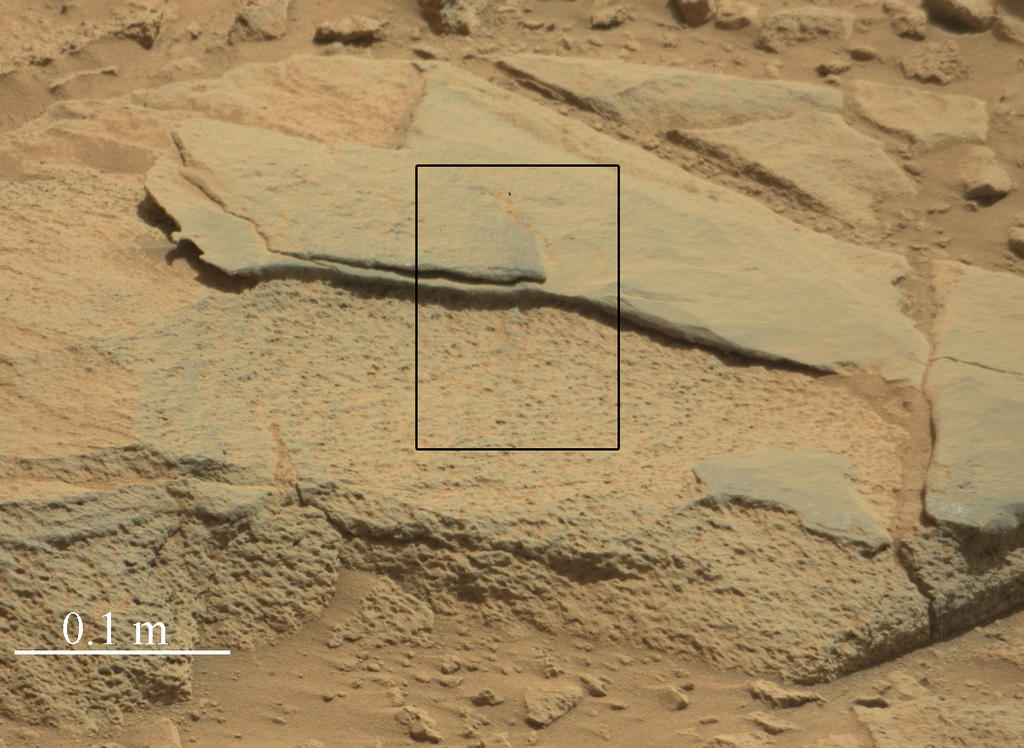
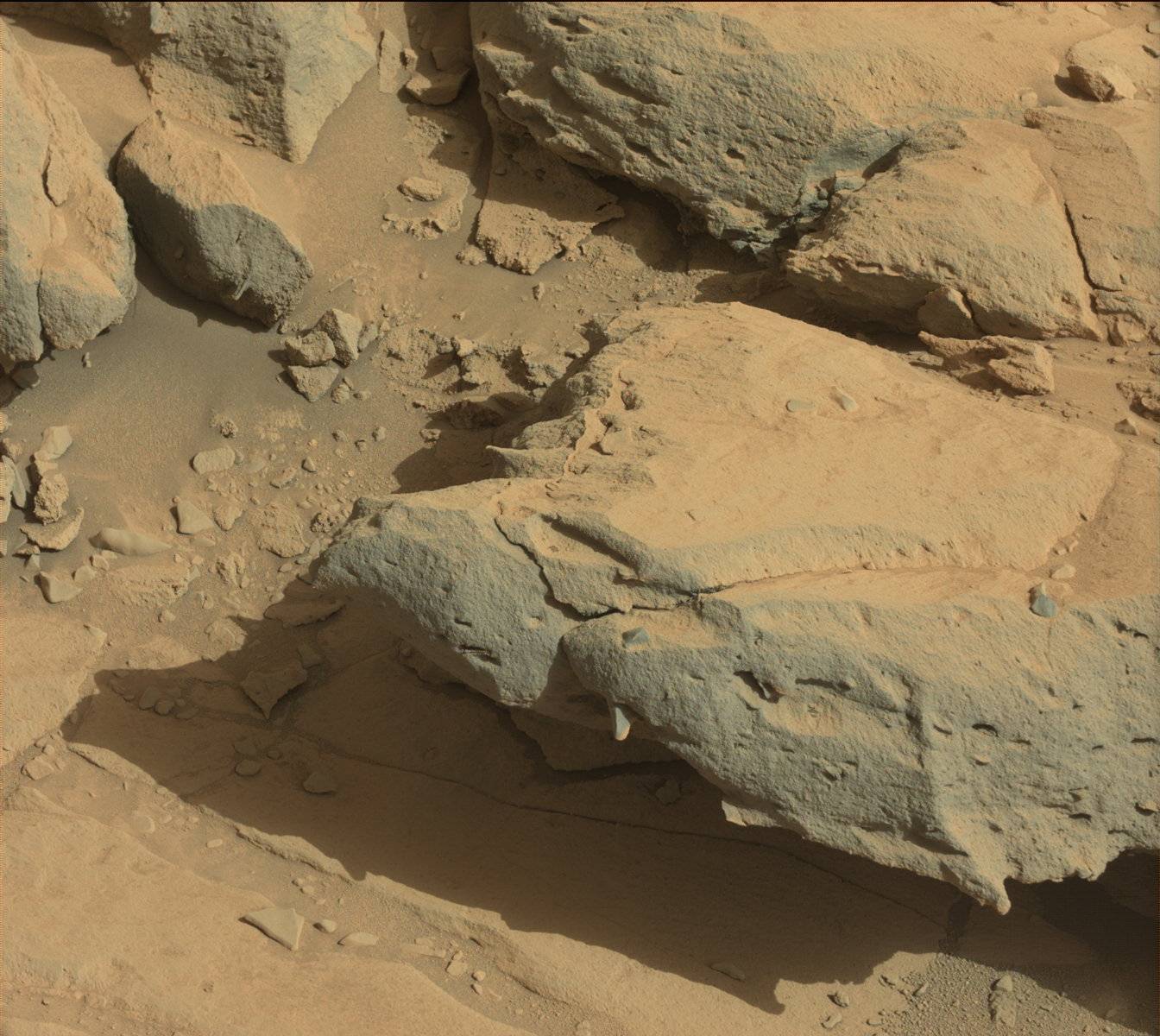
The shot was one of a series of 300 fired at a total of 10 locations on a rock called “Ithaca”, and was taken at a range of 4.04 metres (just over 13 feet) from the target. The laser is used to vaporise tiny amounts of an object (the target area being around the size of a pin head), producing a spark of plasma (ionised gas). This spark is observed via a telescope which also forms a part of the ChemCam system, and the spectrum of light from the spark is analysed to identify chemicaal and mineral elements within it.
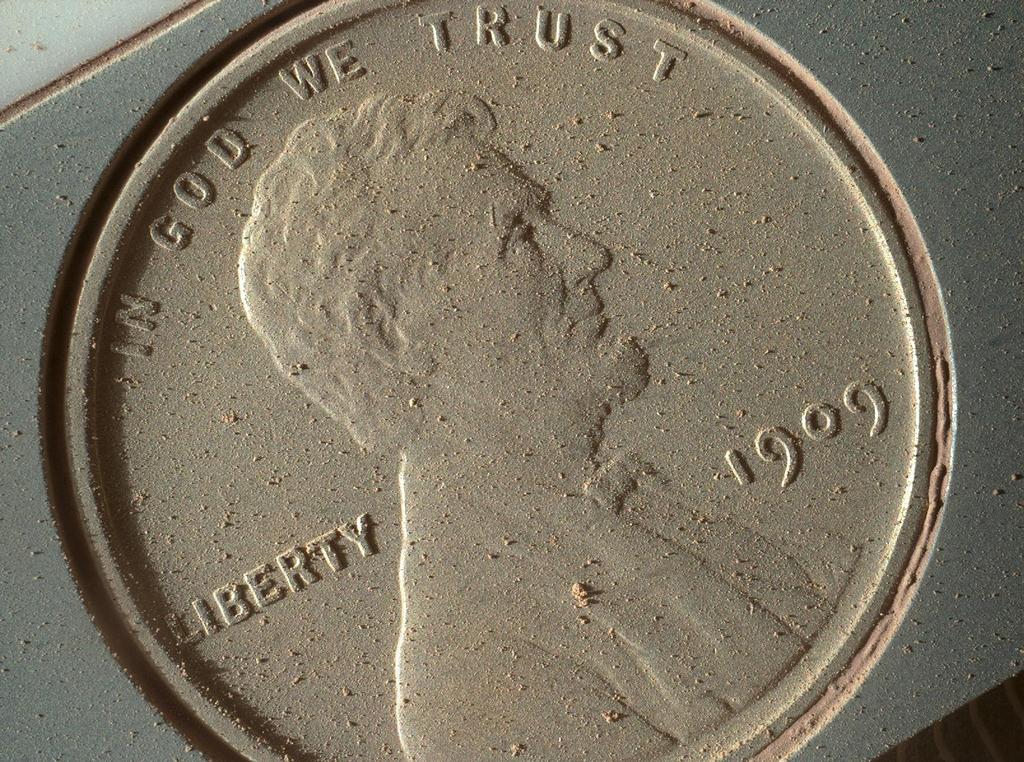
Each pulse from the laser delivers more than a million watts of power for about five one-billionths of a second. The technique used by ChemCam, called laser-induced breakdown spectroscopy, has been used to assess composition of targets in other extreme environments, such as inside nuclear reactors and on the sea floor. Experimental applications have included also environmental monitoring and cancer detection. MSL is the first mission to use the technique on another planet.
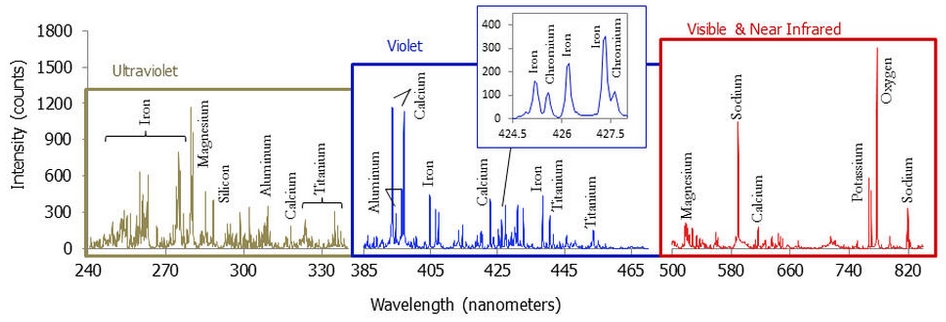
Virtually every shot taken by the laser yields a spectrum of data which is returned to Earth. Most targets get zapped at several points with 30 laser pulses at each point. An international team of scientists and students is mining information from ChemCam to document the diversity of materials on the surface of Gale Crater and the geological processes that formed them. The range of materials recorded so far includes dust, wind-blown soil, water-lain sediments derived from the crater rim, veins of sulphates and igneous rocks that may be ejecta from other parts of Mars.
Since reaching the 100,000 total in late October, the laser has been fired a further 2,000 times. ChemCam also includes a micro-imager camera, which has taken over 1600 images during the time the rover has been operating on Mars.

Four Billion Years
In a little more than a year on the Red Planet, Curiosity has determined the age of a Martian rock, found evidence the planet could have sustained microbial life, taken the first readings of radiation on the surface, and shown how natural erosion could reveal the building blocks of life. MSL team members presented these results and more from Curiosity in six papers published on December 9th, 2013 by Science Express and presented them in press briefings and talks at the Fall Meeting of the American Geophysical Union in San Francisco.
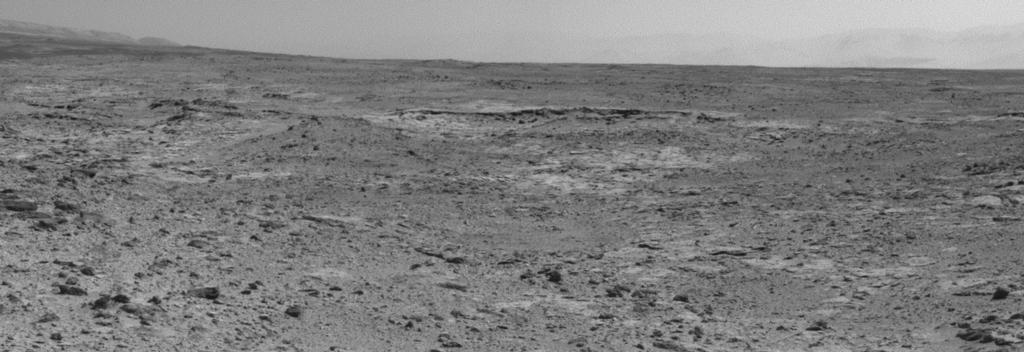
As a part of its operations, Curiosity has carried out a number of sample drillings into rocks on Mars. The second rock, dubbed “Cumberland” from which the rover obtained cuttings for analysis is now the first rock ever to be dated while sitting on another planet. Analysis of the mineral ingredients in the cuttings obtained from “Cumberland” estimates the age of the rock to be about 3.86 to 4.56 billion years; this matches estimates as to the overall age of Gale Crater itself, obtained through other means, which suggests that the techniques being used to analyse the samples gathered by the rover are reliable.
“The age is not surprising, but what is surprising is that this method worked using measurements performed on Mars,” Kenneth Farley, from the California Institute of Technology and a co-author of one of the new papers, said. “When you’re confirming a new methodology, you don’t want the first result to be something unexpected. Our understanding of the antiquity of the Martian surface seems to be right.”
Before they could measure rocks directly on Mars, scientists estimated their ages by counting and comparing the numbers of impact craters on various areas of the planet. The crater densities are correlated with ages based on comparisons with crater densities on the moon, which were tied to absolute dates after the Apollo lunar missions returned rocks to Earth.
The Cumberland sample analysis was a fundamental and unprecedented measurement which had been considered unlikely even as recently as the rover’s arrival on Mars in August 2012. To obtain it, Farley and his colleagues adapted a 60-year-old radiometric method for dating Earth rocks that measures the decay of an isotope of potassium as it slowly changes into argon, an inert gas. Argon escapes when a rock is melted. This dating method measures the amount of argon that accumulates when the rock hardens again.
The researchers also assessed how long Cumberland has been within about an arm’s reach of the Martian surface, where cosmic rays striking the atoms of the rock produce build-ups of gasses Curiosity can measure. The analysis of different gases present in the rock yielded exposure ages in the range of 60 million to 100 million years. This suggests shielding layers above the rock were stripped away relatively recently. Combined with clues of wind erosion Curiosity has observed, the exposure-age discovery points to a pattern of windblown sand eroding relatively thick layers of rock, which form a retreating vertical face, or scarp.
“The exposure rate is surprisingly fast,” Farley said. “The place where you’ll find the rocks with the youngest exposure age will be right next to the downwind scarps.”





 Inara Pey: Living in a Modemworld