Update: Botgirl Questi pointed me to this coverage of the Yahoo! buy-out of Cloud Party, which includes a statement from Yahoo! on the acquisition.
It’s been the darling for some, and has come a long way in a short period of time. However, it now appears is if things are to draw to a close at Cloud Party, as spotted by Phadrus on the SLU forums.
After a year which has seen some rapid development, particularly in the latter half of 2013, with features and options being added nigh-on weekly – such as Oculus Rift support, and e-mail updates hitting users’ in boxes as a matter of routine, the company has today announced a major change of direction via a new blog post from Cloud Party’s CEO, Sam Thompson.
The blog post reads in full:
We’re excited to announce that the time has come for the Cloud Party team to start our next adventure. We are joining Yahoo! The last two years have been an incredible experience for everyone here. We’ve been continually amazed by your creativity and the worlds you’ve built and shared with us.
Cloud Party will continue to run until February 21, 2014. We want to support our community during this transition. In the interest of preserving your extraordinary Cloud Party creations, we’ve added export tools and written this guide to help you export your content. If you have any questions, please contact us at support@cloudpartyinc.com.
We are privileged to have had so many wonderful users share ideas and creations. We are excited to bring our vision and experience to a team that is as passionate about games as we are. Thank you all for sharing in this journey with us, and we hope you stick around for what’s next!
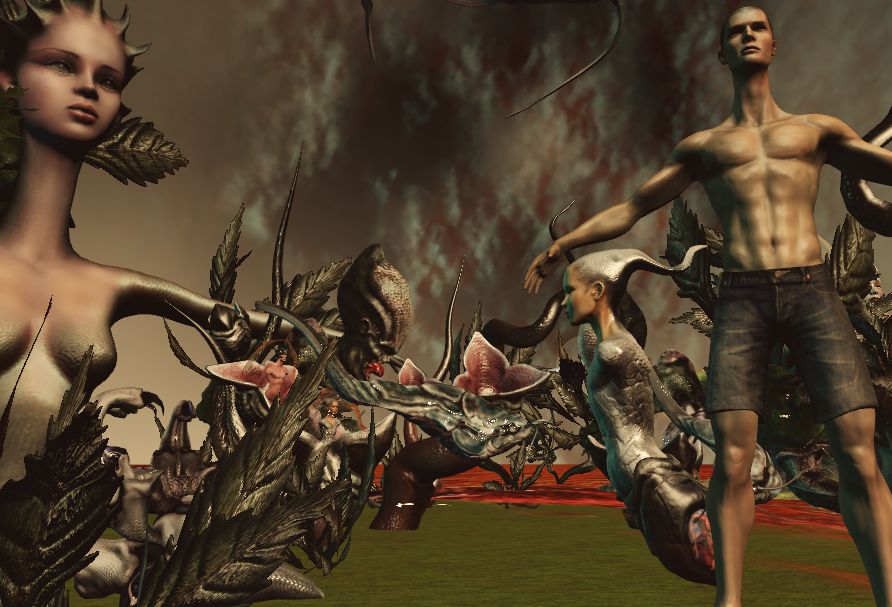
Claudia222 Jewell is one of a number of well-known virtual world artists who has been involved with Cloud Party
While “closing” isn’t specifically mentioned in the post, an end-date for the service is clearly given – February 21st. This tends to indicate that this is more than a matter of Cloud Party simply transitioning to a new owner following acquisition, and that the platform is indeed going away. This begs the question as to what Sam and his team will be doing at Yahoo!, and will the experiences they’ve gained through running Cloud Party be part of whatever plans their new employers have?
Given that this is Yahoo!, who haven’t exactly covered themselves in glory with either the acquisition of Flickr or the overhaul of their own Yahoo! Groups, will anyone from the “old” Cloud Party be sufficiently motivated to sign-up to whatever does follow?
While it perhaps never attracted the volume of users it might, Cloud Party offered some intriguing concepts, many of which did attract a fair few content creators from the likes of Second Life, particularly given the ease with which mesh creations could be designed and imported into the platform.
So far, there has been no visible response to the announcement on the Cloud Party forums, although the word is spreading.
I’ve been keeping a sort-of eye on news concerning Philip Rosedale’s High Fidelity from something of a distance, occasionally checking the website and seeing what is going on. However, as a lot of it goes somewhat over my head, I tend not to report on it, preferring to wait as see to what actually starts to emerge in the future.
Nevertheless, Ciaran Laval poked me earlier in the moth that some interesting news might be coming out of the company, and so I’ve been watching various feeds to see what does. As a result, I caught Hamlet Au bringing the news, courtesy of “Epona666”, that High Fidelity have put out a call for alpha testers.
High fidelity: seeking alpha testers – click to follow
Hamlet refers to the company as looking for “creative builders” for the Alpha testing. However, the sign-up form is scant on specifics, and leans more towards the hardware and operating systems applicants have at their disposal, rather than on specific skill sets of any description. There also doesn’t appear to be ant blog post associated with the announcement, so it is a little hard to discover further information relating to the call.
The application form: hardware and OS-focused
This request is somewhat easier than the company’s last, as reported by Ciaran Laval at the time. In December, the company invited those wishing to work for / with them on code aspects of the platform to build the High Fidelity user interface from source code and then log-in to the system to get the company’s attention, and then attempt to tackle one of the current tasks the company has listed on Worklist.
The company’s last call for assistance took the form of a challenge to those interested
For those interested in signing-up for this alpha testing can do so by following the link from the High Fidelity home page, or by following this link (or click the banner ad towards the top of this article) to the application form itself.
Hamlet also points to a new subReddit where High Fidelity can be discussed by those interested in the project.
Curiosity, the NASA rover carrying the Mars Science Laboratory is continuing towards its rendezvous with the foothills of “Mount Sharp” (Aeolis Mons) in Gale Crater, Mars. As such, there is little coming out of NASA in terms of updates on progress (which would likely sound the robotic equivalent of “Are we there yet?” “No!” cycles).
However, on January 9th, NASA released several images captured by the High Resolution Imaging Science Experiment (HiRISE) camera aboard the Mars Reconnaissance Orbiter (MRO). Taken in both black-and-white and colour, these show Curiosity’s long and lonely drive across the “magnificent desolation” of Gale Crater.
Tracking Curiosity’s progress towards “Mount Sharp” – the arrows point towards to tracks left by the rover as it heads southwest towards a gap in the dune field (seen lower right) sitting between it and the foothills of its primary destination. For scale, the wheel tracks are about 3 metres (10 feet) apart (click to enlarge)
The images show the rover’s tracks as it manoeuvred around obstacles on its route toward the lower slopes of “Mount Sharp”, and were captured in early December 2013 as the MRO, which acts the and primary communications relay between Earth and Curiosity, passed over the rover’s location at an altitude of some 250-316 kilometres (160-196 miles).
HiRISE first imaged the Mars Science Laboratory spacecraft while it was descending on a parachute to place Curiosity on Mars 17 months ago. Since then, it has provided updated views of the rover’s traverse, as seen from orbit.
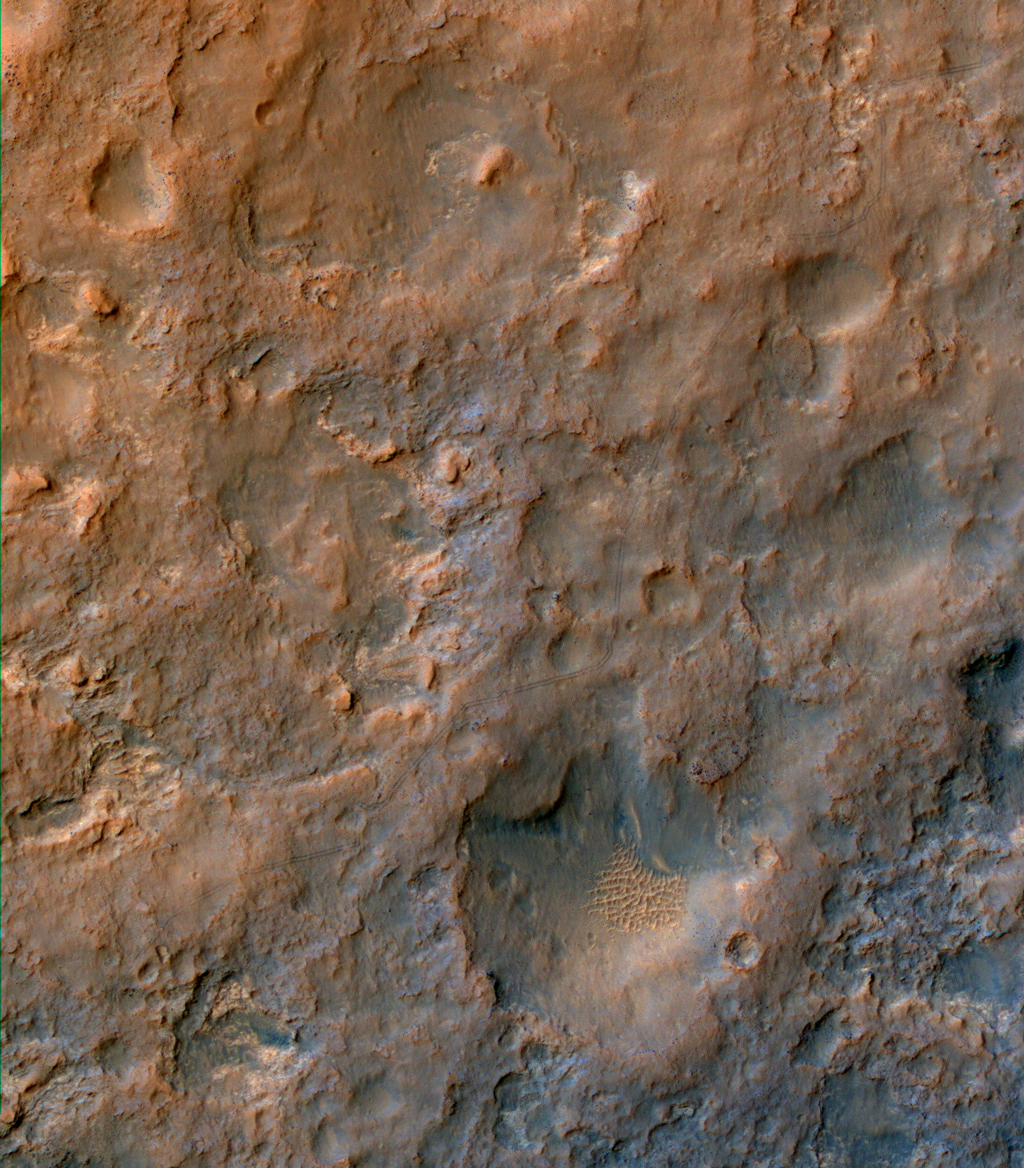
A rover’s progress: a large image of Curiosity’s journey, as captured by the HiRISE camera aboard the Mars Reconnaissance Orbiter in December 11th, 2013. The rover itself is just out of frame to the lower left of the image. The orientation is so that north is to the top (click to enlarge)
At the time the images were captured, Curiosity had clocked-up some 4.61 kilometres (2.86 miles) since its arrival in Gale Crater in August 2012. The long trek in a generally southwest direction commenced in the latter half of 2013, after the rover had spent some six months within the “Glenelg” and “Yellowknife Bay” areas of the crater studying a range of rock and surface conditions which allowed Curiosity to meet criteria relevant to its primary mission objective – to determine whether Mars may have once harboured conditions in which life might have arisen.
NASA’s Curiosity Mars rover and tracks left by its driving appear in this portion of a Dec. 11, 2013, observation by the Mars Reconnaissance Orbiter. The rover is near the lower-left corner of this view. For scale, the two parallel lines of the wheel tracks are about 3 metres (10 feet) apart (click to enlarge)
On December 15th 2013, Kitely announced the first phase of a major overhaul of their pricing structures. That announcement covered the introduction of their new account types (Regular and Premium) and their Metered world options which have replaced their “time-based” system of payment options.
I covered that announcement in some depth at the time, noting that there would be further clarification to come from Kitely on elements of the new Regular account, as well as information on the new Fixed-price options. On January 1st 2014, Kitely followed-through on their promise of providing this additional information when they issued a further pricing update.
More on Account Types
As I reported in December alongside of Kitely’s initial blog post on this subject, the company has introduced two account types, Regular and Premium. The salient points to note on these are that:
The Regular account is free of charge and includes a single Metered region and a one-off 6-hour trial period which can be used in developing their Metered region(s)
The Premium account costs $19.95 a month, and includes up to five Metered regions with the ability to visit any metered region on Kitely (their own or anyone else’s) for free
Either type of account can be used when joining Kitely
Either type of account can be used when purchasing Fixed-price world options (of which more late in this article)
Either type of account can add further Metered regions at the rate of 10 KC per day per Metered region (+ access costs for Regular accounts, where applicable).
Metered Regions and Regular Account Visitors
The key point to grasp here is that the time anyone with a Regular account spends visiting any Metered region (including their own) must be paid for by the region holder. This means that someone with a Metered region will be charged at the rate of 1 Kitely Credit (KC) for each minute a Regular account holder spends visiting that region.
The only exception to this is the initial 6-hour trial period Regular account holders are given in order to start developing their own Metered region. Once this trial period has been used, a Regular account holder can either continue to pay for their time on their own region(s) at the rate of 1KC per minute, or opt to pay for one of the Fixed-price world options (there is no charge for anyone visiting Fixed-price regions) or opt to upgrade to Premium (both of these latter options are open to Regular account holders at any time).
Because there is a cost involved in having Regular account holders visit a Metered region, Kitely has included an option for region holders to block Regular accounts from accessing their Metered regions if they so wish, thus preventing the build-up of unwanted costs in respect of such visits. The Kitely blog post elaborates in detail on how this access restriction can be set.
Fixed-price World Options
As of January 1st, 2014, the company has discontinued its original $40.00, $60.00, $80.00 and $100.00 fixed-prix options – although users already paying for these options can continue to do so if they wish. Three new Fixed-price options have been introduced in their place, referred to as the Starter World, Standard World and Advanced World options, as defined below.
Kitely’s new fixed-price options, available to both Regular and Premium account holders (image via Kitely)
Both the Starter and the Standard World options come with slightly reduced resources, as indicated, while the Standard and Advanced World options include the ability to combine the regions included in those worlds into a single Advanced Megaregion. As with the old Fixed-price options, no-one is charged for the time anyone spends on a Fixed-price region.
Whether or not users on one of the discontinued Fixed-price options will want to change to one of the new options will depend upon on a number of things, such as the complexity of their build(s), and their typical numbers of daily users or their requirements for avatar-intensive events. However, the ability to swap is there for them to use, if they so wish.
General Feedback
It will be interesting to see broader reaction to the idea of Metered region holders having to pay for any visits made to their regions by Regular account holders – and how many Metered regions are closed to Regular account holders as a result (I have already closed my own Kitely region to Regular account access, for example). However, the initial reaction to these changes has been favourable, even allowing for the confusion which occurred when the initial part of the restructuring was announced in December 2013.
As it is, the new Metered and Fixed-price payment options continue Kitely’s tradition of offering competitive and flexible payment options, and may well serve to attract new users into giving the platform a try.
AvaCon, former organisers of the now defunct Second Life Community Convention, and co-organisers of the OpenSimulator Community Conference, have launched their completely revamped website ahead of what looks like being a very busy year for the team.
The new website is a crisp, clean, easy-to-navigate blog-style environment (the engine driving the site is WordPress.org with a professional theme courtesy of Kriesi Art). This is perhaps a long-overdue overhaul to AvaCon’s web presence, and it certainly gives a whole new look and feel – and vibrancy – to the site.
In 2013, AvaCon co-organised and hosted the first Annual OpenSimulator Community Conference, (OSCC) which I previewed in these pages (and was booked-in to attend before RL got in the way). The event itself was a great success for both AvaCon and the Overte Foundation, and they’re now planning the 2014 event.
Those wishing to help with the 2014 conference are invited to e-mail AvaCon to volunteer their services. In the meantime, videos from the 2013 conference are available on YouTube for those wishing to catch-up on events, and AvaCon have provided a link to a fascinating visualisation video by Nebadon25 showing the OpenSimulator code commits by core developers, charting the growth of the project.
Metaverse Cultural Series
In 2013, AvaCon also launched the Metaverse Cultural Series, a set of events which featured performances and lectures highlighting unique aspects of metaverse culture, and which took place in multiple virtual world spaces. The inaugural series showcased innovative artists, thinkers, performers, and academics whose work is on the forefront of exploring what it means to work, play, and live in the emerging metaverse.
In 2014, AvaCon plan to expand the series, and will be issuing a call-for-proposals in January, 2014. Successful presenters and venue hosts will receive a $50 USD honorarium for accepted presentations, and I’ll be endeavouring to bring news on things once the call goes out publicly.
All-in-all, 2014 looks to be an exciting year for AvaCon, and I’d like to extend my congratulations to the team on their successes in 2013 and my best wishes for 2014.
NASA’s Curiosity rover Has completed a significant software upgrade, marking the third time the rover’s flight software has been updated since arriving on Mars in August 2012. The update was originally scheduled to take place over the course of a week in early November. However, during the course of the software upload, Curiosity unexpectedly committed a (non-threatening) software reboot (technically referred to as a “warm reset”), which eventually saw the software reverted to its original state.
Analysis of data received as a result of the reset revealed a catalogue file for the existing onboard software was triggered as a result of the newly uploaded flight software. As a result of this analysis the rover team were able to determine the steps required to ensure the correct software execution took place before allowing the rover to resume normal operations using the existing flight software (version 10).
A second attempt was then made up upload and execute the new flight software (version 11) over the course of a week earlier in December, which saw the rover transition to the new software without incident.
The new software further expands the rover’s ability to deploy and use its robot arm and the turret-mounted science instruments and tools while the vehicle is operating on sloping surfaces – a vital requirement once Curiosity starts exploring the lower slopes of “Mount Sharp”. The software also further enhances the rover’s ability to safely store and retrieve navigational data, increasing its autonomous driving abilities even further.
Over the last several weeks, Curiosity has been driving over exceptionally rugged terrain while en route to a point where it can traverse a series of sand dunes lying between it and “Mount Sharp” and start its explorations there. As a result of this, concerns have been raised that the rover’s six aluminium wheels are perhaps suffering an accelerated wear.
While the wheels can sustain a significant amount of damage without impairing the rover’s driving abilities, the mission team have decided to locate and drive the rover to a relative smooth area of Gale Crater where the robot are can be deployed to use the Mars Hand Lens Imager (MAHLI) to inspect each wheel for holes and other signs of damage.
“We want to take a full inventory of the condition of the wheels,” said Jim Erickson, project manager for the NASA Mars Science Laboratory Project. “Dents and holes were anticipated, but the amount of wear appears to have accelerated in the past month or so. We would like to understand the impact that this terrain type has on the wheels, to help with planning future drives.”
Depending upon the outcome of these checks, it may be that mission planners will opt to review the rover’s course to “Mount Sharp” and destinations along the way in order to try to reduce the amount of time spent traversing such rough terrain.
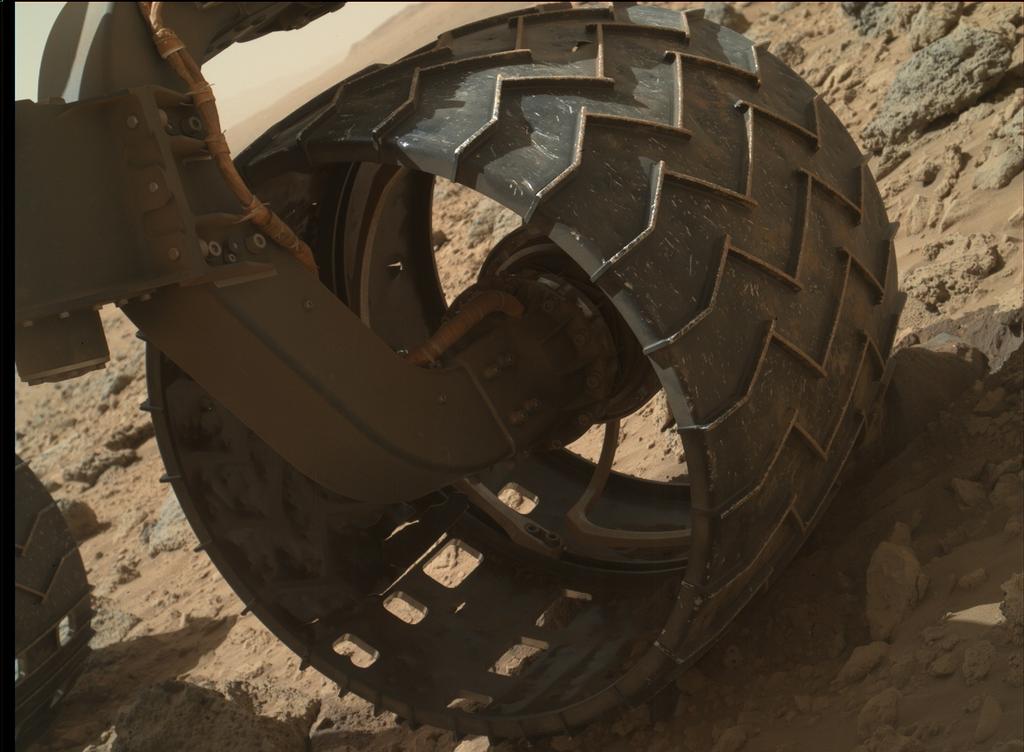
Curiosity’s left front wheel shows signs of accelerated wear as a result of travelling across terrain that is rough even by Martian standards. As a result of this, mission managers plan to have all six wheels checked-out for wear and tear in the near future. This image was taken by the Mars Hand Lens Imager (MAHLI) mounted on the rover’s robot arm turret on Sol 469 (November 30th, 2013). Note, also, the heavy coating of dust and dirt on the wheel’s drive arm. At the time this image was captured, Curiosity had driven 4.47 kilometres (2.78 miles).
Almost Four Miles
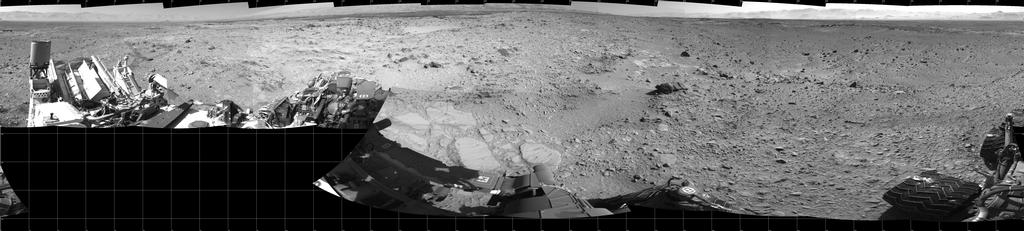
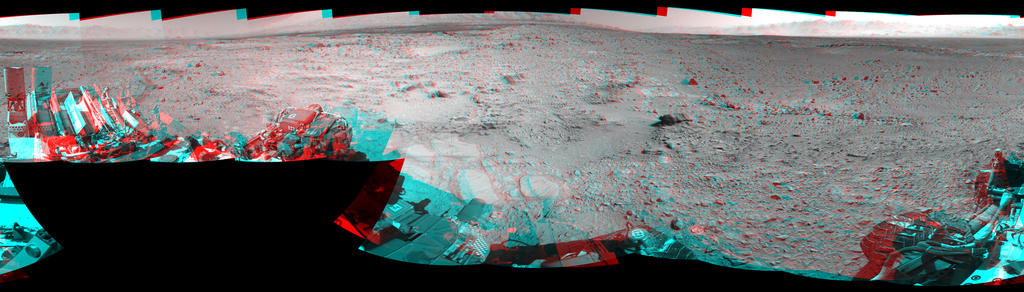
On December 8th, 2013 – Sol 477 of the mission, Curiosity clocked-up a distance of 4.61 kilometres (3.86 miles), and the rover paused to take a series of images of its location using the mast-mounted monochrome Navcams, which were then put together to form a cylindrical mosaic (below).
Click to enlarge
In the image, north is at either end of the mosaic, and south in the centre . The black squares are areas outside of the visual range of individual images used to create the mosaic. The images were individually captured by the left and right Navcam systems, and the two sets of images combined to offer a stereo view of Curiosity’s surroundings which can be seen using red-blue glasses with the red lens on the left (below).
Click to enlarge
In my last MSL report, I referenced the research into the age of the rocks in Gale Crater and the effects of weathering and erosion. Understanding of both helps scientists learn about the processes at work close to the surface of Mars, infer whether features were predominantly formed by action of wind or water (or a combination of both, and where one took over from the other), and understand relative levels (in ages) different rock has been exposed to cosmic radiation. Further images used in that research have since been released.
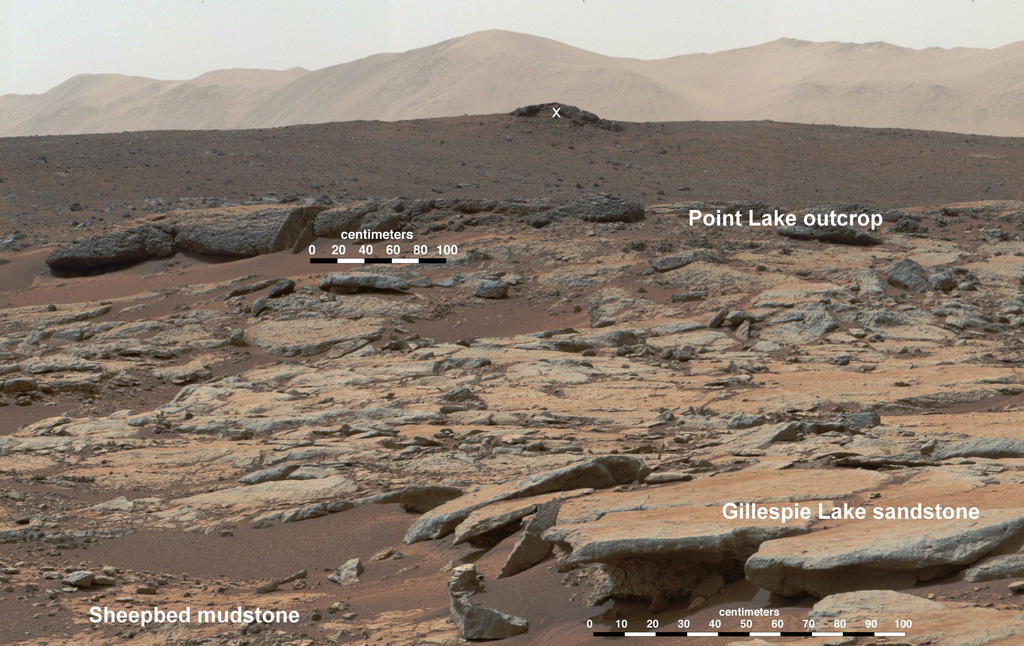
Click to enlarge
The image above show a mosaic put together using pictures captured by Curiosity’s Mastcam system on Sol 188 (February 14th, 2013), while the rover was operating in the “Yellowknife Bay” area. Looking west-northwest, the scene shows the various levels of rock which have been exposed in a process known as wind-driven scarp retreat, which can be described as the sideways erosion of a vertical face.
In the lower left corner is the “Sheepbed” mudstone deposit, which contains the “Cumberland” rock formation from which Curiosity gathered drilling samples. Gas analysis of the samples (some of which were saved by the rover and further analysed during the long road trip towards “Mount Sharp”) suggest the rock has only been exposed for about 80 million years – which is a lot more recent an exposure than previous estimates of the overall exposure of the Martian surface to the rigours of cosmic and solar radiation had suggested.
The evidence for wind erosion being the primary cause of exposure is strongly suggested to the right of the image, where erosion of the mudstone is clearly undercutting the “Gillespie Lake” sandstone layers. These layers were about 15.4 metres (50 feet) from the rover. The mid-image “Point Lake” layers are some 36 metres (118 feet) from the rover, while the rocky outcrop marked by the white “X” is around 240 metres (780 feet) away, and on an elevation about 13 metres (43 feet) higher than “Sheepbed” and “Gillespie”.
A key aspect of understanding how and when such exposure of previously hidden rock layers occurred is that it gives the rover team better insight for selecting future targets for drilling to investigate whether organic chemicals have been preserved in rocks.
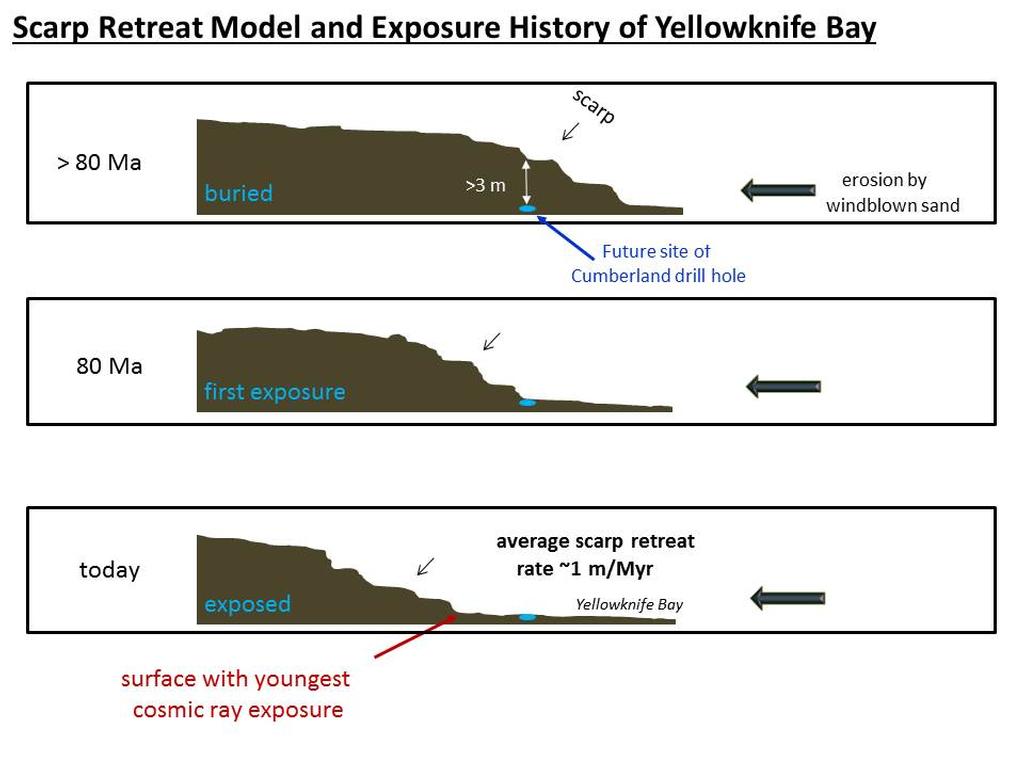
This set of drawings depicts cross sections of the “Yellowknife Bay” area of Mars’ Gale Crater at three points in time going back more than 80 million years (>80 Ma). Analysis of samples indicate the “Cumberland” rock target has been exposed at the surface for about 80 million years. Longer ago than that, the drill site was covered with about 10 feet (3 meters) of rock, as depicted in the top panel. At about 80 million years (middle panel), “Cumberland” was exposed as the scarp retreated due to abrasion by windblown sand. The sideways erosion, or retreat, occurred at an average rate of about one metre (3 feet) per million years (click to enlarge)







 Inara Pey: Living in a Modemworld