To infinity and beyond

Things are a tad quiet on the Mars news front, with Curiosity still on walkabout in the “Pahrump Hills”. So here’s a little round-up of some upcoming NASA news.

Orion Countdown

Thursday, December 4th should see the first launch of NASA’s next generation crewed space vehicle, the Orion Multi-purpose Crew Vehicle (MPCV). Superficially harking back to the days of the Apollo Moon landings, Orion is a two-stage vehicle comprising a capsule-like Command Module, capable of seating up to 6 astronauts, and a smaller Service Module, which supplies propulsion, power and life support. However, Orion is a lot more sophisticated than the Apollo craft, the capsule unit being a lot larger in both size and volume, and having the capabilities of both being reused and of making either a splashdown or landing on dry land on its return to Earth.

The Orions MPCV: an Apollo-like command module and, with its solar panels deployed, the Service Module
The Orion MPCV: an Apollo-like Crew Module and, with its solar panels deployed, the Service Module

As I’ve previously reported, this first launch of Orion will be uncrewed, serving to test the vehicle’s launch, flight and recovery capabilities in a mission lasting some 4.5 hours which will take the craft further from Earth than has been the case for any crewed vehicle since the last of the Apollo lunar missions in the 1970s. In doing so, the vehicle will be tested through the Van Allen radiation belts surrounding the Earth, and the capsule will be directed to re-enter the Earth’s atmosphere at around 80% of the velocity it would achieve on a return from a cislunar mission (that is, roughly 4,000 kp/h (2,500 mph) faster than the space shuttle ever returned to Earth).

Orion is designed to sit at the hub of NASA’s plans for the initial human exploration of the solar system. Its likely future uses include ferrying crews to the Moon and back and, in the 2030s, forming the command vehicle in a human mission to Mars.

An artist's conception of Orion delivering a large lunar lander to the Moon
An artist’s conception of Orion delivering a large lunar lander to the Moon

For lunar missions, Orion will, again like Apollo, be mated to a lunar lander, which it will ferry to the Moon, before the crew transfer to the lander and descend to the Moon’s surface. Again, the differences are that with the Orion mission, the MPCV can remain “parked” in lunar orbit unattended while the crew use their lander and equipment and facilities landed remotely on the Moon to spend weeks or Moons there, rather than days.

For missions to Mars, Orion will be part of a much larger vehicle, the details of which are still to be decided, but which is likely to be launched by Orion’s dedicated rocket, the Space Launch System (SLS), in a number of parts which will rendezvous in orbit prior to the crew flying to it via Orion and embarking. An Orion capsule would then serve as the Crew Return Vehicle, delivering the crew back to Earth at the end of there 3-year mission.

An Orion would serve as the Crew Return Vehicle to deliver the crew safely back to Earth at the conclusion of a nuclear-powered mission to Mars (NASA Design Reference Architecture mission)
An Orion would serve as the Crew Return Vehicle to deliver the crew safely back to Earth at the conclusion of a nuclear-powered mission to Mars (concept: NASA Design Reference Architecture mission)

Orion’s first mission will use a fully-functional capsule mated to a “dummy” service module (the actually service module is to be built by the European Space Agency, using the technologies developed in the hugely successful but grossly under-sung Automated Transfer Vehicle design, which has been quietly resupplying the International Space Station for the last five years (and refuelling it) with up to 7 tonnes of supplies per flight – more than double anything managed by the Russian Progress supply vehicles, the SpaceX Dragon and Orbital Science’s Cygnus vehicle.

In 2017, Orion will make an unmanned flight around the Moon (shown in the video below), this time using an actual Service Module and the SLS launcher, in what is being called the Exploration Mission 1. Then, in around 2021, Orion will fly its first crew in a mission to rendezvous and land on an asteroid.

New Horizons to Wake-up

Assuming all goes according to plan, two days after the Orion test flight, over 26 AU from Earth (AU being an astronomical unit – the average distance between the Earth and the Sun – that’s 149,597,871 kilometres or 92,955,807 miles), a tiny space craft will “wake up” from the third of three hibernation periods which have collectively lasted 31 months, allowing it to ready itself for its primary mission objective: a 6-month “flyby” of the dwarf planet Pluto, which should yield masses of information about that world and its major companion Charon.

after 10 years in space – the last 31 months of which have been largely in hibernation (other than brief periods of science data gathering), and a voyage through our solar system which has, like that of ESA’ comet-chasing Rosetta mission – provided many other opportunities for science discovery, New Horizons will commence its primary mission in January 2015, as it starts into its approach and fly-past of Pluto, Charon and their family of tiny “moons”, Kerberos, Styx, Nix and Hydra.

An artist's impression of New Horizon passing Pluto, with Charon and the Sun behind.
An artist’s impression of New Horizon passing Pluto, with Charon and the Sun behind.

No-one actually knows what New horizons will reveal; such is the distance between Earth and Pluto, we know very little about it in real terms, so the mission is very much like those of the pioneering days of space exploration, when we sent vehicle to Venus and Mars, not actually knowing for sure what they’d find.

Despite travelling at 1,600,000 kilometres a day, it will take New Horizons until July 2015 to reach its point of closest approach to Pluto – just 10,000 kilometres from the planet’s surface. The images and data it should return to Earth promise to be astounding.

And after July 2015? New Horizons will be heading out into deep space beyond our solar system, becoming only the third vehicle built by humans to do so, the other two being Voyagers 1 and 2. Providing it is still active, New Horizon should reach the heliosphere,  the “boundary layer” marking the divide between the solar system and interstellar space, in 2038. Between 2015 and then, the craft will be used to observe other Kuiper belt objects of interest and send back data on the space through which it is travelling.

Wanderers

Whether humanity ever joins Voyager and New Horizons in moving beyond our own solar system is a subject of popular debate. Given the distances involved between the stars, the only practical way of reaching solar systems beyond our own in through exotic methods – faster-than-light travel, wormholes, and the like – if we are to avoid centuries and generations travelling the interstellar void; and there is still no guarantee we’ll harness either.

But even should we remain locked inside our own solar system for centuries to come, we still have a vast range of environments to explore and possibly tame. This is something Erik Wernquist reminds us about in a stunning video he’s produced, using selected commentary spoken by the great Carl Sagan during his ground-breaking television series, Cosmos. This really is one to watch.

My thanks to Nalates Urriah for pointing me to Erik’s video.

The Federal Consortium of Virtual Worlds 2015 workshop

Moses

The US Army’s Military Open Simulator Enterprise Strategy (MOSES) and AvaCon have announced the first Federal Consortium of Virtual Worlds (FCVW) workshop, which will take place in a specially built virtual conference centre on Friday, March 6th and Saturday March 7th, 2015.

The workshop will be an active experience, with on-line exhibits and presentations provided in an interactive manner. Workshop participants are encouraged to engage and interact with the presenters, and the exhibits will range from cultural training material in a mock village to scientific ethical dilemmas in a city landscape.

The press release for the workshop notes that:

Virtual world technology has matured significantly and rapidly over the past eight years to the point where hundreds of people are able to simultaneously participate in an on-line event. The workshop is open to military and civilian personnel, including the public. The conference will be held entirely within an Open Simulator virtual environment, and reservations will be free for attendees.

The workshop will be a multi-track event, featuring keynote speakers and break-out sessions, and the FCVW and conference organisers are inviting proposals to be a speaker, presenter, or performer in one of the following tracks:

  • The Alternative User Interfaces track 
  • The Metacognition
  • Military Applications track
  • Security, Privacy and Identity track

In addition, the Knowledge Transfer track seeks public sector participants for a panel entitled Public Service Education in Virtual Worlds: Past, Present, and Future, which will discuss public service education uses for virtual world learning simulations as well as will feature panelists’ views on public service virtual world education projects from the past, present, and future. Participants in this discussion will be able to showcase relevant Open Simulator virtual world learning simulations via OAR and IAR uploads to be coordinated with the workshop organisers.

Full details on the above tracks, including information on areas of interest applicable to each of them, can be found in the workshop Call for Proposals page of the official website. Proposals must be received by the organisers by Monday, January 5th, 2015.

About the FCVW

The Federal Consortium for Virtual Worlds (FCVW) supports individuals and organisations from government (federal, state, local, and international), academia, and corporate sesectors to improve government collaboration through the use of virtual worlds, enrich collaborative online experiences, explore technologies that may enhance telework, and foster cross-agency collaboration.

About MOSES

The Military Open Simulator Enterprise Strategy (MOSES) is operated by the operated by the US Army’s Simulation & Training Technology Center (STTC), a part of the U.S. Army Research Laboratory, Human Research and Engineering Directorate. It is a coalition of military, industry, and academic partners who share a common interest in the advancement of virtual world technology for simulation based training and education. The MOSES Project seeks to address issues surrounding current game based virtual environment training systems in the two key areas of scalability and flexibility, and create a practical and deployable virtual simulation-based training system capable of providing a learner with a means to test skills in an accreditable manner. http://militarymetaverse.org/

About Avacon

AvaCon, Inc. is a 501(c)(3) non-profit organisation dedicated to promoting the growth, enhancement, and development of the metaverse, virtual worlds, augmented reality, and 3D immersive and virtual spaces. We hold conventions and meetings to promote educational and scientific inquiry into these spaces, and to support organized fan activities, including performances, lectures, art, music, machinima, and much more. Our primary goal is to connect and support the diverse communities and practitioners involved in co-creating and using virtual worlds, and to educate the public and our constituents about the emerging ecosystem of technologies broadly known as the metaverse.

Rock-paper-scissors at HiFi, with thanks to SL’s Strachan Ofarrel!

HF-logoDan Hope over at High Fidelity has provided  a light-hearted blog post on using the Leap Motion gesture device with the High Fidelity Alpha.

The blog post includes a video showing Chris Collins and Ozam Serim in-world in High Fidelity playing a game of rock-paper-scissors. The intention is to provide something of an update on integrating Leap Motion with High Fidelity.

Both Chris and Ozan’s avatars have intentionally-oversized hands, which although they look silly / awkward, help emphasise the  dexterity available in the High Fidelity avatar. Not only can avatars mimic user’s gestures, they can mimic  individual finger movements as well (something Dan has shown previously in still images).

Dan also points out the work to integrate Leap Motion hasn’t been done internally, but has  been a contribution from CtrlAltDavid – better known in Second Life as Strachan Ofarrel (aka Dave Rowe), the man behind the CtrlAltStudio viewer. As such, Dan points to it being an example of the High Fidelity Worklist being put to good use – although I say it’s more a demonstration of  Dave’s work in getting new technology into virtual environments :).

A lot of people have been fiddling with Leap Motion – including fixing it to the front of an Oculus Rift headset (as noted in the HiFi blog post) in order to make better use of it in immersive environments.Having it fixed to an Oculus, makes it easier for the Leap Motion to capture gestures – all you need to do is hold your hands up in your approximate field-of-view, rather than having to worry about where the Leap is on your desk.

Mounting the Leap motion to the front of Oculus Rift headsets is seen as one way to more accurately translate hand movements and gestures into a virtual environment. Perhaps so - but a lot of people remain unconvinced with gesture devices as they are today
Mounting the Leap motion to the front of Oculus Rift headsets is seen as one way to more accurately translate hand movements and gestures into a virtual environment. Perhaps so – but a lot of people remain unconvinced about using gesture devices as we have them today

Away from the ubiquitous Oculus Rift, Simon Linden did some initial experiments with Leap Motion with Second Life in early 2013, and Drax also tried it out with some basic gesture integration using GameWAVE software, however the lack of accuracy with the earlier Leap Motion devices didn’t easily lend their use to the platform, which is why more recent attempts at integration didn’t really get off the ground. However, Leap Motion have been working to improve things.

That said, not everyone is convinced as to the suitability of such gesture devices when compared to more tactile input systems such as haptic gloves, which have the benefit of providing levels of feedback on things (so when you pick a cube up in-world, you can “feel” it between your fingers, for example). Leap certainly appears to suffer from some lack of accuracy  – but it is apparently getting better.

Given a choice, I’d probably go the haptic glove + gesture route, just because it does seem more practical and assured when it comes to direct interactions. Nevertheless, it’s interesting to see how experiments like this are progressing, particularly given the Lab’s own attempts to make the abstraction layer for input devices as open as possible on their next generation platform, in order to embrace devices such as the Leap Motion.

Related Links

Magic Leap: bringing augmented reality to film in 2015

The Age of Starlight Promotion picture
Magic Leap technology is to be “premiered” at a UK festival in 2015, in a special film / show entitled The Age of Starlight (image: Manchester International Festival)

Professor Brian Cox may not be a familiar name to everyone, but in the UK and for those with an eye for science on television, he has become something of England’s answer to Neil deGrasse Tyson.

Professor Brian Cox
Professor Brian Cox

Cox, who played keyboards in the pop group D:Ream whilst studying physics at the University of Manchester in the 1990s, started his television career in 2005, appearing on the BBC’s science and philosophy series, Horizon.

Since then, he has fronted a range of science programmes and series, as well as appearing on chats shows on both sides of the Atlantic. He’s even  had a guest starring role in the adventures of the very master of time and space itself, Doctor Who.

Now, the BBC reports, he will be presenting in a cutting edge show / film (which he is also scripting) entitled The Age of Starlight, telling the story of the universe, intended to be one of the focal events of the 2015 Manchester International Festival. The production will also feature visual effects by Framestore, the team that won an Oscar for their work on the 2013 George Clooney / Sandra Bullock sci-fi vehicle Gravity, and will be directed by Kevin MacDonald whose films include the Oscar-winning Last King of Scotland and One Day in September and the BAFTA-winning Touching the Void.

But what makes The Age of Starlight particularly interesting is that it will utilise augment reality technology being developed by Magic Leap, the company that hit the headlines in October 2014, when it received $542 million in funding from a broad range of investors.

For those of you who missed it, Magic Leap is the company behind a headset that uses augmented reality to combine realistic computer graphics with everything the wearer sees in real time, in what the company calls “cinematic reality”. The results can be startling, going on the available promotional material: tiny elephants in the palms of your hands, dragons flying among flocks of birds,  yellow submarines sailing through streets, humpback whales floating over crowded beaches, and more.

One of the Magic Leap promotional images: a yellow submarine apparently floats down a street the Magic Leap wearer is walking along
Magic Leap merges realistic computer graphics with everything the user sees in the real world, in what the company calls “cinematic reality”.

However, beyond the stunning promotional images and video, the company has publicly revealed very little about what it is up to. But what they have shown behind closed doors has been enough to get John Markoff from the New York times very excited, and has been sufficient to get Google to lead that US$542 million (£346 million) round of investment in October, which itself came on top of an initial $50 million of funding earlier in 2014.

Given all the apparent mystery surrounding Magic Leap, Sean Hollister over at Gizmodo, decided to spend a little time digging around trying to find out more on what Magic Leap is all about.

In his article, Hollister starts out by framing something of the company’s history, revealing that Magic Leap has been chipping away at things for quite a while. In a fascinating track through the company’s history, he references their 2011 collaboration with Weta Workshop on something called The Hour Blue, as reported by Dice (see the video, below). This still appears to be around today, although exactly what it is, isn’t clear. This collaboration may have been the reason why Weta’s co-founder, Richard Taylor, opted to make a personal investment in Magic Leap during the $50 million round of funding and now sits on the board of directors.

Making augmented reality of the kind Magic Leap is trying to achieve is a significant challenge, as Hollister explains:

If you’re looking at the real world, your eyes are focusing at a variety of different distances, not necessarily on a tiny piece of glass right in front of your face. The real world also reflects a lot of light into your eyes, which is why the images from heads-up displays like Google Glass appear transparent and ghostly. Because you need to see the real world, you obviously can’t have a projector covering the front of the glasses: that light has to be bounced in from the side, which generally results in a narrow field of view.

And of course, you need some way to track your head and your surroundings so that CG objects appear to occupy a real place in the world, instead of looking like a flat image— which, sadly, is how many existing augmented reality specs do it.

Given this, Hollister reasoned, the best way to understand what the company might actually be developing is to take a look at the patents they have filed and which address such challenges. In taking this line, he’s actually following the lead set by Tom Simonite, a bureau chief at MIT Technology Review.

Continue reading “Magic Leap: bringing augmented reality to film in 2015”

Of Martian walkabouts, pictures from a comet, and getting ready to fly

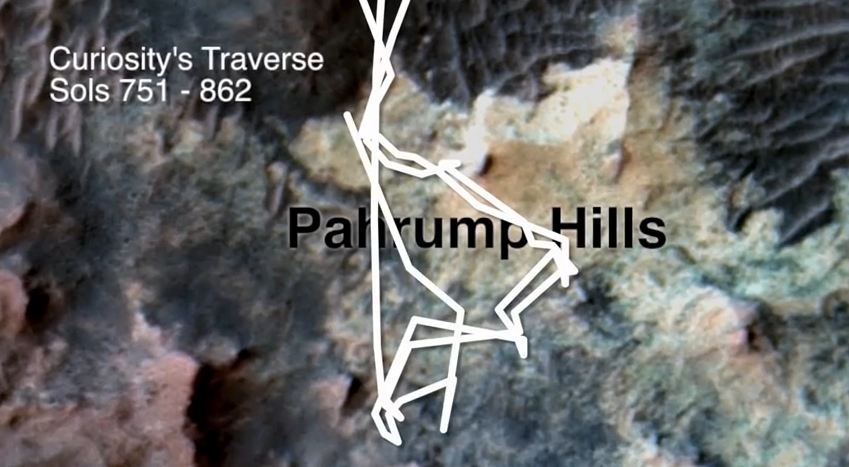
CuriosityIn my last report on the Mars Science Laboratory, I mentioned that Curiosity has been on a geology “walkabout” up the slopes of the “Pahrump Hills” at the base of “Mount Sharp” (more correctly, Aeolis Mons). The zigzagging route up through the area took the rover from “Confidence Hills” and the location of the last drilling operation up to a point dubbed “Whale Rock”, the drive being used to gather information on potential points of interest for further detailed examination.

The exposed rocks in this transitional layering between the floor of Gale Crater, in which Curiosity arrived back in August 2012, and the higher slopes of “Mount Sharp” is expected to hold evidence about dramatic changes in the environmental evolution of Mars. Thus, the “walkabout”  – a common practice in field geology on Earth – was seen as the best means of carrying out a reasonable analysis of the area in order for the rover to be most efficiently targeted at specific locations of interest.

Curiosity’s walkabout, from “Confidence Hills” to “Whale Rock” in October, the rover is now working its way back to various points of interest for further studies

“We’ve seen a diversity of textures in this outcrop,” Curiosity’s deputy scientist Ashwin Vasavada (JPL) said of the drive. “Some parts finely layered and fine-grained, others more blocky with erosion-resistant ledges. Overlaid on that structure are compositional variations. Some of those variations were detected with our spectrometer. Others show themselves as apparent differences in cementation or as mineral veins. There’s a lot to study here.”

During the drive, Curiosity travelled some 110 metres, with an elevation of about 9 metres, using the Mastcam and the ChemCam (Chemistry and Camera) laser spectrometer system to inspect and test potential points of interest for more detailed examination at a later date. Since completing that drive, the rover has been working its way back through Pahrump Hills, this time examining specific targets using the robot-arm mounted Mars Hand Lens Imager (MAHLI) camera and spectrometer. Once this work has been completed, specific targets for in-depth analysis, including drilling for samples will for the core activity of a third pass through the area.

So far, two specific areas have been identified for detailed examination. The first, dubbed “Pelona” is a  fine-grained, finely layered rock close to the “Confidence Hills” drilling location. The second is a small erosion-resistant ridge dubbed “Pink Cliffs” the rover drove around on its way up the incline.

“Pink Cliffs” is roughly a metre (3ft) in length and appears to resist wind erosion more than the flatter plates around it.As such, it offers precisely the kind of mixed rock characteristics mission scientists want to investigate in order to better understand “Mount Sharp’s” composition. This image is a mosaic of 3 pictures captured on October 7th PDT, 2014 (Sol 771 for the rover) by Curiosity’s Mastcam. It has been white balanced to show the scene under normal Earth daylight lighting – click for full size.

Another target of investigation has been the edge of a series of sand and dust dunes right on the edge of “Pahrump Hills”.  In August 2014, Curiosity attempted to use these dunes as a means to more quickly access the “Pahrump Hills” area, but the effort had to be abandoned when it proved far harder for the rover to maintain traction than had been anticipated, particularly given the rover has successfully negotiated sandy dunes and ridges earlier in the mission. As a result, scientists are keep to understand more about the composition of the dunes.

On November 7th, Curiosity was ordered to venture onto the dunes very briefly in order to break the surface of one of the rippled dunes and expose the underlying layers of sand in an effort to better understand why the rover found the sand such hard going the first time around, and what might be within these wind-formed dunes that would prove to be so bothersome to driving over them. Data gathered from the drive is still being analysed.

Spanning roughly 1.2 metres from left to right, a wheel track breaks the surface of a dust sand dune ripple on the edge of “Pahrump Hiils”. The MSL science team hope the exposed material within the ripple will help them understand why Curiosity found these dunes hard-going when trying to cross them in August 2014.

The work in the “Pahrump Hills” area has given rise to concerns over one of the two lasers in the ChemCam instrument. As well as the main laser, known for “zapping” targets on the surface of Mars in order to reveal their chemical and mineral composition, the system uses a second laser, a continuous wave laser, used for focusing the ChemCam’s telescope to ensure the plasma flash of vaporised rock is properly imaged when the main laser fires. Data received on Earth when using the ChemCam to examine rocks on the first pass through “Pahrump Hills” suggests this smaller laser is weakening and may no longer be able to perform adequately.

If this is the case, the laser team plan to switch to using an auto-focus capability with the telescope so it will automatically focus itself on a few “targeting” shots from the main laser ahead of any data-gathering burst of fire, allowing for proper telescope calibration.

Continue reading “Of Martian walkabouts, pictures from a comet, and getting ready to fly”

The little lander that could – and did

Rosetta,
Rosetta,Philae and, behind them, comet 67P/Churyumov–Gerasimenko seen in an artist’s impression of the mission

It’s been a hectic 48 hours. On Wednesday, November 12th, after 10 years in space, travelling aboard its parent vehicle, Rosetta, the little lander Philae touched down on the surface of comet 67P/C-G/Churyumov–Gerasimenko (67P/C-G). It was the climax of an amazing space mission spanning two decades – and yet was to be just the beginning. Packed with instruments, it was hoped that Philae would immediately commence around 60 hours of intense scientific investigation, prior to its batteries discharging, causing it to switch to a solar-powered battery system.

Unfortunately, things haven’t quite worked out that way. As I’ve previously reported, the is very little in the way of gravity on the comet, so in order for Philae to avoid bouncing off of it when landing, several things had to happen the moment it touched the comet’s surface. As it turned out, two of these things didn’t happen, with the result that the lander did bounce – twice.

Where Philae may be (ESA image via BBC News) – Rosetta has yet to positively locate the lander beyond a rough estimate based on communications and signals received from the CONSERT instrument on the lander

The first time it rose to around 1 kilometre above the comet before descending once more in a bounce lasting and hour and fifty minutes, the second time it bounced for just seven minutes. Even so, both of these bounces meant the lander eventually came to rest about a kilometre away from its intended landing zone. What’s worse, rather than touching down in an area where it would received around 6-7 hours of sunlight a “day” as the comet tumbles through space, it arrived in an area where it was only receiving around 80-90 minutes of sunlight – meaning that it would be almost impossible to charge the solar-powered battery system.

As noted above, the mission was designed so that most of the core science could be carried out in the first 60 hours of the mission, just in case something like this occurred. Even so, in order to prolong the life of the vehicle, it would have been nice to move it into a greater area of sunlight. A means of doing this had also been built-in to Philae: the three landing legs can be flexed, allowing it to “hop”. But as images were returned to Earth by the Lander, it became apparent that one of the legs is not in contact with the ground, making such a hop problematic. After discussion, it was decided not to attempt to move the lander, but focus on trying to achieve the planned science objectives.

In this image released by ESA, a model of the Philae lander has been superimposed on images of the vehicle's shadowy surroundings as captured by the panoramic cameras mounted around the lander (image: Image: Sipa USA/Rex)
In this image released by ESA, a model of the Philae lander has been superimposed on images of the vehicle’s shadowy surroundings as captured by the panoramic cameras mounted around the lander (image: Image: Sipa USA/Rex)

As it turned out, the initial contact between the lander and the comet confused several of Philae’s instruments into “thinking” it had in fact landed, causing them to activate. These included the ROMAP magnetic field analyser, the MUPUS thermal mapper, the CONSERT radio sounding experiment and the SESAME sensors in the landing gear. Data received from these instruments, arriving on Earth some 30 minutes after initial contact with the comet, and the information which followed, help alert mission staff that something had gone wrong, and enabled them to subsequently piece together the events that occurred during the landing sequence, while the instruments continued to gather data and transmit it back to Earth via Rosetta.

On Friday, November 14th, the decision was taken to activate Philae’s sample-gathering drill, officially referred to as SD2. This had been postponed from the previous day, as the drill uses a lot of power. However, obtaining and analysing samples from inside the comet is a central part of the mission, the decision was made to push ahead with drilling operations.

Continue reading “The little lander that could – and did”