High Fidelity tutorial videos

HF-logoEarly December saw High Fidelity slip out a series of introductory videos on their YouTube channel under a play list entitled Intro to High Fidelity: The Basics.

At the time of writing this piece, six video are included in the play list, which together run to a total of some 16 minutes, although individually they range from just over the minute mark to just shy of five minutes in length. All six are narrated / produced by Chris Collins from HiFi, and the topic areas covered are:

  • First time log-in
  • Edit entities
  • Stack Manager
  • Oculus Rift set-up
  • Hydra support
  • Leap Motion controller.

First time log-in: takes the user from the point at which they have downloaded and installed the High Fidelity client software – referred to as “the interface”, and have logged-in for the first time, arriving in the High Fidelity sandbox area.

From here, Chris takes users quickly through changing the appearance of the default robot avatar by using one of the available pre-sets (“Ron”, shown in the image above), and noting that people can also upload their own avatars. He also covers ensuring the audio is correctly set (microphone pick-up, etc.), and basic navigation between domains / locations within the High Fidelity topography. Interface customisation through the use of JavaScript elements is also touched upon (the entire interface is written in JavaScript and includes some additional elements, making it highly customisable).

Editing entities: the second video provides a very high-level overview of creating and editing content (entities) in High Fidelity, starting with making sure the toolbox is correctly displayed (if necessary). Importing pre-built elements supplied with the interface is covered, and the ability for collaborative building within a domain is mentioned as is using FBX animations, and editing object properties is looked over.

A quick overview is also given on uploading custom content (in .FBX format), noting that it needs to be available from a web service (such as Dropbox or your own web server, if you happen to run one.

The Stack Manager focuses on building your own server to host a dedicated domain where you can build and share content, invite friends to come an join you and interact with them, etc. Servers can be run on your own local machine, or on any other machine to which you have suitable access (e.g. a web server).

The video runs through everything from downloading and installing the Stack Manager through to importing initial content. An overview of various settings (security, audio) and tools (logs, nodes), is also provided.

The final three videos provide quick start guides to using the Oculus Rift, Sixense Hydra and Leap Motion (attached to the Oculus Rift headset). All assume that you already have the hardware set-up and ready to go with your computer, and so each simply steps you through the basics to get yourself going (making sure the correct scripts are running, etc.).

Using the Sixsense Hydra with the High Fidelity interface
Using the Sixense Hydra with the High Fidelity interface

As noted, these are introductory videos, so don’t expect them to go into great detail in terms of what you can do, troubleshooting or anything like that. However, as quick start guides, they are clear, concise and do exactly what it says they do on the label.

Related Links

Videos courtesy of High Fidelity Inc.

Of mountains, methane and molecules

CuriosityAfter what has been a relatively quiet period in terms of news from Mars, things are once again proving interesting.

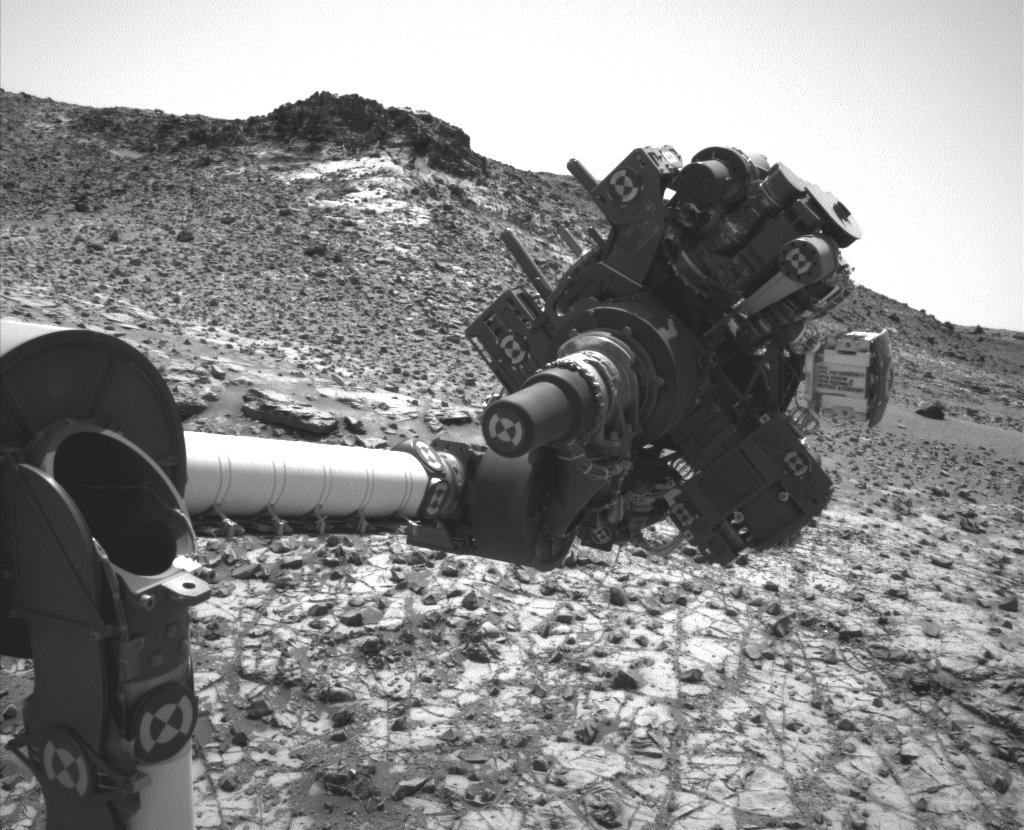
The first uptick came following the start-of-month teleconference Mars Science Laboratory personnel held to summarise the results of the last several months of activities the Curiosity rover has been performing in Gale Crater. In particular, these have allowed scientists to better determine how the 5 kilometre high mound at the centre of the crater may have been formed.

Even before Curiosity arrived on Mars, sufficient evidence had been obtained from orbit to show that features in and round Gale Crater were likely influenced by water-related activity. Curiosity itself found evidence for water once having flowed freely across parts of the crater when it encountered the beds of ancient rivers and streams as it explored the regions dubbed “Glenelg” and “Yellowknife Bay”.

With the journey down to “Mount Sharp”, and NASA call the mound, and the recent explorations of its lower slopes, the science team have been able to piece together the processes that led to its formation.

The first clues came while Curiosity was still en route to the point where examination of the “Mount Sharp’s” lower slopes could begin. As it drove southwards and towards the mound, the rover started to encounter layered sandstone deltas, all inclined towards “Mount Sharp”. On Earth, such layered, angled deposits are found where a river flows into a large lake.

A mosaic of images captured by Curiosity’s Mastcam on March 13, 2014 PDT (Sol 569). White-balanced for natural Earth light, the images show layered sandstone deposits, all pointing towards “Mount Sharp”, indicative of delta sediments dropped by a flowing river as it enters a large lake

Once in the foothills of “Mount Sharp”, in the area dubbed “Pahrump Hills”, Curiosity has repeatedly come across layers of tightly-compacted sedimentary mudstone which are entirely consistent with the sedimentary layering found in the muds and rock in lake beds on Earth. Intriguingly, while most of these layers appear to have been formed by sediments settling out of a large, still body of water, some of them appear to have been affected by wind erosion.

This latter point would indicate that rather than the crater floor once being covered by a single body of water which gradually vanished over time, it was subjected to cycles of wet and dry periods, giving rise to a number of lakes forming within the crater over the ages, each one only a few metres deep. As the water receded / vanished during the dry periods, so the uppermost layers of each lake bed were exposed to the wind, eroding them, before the next wet period started, and a new lake formed, gradually depositing more sediments on top of them.

Thus over a period of millions of years, Gale Crater was home to numerous lakes, each of them fed by assorted rivers and streams flowing into them, giving rise to the alluvial plains around the base of the crater walls, and the sedimentary deltas closer to “Mount Sharp” where these rivers and streams met the standing waters of each lake.

This diagram depicts a vertical cross section through geological layers deposited by rivers, deltas and lakes. A delta builds where a river enters a body of still water, such as a lake, and the current decelerates abruptly so sediment delivered by the river settles to the floor.

This view of Gale Crater is further supported by measurements of the deuterium-to-hydrogen ratio in the rocks sampled by Curiosity. These suggest that the sediments the rover is now examining were laid down during a period when Mars had already started losing its surface water, suggesting an extended period of climatic change on the planet, where the amount of free-standing water may well have been in flux.

Once the water had completely vanished from Gale Crater, it seems likely that “Mount Sharp” was sculpted by wind action within the crater. Thus, it is thought, would have eroded the material of the alluvial plains faster than the more densely compacted mudstone formed under the weight of the successive lakes.

As it might have been: the left image shows the repeated depositing of alluvial and wind-blown matter (light brown) around a series of central lakes which formed in Gale Crater, where material was deposited by water and more heavily compressed due the weight of successive lakes (dark brown). Right: once the water had fully receded / vanished from the crater, wind action took hold, eroding the original alluvial / windblown deposits around the “dry” perimeter of the crater more rapidly than the densely compacted mudstone layers of the successive lake beds, thus forming “Mount Sharp”

Continue reading “Of mountains, methane and molecules”

The man whose novel helped inspire Second Life takes a Magic Leap

It has been announced that science-fiction author Neal Stephenson has become the latest high-profile individual to join the ranks of Magic Leap, the still-mysterious company that seems to be doing something highly innovative with augmented reality – and perhaps virtual reality as well.

Stephenson, who wrote Snow Crash, the novel which first coined the term “metaverse” and is often referred to as one of the influences behind the development of Second Life, has accepted the position of “Chief Futurist” at Magic Leap, in news being broken by the likes of Wired and The Verge.

Neal Stephenson, Magic Leap's new
Neal Stephenson, Magic Leap’s new “Chief Futurist” (image: Bob Lee via Flickr)

Writing in a blog post for Magic Leap, Stephenson states he had been approached by the company months ago – and in a rather unique way:

A few months ago, two Irishmen, a Scot, and an American appeared on my doorstep with Orcrist, aka “Goblin-cleaver,” the ancient sword forged during the First Age of Middle Earth by the High Elves of Gondolin, later retrieved from a troll hoard by Thorin Oakenshield. It’s not every day that someone turns up at your house bearing a mythic sword, and so I did what anyone who has read a lot of fantasy novels would: I let them in and gave them beer. True to form, they invited me on a quest and asked me to sign a contract (well, an NDA actually).

The use of Orcrist in the offer is cleverly symbolic: one of the Board of Directors of Magic Leap is Sir Richard Taylor, founder and head of WETA Workshop, the company behind the models, costumes and special effects seen in the Lord of the Rings and Hobbit trilogies directed by Peter Jackson.

Precisely what Magic Leap is developing is something of a mystery, although as I’ve previously reported in these pages, what has been shown to the likes of Google, Legendary Pictures, Andreessen Horowitz and others led them to invest some $542 million into the company in October – and that on top of $50 million of investment at the start of the year.

What little is known about Magic Leap is that it is currently working on what it calls “cinematic reality”, which uses a headset which may eventually look something like a pair of sunglasses to overlay anything the wearer sees in the real world with 3D digital images that move and respond to the wearer’s own head an eye movements, and which appear to “interact” with the physical world around the wearer.

You'll believe a whale can fly - or that's perhaps Magic Leap's hope (among more practical things)
You’ll believe a whale can fly – or that’s perhaps Magic Leap’s hope (among more practical things)

Recently, Sean Hollister over at Gizmodo followed the lead set by Tom Simonite, a bureau chief at MIT Technology Review, in tracing down patents filed by Magic Leap in an attempt to find out more about what the company may actually be producing. As I again reported, their findings make fascinating reading for anyone interested in emerging AR and VR technologies – and in the history of Magic Leap, which up until the huge investment by Google et al, had been quietly flying under the radar for a number of years.

In that same report, I also covered the fact that what might be on of Magic Leap’s first major public demonstrations could be at the Manchester International Festival here in the UK in July 2015.

The Age of Starlight is a new film bringing together Oscar-winning director Kevin MacDonald, the visual effects team behind the 2013 George Clooney / Sandra Bullock blockbuster Gravity and science pundit and physicist Professor Brian Cox. The film will tell the story of the cosmos around us utilising Magic Leap technology, allowing audiences of up to 50 people at a time witness – and be immersed in – the unfolding majesty and mystery of the universe in what is billed as being a transformative, emotional experience.

The Age of Starlight: an immersive, transformative film using Magic Leap technology will be shown at the Manchester International Festival in the UK in 2015

It is apparently this transformative power within the Magic Leap technology that has attracted Neal Stephenson. Again, on the Magic Leap blog he states:

Here’s where you’re probably expecting the sales pitch about how mind-blowingly awesome the demo was. But it’s a little more interesting than that. Yes, I saw something on that optical table I had never seen before–something that only Magic Leap, as far as I know, is capable of doing. And it was pretty cool. But what fascinated me wasn’t what Magic Leap had done but rather what it was about to start doing.

Magic Leap is mustering an arsenal of techniques–some tried and true, others unbelievably advanced–to produce a synthesized light field that falls upon the retina in the same way as light reflected from real objects in your environment. Depth perception, in this system, isn’t just a trick played on the brain by showing it two slightly different images.

Magic Leap is not exclusively about games. It’s also going to be a great tool for readers, learners, scientists, and artists … What applies to games applies as well to other things of interest, such as making the world safe for books, doing new things with science and math visualization, and simply creating art for art’s sake.

We still don’t know precisely what Magic Leap will present or how it will work, and truth be told, there is an awful lot of hype and hyperbole surrounding the emerging new market for AR and VR it is hard at times to separate fact from fiction. But when the likes of Sir Richard Taylor and Thomas Tull (CEO of Legendary Pictures) pour their own money into a project, and it attracts names such as Brian Cox, Kevin MacDonald and now Neal Stephenson – you have to suspect something very special might well be sitting just over the horizon.

Related Links

The Great Gatsby: virtually redefining educational outreach

Explore TGGThose of us involved with and immersed in virtual worlds are very familiar with the power and opportunities they offer for educational purposes.

In January and February 2015, this will again be demonstrated in a unique way as literature, live theatre and a virtual world combine to present theatre goers and school children with the opportunity to not only witness the unfolding of one of the great stories from American literature – F. Scott Fitzgerald’s The Great Gatsby – but to actually immerse themselves in the story itself due to a new an unique collaborative partnership between the Tacoma Little Theatre (TLT), in Tacoma, Washington state, and the folk at Seanchai Library.

From on January 23rd, 2015 through until  February 8th, TLT will be presenting Simon Levy’s stage adaptation of The Great Gatsby, directed by Dale Westgaard, to adult audiences and daytime audiences from local schools.

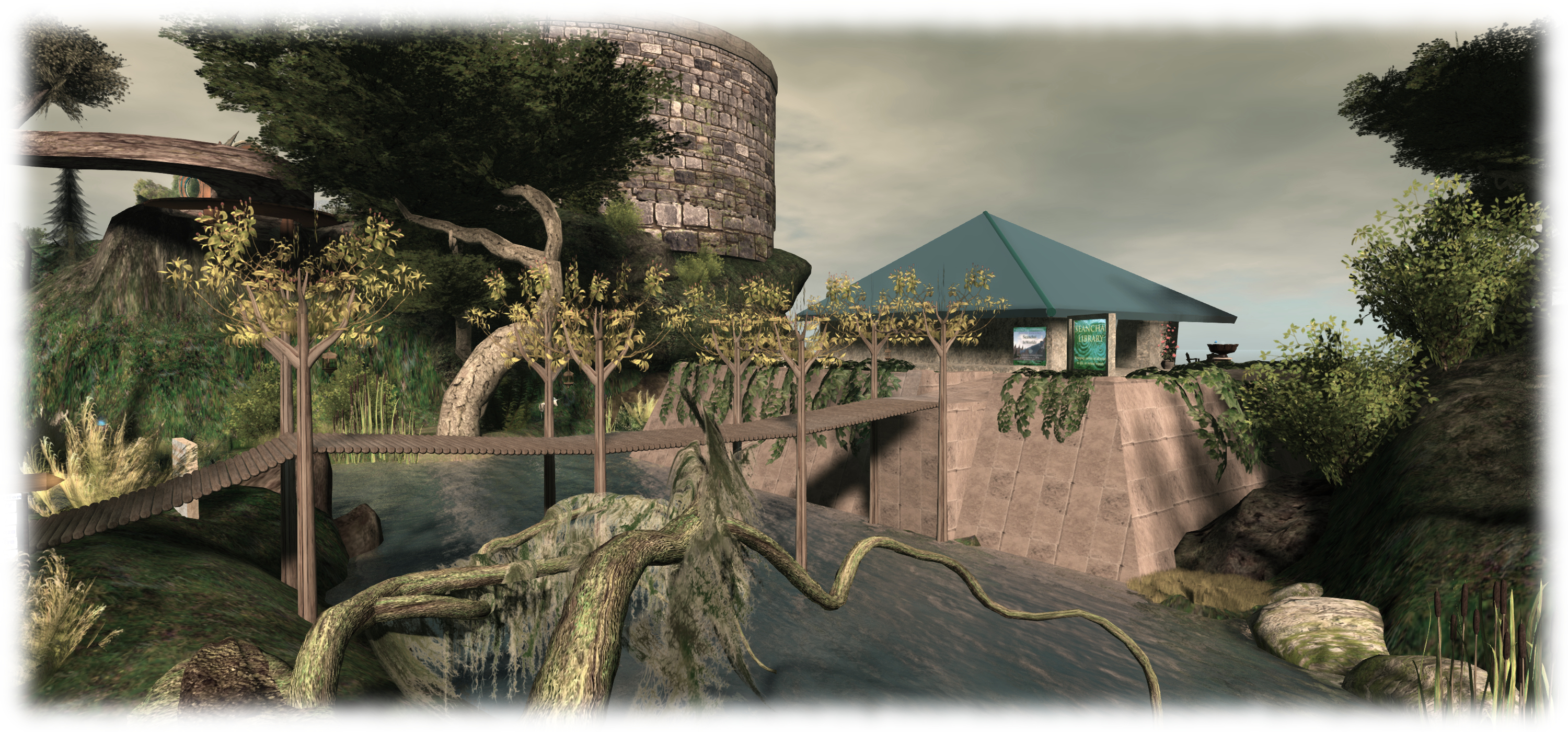
Coinciding with the play, through their extensive facilities on Kitely, the Seanchai Library will be offering audiences and schools attending performances with the opportunity to explore the world presented by the novel from the comfort of their own home or from within the classroom.

Explore Gatsby will run alongside TLT's production of 's stage adaptation of the novel, giving patrons the opportunity to explore F. Scott Fitzgerald's world in greater detail
Explore Gatsby will run alongside TLT’s production of Simon Levy’s stage adaptation of the novel, giving TLT patrons and schools  with the opportunity to explore F. Scott Fitzgerald’s world in greater detail

Explore the Great Gatsby Online, the début production in Seanchai Library’s EXPLORE the Stories Behind the Art series, will open its doors on January 14th, 2015. It will offer visitors the opportunity to visit key locations from the novel and play, and in doing so learn more about the era in which the story is set, explore Fitzgerald’s life and writings and discover more about the theatre in which the play is being performed.

On offer within Seanchai Library’s virtual environments will be a reproduction of the fictional West Egg, where the story’s narrator, Nick Carraway rents a small holiday guest house, only to find himself living next door to the enigmatic Jay Gatsby, giver of lavish summer parties. Both Carraway’s little holiday house and Gatsby’s mansion will be open to explore.

Also presented with the Explore Gatsby facilities will be a portion of East Egg, where Daisy Buschanan, the subject of Gatsby’s desires, lives in opulence with her husband Tom. Here, behind the Buchanan mansion’s façade, will reside a reproduction of the Tacoma Little Theatre itself, offering the opportunity for people to discover more about the theatre itself, which is among the oldest community theatres in the United States, and the oldest on the U.S. west coast, with a rich heritage going back to 1918.

And, of course, there will be the opportunity to visit the so-called “Valley of Ashes”, the industrial dumping ground so pivotal to the unfolding story, which lies between the fictional East and West Egg and the beating heart of New York City.

These various locations will serve as venues for a range of live events which both support TLT’s  production of The Great Gatsby and which also encourage visitors to further immerse themselves in literature, the stage and more; there will be readings and performances from the novel, interactive elements, within the various settings will provide information on a broad range of subjects, including information on the 1920s and the social issues people living then faced, the characters from the novel, etc.

Explore Gatsby will essentially be an educational study guide brought to three dimensional life. Through a special portal currently being developed by Seanchai Library, visitors will be able to learn how to download and use a viewer and operate an avatar, and then connect to Explore Gatsby in Kitely.

Tacoma Little Theatre will feature in Explore Gatsby, allowing people to discovery more about this historic community theatre
Tacoma Little Theatre will feature in Explore Gatsby, allowing people to discover more about this historic community theatre

Of special note with the project is the fact TLT present daytime performances of the plays they stage for local schools to attend. Thus, through their Explore Gatsby partnership with Seanchai Library TLT is presented with a dramatic – no pun intended – new way to engage with teachers, educators and school children in an immersive manner which links the performance of the play directly with classroom learning opportunities. The same also goes for TLT’s patrons, who can take a performance of The Great Gatsby home with them and them delve into Gatsby’s world through the Seanchai Library’s virtual recreations and events.

As noted above, Explore Gatsby will be opening its doors on Wednesday, January 14th, 2015, with in-world events and activities commencing on Friday, January 16th. Everyone involved in virtual worlds is extended a warm invitation to pop along and join in with planned activities as they take place – a programme calendar will be available nearer the time, and I’ll also be presenting it through these pages.

I’ve been privileged to be associated with Seanchai Library for a while now, and as a part of this association, I will be covering Explore Gatsby and the EXPLORE the Stories Behind the Art series as it develops. I’ll be kicking-off things in due course with a behind-the-scenes look at preparations for the début production.

Related Links

The human adventure is just beginning

Orion EFT-1 lifts-off exactly on time, 12:05 UTC, on Friday, December 5th, 2014
Orion EFT-1 (Exploration Flight Test 1) lifts-off exactly on time, 12:05 UT, on Friday, December 5th, 2014

Friday, December 5th marked what will hopefully be the first genuine step humans take in exploring the high frontier of space without total reliance upon robot vehicles. It came in the form of the launch, at 12:05 UT, of the first space vehicle in over forty years to be specifically designed to carry a crew beyond the limits of low Earth orbit and out into the depths of the solar system: the Orion Multi-purpose Crew Vehicle.

Originally, the lift-off had been planned for Thursday, December 4th. However, a series of incidents involving a small boat compromising the range safety exclusion zone, difficult winds over the launch pad, and then technical issues with two fuel valve systems aboard the Delta IV Heavy rocket, prompted the delay of the mission by 24 hours. But when the mission did get under way, it did so flawlessly, and continued in that manner right through until splashdown 4.5 hours later.

The two fairings which protect the Service Module as it sets between the Orion capsule and the upper stage of its launch booster (and which also take a fair amount of the dynamic pressures the vehicle experiences during launch) are jettisoned

Orion launched precisely on time, lifting-off in the post-dawn light of Florida’s Space Coast, and rising smoothly from Launch Complex 37 at Canaveral Air Station. The textbook launch was followed by a mission that followed the flight plan with amazing accuracy to the point where the craft, after a journey that carried it further than any vehicle intended to carry humans has flown in 42 years, and  which saw it punch its way back through the Earth’s atmosphere at 32,000 kph, splashed down just three kilometres or so from its planned target point.

The mission, called Exploration Flight Test 1, was uncrewed, and intended to test all of the critical systems for the vehicle with the exception of the Service Module, which won’t fly until the next Orion mission in 2017. Through the flight all of the system vital to the safety of a crew were put through their paces: the Launch Abort System, radiation protection, heat shield, and multiple parachute systems and the floatation system, together with all the vehicle’s complex flight avionics and software.

The limb of the Earth as Orion reaches some 4,000 km from its home, on its way to over 5,800 km, before making its return

So well did the vehicle perform through the flight that it was, in some ways, mundane; milestones came and went without a hitch, with only the launch and re-entry / splashdown forming points of drama / excitement. But really, that’s the whole point; problems aren’t what you need on a space mission. Let Hollywood play with them, but leave them out of the real thing.

Following launch, the vehicle rapidly climbed to orbit, the Delta launch vehicle’s two side boosters dropping away after the first few minutes of the flight to leave the core booster to get the vehicle to its initial height. Separation of the upper stage, complete with the “dummy” Service Module and Orion capsule then occurred, follow by the jettisoning of the fairings covering what would normally be the Service Module, and the ejection of the Launch Abort System (which, in a real mission, would automatically pull the capsule, which it enshrouds during launch, away from the main rocket the millisecond a serious anomaly in the rocket’s flight status is detected).

Re-entry: a camera aboard Orion captures the limb of the Earth, with the flames of super-heated plasma just visible as the bow-shock wave of the craft's entry into the atmosphere generate temperatures of 2,200C (twice that of molten lava) directly in front of the capsule, and around 1,800C around it, all of which is prevented from burning-up the vehicle by the presence of the heat shield 2under" the capsule and the shuttle-like thermal tiles covering its conical sides
Re-entry: a camera aboard Orion captures the limb of the Earth, with the flames of super-heated plasma just visible at the top, as the bow shock compression of air in front of the craft generates enormous friction with the air around it. Temperatures within the plasma reach 2,200C (twice that of molten lava) directly in front of the capsule, and about 1,800C around it, all of which is prevented from burning-up the vehicle by the presence of the heat shield “under” the capsule and the shuttle-like thermal tiles covering its conical sides

Passing through the Van Allen radiation belts – a critical test for the vehicle’s radiation protection and its electronics – Orion rose to a height of over 5,800 km above the Earth prior to separating from the Delta upper stage and “dummy” Service Module to start its return to Earth under its own power. This allowed mission planners to test the vehicle’s propulsion systems, which also functioned perfectly and with a greater degree of accuracy than had been expected.

Indeed, the only “failures” encountered with the flight, were the loss of the parachute bay cover – a section of the spacecraft which protects Orion’s parachute systems, and which is jettisoned for later recovery following re-entry into the Earth’s atmosphere – and the first set of drogue ‘chutes deployed. Following splash down, it was discovered that one of the 35-6 metre diameter main parachutes had sunk before it could be recovered, and one of the five floatation devices used to right the craft should it land inverted in the water (it didn’t), had failed to inflate.  All of these are really minimal loses when compared to the overall success of the flight.

A great shot from the recovery ship USS Anchorage, sent via the NASA Google Hangout covering the mission, showing Orion EFT-1 descending under 3 fully deployed main parachutes

There will now be a three-year pause in Orion flights. This will allow the first Service Module to be built and delivered to NASA by the European Space Agency and, more particularly, allow NASA to complete the construction of the first in its new generation of launch vehicles, a rocket simply referred to as the Space Launch System.

Even so, and as I recently blogged, Orion EFT-1 marks the first step in what will hopefully, political will allowing, be a new era in the exploration of our solar system. As such, and despite more than fifty years having passed since the first man orbited the Earth, it is fair to say that where space flight is concerned, the human adventure is just beginning.


Orion: first flight time line

The moment of separation: Orion, shrouded by the Launch Abort System, and attached to the "dummy" Service Module / Delta upper stage combination at just after separation from the main stage of the Delta rocket. The two panels seen either side of Orion are the panel that protect the Service Module during ascent to orbit
The moment of separation: Orion, shrouded by the Launch Abort System, and attached to the “dummy” Service Module / Delta upper stage combination, just after separation from the main stage of the Delta rocket. The two panels seen either side of Orion protect the Service Module during ascent to orbit, and are jettisoned just ahead of the Launch Abort System

Update: Friday, December 5th. The Orion EFT-1 mission was a complete success, and I have an update available for those interested.

Update: Thursday, December 4th, 2014: due to a series of issues involving a boat straying too close to the launch pad, wind speeds around the pad exceeding safe limits, a fuel valve problem on two of the booster engines and – finally – concerns over the battery lief on Orion’s camera systems expiring due to lack of charge (with the fuel valve issues also unresolved) a decision was made to scrub the launch. A re-try will be made on Friday, December 5th, all major times given in the time line here remain the same, although NASA TV coverage will not commence until 11:00 UTC / 06:00 EST.

At approximately 12:05 PM UTC, on Thursday, December 4th, a Delta IV Heavy booster should lift-off from Launch Complex 37 at the Cape Canaveral Air Force Station (immediately to the south of NASA’s Kennedy Space Centre, and the home of the vat majority of America’s unmanned rocket launches).

Sitting at the top of the rocket, covered by the protective shroud of its Launch Abort System, will be America’s newest space vehicle, one that will – if all goes well, and political willingness is maintained – carry a crew to an asteroid in 2021, before taking humans back to the Moon, and then, perhaps around 2032, onwards to Mars and back.

The Orion "stack" at launch
The Orion “stack” at launch

The Orion Multi-purpose Crewed Vehicle (MPCV) is, as I’ve mentioned before in these pages, the first crew-capable space vehicle NASA has commissioned and will operate since the the space shuttle – a design itself rooted in the !970s. Yet in some respects, Orion evokes an even earlier era than that – the heady days of Apollo. Not only will it hopefully participate in lunar missions in the future, it actually resembles the Apollo Command Module, being a capsule vehicle, albeit one larger than Apollo (it can carry up to six crew, although four will likely be the usual crew number) and it is truly state-of-the-art in terms of design and capabilities.

This first launch will see Orion operated in an uncrewed proving flight, and will mark the start of a 4.5 hour mission that will see the capsule, complete with a “dummy” service module (again, like Apollo, Orion uses a Service module unit to supply life support, power and propulsion), travel further from the Earth than any vehicle designed to carry a crew has gone since the last of the Apollo Moon missions in 1972.

In doing so, the vehicle will be tested through the Van Allen radiation belts surrounding the Earth, and the capsule will be directed to re-enter the Earth’s atmosphere at around 80% of the velocity it would achieve on a return from a cislunar mission (that is, roughly 4,000 kph (2,500 mph) faster than the space shuttle ever returned to Earth).

For those interested in the mission, here’s a brief time line of events:

  • 03:50 UTC, December 4th / 10:50 EST, December 3rd: The mobile launch gantry starts to withdraw from the launch vehicle
  • 07:35 UTC / 02:35 EST, December 4th: Fuelling the Delta IV Heavy commences
  • 08:35 UTC / 03:35 ET: NASA flight control team take over from United Launch Alliance in managing launch preparations
  • 09:30 UTC / 04:30 EST: NASA TV coverage of the launch commences
  • 11:46 UTC / 06:46 EST: Terminal countdown hold for final pre-launch checks
  • 11:57 UTC / 06:57 EST: Go / No Go launch poll; Orion switches to internal power
  • 12::01 UTC / 07:01 EST:  Terminal countdown begins
  • 12:05 UTC: / 07:05 EST: Lift-off!
  • 12:05  through 12:22:39 UTC / 07:05 through 07:22:39 EST:  vehicle climbs to initial orbit of 185 x 888 kilometres (115 x 552 miles), during which boosters and first stage are jettisoned, as are the Service Module fairings and Launch Abort System. Orion and Service Module still attached to Delta upper stage
  • 14:00:26 UTC / 09:00:26 EST: Delta upper stage engine re-fires for 4:45 minutes, pushing the vehicle to its extended elliptical orbit that will carry it 5,800 km (3,600 miles) from Earth
  • 14:10-14:25 UTC / 09:10-0925 EST: Orion passes through Van Allen radiation belts; cameras turned off during this period
  • 15:10 UTC / 10:00 EST: Orion reaches furthest distance from Earth
  • 15:28:41 UTC / 10:28:41 EST: Orion capsule detaches from “dummy” service module / Delta upper stage
  • 15:35-16:10 UTC / 10:35-11:10 EST: Orions passes back through Van Allen radiation belts, reaction control motors used to initiate return to Earth
  • 16:18:35 UTC / 11:18:35 EST: re-entry into Earth’s atmosphere commences at 36,000 kph (20,000 mph)
  • 16:18:41-16:21:11 UTC / 11:18:41-11:21:11 EST: radio blackout & hottest period of re-entry with heat shield temperatures reaching 2,200C (4,000F), slowing the vehicle to around 480 kph (300 mph)
  • 16:24:29 UTC / 11:24:39 EST: parachute bay cover jettisoned (and also recovered after parachuting to its own splashdown)
  • 16:24:31 UTC / 11:24:31 EST: drogue parachute deployed, slowing vehicle from 480 kph (300 mph) to 160 kph (100 mph)
  • 16:25:40 UTC / 11:25:40 EST: main parachute deployed, slowing the vehicle from 160 kph (100 mph) to less than 30 kph (20 mph)
  • 16:28:29 UTC / 11:28:29 EST: Spashdown, to be followed by recovery by the USS Anchorage.
The boat (arrowed) that initially held the Thursday, December 4th launch, as it sits within the safety exclusion zone
The boat (arrowed) that initially held the Thursday, December 4th launch, as it sits within the safety exclusion zone. the first of several delays and issues which eventually resulted in the planned launch being scrubbed for 24 hours.