Space Sunday: previewing missions in 2021

The uncrewed NASA Artemis-1 mission, featuring the first flight of the Block 1 Space Launch System (SLS) carrying an Orion MPCV at the start of a 26-day mission to and around the Moon, should occur towards the end of 2021. Credit: NASA

Despite the pandemic, 2020 proved to be a busy year for space activities, with a range of significant launches of both government-led / overseen missions and private sector launches. However, as busy and as challenging as it was, 2020 potential pales somewhat in comparison to what we should / will hopefully see in 2021. So, as with last year, I thought I’d kick-off Space Sunday in 2021 with a look ahead to some of the year’s  space missions.

Mars

2021 will see three new arrivals orbiting and landing on Mars.

The first to arrive will be the United Arab Emirates’ Hope spacecraft. Launched on July 20th, 2020 from Tanegashima Space Centre in Japan atop a H-IIA rocket, the mission comprises an orbiter vehicle designed to study the Martian atmosphere and climate.

Built entirely in the UAE, the mission marks the first attempt to operate an interplanetary mission by any West Asian, Arab or Muslim-majority country. It carries a range of science systems provided by the Mohammed bin Rashid Space Centre (MBRSC) and the University of Colorado Boulder with support from Arizona State University (ASU), and the University of California, Berkeley. Hope is due to arrive in an initial orbit around Mars on February 9th, 2021.

The UAE Hope orbiter Credit: Mohammed bin Rashid Space Centre via the New York Times

China’s Tianwan-1 (“Questions to  Heaven”) mission will be the next to arrive in Mars orbit. The precise date has yet to be confirmed, but orbital insertion should happen between the 11th and 24th February, 2021. It is an incredibly ambitious mission,  comprising a total of 13 science instruments and experiments, split between two distinct mission elements.

The first of these is the orbiter vehicle, which will commence operations almost immediately. It is tasked with producing Martian surface maps, characterising the Martian atmosphere – notably its ionosphere, measuring the Martian magnetic field, examining the composition of the Martian subsurface via radar, and imaging the surface of Mars in high-resolution. As a part of the latter work, the orbiter will carry out extensive surveys of the proposed landing zones for the second part of the mission: a lander / rover.

These will deploy some time around April  23rd. The rover’s mission is to examine the Martian sub-surface to a depth of around 100 metres using ground-penetrating radar and study of Martian weather systems. In particular, both elements of Tianwen-1 will aim to find evidence of current or past life on Mars.

The third mission that will arrive at the Red Planet will be the NASA Mars 2020 mission, comprising the rover Perseverance and the robot helicopter Ingenuity. Unlike the other two missions, Mars 2020 won’t spend any time in orbit: instead, it will proceed directly to atmospheric entry and delivering its payload to the surface on February 18th, 2021.

The primary goal of Perseverance will be to seek signs of habitable conditions on Mars in the ancient past, and will also search for evidence — or biosignatures — of past microbial life and water. As with Curiosity, the rover is powered by a nuclear “battery”, capable of keeping the rover operating for some 14 years. Based on the Mars Science Laboratory (MSL) Curiosity rover, it will be delivered to the surface of Mars in the same manner – using a “skycrane” system.

NASA Mars 2020 Perseverance rover and Ingenuity helicopter. Credit: NASA via the New York Times

Ingenuity, the helicopter will arrive on Mars attached to the underside of the rover. Some time in the first few months after arrival, the rover will deposit it on the surface, and it will then complete around 5 flights over a 30-day period. Fully automated, and lasting up to 3 minutes apiece, these flights will each carry Ingenuity up to 10 metres altitude and a distance of up to 600 metres. The primary aim of the mission is to test the ability of an automated aerial vehicle to support ground operations on Mars, in this case, helping to map the best driving route for the rover as it explores Jezero Crater.

The Moon

While America’s Project Artemis is unlikely to achieve its original goal of returning humans to the surface of the Moon by 2024, the coming years should see a number of significant lunar missions take place in the run-up to an eventual human return to our natural satellite.

In April, NASA will launch  CAPSTONE, the Cis-lunar Autonomous Positioning System Technology Experiment via a commercial electron rocket. A cubesat mission, CAPSTONE is intended to test and verify the calculated orbital stability planned for the Lunar Gateway space station.

In July a privately-funded mission in support of Artemis will deliver 14 NASA- funded science missions and 14 private-sector missions to the surface of the Moon, including a trio of rovers – one from the USA, one from Japan, and a novel mini walking robot from the UK called Asagumo. Originally a contender for the lunar X-Prize, the Peregrine mission has been expanded by NASA to test technologies that may be used in support of Artemis. It will be the first operational flight of United Launch Alliance’s Vulcan rocket.

On October 11th (or thereabouts) the Intuitive Machines 1 (IM-1) mission will  similarly deliver a NASA science payload to the surface of the Moon on the company’s NOVA-C lander.

An artist’s impression of the 3m tall NOVA-C lander on the surface of the Moon. Credit: Intuitive Machines

Launched via a SpaceX Falcon 9 rocket, the mission will target a relatively flat area near Vallis Schröteri in the Oceanus Procellarum (Ocean of Storms), where it will operate the package of 5 science systems on behalf of NASA. Overall, NOVA-C is designed to be a highly flexible lander system standing up to 3 metres tall and capable of delivering a wide range of small payloads to the Moon.

The end of the year should also see the first launch of NASA’s massive Space Launch System (SLS) rocket, intended to be the core workhorse for the Artemis programme, as well as offering a potential heavy launch vehicle NASA’s deep space aspirations.

The Artemis-1 mission, currently slated for November 2021, will be the first launch of a the Block 1 variant of the launcher. It will send an uncrewed Orion Multi-Purpose Crew Vehicle (MPCV) to the Moon in a 26-day mission that will include 6 days in which the Orion capsule and its service vehicle will be in a retrograde orbit around the Moon, followed by a return to Earth and splashdown. If successful, the mission will pave the wave for a crewed mission around the Moon in 2023.

October will see Russia make a return to with the launch of the Luna 25 (formerly Luna-Glob) lander combination on October 1st, 2021. Directly to land in the Boguslavsky Crater near the lunar south pole, the mission will characterise the nature of the crater floor, including the presences of any sub-surface water ice, and will attempt to obtain samples for on-board analysis.  The mission was renamed “Luna 25” to mark it as a direct continuance of the old Soviet Luna missions, the last of which – Luna 24 – took place in 1976.

India also intends to expand on its lunar presence in 2021 with the launch of its Chandrayaan 3 mission. A proof-of-concept mission, it is designed to deliver a lander and rover directly to the surface of the Moon (no orbiter vehicle will be used), and is a follow-on to India’s Chandrayaan 2, which successfully placed an orbiter of that name about the Moon (which is still operating), but saw a failure with its Vikram lander and Pragyan rover, lost when a software error resulted in them crashing into the Moon, rather than landing on it.

Continue reading “Space Sunday: previewing missions in 2021”

The art of … well, me, actually!

Kultivate Loft Gallery, January 2021

As a rule, I’m not a great believer in self-promotion, however, I also have to admit to being delighted and honoured to be invited by John Huntsman to present some of my images of the places I’ve visited in SL in the opening exhibition of 2021 for Kultivate Magazine’s Loft Gallery.

As I’ve oft – and genuinely – stated, I do not consider myself as “artist” when compared to the many, many talents of genuine artists who have a genuine talent for bring Second Life and its avatars to life; my work is really attempts at illustrating the places I visit rather than trying to be any form of artistic statement. So, when I receive an invitation such as this, I am genuinely (and quite considerably) honoured and flattered. In  this case, very, very much so, given the calibre of artist who are generally invited to exhibit at the Kultivate galleries.

I’m also not great with opening events – I prefer to keep to the background and patter / putter around where I can’t be notice. However, and all things being equal, I’ll be at the Loft for the opening John and Tempest have arranged, and I hope that you’ll drop by either for the opening event from 12 noon SLT on sunday, January 3rd, or over the next few weeks and have a peek at the images I’ve selected for the exhibition.

Many thanks again to John and Tempest for arrange this exhibition.

SLurl Details

An Ambient Hideaway in Second Life

Ambient Hideaway, January 2021

Shawn Shakespeare got us off to our 2021 visits around Second Life with a suggestion we drop into Ambient Hideaway, a Homestead region that is a joint design by Yoyo Collas with the assistance of Mirias and Silly Snook.

A rugged setting currently caught beneath the cloak of winter, the region comprises a large island with a north-to south orientation with a smaller shelf of rock to the south-east, reached via a wooden bridge.

Ambient Hideaway, January 2021

Visits commence in the northern highlands of the main island, a plateau sitting atop cliffs rising from an icy sea.It is home to a cosy restaurant bar delightfully called The End in contrast to it actually being the start of a journey through the region. With seating space both indoors or out under the low-lying (mesh) clouds, the bar shares the plateau with a small hall where visitors can find out about the region’s photography contest which still had a few days to run at the time of our visit, the closing date being January 6th, 2021.

There are three routes down from this plateau, each of which offers its own opportunities for discovery. To the west, wooden steps and a board walk lead down to first a lower shoulder of the plateau and then to a finger of rock pointing west as a slender promontory. Deer wander here, and a wooden cabin lends the warmth of a fire within and that of a brazier to the rear, where the snowy slopes drop down over frosted rocks to the ice and cold waters of the sea below.

Ambient Hideaway, January 2021

Further steps  lead down to a deep bay that faces south-west, sitting between the western promontory and the southern lowlands of the main island. The bay holds within its arms a frozen beach and an old pier and deck extending into the waters, what might have once been a warehouse located on the deck now converted into a cosy snug.

Stone steps climb gently from the east side of the snow-covered beach to link with the second route down from the plateau with its bar and restaurant. Watched over by a Canadian goose and an impressive statue of a stag-headed female figure (“Hern the huntress”, perhaps?), this second path down from the landing point offers the way to a long, thin sand bar that points south and east to where a great circular tent stands in a suggestion of Genghis Khan, the horses walking the sandy finger perhaps adding the feeling one is travelling time to the Mongol times as one follows it to the tent.

Ambient Hideaway, January 2021

Also reached from the path is an open-sided gazebo with a hint of the Christmas just passed standing alongside it, as both stand over the bridge leading to the smaller island. A beach house awaits discovery on this small shelf of rock, and while it lacks a fire inside, a brazier on the deck outside offers an invitation for visitors to go in and a spend a little time away from the cold.

The third route down from the high plateau is by way of wooden steps and platforms to a low-lying out-thrust of flat rock with a shale beach on its north side. An old shipping create, perhaps washed ashore years ago, resides here, but rather than being left to rust and fall apart, it has been turned into a comfortable little hone, complete with windows and doors cut into its side, a large raised deck offering additional outdoors space as it overlooks the beach.

Ambient Hideaway, January 2021

This is a setting that appears to be a lot larger than the 256×256 metres of a Second Life region, the natural shaping of the land and the use of elevation and defined paths giving a sense of expansive space, while the sound scape adds to the sensation that this is place within the wilderness – perhaps an island in northern latitudes lying off the coast of a continent that is itself caught in winter.

There is a wealth of detail to be found within the setting as well – be it outdoors or within the various buildings. Couples are clearly welcome here; there are numerous opportunities for romance waiting to be found in the form of cuddle spots such as that waiting at the end of the western promontory or the old cable-car sitting on the edge of upper plateau.

Ambient Hideaway, January 2021

Photogenic – hence the local competition – richly designed and constructed, Ambient Hideaway makes for an engaging visit; just mind the rather exuberant humpback whale off the south coast! 🙂 .

SLurl Details

A new home for an Artists’ Village in Second Life

Campbell Coast, January 2021

Back in September 2020, I wrote about the Artists’ Village at Campbell Coast, operated by BJoyful and Doc Rast (rasterscan) and curated by Owl Dragonash.  Since that time, both Campbell Coast and the Village has relocated, the latter now forming a sky platform over the region.

Work recently completed on the relocation, which sees Campbell Coast offer a similar facility as found at the Phoenix Artists Collaboration – a collection of study-style spaces available to artists (group membership required), with up to 110 LI available per artist.

The studios are presented in town house style units with two floors of exhibition space (artists will need to install their own teleport systems between floors), with the studios laid out in blocks separated by cobbled streets and open spaces, complete with an open-air bar / event space at the southern end of the village.

Campbell Coast, January 2021

Some 42 units are available, with 29 already occupied  / reserved by the following artists: Dhyezl, Etamae, Jaz, Gidgy Adagio, Shakti Adored, Caly Applewhyte, Whimsical Aristocrat, Ceekay Ballyhoo, Michiel Bechir, Thomaz Blackburn, Giovanna Cerise, Rey Charles, Owl Dragonash, Apple Fall, Johannes Huntsman, Uli Jansma, Suzen Juel, Lena Kiopak,  Anouk Lafavre, Dimivan Ludwig, Radagast Malaprop, Kitty Mills, Nympheas Nogah, Inara Pey, Blues Rocker, Tempest Rosca, David Silence and Skip Staheli.

They are joined by musicians Jed Luckless, Lexus Melodie, Larree Quixote, and writer GoSpeed Racer. All of whom amount to a rich selection of artistic expression.

With music events to be held on occasion, as well as entertainment for art events, the Artists Village offers a lot for the patron of the arts to appreciate. When not enjoying the art on display, there are opportunities to sit and appreciate the setting  – designed by Kitty Mills and Owl Dragonash – and also to go horse riding.

Campbell Coast, January 2021

Those interested in obtaining a space at the Village should contact one of Bjoful, Doc or Owl in-world.

SLurl Details

A visit to an owl’s nest in Second Life

Eulennest, January 2021

Sitting on the southern coast of Corsica is small island occupying the south-western corner of Novatron is a small island called Eulennest (“owl nest”).

Held by Kitty (Kitten Mills) the island is home to a range of social venues Kitty has developed for public use. These include music events areas on the beach and up on the table of rock that forms the island, a  hidden water cistern, room to dock boats (the island can be reached by sailors) and to re-rez them, as well as numerous places to explore and / or to sit and enjoy the views.

Eulennest, January 2021
[Eulennest is] open for your events and parties – just book an appointment with Uli Jansma, register a DJ (you have to bring your own stream). If special decoration is desired or recitals are required, please contact Uli Jansma or Kitten Mills. It costs nothing!

from Kitten’s Profile

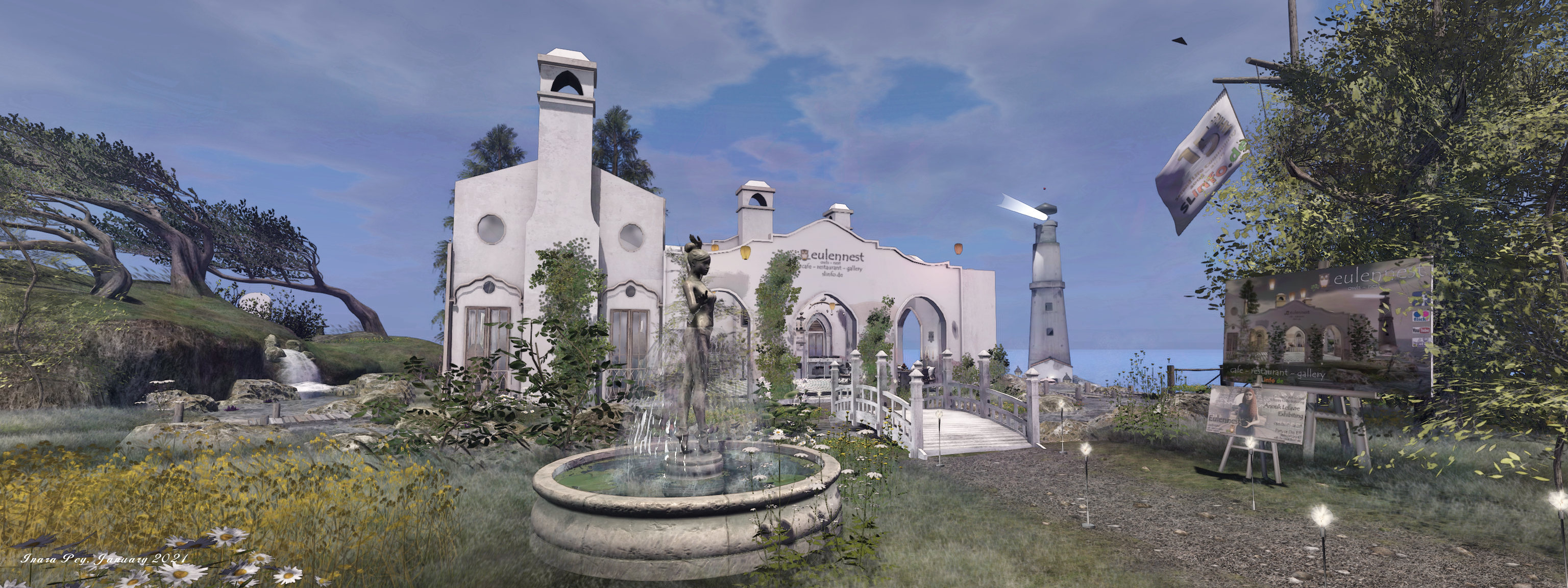
The focal point of the island is the Eulennest café-restaurant and gallery. It is set within Scarlet Creative’s Serendipity Retreat – oft seen within public regions as a deserted structure, and which here is put to very good use.   The café element sits within the courtyard of the building, whilst the two wings of the building form the gallery space within.

Eulennest: Anouk Lefavre

It was the gallery that drew me to visit, hosting as it does (at the time of writing) an exhibition of landscape images by Anouk Lefavre. Always a delight to see, the 19 images here perfectly encapsulate Anouk’s ability to bring the settings she visits to life . Here, the majority of images presented by the artist have a focus / theme of water, from coastal settings to rivers and streams – with the presence of water in one being quite subtle.

These are all captivating pieces, each one guaranteed to hold the attention and offered for sale at L$450, whilst the island as a whole offers plenty for the eye and camera to appreciate, and the body and mind to sit and rest while enjoying a visit.

Eulennest: Anouk Lefavre

SLurl Details

A Binemust winter in Second Life

White Binemust, December 2020

I’m rounding out my 2020 region explorations with a return trip to Biné Rodenberger’s Binemust, which Caitlyn and I last visited in September. At that time, the region was dressed as a representation of Bungenäs, a region of Sweden’s largest island, Gotland (see: Bungenäs at Binemust in Second Life).

That design is still available at ground level, but for Winter 2020/21 Biné has added a sky platform – White Binemust. As its name suggests, this is a place dressed as a winter setting that is nicely Scandinavian is style, whilst also lending itself as a snowy setting from almost any suitable mountainous region in snowy latitudes.

White Binemust, December 2020

Blending seamlessly with a snow-capped and off-region mountain range on all sides, the platform offers a richly wooded environment – a familiar element within Biné ‘s designs, both and above water level, as she has often demonstrated an imaginative use of space within her region that has included woods and copses below sea level as well as on  land -, the setting sits under a lowering sky that suggests a lot of snow is awaiting the opportunity to fall on top of that which has already settled.

The woods hide the fact that this is setting of two levels. The upper, home to the majority of the woodland, also forms the landing point for this winter setting, sitting as it does close to a junction of pathways visitors are free to follow. One of these, marked by an avenue of arched trees, leads to a snow-bound country chapel, an icy path links the chapel with a glass and steel igloo, both of which are watched over by an unexpected guardian: and oriental-style flying dragon.

Binemust, December 2020

A second path leads to a large house overlooking the lower aspect of the region (of which more anon). Of a modern, clean design, with large windows and cosily furnished, the house is suited to this snowy location, and appears to be open for visitors to explore – as do all the buildings to be found with White Binemust. The icy path running to the house ends in a circular pond, its surface frozen, revealing the smooth path may itself be a stream caught beneath the ice. A small cabin sits close by the pond; in warmer days it might form a summer house converted from a greenhouse; for now it presents a cosy den / bar.

A tiny cabin and a shed offering Christmas trees round-out the high-level section of the platform. Below them, reached via a path than descends via a line of steps, and a more open space, the woodland ending at a line of trees at the foot of the slope, having marched down it to meet a rutted track that follows the contours of the hill.

Binemust, December 2020

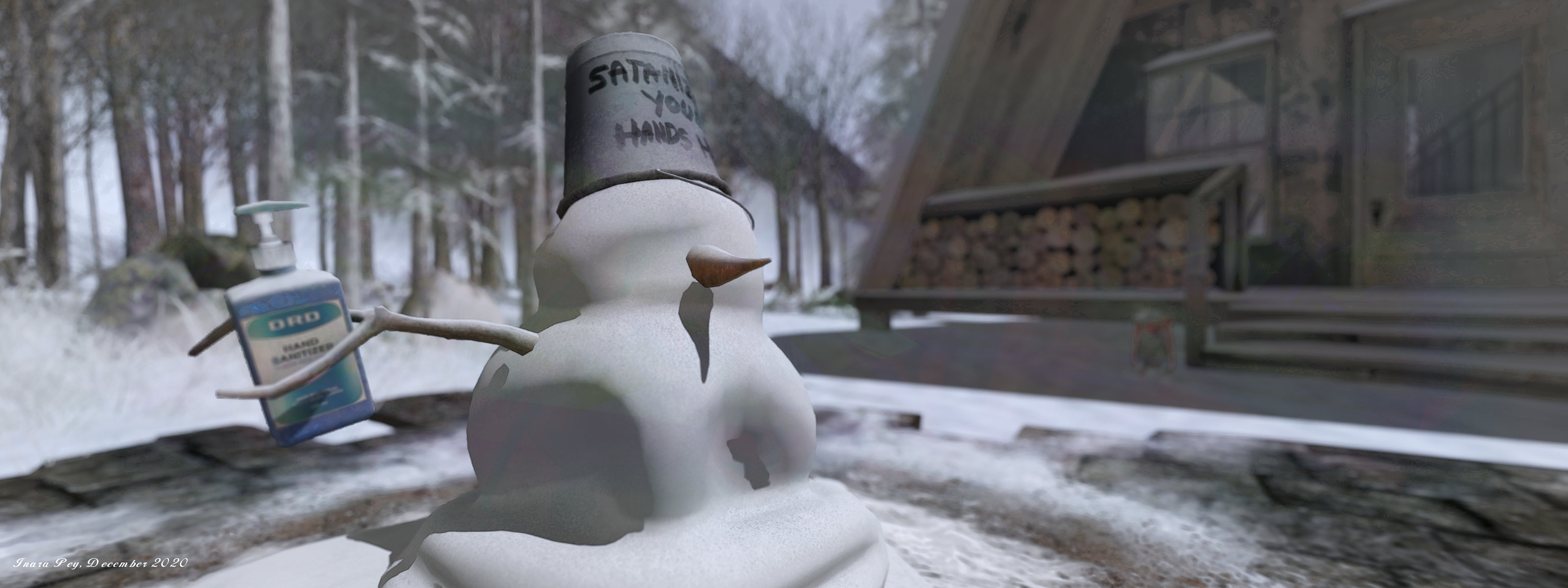
The selection of buildings here – focused on another clean design of a wood-framed ranch house –  has the feel of a farm caught in the depths of winter about it. Shaggy highland cattle graze in a fences field, a wagon of hay close-by should the snow overcome the grass of the field. Across the snow and ice sits and A-frame cabin, perhaps offered as a holiday home by those who own the farm. Sitting outside of it is a little snowman offering a reminder of a more unpleasant aspect of this past year.

Although sitting below the landing point, the farm and its buildings art nestled on the edge of a mountain valley, one suggestive of being formed in the ancient past by the passage of glacier that encountered a hard table of rock that forced it to split, giving rise to the plateau on which the setting is located.

White Binemust, December 2020

It is within this valley, visible from the large glass frontage of the farmhouse, that another of one of Binemust’s iconic elements can be found: the wreck of a Viking long ship. It’s a piece Biné uses as an emblem for her designs, a visualisation of her Norse / Scandinavian heritage.

While there are touches of Christmas to be found within the setting – decorated trees (one of them of a most interesting design), lights festooning tree branches and so on. However, this is far more a delightful winter setting than Christmas focused, thus it offer an ideal seasonal visit with which to see out the year (as it did for me) or as a winter setting in which to see in the new.

White Binemust, December 2020

SLurl Details