A magical Wildwood Gardens in Second Life

Wildwood Gardens, January 2021 – click any image for full size

With the end of an old year and the start of a new one, thoughts inevitably change from those of winter and snow to the arrival of spring and the rebirth of nature’s colours. Given this, I decided to hop over to Legallyblondmod Demonista’s setting of Wildwood Gardens.

Occupying a little over half a Full region, this is a richly detailed environment that is rich in colour; one that attracted me through the promise of a timeless setting within its description, and I was far from disappointed.

Wildwood Gardens, January 2021
Enjoy lakeside deep forest and exotic caves gardens among the ruins of old. Where hints of ancient magic still linger. Relax and take time to explore.

– Wildwood Gardens About Land description

The lake in question lies on the east side of the setting, at the far end of the woods and their gardens relative to the western landing point. This sits on a small headland that looks out over a narrow channel of water sitting between Wildwood Gardens and an off-region ribbon of an island  and overlooking a west side beach.

Wildwood Garden, January 2021

With its flower-bordered track running south along the back of the beach and lit by iron street lamps, together with the offer of a Teagle horse rezzer for those who might want to ride, and a folly-style rotunda sitting on the grassland on the far end of the beach, this initially has the feel of a simple garden, but there is fall more awaiting discovery, as the About Land description hints.

Proof of this comes by following the track as it passes along the back of the beach before turning inland to arrive at a junction. One arm of this points towards the rotunda on the coast, the other turns east, passing along the foot of a large elven hall that brings a slight flavour of Tolkien to the region.

Wildwood Gardens, January 2021

Elven in style the hall maybe, it has a  distinctly contemporary feel to its furnishings. There’s nothing wrong it this; the two styles compliment one another perfectly, offering a unique look to the hall. A further element of this magic can be found along the branch of the track pointing towards the rotunda near the beach. Following it will reveal it passes by the rotunda to arrive at the entrance to a network of tunnels and caverns.

The network is surprisingly extensive, winding its way under the highlands that form the southern side of the setting, and it is worth both following the suggestion of the sign at the entrance and set your viewer to Midnight and in  taking time to explore underground; the caverns offer hidden waterfalls and pools of water, exotic flowers and crystals and a choice of routes back to the surface.

Wildwood Gardens, January 2021

One of these offers a way back to the main track which, after passing over a stone bridge near the elven hall, passes through the denser trees, side paths branching off to reach places to sit – a camp ground here, a swing seat there, or a parasoled banket – look carefully and you’ll find them.

The remaining route through the cliffs leads to the southern bank of the lake and a hidden tree house that awaits discovery and enjoyment. It is overlooked by a cliff-edge stone pavilion that offers another Middle Earth feel, even though it is not intentionally designed as such. It stands as a hint of another secret to the setting: the cliff-top gardens that also await discovery.

Wildwood Gardens, January 2021

These offer multiple points of interest – a pond with cosy summer house, a walled garden that further combines hints of fable with a contemporary design, a wooden gazebo  – but how do you get up to it is the question. All I’ll say is, find the ruins watched over by unicorns that lies below the cliffs  – you’ll find them further along the track from the main hall, and the entrance to a tunnel and steps that lead up to the plateau are not far away. Should you miss it, you can still carry on along the track to where a bridge spans a gorge linking the lake with open water and another table of grass-topped rock that offers another wild garden with its own attractions,  and when finished there, find the tunnel stairs on your way back.

And all of this just scratches the surface of the beauty and magic of Wildwood Gardens, which is genuinely a place in which to lose oneself. There are multiple places to sit and share, a profusion of colours that naturally blend through flowers and plants, that captivating mix fable and contemporary that gives the setting a truly magical depth and sense of timelessness, all of which is rounded out by a perfect sound scape.

Wildwood Gardens, January 2021

An altogether enchanting design.

SLurl Details

A personal look at the Linden Stilt Homes in Second Life

My over-the-water Stilt Home parcel at Bellisseria, with the Tortuga style house rezzed and furnished

Back when I previewed the Linden Homes Stilt House theme, and again when the theme was released at the end of 2020, I mentioned it was the first theme that might tempt me away from the Houseboat theme, which has tended to always win-out against the subsequent Linden Home releases in terms of desirability.

While swapping homes wasn’t high on my priority list, I have to admit that the temptation to just give the Stilt Homes a try had been growing over the Christmas break. And so, while it did cause no small amount of anxiety – my Houseboat location was really very good – at the start of the week, I decided to make the swap, trying for an over-the-water Stilt Home.

Obtaining one took a little time – Stilt Homes-are obviously popular, being new, and the over-the-water version particularly so (Stilt Homes are offered individually as over-the-water; with pier or on land variants on the Linden Homes selection page). But careful refreshing within the page throttle limit meant I was able to eventually pick one up.

My Linden Stilt Home parcel with the Havana style house with moorings I’ve added myself

When previewing the houses, I had been somewhat swayed towards the two-storey designs (Lauderdale and Santiago). However, after re-familiarising myself with all four styles, I actually found the Havana and Tortuga better suited to my tastes, providing the best value (in my view) between living space and available water in the parcel for mooring boats, and betted options for interior customisation, having very good sized rooms (the Tortuga in particular).

Both styles are 3-roomed designs, with the Tortuga offering the slightly greater interior space in the form of two large through-rooms and a smaller room, while the Havana presents a central front-to-back through room flanked by a smaller room on either side. Both designs have a large, split-level rear deck that gives plenty of scope for sun decks and moorings.

Havana interior: the main room gives plenty of room for expression

While I cannot compare it directly with  Camper / Trailer, Victorian or Log Home themes, the Content Creation Pack for the Stilt Homes offers a somewhat greater range of options than the pack for the Houseboats, with furniture plants, textures, useful colour matching guides and other little goodies than might be put to good use. I was a little disappointed no corner posts were offered to go with the additional deck railings, or that there was no bi-fold door that might be used to split the Tortuga’s two through-rooms, but these are not exactly hard-to-overcome “shortfalls”.

Although there are already add-on kits for the Stilt Homes a-plenty on the Marketplace, I much prefer building / kitbashing, and the Tortuga with its big rooms immediately attracted me with the potential for adding my own features. So much so, that I spent several hours playing with different ideas in both rooms!

The Tortuga’s large deck area can be used for boat moorings without it feeling crowded – although admittedly, I’ve thus far minimalised décor and furnishings( a simple pergola, suitably sized, shading a couple of rocking chairs and some planters with flower to break things up

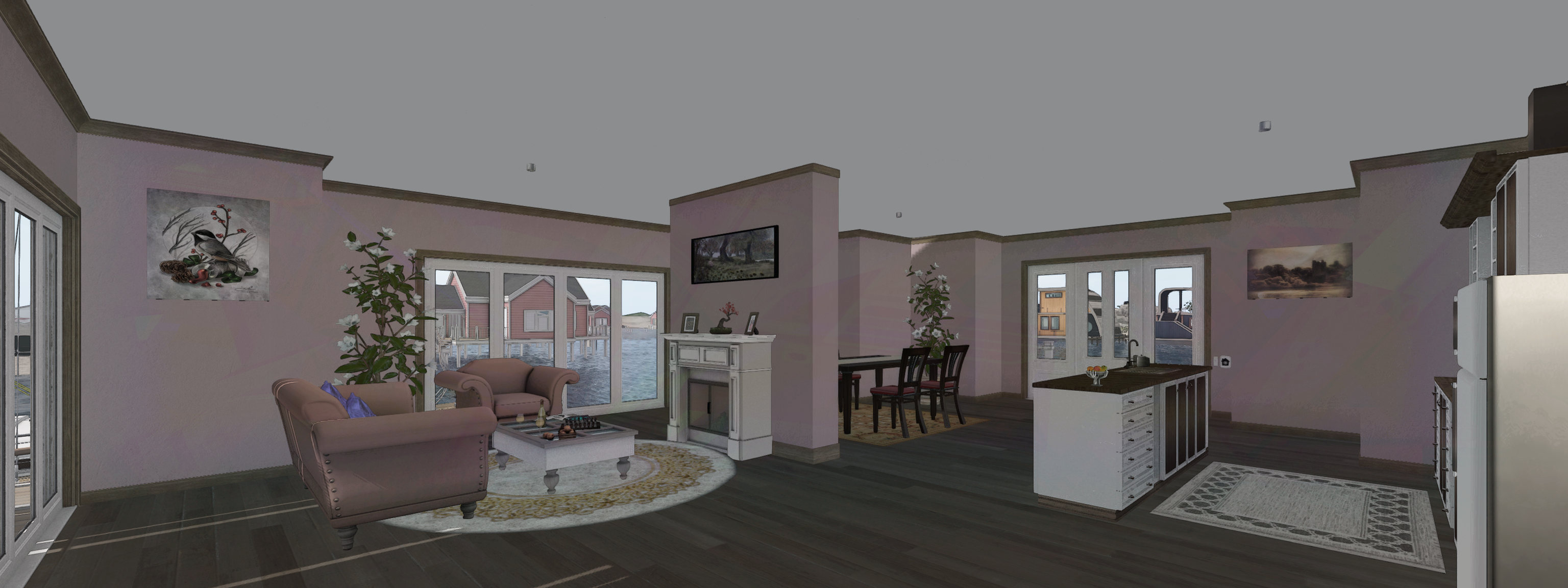
In the end, I went with the simplest approach: a free-standing “room divider wall” that splits the largest room in the Tortuga into two without actually dominating the space or looking out-of-place. One side of this became my “living room” overlooking the rear decks, with the divider itself neatly providing space for a fireplace (with added chimney jutting from the roof above!). This then allowed me to use the “front” part of the room as a kitchen / the dining area, with the long interior wall ideally suited for placing kitchen units, while the width of the room meant I could include a kitchen island, again naturally breaking up the floor space quite naturally.

While the Havana’s large main room could be similarly broken up, I found that with a little careful placement of bits, this isn’t really necessary; I was again able to include living area, dining area and kitchen comfortably into it. With the addition of decking and steps to  moorings outside the front of both (and the use of one side of the Tortuga’s deck), I have been able to provide ample space for mooring those boats I want to have rezzed (all of them otherwise sitting in my vehicle rezzer until I want them).

I’ve deliberately kept furnishings and décor on the decks of both the Havana and Tortuga to a minimum, the former having a free-standing pergola with large sofa, etc., and the latter a pergola and shades directly adjoining the back of the house (thus helping to shade the living room from the Sun) and a couple of rocking chairs  I may admittedly play with both decks a little more in the future, but for now, that’s all I really need.

I like the large main room of the Tortuga particularly amenable to being made a comfortable living space – plenty of room for a kitchen, dining area and lounge space – and even a fireplace to act as a natural room divider

As noted earlier, giving up my Houseboat did give me a moment of anxiety after I’d let it go, but over the last 3+ days I’ve become more settled with my decision; the Tortuga has been proving to be a very comfortable and flexible living space (even if only as a second home when Isla Caitinara isn’t available), and it is very likely I’ll end up saving several internal layouts of furnishings, etc., into my personal rezzer, just as I did with the Houseboat. I’m also admittedly fortunate that, like my old Houseboat, the parcel I’m on is fronted by a large channel of open water (a natural divide between Stilt Homes and Houseboats), so I don’t feel at all crowded in.

I’m not sure I’ll make use of the 2-storey styles;  while I like to look of both, they’re a little too big for my needs. But then, I might just be tempted at some point to have a play.  in the meantime, would I recommend the Stilt Home designs to someone looking for a new Linden Premium Account Home? Absolutely.

2021 SUG meeting week #1 summary

The Outer Garden – The Farthest Light – blog post

The following notes were taken from the Tuesday, January 5th, 2021 Simulator User Group (SUG) meeting.

There were no planned deployments for 2021 week #1. It  is hoped that the deployment schedule will resume in week #2, depending on their run through QA.

SL Viewer

There have been no changes to the current crop of official viewers, leaving them as:

  • Current release viewer version 6.4.11.551711, formerly Cachaça Maintenance RC viewer promoted on November 12 – No Change.
  • Release Channel cohorts:
    • Dawa Maintenance RC Viewer, version 6.4.12.553723, December 15.
    • Custom Key Mappings project viewer, version 6.4.12.552100, November 12.
  • Project viewers:
    • Simple Cache project viewer, version 6.4.11.551403, issued on November 12.
    • Project Jelly project viewer (Jellydoll updates), version 6.4.12.552224, December 4.
    • Legacy Profiles viewer, version 6.4.11.550519, October 26.
    • Copy / Paste viewer, version 6.3.5.533365, December 9, 2019.
    • Project Muscadine (Animesh follow-on) project viewer, version 6.4.0.532999, November 22, 2019.
    • 360 Snapshot project viewer, version 6.2.4.529111, July 16, 2019.

In Brief

Experience Keys

It is believed that the end-of-year experience keys issue (the XP_STORAGE_EXCEPTION problem, see my 2020 #week #52 update and BUG-229892) has been resolved. However it has been noted that some user may still be experiencing “lingering performance issues” with experience keys. Those experience any experience key issues are asked to contact Support.

Issues and Rumours

There were some issues experienced over the weekend, with users reporting an inability to rez and / or their avatars remaining as a cloud, and poor attached scripts performance. Rumours circulated about the issue being due to a “server” fire, and some reports appeared to have been  exaggerated (e.g. the issuing being open on Grid Status for “several hours”, when in fact it was reported as resolved some 45 minutes are initially appearing). Whilst not going in to specifics, Oz Linden noted that while there were issues, in terms of the circulating rumours, he noted:

It was much much less dramatic and interesting than that.

Map Tiles

Map tiles are still not being regularity updated, however the Lab both identified the cause of the issue and a possible fix. Progress is being made on the fix, however, it appears that it is taking time due to the Map code not having been touched in a good while.

General Post-Uplift Issues

While the core work of transitioning all SL services to AWS systems has been completed, there are still some niggling problems that are being dealt with – such as with the Map tiles (above) and on-going issues with things like the official viewer Splash screen updating, the land store, etc. The Lab is addressing these as they can.

Linden Lab gives cloud migration update & new ownership announcement (updated)

The former co-location cage used to operate Second Life and its services. Credit: Linden Lab

Update: since this post was published, Linden Lab have clarified the fact that the acquisition process is in fact complete, revising their comment on the acquisition process.  I have therefore revised the end of this post to reflect the updated comment on  the acquisition. See also: Meet Linden Lab’s new board of directors.

On Tuesday, January 5th, Linden Lab provided a short update on the cloud migration work and on the current situation regarding the company’s acquisition.

The physical move to AWS services was completed at the end of 2020, and the blog post expands on some tweets made by April and Soft Linden over the Christmas period.

In her December 23rd tweet, April Linden confirmed that the last of the Lab’s services had been migrated to AWS services, and that the remaining systems within the Lab’s (now former) co-location facility in Arizona had been powered off.

April Linden confirming the migration of the last of the SL services to AWS

In discussing the fate of the data held on the old hardware in late 2020, Oz Linden had indicated that Linden Lab had arranged for all of the hard drives from  the co-location facility would be shredded – and on December 31st, 2020, Soft  Linden tweeted that the work had been completed by a professional data destruction company, with a total of 10,588  hard drives and solid state drives that had been contained within the Lab’s old hardware had indeed been shredded.

Soft Linden on the shredding of the Lab’s old disk drives

The January 5th blog post builds on both of these tweets by providing a photograph of the cleared-out cage at the Lab’s former co-location facility, and a short video of drives being shredded, both of which I’ve included here.

Linden Research Acquisition Complete

Turning to the July announcement that an agreement in principle had been reached with an investment group led by Randy Waterfield and Brad Oberwager to acquire Linden Research Inc., (as Linden Lab is formally known), the blog post confirmed the acquisition process has been completed, and Linden Lab is now under new ownership:

Another noteworthy development for the new year is that Linden Lab has new owners! As announced in mid-2020, an investment group led by Randy Waterfield and Brad Oberwager signed an agreement to acquire the company subject to regulatory approval by financial regulators in the U.S. related to Tilia Inc.’s status as a licensed money transmitter as well as other customary closing conditions. We are pleased to share that the regulatory review has been completed and Linden Lab is now under new ownership.

At the time of writing, the official About Linden Lab page had yet to show any changes in the board structure to reflect the acquisition completion – I expect that will come in due course.

Read the official blog post for more.

Related Links

Tales and myths and letters from history in Second Life

Seanchai Library

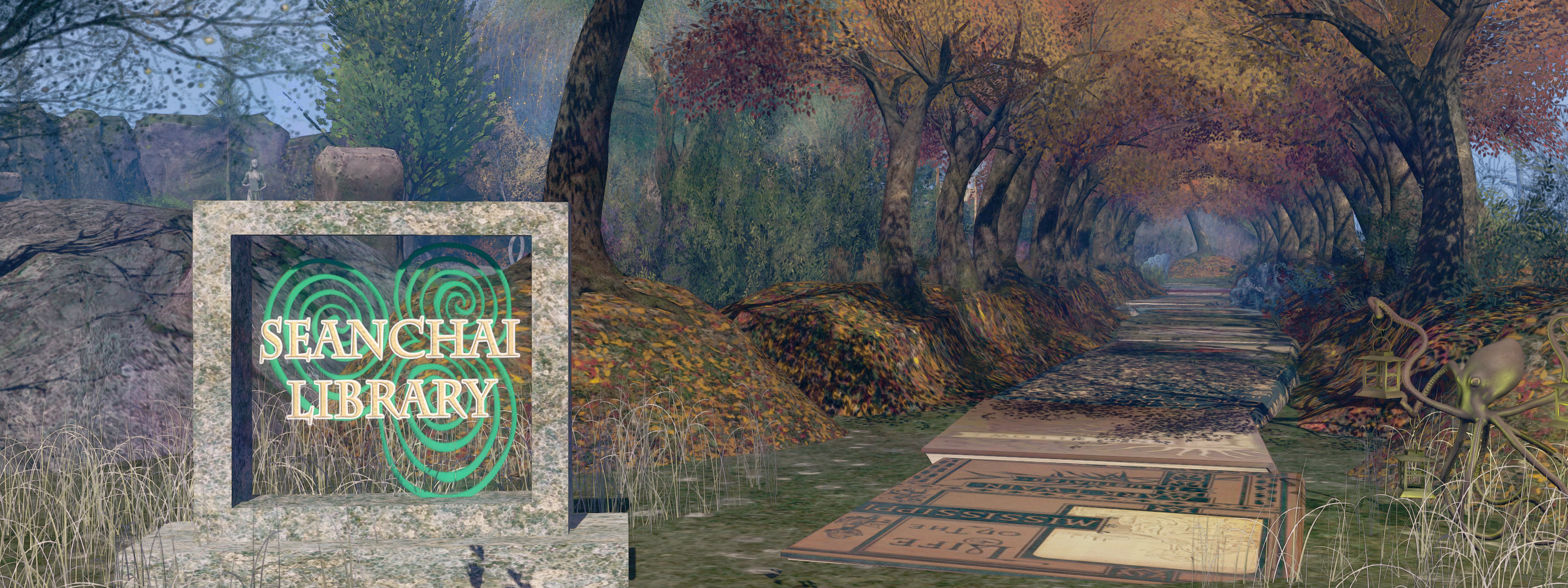
It’s time to highlight another week of storytelling in Voice by the staff and volunteers at the Seanchai Library. As always, all times SLT, and events are held at the Library’s home in Nowhereville, unless otherwise indicated. Note that the schedule below may be subject to change during the week, please refer to the Seanchai Library website for the latest information through the week.

Monday, January 4th, 19:00: The Dark Bright Water

Gyro Muggins reads Patricia Wrightson’s second novel charting the life of Wirrun of the Inlanders.

First encountered in The Ice Is Coming, when Wirrun set out on a quest to overcome the rise of the ancient enemy of Australia, the ice-bearded Ninya, the young janitor now has a reputation as a Hero among the Inlanders (Wrightson’s fantasy view of the Australian Aboriginals). It’s not a title he appreciates; he would much rather just get back to his janitorial work.

But the spirits of the land are restless: Yunggamurra, a river spirit is lost, so uses her siren-like powers of song to draw to herself those who might might take her home. Her singing come to Wirrun’s ears, and those of an elderly aboriginal emissary, and he realises he must journey to the very heartlands of Australia to better understand what he is feeling.

This he does, with the old emissary and his friend Ularra. Once there, he discovers that a storm is indeed rising within the domain of the spirits, and he is uniquely placed to both find Yunggamurra and prevent the coming storm. And so his new adventure begins.

Tuesday, January 5th

12:00 Noon: Russell Eponym, Live in the Glen

Music, poetry, and stories in a popular weekly session at Ceiluradh Glen.

19:00: Written in History: Letters that Changed the World

WRITTEN IN HISTORY celebrates the great letters of world history, creative culture and personal life. Acclaimed historian Simon Sebag Montefiore selects over one hundred letters from ancient times to the twenty-first century: some are noble and inspiring, some despicable and unsettling; some are exquisite works of literature, others brutal, coarse and frankly outrageous; many are erotic, others heartbreaking.

The writers vary from Elizabeth I, Rameses the Great and Leonard Cohen to Emmeline Pankhurst, Mandela, Stalin, Michelangelo, Suleiman the Magnificent and unknown people in extraordinary circumstances – from love letters to calls for liberation, declarations of war to reflections on death. In the colourful, accessible style of a master storyteller, Montefiore shows why these letters are essential reading: how they enlighten our past, enrich the way we live now – and illuminate tomorrow.

Join Caledonia Skytower as she reads selections from this remarkable book.

Wednesday, January 6th 19:00: In Walt We Trust

More from Craig Johnson’s Sherriff Longmire Series with Kayden Oconnell.

Thursday, January 7th, 19:00 Monsters and Myths

The Pig’s Ploughman – Part 1, Shandon Loring presents another mythic adventure from the works of Bernard Evslin. Also in Kitely!  Find teleport from the main Seanchai World grid.kitely.com:8002:SEANCHAI.

Second Life land and users in 2020, via Tyche Shepherd

Sunset at home in Second Life

The last few months of 2020 saw Tyche Shepherd release some brief summaries related to Second Life that – as always – make for interesting reading for those interested in the general state of the platform.

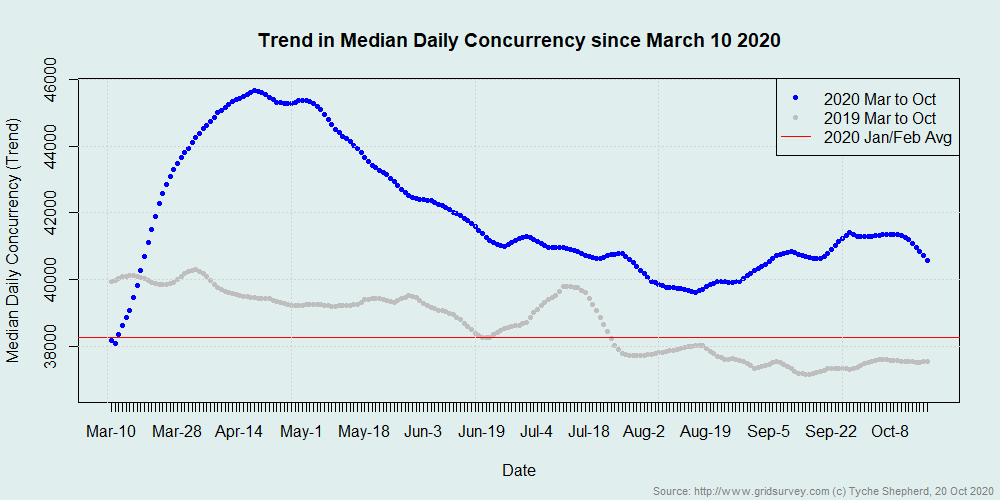
In the first, a tweet Tyche issued in October, we were offered insight into general use of the platform in terms of sign-up and concurrency. It came as a the last in a brief series of tweets from Tyche on the subject that started after the Lab indicated that with the spread of the SARS-CoV-2 pandemic, they were seeing an increase in general usage of the platform, particularly among returning users.

Following-on from Tweets in June -, Tyche confirmed that overall, median concurrency on the platform saw clear growth in March through mid-May (when the first ’bout of lockdowns hit a fair portion of the world  due to the pandemic, before gradually falling through until mid-August, when a further “bump” occurred that lasted through until October (when Tyche made her Tweet). She also showed that overall, median concurrency remained well above that seen in 2019.

SL concurrency, March-October 2020. Credit: Tyche Shepherd

That concurrency is up can be taken as a good sign; it means that more people are engaging in the platform at any given period, allowing greater opportunities for interactions  – which can be particularly important for incoming new users looking for things to do and people to meet. However, it is with regards to the latter that Tyche’s observations have been more mixed.

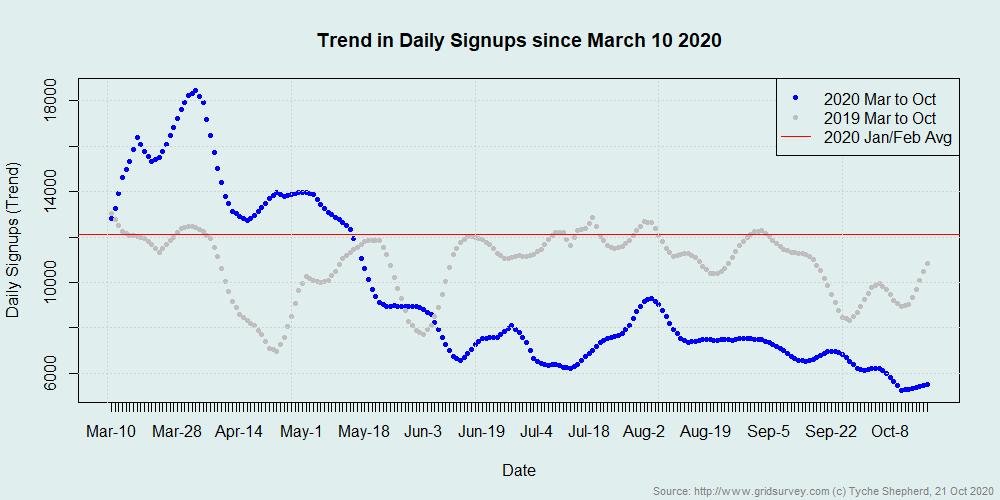
On the one hand, the second graphic included in her tweet appears to in part confirm commentary from the Lab itself: that 2020 has seen an upswing in the number of users returning to the platform, whilst also suggesting that – again, understandably, given the pandemic – that existing users were spending longer in-world in 2020 that had been the case in recent years. All of which is also to the good (particularly if returning users find reasons to maintain their engagement in the platform once more).

Second Life new user sign-ups 2020. Credit: Tyche Shepherd

However, on the other, the graphic reveals a niggling concern: whilst sign-up have remained relatively stable for a number of years, with occasional peaks and crevasses, 2020 saw a distinct decline in sign-ups from the end of March through until early October, despite an initial spike in sign-ups in the March-April period, again potentially fuelled by the pandemic. In particular, the drop-off not only saw sign-ups fall below the average set in the first two months of 2020, but also fall and remain below average sign-ups seen throughout 2019.

As such, Tyche’s figures tend to suggest that, while the Lab is determined to grow SL’s user base through the attraction of new users – a programme it has, to varying degrees,  indicated it has been focused on since around mid-2019 – there is still a lot to be done in this area, if the hoped-for growth is to be realised. However, this is somewhat tempered by the fact that given the rise in median concurrency is in part fueled by returning users, it demonstrates that the Lab is correct in focusing a portion of its marketing efforts towards former users who have drifted away for one reason or another.

Land use – or more correctly, grid size – is another metric Tyche tracks, providing as she does regular reports on the overall size of the main grid and the comings and goings of both private and “Linden owned” regions. While the relative size of the grid, if looked at in and of itself only, can be a false or misleading indicator of the overall state of SL, tracking the number of private regions does help in building a picture of LL’s core revenue flow – region tier.

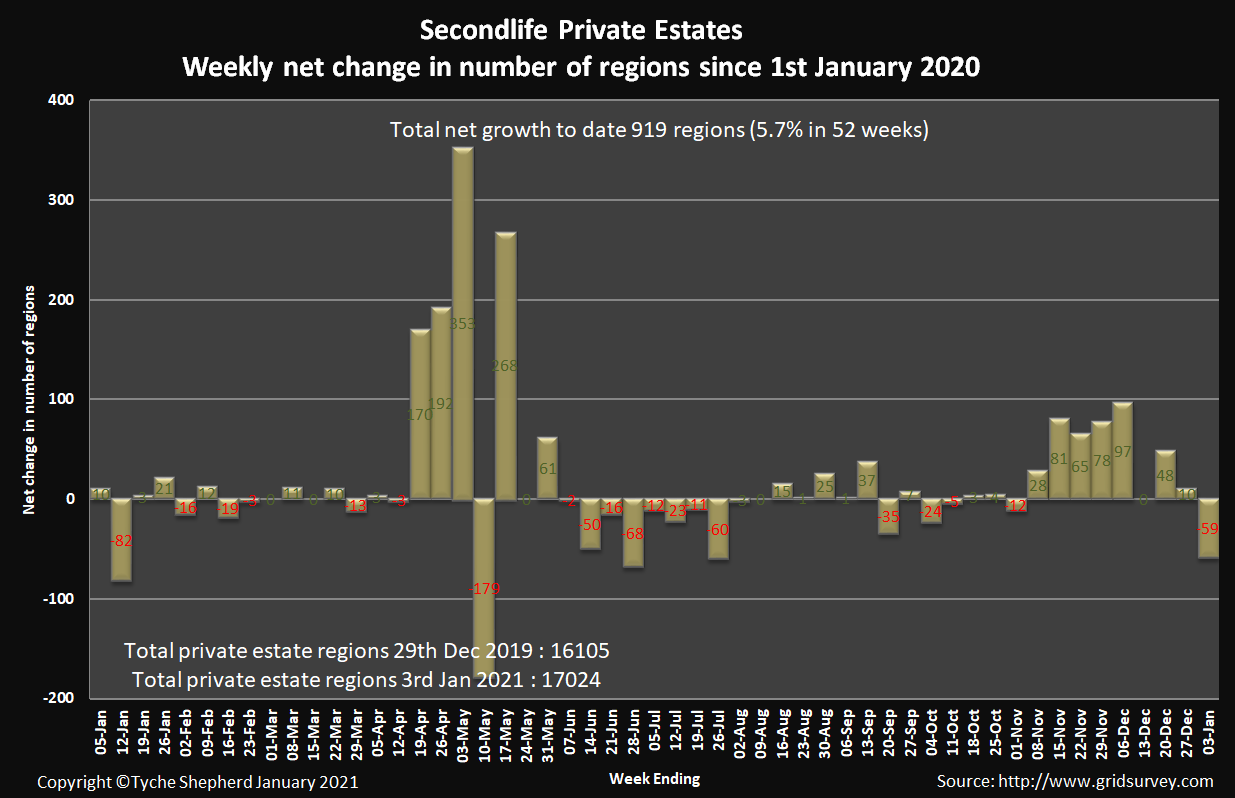
On January 3rd, 2021, Tyche tweeted her year-end analysis on private region numbers, revealing that 2020 saw an overall net growth of some 919 private regions (Full and Homestead) through the year, representing a 5.7% increase.

Second Life private regions in 2020. Credit: Tyche Shepherd

The majority of this growth came in two bursts: mid-April through to the end of May (with one significant period of shrinkage during the week to Sunday, May 10th, 2020), and then November-December 2020, immediately following the period of unavailability of new regions through the mid-months of the year resulting from the work transitioning SL to AWS services.

While the increase in the size of the grid is not exceptional when compared to increases seen prior to 2011/2012, it is still positive, indicating that there is a general willingness among users to invest in land, helping the Lab’s bottom line. The uptick in 2020 has meant that when the general reduction of Linden-held regions through the year is taken into account, the total number of regions in the grid grew by 3.3%.

Given the difficulties of 2020, Tyche’s figures tend to show Second Life held its own through what has been what might be termed a less-than-optimal year. With the Lab looking to further ramp-up advertising in 2021 (and perhaps further tweaking of the on-boarding process), it’ll be interesting to see how the overall level of users / size of the grid fares through the year.

Related Links