2021 SUG meeting week #20 summary

Cherishville II, March 2021 – blog post

The following notes were taken from the Tuesday, May 18th, 2021 Simulator User Group (SUG) meeting. These notes relate to the core points of discussion; other topics may have ben raised without specific feedback from LL as actionable items, so  please refer to the video at the end of this report for the full meeting and all points covered.

Server Deployments

At the time of writing, there had been no server deployment thread available for review.

  • Tuesday, May 18th saw no deployment to servers on the Main SLS channel.
  • Wednesday, May 19th should see some of the RC channels updated with the new llOrd, llChar and llHash LSL capabilities. A further change is that the updated simulator no longer reports child agents as part of agents, as it has been doing so inconsistently.
  • The remainder will keep to release  559679 with the llOpenFloater() function intended for use with Linden-owned Experiences – see my week #18 SUG summary for more.

From Rider Linden’s comments at the week #14 SUG summary:

LlOrd() will return the ordinal of the first character in a string, llChar() given an integer will return a single character string, and llHash() is a non-cryptographic 32 bit hash. I was looking for a way to just have an integer that had a reasonable change of being unique for an arbitrary string.
Use case I can see: Given an owner of two objects I want to select a chat channel with a low probability of colliding with other agents in the area.

SL Viewer

The start of the week has seen no updates to the current crop of official viewers, leaving the pipelines as follows:

  • Release viewer: Eau de Vie Maintenance viewer, version 6.4.18.558266, dated April 23, promoted April 29 – No change.
  • Release channel cohorts:
    • Project UI viewer updated to version 6.4.19.559612, May 14.
    • Love Me Render (LMR) 5 viewer, version 6.4.18.558365, dated April 22.
    • Maintenance 2 RC viewer – Fernet, version 6.4.18.558441, dated April 21.
  • Project viewers:
    • Legacy Profiles viewer, version 6.4.11.550519, dated October 26.
    • Copy / Paste viewer, version 6.3.5.533365, dated December 9, 2019.
    • Project Muscadine (Animesh follow-on) project viewer, version 6.4.0.532999, dated November 22, 2019.
    • 360 Snapshot project viewer, version 6.2.4.529111, dated July 16, 2019.

In  Brief

  • The Lab has a group working on various simulator physics issues and general health, some of which can generate errors (e.g. “Unable to create object that has caused problems in this region”). No ETA on when these might be deployed.
  • Thought is still being given as to how to fix the dim ambient lighting seen on the Mainland since the introduction of EEP – a problem that appears to be harder to fix than people appreciate / understand.
  • Questions have been asked if some of the simulator-side resource issues could be fixed if additional CPU cores could be allocated to support really busy regions – such as events, etc. Responding to this, Mazidox Linden, Lead Server QA Engineer said:
There are various hardware (and *maybe*) some software resources that can be in contention for any given set of simulators on a simhost, network, memory, CPU, IO, things like that. So allocating an additional core to a simulator fixes *maybe* one of those bottlenecks. If it’s the bottleneck affecting your performance. Which is a big if.
  • There have been reports of teleport failure spiking recently,  including viewer disconnects. Rider Linden is hoping to poke at the teleport code some more as time allows,  but it appears the issue might be a communications issue between the receiving region and the viewer.  Maxidox Linden explained the matter thus:
The destination simulator knows someone is supposed to show up, so it creates some space in the receiving warehouse. No one ever arrives to fill it … Our best guess (and it is a *guess*) is that it involves the destination region and the affected viewer waiting for each other to send something first.

Video

The following video of the meeting is courtesy of Pantera Północy.

A dreamer’s golden stories in Second Life

The Itakos Project: Golden: A Journey into the Art of a Dreamer

Currently open at the Itakos Project Art Gallery, curated by Akim Alonzo, is Golden: A Journey into the Art of a Dreamer, featuring the work of Paola Mills.

Spread across the two levels of the gallery are some 29 exquisite avatar studies that incorporate a range of themes, and are linked by the fact that each one forms a single frame story.

The Itakos Project: Golden: A Journey into the Art of a Dreamer

From fantasy to what might be considered beauty shots and going by way of touches of sci-fi, horror, edges of transhumanism, and even a homage to a classic film (Hitchcock’s classic North by Northwest (see:Follow the Ageless Tide), these are all stunning pieces. Many carry a degree of subtext through title to further drive their story, although equally, a fair number are untitled – but they still speak clearly to those who study them.

This is because all of the pieces offered here, produced in both colour and monochrome, are marvellously crafted, rich in detail and composition. Within them are to be found stories centred on a range of subjects: identity, love, life, sexuality, emotions, loneliness, memory and more.

The Itakos Project: Golden: A Journey into the Art of a Dreamer

As well as the individual images mounted on the gallery walls, Akim has included an animated slide show system that pages through copies of all of Paola’s pieces in the exhibition. It’s an approach that will a new feature with exhibits at the gallery. Here, with its smooth, gentle animations and cross-fades, the slide show brings together the images in such a way that the transitions from one to the next presents a feeling of shifting dreams in keeping with the sub-title of the exbition. Further, several times during the show, the transition from one image to the next naturally suggests a broader story spanning the art than might be found when viewing in the individual images around the walls.

It is really hard to write about this exhibition, as the pieces are so rich in narrative that they really should be seen first-hand, rather then through the intervening eyes of and thoughts of another. Nor are they pieces to be simply seen; they deserve to be given the time to speak and tell their stories. As such, I strongly suggest paying a visit through the month the exhibition will be available.

The Itakos Project: Golden: A Journey into the Art of a Dreamer

SLurl Details

A trip to the Bayou in Second Life

*80 Days* The Bayou, May 2021 – click any image for full size

*80 Days* The Bayou is the latest region design by Camila (Camila Runo). As the name suggests, it’s a region design that takes us down into Louisiana, where a mix of open water, mangroves and a small town that feels like it might have been cut from a corner of New Orleans just across the state line, and dropped neatly into the grasslands here.

The landing point is located on a large waterside pier, against which is docked a paddle steamer of the kind perhaps also more readily associated with the Mississippi – although that was not the only river along which these majestic boats once regularly plied, their great stern wheels thrashing the water.

*80 Days* The Bayou, May 2021

The unmistakable work of Analyse Dean, the steamer sits with her saloon and card table set as if awaiting fare-paying customers, the perfect backdrop from which to start a visit to the region. And, from the paraphernalia on the wharf, the perfect backdrop for a film crew – a sign even inviting you to sit in the spotlight and take your own picture (or have a friend take it for you).

The wharf joins with a trestle bridge that spans the river on which the steamer sits, suggesting that if she does still make way under her own power, this is one end of any journey she might make. Across the bridge on the south side of the river, lies a muggy, tree-shaded expanse of bayou, cut here and their by water channels. A raised board walk offers a route over the waterlogged land to keep feet dry as it winds its way to a grungy bar sitting among the mangroves.

*80 Days* The Bayou, May 2021

On the river’s north side, the bridge gives way to a road leading to the little town, passing the obligatory cemetery along the way. This is the place where the main street basks in the late afternoon heat and humidity, overlooked by the balconies of the places of business that line it on either side. Up on one wall, Satchmo plays his horn, while the sounds of his playing echoes along the street from open windows, washing over visitors as they explore places like Maison Devil, with its voodoo overtures, or drop into the quirky Goofy Gator lounge (which has a nice minimalist ambience, but I wasn’t entirely convinced by the green beer!).

To one end of the town sits a small restaurant with streetside dining and dancing, the road beyond it giving way to a dirt track which curves down to a beach looking out over (presumably) the Gulf of Mexico. A second track parallels the route to the beach, just across the car park from the restaurant. However, rather than also leading to the beach, it instead offers a path to the local alligator farm.

*80 Days* The Bayou, May 2021

Between the town and the river, the land is flat and given over largely to grass and wild flowers, although a third track does point the way to a little pier that juts out into the river. Watched over by a plump pelican, this pier is home to a little motor boat rezzer people can use to putter around on the water – just be wary of the region boundaries when doing so.

The rezzer is one of a number of little interactive elements included in the setting that help bring it to life. Others include opportunities to dance or scrub a car, enjoy a drink or pose for a photo. There are also number places where visitors can sit and pass the time, some of which sit out in the bayou to offers places of solitude for those who want to be on their own, while others are well suited to couples or small groups.

*80 Days* The Bayou, May 2021

Populated by the static figures that appear to be having their 15 minutes of fame among region designers at the moment – and which do help bring a sense of life to region designs – and rounded-out by a nicely balanced sound scape, *80 Days* The Bayou makes for a photogenic and engaging visit.

With thanks (again!) to Shawn Shakespeare for the pointer.

*80 Days* The Bayou, May 2021

SLurl Details

2021 viewer release summaries week #19

Logos representative only and should not be seen as an endorsement / preference / recommendation

Updates from the week ending Sunday, May 16th

This summary is generally published every Monday, and is a list of SL viewer / client releases (official and TPV) made during the previous week. When reading it, please note:

  • It is based on my Current Viewer Releases Page, a list of all Second Life viewers and clients that are in popular use (and of which I am aware), and which are recognised as adhering to the TPV Policy. This page includes comprehensive links to download pages, blog notes, release notes, etc., as well as links to any / all reviews of specific viewers / clients made within this blog.
  • By its nature, this summary presented here will always be in arrears, please refer to the Current Viewer Release Page for more up-to-date information.
  • Note that for purposes of length, TPV test viewers, preview / beta viewers / nightly builds are generally not recorded in these summaries.

Official LL Viewers

  • Release viewer: Eau de Vie Maintenance viewer, version 6.4.18.558266, dated April 23, promoted April 29 – no chnage.
  • Release channel cohorts:
  • Project viewers:
    • No updates.

LL Viewer Resources

Third-party Viewers

V6-style

  • No updates.

V1-style

Mobile / Other Clients

  • No updates.

Additional TPV Resources

Related Links

Space Sunday: China on Mars, JWST and a space tourist

An artist’s impression of the Zhurong rover unfolding its solar arrays shortly after its lander touched down on Mars. Credit: New China TV

On Saturday, May 16th, 2021, China became only the second nation in the world to successfully land a rover on the surface of Mars.

The 240-kg Zhurong rover touched down on the dunes of southern Utopia Planitia a few minutes after midnight, UTC (19:00 US Eastern on Friday, May 15th), some nine minutes after the lander and rover combination entered the Martian atmosphere.

The two form a part of the Tianwen-1 (Heavenly Questions) mission, operating alongside the mission’s titular orbiter, which arrived in Mars orbit in February this year. For the three months since that event, the orbiter has, as part of its overall mission, been surveying Utopia Planitia – a location first visited in the 1970s by NASA’s Viking 2 mission – in order for mission managers to confirm the best touch-down point for the lander / rover combination.

Following their separation from the Tianwen-1 orbiter, the lander and rover entered the Martian atmosphere protected by a heat shield and aeroshell, to commence an Entry Descent and Landing (EDL) very similar in nature to US Mars surface missions.

The CNSA mission control during the Zhurong lander. Credit New China TV

While China has successfully landed missions on the Moon – Chang’e 5 with its surface rover is still operating – a landing on Mars is far more complex in nature, simply because of the presence of an atmosphere that, while tenuous, nevertheless interacts with a vehicle to increase the potential for things going wrong.

However, Zhurong (named for a god of fire and of the south), completed the first part of its descent successfully, using the frictional heat generated be entry into the atmosphere to slow itself to a point where a supersonic parachute could be deployed by the aerodynamic backshell, which in turn triggered the jettisoning of the heat shield, exposing the lander / rover.

Approaching the ground, Zhurong deployed its landing legs whilst still attached to the aeroshell, prior dropping clear. once free, the lander’s rocket motor fired moving it clear of both the aeroshell and the parachute. As well as continuing to slow the craft in its descent, the rocket motor and the lander’s reaction control system worked with a downward-looking radar scan for potentially harmful surface obstacles, the motors then steering the craft away from them. The main motor then continued firing as the vehicle descended over its landing site, cutting out a couple of metres above the ground to let the lander make a soft, unpowered touchdown.

Carried out entirely autonomously, the landing appears to have been a complete success, although China has yet to confirm the precise time of touch-down or the overall status of the lander and rover. Following landing, the rover deployed its solar panels in order to commence charging its systems, while the mission control team work to carry out initial checks of the rover and prep its camera systems to take a complete a panoramic image of the landing area – although at the time of writing, images from the lander / rover had yet to be confirmed as being received.

Zhurong is roughly the size of NASA’s Spirit and Opportunity rovers  and like them, is solar-powered, although it is around 55 kg heaver. It carries a payload of six science instruments, including a laser-induced breakdown spectroscopy instrument for analysing surface elements and minerals, panoramic and multispectral imagers, a climate station, magnetometer and a ground-penetrating radar.

With an initial primary mission period of 90 sols (around 93 terrestrial days), the mission aims to return data on potential water-ice deposits, weather, topography and geology, complementing science carried out by missions from other space agencies. Given the nature of Mars missions and China’s record on the Moon with Chang’e 5, should the rover survive the initial primary mission period, its work on Mars will likely be extended.

James Webb Tests Mirror a Final Time, but Launch likely to be Delayed

The James Web Space Telescope (JWST) unfolded its massive mirror for the final time whilst on Earth in a last test before it undergoes preparations for launch.

The 6.5 metre diameter mirror is a complex mechanism made up of 18 hexagonal sections, 12 of which form the main part of the mirror and the remaining six form two fold-out elements on either side. For launch, the mirror is folded down against the main sun shield that will protect it from the heat and light of the Sun once it is in space., and the two flanking sections folded back against it.

The James Webb Space Telescope. Credit: NASA

The May 11th test saw the entire telescope supported by a special crane to simulate zero gravity, allowing engineers to run the software that will control the mirror’s unfurling using 132 individual actuators. These actuators raise the mirror, then unfold the side panels before gently bending or flexing the 18 individual mirror segments to align and focus them on the telescope’s secondary mirror that directs the light caught by the primary into the instrument aperture at the centre of the primary.

Following the deployment test, the mirror was returned to its folded and stowed position. Later this year, the 6.5 tonne 20 x 14 metre telescope will be stowed in a climate controlled shipping container for a 2-week trip to the European rocket facility at Kourou in French Guiana. Once there, it will be integrated into the payload fairings of a European  Ariane 5 rocket ready for a launch currently planned for the end of October.

That is, if the Ariane 5 cleared for launch.

Normally one of the most reliable launch vehicles on the market, the rocket has been grounded after the two last launches suffered issues with the payload fairing separation process – although the payloads from both flights were successfully place in orbit. Investigations into the issues are still in progress, but Arianespace has two launch commitments ahead of JWST, and so it is likely at the telescope’s launch will be delayed – the last in a long series of delays for JWST, all of which will hopefully mean that once it has been launched, the telescope will go on to be highly successful, operating in a halo orbit around the Lagrange L2 position on the opposite side of Earth compared to the Sun, and some 1.5 million kilometres from Earth.

Continue reading “Space Sunday: China on Mars, JWST and a space tourist”

Aliens, tales and fables in Second Life

Seanchai Library

It’s time to highlight another week of storytelling in Voice by the staff and volunteers at the Seanchai Library. As always, all times SLT, and events are held at the Library’s home in Nowhereville, unless otherwise indicated. Note that the schedule below may be subject to change during the week, please refer to the Seanchai Library website for the latest information through the week.

Sunday, May 16th: 13:30 Tea-Time with L. Frank Baum

Lyman Frank Baum (May 15th, 1856 – May 6th, 1919) was an American author best known for his children’s books, particularly The Wonderful Wizard of Oz and its sequels (14 novels in all). His prolific output included 55 novels, 83 short stories,  over 200 poems and at least 42 scripts.

In 1901, twelve of his stories were published in anthology form by the George M. Hill Company under the title American Fairy Tales, the move designed by Baum and his publisher to capitalise on the success of The Wonderful Wizard of Oz.

The 12 stories comprise The Box of Robbers, The Glass Dog, The Queen of Quok, The Girl Who Owned a Bear, The Enchanted Types, The Laughing Hippopotamus, The Magic Bon Bons, The Capture of Father Time, The Wonderful Pump, The Dummy That Lived, The King of the Polar Bears. and The Mandarin and the Butterfly.

All 12 are noted for the ironic or nonsensical morals attached to their ends and their satirical, glib, and tongue-in-cheek  tones that gives them an appeal to adult readers. They are also the subject of Tea-Time with L. Frank Baum, with Kayden OConnell, Corwyn Allen, Glori, and Caledeonia.

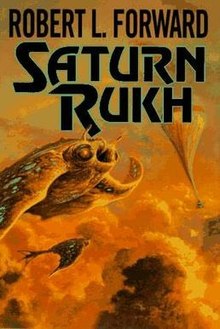
Monday, May 17th: 19:00 Saturn Rukh

In an unspecified time in the future, a team of astronauts is sent to Saturn on what could be a one-way mission. Financed by a multi-national consortium, their mission is to establish a factory in to upper reaches of the planet’s atmosphere where it can “mine” Saturn’s abundant helium to produce “meta” (nitro-stabilised metastable helium), a powerful propellant.

If they are successful, each of the astronauts stands to earn a billion dollars on their return to Earth. The catch? They only have sufficient fuel to reach Saturn – they must use the factory to produce the fuel needed to make their return to Earth.

However, things go awry when the mission enters the Saturnian atmosphere – and crash-lands on the back of an enormous creature that “swims” through the atmosphere. Another of the creatures – which appear to be semi-intelligent and which the astronaut dub “Rukh” – swallows some of the mission’s equipment, leaving the team with no choice but to attempt to establish communications with the creatures and attempt to recover their equipment.

Join Gyro Muggins as he reads the last full-length novel by physicist and author Robert L. Forward.

Tuesday, May 18th

12:00 Noon: Russell Eponym, Live in the Glen

Music, poetry, and stories.

19:00: Old Peter’s Russian Tales

Journalist Arthur Ransome – who would later gain fame for Swallows and Amazons, – travelled between England and Russia either side of the 1917 revolution. His initial reason for doing so was to escape his marriage. However, he became fascinated by the Russian language and life, particularly old folk tales.

In 1912 he came across a collection of translations of tales into English, but found the language and style exceptionally poor. However, he was captivated by the richness of the material, noting it differed from both Scandinavia, Brittany, Wales and Scotland.

So in 1914, he set about collecting tales and translating them for himself whilst in Russia, with a volume of stories published under the title Old Peter’s Russian Tales in 1916, when he was staying in Vergezha, on the River Volkhov.

Now Willow Moonfire brings these tales to Seanchai Library.

Wednesday, May 19th, 19:00: When You Trap a Tiger

When Lily and her family move in with her sick Halmoni (grandmother), a magical tiger straight out of her halmoni’s Korean folktales arrives, prompting Lily to unravel a secret family history.

Long, long ago, Halmoni stole something from the tigers and now the tigers want it back. So the tiger visiting has arrived with an offer for Lily: return what Halmoni stole in exchange for the return of her health Halmoni’s health.

It is a tempting offer; but deals with magical tigers are not always what they appear to be. So Lily must, with the help of her sister and her friend Ricky, find her voice and her courage, and face whatever trickery the tiger may conjure.

Caledonia Skytower reads the 2021 2021 Newbery Medal winning story by Tae Keller.

Thursday, May 20th

19:00: Little Fuzzy

Ktadhn Vesuvino reads the book by H. Beam Piper that spawned a series by him and other science fiction authors about a small, furry species dubbed Fuzzies.

Little Fuzzy charts the discovery of small furry species on the planet Zarathustra and the attempts by humans to determine whether or not they are sentient. If they are, then their planet will be declared a protect aboriginal  world. However, The Company has desires to control the planet and its resources.

21:00: Seanchai late Night

Contemporary sci-fi and fantasy with Finn Zeddmore, from such source as Escape Pod, Light Speed, and Clarkesworld ‘zines, and more!