Logos representative only and should not be seen as an endorsement / preference / recommendation
Updates from the week ending Sunday, June 13th
This summary is generally published every Monday, and is a list of SL viewer / client releases (official and TPV) made during the previous week. When reading it, please note:
It is based on my Current Viewer Releases Page, a list of all Second Life viewers and clients that are in popular use (and of which I am aware), and which are recognised as adhering to the TPV Policy. This page includes comprehensive links to download pages, blog notes, release notes, etc., as well as links to any / all reviews of specific viewers / clients made within this blog.
By its nature, this summary presented here will always be in arrears, please refer to the Current Viewer Release Page for more up-to-date information.
Note that for purposes of length, TPV test viewers, preview / beta viewers / nightly builds are generally not recorded in these summaries.
Official LL Viewers
Release viewer: Love Me Render (LMR) 5, version 6.4.19.560171, dated May 27th, promoted June 7th – NEW,
Release channel cohorts:
Project UI RC viewer updated to version 6.4.20.560422, on June 8th.
Grauland Falls Art Park, June 2021 – click any image for full size
I first visited Grauland, the Homestead region held by by JimGarand and home (in the sky) to his M-1 Art Pose business in March 2019. At the time, I was immediately struck by its genuine uniqueness, offering an environment that expresses art as a landscape.
Since that time, Jim has continually revised the region on a regular cycle of iterations, some of which have continued that idea of art-as-landscape, others of which might be regarded as more “natural” settings – tropical beaches, oriental gardens, deserts – all of which have been highly engaging and kept me returning to the region to write about many of them.
Grauland Falls Art Park, June 2021For the iteration I visited in June, Jim has returned the region to what, for me at least, is its roots – a setting in which art plays an important role in expressing the overall landscape.
Rapidly dropping from eastern highlands marked by a high peak and a curtain of cliffs backed by high mountains, the region is immediately visually engaging; the peak giving birth to falls that in turn feed the streams that break up the lowlands as they flow out to the surrounding waters.
Grauland Falls Art Park, June 2021
Rugged and attractive, with western and northern bays watched over by a ranger’s watchtower to the north-west, two tidy woodland areas and a scattering of buildings, the landscape is highly photogenic. However, it is what is to be found within it that captures the eye.
From obelisks through the familiar concrete blocks to statues, tiered gardens and totems, the art to be found throughout the region fits neatly and elegantly into the setting, bringing it naturally to life.
Grauland Falls Art Park, June 2021
As an art park, the setting is laid out as a place one travel to in order to visit: the landing point is presented as a cark park, the road running from it vanishing into a tunnel that appears to pass under the mountains to connect the part with the rest of the world. It sits bounded on two sides by the remnants of what might have once been a complete costal fortification built during the last world war, but which now stand with gaping windows and walls that have in part started to lean somewhat as their foundations have settled.
Forming the entrance to the park, the great blanks walls of this ruin also naturally lend themselves as a part of the park’s artistic statement, providing access to the tiered gardens that form the starting point for explorations.
Grauland Falls Art Park, June 2021
From the gardens with their cobbled paths, visitors can roam where they please – as indicated by the static characters already in the region that add a further sense of it being a a popular place to visit. A single path does offer a route from the landing point, one that passes over the region’s three bridges – which also very much form part of the art statement. These bridges lead the way to the largest complete building on the region, a boxy unit offered as something of a meeting / relaxing space.
Jim’s designs are always engaging and a pleasure to visit, but I admit to finding this iteration particularly engaging. There’s that sense of returning to the focus of early iterations of the region whilst retaining a completely unique look and feel.
Grauland Falls Art Park, June 2021
With photographic opportunities can be found throughout, and the 3D art elements bringing a richness to the environment that encourages the visitor to remain, explore and appreciate, Grauland Falls Art Park is not to be missed.
You would be forgiven for thinking the banner image for this update is an artist’s impression of China’s Zhurong rover and its lander on Mars. But you’d be wrong – the image really was taken on Mars.
It is part of a batch of images the China National Space Administration (CNSA) have released charting the recent activities of their rover on the Red planet, and they are as remarkable as anything seen with the US rover vehicles, with others showing panoramic views around the rover and shots of its lander vehicle.
The Zhurong lander, part of China’s Tianwen-1 Mars mission., as seen from the rover vehicle at a distance of some 6 metres. Credit: CNSA
Captured on June 8th, the image of rover and lander was taken by a remote camera originally stowed in Zhurong’s belly, and which had been safely deposited on the surface of Mars some 10 metres from the lander, allowing mission control to remote capture the unique sight of a rover and its lander side-by-side.
Zhurong has now completed the first third of its initial 90-day mission on Mars, and is well into its survey of its surroundings within Utopia Planitia. In addition to the high-resolution cameras, used to produce these images, the rover is fitted with a subsurface radar instrument, a multi-spectral camera and surface composition detector, a magnetic field detector and a weather monitor.
A 360 panorama of the Zhurong landing site, captured by the Chinese rover prior to is descent from the back of its lander. Credit; CNSA
Ahead of the images released by CNSA, NASA released their own image of the Chinese rover and lander as seen by the HiRISE camera on the Mars Reconnaissance Orbiter from an altitude of around 400 km.
Taken on June 6th, three weeks after Zhurong touched-down, the image clearly shows green-tinted lander (a result of the image processing, not the actual colour of the lander) sitting between two areas of surface material discoloured by the thrust of the lander’s outward-angled descent and landing motors. Zhurong itself can be seen a short way south of the lander, within the eastern arc of discolouration.
Captured by the HiRISE imager on NASA’s Mars Reconnaissance Orbiter on June 6th, this image shows the Zhurong lander surrounded by surface material discoloured by the lander’s rocket motors, with the rover sitting just to the south. Credit: NASA/JPL
And turning to NASA’s surface mission on Mars (specifically Mars 2020): on June 8th, the Ingenuity helicopter completed a 7th flight, this one error-free.
Lifting off at around 12:34 local mean solar time (roughly 15:54 UTC on Earth) proceeded south during the 63-second flight, covering a distance of around 106 metres before touching down at a new location.
Ingenuity captured this image of its shadow passing over the surface of Mars on June 8th, 2021 during its 7th flight. Credit: NASA/JPL
In difference to the 6th flight on May 22nd, which saw the helicopter encounter some anomalies (see: Space Sunday: Martian Clouds, Lunar missions and a Space Station), the seventh flight was completed with incident, once again raising confidence that the helicopter will be able to continue flying several more times.
Overlaid onto an image be NASA’s Mars Reconnaissance Orbiter are the routes for the first and second science sorties to be made by Perseverance. Credit: NASA/JPL
Now regarded as fully commissioned, Perseverance has put its duties as caretaker-watcher for Ingenuity largely behind it, as is now driving south and away its landing zone on its way to study a 4 square kilometre of crater floor, where it will examine two very different geological units and collect samples for analysis and for storage and possible return to Earth as part of a future mission.
“Crater Floor Fractured Rough” is a region of ancient bedrock, whilst “Séítah” (Navajo for “amidst the sand”) presents a mix of bedrock overlaid with more recent ridges and also sand dunes. The rover will perform a gentle loop through these areas, visiting “Crater Floor Fractured Rough” first then travelling through the ridgelands and then back up through “Séítah S” and Séítah N”, before heading for its next target, an area dubbed “Three Fours”.
ESA Looks to Venus and the Outer Planets
The European Space Agency has announced its goals for the next several decades in terms of robotic exploration of the solar system and cosmic science.
Announce on June 10th, the EnVision mission will carry a suite of spectrometers, sounders and a radar to study the interior, surface and atmosphere of Venus. The target launch period is May 2032, with the vehicle arriving in orbit around Venus in August 2033, where it will use the planet’s upper atmosphere to aerobrake into its final science orbit over a 3-year period, before commencing its four-year primary mission. It is expected to cost around 500 million Euros.
ESA plans to further extend our knowledge and understanding of Venus with the EnVision mission, due to launch in 2032. Credit: ESA
While there has been no coordination between NASA and ESA in terms of mission selection, EnVision’s science mission is highly complementary to the two NASA missions – VERITAS and DAVINCI+ – also recently announced, covering aspects of Venus science they do not. Further, ESA will be flying science packages on VERITAS, and NASA will be providing the synthetic aperture radar for EnVision.
EnVision is the fifth M-class mission ESA has selected as part of the Cosmic Vision program. The first, Solar Orbiter, was launched in February 2020, and three others are in development: Euclid, a mission to map dark matter and dark energy to launch in 2022; Plato, an exoplanet search mission launching in 2026; and Ariel, an exoplanet characterisation mission launching in 2029.
In addition To EnVision, ESA intends to spend the next several decades developing missions to follow after the Jupiter Icy Moons Explorer, that will help assess the habitability of the icy moons in the outer solar system and seek any biosignatures they may have. At the same time ESA intends to support further science endeavours aimed at increasing our understanding of our own galaxy and the likely state and development of the early universe.
Janus II Gallery: Etamae and Imaginary Footprints – Variation
Saturday, June 12th saw the opening of Variation, a joint exhibition of art by Eta (etamae) and Imaginary Footprints.
Hosted at the Janus II Gallery at Chuck Clip’s Sinful Retreat, Variation is the second such collaboration by the artists I’ve visited, the first being Memories of a Forgotten Reality (see: A Foreign Reality in Second Life), which I found to be an absorbing exhibit both in style and its collaborative development – and the e same can be said of Variations.
Supplied without exposition by the artists, Variation appears to follow the approach seen with Memories, with each artist starting with a single piece before passing it to the other, the back and forth continuing as the piece gradually evolve in accordance with the perceptions and thoughts of the artists.
Janus II Gallery: Etamae and Imaginary Footprints – Variation
However, where there was a central theme to Memories that likely focused each artist’s thinking when working on an image, the lack of stated vision apparent with Variation has offered perhaps far greater freedom, with each piece becoming entirely framed within the individual thought processes and feelings of each artist as they worked with it. Thus, the focus of the art – and the exhibition as a whole, is the variation that marked the evolution of each piece.
The result is a collection of art that is broad in scope and potential interpretation. In terms of style and / or genre, there are pieces that might be said to have their roots in abstraction, others that lean towards expressionism or surrealism, and still others touching on abstract expressionism or digital etching. Not all are 2D or static; the added 3D elements presenting a certain depth, particularly those that are placed alongside 2D images they appear to reflect.
Janus II Gallery: Etamae and Imaginary Footprints – Variation
In terms of subject matter, the best place to start is to paraphrase a comment by Eta’s SL partner, Jos:
The only perspective that will be objective is your subjectivity.
That is to say, such is the depth to which these pieces speak, the only way to hear what they might say is to witness them for yourself and and let your own eye and emotions frame your perception / understanding of them.
However, with that in mind, I will say that I found Variation suggestive of a dream state – something enhanced by the overall environment in which Eta and Imaginary have framed the exhibition. A condition wherein the conscious mind is at rest and the subconscious is steady processing all that it has been a party to. Such processing can give rise to bright and dark moments (dreams and nightmares), and similar moments might be found within these piece, tugging and twisting our thinking and emotions into a state of variation.
Janus II Gallery: Etamae and Imaginary Footprints – Variation
Superbly produced and presented, Variation is a marvellously absorbing exhibition.
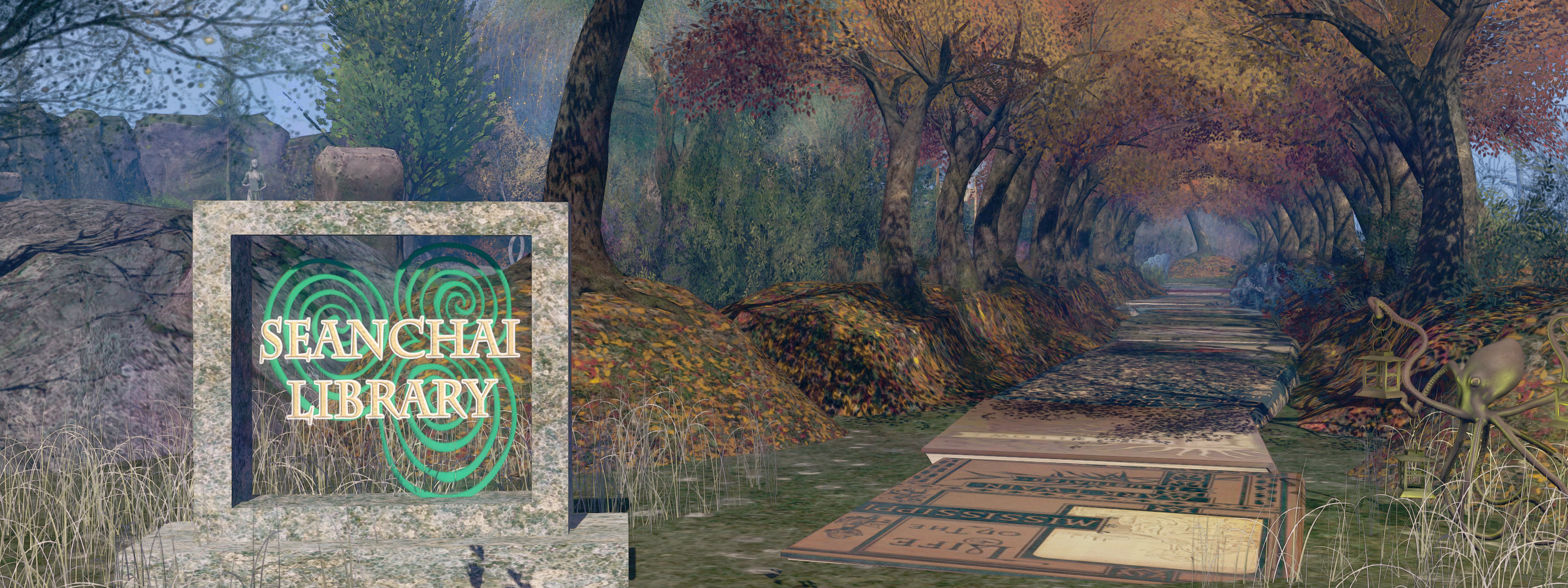
It’s time to highlight another week of storytelling in Voice by the staff and volunteers at the Seanchai Library. As always, all times SLT, and events are held at the Library’s home in Nowhereville, unless otherwise indicated. Note that the schedule below may be subject to change during the week, please refer to the Seanchai Library website for the latest information through the week.
Sunday, June 13th, 13:30: Candy Matson–YUkon 2-8209
“Candy Matson, YU 2-8209.”
These were the words spoken at the start of every episode of NBC’s West Coast radio show of the same name, which ran from mid-1949 through until mid-1951. The “YU 2-8209” referred to the telephone number for Candy Matson, a private investigator operating out of her apartment Telegraph Hill, San Francisco.
Created by Monty Masters and starring his wife Natalie Parks as the voice of the heroine, each week the story saw Candy pick up a case that would take her to an actual location in San Francisco – notably the Bay Area – possibly in the hope of attracting local sponsors.
Intelligent, tough and fearless, Candy rarely resorted to the use of her gun, but instead relied on her wits and intelligence, frequently dispatching her adversaries not with an uppercut, but with hard evidence and a caustic quip to see them into the hands of the law – which generally came in the form of Lt. Ray Mallard (voiced by Henry Leff), who frequently worked the same cases in an official capacity and was Candy’s understated love interest. Also helping out would be Candy’s best friend and assistant, Rembrandt Watson (voiced by Jack Thomas).
While the show only ran for two years, Candy Matson is generally regarded as the finest of all female PIs on US radio, and you can catch up with her adventures at Seanchai Library via the voices of Corwyn Allen, Gloriana Maertens, Elrik Merlin, Kayden Oconnell, and Caledonia Skytower.
Monday, June 14th 19:00
In 1914, the world is divided into Darwinists and Clankers. The Darwinists have evolved genetics to make animals more useful to humans. The Clankers have built their society on machinery technology.
When the Leviathan, a living whale flying ship, arrives in Constantinople, a city where Clanker culture and Darwinst principles intersect in the most intriguing ways, Dr Barlow and Deryn Sharp deliver their precious cargo to the Sultan as part of a peace-keeping mission, only for things to suddenly take a left turn. Now the only way to save themselves in this hostile, politically-charged city is for Dr Barlow to offer up the thing that matters most: Leviathan itself.
Meanwhile, Prince Aleksandar Ferdinand, the would-be heir to the Austro-Hungarian throne following the murder of his father, escapes from his prison camp and once more goes on the run with his men and the Loris, while Count Volger stays behind to fend-off the pursuit, forcing Alek to take on new responsibilities.
Thus, fate once again sees to it that both Deryn and Aleks must re-evaluate their precarious situations in the world…
Join Gyro Muggins as he returns to Scott Westerfield’s alternate history of Earth.
It is the summer of 2013 and Abigail Kamara has been left to her own devices. This might, by those who know her, be considered a mistake.
While her cousin, police constable and apprentice wizard Peter Grant, is off in the sticks chasing unicorns Abigail is dealing with her own mystery: teenagers around Hampstead Heath have been going missing but before the police can get fully engaged the teens return home – unharmed but vague about where they’ve been.
Aided only by her new friend Simon, her knowledge that magic is real and a posse of talking foxes that think they’re spies, Abigail must venture into the wilds of Hampstead to discover who is luring the teenagers and more importantly – why?
Join Corwyn Allen as he reads Ben Aaronovitch’s latest novel.
Wednesday, June 16th, 19:00: Carl Hiaasen’s Skink
A native Floridian, Carl Hiaasen is an American journalist who focuses on political issues (notably corruption, environmental issues and other wrong-doings) within his home state. Starting his career in the 1970s , he became renowned for being exceptionally outspoken – even against his own employers.
Carl Hiaasen. Credit: Joe Rimkus Jr.
During the 1980s, he started writing fiction in his spare time, achieving initial success with three co-authored novels published between 1981 and 1984, as well as writing several non-fiction titles.
In 1987, his second novel, Double Whammy introduced the “trailer park star tenant” and private eye, C.J. Decker, which Hiaasen fondly refers to as “the first (and possibly only) novel ever written about sex, murder and corruption on the professional bass-fishing tour.” Among the cast of characters mixed into Double Whammy is one Clinton Tyree, the one-time governor of Florida, who abandoned his office and now lives as a outdoorsman (and partaker of roadkill cuisine) in the Everglades and the Florida Keys, using the pseudonym Skink.
Skink went on to become a recurring character in a further seven of Hiaasen’s novels to date, with all the books in which he features being gathered together under the general title of SKINK, with several of them being been among the 20+ works of fiction and non-fiction by Hiaasen to appear on the New York Times best-seller list.
Join Kayden Oconnell as he continues a journey with Hiaasen’s characters.
Thursday, June 17th
19:00: Little Fuzzy
Ktadhn Vesuvino reads the book by H. Beam Piper that spawned a series by him and other science fiction authors about a small, furry species dubbed Fuzzies.
Little Fuzzy charts the discovery of small furry species on the planet Zarathustra and the attempts by humans to determine whether or not they are sentient. If they are, then their planet will be declared a protect aboriginal world. However, The Company has desires to control the planet and its resources.
21:00: Seanchai Late Night
Contemporary Sci-Fi-Fantasy with Finn Zeddmore.
Friday, June 18th, 19:00: Terry Pratchett’s Unseen Academicals
Football in Ankh-Morpork is not as we might know it. Rather than being comprised of rules and played within a recognisable ground, it is far more akin to the somewhat violent mob football of medieval Europe.
Not that this is a concern for the elderly, mostly indolent and (some might be tempted to think) somewhat inept old wizards making up the faculty staff at the city’s school of wizardry, the Unseen University. Until, that is, their very handsome annual endowment becomes subject to their playing the game themselves.
Thus, Archchancellor Mustrum Ridcully sets out a two-pronged strategy: to ensure the city’s version of football is restructured with proper (and favourable?) rules, and to put team preparations at the university in the hands of the talented candle dribbler, Mr. Nutt and his assistant, Trevor Likely, the son of the city’s most famous (if deceased – did I mention the game can be violent?) player, who are in turn supported by Glenda Sugarbean, who runs the university’s night kitchen and her assistant Juliet Stollop.
Except Mr. Nutt soon discovers he has problems of his own to deal with, and Trevor has promised his Mum he’ll never get involved in the game. Meanwhile, Glenda has the daily responsibility of baking the Discworld’s best pies, and Juliet is about to find herself whisked towards the heights of fame as a fashion model, thus potentially leaving the team a little short on practical advice…
Join Caledonia Skytower as she presents the 37th novel in the Discworld series, and possibly one of its greatest satirical undetakings encompassing football, academia, traditions, the fashion industry, politics, love, fandom, and which mixes in more serious themes of identity, crab mentality and self-worth.
Water. There’s a lot of it to be found in Second Life, particularly of the Linden variety. Not all of it may be accessible, but the areas that are have encouraged animation override makers to include basic surface / underwater swimming animations in their products, whilst a number dedicated swimming systems have appeared over the years.
One of the most recent of the latter to pop-up is the Dripping Wet Swimming Suite, created by Sakasi Hasudo (HerdMother) and marketed under her Lactopia brand. It is designed to provide a complete Second Life swimming experience for four-limbed human avatars (it will not by default work correctly for merfolk), I found the description and outlined functionality intriguing enough to give it a go.
At L$699, Dripping Wet sits within the typical price range for animation overrides, and offers a genuine swimming experience with surface and underwater swimming animations, idling / floating animations, water effects and splashing sounds, and water droplets that will fall from the body on exiting Linden Water.
As such, the package comes with no fewer than 14 items: the HUD, 12 water dripping / splashing attachments and a script. The attachments provide particle effects when swimming, entering / leaving the water, and also particle drips that “fall” from the body, and which can be turned on / off manually, if required).
Twelve attachments may sound a lot, but whey you consider that for swimming, many other attachments (multiple mesh clothing items, for example) can be removed, this is actually not too bad. Further, not all of the attachments need to be worn; as I’m not overly enamoured with the dripping effect, I only use the arm / leg attachments to the swimming particle effects can be generated.
Still swimming!
The included script can be used by those using ZHAO-style animation override HUDS to ensure a smooth transition between walking / swimming animations when moving to / from Linden water and land without having to toggle either HUD on / off. I confess to not having tried this, as I use the TPV client-side AO system, which can be easily clicked on / off via the toolbar.
The HUD and attachments should be ADDed to your avatar, rather than worn – again, possibly the easiest way is to create an outfit and include the HUD and the dripping attachments you wish to use together with your swimming costume.
Sitting at the bottom of the viewer window by default when attached, the HUD is very unobtrusive, comprising three buttons: swim, dive and “drip”. The first two are reasonably self-explanatory, accessing as they do the swimming and diving options respectively, whilst the drip button will turn on the body dripping / splashing (thus allowing the “wet look” to be used n land for photography, etc).
Overall the following animations are included:
12 surface / underwater animations swimming animations (the breaststroke can be used both on the surface and underwater).
6 floating / idling animations (4 available for surface & underwater swimming, two for use when on the surface).
8 diving animations.
The HUD (1) will request permissions to animate your avatar (2) whenever attached; this is to allow the swim / dive animations and teleporting you back to a saved dive point. Clicking the swim / dive buttons will take you to the dialogue system (3 – main menu options shown).
The easiest way to use the system is to select your preferred surface swim and idle animation, and then do the same for underwater (obviously, you can change these at any time you wish). Using the movement keys in Linden Water will automatically engage your swim animation and your avatar will return to the “idle” animation (e.g. treading water) when movement stops.
Using PAGE DOWN will move you under the waves and engage the underwater swim / idle animations. While it may well be an issue with my Bluetooth keyboard, I found I had to tab PAGE UP to cancel the “downward” swimming, otherwise my avatar would simply remain face down stuck in that animation. PAGE UP will return you to the surface, with an automatic transition to surface swim / idle. When swimming / idling on the surface, you can adjust your position in the water via the HUD’s z-offset controls.
The dives will operate at any height, providing Linden Water is properly detected beneath you. If it is not, because you’re attempting to dive onto land, for example, or if the water is simply too shallow, your dive attempt will be stopped and you’ll be warned in chat:
You will break your neck – there’s no water to land in!
All of the dives are exceptionally graceful – if a little rocket-powered, given the height you can reach! In addition, you can save a dive spot to the HUD and use it to return to that spot – handy if you are diving from, say, a boat (assuming there is someone else on the boat to stop it being auto-returned if in public waters!).
Feedback
Dives are graceful, but tend to reach a fair height!
Admittedly, this is the first HUD-based swimming system I’ve tried, and I’ve found it does exactly what it says on the tin – and does it very well. As noted, the swims are smooth, the dives effective and the entire package easy-to-use whilst the unobtrusive nature of the HUD means it does not get in the way of things.
In terms of the z-offset adjustments, this can be done via the HUD’s dialogue, as noted, and also by editing a configuration note card in the HUD.
The latter could do with more explanation in the user manual for those who may note be comfortable in editing objects and playing with config files. Those who aren’t, and who find fiddling with the HUD’s dialogues irritating, may find tweaking their hover height slider an acceptable compromise.
I understand from Sakasi that an update is in progress, and that their are plans for the system to work in non-Linden water – all of which will further increase the value of the system.
For my part, the system has already become part of a swimming outfit (with cossie and a suitable hair).





 Inara Pey: Living in a Modemworld