2021 SUG meeting week #37 summary

Missing Melody, May 2021 – blog post

The following notes were taken from the Tuesday, September 14th, 2021 Simulator User Group (SUG) meeting. The meeting was recorded by Pantera Północy, and the video is embedded at the end of this summary. Note this summary focuses on the key points of the meeting; where there is something to report, the video should be referred to should full details of the meeting wish to be reviewed.

Server Deployments

At the time of writing, the server deployment thread had not been published.

  • Tuesday, September 14th: no deployment to the Main SLS channel.
  • Wednesday, September 15th all simhosts should be updated to the same revisions to the new server configuration that was deployed to the Ferrari RC in week #36.

HTTP-Out Proxy

Monty Linden deployed the new HTTP-out proxies in week #36. It wasn’t entirely glitch-free (but not as bad as the August attempt), with issues occurring in a part of the configuration that didn’t allow for immediate correction. Monty hopes that the lessons learnt with make future deployments smoother.

SL Viewer

No updates to the current batch of official viewers to mark the start of the week, leaving the current pipelines as follows:

  • Release viewer: version version 6.4.22.561752, formerly the CEF Update RC viewer, issued July 24 and promoted August 10.
  • Release channel cohorts:
    • Grappa Maintenance RC, version 6.4.23.563012, dated August 24.
    • Happy Hour Maintenance 2 viewer, version 6.4.23.562602, issued August 23 (dated August 20).
    • Simplified Cache RC viewer, version 6.4.22.561873, dated August 9.
  • Project viewers:
    • 360 Snapshot project viewer, version 6.4.23.563579, issued September 3.
    • Performance Floater project viewer, version 6.4.23.562625, issued September 2.
    • Mesh Optimizer project viewer, version 6.4.23.562614, issued September 1.
    • Legacy Profiles viewer, version 6.4.11.550519, dated October 26.
    • Copy / Paste viewer, version 6.3.5.533365, dated December 9, 2019.

In Brief

  • The question was asked on why, when set using llCollisionSound, the sound heard on colliding with an object will revert to the default if the script making the change is removed, rather than being retained as a prim property (like other sounds “scripted into” an object). This is because currently, the sound remains a property of the script, but there are plans to make it consistent with other prim properties.
  • LL are working on “stuff” (Mazidox Linden’s term) to help with more efficient script running within regions. The precise details remained unspecified, although some aspects of the work are already on at least some of the RCs channels, and the hope is to get more grid-wide by the end of the year.
  • The Percentage Script Run metric within the viewer stats (CTRL-SHIFT-1) is not seen by the Lab as a particularly useful metric when compared to something like total scripts run, as the Percentage Run metric can depend on circumstance, rather than being indicative of actual simulator performance.
    • Example: a region running 1000 out of 1000 scripts in a frame will report 100%, whilst a region running 1000 out of 10,000 will report 10% – but both are processing the same number of scripts, and so performing equally in this regard.
    • Monty Linden also pointed out that the Percentage Run metric can easily be warped simply by the behaviour of a single script, and noted he has some new internal metrics he is testing that he hopes might provide a better perspective of script performance within a region.
  • The above points led to an open discussion on script processing as a whole: the use of “fairness” policies to prevent parcels within a region making too heavy a call on simulator / simhost resources (including being swamped by heady script loads on avatars, etc.); allocating script memory size; general ideas on improving script efficiency through the use of things like regular expressions; etc.
    • This conversation included a comment from Rider Linden that LL would be interested in the Firestorm script pre-processor were it to be contributed.
    • The suggestion was made that LL could provide HTTP-out access using the AWS Dynamo DB for those who need bigger KVP databases – and it was pointed out that users can always rent their out Dynamo DB stack.
    • No specifics on what the Lab might or won’t do vis scripts and script management, although Monty Linden revealed he’s been personally speculating on the advantages (or otherwise) of “higher level functionality” in the LSL libraries so that “more could be done with less code” – although he has only general ideas of possible functions in this regard.
    • See the video for more on specifics.

Lana’s seasons in Second Life

LANA, September 2021 – click any image for full size

Valarie (Zalindah) is a region designer whose work I have covered on multiple occasions in this blog; working on her own or with with Jayden Mercury, she has created a series of memorable region designs over the last few years, all of which I have enjoyed visiting So I was delighted to visit her most recent design for 2021, which opened in August within a Homestead region.

A solo design by Valerie, LANA presents a rich, and in places quirky, setting. The name she has chosen for the setting is rich in its potential meanings – loyalty, wool, an alternate form of the names Alana or Helen, the name of a village in the Tyrol region, and so on. Here, Valerie offers her own definition for the word for the name of her design:

To be ‘calm as still waters’ or ‘afloat’, holding on and inhaling what the world has to offer despite experiencing loss. Allowing nature to take over, seasons to tease you and animals to be our friends. 

– LANA, About Land description

LANA, September 2021

It’s an interesting introduction to the region, suggesting as it does this is a place of recuperation from loss, together with the idea of renewal and recovery, of giving space. Almost all of this is present within the region, which offers itself for rest, exploration and enjoyment; but whether drawn to it out of a sense of loss or not is really down to personal circumstance, although there is  more than enough within the setting to allow memories free passage as we explore.

This is also place, as the description notes, that teases visitors with the four seasons, from a tropical summer in the south-east, through warmer summer greens around the middle of the setting that rise to a large northern hilltop rich in the sense of spring. These are balanced to the west by an autumnal setting that surrounds a small pair of roads and their buildings and, north of this, an avenue of trees that carry the darker green of later summer days as they skirt the base of the springtime hill to reach a small winter’s headland.

LANA, September 2021

It is on the western side of the region, sitting in the bay between autumn and winter, that the landing point sits. This has the first quirk in the region, a short spur of rail line that extends into the water to end in a photo backdrop and on which a single railcar sits. The latter blocks the walk to shore and must be waded around, although this is not an inconvenience, as it reveals the first hint of the oriental touches to the setting in the form of lanterns floating in the water.

Further oriental touches can be found across the setting – such as in the winter headland, for example, where torii gates lead the way to to the upper part of a pagoda sits on a rocky outcrop or up on the springtime hilltop, ripe in Sakura blossom that surround a koi house and its little garden. Not that the far east is the only influence here. The route from tropical beach to hilltop spring, for example is marked by ruins that might be considered medieval in looks – but could also be from central or southern Asia (as well as having a slight elven lean to that as they reach up to the Japanese-style bridge that spans the hilltop’s bubbling stream.

LANA, September 2021

The animals mentioned within the About Land description take multiple forms, from the familiar to the fantastical. Most seem to be standing guard or observing what is going on close by. For example, a floating market in the central lake that carries echoes of Indonesia is being watched over by tigers, while, the route between beach and hilltop appears guarded at various points by a black panther (bringing forth thoughts of Bagheera, Mowgli and India) within the ruins, an albino lion along the path leading to the Koi house and between them, on the bridge, a flying (if wingless) dragon.

To the west, in the little urban setting with is overgrown streets and tumble-down buildings, deer away discovery, watched over by the statue of a Chinese dragon sat before a torii gate, whilst overhead, a chinthe-like dragon hovers with lazy wing flaps. Even the path from the landing point is watched over by a red panda – albeit it one of the stuffed toy variety (and a little oversized!). More animals await discovery, but I’ll leave them for you to find.

LANA, September 2021

Throughout all of this are places to sit and relax, some in the open, others at the townside cafes or in the Koi house, and one neatly tucked away under a hill that might be missed by the hasty. Needless to say, there are also numerous opportunities for photography.

Finished with a gentle sound-scape, LANA adds-up to an engaging visit rich in detail without feeling crowded, with room to explore without feeling you’re constantly bumping into others.

LANA, September 2021

SLurl Details

  • LANA (rated Moderate)

Aliens, fairy tales, music and witches in Second Life

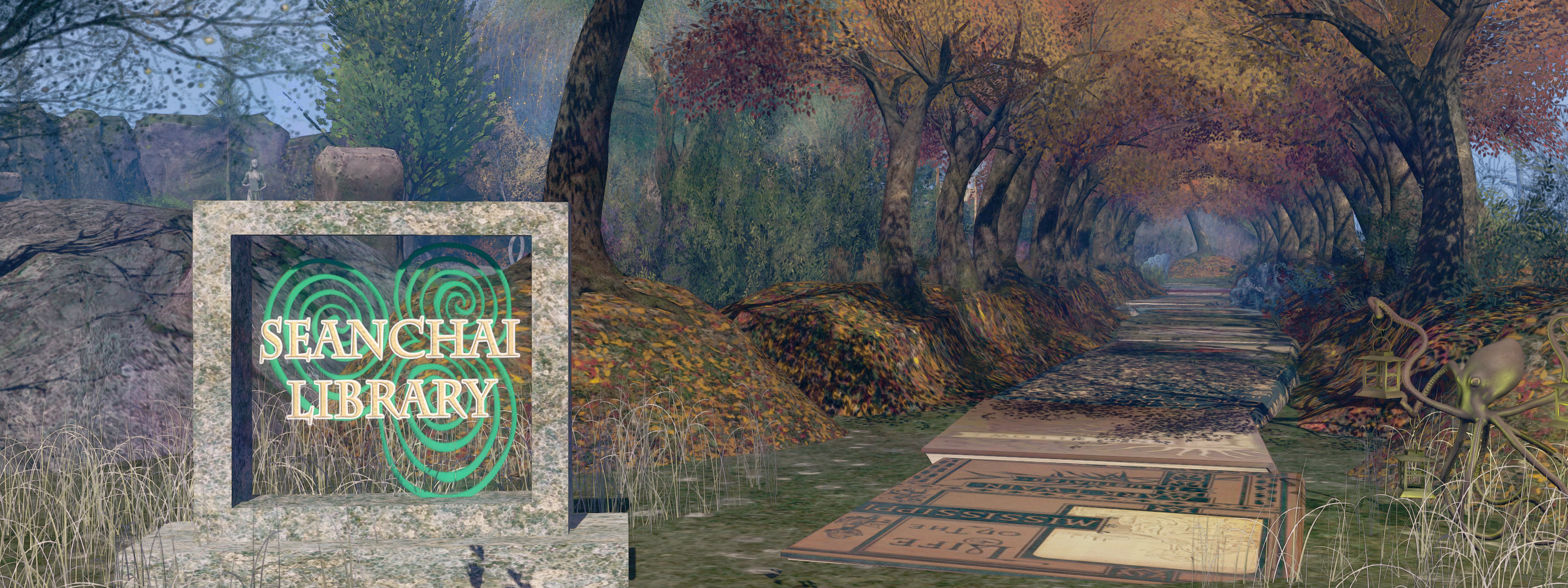
Seanchai Library

It’s time to highlight another week of storytelling in Voice by the staff and volunteers at the Seanchai Library. As always, all times SLT, and events are held at the Library’s home in Nowhereville, unless otherwise indicated. Note that the schedule below may be subject to change during the week, please refer to the Seanchai Library website for the latest information through the week.

Monday, September 13th 19:00: The Weigher

A world dominated by sentiment big cats where the rule of law is enforced by the Weighers, a combination of judge, peacemaker and accountant through a brutal code of honour and combat. Without their violent intervention in things, all-out war and anarchy would ensue.

When two human explorers – fragile, weak and potentially easy prey – arrive on that world, Slasher, a Weigher of skill and talent in physical combat, finds herself defending them. In doing so, she finds herself a disgraced outcast.

Join Gyro Muggins as he resumes the story by Eric Vinicoff and Marcia Martin.

Tuesday, September 14th

12:00 Noon: Russell Eponym

With music, and poetry in Ceiluradh Glen.

19:00: Nightbird

Twig lives in Sidwell, where people whisper that fairy tales are real. After all, her town is rumoured to hide a monster. And two hundred years ago, a witch placed a curse on Twig’s family that was meant to last forever. But this summer, everything will change when the red moon rises. It’s time to break the spell.

Willow Moonfire read’s Alice Hoffman’s novel.

Wednesday, September 15th, 19:00 TBA

Check the Seanchai Library website for updates.

Thursday, September 16th, 19:00: The Sea and Little Fishes

Caledonia Skytower takes us back to Terry Pratchett’s Discworld for a tidy little tale of allowing someone to prove they are wrong – whether in word or deed or both.

It is time for the annual Lancre Witch Trials, and  Lettice Earwig appoints herself as head of a cadre of witches who decide Granny Weatherwax should not compete on account of her winning every year. Asking her to step aside is anticipated as a possibly unpleasant task – so when she agree with disarming courtesy. Just what could it mean…?

First published in 1998, Pratchett later explained that the title of the story comes from an ancient saying (which he’d made up!): The big sea does not care which way the little fishes swim. 

2021 viewer release summaries week #36

Logos representative only and should not be seen as an endorsement / preference / recommendation

Updates from the week ending Sunday, September 12th

This summary is generally published every Monday, and is a list of SL viewer / client releases (official and TPV) made during the previous week. When reading it, please note:

  • It is based on my Current Viewer Releases Page, a list of all Second Life viewers and clients that are in popular use (and of which I am aware), and which are recognised as adhering to the TPV Policy. This page includes comprehensive links to download pages, blog notes, release notes, etc., as well as links to any / all reviews of specific viewers / clients made within this blog.
  • By its nature, this summary presented here will always be in arrears, please refer to the Current Viewer Release Page for more up-to-date information.
  • Note that for purposes of length, TPV test viewers, preview / beta viewers / nightly builds are generally not recorded in these summaries.

Official LL Viewers

  • Release viewer: version 6.4.22.561752, formerly the CEF update viewer, dated July 24th, promoted August 10th – No change.
  • Release channel cohorts:
    • No updates.
  • Project viewers:
    • No updates.

LL Viewer Resources

Third-party Viewers

V6-style

  • No updates.

V1-style

Mobile / Other Clients

  • No updates.

Additional TPV Resources

Related Links

Mihailsk’s Red Sky at Nitroglobus in Second Life

Nitroglobus Roof Gallery: Mikailsk – Red Sky

It was back to Dido Haas’ Nitroglobus Roof Gallery for the second time in less than a week, this time to visit Dido’s Space in the gallery (follow the bare footprints on the floor from the landing point to find it), where Greek photographer-artist Mihailsk makes his second appearance in a 3-month period, this time to offer a selection of new pieces under the title Red Sky.

Mihailsk is relatively new to the SL art scene in terms of exhibiting his work – his first such exhibition was actually the July appearance at Nitroglobus mentioned above, which took place in the main gallery space (see: Mihailsk’s Baptism of Fire in Second Life). The smaller Red Sky offers both an expansion on what made that exhibition so attractive whilst also contrasting very strongly with it.

In writing about Baptism of Fire I noted that Mihailsk – Miha to those close to him – produces work that is avatar-focused, but not necessarily avatar-centric. That is, whilst an image may include an avatar and framed in such a way to draw the eye to that avatar, it is the overall composition – pose, expression, surroundings – be they indoors or out – use of lighting and colour, etc., that are as equally as important in telling the story within the image, rather than sitting merely as a backdrop. With Red Sky, this is equally if more more true, with each of the pieces featuring – as the title of the exhibition suggests – a red sky of a deep crimson hue which serves to  additionally frame the emotional depth of each image.

Nitroglobus Roof Gallery: Mikailsk – Red Sky

Colour is oft used to define or evoke emotions and emotional responses; we talk in terms of someone “seeing red” when exceptionally angry, or of having a “black mood” or being caught in “the blues”; we believe muted tones and colours help evoke feelings of calmness or help people to relax, and so on. Red is especially evocative, as it generates so many responses / emotions / feelings. As noted here, it is often used to represent the stronger emotions of anger and rage, but at the same time it can also express the more tender – love, compassion, care; it can also express danger, the need to be careful or to keep away and, conversely it can emphasise attractiveness and wanting to attract through its use in the clothes we wear.

In his eight pieces, Miha offers six expressions / emotions with which were are all familiar: love, joy, longing, power, pain and danger, together with two pieces – Balance and Visualisation – that speak to broader themes. Within each image, the red sky / backdrop serves to reflect and enhance the sense of emotion already present through the use of other colours, pose, framing, and overall composition.

It is here that the contrast with Baptism of Fire is most evident: were the images there used darker or muted tones / monochrome shading that coalesced within each piece to express their emotion; here it is the strong contrast between the sky and other colours present – green, yellow, the tones of nature, etc., that frames the emotion. But at the same time, the use of colour / tone / shading in this way offers the same strength of narrative context through both exhibitions.

Nitroglobus Roof Gallery: Mikailsk – Red Sky

Writing in his liner notes for Red Sky, Miha states, “We are a part of the environment around us, not the main theme.” This is again evident through his work seen within this collection: the poses are natural in form, capturing simple gestures, etc., any one of us might naturally make in any situation; thus they are devoid of any sense of intentional construction, but appear as moments of life caught in a blink of a shutter, avatar and setting forming a natural balance. And here too, the crimson skies also play a role, for crimson is oft referenced as the colour of blood, the oil in our machine, so to speak, that keeps us running; thus we are reminded both through the emotional content of these pieces and the use of colour that life is not just about participating in it, it’s about experiencing it to the fullest extent we can.

SLURL DETAILS

Space Sunday: SpaceX, NASA and interstellar visitors

SpaceX Starbase, Boca Chica, September 7th, 2021: to the left, Booster 4 stands on the launch table, the launch support tower standing over it. To the top right is Starship 20 sitting on sub-orbital pad B, with the lower half of Booster 3 (the upper tank section of which was cut off and removed in August. Credit: RGV Aerial Photography

SpaceX is continuing to move towards a first flight-test ready stack of its massive Super Heavy vehicle and a proof-of-concept Starship payload carrier – although there is still some way still to go before an actual launch attempt can be made.

Following the test stacking of Booster 4 and Starship 20 on the launch table back in August (see Space Sunday: the Ups and Downs of Space Vehicle Development), Booster 4 was rolled back to the production facilities at the company’s Starbase centre at Boca Chica, Texas, to undergo a number of revisions.

Chief among these has been modification to the vent valve system, nominally used to allow excesses gaseous oxygen and methane to be vented from the rocket’s tanks as it naturally “boils off” due to temperature differentials the vehicle experiences when fuelled ahead of a launch. In particular, the vents for the booster’s lower tank now have covers that direct any gas downwards along the rocket’s body, and the vents for the upper tank force the gas outwards and away from the rocket.

Booster 4 re-departs the production facilities at Starbase to drive the 1.5 km down the road to the launch facilities Credit: StarshipGazer.com

This suggests that SpaceX plan to use the release of gas from the tanks as a means to help control the orientation of the rocket during its descent back through the atmosphere in a manner similar to a more traditional reaction control system (RCS). If this proves to be successful, it means SpaceX have further reduced Super Heavy’s mass by avoiding the need for separate RCS systems and tankage.

Another issue with rockets is that as the fuel tanks empty they lose internal pressure, and this can interrupt the steady flow of propellants to the engines. To prevent this, most launch systems utilise a reserve of helium that can be fed into the tanks as the propellants are burnt, maintaining the necessary tank pressure. To remove the mass created by a helium system, SpaceX have opted to use the rarer option of autogenous pressurisation. This draws a small flow of heated propellants before they reach the engines, and feeds this flow – in gaseous form – back up the outside of the rocket via dedicated pipes to be returned to the fuel tanks to re-pressure them.

The new vent systems and the piping of the autogenous pressurisation feeds where clearly visible as Booster 4 was rolled back to the orbital launch facilities on Tuesday, September 7th, and hoisted back onto the launch table, with the speculation iit may remain there until the actual launch attempt.

Two views of Booster 4 showing the revised excess gas vents from the top of the lower tank tank and the autogenous pressurisation feed pipes, Also visible is the black mass of the QD Arm. Credit: What About It

When this will be is unclear; the operation to hoist the booster into position showed the launch table itself is still being completed, being wrapped in scaffolding. It’s also not clear how much of the necessary propellant and electrical feeds have been installed in the launch support tower – although the Quick Disconnect (QD) arm that actually feeds propellants into the starship vehicle and provide it and the booster with electrical power has been installed (with further additions to come). Similarly, the actual tank farm that will supply consumables – water, propellants, etc., – to the pad to enable launches.

Even so, SpaceX CEO Elon Musk has suggested an initial static fire test with Booster 4 could come within the next week. Even if the majority of the required plumbing, etc., is in place, this seems possibly ambitious,  given that such a test will likely only come after at least one each of cryogenic propellant loading / pressurisation tests to ensure the system is ready for any static fire test.

How many static fire tests might be run is unclear; its unlikely that SpaceX will want to fire all 29 engines in the first test but will likely build up to it – perhaps starting with the three motors at the centre of vehicle, followed by a firing of all nine of the middle engines before progressing to firing all 29 engines. And it should be remembered any of these tests, from pressurisation through the engine firings, could result in the rocket sustaining damage or even being completely destroyed.

Booster 4 being gently lowered into the launch table ring mount at the Starbase orbital launch pad. Notes the amount of construction scaffolding still in place. Credit: Nic Ansuini / NASASpaceflight.com

After the August stack test, Starship 20 was moved from the the orbital launch pad to sub-orbital launch pad B, where it has been undergoing an extensive examination of its thermal protection system (TPS) designed to protect it during entry into the atmosphere. The tiles on this system appear to have suffered more than the anticipated amount of stress / damage due to it being lifted up onto the booster by its snout in order to be stacked on the booster, requiring a lot of them to be replaced and others refitted / re-aligned. This work is now drawing to a close, but does point to a need for the tile system to be more robust during vehicle moving / operations.

Most recently, the vehicle has been receiving the six Raptor motors that will power it. This has sparked speculation that once this work is complete, Starship 20 could be ready to start its cryogenic and fuel pressurisations tests ahead of static firing test – again, possibly the inner three first, then all six.

How it started and how it is going: two shots indicating the number of Starship 20 heat shield tiles that needed to be completely replaced (red tags) or which required refitting / realigning (green tags) following the operation to stack and remove the vehicle on its booster in August. Credit: NASASpaceflight.com

A final element key to any launch attempt (and the full booster static fire test) is the granting of permission and a licence by the Federal Aviation Administration, which appears to be rightly determined not to be rushed into giving the OK whilst it is still conducting an extensive review of the Starbase facilities and their overall suitability for Super Heavy / starship launches  in the event of an accident (particularly after the airborne explosion of SN11in march 2021 resulted in debris falling to earth 8 km from the SpaceX facilities and close to a populated area).

Continue reading “Space Sunday: SpaceX, NASA and interstellar visitors”