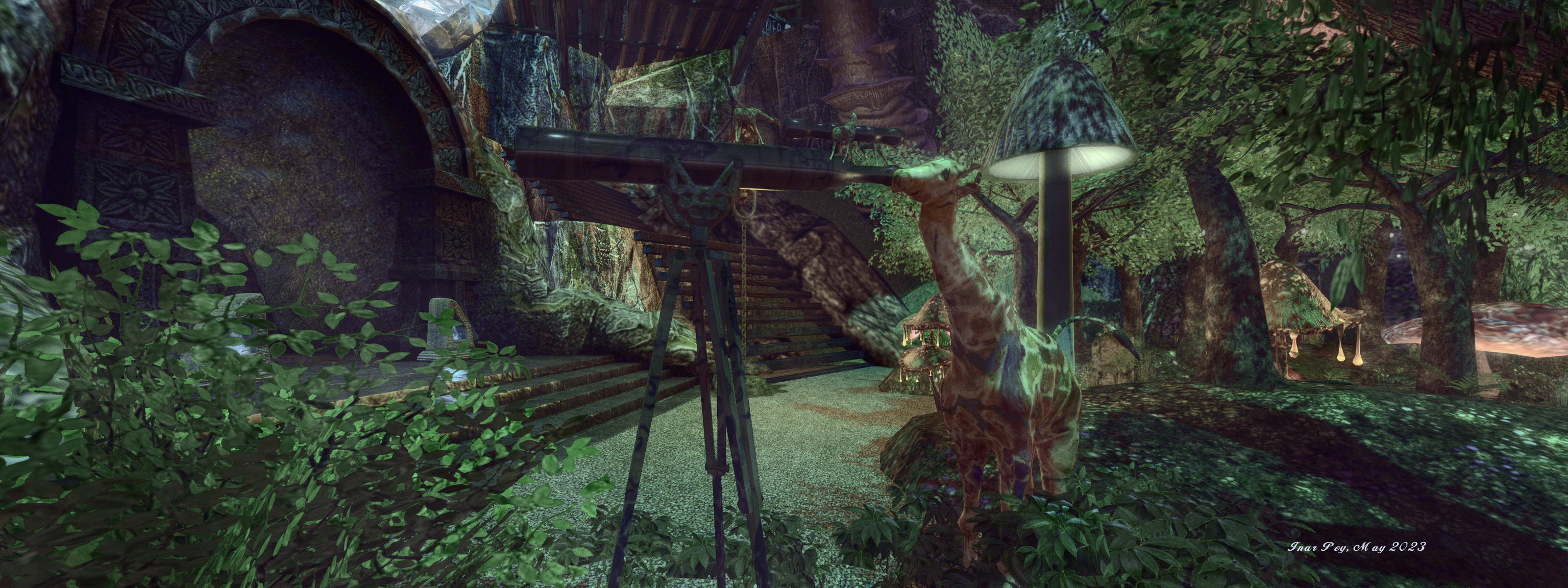
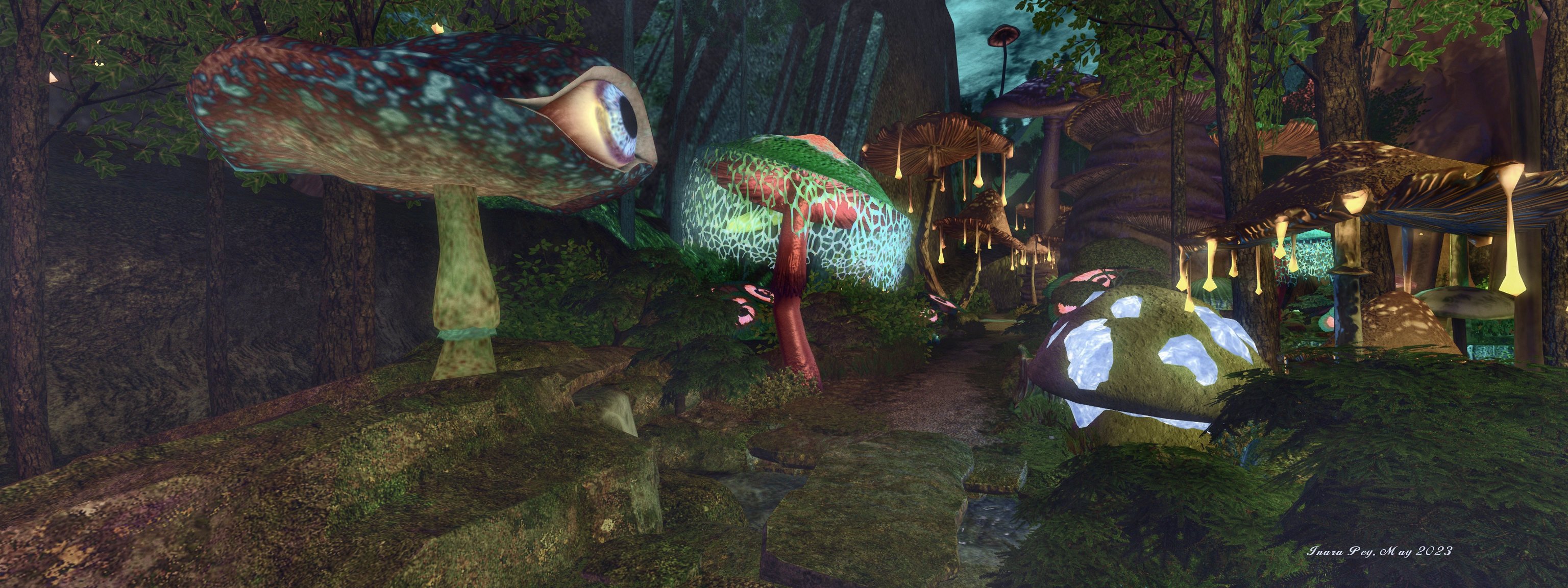
Luane’s Magical World, May 2023 – click ay image for full size
I had not intended to write about two fantasy / magical places in Second Life one after the other, however, after visiting Xanadu Forest (see: The mystical magic of Xanadu Forest in Second Life), I found that a trip to LauneMeo’s wonderful environments, this time to visit Luane’s Magical World, her most recent creation on her Homestead region, Le Monde Magique.
Luane’s Magical World, May 2023
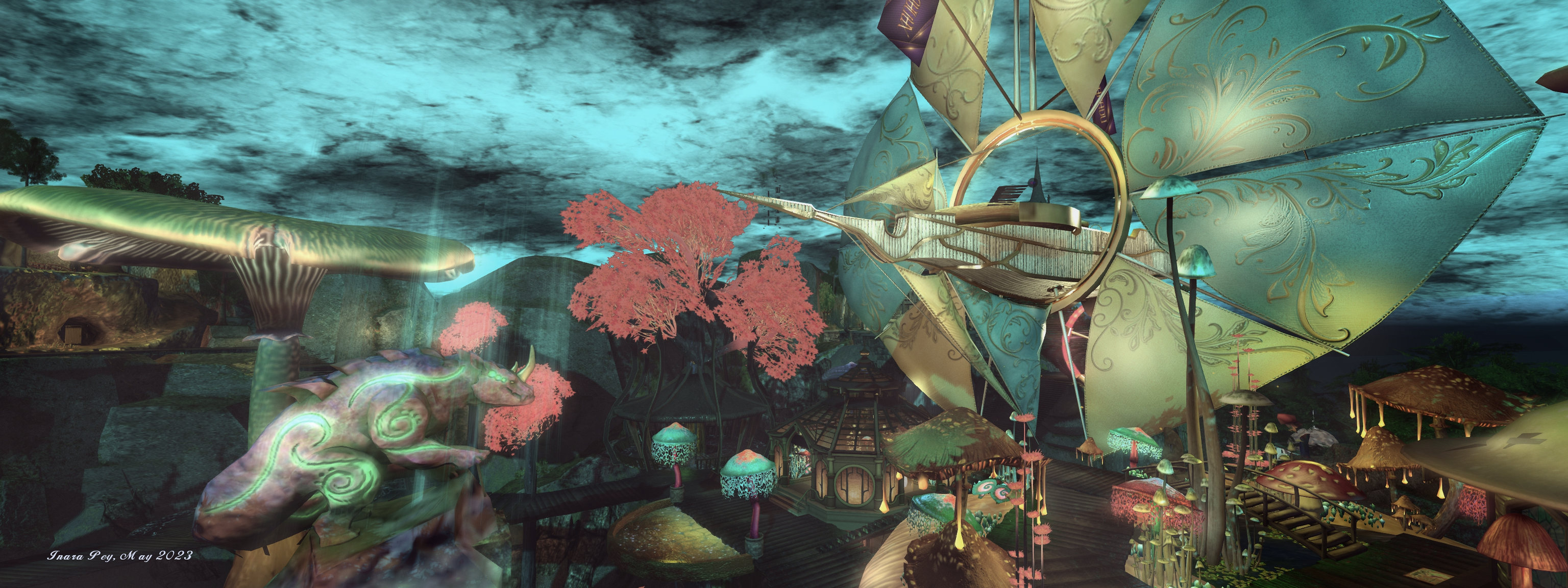
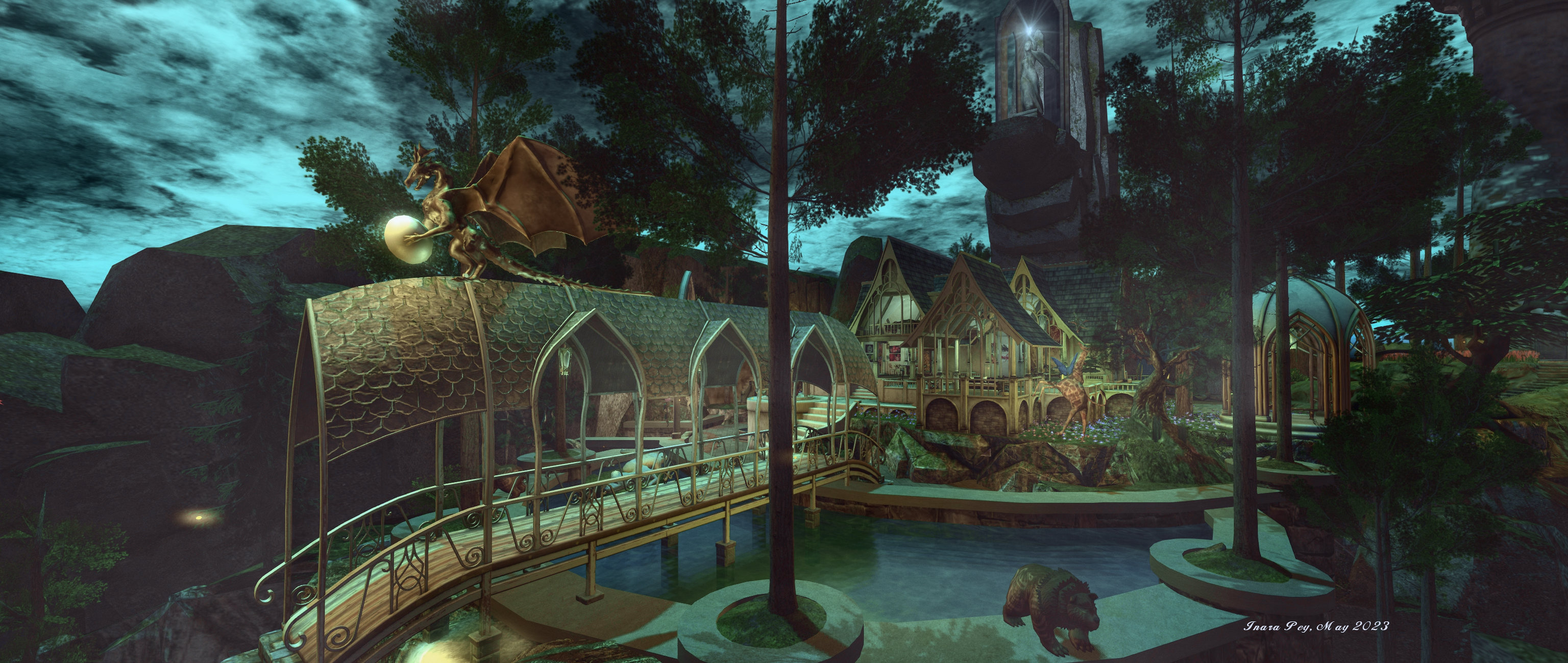
Luane has a well-deserved reputation for producing engaging, romantic and photogenic environments – and that is the case with Magical Worlds, a place where dragons and alicorns and albino elephants wander the shallow waters under the watchful eyes of giant translucent tubers and silvan trees and fae folk flits and sit upon plants and under the shade of trees in green and pink blossoms rising from a lush carpet of grass.
Luane’s Magical World, May 2023
This is a place of serene beauty, a garden of many faces and many spaces, the first all awaiting discovery, the second all offering places in which to retreat and spend time. The primary landmass forms a circular island sitting in the south-east quarter of of the region. Home to the landing point as it sits overlooking crystal waters bounded on their far side by the silvered wetlands.
Luane’s Magical World, May 2023
While the waters are protected by transparent surfaces making them walkable, to maintain the illusion of the setting, easiest way across the water is to take the ice0like stones as they form a path around the water’s edge and along the wetlands – although beware the odd alicorn also wandering the path.
To describe this setting is really an exercise in futility; it more than speaks for itself. Just be sure to take the time to seek out everything awaiting to be found here – there is likely to be more than a casual wander and camming around might reveal. As such, I don’t plan to say more here; instead I’ll simply leave some further images to offer a shallow reflection of Luane’s creativity in the hope they will encourage you to go and see for yourself. You are unlikely to be disappointed.
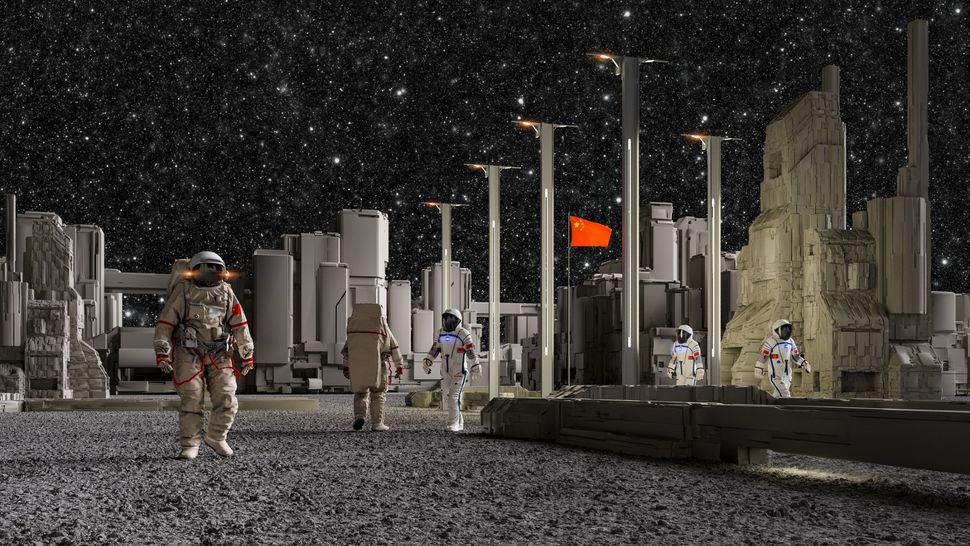
An artist’s impression of the Chinese lunar base by the late 2030s. Credit: Chinese Lunar Exploration Programme
China has been making a lot of space-related news recently, so it’s time to catch-up on things.
At the end of April, the country confirmed it intends to have boots on the Moon by 2030. This confirmation came during a wide-ranging interview with Wu Weiren, the head of the country’s lunar exploration programme, broadcast in China ahead of the “national Space Day”, held on April 24th.
As with the US-led Artemis programme, the Chinese aim to start with a short-term stay on the Moon, followed by additional missions intended to build up to a permanent presence within a research base called the International Lunar Research Station (LRS) by the end of the 2030s.
The CLEP logo of the crescent Moon and tiakonaut boot prints, combined to resemble the Chinese symbol for the Moon
In support of this, China is operating a highly integrated development programme – the Zhōngguó Tàn Yuè (Chinese Lunar Exploration Programme (CLEP) – overseen by Wu. This combines the development and operation of on-going and future robotic mission to the Moon along with the longer-term development of crew vehicles either designed specifically for, or in support of, lunar exploration. These activities fold into them the existing orbital and soft-landing missions of Chang’e 1 through Chang’e 5, and will continue in May 2024.
It is then that China will launch Chang’e 6, a mission to investigate the topography, composition and subsurface structure of the South Pole–Aitken basin, one of the sites seen as a potential location of a future lunar base. This mission will also see an attempt to return further lunar sample to Earth – the first time samples have been returned from the Moon’s far side.
Then in 2026, Chang’e 7 will visit the same region, leaving a communication relay satellite in orbit and delivering a lander and a miniature flying probe to the surface; in 2028, Chang’e 8 is likely to deliver of a small-scale 3D printing system intended to demonstrate the use of the Moon’s regolith in the construction of a lunar base.
As well as the Chinese mission, Russia is expected to provide input to the programme as the first major partner to join with China in their lunar ambitions. This involvement is due to commence later in 2023 with the launch of the Luna 25 lander, to be followed by the Luna 26 orbiter and Luna 27 lander missions in 2027 and 2028 respectively. Russia will also provide personnel and equipment for the LRS.
Alongside of this, the China Aerospace Science and Technology Corp. (CASC) will work on crewed vehicles for transporting taikonauts to the Moon and delivering them to the surface and then back to orbit. If the plan progresses as intended, it is expected that the first phase of the International Lunar Research Station in operation by 2035 – potentially mirroring or possibly ahead of the US plans for an expanded Artemis base in the Moon’s South Polar Region.
Most recently for China has been the return to Earth of their ultra-secretive Chongfu Shiyong Shiyan Hangtian Qi (CSSHQ), an experimental spaceplane after 276 days in orbit.
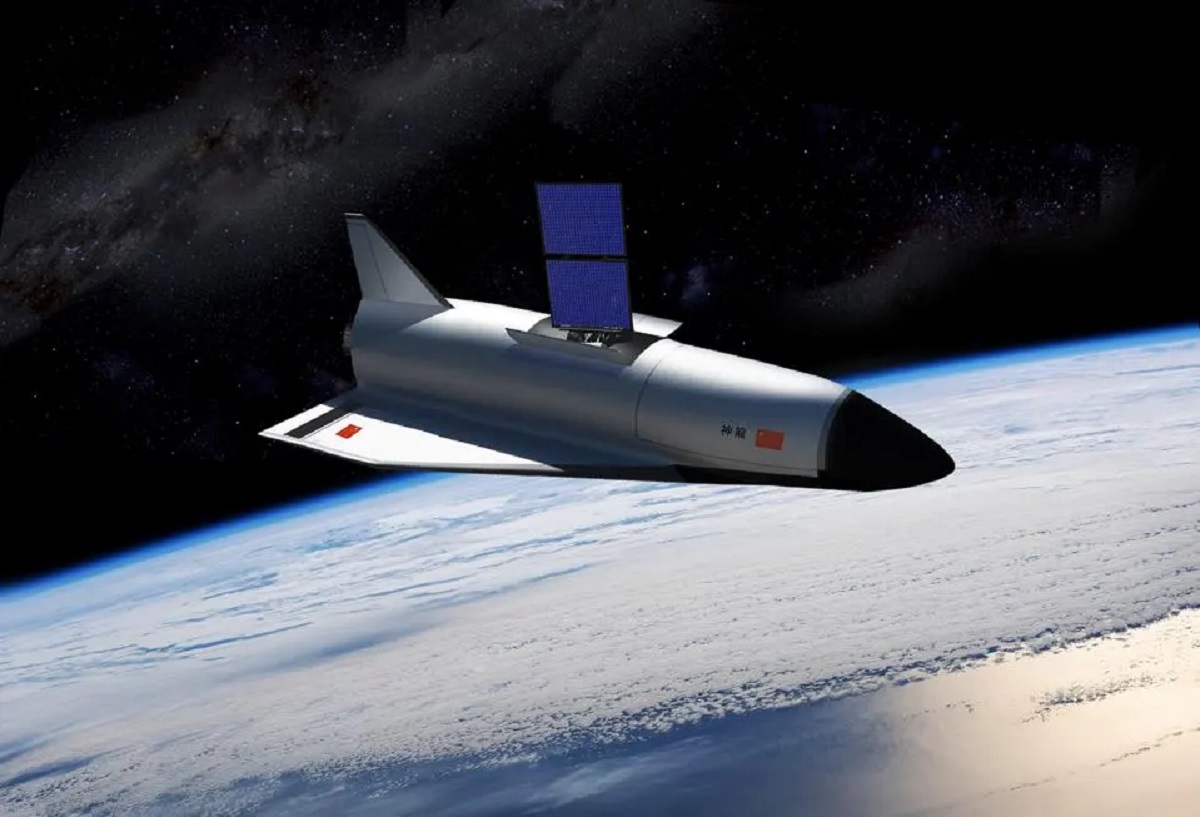
An artist’s impression of China’s reusable Shenlong spaceplane. Credit: China Aerospace Studies Institute
Quite what the vehicle is remains unclear to western analysts – and matters have been muddled by differing statements made by Chinese authorities (some of which are doubtless intended to obfuscate matters), indicating that the vehicle is both an unscrewed cargo-carrying vehicle and a craft designed to carry a crew of 6 to orbit. However, this latter claim appears to be unrealistic; CCSHQ’s two flights have been aboard Long March 2F vehicles, which have a maximum payload capacity of 8.4 tonnes – but a vehicle capable of supporting a crew of six in orbit and returning them safely to Earth would have a mass well; perhaps as much as 20 tonnes at launch. The Chinese have also suggested the vehicle is a two-stage craft, using a scramjet engine for first stage propulsion.
The vehicle’s size approximates to that of the equally secretive X-37B spaceplane, some 8-9 metres in length and with a wingspan of between 3 and 4 metres. The May 8th return to Earth marks its second flight into space – the first being a modest 3-day flight in 2020.
The current mission commenced on August 4th, 2022, and gave rise to a lot of speculation when the vehicle deployed a small satellite, with some in the west claiming it was a weapons platform – something China hotly denied. As it was, vehicle and cargo operated in close proximity to one another for a time, as if practicing rendezvous manoeuvres. In addition to this, CSSHQ performed more extensive manoeuvres, including altering its orbit, raising and lowering it.
The reusable test spacecraft successfully launched by our country at the Jiuquan Satellite Launch Centre successfully returned to the scheduled landing site on May 8 after flying in orbit for 276 days. The complete success of this test marks an important breakthrough in our country’s research on reusable spacecraft technology, which will provide a more convenient and inexpensive way to and from the peaceful use of space in the future.
– China Aerospace Science and Technology Corp. (CASC) statement
The Chinese space plane is roughly the same size and the US X-37B, shown above in its former USAF marking. Credit: Giuseppe De Chiara
As with the first mission, the launch commenced from the Jiuquan Satellite Launch Centre in the Gobi Desert and while accounts vary, it appears to have concluded with the craft landing at the Lop Nur military base in Xinjiang, as it did at the end of its maiden flight.
Some in the west have been keen to play down this mission, noting that the X-37B’s first flight lasted 224 days, and its most recent – which ended in November 2022 – was908 days in length. However, the X-37B has a development history going back, and took a decade to extend its flight envelope from 224 to 908 days. CSSHQ appears to have been in development for less than a decade, and saw its mission duration leap from 4 days to 276 in just two flights – so it is hardly something to be sneezed at purely on the basis of flight duration.
Vast Contract SpaceX to Launch “World’s First Commercial Space Station”
Vast (also styling itself Vast Space), a privately held American aerospace company founded in 2021, has announced ambitious plans to launch the world’s first commercial orbital facility, Haven-1 in August 2025, and that they have engaged SpaceX to handle the launch and deliver at least one 4-person crew to the station.
“Ambitious”, because prior to February 2023, all Vast has was a mission statement (to build artificial gravity space stations), a logo and a 10,700 square metre facility in Long Beach California; outside of the founders, it did not even have employees. That changed in February with the acquisition of another start-up, Launcher, a company developing 3D printed rocket motors and an orbital transfer vehicle; this afforded Vast assets, products – but not the expertise required to build a module capable of supporting 4 people in orbit for up to 30 days at a time.
An artist’s impression of the Vast Haven-1 module with a Crew Dragon docked against it. Credit: Vast Space LLC
However, Vast claim they can reduce the time required to build the unit by “repurposing” elements of the automated orbital transfer vehicle. If true, this still leaves them having to ensure the 10.1 metre by 3.8 metre module is fully capable of supporting life – something which is not a priority for robotic vehicles.
In addition, the module will have deployable solar panels capable of generating up to 15 kW of electrical power, a docking module at one end suitable for capturing Crew Dragon vehicles, and around 70 cubic metres of total pressurised volume. At 14 tonnes, it is intended to be launched with all the consumables needed to support a visiting crew during their stay, with additional crews able to carry further supplies with them aboard Crew Dragon.
Exactly what Haven-1 will be used for is unclear. “Research” has been mentioned, but it also seems to be about space tourism; as a part of a deal with SpaceX, which will see the module launched on a Falcon 9 rocket, Vast have committed to one 4-person Crew Dragon launch to the module (the “Vast-1” mission), and plan to sell these seat on to interested parties, who will also have to pay for training through SpaceX. The contract also includes the option to purchase a second Crew Dragon flight in 2026.
CAD drawings of the proposed “spinning stick” station (l) and a space wheel from Vast Aerospace, both of which will supposedly provide artificial gravity environments – the former by spinning the 7-metre diameter chain of modules around its longitudinal axis, a proposition that looks questionable at best. Credit: Vast Aerospace
Equally ambitious are the company’s longer-term plans. According to their website, they place to launch a much larger “Starship class” module with a diameter of 7 metres (but unspecified length) using the SpaceX Starship. This module class will then – they claim – be used to build 100-metre long “spinning stick” stations which will “provide various gravitational environments including Earth, Mars, Moon, and asteroid gravities” – although whether this is really practicable in a space just 7 metres across and spinning around its longitudinal axis is questionable at the least.
Vast claim these “spinning sticks” will be constructed over seven Starship launches apiece and support up to 40 people each, paving the way through the 2030s to a “proliferated space fleet” comprising “dozens” of stations of various types “across the solar system” in the 2040s. These, if the website is to be believed, will include units modelled on the classic “spinning wheel” stations beloved of science-fiction.
Just how well the company succeeds in these goals remains to be seen. I’m personally not holding my breath. I will give them full marks for the Haven-1 promo video, however.
Raglan Shire, Second Life’s Tiny community, has once again opened its doors to people from across the grid as participating artists and visitors are invited to the Raglan Shire Artwalk 2023.
This year, the the event runs from Sunday, May 14th, through until Sunday, June 18th, 2023, inclusive. It offers an opportunity not just to appreciate a huge range of art from both the physical and digital worlds, but to also tour the Shire regions and enjoy the hospitality of the Raglan Shire community.
A non-juried exhibition, the Artwalk is open to any artist wishing to enter, and has minimal restrictions on the type of art displayed (one of the most important being all art is in keeping with the Shire’s maturity rating). All of this means that it offers one of the richest mixes of SL art displayed within a single location in Second Life, with 2D art is displayed along the hedgerows of the Shire’s pathways and tree platforms overhead and 3D art among the community’s parks.
Raglan Shire Artwalk, 2023
2022 attracted 150 artists, and 2023 is set to match that number, with many artists participating for the first time. As such, the depth and range of art on display is guaranteed to keep visitors exploring the paths and walks around and through the hedgerows – and if walking proves a little much, there are always the Shire’s tours to ease the load on the feet, together with the teleport boards to help move visitors swiftly around and through the different display areas. But that said, I do recommend exercising your pedal extremities and doing at least some of your exploration on foot – just keep in mind people do have their homes in the regions as well.
Given the number of artists involved, there isn’t a published list of participants, but anyone interested in the world of SL art is bound to recognise many of the names of the artists here. The Artwalk is also a marvellous way to see art from both our physical and digital worlds and for catch artists both familiar and new to your eye. Just don’t try to see it all at once; the Artwalk is open for a month, which gives plenty of time for browsing and appreciating the art without feeling overloaded.
Dragonfly, March 2023 – blog post
The following notes were taken from my audio recording and chat log transcript of the TPV Developer (TPVD) meeting held on Friday, May 12th 2023 at 13:00 SLT.Meeting Overview
The TPV Developer meeting provides an opportunity for discussion about the development of, and features for, the Second Life viewer, and for Linden Lab viewer developers and third-party viewer (TPV) / open-source code contributors to discuss general viewer development.
Maintenance S RC viewer, version 6.6.12.579987, May 11.
Maintenance T RC viewer, version 6.6.12.579927, May 11.
PBR Materials project viewer, version 7.0.0.579766, April 25.
Project viewers:
Puppetry project viewer, version 6.6.12.579958, May 11.
General Viewer Notes
Inventory thumbnails viewer: work is progressing and a public-facing viewer should be available in the “not too distant future”.
The viewer-side work to support emojis is now more-or-less complete, and release of any project viewer is pending some additional back-end work.
There will be changes coming to the Second Life System Requirements, minimum specifications:
Mac OSX will be set at version 11.
Window 32-bit is liable to be dropped.
LL is close to completing the move of viewer builds to Github Actions. This has involved getting many of the 3rd party libraries for the viewer updated and refreshing all build dependencies.
There is a project underway to provide PDR support for terrain.
The overall scope is not clear, but it apparently exploits an asset-checking weakness in the simulator code related to terrain, allowing the use of Materials asset IDs in place of the usual texture IDs, allowing them to be applied to the ground.
This is seen as a means of leveraging PBR Materials to offer some quality improvements to terrain ahead of any longer-term terrain project which might yet be considered / actioned.
It is hoped that this work will be available in a project viewer Soon™.
In Brief
PBR Materials mini-update:
Overall visual quality is pretty much where it will be when the viewer reaches formal release status.
There are still issues with rendering the sky – such as alpha glitching on the Sun. This is being worked on, but it is unlikely to see an imminent solution / viewer update.
Other known issues are also being worked on and progress is being made in clearing them.
A general discussion of the on-line / off-line friends issues (frequently raised t the Server User Group meetings) – see BUG-232037 “Avatar Online Offline Status Not Correctly Updating”. As per notes from that meeting, the UDP fix does not appear to have had the desired impact in helping to reduce the issue, and LL are looking at the matter again.
A lot of general chat on WIP regarding PBR Materials and reflection probes, most of it relating to issues likely to be addressed – please refer to the video.
A general discussion on possible standards for avatar “metaverse interoperability” which runs through the latter half of the meeting. As a theoretical discussion rather than something LL is working on, please refer to the video.
There is also some further discussion on the Puppetry project, however, this will form an addendum to my recent Puppetry Project meeting summary, as it is more relevant there.
Xanadu Forest, May 2023 – click any image for full size
Fantasy Faire may have passed into memory for 2023, but those who appreciate the splendour and beauty of the Fairelands can recapture the spirit of it, and past Fantasy Faire events through the largesse of Evangeline Ling. She is the creator of the simply stunning Xanadu Forest, a place of mystical magic ringing with the echoes of Fantasy Faire hidden – like Tolkien’s Rivendell, within a deep cleft within the Mainland continent of Sansara.
WELCOME to Xanadu Forest, a place of magic and mystery … Here you are welcome to role-play, explore, relax with your friends or take beautiful photographs for your special memories, or just play a game or two of greedy. We invite you to use the shared environments as our lighting here is part of the attraction and don’t forget to take a visit to our fantasy bowling alley (Even elves enjoy a little bowling too). You will find dryads and elves, Dragons, pirates, scattered evidence of a demonic presence.
– from the introductory note card for Xanadu Forest
Xanadu Forest, May 2023
Comprising multiple levels from the waters at the bottom of its deep gorge to platforms and plateaus amidst its peaks, this is a place of vivid colours, otherworldly plants, winding trails and climbing stairs, all of which fully captures the romance and magic of multiple Fairelands without ever feeling as though it is merely trying to copy them. Thus, it stands as a rich and vibrant land in its own right, as much as standing in homage to Fantasy Faire.The landing point sits high up on one of these platforms, sitting within a build from The Looking Glass and harking back to Fantasy Faire 2022. Here, under the shadow of Ketsui Naidoo’s The Majestic Revived – better known to Fairelanders as The Fairechylde – walkways extend out and across the valley, held aloft by the trunks of giant mushrooms and the faces of cliffs rising and falling to reach other levels, houses and the gardens below.
Xanadu Forest, May 2023
Along the way, there is much to find, again as the introductory note card for the setting describes:
You will find dryads and elves, Dragons, pirates, scattered evidence of a demonic presence. With enough searching you may even find the home of a certain Slenderman (we advise extreme caution entering his home). There are no strict role-play rules in Xanadu, you bring your own RP here or perhaps use Xanadu as a foreign land for your own RP group. Please join our Group, Xanadu Forest, and we will keep you up to date on any fun activities or events. Stop by anytime the forest welcomes you.
– from the introductory note card for Xanadu Forest
Xanadu Forest, May 2023
Also awaiting discovery are teleport points, both light and dark, offering trips to destinations which may appear in opposition to their outward appearance; a hidden gallery of art, a high (literally) elven home and many, many, elements from the Fairelands, from the giraffes of Haveit Neox and the bears of Loki Eliot – even the suspended walkways are liable to bring forth recollections of Fairelands past. There are also one or two unexpected characters to be found along the way!
This is a place so cleverly put together that just when you think you have found everything, you turn around and discover something new and / or unexpected. It might be a throne sat back and above the garden trail or a hollow within the rock where a board game might be enjoyed or an unexpected cliffside path rises, offering an alternate route to where the elven house sits.
Xanadu Forest, May 2023
As with the Fairchylde, the Majestic Revived offers the opportunity for dancing – at least for couples, I didn’t notice any solo dances – and more places to dance are also await discovery as people explore. There are also multiples to sit and / or cuddle and – obviously – endless opportunities for photography.
With regards to the latter, the setting comes with its own EEP settings, and I recommend using them when visiting – just go to World → Environment and make sure Use Shared Environment is checked. Also, and for the fullest experience, make sure local sounds are enabled. Should you appreciate Evangeline’s work in creating Xanadu Forest, or if you are a Fairelander yourself, do please consider a donation towards the future upkeep of the setting.
Puppetry demonstration via Linden Lab – see below. Demos video with the LL comment “We have some basic things working with a webcam and Second Life but there’s more to do before it’s as animated as we want.”
Note: this has been updated to include comments made at the TPV Developer meeting on Friday, May 12th.
The following notes have been taken from chat logs and audio recording of the Thursday, May 11th, 2023 Puppetry Project meetings held at the Castelet Puppetry Theatre on Aditi. These meetings are generally held on alternate weeks to the Content Creation User Group (CCUG), on same day / time (Thursdays at 13:00 SLT).
Notes in these summaries are not intended to be a full transcript of every meeting, but to highlight project progress / major topics of discussion.
Project Summary
General Project Description as Originally Conceived
LL’s renewed interest in puppetry was primarily instigated by Philip joining LL as official advisor, and so it really was about streaming mocap. That is what Philip was interested in and why we started looking at it again. However since Puppetry’s announcement what I’ve been hearing from many SL Residents is: what they really want from “puppetry” is more physicality of the avatar in-world: picking up objects, holding hands, higher fidelity collisions.
As a result, that is what I’ve been contemplating: how to improve the control and physicality of the avatar. Can that be the new improved direction of the Puppetry project? How to do it?
Leviathan Linden
Previously referred to as “avatar expressiveness”, Puppetry is intended to provide a means by which avatars can mimic physical world actions by their owners (e.g. head, hand, arm movements) through tools such as a webcam and using technologies like inverse kinematics (IK) and the LLSD Event API Plug-in (LEAP) system.
Note that facial expressions and finger movements are not currently enabled.
Most movement is in the 2D plain (e.g., hand movements from side-to-side but not forward / back), due to limitations with things like depth of field tracking through a webcam, which has yet to be addressed.
The back-end support for the capability is only available on Aditi (the Beta grid) and within the following regions: Bunraku, Marionette, and Castelet.
Puppetry requires the use of a dedicated viewer, the Project Puppetry viewer, available through the official Second Life Alternate Viewers page.
No other special needs beyond the project viewer are required to “see” Puppetry animations. However, to use the capability to animate your own avatar and broadcast the results, requires additional work – refer to the links below.
There is a Puppetry Discord channel – those wishing to join it should contact members of LL’s puppetry team, e.g. Aura Linden, Simon Linden, Rider Linden, Leviathan Linden (not a full list of names at this time – my apologies to those involved whom I have missed).
Additional Work Not Originally In-Scope
Direct avatar / object / avatar-avatar interactions (“picking up” an apple; high-fives. etc.).
Animations streaming: allowing one viewer to run animations and have them sent via the simulator to all receiving viewers without any further processing of the animations by those viewers.
Enhanced LSL integration for animation control.
Adoption of better animation standards – possibly glTF.
Given the project is incorporating a lot of additional ideas, it is likely to evolve into a rolling development, with immediate targets for development / implementation decided as they are agreed upon, to be followed by future enhancements. As such, much of what goes into the meetings at present is general discussion and recommendations for consideration, rather than confirmed lines o development.
Bugs, Feature Requests and Code Submissions
For those experimenting with Puppetry, Jiras (bug reports / fixes or feature requests) should be filed with “[Puppetry]” at the start of the Jira title.
An updated version of the viewer – version 6.6.12.579958 – was release on Thursday, May 11th.
This update includes access to Rider Linden’s experimental attachment point tracking & forwarding to the server feature.
It also includes various incremental improvements to handling puppetry, such as support for parsing binary LEAP data from the LEAP script.
Avatar attachment point tracking (per the TPVD meeting discussion on May 12th):
This allows the tracking of joints (using attachment points) using a script.
Using visible attachment points (i.e. those on the avatar , NOT any of the screen-based HUD attachment points) cuts down on the the amount of data having to be be handled at both ends.
The speed at which the attachment point movement is read back is such that it could not be exploited to create a copy of an animation with any real fidelity.
This is a deliberate move to ensure that animation creators are not left feeling uncomfortable about LSL animation tracking.
There is a combined throttle / sleep time elements to tracking attachment points: the throttle limits the number of attachment points that can be tracked over a certain period of time; he script sleep time is designed to allow an animation to move those attachment points forward sufficiently before a further taking record is made. Thus, it is next to impossible to track and record a coherent animation frame.
It was noted that previously, joint constraints had been hard coded in C++, but their configuration has been moved into a human-readable LLSD file which can be modified without rebuilding the viewer.
Two areas of focus going forward are:
Improving the Inverse Kinematic (IK) system within the viewer – something Leviathan Linden is already working on. This will include overall improvements to IK constraints as well as to positioning, with the existing source-code constraints moved replaced by a further config file – “constraints” here being in terms of joint rotation / movement.
Providing .FBX animation file import and Mixamo skeleton re-targeting.
The IK work is still being thrashed out (and subject to much more discussion at meetings, but is seen as a priority over other elements of work, such as the animations streaming idea Leviathan Linden had been working on. The hope is that by improving IK, it will play into streaming and “live” animations a lot more robustly and smoothly. It is also seen as a foundational piece of work for further opening up puppetry and animation work.
General Notes
It was noted that for animation import, LL is looking towards using / supporting Assimp (github: https://github.com/assimp/assimp), which supports some 30-40 animation formats, converting them to it ownformat for ease of import to multiple platforms. Notably, it supports .FBX and glTF, so it fits with the Lab’s goal of utilising glTF for materials, mesh imports, etc.
[TPVD meeting, May 12th] This will not alter the existing internal format for animation. It is just to allow the import of other formats.
It is acknowledged that alongside o that, the Labe will require a retargeting system for animations; although what form this will take is still TBD.
The core of the meeting was a general discussion of things that might / could e done in the future, and what technologies LL might look towards.