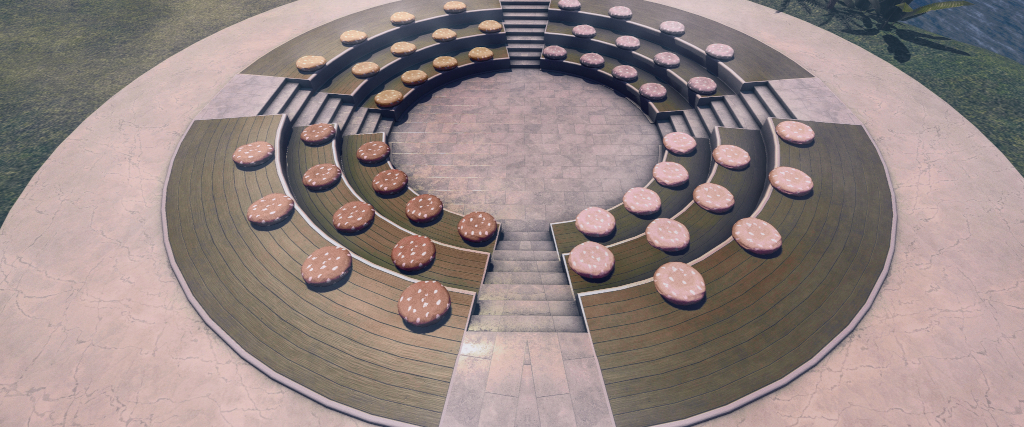
The Simulator User Group meeting place at Longfellow
The following notes were taken from the Tuesday, July 14th, 2026 Simulator User Group (SUG) off-week meeting (the “SUG Leviathan Hour”). These notes form a summary of the items discussed, and are not intended to be a full transcript. They were taken from my chat log of the meeting, and Pantera’s video is embedded at the end of this article – my thanks to her, as always, for recording and providing it.
Meeting Overview
The Simulator User Group (also referred to by its older name of Server User Group) exists to provide an opportunity for discussion about simulator technology, bugs, and feature ideas is held every other Tuesday at 12:00 noon, SLT (holidays, etc., allowing), per the Second Life Public Calendar.
The “SUG Leviathan Hour” meetings are held on the Tuesdays which do not have a formal SUG meeting, and are chaired by Leviathan Linden. They are more brainstorming / general discussion sessions.
Meetings are held in text in-world, at this location.
Simulator Update
As recorded in my notes from the the previous Simulator User Group, there has been a bug which has been causing some regions to fail to grant capabilities.
Rider Linden has been investigating the issue, and a hot fix should have been / will be deployed during the July 14th SLS Main channel restarts and the restarts of the RC channels on July 15th.
Game_Control
Whilst not directly linked to Lua, Leviathan hopes to get his work on game_control complete and into the Lua editor viewer so it can be shipped with the Linux viewer support.
It has been suggested that PromptFont could be used for the game_control preferences UI, and Leviathan is investigating this.
He will also be providing some viewer-side actions that can be mapped to, and triggered by, pressing buttons on the game controller (e.g. fly, run, toggle Voice on/off) in addition to the existing ability to move the avatar around (walk, crouch-walk, jump, strafe).
Another area of work he is investigating is to add a limited interaction capability so avatars can walk up to in-world, unseated object and transmit an action event to it (such as display any dialogue menu it has associated with it).
Leviathan has previously mentioned the idea of adding “semantic” meanings to the game-control data, and had been considering adding a new event to provide that info.
However, Monty Linden has suggested using a new function call (e.g. “llGetSemanticGameControl()” or similar) which could be used in the regular event to get the same data but resorted according to how the viewer has mapped it.
Leviathan noted he also needs to add new data to the GameControlInput message.
These updates led to a further discussion on possibilities for game_control together with possible additional avatar movement option – please refer to the video for more.
Alongside of game_control, Leviathan has been working on enhancement for the viewer’s flycam capabilities (e.g. for use with a 3D mouse system), such as Roll. More work is required on this, which might see the enhancements ported to game-control.
In Brief
Leviathan noted he has been working on a fix for an issue he actually caused, in which attachment scripts sometimes cease working correctly according to parcel permissions. He tracked this to his changes in making the simulator process idle scripts faster.
Lua:
Following an internal meeting, it appears there is a “hopeful tentative plan” to release Lua in the “O” simulator update.
If time frames stand, this could be sometime in late August or September, given that the next simulator release will be Mango, which will be followed by Nectarine, which is targeting late July or August.
This would see the Lua editor viewer (with resumed official support for Linux) released around the same time, if not a little earlier.
Work on this has not as yet been merged into the simulator development code.
Leviathan believes the work is almost done, he just needs consensus for the rest of the team that the fix as he’s implemented it is the right thing to do.
Once consensus has been reached, the fix will likely be merged into the simulator development code for a future release.
It has been reported that there is an issue with events being dropped causing scripts to stop working as intended.
One report is that scripted object stop working correctly when they change owner change owner, or message_linked or linksetdataRead randomly stop working.
The issue of scripts dropping is known to LL and Monty Linden is apparently investigating it.
A report has been made about the new dual-queue UDP messages processing code (currently in viewer-development but not released) in the viewer in that it causes out-of-order messages processing.
In particular, the first ObjectUpdate message creating an avatar can be processed too late and after the AvatarAppearance message to rez that avatar: since the avatar object is not yet created (not in object list), the AvatarAppearance is ignored and the avatar does not rez.
This may be due to there being assumptions in the dual queue design (both server and viewer side), which could be inappropriate, on the order in which some messages must be sent and processed for things to work properly.
Leviathan has indicated this will be looked into.
The above prompted Leviathan to note that he has a follow-up project to his UDP work and related to viewer networking he still hopes to get to.
This will be to tighten up the back-pressure info from viewer to server when it starts to get overloaded by network traffic, the problem being that when the viewer gets into this state, it will inform the server, but the process to send the messages takes too long and the viewer might only inform the primary simulator to which it is connected, not all the simulators it is currently talking to.
This led to a brief discussion on bandwidth throttling and use of an ACK UDP message to inform the server that its UDP queue is getting full, reducing the volume of messages until the flag is cleared by the viewer.
This was seen by Leviathan as a good idea.
See the last 15 minutes for the video for more on this.
Qaldera, July 2026 – click any image for full size
Occupying a Homestead region, Qaldera is the work of Adius Curzi (Adiabatic), and serves as both home to him and his partner, Snow (SarcasticSmile), and public space open to visitors.
Surrounded by tall peaks open the sea on one side, the description of the setting suggests the off-region surrounds are intended to be the walls of a caldera, a kind of sinkhole created when the magma chamber feeding the volcano is suddenly fully or partially evacuated, leaving it unable to support the mass of the rock above, which then slumps.
Qaldera, July 2026
Calderas can be hundreds of metres to kilometres in diameter. If there is still active magma left, then new volcanic cones and craters might form in further eruptions; if not, the caldera might over time fade into the landscape or be flooded to form a lake.
In this case, it’s not hard to imagine the setting many have once been a shallow shield volcano on a coast somewhere. Then, in the ages following the formation of the caldera, the seaward wall eventually collapsed under erosion, allowing the sea in to leave the central mound of the slumped land remaining as a small island, now turned into a haven of retreat.
Qaldera, July 2026
The enforced Landing Point sits to the north-east of the island, down on the foreshore. It is located on the courtyard of a large warehouse which, surprisingly given this is a residential island, appears to still be in operation. The slips alongside the warehouse appear to be built for smaller vessels, adding a further little twist as to how the containers within the warehouse might be shifted.
South of the Landing Point is the curve of a tan beach, suggesting that at least some of the rock making up the island contains quartz, feldspar and iron oxide, which the wash of the sea has worked down the years to break down into the sand.
Qaldera, July 2026
Behind the Landing Point sits a pond, both home to Peking ducks and their offspring and a place for casual bathing going by the raft and various floating toys. Between the beach and this pond, a wheel-worn track winds its way up the east side of the island, forming a route to the main house. As it starts its way up the hill, the track branches, allowing an arm to reach down the north side of the island to touch large barn (which can also be seen from the Landing Point).
It is here that a degree of warning should be given. Qaldera sits within an Adult rated region, and Adult activities – including BDSM – are permitted. Most of this activity and equipment is focused on the barn, where the majority of the equipment resides; so if you’re not keen on such things, then you might want to avoid the barn. While other such items of are scattered around the island, they are subtle in nature and blend into their surroundings far more that stand out, so they don’t interfere too much with explorations.
Qaldera, July 2026
The remaining building on the island is one with another industrial look about it. It sits on a rocky promontory overlooking the beach and whatever its original purpose, now fulfils the role of a coffee bar. It can be reached via wooden steps leading up to from the sands, or via a further branch of the track leading up to the main house.
The house and its grounds sit on the upper reaches of the island, the house with its back to a stream possibly fed by the waters which create a set of high falls also behind the house. Beyond the stream, the land falls precipitously down to the waters below.
Qaldera, July 2026
The house itself is expansive and stylishly furnished (I didn’t actually go in as it is a residence, even if open to the public and instead peeked through the windows), with the land on the south side given over to growing grapes and outdoor party space. A bridge across the stream at the back of the house leads to a way down the cliffs to where a little secret might be found (which can also be reached via a tunnel in the stonework below the front of the house).
For those wishing to see the island from the water, keep an eye out for the little motorboat rezzing dock.
Qaldera, July 2026
Throughout all of this, the island is perfectly landscaped and inviting. Places to sit and relax (or engage in a little adult-orient fun) can be found throughout, and the local Shared Environment gives a sense that the island is just waking up with the early morning Sun.
Static NPC have been used in places – such as at the Landing Point and on the beach. For the most part, these are not too intrusive and give a sense of occupation to the setting. However, for those not so keen on them and who use a suitable viewer, remember that Derender is your friend if taking photos!
Qaldera, July 2026 – click any image for full size
Visitors to the region are asked to do so in human form. Rezzing is open with a 5-minute Auto Return, so I assume limited rezzing of props for photography is permitted (just don’t quote me on this! 🙂 ). In all, an engaging and photogenic visit.
IMAGOLand Art Galleries, July 2026: Carelyna – Phantasmagoria
In October 2023, I visited and wrote aboutPhantasmagoria, an exhibition of art by Carelyna hosted at Mareea Farraco’s IMAGOLand gallery. For July 2026, Carelyna has returned to IMAGOLand with an continuation / extension to that exhibition entitled, appropriately enough, Phantasmagoria II.
As I noted with the original exhibition, while the title might well evoke thoughts of ghosts and spectres, it can also reference the idea of a sequences of haphazardly associative imagery as seen in dreams. This latter interpretation is close to what we see here (and as was the case with the original Phantasmagoria – from which several of the pieces in this exhibition have been drawn), a juxtapositioning of images that speak to ideas of memory, emotions, absence – perhaps even loss – and the inner workings of the mind.
IMAGOLand Art Galleries, July 2026: Carelyna – Phantasmagoria
The 16 images on display are offered within a darker surround that the original exhibition, one that presents a more immersive sense of night and dreams to those inner thoughts of the mind as we become lost in subconscious, rather than conscious, thought. Candelabras which further imprint the idea of being within a hallowed place of memory and remembrance.
All of the 16 is a sepia-rich pieces, with their washed tone and faded or ghost-like images designed to represent both fragments of memory – events recalled through the mists of time in which ghost-like individuals appear sometimes almost clearly, others almost completely washed out – and of emotions and feelings.
Some of this might be gained by peeking at the individual names of the pieces via a right-click & edit; but it is far better to spend time contemplating what each means to you, and how they speak to how memories important to us, together with their associated emotions and feelings, never truly vanish – although they might over time become transformed by the passage of time and by our own growth and change. They can come unbidden and jumbled, but they can also be a journey through times past, reframing them and comforting or even healing us as they give us a second chance to recall those times.
IMAGOLand Art Galleries, July 2026: Carelyna – Phantasmagoria
Logos representative only and should not be seen as an endorsement / preference / recommendation
Updates from the week through to Sunday, July 12th, 2026
This summary is generally published every Monday, and is a list of SL viewer / client releases (official and TPV) made during the previous week. When reading it, please note:
It is based on my Current Viewer Releases Page, a list of all Second Life viewers and clients that are in popular use (and of which I am aware), and which are recognised as adhering to the TPV Policy.
This page includes comprehensive links to download pages, blog notes, release notes, etc., as well as links to any / all reviews of specific viewers / clients made within this blog.
By its nature, this summary presented here will always be in arrears, please refer to the Current Viewer Release Page for more up-to-date information.
Outside of the Official viewer, and as a rule, alpha / beta / nightly or release candidate viewer builds are not included; although on occasions, exceptions might be made.
Official LL Viewers
Default viewer – 26.2.0.25386466510, May 19 -“flat” UI and font update – No change.
Second Life Lua Editor Alpha viewer 6.1.0.23768336784, April 29 – No change.
Hi-Café, July 2026 – click any image for full size
It was sort-of back on the road in Mainland for me after catching a Tweet from Hico Spicy concerning her Hi-Café, tucked away on the northern arc of Heterocera’s Route 3. This is an utterly charming little corner of SL, lovingly packed into less that 1,500 sq metres to present a restful environment rich in colour and with a sense of fun, ideal for relaxing within and take photos.
With the rainy season at hi-cafe over, the season has shifted from hydrangeas to sunflowers! I hope you can enjoy the full-on summer atmosphere
– From Hico’s Tweet
Hi-Café, July 2026
Set a little back from the main road, the café / bakery offers its own bus stop, with two entrances to its garden space, the smaller passing by way of a newspaper and magazine stand to the one side of the building, and a larger one complete with a greeting to the regions the café is both with and faces, whilst leading to the other side.
Being effectively double-front in design, the building – which is of Hico’s own design and available in her Marketplace store – naturally lends itself to something of a mirrored setting, with brick-edged paths bordering it to either side which are in turn bordering by long, rectangular ponds.
Hi-Café, July 2026
The footpaths contrast nicely with the paving of the courtyard within which the café sits, whilst the trees lined up between each path and pond provide welcome shade.
The setting is surrounded by brick walls, giving it a nice sense of calm and separation from its surrounding without feeling overly enclosed. Even the tall viaduct-like bridge marking the back of the setting fits well with the scene, both blending with the trees and providing an arched space before which an aged tree grows, bench seating and a busker’s music stand under its spreading branches.
Hi-Café, July 2026
Given the paved nature of the courtyard, the majority of the trees have been trained up through tree grates which are also home to many of the sunflowers that give bright bursts of colour to the place, and which can be found in brick-built planters and the brick-retained front garden space.
Further depth is given to the setting through the use of signs and advertising boards, splashes of graffiti on the surrounding walls and the richness of the décor in and around the café. I couldn’t help but smile at a lot of the signage, such as the chalkboard noting that Our coffee is an experience that chalk is unable to convey.
Hi-Café, July 2026
Cats appear to be the overlords here as well; they keep an eye on things from various vantage points, and one appears to be prepared to help out in cleaning up dropped ice cream cones – although admittedly, the cherry which presumably once topped the ice cream is the centre of his attention.
A cosy, memorable place to visit – limited rezzing for photographic is available via joining the local group, but please do clean-up when done!
Smoking pouring from it upper end, possibly as a result of a non-critical fire in the interconnect bay, the first Long March 10B to fly a mission to orbit settles towards “net” capture aboard the recovery vessel LingHang Zhe, July 10, 2026. Credit: CCTV
A lot of people laughed when China announced it planned to develop a launch vehicle with a reusable first stage that would, on its return to Earth, be caught by a net. Well, they’re not laughing any more.
On Friday, July 10th, a Long March 10B (CZ-10B) medium lift launch vehicle (MLLV) lifted-off from the Wenchang Commercial Space Launch Site, China’s first commercial spaceport on the type’s maiden flight. Roughly in the same class of vehicle as the SpaceX Falcon 9, the CZ-10B has a 16-total maximum payload capacity and is a derivative of the the CZ-10 design, specifically developed for the commercial space sector and for its first stage to be recovered.
This maiden flight not only tested the system for recovering the rocket’s first stage but confirmed the rocket’s ability to deliver payloads to orbit, which it did so successfully. The vehicle lifted-off at 04:14 UTC, climbing up through Max Q and to upper stage release altitude. Following separation, the booster stage then continued on an upwards ballistic trajectory before starting a fall back towards Earth, deploying a set of grid fins to maintain its vertical orientation and providing steering during the passive descent for an at-sea recovery.
The Long March 10B recovery ship LingHang Zhe without the capture gantry mounted on her deck (although the groups of raised fitting plates can be seen). Credit: China in Space
Following a powered re-entry into the denser atmosphere – lessening the dynamic stresses on the booster – it dropped in an unpowered state to just over 1 km altitude, when the 7 YF-100K motors were relit and, under automated control, the booster steered towards the recovery vessel LingHang Zhe (“Navigator”) with its huge recovery gantry. Under the guidance of four LIDAR systems mounted on the gantry, the booster positioned itself over the middle of the gantry, and began a slow final descent, deploying four hooks on its upper end.
At the same time, the LIDAR system guided four arresting cables along the gantry so they enclosed the booster which was then commanded to shut down its engines. Doing so, it gently dropped the last couple of metres, the hooks catching the arresting cables, which acted alike shock absorbers, bringing the booster to a gentle stop before tensioning. Whilst not seen in the videos released of the landing, the gantry includes a circular restraining mount which can be rotated out, allowing the booster to be placed within it by the arresting cables, securing it for the voyage back to port.
A camera on the side of the CZ-10B provides a view down as the booster positions itself over the capture gantry aboard LingHang Zhe. Credit: CCTV
Incidentally, if you’re wondering about the thick black smoke pouring out of the top of the booster as seen in the video below, it is believed that dumping excess RCS propellants out through valves in the top of the booster (designed to minimise shipboard crew exposure to toxic hypergolic propellants) resulted in a small fire in the booster’s interconnect bay.
If this all sounds mind-bogglingly crazy compared to putting landing legs on the booster and allowing it to land directly on the ship a-la SpaceX / Blue Origin, it actually isn’t. A direct landing system requires landing legs, shock absorbers, a deployment mechanism, etc., whilst the booster itself requires strengthening against the shocks and stress of landing. All of this makes the booster heavier, more complex and thus less payload-capable. It also means the structure of the booster has to be extensively checked for micro fractures, etc., and multiple landings take their toll. None of this is the case when the booster a captured like this. As a result, the booster can be simpler, lighter and lift heavier payloads. Hence why SpaceX discarded landing legs for Starship / Super Heavy.
Following the CZ-10B success some critiqued the Chinese system because any collision between a descending booster and the gantry / capture system could destroy the latter. However, the same is true for Starship / Super Heavy, only more so: it is easier to replace a damaged gantry system when the ship returns to port (or on land, if the Chinese also go on to use land-based captures) than have to completely rebuild an entire launch / return site).
One other interesting offshoot of this is that the CZ-10B first stage is nigh-on identical to the CZ-10 first stage (other than the latter not being reusable). Three of the CZ-10 first stages are to be used to initially power the full CZ-10 which it commences operations – much as three Falcon 9 first stages power the Falcon Heavy. Therefore, it is possible that has experience is gained with capture operations, the Chinese might also launch the CZ-10 using one or more recoverable CZ-10B first stages, thus lowering CZ-10 lunch costs somewhat.
Asteroids, Collisions and Dust
The subject of asteroid impacts on Earth has come up numerous times in this column. While the risk of such an impact is – relatively speaking – small, it is far from non-existent. The 2013 Chelyabinsk meteor at 18 metres across, for example is in the size category of asteroids liable to strike Earth once every decade (ish). Then there is the Tunguska event of 1908. That’s thought to have been caused by a stony asteroid 50-60 metres across and devastated 2,150 square kilometres of forest. This kind of impact is believed to happen once every 1,000 years.
An artist’s impression of a small (approx 60m) asteroid air burst disintegration over a city. Credit: Igor Zh./Shutterstock
Both of these were air-burst events, the Chelyabinsk object exploding at an altitude of some 30km, and the Tunguska object at around 7km.
The latter came apart with an energy yield of 22.79 megatons. If such a blast were to occur over a city like New York, the thermal radius (the distance at which people exposed to the blast would receive at least third-degree burns) would be 112 km, whilst the 20psi blast radius (enough to demolish buildings and cause 100% fatalities among those caught by the shockwave) would be 21 km.
A simulation of the effects of a Tunguska-sized asteroid fragment exploring some 7 km above Central Park, New York. Credit: NASA Meteor Impact Simulator
However, if the Tunguska object had been an iron-nickel asteroid rather than stony, things get a lot worse because the asteroid would be solid enough to impact Earth, causing a crater some 2.5 km in diameter. The energy yield from the impact would be around 59 megatons; the 20psi blast radius some 24.2 km; and the thermal radius 220 km, while estimated immediate fatalities would be in the 1-3 million range.
This is why decades have been devoted to identifying and tracking near-Earth asteroids in order to assess the threat of one striking Earth at some point in the future. Thus far, over 32,500 such objects have been catalogued, ranging in size from a few metres in diameter to over 1 km across (853), with over 10,500 around three times the size of the Tunguska object. While none has been identified as presenting a real threat of hitting Earth, they represent less than half of the estimated total number of potentially threatening NEAs.
With the map at the same scale, a simulation of a iron-based, Tunguska-sized asteroid fragment impacting Central Park, New York City. Credit: NASA Meteor Impact Simulator
Hence why, as well, the news that China is planning on joining the hunt to find more potentially dangerous NEAs has been welcomed. The announcement was made on June 30th, International Asteroid Day and was a little lean on details. However, based on recently-published papers coming out of China, it appears the broad plan is to establish a combined ground / space effort to hunt and track NEAs and add gathered the information to the growing international database on the subject.
The ground-based effort is to be a chain of large-aperture optical telescopes placed at advantageous high-altitude locations around the world where they can scan the skies continuously at night. In space, China is looking to launch an observatory to the Sun-Earth Lagrange L1 position where it has the Sun behind it and so can much more effectively scan for NEAs both visually and in the infrared – the latter being the route the European Space Agency is taking with its planned NEOMIR (Near-Earth Object Mission in the Infrared), due to launch in the 2030s.
This point in space is important because many NEAs come at us “out of the Sun”, so we’re unable to see them until they are literally right on top of us – or worse, have zipped by without being seen, and we only spot them as they head off back around the Sun – so if one of that had hit Earth, we’d only have known about it after the bang (if at all).
An artist’s impression of NEOMIR occupying the Sun-Earth L1 position as it observe the space around Earth for potential near-Earth asteroids which may pose a threat. Credit: ESA
In addition to the Sun-Earth Lagrange L1 position, China has indicated it may also place an observatory in orbit around Venus and another in what is called a distant retrograde orbit around the Moon. Both of these positions would again allow near-continuous observation of the space around the Earth-Moon system.
Of course, identifying a potential threat is one thing; what to do about it is quite another – which is not to say we don’t have any ideas. If the threat is identified whilst it is far enough away (or when its current orbit will not result in a collision), then the solution could be to give it a short, sharp nudge so its trajectory and orbit changes sufficiently such that it will no longer strike Earth. This is the concept put to test in NASA’s 2021/2022 Double Asteroid Redirection Test (DART), which deflected one asteroid orbiting another by slamming a spacecraft into is at a precise angle and velocity.
Moment of impact: the DART spacecraft impacts the 160-metre across asteroid Dimorphos (top) as it orbits the 780-metre diameter Didymos. The event was captured by a camera on the LICIACube satellite which piggyback to Didymos on DART before separating. Credit: Italian Space Agency
For larger objects, a proximity blast from a nuclear warhead could achieve the same by vaporising a portion of the object’s surface and generating the thrust needed to divert it. If the object cannot be deflected, it could potentially be vaporised using a combination of kinetic impactor and nuclear warhead – the impactor driving the warhead deep into the object prior to detonation, leaving a cloud of dust and debris small enough none of it would survive re-entry into the atmosphere.
Or that has been the perceived thinking until now. Also at the International Asteroid Day astronomers from the University of Edinburgh presented a paper demonstrating how dust from an impact with an NEA – and more particularly “space dust” in general – is now posing a very real threat to our ever-increasing orbital infrastructure and our reliance upon it; a threat that has not really been considered until now.
As we’re all aware, the space around Earth is getting very crowded. The number of satellites in orbit, for example has risen from 1,500 just under 10 years ago to over 12,000 today – and that number is steadily increasing. On top of this, there are literally tonnes of human-made junk in orbit – decommissioned or failed satellites, parts of launch vehicles, debris from anti-satellite missile tests, even bits of equipment lost during spacewalks. All of this has given rise to fears of a Kessler Syndrome event: a single collision between, say, a lump of junk and a satellite starting a cascade of collisions between debris and satellites until much of that orbital infrastructure (potentially including the space stations) becomes a massive orbital cloud of debris that renders large part of the space above us unusable.
Hence why there are increasing efforts to try to clean-up the “junk”. Unfortunately, most of these rely on shunting dead satellites and other large objects into the atmosphere to burn up – which leads to a whole other problem of atmospheric pollution I’ve previously covered (see here and here for example) and outside the scope of this piece.
Some of the existing and potential future threats of dust and natural debris might generate for our growing on-orbit infrastructure. Credit: Murphy & Cannon / University of Edinburgh
However, in their paper the Edinburgh team points out that the dust created by something like an asteroid impact mission, or those that give rise to the annual series of meteor showers we witness each year – such as the Perseids every July / August (the result of our passage through a cloud of debris left by the passage of comet Swift-Tuttle around the Sun once every 133 years), or the Geminids (the result of trails of dust almost constantly being thrown off by the asteroid 3200 Phaethon as it zips around the Sun) – is travelling at tens of kilometres per second. Just a single impact from one piece of this dust could be catastrophic for a satellite or space craft.
This certainly happened in 1993, when particles later identified as being from the dust cloud causing the Geminids struck Europe’s $1.2 billion Olympus 1 communications satellite, resulting in its loss. It is also possible (but unconfirmed) that the dust responsible for 2022’s coolant leak aboard Soyuz MS-22 may have come from the dust that generates the Geminids meteor shower.
The point here is, as the paper notes, that while many clouds of dust and particles are known, how we pass through them is variable; most of the time Earth tends to whisk through the outer limits of such clouds. But once every 2-3 decades orbital mechanics dictate that we pass far deeper through several of them over the course of a few years, experiencing far more spectacular meteor showers in our night skies.
One of those periods is due to start in 2028 and run through until 2034. It will be the first one we’ve experienced since the “orbital boom” in satellites in low and medium Earth orbit began – and right at the time we’re trying to get back to the Moon and when activities in orbit will be expanding with new commercial space stations, etc. The University of Edinburgh study suggests that just a 5% uptick in the volume of dust encountered during this period could be enough to trigger on or more Kessler Syndrome events sufficient to cause major damage to most communications, defence data, relay, GPS, and other satellites in relatively short order – and could even impact activities on the Moon or cislunar space. Or it may not; the point is, we simply don’t know.
Another problem here as well is that dust cannot be deflected, so we need spacecraft and satellites better able to deal with it. Thus, the Edinburgh study calls for the formation of two international bodies: the International Commission on Space Infrastructure Resilience (ICSIR), and WARDEN (Warning-network for Asset Resilience from Dusts, Ejecta, and NEOs).
ICSIR, an independent group of experts would investigate the aforementioned risks, and work to integrate our space-based infrastructure into planetary defence systems and methodologies, and establish a managing framework to deal with the treat in cooperation with other planetary defence initiatives.
The ICSIR roadmap. Credit: Murphy & Cannon / University of Edinburgh
WARDEN, meanwhile, would use ICSIR’s finding to work with spacecraft and satellite manufacturers to try to mitigate as many of these threats as possible through improved engineering and hardware resilience.
It’s not clear if the recommendations of the report will be taken up directly, but it does offer a startling reality check on the continuing efforts to just lob everything into orbit to solve whatever the problem of the day might be (yes, I’m looking at you, “space data centre” enthusiasts).





 Inara Pey: Living in a Modemworld