Raion No Su, August 2022 – click any image for full size
Valarie (Zalindah) recently invited me to visit the current iteration of Raion No Su, a homestead region design she has produced alongside of the Knick Knacks store, owned and operated by Natacha Haroldsen.
I’ve covered a number of Valerie’s region designs in this blog and I’ve always enjoyed the fusion of Asian, oriental and fantasy she brings to her designs – and Raion No Su is no exception. However, rather than having a specific theme to this build, Zalindah has brought together a setting of separate and yet conjoined vignettes, each featuring a certain animal motif.
Raion No Su, August 2022
The Knick Knacks store sits tucked into the south-east corner of the region, along with the main landing point. Occupying stepped ruins, the store fits in with the overall styling of the region, and is separated from Raion No Su by a long over-the-water boardwalk running westwards to a chain-like spread of land that almost breaks into a series of islands. This sensibly allows the store and the rest of the region to remain apart so that tourists don’t get in the way of shoppers and vice-versa.
The end of the boardwalk comes in two parts: a short walk to a Japanese-style gazebo also sitting over the water, and the second to the foot of a steep slope rising from the water.
Raion No Su, August 2022
Torii gates march up the side of a hill, guarding the steps rising from the end of the boardwalk, the gates themselves guarded by stone cats. The top of this hill offers the first of multiple places spread across the setting to sit and relax and have fun. Beyond it, the land falls away back towards the waters below, offering a broad meadow, a narrow channel separating it from the rest of the landscape.
Reached via a brightly-painted bridge, the lowlands continue onwards before rising to the top of a long spine of north-pointing rock along which a tree-shaded path runs. Close to the northern end of this path, a bridge branches away to cross a steep-sided gully to a thumb of rock almost sitting as an island in its own right. Beyond the bridge the path slopes gently down before switch-backing its way back up to a high, flat-topped promontory marked by a wide beach on its western side.
Raion No Su, August 2022
All of which barely describes the beauty of the setting. Throughout all of it are the aforementioned places to sit – ranging the benches to swings to little shaded sheds, rafts and even giant plushies; flowers bring sweeping blankets of colour or stand as beacons of reds and violets and blossom to mark the paths that await people’s footfall, and which rise from the waters as gardens of colour.
Also to be found through the setting and helping to bring it marvellously to life – frequently in the most fantastical and mythological of ways – are the animals and creatures which act as the aforementioned motfis for the different vignettes. From skull-headed foxes to sea-worms to great dragons to Krin, many of these creatures draw on Japanese influences, and they share the setting with cats, birds, rabbits, stag, orca, wolves and even an albino lion.
Raion No Su, August 2022
Nor does it end there; Valerie has added a huge amount of subtle detail to the region as well, much of which can be easily missed by the hurrying eye, but which also doesn’t strain the viewer overly much providing a little sensible care is taken with settings.
Finished with an engaging soundscape, photogenic under a broad range of EEP settings, this iteration of Raion No Su makes for a rewarding visit. However, if you do want to catch it, then you’d better hop along in the next couple of weeks – I understand from Valerie that she’ll be changing things towards the end of the month.
Logos representative only and should not be seen as an endorsement / preference / recommendation
Updates from the week through to Monday, August 15th, 2022
This summary is generally published every Monday, and is a list of SL viewer / client releases (official and TPV) made during the previous week. When reading it, please note:
It is based on my Current Viewer Releases Page, a list of all Second Life viewers and clients that are in popular use (and of which I am aware), and which are recognised as adhering to the TPV Policy. This page includes comprehensive links to download pages, blog notes, release notes, etc., as well as links to any / all reviews of specific viewers / clients made within this blog.
By its nature, this summary presented here will always be in arrears, please refer to the Current Viewer Release Page for more up-to-date information.
Note that for purposes of length, TPV test viewers, preview / beta viewers / nightly builds are generally not recorded in these summaries.
Official LL Viewers
Release viewer: version 6.6.2.573358 – formerly the Maintenance 2 RC viewer, dated August 1, promoted August 4 – NEW.
Release channel cohorts::
Maintenance P (Preferences, Position and Paste) RC viewer version 6.6.3.573877 issued August 15.
Izarra Maintenance RC updated to version 6.6.3.573920, on August 15.
Open through until September 25th, 2022 at the NovaOwl Sky Gallery is a exhibition of Second Life art by Vanessa Jane (VanessaJane66), which stands a both a celebration of the beauty of Second Life, and also as a reflection of some of the artist’s thoughts on matters within the world at large.
Placed across the two floors of the gallery space are 26 images of locations around Second Life, all of which offer reflections of all that might be found here in terms of landscapes and similar. They encompass townscape, pastoral and rural scenes, coastal studies, street scenes and life studies (primarily and intentionally using NPCs that can be found within various locations in SL, rather than avatars).
NovaOwl Sky Gallery: Vanessa Jane – Endymion
As one would expect with Vanessa’s work, these are all pieces that have been carefully framed and focused so as to offer a single frame story; one enhanced by Vanessa’s considered use of post-processing techniques to evoke mood and narrative. For example, the painting-like finish to pieces like Orkney Croft, Mist Lake and Sunset Trees) gently calls forth thoughts of the great landscape masters; meanwhile, the more photo-like finish to the likes of The Horses, The Picnic Spot and The Bend in the Road, entice us with ideas of romance as bound within the words of the great romantic poets. Together, they remind us of the enduring beauty and power to be found within life’s passage.
However, this is not simply an exhibition of yet more tranquil and / or engaging places we can visit in Second Life. Set between the above are other pieces that are more subtle in their narrative tone. They start as subtle whispers through the likes of The End of the Holiday, The End of the Line, Aftermath, The Room, Bleak House, and reach full voice within the upper floor trio of The Lights in the Sky,The Innocents and The Cornfield, three pieces specifically produced in response to the war in Ukraine.
NovaOwl Sky Gallery: Vanessa Jane – Endymion
As Vanessa explains via her Artist’s Statement located that the top of the stairs accessing the galley’s mezzanine-like area, this is an exhibition that offers reflections on both the enduring beauty of life (and art), and also its great fragility – and the inherent risk that in only focusing on the one (beauty), we forget the inherent nature of the other (fragility), putting that beauty at risk of being torn down and broken by darker forces within our natures, unless we awaken and take proper action to avoid such fates.
To underscore this, Vanessa has called the exhibition Endymion, after the romantic poem by John Keats (published 1819, and itself building on the Greek legend of Endymion the shepherd / astronomer of Greek mythology and his love for Selene, the Titan goddess of the Moon), with the first stanza of the first book also quoted within the exhibition.
It is a poem which focuses on the idea that whilst it is easy to dream of eternal love in the arms of another (book 1 of the poem), it is much harder to achieve the same whilst awake; requiring as it does earnest travail and conscious effort (as depicted in Endymion’s journeys, recounted through books 2-4 of the poem). Thus its is only through conscious effort and action, rather than dreamy reflection, that we can truly appreciate – and safeguard – the real beauty and power of life.
NovaOwl Sky Gallery: Vanessa Jane – Endymion
In this, perhaps, there is also a reflection on Second Life itself: it is a places of dreams and the imagination kept alive and available through our daily conscious effort of logging-in and devoting our time and attention on it.
Evocative, beautiful, and personal, Endymion is thus a rare and thoughtful journey through Second Life, life, and the thoughts and reflections of the artist.
Ten years ago, on August 6th, 2012, the world held its breath as a capsule the size of a small truck slammed into the Martian atmosphere at the start of 7-minute descent referred to as the “seven minutes from hell”.
It would either end with the extraordinary sight (had we been able to see it) with a rocket-propelled platform hovering just metres above the surface of the planet as it gently winched a rover the size of an SUV to the floor of Gale Crater – or in a fresh new crater within the crater.
Fortunately, the former was the case, marking the true start of the Mars Science Laboratory (MSL) mission on Mars, an attempt to seek evidence that, billions of years ago, Mars had the conditions needed to support microscopic life. Coincidentally, it marked the start of the column that would morph into Space Sunday.
Since that heady day, the rover – called Curiosity – has clocked up some impressive statistics, including:
Achieving its primary mission objective – to discover whether Mars had the conditions under which life may have arisen – within its initial 90-day mission period.
Driving almost 29 kilometres around Gale Crater.
Ascending 625 metres above the floor of the crater.
Analysing 41 rock and soil samples using its onboard suite of science instruments, furthering our understanding about Mars.
Providing huge insights into the Martian climate and weather.
Being so successful, it has seen its mission initially extended to its full 2-year “post landing” period, and then in multi-year increments, including a recent 3-year further extension.
While Curiosity’s work has been more recently overshadowed by its sibling, Perseverance, it is still ongoing. In the last ten years, the rover has studied the Red Planet’s skies, capturing images of shining clouds and witnessing the transit of the Martian moons Phobos and Deimos across the face of the Sun, causing very localised eclipse phenomena.
This series of images shows the Martian moon Phobos as it crossed in front of the Sun, as seen by NASA’s Curiosity Mars rover on Tuesday, March 26th, 2019 (mission Sol 2359). Credit: NASA/JPL / MSS
In addition, the rover’s radiation sensors have helped scientists measure the amount of high-energy radiation future astronauts would be exposed to on the Martian surface, increasing our understanding of what will be needed to keep them as safe as possible – both in terms of practical protections and the types of procedures required to minimise their overall exposure whilst working on the surface of Mars.
However, Curiosity’s most important work is that of determining that liquid water as well as the chemical building blocks and nutrients needed for supporting life were present for at least tens of millions of years in Gale Crater – and that similar conditions could exist elsewhere on Mars. These discoveries directly confirmed the need for the Mars 2020 mission with Perseverance – which is designed to look for the direct evidence that microbial life did take hold in the conditions Curiosity found to be true.
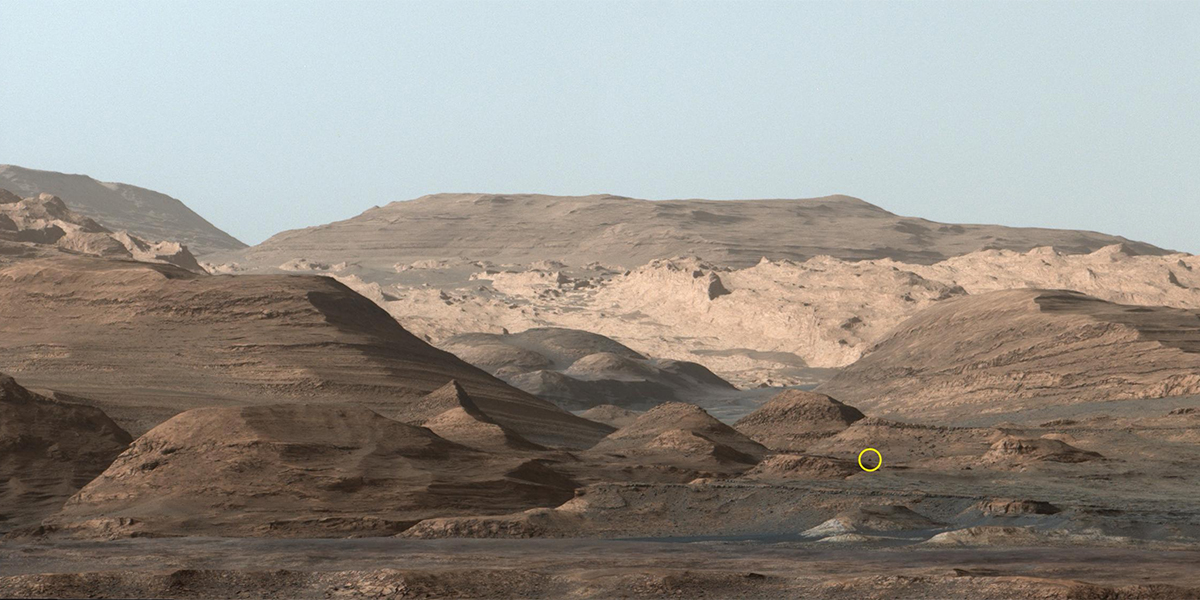
A view across the slopes of “Mount Sharp” captured on September 9th, 2015 using Curiosity’s MastCam. The circle denotes a boulder roughly the size of the rover, to the left of which is “Paraitepuy Pass,” which Curiosity started traversing in 2022. Credits: NASA/JPL
After exploring the bedrock floor of the crater, Curiosity started on a major phase of its mission – scaling the flank of “Mount Sharp”, a 5-km high mound of materials deposited against and around the crater’s central impact peak during the many warm, wet periods that marked the very early history of Mars, and which meant Gale Crater was once the site of a huge lake of liquid water.
The climb has taken up the majority of the rover’s time on Mars, and is still continuing, with Curiosity recently move into an entirely new phase of operations. For the last few months the rover has been making its way along a canyon marking the transition between the more submerged parts of “Mount Sharp” – officially called Aeolis Mons – a region believed to have formed as water was drying out, leaving behind salty minerals called sulphates.
Centred in this 360-degree collage of 27 images is the boulder circled in the above image, and which Curiosity drove by on July 15th, 2022 (mission day Sol 3533). Credit: NASA/JPL
We’re seeing evidence of dramatic changes in the ancient Martian climate. The question now is whether the habitable conditions that Curiosity has found up to now persisted through these changes. Did they disappear, never to return, or did they come and go over millions of years?
– Ashwin Vasavada, Curiosity’s project scientist
The team plans to spend the next few years exploring the sulphate-rich area. Within it, they have targets in mind like the Gediz Vallis channel, which may have formed during a flood late in Mount Sharp’s history, and large cemented fractures that show the effects of groundwater higher up the mountain.
All this progress has come at a cost, however. Along the way, Curiosity had suffered several issues – all of which have been overcome as a result of a team of literally hundreds of engineers and scientists based at the Jet Propulsion laboratory (JPL) and other NASA centres as well as research centres and universities across the United States.
This has allowed major issues that might otherwise have crippled the rover’s abilities. How Curiosity drills for samples has been reinvented a number of times to overcome problems that as the very least might have ended the rover’s ability to drill at all and at worse, crippled its ability to use its robot arm.
Another area of concern has been the rover’s aluminium wheels. These bear the brunt of the sheer force of Curiosity’s progress as it makes its way over the unforgiving Martian landscape; and even while the rover’s daily progress can only be measured in metres-per-day, the fact is that it is constantly traversing terrain which could rip any one of the large aluminium wheels apart given sufficient time. As such, damage was to be expected – but the speed with which it occurred early in the mission still came as a shock, with engineers going so far as to have the rover reverse course and find a new way around some particularly rough terrain at the foot of “Mount Sharp”.
Captured earlier in 2022, this image shows the damage suffered by Curiosity’s left centre wheel after almost 10 years of operations on Mars. Credit: NASA/JPL
To counter the risk of wheel breakage, Curiosity’s driving has been extensively revised, and new algorithms written to help the rover better maintain traction whilst manoeuvring over rocks and to better analyse feedback from wheel motors to prevent them overworking or forcing the rover into an manoeuvre that might result in the loss of a wheel. In addition, the rover routinely examines the state of its wheels using both the MastCam system and the MAHLI imager on the robot arm.
Another threat to the rover’s future is that of electrical output. Curiosity utilises the radioactive decay of plutonium pellets within its radioisotope thermoelectric generator (RTG) to create heat which can be converted into electrical power. On the plus side, this means the rover is not dependent on the vagaries of solar power and can (initially) produce much higher levels of electrical power – some 2,000 2atts on its arrival on Mars.
The downside, however, is that the 4.8 Kg of plutonium within Curiosity’s RTG have a half-live of 14 years – and the rover is now 10 years into that period. As such, it is generating a lot less heat that can be turned into electrical power,, and as a result engineers and scientists are now looking at ways to operate the rover more efficiently and reduce the daily power requirements. This includes switching some operations to run in parallel, effectively sharing power.
Despite this latter points, Curiosity is still performing at near-optimal levels for this period in its life, and with caution and forethought, in is not inconceivable to believe the rover will not still be investigating “Mount Sharp” – even on a reduced basis – in another 10 years.
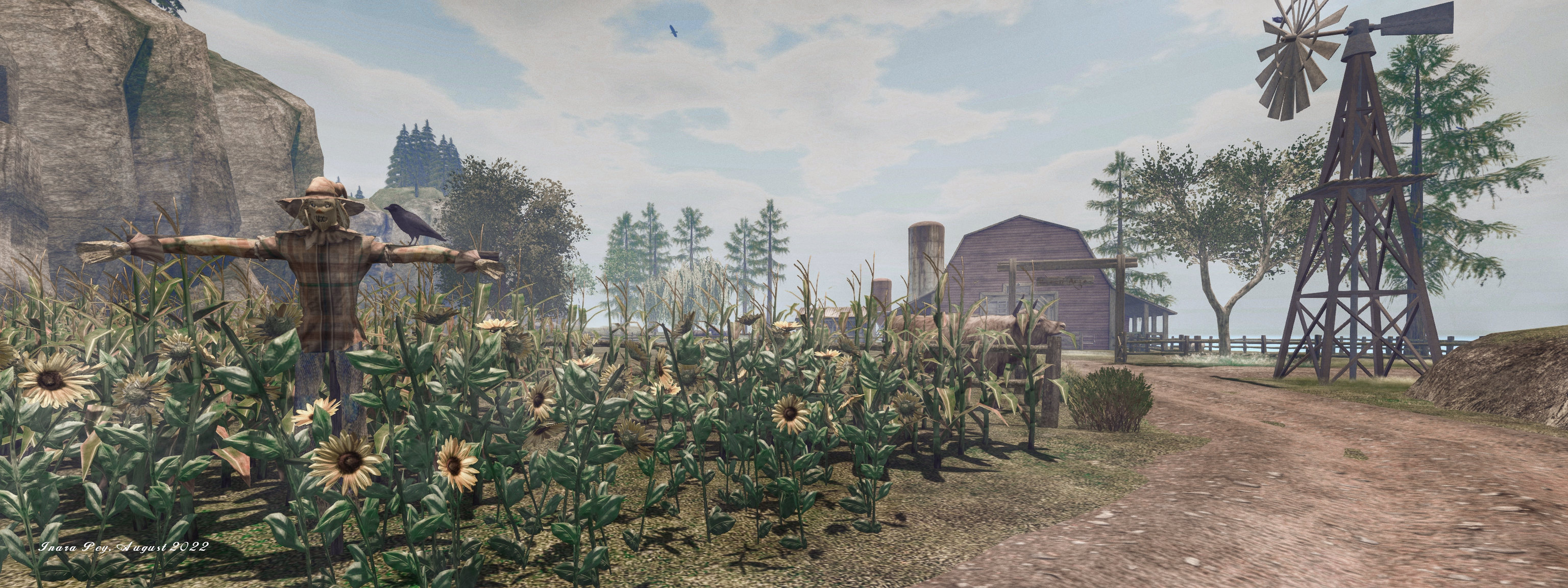
Green Acres, August 2022 – click any image for full size
Back in March 2019, I dropped into Green Acres, a Homestead region designed by Alsatian Kidd with assistance from Iniquity Constantine. At the time, the setting presented a slice of rural Americana in a very photogenic setting, one I enjoyed exploring and photographing (see A Trip to Green Acres in Second Life).
Three years is a long time in Second Life; it’s a period sufficiently long enough that it can see many changes take place. This is certainly true with Green Acres; much has changed, making a re-visit (as suggested to me by several people over the last couple of weeks) very worthwhile; although at the same time, the changes are such that they show a natural progression for the setting in its rural appeal, rather than a complete revolution in its style and sense of place – a fact that makes a revisit even more appealing.
Green Acres, August 2022
Green Acres provides the three R’s. Rustic. Rural. Retreat. This adult-themed region has open vistas providing opportunities for photography, horseback riding, and hanging out. Explore the farm with livestock, crops and a farmers market.
– Green Ares About Land Description
The land retains its split between rugged grassy uplands and equally green lowlands. The former run from the south-east corner of the region and point their way inland and northwards. Nestled to the east of them sits the landing point, located between a copse of trees and the main path which runs around most of the island.
Green Acres, August 2022
The path partners with a stream originated the foot of falls which drop from the inner highlands, the two running north before parting way once more, the stream turning to follow the foot of the hills and then joining a broader river flowing along their west side, the path continuing to run close to the coastline as it also turns westwards.
Go south along the path and it steps its way up onto the feet of the hills, offering a climb up wooden steps up to the hilltops and the large pond nestled there, reaching the water by way of the deck and cabin facing it – the cabin being a public space. For those who prefer, the point at which the steps commence also offers a grassy climb up to the spine of the hills.
Green Acres, August 2022
Westwards, the land is largely flat or low-lying compared to the hilly east. The majority of it is separated from the hills by a rocky escarpment and a river which flows north from a broad lake at the foot of the cliffs. This land is home to the Green Acres farm, the farmhouse set back overlooking the west coastline, the farm’s outbuildings – barns, farm produce store and greenhouse – all scattered around, set between fenced meadows where livestock and horses graze, and where crops grow.
A point to note here is that while the farm’s outbuildings are available to the public, the farmhouse itself is a private residence, so please keep that in mind when visiting.
Green Acres, August 2022There is no direct route over the hills from the landing point to the farm; if you want a safe way to go from one to the other, it have to be by following the footpath north and then west. This brings visitors to Sahar Point, occupying the north-west corner of the region, and Constantine Harbour.
This is marked by a broad, dune-waved beach nestled in a small cove watched over by a lighthouse sitting between it and the river estuary that forms the waterfront for the harbour, the wharf and harbour buildings the home to a seafood market. A stout bridge spans the neck of the river just before it broadens into the estuary, presenting a crossing-point to reach the farm.
Green Acres, August 2022
Rich in places to sit – just check the annotated map at the landing point -, with wildlife waiting to be found throughout and finished in a fitting soundscape, Green Acres remains a beautifully photogenic visit.
During a recent conversation on matters SL and this blog, the subject of tutorials came up. While the details aren’t important, it was commented that the person I was talking to hadn’t realised I’ve written a number of tutorials, one of which turned out to be precisely what they had been looking for.
This is actually my fault; while I have written a fair number of tutorials and mini-guides to various aspects of Second Life, in a past update to the blog navigation menu, I opted to place the tutorials list under the “SL” heading – and frankly, haven’t done a good job of maintain it. Hence it has been easy to miss.
To rectify this, I’ve made a couple of changes to the menu system, that will hopefully make things easier to find, and also help keep the menus from extending beyond them limits of most people’s browsers (sadly, WordPress menus do not use intelligent wrapping).
In short the changes are:
Tutorials Section
Presents a menu of Second Life tutorial categories (shown in the banner image for this article).
Clicking the menu title or the top-level item in the drop-down – Tutorials Index – will both display a list of all tutorials written for this blog and a list of the official Second Life University video.
The latter to help people find them in addition to the Second Life You Tube channel and the SL University video playlist.
Clicking on the title of any menu item with a right-pointing caret (“>”) will open the Tutorial Index at a list of tutorials related to the menu item title.
Hovering over any menu item with a right-pointing caret (“>”) and dragging the mouse to the right will open a drop-down menu of the tutorials related to that item.
Clicking on an individual tutorial title will then open it in your browser.
Blog Bits & Contact
This heading now encompasses the Contact Me form which previously appeared in the menu bar, as the first item in the drop-down displayed when hovering over the option.
I will be adding to the Tutorials index as I work back through the blog an pick up any stragglers I’ve missed – and obviously with any further tutorials / guides as they are written. As always, I hope these changes will help make this blog more of a useable resource.





 Ten years ago, on August 6th, 2012, the world held its breath as a capsule the size of a small truck slammed into the Martian atmosphere at the start of 7-minute descent referred to as the “seven minutes from hell”.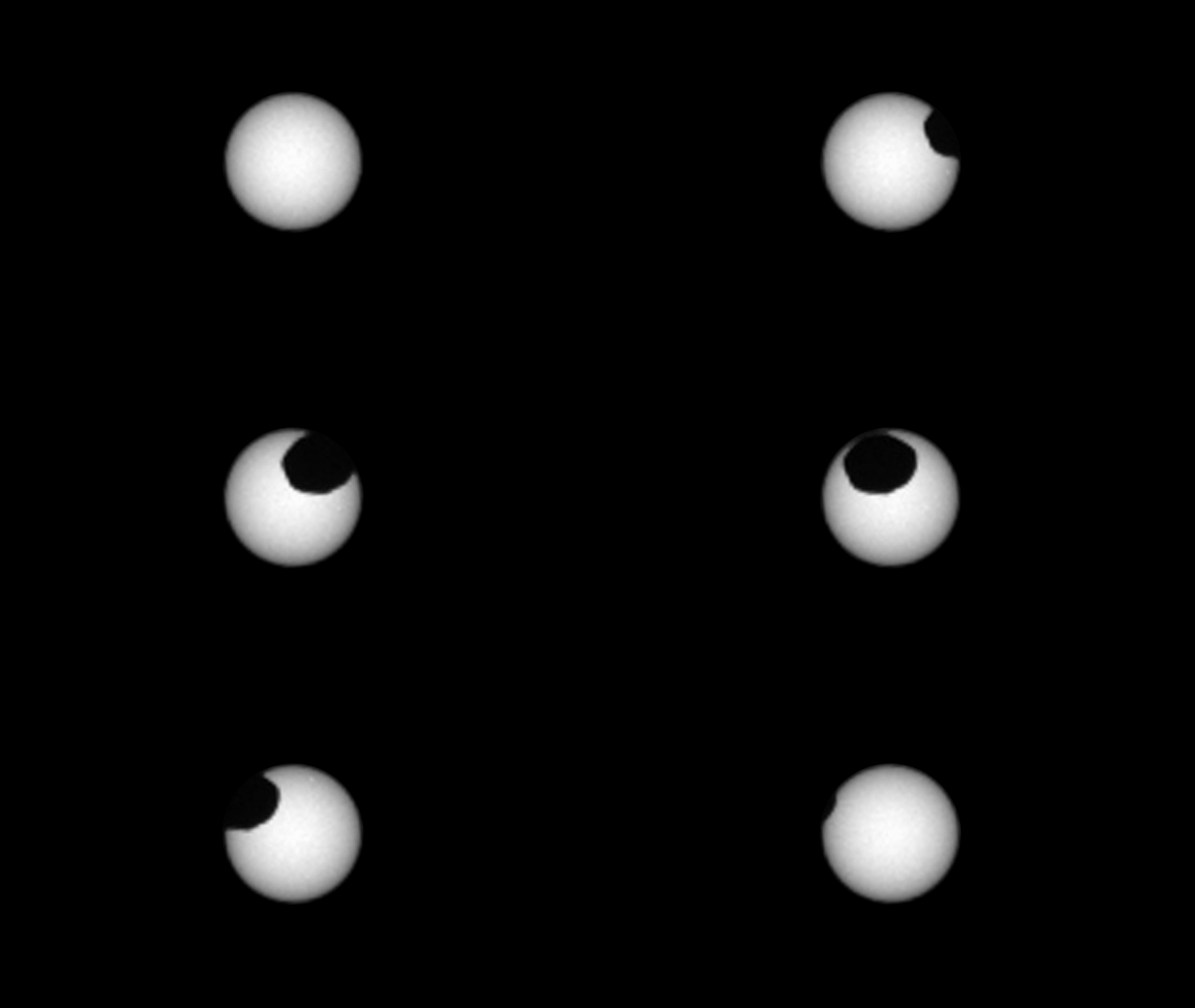




 Inara Pey: Living in a Modemworld