Following the creation of Meta accompanied by the grandiose announcements by the media singing the praises of future metaverses, we can rightly ask ourselves, which metaverses and what future are we talking about? … My friend, Yann Minh, a fellow explorer of cyberspace shares with us his thoughts and fears.
– From the introduction of Mon Métaverse by Tutsy Navarathna
With these words, Tutsy Navarathna leads us into his latest video, one that among his most thought-provoking (which is saying something, given the depth of content and ideas that are always embraced by his work).
Yann Minh
Published on his You Tube channel on January 16th, Mon Métaverse (“My Metaverse”) offers thoughts and reflections on the futures of “the metaverse” from both Tutsy and cyberspace explorer Yann Minh, who has been active within, and considering, virtual spaces for over 20 years.
Running to just a touch over 5 minutes, the video is a fascinating dissection of the current hype around “the metaverse”. Within it we are invited to consider what we have had up until now, and the choices we may face in the future. Do we hold on to we have thus far had: a digital life of almost limitless horizons and infinite diversity in which freedom of expression and creativity are embraced; or are we going to allow ourselves to be herded into sanitised corporate-defined spaces where expression and creativity run second to the surrender of personal data to feed the corporate revenue machine, and activities are governed by fake corporate morals.
When I thought twenty years ago that we were heading towards a more flexible, versatile and mature future, in fact the opposite is happening. We are clearly heading towards an infantizing, paternalistic future similar to the time when religious morals massively imposed their absurd rules on individuals.
Yann Minh, Mon Métaverse
This is a subject that can be debated at a length that will easily exceed the 5 minutes of the video. However, the beauty of Mon Métaverse is that Yann encapsulates these concerns eloquently and concisely, challenging us to think about our digital future without belabouring the message. In doing so, he positions things perfectly for Tutsy to present a – frankly – marvellous and honest look at the richness we have within Second Life, perfectly illustrating what “the metaverse” should really be about: the creativity of individuals, built without the data-hungry maw of algorithm and data collation sitting beneath it.
Beyond this, and on a personal level, I couldn’t help but see a possible broader context within the video; a more subtle questioning / challenge. It comes both in Yann’s comments around Facebook / Meta as the tip of an iceberg and the follow-on statement regarding religious censorship. We already know Facebook is responsible for the spread of disinformation – a practice it is unwilling to stop, and which has assisted the open growth of authoritarian politics that are, to no small extent, founded on a fake moralistic and divisive organised religion. As it turns out, this was in fact something that both Yann and Tutsy had also been considering in developing the concept of the video, as Tutsy informed me.
We are faced with a system that’s increasingly dominated by normalising algorithms in the service of a radical, conservative, authoritarian right unchallenged by most of the media. Within digital spaces, Meta is just the tip of the iceberg which as Yann Minh puts it, “leads us to a paternalistic, infantilizing future”; it seems high time we express our opposition to the way our freedoms and democracy are being so challenged least, as Yann notes, we see the absurd rules of the religious conservatives imposed on all of us within virtual spaces as well.
– Tutsy Navarathna
Thus, Mon Métaverse folds into itself a broader narrative that is not entirely out-of-place, and which adds further depth to its message for those who like to ponder such matters.
But, leaving messages and narratives aside, Mon Métaverse stands as a superb promotional piece for Second Life, both within the broader context of “the metaverse” and as a means of offering insight into the platforms power to attract, engage and retain users. This makes it more than worth the time take to watch it, and I encourage you to do so, either by viewing it below or clicking on the link within the video panel and watching it directly on Tutsy’s You Tube channel.
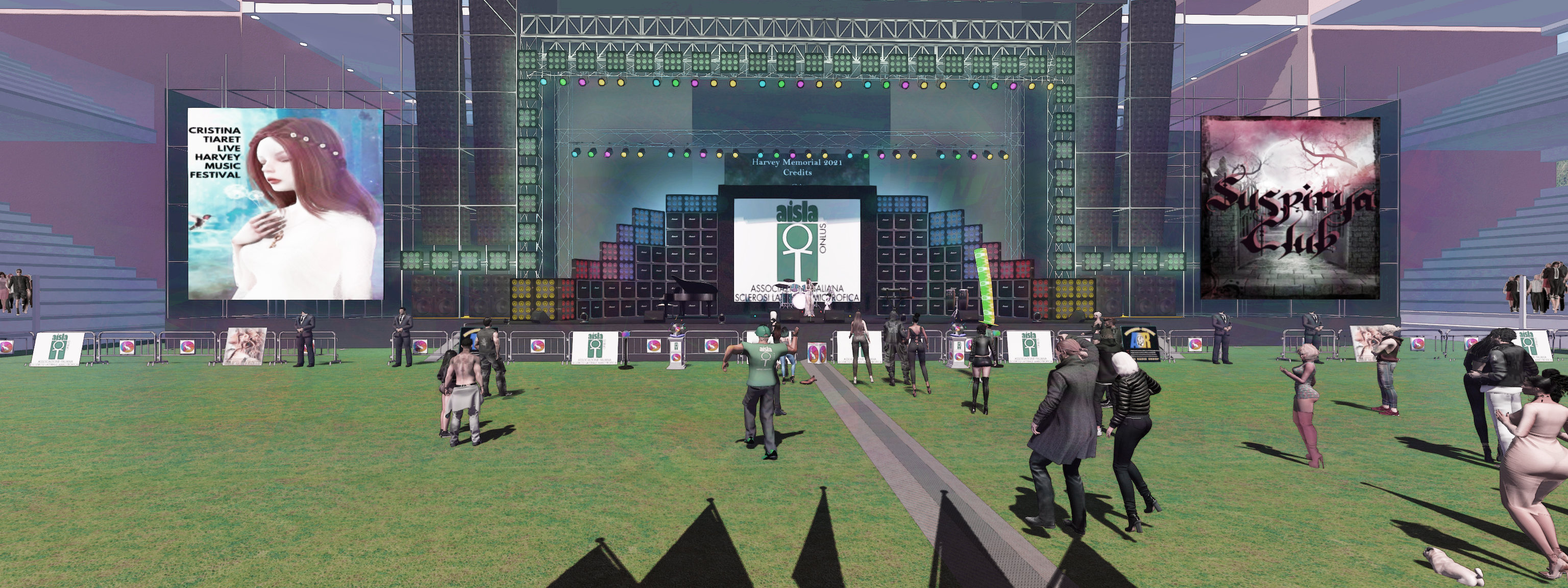
Music stage, Harvey Memorial ALS Awareness Week, 2021
Every year the Italian community in Second Life comes together to host the Harvey Memorial Ensemble ALS Awareness Week, a festival of music and art dedicated to raising funds for AISLA, the Associazone Italiana Sclerosi Laterale Amiotrofica for research into, and treatment of, Amyotrophic lateral sclerosis (ALS), in memory of Second Life resident Harvey22 Albatros, who passed away from the disease.
First held in 2015, the festival has raised over L$2.8 million (roughly €9,000 / US $10,267), and this year it will take place from 13:00 SLT on Sunday, February 20th and run through until 17:00 SLT Sunday February 27th, 2022.
A 2D artist display area for The Harvey Memorial Festival 2022. Credit: Sniper Siemens
As noted above, the Festival offers a mix of music entertainment and art, and this year, event organisers, Sniper Siemens and the Supporto Italiano group, want to expand the latter by presenting an art auction / exhibition. To this end, they’ve asked me to help spread the word.
In short, they are seeking donations of art for the auction / exhibition from both 2D and 3D artists in Second Life, with the requirements summarised below:
3D artists:
Artists will have a 10m x 10m area in which to place their art.
Each artist can use a maximum of 300 LI for their art.
A maximum of 8 display spaces are available.
2D artists:
Artists can donate up to 3 pieces of art.
Art should be suitable for display on an easel (see example image)
Easel can be supplied, if required.
1024 resolution recommended for submissions.
8 display spaces are currently available.
In addition:
Art must be submitted to Sniper Siemens no later than 3 days prior to the festival’s opening, and will be placed on display by the organisers.
All art will be displayed through the week of the festival in a display area directly adjacent to and surrounding three sides of the main music and entertainment area, where it can be easily viewed by those attending the event.
Bidding will open on February 20th, and close on the afternoon of February 27th, when the highest bidder for each piece of art will be charged for, and receive, the art.
All questions / enquires about the art auction should be directed to Sniper Siemens.
3D art from theHarvey Memorial ALS Awareness Week, 2020 (Solkide Auer (l) and Cica Ghost (r))
About ALS
Sometimes also referred to as motor neurone disease (MND) or by the synonyms Lou Gehrig’s disease and Charcot disease, Amyotrophic lateral sclerosis (ALS) is a specific disorder that involves the death of neurons that control voluntary muscles. For about 90-95% of all diagnosed cases, the precise cause of the disease is unknown; for the remaining 5-10% of diagnosed cases, it is inherited from the sufferer’s parents. There is no known cure, and symptoms generally first become apparent around the age of 60 (or 50 in inherited cases). The average survival from onset to death is three to four years. In Europe and the United States, the disease affects about 2 people per 100,000 per year.
About AISLA
AISLA Onlus was founded in 1983 with the aim of becoming the Italian national reference centre for the protection, assistance and treatment of ALS patients, promoting information on the disease and stimulating the competent structures to take adequate and qualified care of the sick.
Headquartered in both Rome and Milan, the Association is recognised by the Italian Ministry of Health, and currently operates 64 centres in 19 regions across Italy working with the support for local doctors, psychologists, physiatrists and consultants to provide support for ALS victims and their families (medical support, information, and general assistance). In addition, the Association supports research into the causes of ALS, and provides training in helping and caring for victims of the disease.
Logos representative only and should not be seen as an endorsement / preference / recommendation
Updates from the week ending Sunday, January 16th, 2022
This summary is generally published every Monday, and is a list of SL viewer / client releases (official and TPV) made during the previous week. When reading it, please note:
It is based on my Current Viewer Releases Page, a list of all Second Life viewers and clients that are in popular use (and of which I am aware), and which are recognised as adhering to the TPV Policy. This page includes comprehensive links to download pages, blog notes, release notes, etc., as well as links to any / all reviews of specific viewers / clients made within this blog.
By its nature, this summary presented here will always be in arrears, please refer to the Current Viewer Release Page for more up-to-date information.
Note that for purposes of length, TPV test viewers, preview / beta viewers / nightly builds are generally not recorded in these summaries.
Official LL Viewers
Release viewer: Mac Voice hotfix viewer 6.5.2.567427, dated January 13 – NEW.
Release channel cohorts:
No updates.
Project viewers:
Mesh Optimizer updated to version 6.5.2.566858, dated January 5 (issued some time after January 10).
Logos via Linden Lab and High Fidelity respectively
Following the announcement that High Fidelity, the company co-founded by Philip Rosedale in 2013 and after his departure form Linden Lab, has invested money, patents and staff into the latter, the news hit a lot of on-line tech publications and even the Wall Street Journal – creating a buzz around Second Life that has so far, if we’re honest, somewhat eluded the Lab in the wake of all the broader “metaverse” chatter that has been going on.
Of these articles, the most detailed came via GamesBeat / VentureBeat (by the ever-informative Dean Takahashi), c|net and The Wall Street Journal (the latter via Archive to avoid the paywall)¹ that added butter to the bread of the original announcement, which I’ve summarised below, and which gave me further pause for thought.
To deal with the bullet point takeaways first:
The patents transfer from Hi Fi is for distributed computing, and include “moderation in a decentralised environment patents.”
In all some 7 members of the Hi Fi team will be moving to work alongside the Second Life engineering team, effectively increasing it by around 20%.
The move will mean that around 165 people will be working on Second Life and Tilia.
Two elements of the work Hi Fi staff will be involved in are:
SL’s “social aspects”, given as “avatars and digital marketplace”. I assume the former is a reference to things like “avatar expressiveness”, on which more below. And the latter potentially greater accessibility to SL’s Marketplace by users using mobile options, etc.
Oberwager also indicated that Hi Fi’s work will be to assist LL in developing “the tools to make virtual economies work” and a concept for “underpinning FinTech to metaverse” – which I assume is a reference to involvement in Tilia, per my original speculations on the investment.
Separate to its involvement with LL, High Fidelity will continue to develop its spatial audio capabilities, which have already been licensed by a number of other companies.
In terms of SL itself:
2020 still seems to be the platform’s most robust year, with the economy put in terms of a US $650 million GDP, with 345 million annual transactions (virtual goods, real estate, and services) and US $80 million cashed-out.
The platform boasts more than 1.6 million transactions per day and generates 1.8 billion messages (presumably user-to-user and Group IMs) per month.
Second Life won’t be moved to support VR headsets any time soon, simply because the latter need much more time to mature, both in terms of their technology and their market reach; something Rosedale believes (and I’d agree, for whatever that is worth) is unlikely to be reached in the next 5 years. However, once SL itself is more performant and better placed to naturally leverage VR hardware.
In terms of my own speculation, this primarily arise – and rather belatedly, given my own previous coverage of High Fidelity in this blog – as a result of a comment from Philip Rosedale in the piece by Dean Takahashi:
The tech changes are all about communication,” Rosedale said. “I don’t think it’s about pixels. I don’t think it’s about radical richness. I don’t even think it’s all about 3D. I think the problem and the opportunity is communicating with people in a naturalistic way where I can interview you.
We already know from Linden Lab’s own review of 2021, which includes a bullet list of deliverables planned for 2022 – that “avatar expressiveness” to Second Life that will bring “camera-based gestures and movement to your avatar for a whole new level of interaction and connectedness”. This is something that marries up to Rosedale’s comments above. More particularly, it is something High Fidelity started to develop back in 2014, when the company was working on its own decentralised virtual spaces – even producing an informal video that helped demonstrate that early work – and which I’ve embedded below.
Yes, the avatars are someone cartoonish is looks, but this work was carried out in Hi Fi early days and before their avatars developed into something SL users might find more appealing, so don’t get too hung up on that fact.
What’s important is to note that how the avatars (faces and hand movements) reflect those of the people behind them. Take, for example, Emily’s face as she emotionally responds to the lyrics she is singing, and the way Ryan’s avatar (with the beard) makes eye contact with viewers as it looks directly out of the screen, and they way his eyes / head naturally move as he also addresses Chris and Emily who are sharing the same office space with him – plus the capture of his real-time hand-clapping at the end of the song! (And as a total aside specific to SL “old timers”, not that the guy providing the backing vocals is none other than Andrew Meadows (once (and again….?) aka Andrew Linden.)
If this capability could be brought into Second Life – and again, I have no idea how much further down the road Hi Fi got in developing / enhancing it and am aware that SL presents a range of its own technical challenges (range of mesh heads, rigging /weighting, etc.) – then clearly, it could offer considerable depth to avatar interactions for those who would care to leverage them. Take the SL live music scene, for example, and the potential for performers to add gestures to their music and (like Emily) have the emotions in singing transferred to their avatars. (I’ve also submitted a question on this subject for consideration in the upcoming Lab Gab session with Brad Oberwager and Philip Rosedale.)
There is a lot more that might be unpacked from these articles – such as the idea of a “decentralised environment” and what that might mean for thing like SL and mobile device access, and a lot to chew on regarding SL’s approach to virtual spaces and how it stands apart from the recent headline-grabbers like Facebook / Meta. Some of these comments should give comfort to those concerned about matters of privacy and the like, and Rosedale at least has carried his view on things beyond talking to journalists, embodying them in some of his tweets.
Given what is available for consumption between the three articles, I would recommend a reading of all three rather than having me drone on further here, or dilute the core speculation I wanted to put forward as a possibility. As such, I’ll leave you to peruse them in your own time, if you’ve not already done so.
While there were other articles on the announcement, most were either baseline reproductions of the original press release (with a sprinkling of commentary in some cases) or re-treads of one of these three pieces.
NASA’s Mars 2020 rover Perseverance rover is suffering what might considered a case of kidney stones that’s proving hard to clear up.
On December 29th, 2021, the rover drilled into a rock the mission team had dubbed “Issole”, coring the material out using the percussive drill at the end of its 2.1 m robotic arm. The coring went smoothly enough, the sample being cached inside one of the titanium tubes used for obtaining sample that are to be geocached on Mars for future collection by a joint NASA-ESA sample-return mission, however, it was then that a problem occurred.
The rover’s sample-gathering system is actually extremely complex, comprising three separate robotic systems. The first is the robot arm itself, which houses the drill mechanism and bit.
Mars 2020 SHArm robotic arm: hidden underneath the rover, SHArm is responsible for handling sample tubes (highlighted in yellow) before / after they have been used to gather core samples gathered by the rover’s drill. Credit: NASA/JPL
The second is another robot arm called SHArm – the Sample Handling Arm -, tucked into the underside of the rover. Its function is to select unused sample tubes from the storage cache at the back of the rover, and pass them forward so that they can be made available to the robot arm and the drill for sample gathering. This also takes tubes containing samples and delivers them to a number of sub-systems before sealing them and stowing them back into the cache area.
Between these two, and acting as a go-between, is the “bit carousel”. This is a wheel-like robot at the front of the rover. This is a go-between for both the main robot arm and SHArm, allowing empty tubes to be delivered to a position where they can be transferred to the robot arm / drill mechanism, and full tubes to be rotated down to where SHArm can collect them. In all the carousel has capacity for up to 10 full / empty sample tubes as they are moved between the robot arm and SHArm.
The “bit carousel” (highlighted in grey) with the robot arm and the drill head it carries (the large object on the left) transferring a sample core tube (yellow) to one of its transfer recesses. Credit: NASA/JPL
It was when attempting to transfer the tube with the latest sample to the carousel that the problem occurred, prompting the mission team to order Perseverance to return the tube to the drill mechanism and then rotate the robot’s hand to allow the WATSON image to photograph the carousel – revealing small pebbles of rock were caught in the mechanism.
While the carousel is designed to operate with a degree of dirt and debris in its mechanism, the decision was taken to attempt a debris removal operation and essentially “reset” the sample gathering mechanisms. This has also proven to be a complicated operation. Firstly, the carousel had to be carefully images to understand the full extent of the debris distribution. Then the ground beneath the rover needed to be imaged for an initial set of “before” photos.
A WATSON close-up of one of the sample tube recesses in the “bit carousel”, showing some of the pebble-like debris caught in the mechanism. Credit: NASA/JPL
After this, the main robot arm was order to rotate to a position where the current sample tube could be emptied, allowing it to be re-used in a future coring of “Issole”. Then, over the course of the weekend, the entire “bit carousel” was due to be put through two rotation operations designed to help shift some of the debris. Once completed, WATSON will again be used to image the mechanism – and the ground under the rover – to ascertain the status of the debris and what further actions need to be taken to clear the remaining debris.
In all, mission engineers believe it could be the end of the week before the sample system is ready to resume operations, at which point a decision will be taken on whether or not to gather a further sample from “Issole”.
The Riddle of ALH84001 Finally Resolved?
In 1996 a fragment of a Martian meteorite that was found in the Allan Hills, Antarctica and designated ALH84001 (marking it as the first Martian meteorite found in the area 12 years earlier, in 1984), caused a storm of controversy- which appears to now being laid to rest.
A cartoon by Kevin Kallaugher that appeared in the Baltimore Sun on August 8th, 1996 highlighting the media’s response to the ALH84001 announcement by David McKay and his team
To summarise: when parts of the meteorite were examined by a group of scientists (it is not uncommon for multiple years to pass between meteorites being found , catalogued and stored and actually being examined) announcing they may have found trace evidence of past microscopic life from Mars. Unfortunately, the press responded in a manner typified by a cartoon from the time.
The pronouncement, over-amplified by the press, garnered immediate push-back by others in the scientific community which in turn resulted in the science team – which included David S. McKay, Chief Scientist for astrobiology at the Johnson Space Centre, Texas, during the Apollo programme to double down on their claims they have discovered fossilised Martian bacteria.
Since then, the debate concerning how the objects – chain structures nanometres in length resembling living organisms – and whether or not they might be organic in origin has raged back and forth – although it did diminish somewhat following McKay passing away in 2013. Not another team of scientists believe they have definitive proof that whilst the structures were organic in nature, they are not signs of life having once been active on Mars.
Instead, the new study – the result of an extensive study of ALH84001 samples and all that has been learned about it in the intervening 25 years – points to the organic structures being the result of abiotic organic chemistry – that is, they formed as a result of chemical reactions between water and rock that did not involve any genuine organic processes.
The chemical interactions likely took place around 4 billion years ago – at a time when Mars was believed to be much warmer and wetter than it is now, and a time when life might have originated on the planet. However, in the case of ALH84001, the team carrying out this study found that the organic compounds in the meteorite are closely associated with serpentine-like minerals. Serpentine is a dark green mineral, sometimes mottled or spotted like a snake’s skin, that is associated with once-wet environments.
On Earth, this kind of association between organics and serpentine is often associated with water percolating / circulating through magnesium-rich volcanic rocks change their mineral nature, producing hydrogen. If the water is slightly acidic and contains dissolved carbon dioxide, it can additionally result in carbonate minerals also being deposited…When taken together, these two processes – referred to as serpentinization in the case of the first and carbonation in the second – can result in deposits that appear to be of an entirely organic origination.
An electron microscopy image showing chain structures resembling living organisms fossilised in meteorite fragment ALH84001. Credit: NASA
Given the rocks in which ALH84001 were formed 4 billion years ago and were exposed to a long period of repeated water interaction, and the similarity they share with similar abiotic mineral deposits found on Earth, the team believes they are more than likely of a similar, non-organic origin.
However, the study doesn’t discount the potential for life to ever have arisen on Mars – it may actually strengthen it. This is because while these abiotic processes are not the result of organic processes, they do leave deposits of chemicals and minerals that can go on to help kick-start microbial life. What’s more, the sheer age of the ALH84001 marks it as the first Martian rock fragment that is old enough to provide evidence that abiotic processes were at work at a time when Mars was warm and wet – and when other processes may have been at work that might have utilised the deposited compounds to get basic life started. And if the rocks in which ALH84001 formed – there may be other similar ancient deposits on the planet that microbial life may have been leveraged.
Astronomers Witness a Star’s Death and a Supernova’s Birth in Real-Time
For the first time, a team of astronomers have imaged in real-time as a red super giant star reached the end of its life, watching as it convulsed in its death throes before finally exploding as a supernova.
The star was about 10 times more massive than the Sun and lay within the NGC 5731 galaxy about 120 million light-years away – meaning what astronomers saw actually occurred 120 million years ago.
In the summer of 2020, astronomers using the Pan-STARRS observatory on Haleakala, Maui noticed the progenitor tar suddenly go through a dramatic rise in luminosity. This warned them something massive was about to happen, focusing attention at Pan-STARRS on the star, and also brought in the W. M. Keck Observatory on Mauna kea, Hawaii Island in to observe the star as it collapsed over 130 days, before it gave a bright flash prior to its final exceptionally violent detonation into supernova SN 2020tlf..
The data from the observations is relatively boring – the star was far, far, far too far away to be actually images by either observatory, so it amounts to lines and dots on a chart. However, it has allows the event to be computer modelled. More particularly, the event has given astronomers first-hand insight into a supernova event involving a red super giant, and raised some puzzling questions.
For a red super giant to go supernova is not uncommon. Normally, however, there is a period of shrinkage and material ejection, referred to as circumstellar material (CSM) prior to core collapse. But that process generally takes place on a much longer timescales than the 130 days experienced by SN 2020tlf, suggesting something unusual or unexpected was taking place within the star.
In addition, the mysterious bright flash prior to the final detonation was unexpected and – thus far – unexplained, although it is thought it be somehow related to the ejected CSM – although astronomers are currently at a loss to explain what this might be. The flash appears to also be liked to a mammoth ejection of gas from the star, another aspect that doesn’t fit with established understanding of red super giant supernovae.
All of this adds up to the end of the star and the birth of SN 2020tlf being far more violent that has been the accepted case for red super giants. The question now is: was this event out of the ordinary for such stars, or does it reflect a more expected behaviour for them. However, given the sudden rise in luminosity witnessed ahead of the event, astronomers involved in projects such as the Young Supernova Experiment now have a clue to what to look for when seeking future potential red super giant supernovae.
In December 2021, I wrote about Eskol, Morlita Quan’s art and event space in Second Life (see: Eskol: music, art and sound (& a photo contest) in Second Life). Within that piece, and as referenced in its title, the review also included information on the Eskol Photo Contest Morlita was running through December to the start of January.
On offer was a single prize of L$5.000 to be awarded to a single winner, as judged by a panel of three judges – Morlita, Lanjran Choche and myself. To enter, photographers could submit up to two images taking using one of the six photo booths Morlita had set-up specifically for the contest.
Eskol Gallery: Eskol Photo Contest – one of the 6 photo booths
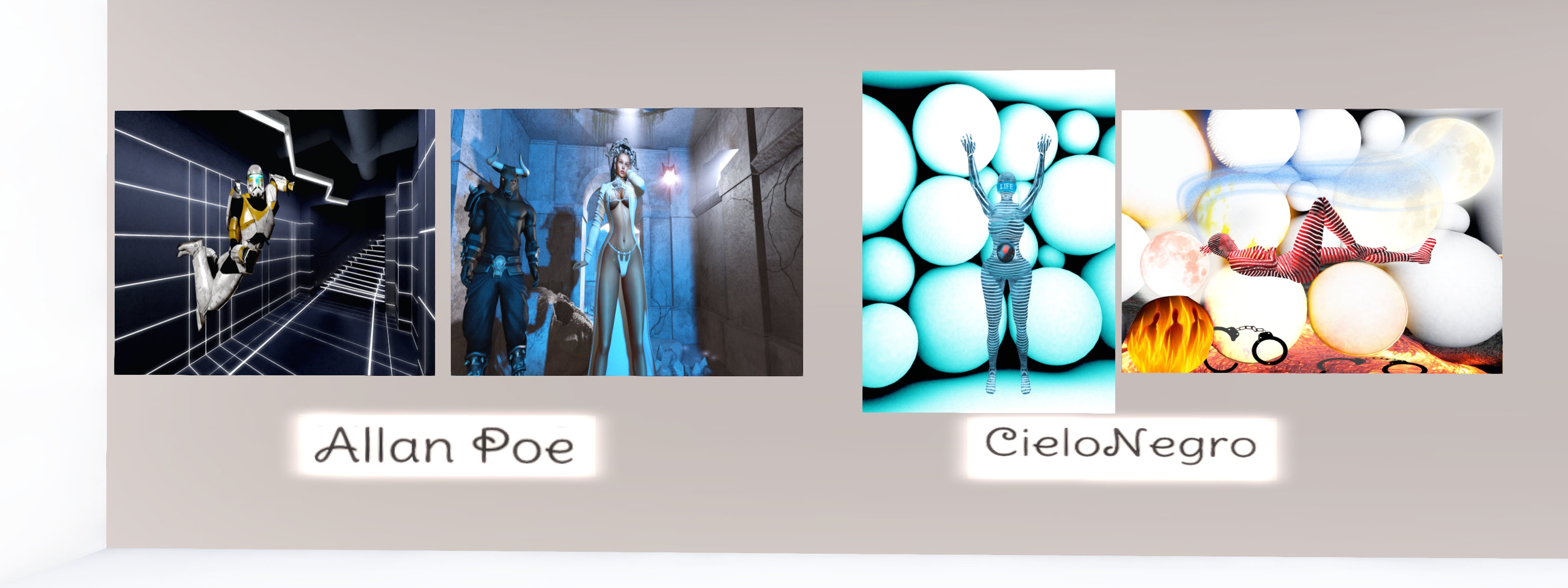
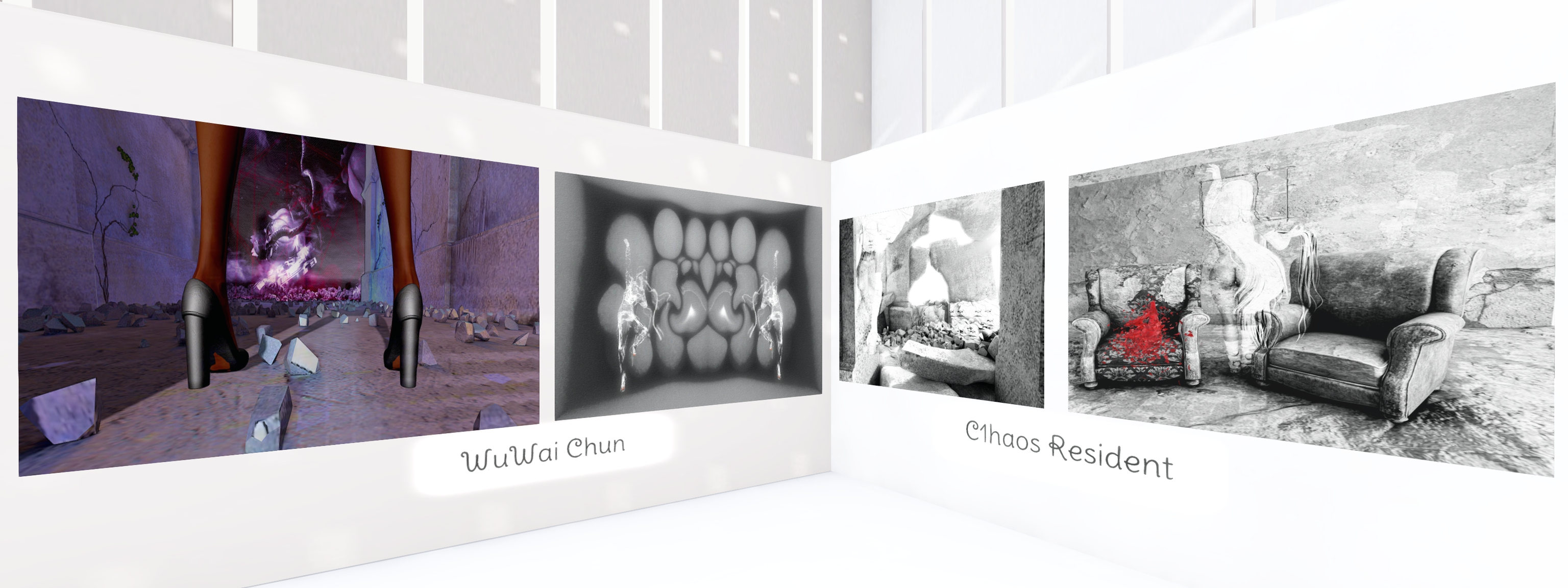
In all 12 photographers submitted entries, comprising Mo Trill (1 image), Mystera Bloodbane-Ragnarok (Mysteria0402 – 2 images), Lucid (Photodoll77 – 2 images), Rya Santana (2 images), 4pril Resident (1 image), WuWai Chun (2 images), 04Noir (C1haos Resident- 2 images), 01NoirA Resident (1 images), Allanpoee Resident (2 images), Cielo Negro (Cielonegro Avril – 2 images), Néstor (NestorXX Resident – 1 image), and Iono Allen (1 image).
Each of the six booths offered its own setting in which pictures could be set and framed, and photographers could dress them as desired, and entrants submitting two photos could either take them in one of the booths or use two booths.
Eskol Gallery: Eskol Photo Contest – Allan Poe and Cielo Negro
Unsurprisingly, most of the photographers opted to concentrate avatar-centric studies for their entries, with only a couple avoiding avatars entirely. Not that focusing on avatars lessened any of the entries; rather the reverse in fact: several presented very unique uses of the avatar and / or unique perspectives on a particular booth and avatar (as is the case with WuWai Chun’s Eskol 1 entry). whilst Iono Allen chose to offer a moment from a certain iconic 1969 motion picture (or as the director referred to it, “the proverbial good science fiction movie”).
While I cannot speak for the other members of the panel, I approached judging the submitted pieces on a set of criteria I’d settled upon before seeing any of them: composition (use of space, colour, lighting), framing, originality and narrative. However, given we all three each came up with a selection of seven initial finalists that were somewhat similar, I’d say we all used similar criteria. And certainly, the winning entry, C1haos Resident’s Eskol 2 was a piece we would all agree on as being a worthy winner.
Eskol Gallery: Eskol Photo Contest – WuWia Chun and C1haos Resident
Currently, all of the entries are on display at Morlita’s main Eskol Gallery, and will be until early February, so why not pop along and judge them for yourself?







 Inara Pey: Living in a Modemworld