Blue Hour Winter Holiday Village, December 2021 – click any image for full sizeThis will be a briefer than usual travelogue piece for today, as I’m currently going in several directions at once, both in and out of SL – it’s that time of year, after all! But I wanted to get notes down about Vita Camino’s most recent public offering, one specifically for the 2021 / 2022 winter holiday season.
Occupying a sky platform above Vita’s My Little Venice – a location I hope to visit in the future – Blue Hour Winter Holiday Village offers another winter / Christmas setting ideal for seasonal photography. As the name suggests, this is something of a rural / urban setting; the landing point Vita provides drops visitors onto a track that is slowly being hidden by falling snow as it winds through woodland in the hours of twilight. Forming a large loop, and periodically lit by lanterns hung from tall posts, it connects a number of small, outlying rental properties with a small town centre.
Blue Hour Winter Holiday Village, December 2021
With a winter market at one end of its L-shaped street, the town is marked by a number pseudo-Tudor building that from shops on their ground floors and living spaces above, Along one arm of the street, these buildings face a row of houses that might be said to be more Victorian in look. The other arm of the street is bracketed by a park-come recreational area, a small café nestled to one side to offer a warm welcome to those needing relief from the snow.
A large pond sits to one side of the shops, a place for a spot of skating, while the lights of cottages light the rocky outland beyond. While these are merely shells of buildings, their presence on the stepped rocks gives the setting a sense of depth.
Blue Hour Winter Holiday Village, December 2021
Additional depth is given through the presences of static NPCs indoors and out, together with vehicles carrying presents and Christmas trees home, as well as providing further opportunities for photography.
Easy to explore, rich in detail, Blue Winter Christmas Village is open for your enjoyment – and should you fancy a Christmas vacation in-world, a couple of of the rental cabins were still available during my visit. However, given this is a foreshortened write-up, I’ll leave you with a couple more images and the SLurl so you can see for yourselves.
Blue Hour Winter Holiday Village, December 2021Blue Hour Winter Holiday Village, December 2021
The following notes were taken from the Tuesday, December 14th, 2021 Simulator User Group (SUG) meeting. The meeting was recorded by Pantera Północy, and the video is embedded at the end of this summary. Note this summary focuses on the key points of the meeting; where there is something to report, the video should be referred to should full details of the meeting wish to be reviewed.
On Tuesday, December 14th, all simulators on the SLS Main channel received a new simulator version 566406, which includes back-end support for the new IMs-to-e-mail options that go live on December 15th – see Lab announces change to e-mail preferences for Group notices).
On Wednesday, December 15th, the tools update simulator will be deployed to all remaining RC channels.
These deployments mark the end of planned simulator deployments for 2021. Monday, December 20th marks the start of the end-of-year No Change window.
The Main channel deployment / restart also saw a number of regions become inaccessible for an extended period (up or and possibly exceeding 3 hours), the latest to due so. These longer restarts are the result of LL still trying to get the concurrency – how many regions can be restarted in a pass – right.
Available Viewers
This list reflects those viewers available via Linden Lab.
Release viewer: version version 6.5.0.565607, formerly the Maintenance RC and dated November 10, promoted November 15 – this viewer now contains a fix for the media issues caused by the Apple Notarisation viewer.
The combined Simplified Cache and 360 Snapshot project viewer, version 6.5.1.566335, issued on December 7.
The Jenever Maintenance RC viewer, version 6.5.1.566306, issued on December 6.
The Koaliang Maintenance 2 RC viewer, version 6.5.1.565905, issued on December 6.
The Tracy Integration RC viewer version 6.4.23.563771 (dated Friday, November 5) issued Tuesday, November 9.
Project viewers:
Performance Improvements project viewer updated to version 6.5.1.566443, dated December 8.
Performance Floater project viewer, version 6.4.23.562625, issued September 2.
Mesh Optimizer project viewer, version 6.4.23.562614, issued September 1.
Legacy Profiles viewer, version 6.4.11.550519, dated October 26, 2020.
Copy / Paste viewer, version 6.3.5.533365, dated December 9, 2019.
In Brief
The SUG meeting on Tuesday December 21st, 2021 will be a party to mark the winter solstice. As such, this is liable to be my last SUG summary for 2021.
There has been a report of the viewer recording failing/timing out event polls for neighbouring regions, as seen from within a region.
This is something that has not apparently been reported to LL via Jira, and it is not clear if it is specific to a region.
The concern raised was that it might impact region crossings, but LL do not see why this should be so.
Map API:
The issue of “empty” land showing on the World Map was raised (i.e. just the terrain, no buildings, etc., despite the land being built-out). This is usually (but not exclusively) the result of a known map issue in rendering mesh objects, particularly if the mash structure is large, but has a very small prim root.
It has been reported that the World Map API (used to interrogate the Map and produce things like the web-based maps for SL) seems “happy” to return region name/location data for a “large number” of regions that no longer exists (search for them with the in-world Map, and you’ll get a “None Found” error.
The Lab’s experiment with using textures on “empty” Map tiles offers this compass.
As a side-note to this – and while revealed some time ago by Alexa Linden – Simon Linden noted the Lab has a proof-of-concept for replacing map tiles with textures, offered in the form of a compass rose visible on one part of the World Map. There are obviously some concerns over how such a capability might be used were it to be rolled out to users, so the idea appears to be to allow LL provide additional info on map tiles via “empty” spaces.
Morlita Quan is a multi-faceted artist I’ve long admired, having written about her art and installations within Second Life on numerous occasions within this blog. So when I received a request from her recently – of which more further down in this article – I decided to take an opportunity to hop over to Eskol, her mixed-media art and events region, and spend a little time there.
The first thing to note about Eskol is that it is far from your “normal” events-style region in Second Life. Nor, in bringing together music, art and sound, is it any kind of conventional “club”; rather, it is the embodiment of Morlita’s multi-faceted talents as an artist, designer and musician. Within the region are various locations, linked via a teleport HUD (look for the little robot HUD givers, click and accept, and then add the HUD), each of which is presented as a means of exploring those various facets.
As a musician, Morlita started playing the guitar at the age of eight, and by her mid-teens had discovered the magic of mixing decks and consoles, tools that allowed her to start experimenting with music as form of artistic expression, first as a DJ, then as a recording artists working independently and the via the Naïf record label. Within Second Life, Mori’s music has led her into numerous collaborations in the realms of music and film, working with the likes of Bsukmet Stormcrow in the former and providing compositional elements for machinima by the likes of Glaz Decuir, NicoleX Moonwall, Cherry Manga and Theda Tammas.
Eskol: Morlita Quan
Give this, the music spaces found within Eskol aren’t intended to be considered “clubs” or dance venues per se; traffic and avatar counts are not a driving metric. Rather, the Eskol Main Stage area and Sound Scape locations are offered as places where different, minority / lesser-known styles of music can be presented and appreciated, although the aesthetics of both locations are very music in keeping with Mori’s approach to digital art and design.
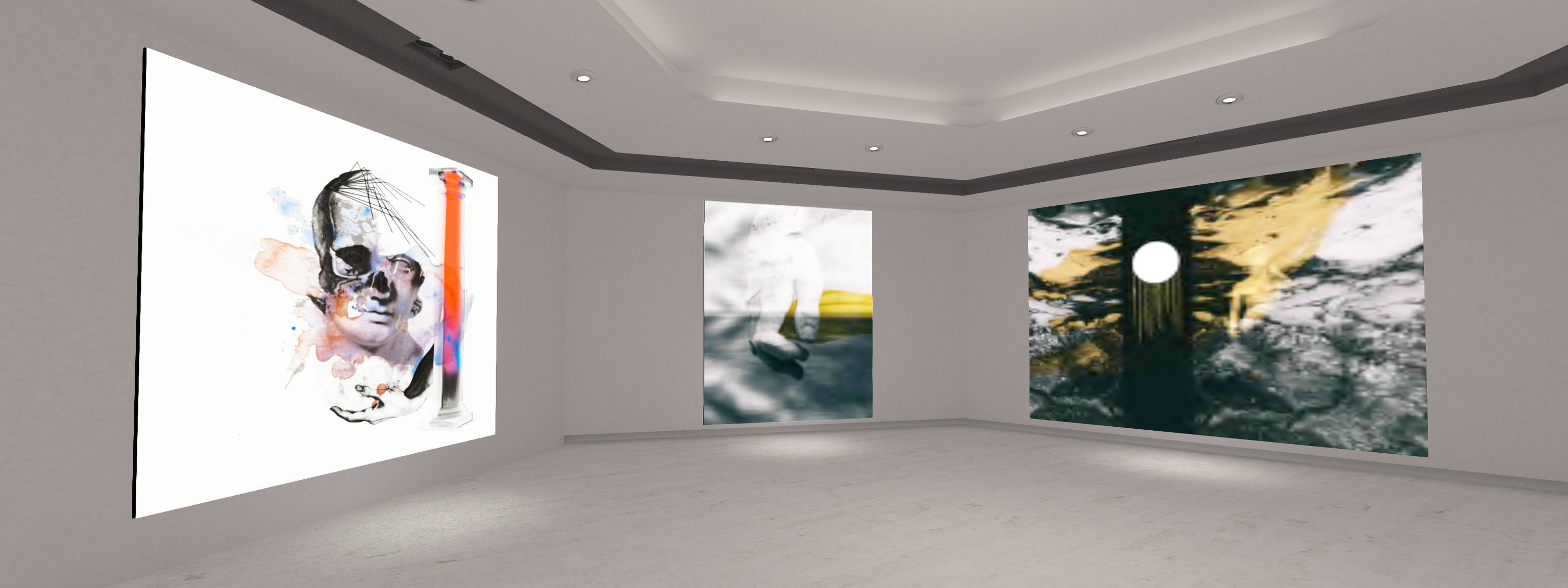
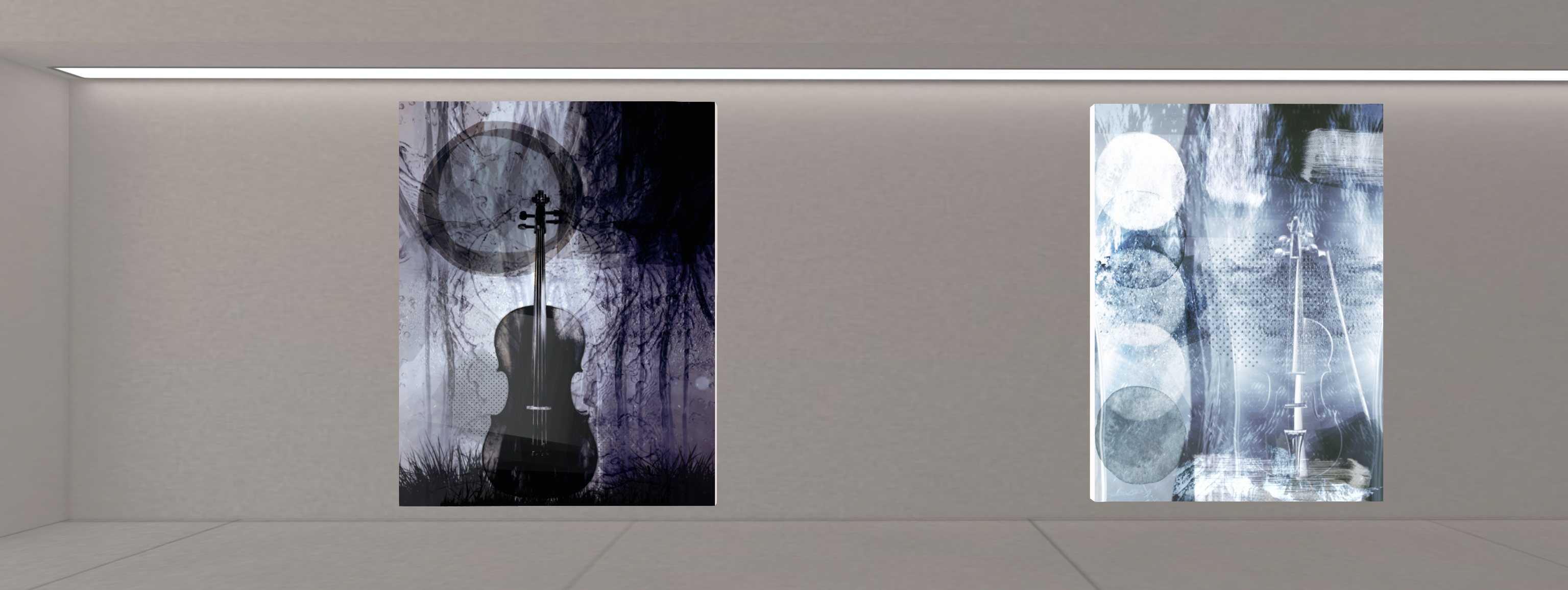
As an artist, Mori has collaborated with other Second Life artists and with various universities and galleries both in her native Spain and around the world. Like her music, her art is very much experimental / abstract , carrying within it a natural fluidity that gives it its own form of life. This is achieved by Mori mixing classical painting with post graphic design processing, while always retaining a core inspirations drawn from Nature, and most often utilising geometry as a further expressive value.
This can most clearly be see within the gallery level at Eskol, where two wings of art displays might be found. the larger, single-level wing presents a broad range of Mori’s 2D art, whilst the smaller, 2-level gallery present her more recent works.
Eskol: Morlita Quan
It is art – or photography – that formed the core of Morlita’s request I mentioned at the top of this article, and which prompted my visit.
Eskol is an evolving environment, offering facilities for fun and presentation, as duly noted in part in this piece. One of the current elements to be form within the region is that of the Eskol Photo Contest, of which Morlita graciously aske me to serve on the judging panel – a request I was delighted to accept.
Eskol: Main Stage
Eskol 2021/2022 Photo Contest
General notes:
Prize: L$5,000 single prize to the winner, as judged by the contest jury.
Use any of the 6 supplied photo booths to take up to two photographs featuring your avatar(s)
You may invite additional models.
If you are submitting 2 images, you may use a different booth for each.
You may post-process / crop / cut your image(s) as required.
When you are satisfied, e-mail your entries to eskolsecondlife@gmail.com, together with your avatar name.
Note that only images submitted to this address with be accepted; submissions to the Eskol Facebook group, or in-world to Morlita Quan or via any other medium will be rejected.
Eskol: one of the contest photo booths
Exhibition and Prize:
After the closing date for submissions, all entries will be exhibited at ESKOL for a period of one month.
During this time, the entries will be subject to judging by the jury of Morlita Quan, Lanjran Choche and Inara Pey.
Judging will be on the basis of aesthetics and originality.
The jury will select one image at the prize winner, and the artist will be awarded the L$5,000 prize.
The winner will be officially announced during January via the Eskol in-world group, and the Eskol Facebook group (I will also review the exhibition of entries during January, and include details of the winner).
Logos representative only and should not be seen as an endorsement / preference / recommendation
Updates from the week ending Sunday, December 12th
This summary is generally published every Monday, and is a list of SL viewer / client releases (official and TPV) made during the previous week. When reading it, please note:
It is based on my Current Viewer Releases Page, a list of all Second Life viewers and clients that are in popular use (and of which I am aware), and which are recognised as adhering to the TPV Policy. This page includes comprehensive links to download pages, blog notes, release notes, etc., as well as links to any / all reviews of specific viewers / clients made within this blog.
By its nature, this summary presented here will always be in arrears, please refer to the Current Viewer Release Page for more up-to-date information.
Note that for purposes of length, TPV test viewers, preview / beta viewers / nightly builds are generally not recorded in these summaries.
Official LL Viewers
Release viewer: version version 6.5.0.565607, formerly the Maintenance RC and dated November 10, promoted November 15 – this viewer now contains a fix for the media issues caused by the Apple Notarisation viewer.
Release channel cohorts:
The combined Simplified Cache and 360 Snapshot project viewer, version 6.5.1.566335, issued on December 7.
The Jenever Maintenance RC viewer, version 6.5.1.566306, issued on December 6.
The Koaliang Maintenance 2 RC viewer, version 6.5.1.565905, issued on December 6.
Project viewers:
Performance Improvements project viewer updated to version 6.5.1.566443, dated December 8.
Snowdrops, December 2021 – click any image for full size
Back in November 2020, I dropped into Snowdrops, a Homestead region designed by Kess Smith (Kess Crystal), and made available during the winter months of 2020 / 2021 for people to enjoy (see: Snowdrops in Second Life). For 2021, Kess has brought the setting back, only this time bigger and with more to see, utilising a Full region for her vision – which this year she has shared with Trouble Dethly in designing and building it.
Snowdrops returns for its second year, bigger and better than before. We welcome you to explore this family friendly, photogenic, winter region in Second Life. With a variety of cold weather activities like a snowboarding, tobogganing, ice skating, teegle horses, mini golf and much more, there is something for everyone. Be sure to pick up your Christmas tree at the farm, take Santa’s train to a café for a cup of warm cocoa and other treats and find all the hidden nooks and hang out spots. Along the winter village, there are also free holiday gifts from Dahlia, KraftWork, Pitaya, Thor, Zerkalo, Elm, Moss&Mink and Atelier Burgundy.
A visit begins in a town square sitting towards the middle of the region. It is bounded on two sides by boutique stores for the brands mentioned in the notes quoted above, each of which has a little seasonal gift giver just outside the door.
The remaining two sides of the square are marked by a gazebo housing a small skating rink (with a skates giver) and a cosy little chapel, the two looking at each other across the band stand in the middle of the square. This band stand is home to a quintet of musicians and to information boards for the region’s social media links and to web pages that provide information on booking the local restaurant or the vacation cabins.
Snowdrops, December 2021
The latter are located in the north-east of the region, five in all, gathered around a frozen pond. All are warmly furnished and offer a little outdoor deck for patrons to enjoy as well during a stay.
The fine dining restaurant, meanwhile, sits atop the region’s high peak, located to the south-east. Offering indoor dining for small parties and a separate gazebo for couples wishing to have a romantic dinner, the dining areas offers commanding views over the rest of the region.
Snowdrops, December 2021
Reached via a ski lift that rises from the south side of the town square, the restaurant shares its hilltop location with a pavilion warmed by an outdoor fire, and a long slope that drops all the way back to the ski lift station, with sled and snowboard rezzers available for those who fancy a little on-piste fun. For those not interested in winter sports, the little mini-golf tucked under the trees a very short walk from the ski lift station might be more to their liking.
Across the region from the rental cabins, and tucked into its north-west corner, is Santa’s North Pole workshop, the walk to it from the cabins passing by a Christmas tree shop and the fenced grazing for Santa’s reindeer, perfectly at home in the falling snow.
Snowdrops, December 2021
These reindeer are not the only animals waiting to be found here; more deer are wandering among the trees or watching those who come and go from the rocks and hills that form a part of the region’s landscape, while horses wander their own fenced areas, with one offering rezzable copies of itself to ride through the region’s wilderness.
With paths and trails to connect its various points of interest – which include several cuddle spots – and finished with a gentle sound-scape, Snowdrops once again provides a photogenic, enjoyable winter visit.
Snowdrops, December 2021
My thanks to Kess for the LM and invitation to visit.
The Hubble Space Telescope – operations fully restored. Credit: NASANASA has successfully restored the Hubble Space Telescope (HST) to full operations after more than a month with the telescope either being in a “safe” mode, or only able to partially operate its science instruments.
The longest-running space mission in Earth orbit, HST has been subject to a range of issues throughout its career, all of which have been overcome, although this has been only of the more draw-out in getting resolved. It started on October 23rd, when the telescope started sending error codes indicating the loss of a specific synchronisation message that provides timing information used by its instruments use to respond to data requests and commands correctly. Two days later, the same error codes were again issued, prompting Hubble to cease science activities and enter a “safe” mode.
Throughout out the rest of October and early November, mission engineers on Earth worked to diagnose and rectify the issue, and on November 8th, 2021, were able to report a restart of the main computer system and a set of back-ups had allowed science operations to recommence on the telescope’s Advanced Camera for Surveys (ACS). Later in November, operations were restored to the Cosmic Origins Spectrograph (COS) and then the Wide Field Camera 3 (WFC-3), Hubble’s most heavily-used instrument, leaving just one major science instrument out of commission.
That was the Space Telescope Imaging Spectrograph (STIS), which was finally restored to operational status on Monday, December 6th, marking Hubble’s full return to its science programmes.
However, the October glitch, following on as it does from a systems error that caused the telescope to enter a safe mode in July 2021, serves as a reminder that HST is running on software and systems designed and built in the 1980s.
As a result, the mission team has been evaluating and testing ways and means to refine and update the telescopes software on both its operating systems and its science instruments. This means that mid-December should see the COS gain a significant software update, with the remaining science instruments also being updated early in 2022.
Such upgrades are vital to Hubble’s continued career, given there has been no means to physically service it since the space shuttle was retired in 2011 – and NASA / ESA very much hope to keep the observatory running through until at least the end of the 2030s, consumables permitting.
That said, and if all goes according to plan, Hubble will so no longer be the only large-scale, space-based observatory in operation.
As I’ve frequently reported in these pages, the James Webb Space Telescope (JWST) is due to be launched from the European Spaceport, Kourou, French Guiana, on December 22nd, 2021. This is actually 4 days later than planned, the result of unexpected vibrations passing through the telescope after a clamp unexpected released as JWST was being integrated with the Launch Vehicle Adapter (LVA) – the element that physically connects the telescope to the rocket. This required a period of checks to be carried out to confirm the telescope’s instruments and systems had not been damaged by the vibrations.
However, following confirmation that no damage had been caused, two of the four remaining pre-launch operations for the telescope have now been completed and a third is in progress.
On November 23rd, European Space Agency engineers started the delicate operation to fill JWST’s propellant tanks with 168 kg of highly toxic hydrazine gas and 133 kg of equally toxic dinitrogen tetroxide oxidizer, both of which are needed to power the observatory’s thrusters. So harmful are both of these propellants, the loading took a total of 10 days, during which time engineers working in the same space as the telescope had to wear Self-Contained Atmospheric Protective Ensemble (SCAPE) suits – essentially space suits for use on Earth that completely isolated them from their surroundings.
JWST sits within a clean room, folded ready for vehicle integration, and receiving its highly toxic thruster propellants as engineers wear SCAPE suits for their protection. Credit: ESA
With fuelling completed on December 3rd work then commenced on bringing both the telescope, mounted on its LVA, and its Ariane 5 launch vehicle together for the first time, moving both of them into the Final Assembly Building and readying them for mating together. This work was completed on December 7th, 2021, clearing the way for the mating process to commence.
Mating involves lifting JWST and its LVA up to the high bay of the building, and then lowering it on to the top of the Ariane booster. Once this has been done, a final series of tests on telescope, LVA and booster will be carried out and the Ariane payload fairings will be closed around the telescope. After this, a final check-out will take place, and the final pre-launch activity will see booster and payload moved to the launch pad a few days ahead of the launch.
The launch itself will in turn mark the start of the most complex deployment of a space instrument undertaken to date. It will take JWST 16 days to reach its operational halo orbit at the Earth-Sun L2 point, with the entire deployment taking some 29 days, as the video below explains.





 Inara Pey: Living in a Modemworld