Nekonuko’s Endless Journey through Second Life

Onceagain Gallery: Nekonuko Nakamori
I’ve forgotten how long I’ve been wandering. In-world is infinitely large, disappearing and reappearing, and the roads are endless. My work is simple. I face with contemporary art in real life, but my work in SL is much simpler. I’ve always wanted to do that kind of work; all I have to do is walk around and click the shutter on “something”, a “moment” that resonates with me. Yes, it’s that easy and everyone does it.
I edit these photos, not to create another story, but to extract “something” from that “moment”. If you can relate to the “something” of my “moment”, then my wandering will not be lonely, and I hope you will enjoy that wandering with me. 

With these words, Nekonuko Nakamori introduces her exhibition at Onceagain Gallery, curated by Onceagain (manoji Yachvili). As is suggested by Nekonuko’s words, this is another selection of her travels through the the endless world of Second Life in a collection that comes to just shy of two dozen images presented across the two floors of the gallery.

I was first introduced to Nekonuko’s art around four years ago through a couple of exhibitions in 2017. I’m not sure if it is because she exhibits sparsely, or just that I’ve managed to somehow miss any exhibitions of her work between then and now, but I confess I was surprised that is has been so long since I’ve had the opportunity to write about her art, as it really is quite captivating.

Onceagain Gallery: Nekonuko Nakamori

Eschewing the more usual rectangular format of images that tends to dominate the SL photographic community, Nekonuko utilises a 1:1 ratio for her art. This alone sets her work aside from that of other landscape artists; but what makes it completely special is the manner in which she selects the focus of each piece, seeking out, as she says, a view that sets each image as a moment in time, made completely personal through the presence of her avatar.

A specialist in conceptual art in the physical world, Nekonuko’s skills as an artist are very much in evidence through these pieces. Her selection of angle, composition – off-centre views of skylines, fire escapes, tunnels and bridges, the gently brushed touch of post-processing that offers skies of dappled colour, hazy horizons and soft lines – may not per se tell a complete story, like all great works of art, they combine to capture attention and offer a hint of a tale, making the moment that that caught into something deeper.

Also folded within her images are hints of more classical art forms, notably impressionism and realism – the latter particularly evident in her broader landscape pieces. This does much to further capture the eye and imagination, again drawing the observer into each piece.

Onceagain Gallery: Nekonuko Nakamori

An altogether engaging exhibition from an artist who reminds us of both the ever-changing vastness of Second Life (a vastness that far exceeds either the physical size of the grid or the constraints imposed by the world map) and the broad uniqueness of this digital realm we regard as home.

SLurl Details

2021 SUG meeting week #28 summary

Summer of ’42, April 2021 – blog post

The following notes were taken from the Tuesday, July 13th, 2021 Simulator User Group (SUG) meeting. The meeting was recorded by Pantera Północy, and the video is embedded at the end of this summary.

Server Deployments

There are no planned deployments for the week.

SL Viewer

There have been no official viewer updates to mark the start of the week, leaving the official pipelines as:

  • Release viewer: Project UI RC viewer, version 6.4.20.560520, dated June 14, promoted June 23 – No change.
  • Release channel cohorts:
  • Project viewers:
    • Legacy Profiles viewer, version 6.4.11.550519, dated October 26.
    • Copy / Paste viewer, version 6.3.5.533365, dated December 9, 2019.
    • Project Muscadine (Animesh follow-on) project viewer, version 6.4.0.532999, dated November 22, 2019.
    • 360 Snapshot project viewer, version 6.2.4.529111, dated July 16, 2019.

Week #29 (commencing Monday, July 19th should see a new RC deployment that includes the following:

  • Opening custom chat ranges to estate managers through the simulator debug console (apparently requires a viewer update as well).
  • Ability for estate owners / managers to set a default EEP environment across an entire estate.

In Brief

  • A general discussion on EEP and possible fixes improvements, including:
    • A brightness slider for the Sun.
    • Possibly adjusting the relative sizes of the Sun and Moon to reflect their actual size ratio (see as possibly a content breaker).
    • Adjustments to cloud density, cloud detail (making it relative to the world) and bumping the maximum value on the cloud scale slider up to 5.
    • One (or more) feature requests have been suggested for these ideas, as well as raising them for discussion at the Content Creation meetings.
  • There was further discussion around the potential to use the Nimble capabilities originally found in Windlight to provide rain, snow etc., with the ability to avoid entering closed structures.
    • Weather systems have been a discussion topic within the Lab, with no commitment on implementing anything.
    • Generating the data server-side is seen as possible, but to use Simon Linden’s words, “the real magic is rendering it on the viewer”.
    • The main issues may come down to the robustness of viewer-side physics and the effort required to get the viewer so it can render weather and the potential impact on performance (although pseudo-weather systems using ray casting, mesh faces, etc., are already either indirectly (waiting on the simulator calcs) or directly (rendering) impactful on viewer performance.
  • There was also a discussion on dealing with AFK avatars at Linden Info / safe hubs, and the complaints that new users tend to make when arriving in one that no-one will speak to them:
    • One suggestion is to have an experience that sits inactive avatars after a period of time – that is, moves them away from the landing point and sits them on a seat, freeing space at the landing point.
    • A counter suggestion was to simply use a landing point mover, given the avatars that are seated are still effectively in the same space (although could in theory be moved to a separate “room”).
    • A further problem with the experience idea is that it assumes all those arriving will opt to join it at least once.


A trip to Rivendell in Second Life

Rivendell – Lord of the Rings, July 2021 – click any image for full size

Back in June 2021, I received an invitation to visit Rivendell – Lord of the Rings, a Homestead region design by Seraph Nirvana and Nida Nirvana (Nidatine). At the time the invite came in, I did drop in for a visit but things being what they were I had to wait for another day to make a longer visit. Thus, with apologies to Seraph and Nida, I’m only just getting to this write-up.

The first couple of things to note about the region is that whilst based on Rivendell / Imladris (depending on your preference), this is not a fantasy role-play environment. Rather, it is a quiet place open to visitors for meeting, exploring and taking photographs. The second point to note is that the setting is not in any way intended to be a reflection of Imladris as seen in the likes of Peter Jackson’s epic movies; rather this is an entirely personal interpretation that seeks to present the elven haven – albeit with a small twist.

Rivendell – Lord of the Rings, July 2021

There is no formal landing point set for the region, so I’ve arbitrarily offered one here that delvers visitors deep in the valley and – surprisingly – onto the deck of a ship. Surprisingly because, as all LOTR fans know, Rivendell lies far, far inland. But rather than being an anachronism, the presence of the ship, looking to the West as it does, offers that little twist to the setting as it links Rivendell with another elven centre on Middle Earth: the Grey Havens, the port from which the elves (and those chosen to travel with them) departed via Círdan’s ships for the Blessed Realm.

A further reason for selecting the ship as a landing point, is that it allows the fullest appreciation of the setting, as it offers the two ways by which visitors can approach the setting and gain a full appreciation for how it sits within a cleft-like valley that appears to have been sliced into the lands that sit above it – just as Tolkien intended.

Rivendell – Lord of the Rings, July 2021

The first of these, reached via steps and a high tower with the greeting Feel Welcome, Friend at its base, presents an elevated view of Rivendell, a graceful stone bridge spanning the valley to reach it.

However, I’d actually recommend the second route. It is not as initially obvious, but lies between the ship and the steep shoulder of land that rises next to it (and against which the tower mentioned above rises). Here on the sand, a wooden walkway winds through the valley floor, hugging the water’s edge to reach a path that rises with the slopes to the east. Marked by lanterns and under the shade of trees, it twists its way up to another bridge, this one roofed to help protect travellers from the spray of the falls behind it. Across this bridge, the path pitches up again, passing the outliers of Rivendell before arriving at the haven proper.

Rivendell – Lord of the Rings, July 2021

It is this route that perhaps offers a fuller appreciation of how Seraph and Nida have built their Rivendell into the slopes and cliffs of their valley, from the great arched walkway that stands almost as a protective buttress for the setting as it follows the curves of the high falls above which it has been built, to come to the elven house that sit both above and back from those falls, which might perhaps be the dwelling of Elrond himself.

Gathered around and below this house are numerous points of interest – the curving walkway itself, as it links a plaza with ruined walls and dominated by a great fountain with a tower that connects it with the grand bridge below; a walled garden enclosing a house that may have been built to make visitors feel at home, and winding paths that lead to spaces further afield, including the domed gazebo passed on the way up from the valley floor.

Rivendell – Lord of the Rings, July 2021

One of these additional spaces sits above the main path. It is reached via the path up from the valley floor, continuing as it does past the house, twisting back on itself to reach an almost hidden arboretum that houses another fountain. However, this isn’t the highest structure within the valley. That honour belongs to a high, square tower that stands aloft and alone on a shelf of rock, a high and apparently unreachable sentinel.

All of this makes for a design that is marvellously engaging in presentation, and quite breath-taking in its beauty. Some elven purists might be critical of the “non-elven” elements found throughout – the little house, the appearance of a grand piano within the elven house, some of the statues scattered throughout the setting. etc. But the fact is, none of these touches detract from the Rivendell in any way. Rather, they tend to enhance it, offering touches of familiarity, a sense of romance and – with the swings and seats – places to rest and simply drink in the entire environment, making it a destination that should not be missed.

Rivendell – Lord of the Rings, July 2021

SLurl Details

2021 viewer release summaries week #27

Logos representative only and should not be seen as an endorsement / preference / recommendation

Updates from the week ending Sunday, July 11th

This summary is generally published every Monday, and is a list of SL viewer / client releases (official and TPV) made during the previous week. When reading it, please note:

  • It is based on my Current Viewer Releases Page, a list of all Second Life viewers and clients that are in popular use (and of which I am aware), and which are recognised as adhering to the TPV Policy. This page includes comprehensive links to download pages, blog notes, release notes, etc., as well as links to any / all reviews of specific viewers / clients made within this blog.
  • By its nature, this summary presented here will always be in arrears, please refer to the Current Viewer Release Page for more up-to-date information.
  • Note that for purposes of length, TPV test viewers, preview / beta viewers / nightly builds are generally not recorded in these summaries.

Official LL Viewers

  • Release viewer: Project UI RC viewer, version 6.4.20.560520, dated June 14th, promoted June 23rd – No change.
  • Release channel cohorts:
    • No updates.
  • Project viewers:
    • No updates.

LL Viewer Resources

Third-party Viewers

V6-style

  • No updates.

V1-style

Mobile / Other Clients

  • No updates.

Additional TPV Resources

Related Links

Plastic People and Dead Cities: reflections on Second Life

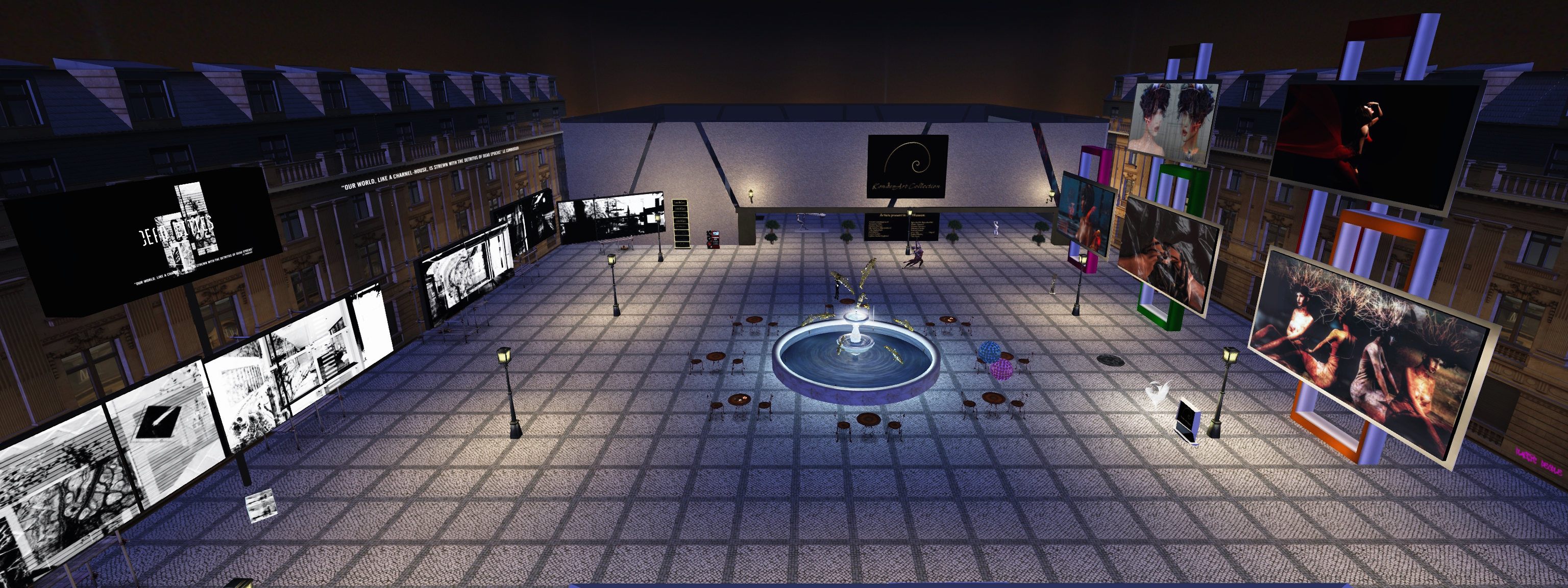
Kondor Art Square, Jul 2021: Dead Cities (l) and Plastic People (r)

Monique “Moni” Beebe and Traci Ultsch are among a group of artists whose work I find immediately engaging, and which I always appreciate being able to see and appreciate. So any new exhibition by either of them is going to get me hopping with interest –  and when they are exhibiting together, then I’m not so much hopping as I am leaping – which has very much been the case with Plastic People / Dead Cities, which opened at the Kondor Art Centre’s Art Square, curated by Hermes Kondor, on July 8th.

Now to be clear – this is not a joint exhibition in the sense of being a collaborative project between the two artists. Rather, and like their joint exhibition at Midgard Gallery in February 2021 (see: Moni and Traci at Midgard Gallery in Second Life), Plastic People and Dead Cities stand as two individual exhibition linked by theme and reflection, allowing them to be appreciated both individually and jointly, with certain truths to be found within them that may well be discomfiting to some.

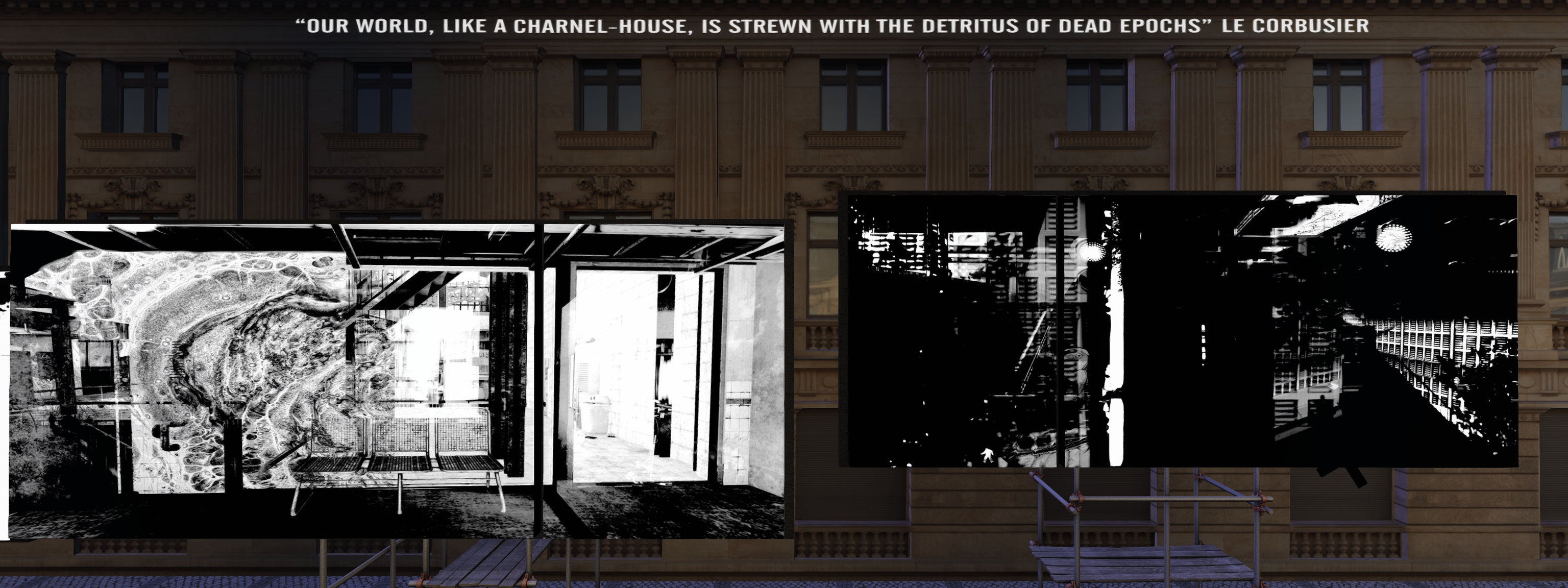
With Dead Cities, Traci explores the impermanence of Second Life through the dual medium of exploring the cityscapes that can be found throughout the grid and the medium of reflections on the ideas of so-called occultist Psychogeography as it relates to the city of London and as espoused through the work of Iain Sinclair and Peter Ackroyd.

Kondor Art Square, July 2021: Traci Ultsch – Dead Cities

In short, the latter might be said to be explorations of the myths and legends that claim much of “modern” London (e.g. from the 1660s onwards) was built on occultist practices, and the idea the “spirit” of all who have dwelt in the city combine to inform its nature down the centuries, and that “spirit” in turn informs the nature of those dwelling in it today.

Thus we are presented with a series of bold monochrome images that, rather than presenting “traditional” views of buildings, streets, and so on, are multi-faceted in the way they have been layered to present us with glimpses of buildings and structure together with the ghostly outlines of something more – that spiritual element to their nature, so to speak. Similarly, the use of scaffolding to mount the images, some of which also has skulls sitting on it, encapsulates the idea of the present being informed by the past.

In taking this route, Traci also underscores her theme of emptiness / impermanence: by presenting facets of structures in this way, with the dark and light obscuring as much as revealing, Traci points to the fact that, like it or not – and contrary to SL myth) – nothing in this virtual realm is in any way permanent; it survives and is constantly rebuilt – like a city as great as London itself – only so long as there are people to populate it. When empty, it might as well not exist – and when the novelty of the platform does finally wane, Second Life and its cities and places will won’t exist.

Kondor Art Square, July 2021: Traci Ultsch – Dead Cities

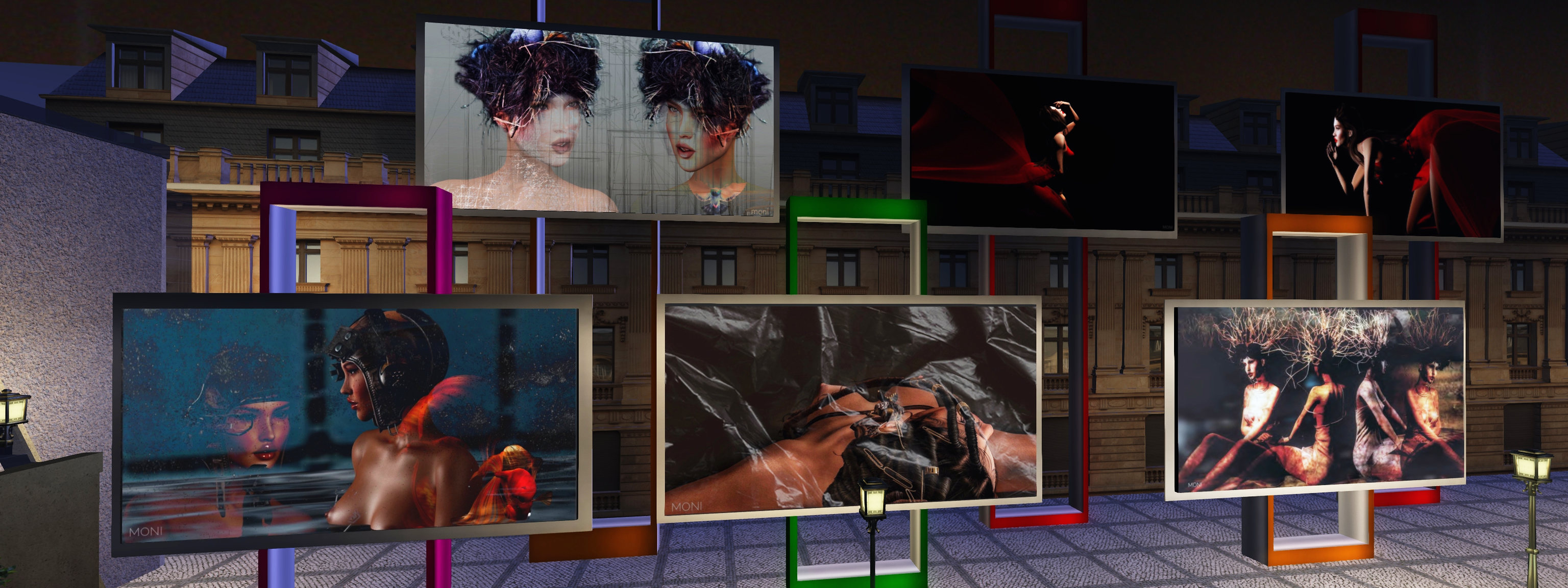
By comparison, Moni’s Plastic People appears to be an altogether lighter, brighter presentation, both in terms of being a series of images that do utilise colour, and in their general theme.

In short, this is the idea that Second Life is a plastic – perhaps malleable might be a more appropriate term – world which we can all bend and shape into whatever we wish, and in which we can express ourselves howsoever we wish, in keeping with the old SL tenet, Your World, Your Imagination. Thus Moni presents us with a series of avatar studies that when first viewed, appear to reflect this in their presentation of “classically” posed images, touches of sci-fi, fantasy and the platform’s more adult elements.

Kondor Art Square, July 2021: Monique Beebe – Plastic People

However, I say “appears”, because – to me at least – there would seem to be a further layer to Moni’s images, evidenced through her use of a stanza from Frank Zappa’s 1967 song, Plastic People within her liner notes for the exhibition:

A fine little girl / She waits for me / She’s as plastic / As she can be / She paints her face / With plastic goo / And wrecks her hair / With some shampoo.

That song was written as a manifesto against conformity and materialistic culture. So is its inclusion in Moni’s liner notes for the exhibition simply a reflection of the malleably of our avatars, or is it a comment on the fact that whilst founded on the ideal of individual expression, SL is increasingly becoming a place of homogenised, materialistic conformity for many? Just look at the way a certain avatar body dominate the platform, or the manner in which “creativity” now seems to be more about looking good and buying the latest fashion.

If this interpretation might be seen as accurate, then it begs the further question: just who are the “plastic people”, the avatars within Second Life, or those who operate them? I’ll leave that to you to ponder.

Kondor Art Square, July 2021: Monique Beebe – Plastic People

Through these two exhibits, Moni and Traci offer collections of images that are in and of themselves captivating, whether or not one wishes to look deeper into them. At the same time, they each hold up a mirror, one of which encourages us to reflect on Second Life is a whole as it relates to us, and the other asking that will look directly on  ourselves, and how we relate to the platform.

What we might discover in looking into either might not be comfortable to consider – but that does negate either exhibition. Indeed, I’d strongly recommend that anyone who likes to ponder on this virtual world in which we invest so much of ourselves, whatever the reason, pay a visit to Plastic People / Dead Cities, and spend time with the art and the artists’ own words.

SLURL DETAILS

Space Sunday: Unity 22 flies

A view from the tail boom camera on VSS Unity, during Virgin Galactic’s Unity 22 flight, July 11th, 2021. Credit: virgin Galactic

How would you really like to celebrate your birthday? We all have our own dreams of the perfect celebration – and for Sir Richard Branson, it meant becoming an astronaut just 7 days short of his 71st birthday.

Branson was one of six people who took to the skies over New Mexico in the first “full” passenger carrying flight of Virgin Galactic’s VSS Unity, in what amounts to one of the last test flights before the company starts flying fair-paying passengers on sub-orbital trips to the very edge of space.

Sir Richard Branson (2nd from right) and fellow “passengers” (all of whom had roles to play during the flight) Colin Bennett, Beth Moses (making her 2nd flight aboard VSS Unity) and Sirisha Bandla ahead of the Unity 22 flight, July 11th, 2021. Credit: Virgin Galactic 

The flight – called Unity 22 to mark the 22 flight of the spacecraft christened by the late Stephen Hawking – took Branson, together with Lead Operations Engineer Colin Bennett and the company’s Vice President of Government Affairs and Research Operations Sirisha Bandla, both of whom were also making their first flights on the vehicle, together with Chief Astronaut Instructor Beth Moses making her return to space on the vehicle, to a peak altitude in excess of 86 kilometres. At the controls were veteran Virgin Galactic pilots Dave Mackay and Michael Masucci.

The entire flight was live streamed by Virgin Galactic in a special show hosted (rather cheesily, it must be said) by Stephen Colbert, although the stream was also carried by a number of You Tube channels such as NASASpaceflight.com, from whom some of the images used here were captured.

MSS Eve carries VSS Unity into the skies over New Mexico, July 11th, 2021. Credit: Virgin Galactic

Weather had initially interfered with things, forcing the take-off of the mated MSS Eve and VSS Unity to be delayed, but at 14:35 UTC, MSS Eve – named after Branson’s late mother, and to whom he credits his outlook on life and his drive to follow his dreams – took off from Spaceport America in New Mexico, Unity mounted on her main wing spar, to climb into a perfect sky above the Virgin Galactic base of operations.

The climb to the planned release altitude of 15 km took some 50 minutes, the two craft closely observed by chase planes. At ten minutes prior to release, both craft entered a final check-out phase of the flight, with Eve maintaining altitude as both her flight crew and Mackay and Masucci worked with ground-side Mission control to confirm all was in readiness for Unity’s flight. At this point, Unity also switched its internal power, allowing her flight control and avionics to be confirmed as ready for release.

The crew in Unity’s main cabin, with Branson forward left, and Moses, forward right, shortly before the release, July 11th, 2021. Credit: Virgin Galactic

With everything checked and ready, and Eve still holding steady, the pyrotechnics that would blow the retaining bolts holding Unity to Eve were armed. Thirty seconds later they fired, separate the two vehicle, and Unity entered a very shallow dive while Eve started a climbing turn to move away from the wake of Unity’s motor.

That motor fired 2 seconds after release, and within 3 seconds had doubled Unity’s forward airspeed to carry it through Mach 1. With the motor firing smoothly, the pilots placed the vehicle into its “Gamma Turn”, essentially pointing the nose straight up  as it continued to accelerate.

VSS Unity is released from MSS Eve, observed by a chase plane. Credit: Virgin Galactic

At 31 seconds after release, Unity passed through Mach 2, climbing rapidly to reach Mach 3 at 55 seconds from release. Just over 10 seconds later, the motor shut down, but Unity continued to climb, and the flight crew initiated the “feather”, raising the vehicle’s tail booms relative to the hull by 60º.

“Feathering” allowed the craft to effectively “back flip” whilst still climbing, so the windows along the top of the cabin to face towards the Earth whilst the cabin itself entered a period of micro-gravity as Unity headed towards an apogee of approximately 86.77 km, where the flight crew used the reaction control system (RCS), small gas-powered jets, to re-orient the vehicle ready to start a belly-first drop back into the denser atmosphere.

An artist’s impression of VSS Unity with its tail boom “feathered” and the vehicle oriented for the drop back into the denser atmosphere. Credit: Virgin Galactic

This apogee point – 86-ish kilometres – has become a bone of contention between Virgin Galactic and Jeff Bezos / Blue Origin in the week or so since the Unity 22 flight was announced, as it is around 20 km below the Kármán line. The latter is recognised by many as being the divide between atmospheric flight from space flight, thus marking those who cross it as astronauts. As  it is a line Virgin Galactic does not cross (but Blue Origin’s New Shepherd does), Bezos has denigrated Branson’s flight in comparison to his own, which is due to take place on July 20th.

However, whilst not reaching the 100 km mark, the Virgin Galactic flights do exceed 80 km altitude – which is regarded as the boundary between air and space by the US Air Force, NASA and the US Federal Aviation Authority – and so those flying with Virgin Galactic do qualify as astronauts. More to the point, an extra 20km of altitude doesn’t give passengers a more expanse view of Earth compared to 86 km, and the overall amount of time spent in micro gravity conditions aboard either vehicle is roughly the same.

Sir Richard Branson floats in the inverted cabin of VSS Unity, looking down at Earth. Credit: Virgin Galactic

Continue reading “Space Sunday: Unity 22 flies”