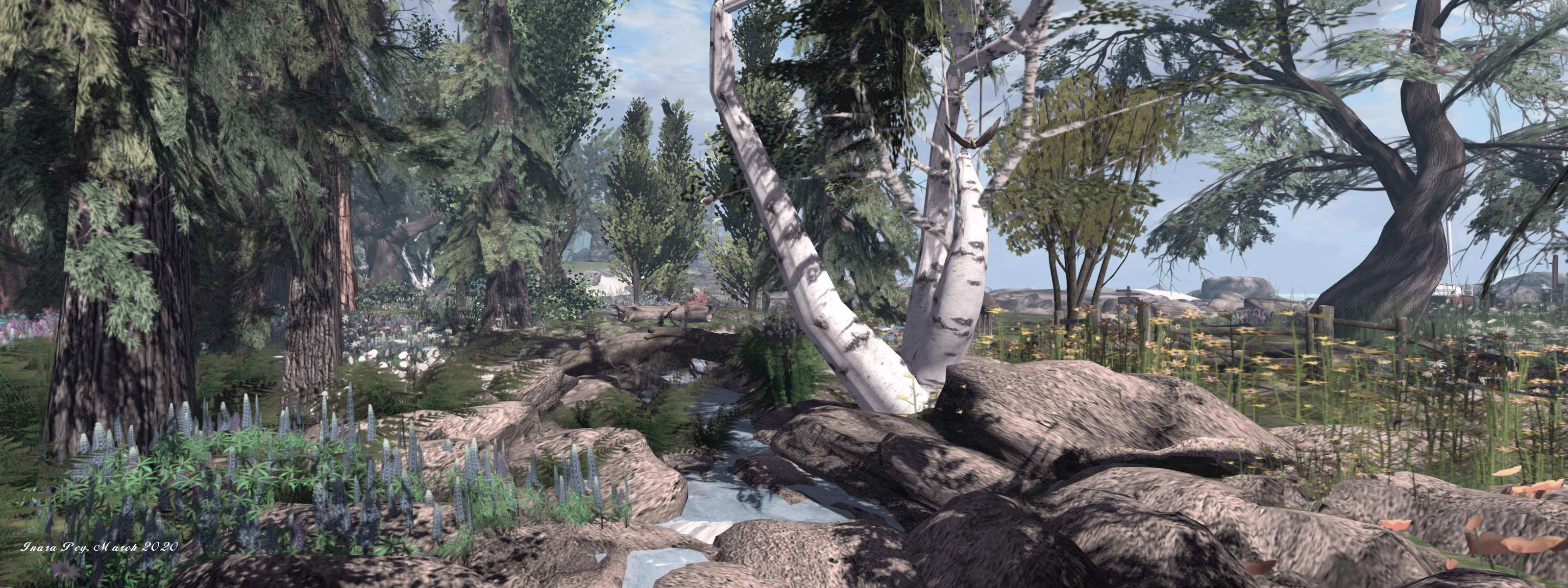
Ubay Island: racing the King Tide in Second Life

Ubay Island, March 2020 – click any image for full size

In October 2013, a 7.2-magnitude earthquake struck the province of Bohol, Philippines, inducing about 1m land subsidence to some of its small island communities. Now, the islands of Batasan, Pangapasan, Ubay and Bilangbilangan of the Municipality of Tubigon experience partial or complete flooding even during normal spring tides. Coming face-to-face with a hundred years’ worth of sea level rise, the island communities show that they are far more resilient than we think.

This is the introduction to Racing the King Tide, a film and website looking at the impact of the 2013 Philippines earthquake that was centred on the island district of Bohol had on the people and islands close to its epicentre. One of these islands – perhaps the most deeply affect of them all – is tiny Ubay, which is the central inspiration for Serene Footman’s latest region design in Second Life, and which opened to the public on March 3rd.

Called, appropriately enough, Ubay Island, the setting offers a marvellous reproduction of little Ubay – which is less than 4 acres in size – perhaps as seen in the the time period immediately after the earthquake had struck the region. As is always his way, Serene has provided a comprehensive blog post to accompany the build, and I cannot recommend enough that it should be read alongside any visit to Ubay in-world, as it really puts the build into perspective. Through his writing, Serene provides not only a lens through which to view the build, but also wider context on on the earthquake, its impact on the peoples of Ubay Batasan, Pangapasan and Bilangbilangan.

Ubay Island, March 2020

The build presents Ubay as it appears for around 130-140 days a year: flooded to a typical depth of some 45cm (1.5 ft) – although tidal ranges can make the actual waters deeper. The flooding is a combined result of both rising sea level de to climate change – and which ultimately threaten Ubay’s future – and the fact that the 2013 ‘quake saw a mean decrease in elevation of a metre (3ft) within the area where Ubay is located (an collapse that also gave rise to The Great Wall of Bohol on Bohol island itself), leaving the island’s maximum elevation when dry at just 2.32 m (7.2 ft) above the surrounding sea level.

Under the default windlight the water is a dirty, brackish grey / brown – a reminder, perhaps that flood waters can carry with them dirt, mud, animal manure and human wastes which can be hazardous to health – with wooden walk ways partially winding through the village streets in an effort to keep passing feet dry. In this, the setting has the feel of depicting Ubay not long after the earthquake struck; more recently, much has been done (starting with an imitative by the islanders themselves before they received external support), to raise the village footpaths above the average level of the flood waters.

Ubay,Island, March 2020

The landing point sits within the local school playground, a location which is both touching and somewhat ironic. Touching, as Serene has captured the graffiti marking one of the playground walls that reminds us of the lives the adults and children of the island face: This Is Where We Play. The irony is that on the actual island of Ubay, the playground was supposed to be the evacuation assembly point should the island be at risk of flooding – but in 2013, it was one of the first places to be submerged.

You might think that given the state of the island, it would have been long deserted – and you’d be wrong. Despite the earthquake, despite the continued and very real threat of rising sea levels as a result of climate change, the people of Ubay steadfastly hold on to their homes and way of life, up to and including the annual threat of typhoons wiping the village off the face of the planet.

Ubay Island, March 2020 (as it might appear under a brighter sky and the invasion of sea water)

This might sound like a case of local hubris, but it’s not. With some 74% of the population living below the national poverty line even before the 2013 earthquake, there is simply nowhere else in the Philippines where the peoples of Ubay and its neighbours can survive. This was proven in the period following the 2013 ‘quake when the 300-ish Ubay islanders were made to evacuate to the “mainland”, and almost all of them quietly moved back to island as it was the only place they could survive as fisher folk. In doing so, they have given Ubay its ray of hope.

Serene has tried to capture this sense of life as well: fishing boats lie in the waters around the village, chairs are set out on raised “porches”, ribbons festoon some of the village paths, clothes are set out to dry in the sun and breeze even as the waters pass under the lines on which they are hung, and so on. Someone has even enterprisingly set-up a stage for a music concert while boat repair yards are still in business. True, one or two liberties may have been taken (for example, the  Racing the Tide website, for example, infers that the half-submerged house that’s included in the build may be at Bilangbilangan Island rather than Ubay), but none of this spoils the setting in any way – rather, they enhance it.

Set as it is under a heavy sky, with its muddied waters and the ruins of buildings pulled down by the earthquake, and its shanty-like corrugated metal walls and roof tops, you might think that Ubay is a bit of a dismal place in SL to visit, but this simply isn’t so. Serene offers something that is once again captivating, poignant and with a depth of story behind it that should not be missed.

Related Links

2020 Simulator User Group week #11 summary

The Dream of Asia, January 2020 – blog post

The following notes were taken at the Simulator User Group meeting held on Tuesday, March 3rd.

Simulator Deployments

Please refer to the simulator deployment thread for updates.

  • On Tuesday, March 10th, the majority of the grid (the SLS “main” channel) updates to server release 537423, primarily focusing on improvements to make rolling the grid more gentle on the Lab’s non-simulator servers.
    • This update has some changes that may help improve vehicular-based  / physical region crossings. People are asked to check & report.
  • An RC deployment is pending for Wednesday, March 11th, but details were TBA at the time of writing this summary. According to Simon Linden, the update shouldn’t contain any user-visible changes.

Continuing Object Rezzing Issues

There continue to be reports of on-going object rezzing issues (reported and noted in past SUG meetings), some of which appear to be specifically tied to the 53743 release whilst on an RC deployment (see: Potential showstopping bug on many mainland regions. Anyone else experienced this?). The issue is again being complicated in that it cannot be easily tied to simulators specifically on that release, because – as some of the comments on the thread note – the possibly offending script calls do not misbehave consistently between different regions on the same channel / release. 

No update was provided at the SUG meeting, but within the thread, Mazidox Linden notes:

Just to chime in here that we’re aware of this issue (as mentioned up-thread it’s not particularly new unfortunately, dating back to late last year), and using the latest information you all have provided we’re able to confirm that the issue under discussion (object_rez events never fire) reproduces in the regions mentioned, but work fine in other regions running the same code. We’re not sure why that is just yet, but we’re going to do our darnedest to find out and get a fix for this behaviour in your hands as quick as we can.

Some people have also reported of a return of breedable issues which may (or may not be) related to this problem. In short, if you are seeing issues with scripted object rezzing – file a Jira.

SL Viewer

There have been no viewer updates to mark the start of the week to leave the official viewer pipelines as follows:

  • Current Release version 6.3.7.535996, formerly the Yorsh Maintenance RC, dated February 7th, promoted February 20th – No Change.
  • Release channel cohorts:
    • Premium RC viewer, version 6.3.8.537335, released March 3rd.
    • EEP RC viewer updated to version 6.4.0.536347, February 11th.
    • Love Me Render RC viewer, version 6.3.7.536179, February 10th.
    • Camera Presets RC viewer, version 6.3.6.535138, January 24th.
  • Project viewers:
    • Copy / Paste viewer, version 6.3.5.533365, December 9th, 2019.
    • Project Muscadine (Animesh follow-on) project viewer, version 6.4.0.532999, November 22nd, 2019.
    • Legacy Profiles viewer, version 6.3.2.530836, September 17th, 2019. Covers the re-integration of Viewer Profiles.
    • 360 Snapshot project viewer, version 6.2.4.529111, July 16th, 2019.

Providing a home for PAC in Second Life

Holly Kai Park: the new east side with welcome area / landing point (foreground) and updated re-brick gallery spaces in the tiers rising to the main gallery

At the start of February I blogged about the The Phoenix Artists Collaboration (PAC) and its search for a new home / partners as a change in circumstance meant the group would lose their current in-world home from the the end of March 2020 (see Seeking ownership or sponsorship: the Phoenix Art Collaboration). Since that time, a couple of things have happened that mean the group now has new opportunities beyond April 1st 2020 – and I’m pleased to say I’ve been able to play a part in bring one about.

In short, starting later this month PAC will be relocating core operations to a new location: Holly Kai Park, and there will also be an additional set of studio spaces that will be made available for the group as it expands.

The Gallery Village – 19 single and two-storey studios units for artists

After thinking about my own  – being frank – failure to ensure the arts programme at Holly Kai Park continues to move forward and so leaving the park largely dormant, and the situation PAC faced, it struck me that both PAC and Holly Kai Park could mutually benefit one another, the latter providing a home for the former, and the former providing the much needed visual arts programme for the latter. So, discussions were started, and both Nber and Mark, owners of HRE, the parent estate for Holly Kai Park, and the core leaders of PAC Luke (Marshmal), Anibrm Jung and Will (Willyharris) were equally positive about the idea, so I started putting together a more formal set of ideas and a plan to revise Holly Kai Park’s layout to better suit PAC’s needs.

One concern with this was that at its launch, PAC had no fewer than 42 exhibiting artists (see: The Phoenix Artists Collaboration in Second Life) – and the numbers had since grown. Obviously, given its location and the fact that the region on which it sits is something of a shared environment, there was no way Holly Kai Park could provide a home to such a volume of artist – and fortunately, it doesn’t have to: thanks to the support of Audie Spade, additional exhibition space is being made available on a separate sky platform.

The Park Walks remain, but have been vastly cleaned-up to form more obvious links between the east and west art areas

Instead, the park can become something of a focal point for PAC activities, provide space for artists, room for 3D and Featured Artists exhibitions within the main gallery complex, as well as a primary Welcome & Information centre serving both PAC and the Park, and provide a social venue for PAC members,

Over the course of the last couple of weeks, I’ve bee re-working the park to better suit PAC’s needs and serve as a base of operations (hence why my blogging has been a little slower than usual). While there is still a little more work to be carried out / finalised, we’re now just about at the point were artists can start transitioning from the current PAC facilities, which will vanish come April, and the park.

The Park retains some “permanent” 3D exhibits, notably the interactive Ice Castle by Giovanna Cerise (above) and Frankx Lefarve’s Reflections at Midnight

I’m not going to bore you with  litany of changes, instead I’ll just say that the park now comprises three distinct areas for visual arts:

  • East side: retains space for boat moorings and provides 4 individual studios for artists, together with Caitinara Bar and a new landing point / welcome centre (which I freely admit I ripped from the “skytower” home design I put together for Isla Pey).
  • Centre: the Holly Kai Gallery, retained for feature exhibitions and a further with eight east-facing artist studios built-in to the hill on which it stands, while the lawns to its front façade have been re-worked to provide space for up to 2 3D art exhibitions.
  • West side: the Art Village, with nineteen individual studio spaces in two designs, with open spaces and boulevards so as not to feel overcrowded.
Another look at the landing point / welcome centre (r) that will be housing information on the park, PAC and exhibitions as well as teleport options to go directly to any given studio gallery, with Caitinara Bar, (l)

At the same time, much improved links between the east and west sides of the park (including via Holly Kai Gallery) have been put in place whilst retaining the park like feel to the north and south of the gallery hill. Improvements have also been made to the park / Seanchai Library space so that the latter feels and looks to be more included in the park as a whole.

For artists who have exhibited at PAC’s original venue, the spaces at Holly Kai park are admittedly smaller, and the LI allowance per head has been reduced as a result, but the hope is this will encourage more variance / update in and of displays within the studios. Discussions are currently in hand as to how best to handle studio allocations and display periods, and to ensure a good flow of traffic between PAC at Holly Kai Park and the upcoming sky platform space.

A view of some of the gallery spaces tiered under Holly Kai Gallery. The bridge to the lest links directly with Seanchai Library, as does the path under it, which also connects to the west side Gallery Village

With the potential to offer space to up to 35 artists at a time, together with representation by Seanchai Library – with whom it is hoped joint events such as Stories at the Park can be (re)initiated, and with Caitinara Bar as a possible social centre for PAC, we  – the PAC Board of Trustees (of which I’m also now a member) and the HRE management team – Holly Kai Park will hopefully become a worthwhile home PAC artists and activities.

I’ll have more about any formal re-opening / exhibition launch in the near future. In the meantime, anyone wishing to visit the Park is welcome to do so via the SLurl below – but please keep in mind it’ll likely be another week or so before art starts to be displayed there.

The lawns to the front of Holly Kai Gallery now offer better space for 3D art installations

SLurl Details

Wizardhat Studios: longevity and beauty in Second Life

Wizardhat Studios, March 2020 – click any image for full size

We’re all familiar with the news of regions that disappear from Second Life – I’ve reported on a few that have announced closure myself. These disappearances can often be high-profile, leading too public upset and, and times, a reason for some pundits to blog about how they are further signs of SL’s “demise”.

What often goes unnoticed, however, are the regions that endure, sitting quietly tucked away, offering a place for people to visit year-on-year, unsullied by time. They remain a constant in the face of change over the passing of time, but can so easily pass notice by bloggers as we rush to seek the latest or new region design or setting.

Wizardhat Studios, March 2020

Take Wizardhat Studios, for example. I made my first visit to it almost seven-and-a-half years ago, in October 2012 (see: Wizardhat: dance, explore, contemplate, admire). At that point in time the region was already entering its fourth year, and it became a place I tended to jump back to semi-frequently over the next few years – although I confess that other than that one 2012 blog post, I’ve never actually written about it again in detail.

This fact had been playing on my mind over the course of the last week or so, a nagging feeling that as it’s been about 4 years since I last dropped, I should pop over and take another look. It’s a thought that was reinforced when reader and friend Miro Collas poked me via Twitter about the region. So, off I hopped.

Wizardhat Studios, March 2020

Designed by Karencreek Melson as the home of artist Wizardhat Mornington, the region is an atmospheric mix of reality, and fantasy, making excellent use of region surrounds and off-sim elements to create a great sense of depth. The default Windlight is perhaps a little bleak – I again found myself flicking to one of my preferred custom presets, but that’s about the only “complaint” I have with the region.

This is a place of coastal castles – one a home to Wizardhat’s photography and art, the other set as a home (but open to the public), where rough-faced cliffs climb to one side, water tumbling from them in places. This cliffs form a semi-circle enclosing the lowlands, their waterfalls forming streams that split the land with its mix of woods, flowers, and cart tracks, as the waters make their way to the sea.

Wizardhat Studios, March 2020

It’s also a place of whimsy: a steampunkian flying submarine floats alongside one of the castles, its interior perhaps triggering thoughts of Captain Nemo’s Nautilus and its vast undersea voyages. Not far away, polar bears take a moment in the sun, stretched out on the western beach; apparently the benefactors of a lottery win. Other animals roam free in the form of scripted agents, some of whom I recall from past visits, such as Happy Camper, others of which may well be new – or at least, relatively new. They wander about the lowlands and / or frolic in greeting while birds wheel overhead.

The animals are not the only perambulating occupants of the region. As you explore, you may notice that a couple of the trees appear to be locating themselves. Wait long enough, and you’ll see this is precisely the case, as one or another of the pair calmly uproots itself and goes for a wander, both of them again being scripted agents. It’s clear that these arboreal wanders are an accepted part of the landscape, as an owl is content to sit in the boughs of one as it takes to its roots and scurries across the land.

Wizardhat Studios, March 2020

What is particularly attractive with this region is that while it retains almost all of its original looks (for those of us familiar it from past excursions), it is also home to subtle changes that both maintain its look and appeal whilst also in part renewing it and making it worthy of return visits. Take the hillside turret to the north; once it looked out towards a storm that seemed to be approaching, now it faces stern-faced faced mass of rock sitting just off-sim.

Eclectic, rich in detail, with lots of opportunities for exploration, photography and dance, Wizardhat Studios remains an engaging visit, one given the added fact it is a place now into its 13th year in Second Life.

SLurl Details

Senna’s Unions at the Itakos Project in Second Life

Itakos Project: Union – Sennaspirit Coronet

Currently open at Akim Alonzo’s Itakos Project is an exhibition of avatar studies by Sennaspirit Coronet that is far from what might be called the “usual” for such exhibitions, given it both presents its subjects and offers a glimpse into their lives through their own words.

Entitled Union, and carrying the strap line Portraits of friends, collaborators, and lovers, it features 18 portraits of couples within Second Life who are friends with Senna, together with notes by one or both of the featured avatars on the nature of their relationship that bring each of the studies to even greater life. In developing and defining the exhibit, Senna notes:

We all know those people who, while individuals, have close ties to another in world person, whether they be friends, collaborators, or lovers. This show celebrates the “Unions” we have in this virtual world. When you think of one, very often you naturally envision the other. The great people who gave their time to participate in this show are wonderful examples of these bonds we form and proves that SL is RL.

Itakos Project: Union – Sennaspirit Coronet

Unsurprisingly, given Senna’s involvement in the SL art scene, the majority of the dual portraits feature other artists and those closest to them, be it their SL partners, long-term collaborators, or closest friends. The portraits themselves are elegant in their simplicity of presentation, each one framing the featured couple such that it that offers a living, breathing look into their virtual selves.

These are studies that would form an engaging series in their own right. Beautifully posed, lit, edited and and finished, each offers a statement on its subjects as both a pairing and as individuals. However, it is through the added words – which are as noted, by one of both of the subjects in each study – that we are carried beyond the images and into the thoughts and lives of those who inhabit the avatars.

Itakos Project: Union – Sennaspirit Coronet

Some of these pieces are short, we both have a passion for creating and I am faster than Cica so she can’t get away. Others more lengthy; all reveal the nature of the relationship between the two subjects, and whether the relationship has tended to remain within the digital boundaries of Second Life, or directly moved to encompass the physical world as well.   All of which makes for an engaging exhibition.

SLurl Details

2020 viewer release summaries week #10

Logos representative only and should not be seen as an endorsement / preference / recommendation

Updates for the week ending Sunday, March 8th

This summary is generally published every Monday, and is a list of SL viewer / client releases (official and TPV) made during the previous week. When reading it, please note:

  • It is based on my Current Viewer Releases Page, a list of all Second Life viewers and clients that are in popular use (and of which I am aware), and which are recognised as adhering to the TPV Policy. This page includes comprehensive links to download pages, blog notes, release notes, etc., as well as links to any / all reviews of specific viewers / clients made within this blog.
  • By its nature, this summary presented here will always be in arrears, please refer to the Current Viewer Release Page for more up-to-date information.
  • Note that for purposes of length, TPV test viewers, preview / beta viewers / nightly builds are generally not recorded in these summaries.

Official LL Viewers

  • Current Release version 6.3.7.535996, formerly the Yorsh Maintenance RC, dated February 7, promoted February 20 – No Change.
  • Release channel cohorts:
    • Premium RC viewer, version 6.3.8.537335, released March 3rd.
  • Project viewers:
    • No updates.

LL Viewer Resources

Third-party Viewers

V6-style

  • Black Dragon updated to version 64-bit 3.7.4, March 2nd (no release notes).

V1-style

  • No updates.

Mobile / Other Clients

Additional TPV Resources

Related Links