On Tuesday, February 11th, Ryan Schultz reported a claim that Linden Lab had shut down development of Sansar, their Social VR platform, and that there had been a large number of lay-offs (up to 40 of the remaining staff of approximately 60-75 people).
Unsurprisingly, the news gave rise to a lot of speculation on the platform’s status and future. I have a request for information in with the Lab, but due to time differences, I’ve yet to receive a reply (the major reason I had thus far held off on writing about the matter – assuming I do get a reply. But in the interim, here is what has been stated:
The Lab is rumoured to have shut down Sansar development.
Some 40 staff are rumoured to have been laid off.
Some staff are rumoured to have been transferred back to Second Life.
The only official word in response thus far on the matter is a Sansar Discord post by Lab CEO Ebbe Altberg:
So, I’m only going to say this tonight as it’s late. We can pick up the conversation in the following days. Yes, there were lay-offs today. A truly wonderful group of people. But as you can see Sansar is up and running. We are still in discussion about next steps. Including with the wonderful group of people. More to come. Don’t give up yet. Go create and have fun. Not much point in speculating until we can tell you more.
So it would appear the rumour of lay-offs is accurate, if not necessarily the number. There is always a temptation to dig into potential departures, but I would rather not unduly add to speculation on that front until more is known via official sources.
In terms of Sansar staff transferring back to Second Life, it is worth noting that a number actually did so in late 2019 (or at least, some transferred back while some may have resumed splitting their time between Sansar and SL – Monty Linden, for example resumed posting to the SL forums on topics at the end of 2019, while one of the rendering team moved back to SL from Sansar). So, at this point, it is not clear if there may have been further moves from Sasnsar back to SL, or whether the current rumours on on such moves is the result of people picking up on last year’s shifts.
As it is, Sansar currently remains accessible to users (I’m in Sansar as I write this), and events through until the end of March 2020 remain active in the Sansar events page. However, this should not be taken to mean “business as usual”; until the Lab comments further on the matter, nothing can really be taken for granted either in terms of Sansar’s continuance or otherwise.
On a general note, I would hope some form of clarification / statement of intent regarding Sansar is made sooner rather than later. This is because news of lay-offs + rumours and speculation, particularly coming on top of the lay-offs at the start of November 2019 and the shift in emphasis with the platform that occurred at that time, tend to rock confidence for those actively engaged in Sansar (and there are a fair number of creators very active within the platform), and can also easily result in FUD and rumour spreading well beyond the platform, potentially to its detriment.
As further information becomes available I’ll follow-up on this post with either updates or additional articles.
A single RC channel deployment is planned for Wednesday, February 12th. Server update 2020-02-05T22:16:31.536040 should comprise support for the upcoming Name Changes capability.
On Monday, February 10th, the Love Me Render RC viewer updated to version, 6.3.7.536179.
At the time of writing, all remaining viewer pipelines remain as follows:
Current Release version 6.3.6.535003, formerly the Xanté Maintenance RC, dated January 22nd, promoted January 27th – No Change.
Release channel cohorts:
Yorsh Maintenance RC viewer, version 6.3.7.535996, February 7th.
EP RC viewer updated to version 6.4.0.535668, February 4th.
Camera Presets RC viewer, version 6.3.6.535138, January 24th.
Project viewers:
Copy / Paste viewer, version 6.3.5.533365, December 9th, 2019.
Project Muscadine (Animesh follow-on) project viewer, version 6.4.0.532999, November 22nd, 2019.
Legacy Profiles viewer, version 6.3.2.530836, September 17th, 2019. Covers the re-integration of Viewer Profiles.
360 Snapshot project viewer, version 6.2.4.529111, July 16th, 2019.
Brief Notes
Work is continuing to try to clear the last blockers staying in the way on the Name Changes deployment.
BUG-228162 “Issue with experience_permissions_denied() and XP_ERROR_NOT_PERMITTED triggered when experience permissions are granted by more than one person” – appears to report an issue in granting permissions if dialogue requests are simultaneously open.
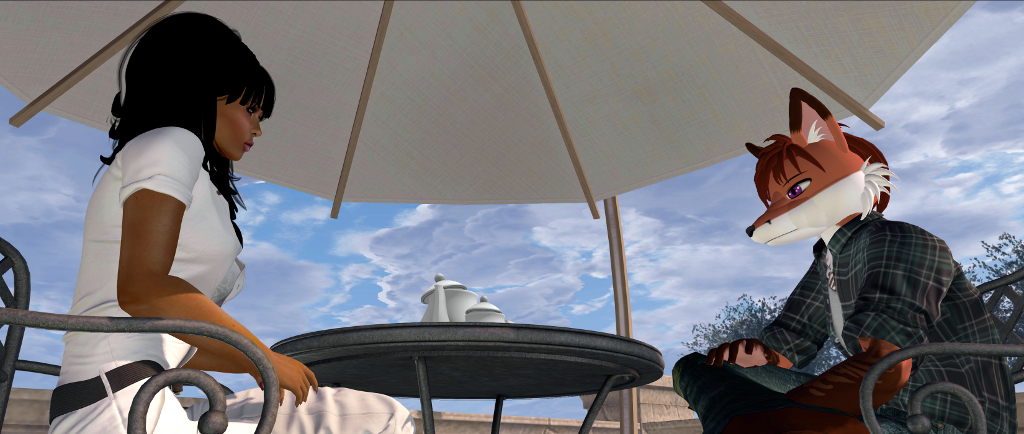
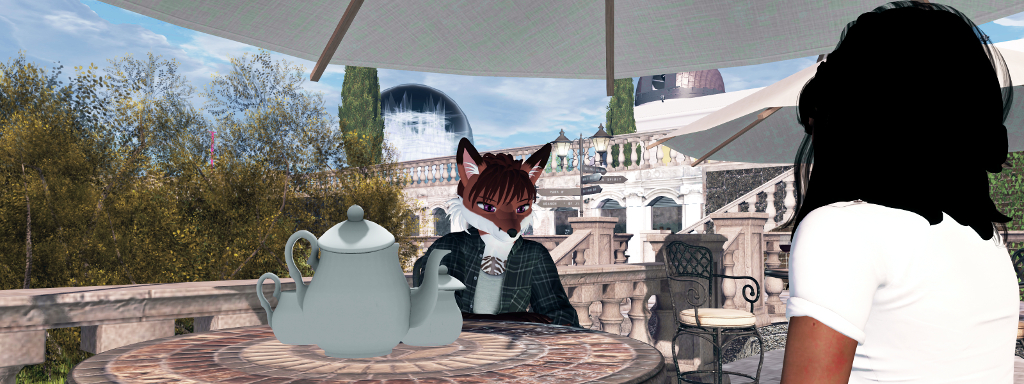
In conversation with The Avatar’s Voice host, Erik Mondrian
The Avatar’s Voice is a video series of conversations hosted (and filmed / produced) by writer, artist, scholar, and virtual worlds thinker, Erik Mondrian. The third segment in the series, featuring an interview with Cubey Terra, recently launched on Erik’s You Tube channel, which further fuelled my interest in the series as a whole and how it came into being, and recently Erik kindly agreed to discuss the series with me – how it came about, his approach to it and future plans, as well as touching on his work in general.
However, before we get to that, some background on the series for those who may not have seen it.
The Avatar Voice, is an ongoing series of conversations between Erik and active virtual world residents, with each 30-minute segment focusing on a single guest (all of whom have thus far been Second Life residents, although Erik hopes to expand the series to cover other worlds), discussing their involvement in virtual environments, their interests, and their thoughts on a range of subject related to virtual living and virtuality.
In this, they are in many respects the virtual equivalent of interviews conducted by the likes of Larry King in his heyday or Christiane Amanpour; rather than being solely interrogatives, they are conversations wherein the host takes a back seat, gently offering up questions and occasional feedback while letting the guests tell their story and offer their views entirely in their own words, without the need for undue interjection. The 30-minute time length Erik has set for each segment allows for a more informative conversation to take place than a shorter format might allow, but without the audience ever feeling it is perhaps being drawn out or becoming stale, as might be the case with a longer time frame; instead, we are able to become quiet listeners as the discussion naturally flows between host and guest.
Erik with MangroveJane
In discussing the series with Erik, I started with perhaps the most obvious question: where the idea for the series originated.
Erik Mondrian (EM): Many years ago, I thought The Avatar’s Voice would be cool as the name of an on-line ‘zine I might eventually start about virtual worlds, pulling together stories/headlines from and about these worlds with “correspondents” from them working and writing together on the one site … I haven’t really done anything with that idea; but at some point I started thinking about it as a podcast instead, with the purpose being to go directly to the avatars themselves, to hear from them personally about what virtuality and their chosen virtual world(s) mean to them, what they’ve done and experienced there, and so on.
Inara Pey (IP): What in particular crystallised the idea of a podcast?
Erik Mondrian
EM: I think the idea for it as a podcast became more clearly defined and make sense to me because of my MFA¹ studies, and the fact that the one side of my multidisciplinary degree at CalArts was in what the Institute calls “voice arts”. So The Avatar’s Voice felt like it fit with the idea of actually hearing people’s voices – the people behind the avatars – in a format that’s not necessarily focused on any one topic or overarching goal, but allows people involved in virtual worlds to have more of their story to be told.
Also, while at CalArts and studying for my MFA,there was a call for graduate students to suggest and run courses during the two-week Interim sessions about anything that interests them. I presented two courses – Virtual Worlds, Real Artists and Virtual Worlds: Placemaking as Art Practice, in January 2017 and January 2018. In them, I attempted to show my students as many examples of virtual world creativity as I could, including having guests appear remotely from Second Life. I think teaching those two courses and especially, having those speakers share their perspectives, was crucial in leading up to the podcast, cementing my desire to try to start a project like this.
IP: Is there a particular fascination for you personally in setting up the series?
EM: I’ve always had a desire to learn more about what makes virtual worlds tick and why so many people, including myself, are drawn to them as places to “live”, often for years or decades. There is also a desire to preserve and document these worlds and their history by recording these conversations and hearing people’s perspectives.
IP: How do you select possible candidates for the series?
EM: I have a long list, even if just in my head, of people I’d love to interview. I’m sort of in a constant state of admiration for what people do in and with virtual worlds, even if it’s “just” living their lives there, building relationships and creating a home of some kind in a way that’s meaningful to them.
Since there are so many people I want to interview, the “who I select” is probably more a matter of scheduling and who’s available and willing; Groves [Mangrovejane] was the first both because I really admired her work and because we’d become good friends in SL, so she was willing to be my guinea pig for the very first interview. For that first session as well, I wanted to have a level of trust and comfort, as I was – and still am – learning by doing; so I wanted a guest who could be at ease with me and I with them.
I’m approaching people over time, and have a couple who have already said yes, and there are two more I haven’t asked yet but I think would do it. Ultimately, I want to have a variety of people, who’ve done different things, lived different virtual lives.
Erik with Cubey Terra
IP: Is there anyone in particular you’d like to interview?
EM: I would absolutely love to interview Steller Sunshine at some point, though I have no idea if she still logs in to SL or what she’s doing these days. I think it would be absolutely amazing to talk to her and hear at length about her experience, given she was the first non-Linden SL user, back in 2002.
IP: One of the attractions with The Avatar’s Voice is the relaxed approach you take with your interviewees. Is this a case of research only, or the result of an initial conversation with them, from which a core set of questions is formed, or a combination of both?
EM: I think it’s a mixture, and may change as I do more interviews and get a better feel for the process. I do try to have certain questions or topics in advance that, for that specific person, I know I’ll want to raise; but at the same time, I try to let things come up naturally during the conversation. How I ultimately edit that conversation’s recording down into the interview is another story; but even there, I try to maintain that sort of (hopefully) unforced flow, mixing thought-out questions with interesting little conversational tangents here and there, sometimes circling back around to cover a particular topic from another angle or in greater detail.
One little addition: I’m a big admirer of Syrmor and his VRChat video interviews. While his approach is to talk more about people’s lives as whole, I think his interviews are quite validating and inspirational as far as being able to use virtual existence and interaction to hear from people in this kind of way, although I don’t try to occupy his space, as The Avatar’s Voice is very much tied to virtuality, virtual worlds, and avatar-based identity as underlying driver of the discussion.
IP: Tell me more about the editing process.
EM: Editing those recordings down to fit that limit can be a challenge, to say the least! But I do find that certain things, certain topics, seem to fit together more easily. I try to also listen and “feel” for when a topic seems like it’s probably more important/personal for the interviewee, and leave those areas in as opposed to other parts of the recording where I can hear it’s [perhaps] less meaningful to them. [It’s] a question of palpable enthusiasm, maybe? Listening for even just a subtle sense of things that are unique to them, rather than being just a part of the conversation that could be seen as a little more generic and unfocused.
In conversation with Erik Mondrian
IP: Given you do have guests who have already committed to the series and have others in mind, how frequently are you hoping to produce segments of The Avatar’s Voice? Is it something you’re aiming to put out perhaps monthly, as with the Bizi and Cubey interviews, or will it be more a case of as time and commitments allow?
EM: I would say that while I would love to actually put out an episode weekly, it’s more likely to be closer to every few weeks or worst case even monthly, as you said, at least for the time being. As I do more of them, of course, I’ll hopefully not only get faster at the editing process but also be better with the planning beforehand and with the interviews themselves in the moment.
I have thought about the possibility of doing a sort of “interlude” episode every 4 or 5 interviews, to keep the momentum going whilst also involving more people. Rather than a whole 30-minute episode with one person [these “interludes”] would instead be me sharing responses from residents to a call I’ve made via Twitter or what-have-you [for thoughts and feedback], either with me giving their response in voice if they answered through text, or even letting them speak for themselves if they wanted to share a brief recording of themselves responding.
IP: In closing, is there anything your like to add concerning the series and your aspirations?
EM: I’m eager to hear what people have to say, whether in the full interviews or in the interlude submissions idea. I started this because I truly believe that there have been, and still very much are, many amazing people in virtual worlds of all kinds, [with] so many interesting things being done; this is a way for me to know more about them and to hear directly from them about why virtuality has been a meaningful part of their lives.
I should also mention that while I do expect the bulk of my interviewees, at least for the time being, to be SL Residents, I think much if not most of what they have to say is applicable to virtual worlds at large, and I do also hope to interview residents of other virtual worlds as well, to ultimately have that diversity of realities represented.
I’d also like to say that – time and money permitting – this is only one series, one facet, of the projects that I’d love to be able to do to show SL and virtuality in multiple ways. [For example] I also have in mind a video series exploring SL as a connected world, and another that would examine some of the activities therein. These would be in addition to the fly-throughs and music videos I’ve made to showcase places … [and] would sort-of complement the podcast by having a similar style or approach with a voice-over talking about them.
In conversation with Erik Mondrian
As noted towards the top of this article, the first three segments of The Avatar’s Voice are available via Erik’s You Tube channel, and are summarised below with links to them for viewing. I recommend anyone with an interest in virtual worlds, Second Life and virtual living take time out to listen to them; they are all equally fascinating.
The Avatar’s Voice 1 – Mangrovejane (August 2018): a visual artist who has been in Second Life since August of 2016, who discusses her time in Second Life, how she established it as her virtual home; the differences she’s noted between it and platforms like Sansar and High Fidelity; and the power (and peril) of avatar embodiment.
The Avatar’s Voice 2: Bizi Pfeffer (January 2020): a software engineering student and accomplished virtual explorer active in SL since early 2007, discussing his travels around the SL mainland and how having a contiguous world can help foster a sense of community and discovery, especially when the spaces there are user-created; the rewards and occasional challenges of sharing that world with a diverse population of people from around the globe; and the impact of decentralisation & open-source software development (or a lack thereof) on a virtual world platform’s evolution and survival.
The Avatars Voice 3: Cubey Terra (February 2020): an acclaimed content creator and pioneering virtual aviator active in SL since the latter half of 2003, discussing the history of the original Abbotts Aerodrome, which he co-founded; the value of SL’s in-world building tools and thoughts on the arrival of mesh in SL; and how Second Life, as a shared, user-built environment, still manages to pull people in and keep them engaged despite the platform’s limitations, visual and otherwise.
Also, if you would like to help support Erik in his work in producing The Avatar’s Voice and to help him with his other projects related to virtual worlds, please consider buying him a coffee via his ko-fi page – the donations made will directly support his work.
MFA: Master of Fine Arts, studies that saw The Avatar’s Voice interrupted between its first and second segments while Erik focused on producing his thesis, which included producing a fabulously engaging 11-part video series exploring matters of identity, life, emotions, desires, introspection and self-understanding as a part of his thesis for his Master of Fine Arts (MFA) in Voice Arts & Creative Writing (please read Erik Mondrian: master of fine arts in and beyond Second Life for more).
Logos representative only and should not be seen as an endorsement / preference / recommendation
Updates for the week ending Sunday, February 9th
This summary is generally published every Monday, and is a list of SL viewer / client releases (official and TPV) made during the previous week. When reading it, please note:
It is based on my Current Viewer Releases Page, a list of all Second Life viewers and clients that are in popular use (and of which I am aware), and which are recognised as adhering to the TPV Policy. This page includes comprehensive links to download pages, blog notes, release notes, etc., as well as links to any / all reviews of specific viewers / clients made within this blog.
By its nature, this summary presented here will always be in arrears, please refer to the Current Viewer Release Page for more up-to-date information.
Note that for purposes of length, TPV test viewers, preview / beta viewers / nightly builds are generally not recorded in these summaries.
Official LL Viewers
Current Release version 6.3.6.535003 and dated January 22nd, promoted January 27th, formerly the Xanté RC viewer, – No Change.
Release channel cohorts:
Yorsh Maintenance RC viewer, released on February 4th, updated to version 6.3.7.535996 on February 7th.
Love Me Render RC viewer updated to version 6.3.6.535087 on February 6th.
EP RC viewer updated to version 6.4.0.535668 on February 4th.
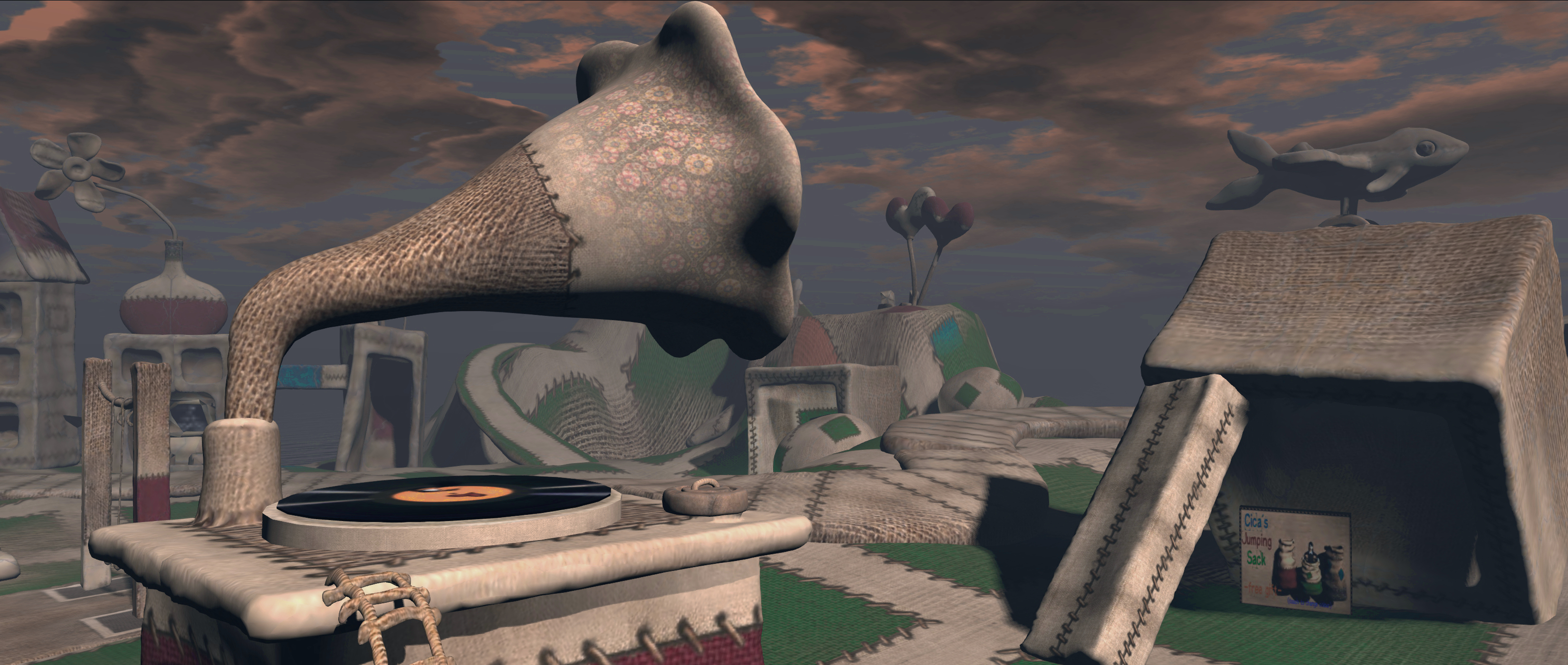
Cica Ghost opened her latest region-wide installation on Sunday, February 9th, and it is another absolute delight from an artist who can chase away the darkest clouds and turn the deepest frown into a smile.
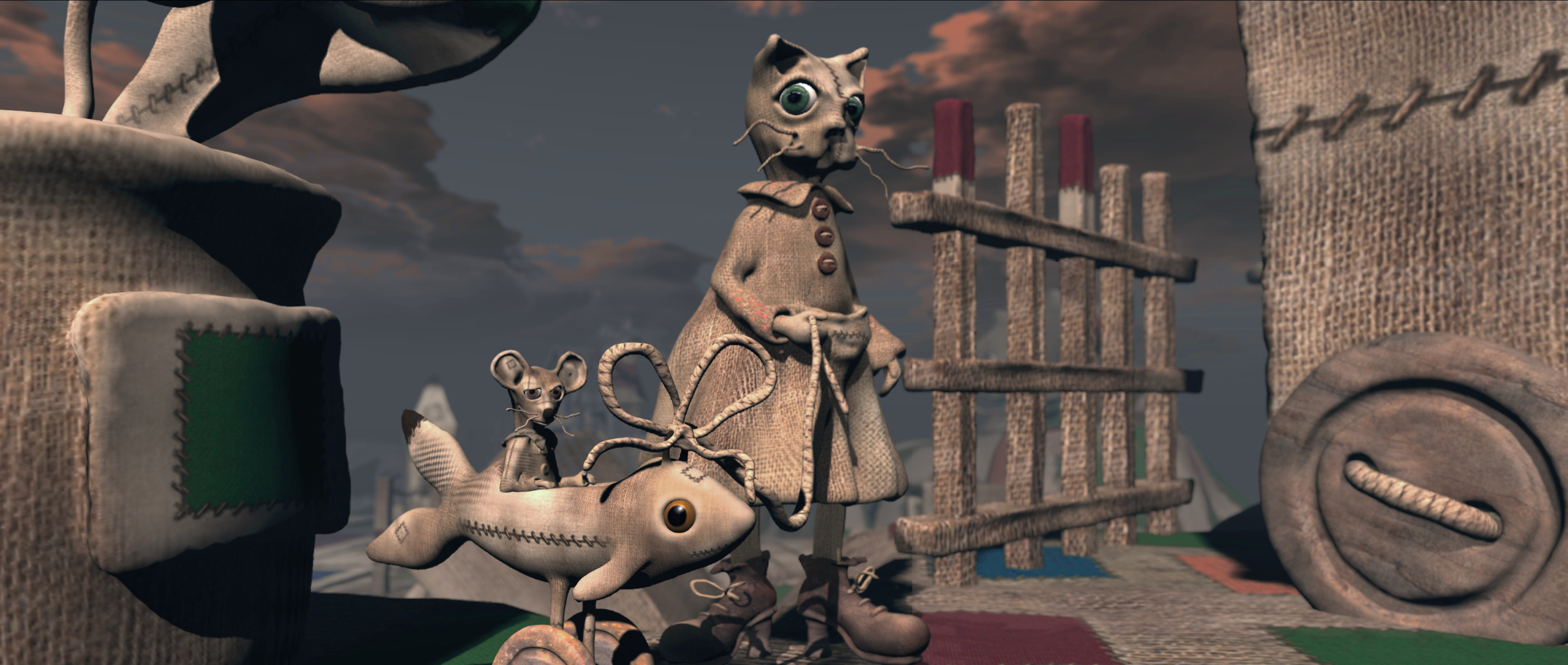
Burlap is a marvellous setting where just about everything is fashioned from that fabric (also known as hessian in some parts of the world). The ground is a stitched-together pattern of plain and coloured burlap swatches, the houses, vases, pots and boxes that lay scattered across it similarly so, while a ribbons the fabric forms a road that winds around and over the land. Even the posts and fences are made from the stuff, as are the flowers that sprout from vase and pot.
Cica Ghost, Burlap
The only real exception to the use of burlap and thread comes in the form of buttons. These not only secure the clothes of the local population – of which more in a moment, they also act as wheels on vehicles large and small, some mobile, some static, some apparently being pulled along. Wheels even sit at the four corners or on either side of some to the finger-like houses, suggesting that with a firm heave-ho, they could be set rolling across the quilted landscape.
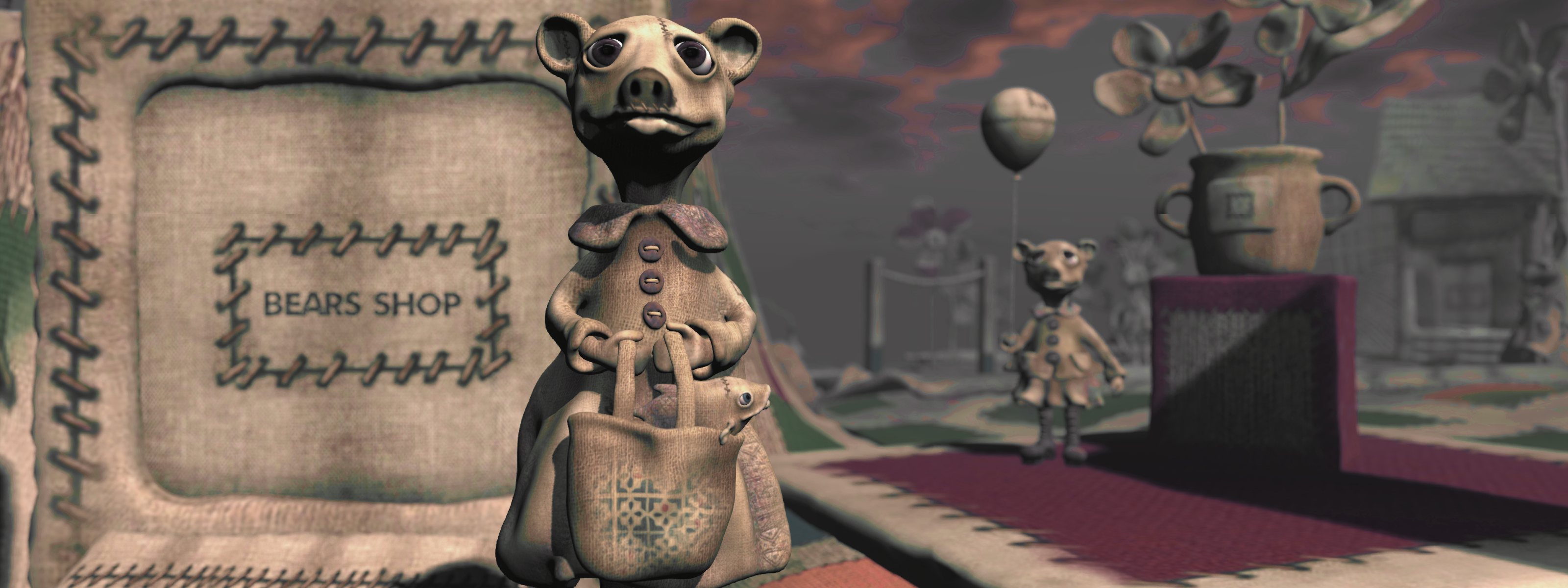
Within the setting, the local inhabitants watch the comings and goings of visitors with interest, forming a little community of burlap-dressed bears, rabbits, ducks, felines and mice (and even a giant fish apparently quite at home draped over a hill!). The bears, rabbits and ducks all have their own little neighbourhood areas, complete with their own burlap-fronted shop, while the felines – a lion jealously guarding his bag of potato chip (or crisps as we’re prone to call them in the UK), and a cat apparently out shopping with a little mouse literally in tow with her – stand apart from one another.
Touch the fronts of the shops, and the burlap “doors” will rise curtain-like, to reveal smaller versions of the locals available for purchase and display.
Cica Ghost – Burlap
As with all of Cica’s builds, Burlap includes a lot of places for avatar animation / interaction, with sits and dances to be found on multiple sufaces – just carefully mouse over things and watch for the Sit icon to appear. Some of the obvious places are the giant gramophone player, the swings and the chairs – but there are more that I’ll leave yo to discover 🙂 .
Also, keep an eye out for the gift giver – it’ll present you with your very own burlap sack you can use to hop around the installation and have sack races with friends. There is also a fish car rezzer sitting to one side of the region awaiting drivers (turn off your AO to sit within in properly). Do be warned, however, that it does tend to launch you and your car once you’re seated!
Cica Ghost – Burlap
Whimsical, fun and bright, Burlap will remain open for about a month. When visiting, do please consider making a donation towards Cica’s work, so we can all continue to enjoy her art in Second Life.
An artist’s impression of ESA Solar Orbiter over the Sun. Credit: ESA
At 04:03 UTC on Monday, February 10th (23:03 EDT, USA), the European Space Agency’s Solar Orbiter is due to be launched atop a United Launch Alliance Atlas V from Cape Canaveral Air Force Station, Florida. Referred to as SolO, the mission is intended to perform detailed measurements of the inner heliosphere and nascent solar wind, and perform close observations of the polar regions of the Sun, which is difficult to do from Earth, in order to gain a much deeper understanding of the processes at work within and around the Sun that create the heliosphere and which give rise to space weather.
The launch will mark the start of a three 3-year journey that will use a fly-by of Earth and three of Venus to use their gravities to help shift the satellite into a polar orbit around the Sun. Once there, and at an average distance of some 41.6 million km, SolO will move at the same speed at which the Sun’s atmosphere rotates, allowing it to study specific regions of the solar atmosphere beyond the reach of NASA’s Parker Solar Probe and Earth observatories for long periods of time.
ESA’s Solar Orbiter, built by Airbus UK within its clean room assembly area. The large flat panel to the left is the craft’s Sun shield. Credit: ESA
Our understanding of space weather, its origin on the Sun, and its progression and threat to Earth, comes with critical gaps; the hope is by studying the the polar regions of the Sun’s heliosphere, scientists hope they can fill in some of these gaps. The outflow of this plasma interacts with the Earth’s magnetic field and can have a range of potential effects, including overloading transformers and causing power cuts, disrupting communications and can potentially damage satellites. Further, the disruption of the Earth’s magnetic fields can affect the ability of whales and some species of bird to navigate.
We don’t fully understand how space weather originates on the sun. In fact, events on the sun are very hard to predict right now, though they are observable after the fact. We can’t predict them with the accuracy that we really need. We hope that the connections that we’ll be making with Solar Orbiter will lay more of the groundwork needed to build a system that is able to predict space weather accurately.
– Jim Raines, an associate research scientist in climate and
space sciences engineering
Specific questions scientists hope SolO will help answer include:
How and where do the solar wind plasma and magnetic field originate in the corona?
How do solar transients drive heliospheric variability?
How do solar eruptions produce energetic particle radiation that fills the heliosphere?
How does the solar dynamo work and drive connections between the Sun and the heliosphere?
To do this, the satellite is equipped with a suite of 10 instruments, some of which will be used to track active solar regions that might explode into a coronal mass ejections (CMEs), a major driver of space weather. When a CME occurs, SolO will be able to track it and use other instruments to be able to break down the composition of the energetic outflow (and that of the outflowing solar wind in general).
Knowing the composition of this outflow should help determine where energy is being deposited and fed into the solar wind from eruptions on the Sun, and how particles are accelerated in the heliosphere – the bubble of space where the Sun is the dominant influence, protecting us from galactic cosmic radiation.
The Solar Orbiter mission. Credit: ESA
Combined with the work of the Parker Solar Probe, launched in August 2018 (see: Space Sunday: to touch the face of the Sun) and which gathers data from within the Sun’s corona, and observations from Earth-based observatories such as the Daniel K. Inouye Solar Telescope (DKIST), Solar Orbiter’s data should dramatically increase our understanding of the processes at work within and around the Sun.
Like the Parker Solar Probe, SolO will operate so close to the Sun it requires special protection – in this case a solar shield that will face temperatures averaging 5,000º C on one side, while keeping the vehicle and its equipment a cool 50º C less than a metre away on the other side. This shield is a complex “sandwich” starting with a Sun-facing series of titanium foil layers designed to reflect as much heat away from the craft as possible. Closest to the vehicle is a aluminium “radiator” that is designed to regulate the heat generated by the craft and its instruments. Between the two is a 25-cm gap containing a series of titanium “stars” connecting them into a single whole. This gap creates a heat convection flow, with the heat absorbed by the titanium layers venting through it, drawing the heat from the radiator with it, allowing Solar Orbiter to both expect excess solar heating and present itself from overheating.
SolO’s primary mission is due to last 7 years, and those wishing to see the launch can watch it livestreamed across a number of platforms, including You Tube.








 Inara Pey: Living in a Modemworld