Lab Gab: Second Life in 2020 with Ebbe and Grumpity (and Keira!)

via Linden Lab

The 14th edition of Lab Gab was live streamed on Friday, February 21st and featured as guests, Ebbe Linden (aka Linden Lab CEO Ebbe Altberg) and Grumpity Linden, Vice President of Product, who between them discussed the Second Life roadmap for 2020.

As might be expected, a call to Second Life users to submit questions that might be asked of Ebbe and / or Grumpity generated a lot of feedback, so little time was lost in getting down to hearing their responses. Note that this summary may not reflect the chronological order in which questions were asked; however, time stamps are provided for those wishing to jump to a specific point in the video, and a complete video is embedded at the end of this article.

But first – Sansar and Linden Lab

[1:09-5:06]

At the top of the programme, Ebbe confirmed Linden Lab is no longer “sponsoring”, as he put it, Sansar, and are actively seeking a new home for the platform.

So as you might have heard, sadly we have decided that we, as Linden Lab, couldn’t continue to sponsor the project financially, so we’re looking for a plan B for Sansar to continue. I can’t say much, but we’re having very interesting conversations with several parties to help that project move forward, which I’m really excited about. But no deal is done yet, so people will just have to be patient and see what happens with it, but yes  it is true that Linden Lab going forward will focus entirely on Second Life and Tilia. I’m still busy making sure that Sansar finds a great home and that the great work that that team has started can continue.

– Ebbe Altberg

He went on to note that the company is continuing to work with those they have laid off to help their secure their futures, and that overall, Linden Lab remains in a strong financial position with strong confidence in the future, vis Second Life and Tilia Inc.

You can read more on this in Lab seeking a “plan B” to secure Sansar’s future.

Current Technical Projects

Cloud Uplift

[5:51-8:28 and 10:30-11:03 and 27:13-28:41 and 49:47-51:51]

  • Cloud uplift is the term now being employed by the Lab to describe the project to transition all of Second Life to cloud-based provisioning.
  • This has been a long-term project, with considerable planning and preparation work having thus far been completed, and 2020 marking the time when the actual transitioning of services takes place (“lifting them to the cloud”).
  • The work is long-term not just because of the number of services that must be transitioned, but also the amount of operational  / engineering requirements required to ensure that services that are linked by physical proximity and connectivity in a single hosting environment continue to function  and communicate with one another when moves to an environment where they no longer share that proximity or direct line of communication.
  • There are a lot of perceived benefits from the move, most noticeably that hardware / infrastructure renewal will no longer be a significant factor for the Lab, while longer-term the grater spread of geographical options, hardware options, etc., may mean the Lab will be able to offer broader simulator products or reduce latency between physical groups of users and  the servers they most regularly access, etc.
  • The downside of this is that for the time being, the focus for engineers and developers at the Lab is very much on the cloud uplift, and not on developing new features.
  • The hope is that his work will be completed by the end of 2020, otherwise the Lab starts incurring costs (e.g. Cap Ex costs) they’d prefer to avoid.
  • Once the transition has been completed, a further benefit could be with LL being able to experiment with different (and more recent) server types to help with simulator-side performance, and perhaps even offer different product offering based on different servers, with suitable price points (e.g. those running venue that have high numbers on attending avatars can opt to pay to have their regions hosted on very high-end servers capable of managing the script, etc., load.
  • Currently, there are no plans to make private regions an on-demand service in the cloud (that is, only spinning up a region when there is one or more avatars in it).
    • This is primarily because of the persistence model around which Second Life has been built, and the expectations of some of the operations services have around this.
    • However, at some point after the cloud migration, it might be possible for LL to offer a kind of on-demand private region product with a suitable price-point.

Mobile Access for Second Life

[11:13-14:03]

  • Lab is developing a “companion” app for Second Life, that will initially be for iOS devices (see: Lab working on a Second Life iOS client?, Linden Lab confirm Second Life iOS client in the making (both January 2019) and Second Life iOS companion app – mini update (March 2019).
  • It is currently in internal alpha, and does *not* have 3D rendering but does provide chat, group chat, IM, and other core communications capabilities, although additional functionality may be added over time.
  • Development will be iterative, and there will be opportunities for users to help test the app when it is ready to be public-facing. The exact mechanism on how this will work is still TBD.
  • There is no formal ETA for the app, but the hope is some form of (closed?) alpha testing period may be made available in the next few months (or sooner).
  • [54:28-55:15] The focus is on iOS, with the hope that once done, it will not be a major effort to port the app to Android.

Premium Plus

[14:05-17:35]

  • Premium Plus is the upcoming new Premium subscription offering that will sit “above” the current Premium, and jokingly referred to as Premium Plös (“ploos” with a French sounding accent).
  • No formal release date as yet – as LL prefer not to commit to specifying dates so as not to disappoint should things get delayed.
    • It has, however, been stated at the monthly Web User Group meetings, that Premium Plus will not be released until some time after Name Changes has been implemented – so it is in the Soon™ category .
  • When introduced, it will have a pro rata option, so existing Premium users will have any remaining balance on their subscription at the time they upgrade credited to Premium Plus.
  • Premium Plus will have a range of additional benefits – most of which are still TBA. However, it will mean Name Changes will be “around” US $20 cheaper for Premium Plus members (so if the Name Changes fee in US $39.99 for Premium, Premium Plus many only have to pay US $19.99).
  • Focus at present is on putting in place the coding and updates required to support multiple Premium account levels.
  • Lab will continue to add value to both Premium Plus and Premium.

The Marketplace

[23:05-25:53]

  • A lot of work has been put into the Marketplace in responding to a lot of long-standing feature requests, etc, from users and in dealing with some of the low-hanging fruit of MP fixes, etc.
  • More work is planned, but again, the cloud uplift project  – which includes the MP and all of the other Second Life web properties – is the primary focus at the moment.
  • In terms of questionable content on the MP (e.g. the mis-selling of No Copy items), this isn’t an issue that can be solved via any automated means, and is thus resource intensive and does require the support of users in flagging items, etc.
    • However there are plans to replace / update some of the existing processes around these issues, so that issues can be more readily reviewed and dealt with.
  • LL are conscious of being vague on matters like this, but feel they need to be, as saying too much publicly could open the door to those less-than-earnest actors trying to circumvent actions that might otherwise impact them.
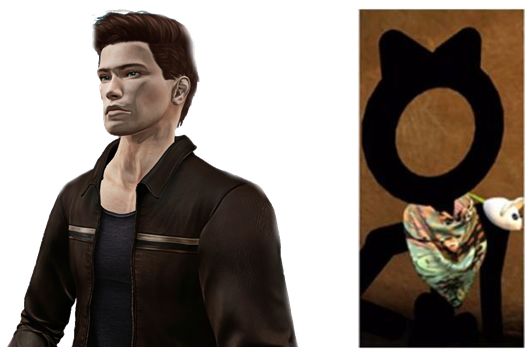
Ebbe, Strawberry and Grumpity (+cats!) in Lab Gab episode 14

Performance Improvements

[25:53-31:55]

  • A major cause of performance issues is sub-optimal content  that the viewer has to deal with when rendering (e.g. poorly-designed mesh, heavily tortured prims, sculpties, flexies, etc.), and which impact performance.
  • There’s not a lot that LL can do about this, other than appeal to content creators to consider performance when designing their models, and to region creators to do likewise when designing their regions and the impact overly complex content or the over-use of unique high-resolution textures has on the viewer.
  • In time, the more powerful server options that will be available for running simulators once they have been transitioned to the cloud may help improve server-side performance (e.g. thing like script processing, etc.).
  • In the future, more work may be put into providing better tools to help creators ensuring their content is more performant.
    • As an aside, and as reported in my CCUG summaries, work is already in progress to provide creators and user with better means of understanding the impact various content is having on their system’s performance – remembering that it is the *viewer*, not the simulator , that does most of the heavy lifting.
  • Elsewhere there have been subtle performance improvements:
    • A move of Marketplace infrastructure to a new environment means page loading times are measuring an 11% improvement; changes made to the asset services have improved inventory stability.
    • There are currently simulator updates that are being / about to be deployed across the grid sever channels that should see improvements in region crossings (updates on server deployments can be found in my weekly SUG summaries).

Name Changes

[38:08-]

  • No confirmed date for deployment.
  • Last Names competition has seen EIGHT names (rather than the originally stated five) selected to go into the first list of last names that will be available when the service is deployed: Conundrum, Dismantled, Huntsman, Littlepaws, Nova, Ravenhurst, Wumpkins, Yeatley.
  • These are the only names that will be in that first list, and the winners will be informed via e-mail.
  • The time taken for the project to be implemented is due to it touching every aspect of SL, and thus requires careful implementation and testing.
  • Rather than using a credit card or similar to pay for a Name Change, Premium members can opt to use a USD dollar balance in the Tilia Wallet, including by converting L$ to USD via the LindeX. Note that anyone who has not previously held a US dollar balance associated with their account will have to accept the Tilia Terms of  Serivce, but no identification documents need be submitted, unless any remaining US dollar balance is to be cashed out.

Environment Enhancement Project (EEP)

[44:10-46:45]

  • Again, no confirmed release date.
  • As per my CCUG summaries, the are around a dozen remaining rendering bugs to be resolved, but the hope is the deployment is now weeks rather than months away.
  • There will still be changes in how some region environments are seen in an EEP viewer compared to a non-EEP viewer, but the decision has been made to deploy rather than constantly trying to strive for a like-for-like look in all cases.
  • There is a pending rendering / graphics project that is held-up by EEP, partially prompting the desire to get what is available deployed.

Land

[17:36-19:58]

  • Transfer costs for buy-down / grandfathered regions is to be reduced from US $600 to US $300.
  • No plans for other land price reductions at this time.
  • The aim is[18:00 to continue to balance revenue generation between land and other sources.
  • Overall, the Lab feel that the reductions in land pricing introduced since 2017 (see: Linden Lab announces SL Mainland price restructuring (March 2018), and Linden Lab announces major SL private region pricing restructure (June 2018) for example) have been positive in helping move the land market forward.
  • The Lab also remains conscious of the fact that too many changes in too short a time period can disrupt the economy.

User Retention

[32:07-35:50]

  • Will be covered more in-depth in a future Lab Gab segment with the Lab’s marketing team.
  • The best way for users to help with new user retention is a) bringing friends into SL and spending time with them, getting them engaged and making friends; b) offering support and friendship to newcomers.
  • There has been some success with recent attempts to re-introduce new user mentoring.
  • LL has also invested a lot of time in bettering understanding the traffic coming to SL, allowing for more refined approaches to user acquisition.
  • There is a firm belief within LL that SL’s user base can be grown.
  • [53:54-54:25] There are roughly 5,000 new accounts logging-in to Second Life every day.

Other Items

  • [8:30-10:30] Will LL resume issuing economic stats for SL?
    • The reports were stopped many years ago. Currently the focus is on the cloud uplift, and this together with the work on projects the Lab does have in-hand or planned, means there are no plans for the present or foreseeable future to re-implement reporting economic stats.
    • However, it might be possible to implement some form of “spot” economic reporting via one of the official blogs.
  • [20:00-23:00] Does Linden Lab manipulate the LindeX L$ exchange rate?
    • Short answer: no, they do not.
    • The most LL do is sell into the market if there is a genuine need for L$, but even then, this is kept to a minimum both in terms of frequency and amount.
    • [52:02-53:52] There will be a blog post (/ series?) on how the LindeX works, etc., appearing in the near future.
  • [35:55-] Account security and two-factor authentication (2FA)
    • Yes, there are plans to introduce 2FA.
    • The first step is providing notifications of possible attempts to wrongfully access your account. This is to be rolled out in the near future. However, notifications will only be sent to verified e-mail addresses (see: Important: verifying your e-mail address with Second Life).
    • The next step will be to disallow unverified log-ins from unfamiliar locations until verification is given.
    • There are some complexities in implementing 2FA as a result of SL’s age and design, but these are being worked on.
  • [47:32-48:18] VR and Second Life:
    • There are no near-time plans to revive the work on supporting VR headsets in SL.
    • The requirement for 90-ish fps throughout for a really smooth experience is considered as mostly beyond SL’s reach due to the nature of the content.
    • However, once the cloud uplift has been completed, and after the major rendering / graphics overhaul has been delivered (e.g. 18-24 months hence), the question of VR support in SL may be re-evaluated.

Lab seeking a “plan B” to secure Sansar’s future

Courtesy of Linden Lab

During the Friday, February 21st live stream of Lab Gab, Linden Lab CEO Ebbe Altberg gave what may amount to the first fully public statement on the future of the Lab’s social VR platform, Sansar.

Speaking at the top of the programme, he stated:

Yeah, so as you might have heard, sadly we have decided that we, as Linden Lab, couldn’t continue to sponsor the project financially, so we’re looking for a plan B for Sansar to continue. I can’t say much, but we’re having very interesting conversations with several parties to help that project move forward, which I’m really excited about. But no deal is done yet, so people will just have to be patient and see what happens with it, but yes  it is true that Linden Lab going forward will focus entirely on Second Life and Tilia. I’m still busy making sure that Sansar finds a great home and that the great work that that team has started can continue.

So that’s where things are at. Hopefully, we can be more specific on what’s going on in the next couple of weeks or so. So lots of conversations going on.

The statement confirms belief that, following the recent lay-offs of staff working on the platform, that Linden Lab is looking for a new home / a new means to continue Sansar. Whether this means the Lab is looking to sell the platform entirely, or looking for a company to partner with them in order to allow development of Sansar to continue, was not made clear – although the former appears to be more likely.

Also in commenting on Sansar, Ebbe also referenced the “heavy hitters” who have returned to Second Life, laying to rest the unfounded rumour that perhaps Philip Rosedale had returned (Philip is still very much engaged with High Fidelity as a company), and instead appeared to pointtowards the long-term Lindens Whirly Fizzle and I have previously pointed to (see: Linden Lab provide statement on SL in the wake of Sansar lay-offs) – for example: Maestro, Monty and Runitai Linden.

You can hear Ebbe’s comments on Sansar’s future in the audio clip below, and in the Lab Gab video, including his remarks vis. the returning “heavy hitters” and his relationship with Philip Rosedale.

In the meantime, Sansar does still remain open for users, community events continue to be added to the events calendar and experiences remain open for people to visit.

The Virtual Black History Museum: Made in SL and more

The Virtual Black History Museum

Thursday, February 20th saw the release of the latest in the Lab’s on-going video series Made in SL. Subtitled History in SL, it could also fit into the category of Learning In SL, given its subject,the  presents a lesson in both history and education: the Virtual Black History Museum, which has re-opened for 2020’s Black History Month is the United States.

Founded and curated by AbriannaOceanside, the museum traces the often uncomfortable history of African Americans from the days of slavery through to modern times, as well as offering featured exhibitions on African American history and the civil rights movement, with the February and March feature focusing on the Unsung Female Heroes Of Black History – women who may not be as famous as Rosa Parks, but who have nevertheless played important roles in the shaping of African American history in the United States.

Abrianna Oceanside

The museum is split between two min buildings. The first, located alongside the landing point, has within the foyer area a complete reproduction of Dr. Martin Luther King Jr’s iconic “I Have A Dream” speech, delivered on August 28th, 1968, on the steps of the Lincoln Memorial, Washington DC.

Through a clearly arrowed door facing the panels bearing Dr. King’s speech, visitors are invited to walk through African American history in America, from 1619 through to the 1960s.

It has been argued that the history of African slavery in America actually dates back almost a hundred years further, to the colony of San Miguel de Gualdape (which also saw the first documented slave rebellion). However, 1619 is not an unreasonable place to start a museum like that, as it was then that a ship privateered by British seamen arrived in Jamestown, Virginia, carrying some 20 African slaves to what might be regarded as the nascent United States as we know it today. Which is not to say Abrianna is in any way ignoring any earlier history of African American slavery in continental America, as I’ll come back to in a moment.

From this point, the museum, through a series of information boards, offers a chronological flow that commences on the ground floor and progress to the upper. This charts the unfolding history of slavery and subsequent matter of segregation, the Jim Crow laws, and the civil rights movement.

The boards can make uncomfortable reading for some, but they do chart a period of American history that forms an important part of the country’s heritage. Currently, they stop at 1965 and the assassination of Malcolm X, and the Watts riots that took place later that same year; but there is a reason for this, which also links back to the use of 1619 for the start of the exhibit, as Abrianna shared with me, as well as revealing some of the future direction for the museum.

At the time I originally set up the museum [2017] I intended to have a build that went into depth as far as what led us to 1619. But a sudden change in real world priorities meant I never had the time for the projects that I now do.

My long-term vision has always been to dig deeper into the “how”; not just a series of events, especially now that I have a more giving volume of space to work within, but also the focus. I want to include an exhibit on modern day issues, like police brutality/high profile cases, the prison system, institutionalised racism in general; it’s a wide topic that would be great for discussion.

– Abrianna, discussing the Virtual Black History Museum and its future

The Virtual Black History Museum

Meanwhile, the second exhibition hall is currently home to the Unsung Female Heroes Of Black History, set to run through to the end of March as noted above. Within it are a series of information boards focusing on nine women noted for their roles in civil rights, LGBTQ issues and as role-models for African American women. These provide an photo of the subject, and a brief outline of her life and work, and are in the process of being updated to direct visitors to a web biography of each woman when touched.

That exhibitions in this building will change around every two months means that visitors to VBHM have an incentive to make return trips to the museum and witness future exhibitions. In this, it forms a part of much wider plans that Abrianna has for public engagement.

I’d love to engage people interactively as well. One example of this would be to stage iconic or significant scenes from the civil rights era that allows visitors to become a witness or participant in them; the Freedom Riders, some of the sit-ins, and Selma.

– Abrianna, discussing the Virtual Black History Museum and its future

The Unsung Female Heroes of Black History

Some of this work will be dependent on Abrianna receiving support – and she is always willing to hear from anyone willing to offer practical assistance; she can be contacted via note card or through the Virtual Black History Museum’s Facebook page. Suitable events are also welcomed at the museum – with the potential for music and arts events already in the planning stages, with Abrianna already looking towards educational opportunities as well – school visits, and similar. So again, those who would be interested in holding a related event at the museum, or who would like to help Abrianna in providing space at the museum as an events venue, should drop her a line.

At a minute and forty seconds, the Made in SL video forms an excellent introduction to the museum, and as excellently narrated by Abrianna, as well as being superbly framed by the use of the famous instrumental version of Billy Taylor’s I Wish I Knew How it Would Feel to be Free, adopted as the unofficial anthem of the US Civil Rights Movement, with a version with lyrics recorded by Nina Simone. Once seen, a visit to the museum is highly recommended.

SLurls and Links

2020 Content Creation User Group week #8 summary

Catena et Cavea, January 2020 – blog post

The following notes were taken from my audio recording of the Content Creation User Group (CCUG) meeting held on Thursday, February 20th 2020 at 13:00 SLT. These meetings are chaired by Vir Linden, and agenda notes, meeting SLurl, etc, are available on the Content Creation User Group wiki page.

Environment Enhancement Project

Project Summary

A set of environmental enhancements (e.g. the sky, sun, moon, clouds, and water settings) to be set region or parcel level, with support for up to 7 days per cycle and sky environments set by altitude. It uses a new set of inventory assets (Sky, Water, Day), and includes the ability to use custom Sun, Moon and cloud textures. The assets can be stored in inventory and traded through the Marketplace / exchanged with others, and can additionally be used in experiences.

Resources

Current Status

  • Work is continuing to clear the remaining rendering bugs, which are being described as “resilient”.
  • The hope is EEP could be ready to move forward by the end of the month.
  • There is a backlog of potential fixes / enhancements for EEP (e.g. further rendering improvements, improving the brightness of stars, etc). Some of these will form future EEP enhancements, others may be dealt with as part of other work such as on-going rendering system improvements, rather than being held for a future EEP-specifc project”.

ARCTan

Project Summary

An attempt to re-evaluate object and avatar rendering costs to make them more reflective of the actual impact of rendering both. The overall aim is to try to correct some inherent negative incentives for creating optimised content (e.g. with regards to generating LOD models with mesh), and to update the calculations to reflect current resource constraints, rather than basing them on outdated constraints (e.g. graphics systems, network capabilities, etc).

As of January 2020 ARCTan has effectively been split:

  • Immediate viewer-side changes, primarily focused on revising the Avatar Rendering Cost (ARC) calculations and providing additional viewer UI so that people can better visibility and control to seeing complexity. This work can essentially be broken down as:
    • Collect data.
    • Update ARC function.
    • Design and provide tool within the viewer UI (i.e. not a pop-up) that presents ARC information in a usable manner and lets users make decisions about rendering / performance.
  • Work on providing in-world object rendering costs (LOD models, etc.) which might affect Land Impact will be handled as a later tranche of project work, after the avatar work.
  • The belief is that “good” avatar ARC values can likely be used as a computational base for these rendering calculations.

Current Status

  • Vir is still working on the Bake Service issue I’ve noted in my last two CCUG updates. However, he believes he now has a fix, and this is currently going through internal testing.
  • One thing that ARCTan testing has shown is the degree of variability in frame rates in terms of how long each frame takes to process. Part of this might be due to multiple operations running in the same thread when they should perhaps be separated into their own threads, particularly in terms of avatar loading.

Project Muscadine

Project Summary

  • Currently: offering the means to change an Animesh size parameters via LSL.

Current Status

  • Still on hold, but the Aditi simhost that did have the back-end code has also been re-purposed for other project work, so the back-end support for Muscadine is currently unavailable.

In Brief

  • Viewer caching project: this has been a long-term project, which has recently re-started (and which is usually a subject for discussion at the TPVD meetings).
    • There is code related to the VFS caching (referenced in the message seen at viewer-start up) the in in-memory processes that sit on top of it that has not been updated in a long while and which can give rise to stability issues.
    • The Lab now plans to work on this code “extensively” over the next few months.
  • There are claims that use of Animesh impacts simulator performance. As Animesh is predominantly a viewer-side capability, it is hard to see how it could impact simulator performance; it is possible that those experiencing issues could be conflating viewer and simulator performance.
  • Poser project: a contribution from the Black Dragon viewer, this is a project that is currently on hold.
    • The idea is to allow local (i.e. viewer side) joint-by-joint poses by entering different values for each of the required positions and rotations for a joint.
    • The fact that the tool is viewer-side with the results unseen by other users has been seen by the Lab as the project’s core limitation.
    • The Lab’s view is that the easiest way to share the results would be to place them in a single frame animation that puts the avatar into the required pose and which can be seen by other viewers, and this would like be the approach taken when / if the project is resumed.
    • This work has nothing to do with the pupeeteering project from 2011.
  • A further project awaiting resumption is the move to HTTP 2, which will hopefully improve things like asset data fetching, offer improved stability in data handling and improve scene loading.
  • Tidbit: the mesh uploader for Second Life apparently took around 10 people over 2 years to develop / get to work (and still has a UI element that might be incomprehensible to some). As such there is some concern at the Lab that attempt to extend SL to support other modelling formats (e.g. FBX) could result in something equally / more confusing – although this is not to suggest LL is resolutely against supporting other file formats for use with SL.

A return to Khodovarikha’s desolate beauty in Second Life

Khodovarikha, February 2020

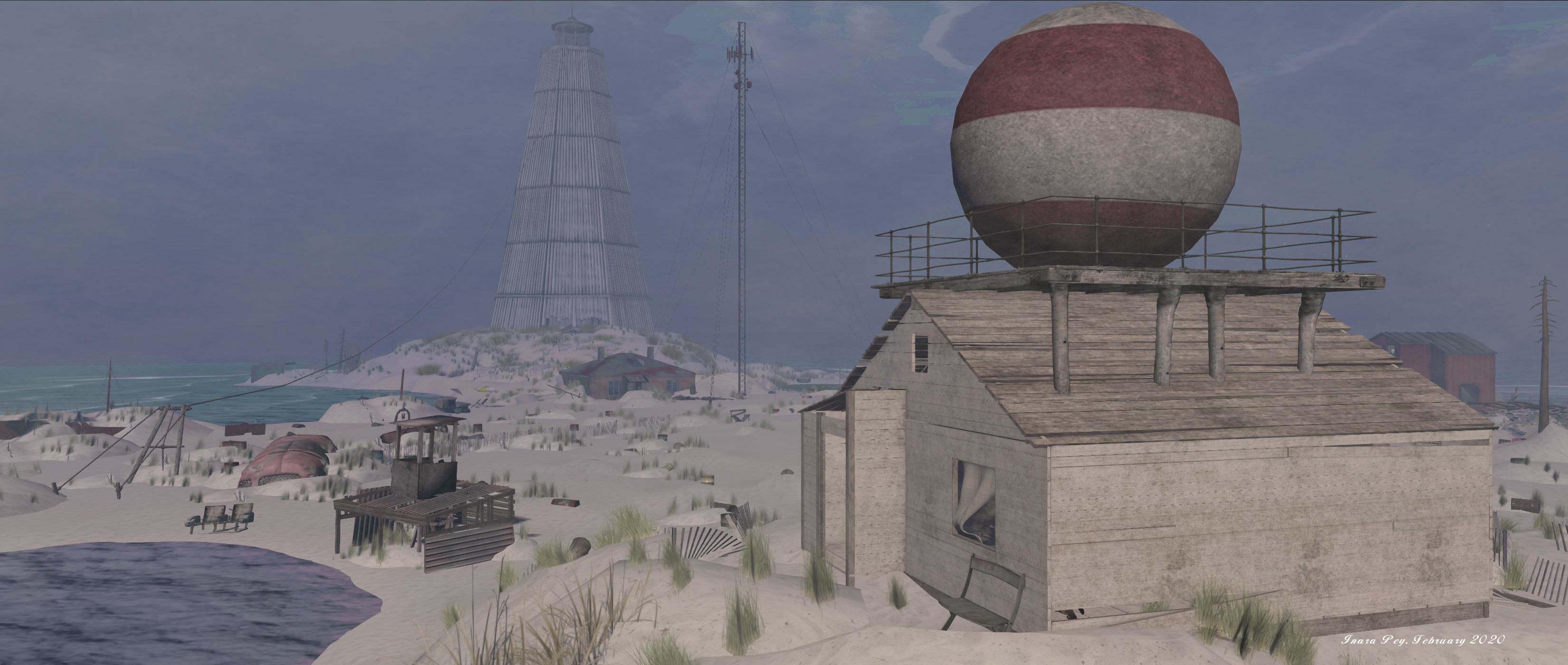
In late 2017, Serene Footman, bringer of some of the more captivating and unusual locations from around the globe, opened Khodovarikha, a Homeland region  design inspired by a spit of land extending into the shallow waters of the Pechora Sea, now regarded as the south-eastern extent of what we call the Barents Sea off of Russia’s north coast, although it bore its name as far back as when the Barents was simply called the Murmanskoye Morye  (“Sea of Murmansk”).

.

It’s a desolate, lonely place, marked by the wood-framed octagon of a lighthouse that once marked the Yugorsky Strait linking the Pechora and Kara Seas, once an important trade route and, during World War 2, the route taken by allied convoys bringing supplies and materiel to aid Stalin and his armies. Today, Khodovarikha is a largely forgotten place, most of its building falling into decline, a single, lonely weather station the only working centre. Its a place so remote, it isn’t even connected by road or rail to the rest of Russia.

Khodovarikha, February 2020

I mention this because Serene’s interpretation of Khodovarikha is once again open in Second Life for a limited period, and brings with it a new blog post on the location and his inspiration for creating it. However, this is not a mere re-establishing of a past build; rather, Serene has taken the spirit of his original build, together with some of the notable elements – the lighthouse, the weather station, etc., – to offer a new interpretation of Khodovarikha and the life of its one permanent resident – Vyacheslav Korotki, or Slava as he is known.

As Serene notes in his 2017 blog post on the original build, it was Slava’s story that first drew him to wanting to represent Khodovarikha in Second Life. Now, in this iteration of the build, we see more of that life brought into focus: the distinctive lighthouse no longer functional (as it was in the original build), reflecting the fact its namesake ceased operations in 1996. Similarly, the damaged side panels apparent in the model and perhaps seen as storm or other damage with the original build, are now explained by Serene as being the result of Slava’s assaults on the wooden frame in order to provide him with the warmth of firewood during the harsh winters. A zipline also now extends down from the lighthouse, a tribute, Serene informs us, to the sports hall that once stood at the base of the structure.

Khodovarikha, February 2020

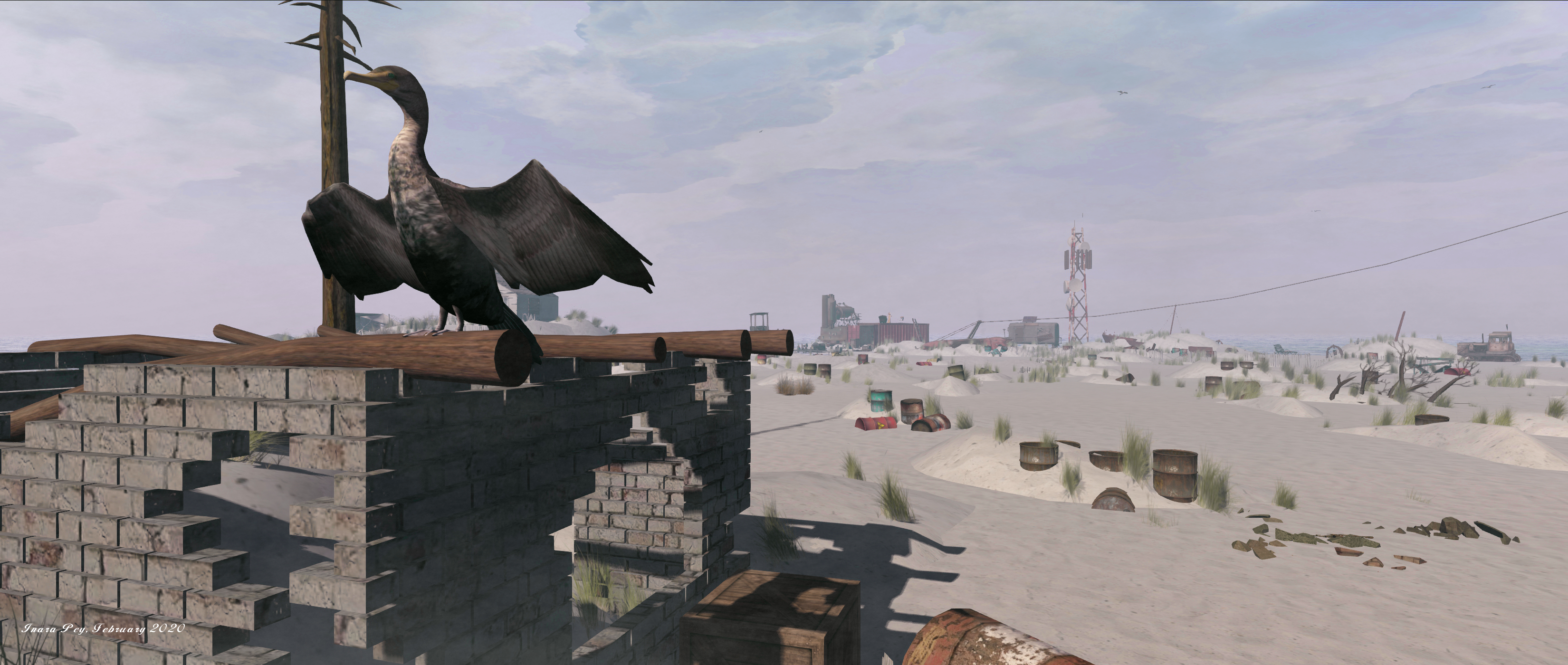
Originally set within the cold harshness of winter, the region is this time offered in the summer months. This iteration brings new life to Khodovarikha: birds are very much in evidence, while with a few tweaks with the viewer’s windlight settings, it’s possible to render the setting under bluer skies as might be seen in the summer months, and which may well life Slava’s mood and thoughts. Certainly, a drop of sunshine adds warmth and light to Slava’s lonely, red-planked home.

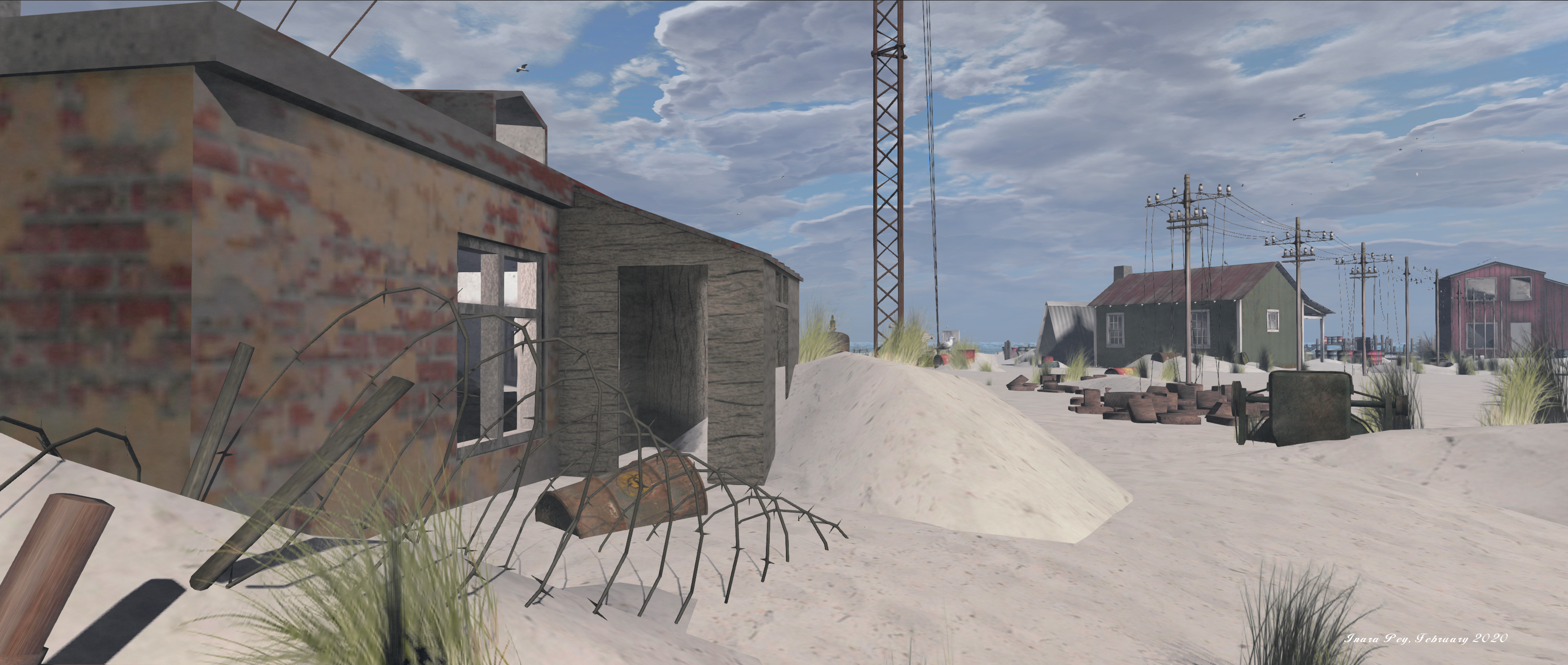
The discovery of more photographs of the area have allows Serene to commission structures reflecting those to be seen in Khodovarikha – such as the brick-built but dilapidated bungalow sitting in the lee of the great lighthouse. This is reproduced within the region courtesy of Impossibleisnotfrench, who also produced the bothy in Serene’s last region design (see: Serene Footman’s Scottish vision in Second Life, December 2019).

Khodovarikha, February 2020

As Serene notes, Khodovarikha does not have any natural beauty to it what would make it a subject for postcards, but in its deteriorating, lonely position, now all but bereft of human presence save for one man and the annual visits of the Mikhail Somov, it has a desolate, captivating beauty of its own. In bringing his vision of the location back to Second Life, Serene is allowing us to experience that isolated, decrepit beauty for ourselves, making a visit to the region – and a reading of both of Serene’s blog posts on it – an absolute must of Second Life travellers and explorers.

SLurl and Links

Lab Gab 14: SL in 2020 – don’t forget to submit your questions!

via Linden Lab

The 14th edition of Lab Gab will be live streamed on Friday, February 21st at 11:00 SLT (19:00 UK; 20:00 CET). For those who have not seen the official blog post about it, the segment will feature Ebbe Linden (aka Linden Lab CEO Ebbe Altberg) and Grumpity Linden. They will be discussing the Second Life roadmap for 2020.

As Linden Lab’s high-profile CEO, Ebbe really needs no introduction; however, as Grumpity may not be familiar to everyone, here’s a thumbnail bio.

Grumpity originally came to Linden Lab as part of the team provided by consulting and software development company, The Product Engine, which supports viewer development at the Lab. She was initially involved in the development (but not the design) of viewer 2.0, and joined the Lab full time in 2014, rising to the position of Director of Product for Second Life, a role in which she became one-third of the “troika” (as she has called it) responsible for SL’s technical and operational directions, alongside Oz Linden and Patch Linden.

In October 2019, Grumpity, Oz and Patch joined the Linden Lab management team, all three being promoted to Vice President in their respective roles.

Ebbe and Grumpity Linden

As per the official blog post, Second Life users can submit questions for the show concerning Second Life’s development roadmap and future.

So if you are curious about Name Changes, the Environment Enhancement Project (EEP), future development of the viewer, the work in transitioning to the cloud, Second Life web services such as the Marketplace, back-end services such as Group chat, concerns about fees or land tier – or anything else that is specific to Second Life, why not submit them through the Lab Gab Episode 14 Questions form? Not all the questions may be asked / answered, but if you don’t try, there’s a greater chance your question may not be asked anyway!

The programmed will be streamed via YouTube, Facebook, Mixer, or Periscope, and if all goes according to plan, I’ll have a summary of the video (and the video itself) available soon after the the broadcast, for those unable to watch live.