April Linden (Systems Engineering Manager, Operations) and Oz Linden (Senior Director, Second Life Engineering) two of this year’s participants in Meet the Lindens at SL16B. Credit: Linden Lab
Don’t forget that the week of Monday June 24th through Friday, June 28th marks this year’s Meet the Lindens sessions at SL16B.
Each day at 14:00 SLT will see one or more members of the Lab and their helpers sit down to discuss their work, Second Life, (and in one case, possibly Sansar as well), and answer questions.
As I’ve previously noted, all the events will take place in the SL16B Auditorium and will feature the following participants:
Day (14:00 – 15:00 SLT)
Participants
Monday 24th June
Patch Linden, Senior Director, Product Operations
Tuesday 25th June
Oz Linden, Senior Director, Second Life Engineering and April Linden, Systems Engineering Manager, Operations
Wednesday 26th, June
Ebbe Linden (Altberg), Linden Lab CEO
Thursday 27th June
Xiola Linden, Lead Community Manager, and Strawberry Linden, Marketing Specialist
Friday 28th June
Meet the Moles – the Linden Department of Public Works
Some of the Moles and Lindens of the Linden Department of Public Works
You can read some brief liner notes about the Lindens taking part (and the Moles!) on the official Second Life blog post reminding people of the events. In addition, I offered some brief introductions to the Lindens who will be appearing in my article SL16B: Meet the Lindens – when and who.
As I noted in that article, and as with past Meet the Linden events, I hope to record all of these sessions (or as many as I can), for a series of summary reports on the sessions, complete with audio extracts for those who may prefer to read about them, rather than watching the full video – although the latter will be appended to each summary.
Logos representative only and should not be seen as an endorsement / preference / recommendation
Updates for the week ending Sunday, June 23rd
This summary is generally published every Monday, and is a list of SL viewer / client releases (official and TPV) made during the previous week. When reading it, please note:
It is based on my Current Viewer Releases Page, a list of all Second Life viewers and clients that are in popular use (and of which I am aware), and which are recognised as adhering to the TPV Policy. This page includes comprehensive links to download pages, blog notes, release notes, etc., as well as links to any / all reviews of specific viewers / clients made within this blog.
By its nature, this summary presented here will always be in arrears, please refer to the Current Viewer Release Page for more up-to-date information.
Note that for purposes of length, TPV test viewers, preview / beta viewers / nightly builds are generally not recorded in these summaries.
Official LL Viewers
Current Release version 6.2.3.527758, formerly the Rainbow RC viewer dated June 5, promoted June 18 – NEW.
Release channel cohorts:
Bakes on Mesh RC – temporarily withdrawn due to a significant bug (the viewer remains listed on the various official viewer pages, but cannot be downloaded + attempts to run any downloaded version should force a download of the current release viewer).
Lumiya is currently unavailable through Google Play – see my article and update here. However, it remains available to new users (or can be re-purchased if urgent) via SlideMe.
Witchwood is the name give to the Full region home of the Petite Mort and Oubliette stores, both of which are owned by Melora Frost (insilvermoonlight). It’s a location I’ve been aware of for a while, the region also being the home of the RMS Titanic dance venue (a quite separate build), which has been a semi-regular destination for us for a good while.
As well as being the home of the two stores, one to the east and the other to the west, the half of the region they occupy has been landscaped by Melora to provide a place of exploration, relaxation and photography – and it is very beautifully laid out.
The landing point occupies the middle ground between the two stores: a low-lying paved area crowned by a fountain that overlooks a small lake backed against high cliffs to the north. This space, with a deck built out over the water and falls dropping from on high, can be a restful place unto itself, with swans swimming on the water from which ornate lotus lilies rise, and places to sit and enjoy the sounds of the falls and the ripples of the water. However, signs close by suggest it might also be the location for occasional flash sales, so there may be times when it is a little less restful!
Three paved paths exit the landing point, those pointing east and west, marked as they are by arches, lead the way to the stores as they sit on higher ground fronted by small formal gardens. The third points south, offering access to a cosy little beach by way of a slightly more distant arch.
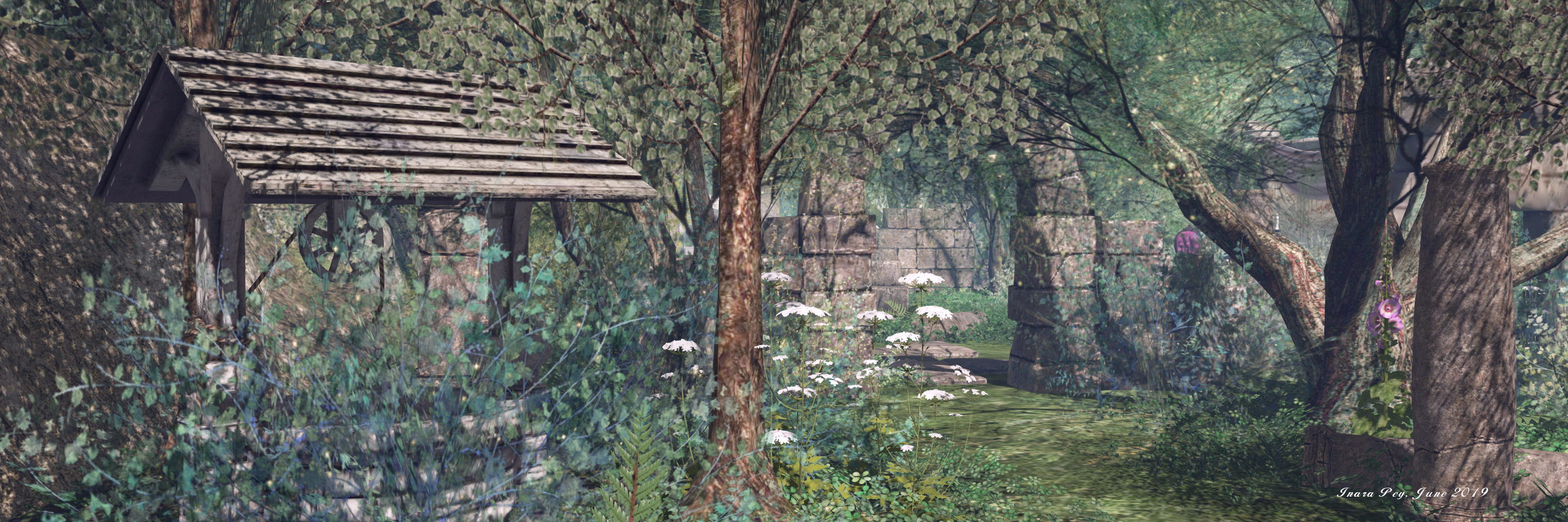
But it is the ground between the stores, sitting beneath the boughs of tress and within small glades in the mists of their green canopy, that the magic of the setting resides. Here, on one side of the path pointing to the beach, and just off the route up to Petite Mort, is a marvellous wild garden sitting among ancient ruins. Flagstones still lie in place on the ground, while ancient walls divide the space under the tall arms of trees into the suggestions of former rooms or halls.
Plants appear to grow wild here, but it is evident from the lay of the grass and the cared-for waters of the koi pond deep among the ruins, that these spaces are actually well tended, the feeling of wild growth carefully cultivated.
Within this garden are many points of interest, from the chaise lounge sitting atop an one stone stairway that perhaps once climbed much higher inside whatever building the ruins once were, the shaded soda close by, or the chaise and chair finished in imperial purple and standing guard either side of an old gramophone player in space clearly intended for photography.
Just off of the path leading to Oubliette is a slightly darker themed, but no less engaging, scene: that of an old graveyard. A single path spotted by flagstones runs between headstones, tombs and mausoleum, many lit by candles, to reach an old stone ring of arches that fold within their arms the statue of an angel.
Stone benches are placed along the path for those who wish to rest in solitude here, and I have to admit that during our visit an aged piano sitting on the path to the beach happened to be playing the adagio sostenuto from Beethoven’s evocative Moonlight Sonata, which added a certain depth to exploring here.
As well as being beautifully laid-out, there is a wonderful juxtaposition within this setting that might be easily overlooked, but which – to me at least – adds a further poetic depth to the design. Sitting below Petite Mort (“little death” (or dead, if you prefer)), are old ruins that many or may have once been a castle or fortress – places that may well once have had an oubliette (a dungeon with an opening only at the top) deep within them. Then, just below Oubliette there sits a small graveyard, a place one might say of a “little death”. Thus, the stores are cross-linked by the themes of the settings over which they respectively stand.
Captivating throughout, Witchwood offers a place to visit and appreciate in its own right, even if you are not specifically shopping there. opportunities for photography lie throughout, either using the default windlight (found within the About Land description) or by setting one of your own. For those visiting purely for the opportunity to explore and who are minded to show their appreciation for such an engaging environment, tip jars are provided in a number of places.
An artist’s impression of the Teegarden’s Star planetary system might look like when observing it from the “far side” relative to our own Sun (shown in the background and inset). Credit: University of Göttingen
Two Earth-sized planets have been found orbiting a star 12.5 light-years from our own, adding to the catalogue of exoplanets located in our own cosmic back yard.
The star in question is Teegarden’s Star, a M-type red dwarf, the most common type of star in our galaxy, and therefore the most frequent type found to have planets and planetary systems. However, Teegarden’s Star is a little different to other red dwarfs we’ve observed with or without planets. For a start, despite being only a short cosmic stone’s throw from Earth, it is incredibly dim – so dim that we didn’t even notice it until 2003. Not that that in itself is usual, it’s believed that the space around us for a distance of about 20 light years could have many dim red dwarf stars hiding within it, simply because this region of our galaxy seems to have a much lower density of such stars than we see elsewhere.
What makes Teegarden’s Star odd in this respect is that it wasn’t found as a result of a search for such nearby dim red dwarfs, but because astronomers tripped over it whilst reviewing data originally gathered in the 1990s by the Near-Earth Asteroid Tracking (NEAT) project. In fact, the star is actually named for the head of the review team, Bonnard J. Teegarden, an astrophysicist at NASA‘s Goddard Space Flight Centre. The star is also somewhat unusual in that it has a large proper motion (approximately 5 arcseconds per year), marking it as one of seven stars with such large proper motions currently known.
Observations of the star made in 2010 by the Red Optical Planet Survey (ROPS) suggested the star might have at least one planet orbiting it, but the data was insufficient to draw a definitive conclusion. However, in June 2019, and after three years of verifying their data, scientists conducting the CARMENES survey at the Calar Alto Observatory announced evidence of two Earth-mass exoplanets orbiting the star within its habitable zone.
A star and its planet moving around a common centre of mass. Credit: wikipedia / “Zhatt”
The planets were detected using the radial velocity method (aka Doppler spectroscopy), also informally referred to as the “wobble method”. Putting it simply, a star with planets doesn’t simply spin on its axis with the planets whizzing around it. Rather, the mass of the planet(s) works against the mass of the star, creating a common centre of mass which, although still inside the star, is sufficiently removed from its own centre to cause the star to effectively rolls around it (see the image on the right).
This means that when seen from Earth, there are times when the star can seem as if it is moving “away” from our telescopes, signified by its light shifting to the red end of the spectrum. Equally, there are other times when it appears to be moving “towards” us, signified by its light shifting to the blue end of the spectrum. It is by observing and measuring this visible Doppler shift that tells us there are planets present. In all, this method of stellar observation has accounted for almost one-third of all exoplanets found to date.
The key point with this method of observation is not only does it allow astronomers to locate planets orbiting other stars, it actually allows maths to be applied, allowing the number of potential planets to be discerned, their distance from their parent star and important factors such as their probable mass, which in turn allows their likely size and composition to be estimated.
In the case of Teegarden’s Star, the data indicates the two planets orbiting the star – called Teegarden’s b and Teegarden’s c respectively – have a mass of around 1.05 and 1.1 that of Earth each, suggesting they are probably around the same size as one another and comparable to Earth in size. Teegarden’s b, the innermost planet, orbits its parent every 4.9 terrestrial days, and Teegarden’s c every 11.4 terrestrial days.
An artist’s impression of the Teegarden’s Star system, as seen from “above”. Credit: University of Göttingen
The combined mass of these planets, coupled with the amount of Doppler shift exhibited by Teegarden’s Star has led to some speculation there may be other, larger planets orbiting much further out from the star. Such planets would be hard to locate because Teegarden’s Star is so dim when observed from Earth, astronomers cannot rely on the transit method – where large planets passing in front of their parent star can cause regular dips in its apparent brightness – to identify their existence.
However, what is particularly interesting about Teegarden’s b and c is their location relative to their parent, and the nature of Teegarden’s Star itself. The latter is a particularly cool and low-mass red dwarf, with just one-tenth of the Sun’s mass and a surface temperature of 2,700°C (4890°F). This means that at their respective distances, both planets are within the star’s habitable zone – and may well have atmospheres.
The two planets resemble the inner planets of our solar system. They are only slightly heavier than Earth and are located in the so-called habitable zone, where water can be present in liquid form.
– Mathias Zechmeister, University of Göttingen, Teegarden planetary team lead
This latter point – the existence of atmospheres around both planets – has yet to be proven. As noted previously in these articles, M-type stars are actually not nice places; when active (and Teegarden does seem to be well past its active stage) in their youth, they can be prone to violent irradiative outbursts which could both strip away the atmospheres of any planets orbiting them over time and irradiate the planets’ surfaces. And even if the planets do have atmospheres, their close proximity to their parent likely means they are both tidally locked with their same face towards it. This is liable to make them pretty inhospitable places and potentially prone to extremes of weather.
But there is one other interesting point to note here. While Teegarden’s Star may well be dim to the point of being practically invisible when viewed from Earth, the same isn’t true the other way around: our Sun would be a bright star in the skies over Teegarden’s b and c. What’s more, the angle of our solar system to those worlds (practically edge-on) means that if we were to imagine one of them having an intelligent, scientific race, they could easily detect the planets orbiting our Sun using the transit method of observation, and could probably deduce up to three of the innermost planets might be capable of supporting life.
Currently open through until July 20th is a celebration of pre-Christian Russia entitled Slavic Rebirth, the opening of which was intentional timed to coincide with the summer solstice. I was alerted to the event by ViktorSavior, who will also be presenting his art at the event, combined with the poetry of AlenaPit.
Occupying floating islands bearing builds by Arin Bellios that float high above Isles of Devotion, the Full region held by Djembe Dragonfire and Jay Abernathy, who have donated the space to the event free of charge, Slavic Rebirth is a multi-faceted event featuring art, music, workshops, a fashion show, and a market. The organisers describe the event thus:
This is the world BEFORE the arrival of Christianity in the Russian lands. This is paganism in its best manifestation, unity with nature and native gods. This is the strength of the spirit, purity of thoughts, the beauty of the body, the awareness of walking the right path. This is a world of fairy tales and epics. This is our ancient memory that you need to wake up and open your eyes.
There are a number of landing points associated with the event, but I’m focusing on the art gallery area here, as this is what particularly drew me to the event.
Slavic Heaven: the location alongside the gallery where music events will be held and where people can relax
Occupying a large central island that is linked to, and within eyesight of, two small event spaces, the gallery is open-air, but has a strong element of what might be regarded as classic Russian architecture which, despite the pre-Christian focus of the event, perhaps carried echoes of a church-like structure.
The art is displayed within the open arches of the tiered walls and is actually deceptive: what at first glance appears to be the works of a single artist is in fact three (or four, once Viktor’s art is added!) individual switchable displays of art: a board close to the landing point allows visitors to select which of the artists’ work is on display. Allowing for the addition of Viktor’s art, the three artists currently on display are:
Roman Papsuev (aka Amok): a contemporary Russian artist who may be known to some for his work depicting scenes and individuals from George R.R. Martin’s A Song of Ice and Fire books (note not the TV series Games of Thrones, so don’t expect images of Kit Harrington or Emily Clarke, etc). The pieces presented in Slavic Rebirth are from his collection Tales of Old Rus’, featuring line drawings presented in monochrome.
Vsevolod Borisovich Ivanov: another contemporary Russian artist inspired by the traditions and history of Russia – particularly that of medieval Russia, and pagan mythologies of old Russia. His paintings are rich in colour and content, covering a wide range of subjects: heroes, gods, creatures, architecture and the harsh beauty of old Russia.
Viktor Anatolyevich Korol’kov: a classically trained artist whose work has encompassed the history and myths of Europe (Germany, Scandinavia, Italy, Greece), Egypt, the books of the Bible and more. All of this led him to a fascination with Slavic history, art and mythology – which led him to the main thrust of his art, as seen in Slavic Rebirth, a celebration of that old history, presented here under the title Enchanted by Old Rus’.
When switching between the artists via the control board, the art on display on the two sides of the gallery will change in unison, as will the exhibition title board on display (each of which offers a profile of each of the artists. How well this might would with multiple people viewing the art might require some coordination to prevent conflicting changes, but the approach is interesting. Note, as well, that touching individual pieces of art will deliver a note card to you, offering information on the art itself.
Throughout the month of the event there will be a number of musical performances taking place at the Slavic Heaven floating island to the south of the art gallery (use the touch-to-teleport portal at that end of the gallery to reach it). These include: Italian SL singer Malesh, who will be appearing at 13:00 SLT on both Tuesday, June 25th and DJ Dalilu who will be appearing at 12:00 noon on Wednesday, June 26th.
Also to be found via the teleport arch at the north end of the art gallery (and closest to the landing point) is the Slavic market built around an ancient temple of Goddess Lada.
The final part of the event spaces for Slavic Rebirth is the Seasons Island. Offering ” all seasons of Russian nature”, this is the focus of a photo exhibition that forms part of the event – details from the event information boards – and for the Slavic Rebirth Fashion Show and Contest that will be taking place on Friday, June 28th at 12:00 noon. The theme for this is Slavic history and fairy-tales, and members of the public can participate; again, details are available at the event spaces, and there are two workshops / rehearsals for those interested in joining in: Sunday June 23rd at 10:00 (so very short notice here!) and Monday, June 24th, at 11:00 SLT.
Further activities taking place at Slavic Rebirth will, I believe, be posted through the event spaces. In the meantime, here’s the full set of SLurl for this event.
It’s time to highlight another week of storytelling in Voice by the staff and volunteers at the Seanchai Library. As always, all times SLT, and events are held at the Library’s home at Holly Kai Park, unless otherwise indicated.
A Midsummer’s Night Dream Events
One of William Shakespeare’s most popular comedies, A Midsummer Night’s Dream is a four-stranded play set within a forest inhabited by the fairy folk under the rule of Titania and Oberon. There is the over-arching theme of the forthcoming wedding of Duke Theseus of Athens and Hippolyta, the Amazon queen, due to take place within the forest. This is to be in part celebrated by a group of six amateur actors staging a play, and who have also come to the forest to prepare. Then there are the four young Athenians who are to be among the guests at the wedding: Hermia, is in love with Lysander, but has been order by Egeus, her face to wed Demetrius, who is deeply loved by Helena, Hermia’s best friend – but whom he dumped to be free to wed Hermia.
Within the forest, Oberon and Titania are somewhat estranged over Titania’s refusal to accede to Oberon’s demand to hand him her Indian changeling. Angered by her actions, Oberon summon Robin “Puck” Goodfellow, his “shrewd and knavish sprite”, with the intent of putting into motion a plan to shame Titania into doing as he wishes through the use of a magical potion. However, as the plot is put into motion, Oberon witnesses assorted actions: the cruel words of Demetrius to Helena, the assery (a deliberately chosen term in the circumstances 🙂 ) of Nick Bottom, one of the amateur players, and the plot inevitably thickens – helped in no small part by a slight case of mistaken identities, until the fairies are forced to convince those with whom they have interacted have just experienced a dream – and Puck suggests that the dream might even extend to the audience.
Seanchai Library continue to celebrate this popular comedy throughout the week with a series of special events:
Saturday, June 22nd, 19:00 The Listening Picnic
Grab a “sammich” and the hand of a friend, and come hang out in Ceilliuradh Glen to celebrate the beginning of summer with a dream or two! Broadcast will be on Stream.
Tuesday, June 25th, 19:00: Making Scenes at A Midsummer’s Night Dream
With Kayden Oconnell and friends at the A Midsummer’s Night Dream installation on LEA 2.
A Midsummer’s Night Dream, LEA 2
Wednesday, June 26th, 19:00: A Midsummer’s Night Dream – The Whole Story
With Shandon Loring at the A Midsummer’s Night Dream installation on LEA 2.
The Rest Of The Week at Seanchai Library
Sunday, June 23rd, 18:00: James and the Giant Peach
Caledonia Skytower reads Roald Dahl’s classic at the Magicland Golden Horseshoe.
Monday, June 24th 19:00: Incident at Hawk’s Hill
Gyro Muggins reads naturalist and historian Allan W. Eckert’s popular novel.
In 1870, Manitoba became the fifth province of the (then) three-year-old Canadian Confederation. Over the previous 18 months, it had seen strife and rebellion, but for William MacDonald, his wife, Esther, and their family, the lands around what would eventually become the city of Winnipeg, are ideal for farming, and so they have settled and built Hawk’s Hill.
The open spaces are perfect for the MacDonald’s four children – or should have been; while the three elder children thrived, the youngest, six-year-old Ben, became increasingly introverted.
Small for his age, Ben was reserved and prefers being with animals, learning to imitate the sounds of many, and well as copying their movements and actions. In return, the local animals seem to respond well to him – although members of his family and the other locals consider him odd.
But then came the day when Ben, in seeking new animals to mimic, wandered further than was usual, venturing into unfamiliar territory – only to become hopelessly lost. When a storm breaks, he has no option but to hide in a badger hole – an occupied badger hole. And thus begins a relationship spanning several months between young boy and a female badger, to the benefit and comfort of both.
Thursday, June 27th
19:00: Monsters and Myths: Shandon Loring continues Bernard Evslin’s words on Hecate, variously associated with crossroads, entrance-ways, light, magic, witchcraft, knowledge of herbs and poisonous plants, ghosts, necromancy, and sorcery.
21:00: Seanchai Late Night: contemporary fantasy and science fiction with Finn Zeddmore.









 Inara Pey: Living in a Modemworld