On Thursday, June 26th, 2019 at the SL16B celebrations, the fourth of five Meet the Lindens sessions was held at the SL16B Auditorium. It featured Xiola Linden, Lead Community Manager and Strawberry Linden, Marketing Content Specialist.
The SL4Live TV video of the event is embedded below, with a couple of brief biographies on Xiola and Strawberry, based on comments they made during the session and in Xiola’s case, at past events.
Xiola is the Lead Community Manager at Linden Lab. she originally came to Second Life in 2006, and joined the Lab in 2011. Her role is broad-ranging, including elements of customer support, through blogging and social media output for the Lab, to organising events such as the in-world get-togethers. For a period of time she was also responsible for community management work on Sansar, but has been back working full-time on Second Life for around 18 months. She will celebrate her eighth anniversary with the company in November 2018.
Born and raised in California’s silicon valley, she naturally immersed her career in technology, working for the likes of Yahoo!, with a particular interest in creative communities. It was a friend’s invitation that she try Second Life that got her started on the platform, and she remains active in-world on her personal account. Her engagement in the platform led to an interest in joining the Lab as an employee, so she started keeping an eye on the Lab’s career page and when a community related post to opened, she applied and was recruited.
Strawberry and Xiola Linden. Credit: Strawberry Linden
Strawberry Linden
Also known as Strawberry Singh, she is one of the more high profile lab recruits to come from the ranks of Second Life residents, thanks to her work in building her own brand – blogging, vlogging, fashion tips, tutorials, etc., – that has been hugely popular among Second Life users, particularly those with a focus / involvement on the fashion aspects of the platform.
It is her personal brand that played a role in her decision to carry her fist name over from resident to Linden in becoming Strawberry Linden – although she notes that she had advice from Patch Linden and others to keep her Linden persona separate from her personal SL persona and admits to perhaps regretting not heeding it!
As a Marketing Content Specialist, she is focused on Second Life (no involvement in Sansar), her current focus is on tutorial videos to help incoming new users, starting with the basics: signing-up, walking around in-world, etc. From here she plans to move onto more intermediate subjects and onwards to more advanced topics, covering a broad range of subjects: buying Linden dollars, editing the avatar shape, dressing, use mesh avatars and mesh heads, etc., with videos aimed at more established users, rather than being purely for newcomers.
She had no major preconceptions about working at the Lab prior to joining, but has been impacted by the degree of love staff have towards the platform. She also loves the fact she can continue with a lot of what she did as a resident: dress avatars, create looks, take photos and make videos, and hopes to be able to carry over her blog challenges to the Lab.
The following notes are taken from the Content Creation User Group (CCUG) meeting, held on Thursday, June 27th 2019 at 13:00 SLT. These meetings are chaired by Vir Linden, and agenda notes, meeting SLurl, etc, are usually available on the Content Creation User Group wiki page.
Environment Enhancement Project
Project Summary
A set of environmental enhancements allowing the environment (sky, sun, moon, clouds, water settings) to be set region or parcel level, with support for up to 7 days per cycle and sky environments set by altitude. It uses a new set of inventory assets (Sky, Water, Day), and includes the ability to use custom Sun, Moon and cloud textures. The assets can be stored in inventory and traded through the Marketplace / exchanged with others, and can additionally be used in experiences.
Due to performance issues, the initial implementation of EEP will not include certain atmospherics such as crepuscular rays (“God rays”).
A new viewer update is due to go to the Lab’s QA team over the weekend, and should surface at the start of week #27 (commencing Monday, July 1st). This should address a number of issues in the EEP code including
Water transparency rendering.
The glow seen around facial features (freckles, lips, eyelashes, and around the neck fix for mesh heads should no longer be apparent.
The difference in viewing an environment with Advanced Lighting Model (ALM) off and viewing it with ALM enabled is not as drastic.
Daytime lighting seen at sunrise, midday and sunset are much closer how they appear in the default viewer.
The request is for people testing EEP to grab the RC viewer when available and test drive it.
Bakes On Mesh
Project Summary
Extending the current avatar baking service to allow wearable textures (skins, tattoos, clothing) to be applied directly to mesh bodies as well as system avatars. This involves viewer and server-side changes, including updating the baking service to support 1024×1024 textures, but does not include normal or specular map support, as these are not part of the existing Bake Service, nor are they recognised as system wearables. Adding materials support may be considered in the future.
The Bakes on Mesh RC viewer was re-issued on Tuesday, June 25th, in the form of version 6.3.0.528495. This includes:
A new inventory icon for the “universal” wearable type.
A fix for a serious security issue type of bug.
It had been indicted at the last meeting that a required appearance service update had been made. However, this deployment did not occur until the afternoon of Thursday, June 27th.
Animesh Follow-On
Vir now has LSL functions to both set and get the visual parameters of slider-related bones in an Animesh object.
These should be enough to test the ability, so he is starting the work on getting a project viewer put together that supports the functionality.
Script Processing Issues
As I’ve noted in recent SUG summaries, there have been numerous reports of script run time issues. See BUG-226851 and BUG-227099 as examples.
There are simulator updates awaiting deployment that should provide better script performance on the “more expensive [resource-wise] scripts events”, such as sensors.
Rider Linden has been working to eliminate the overhead of idle scripts, reducing the time they need to simply work out they don’t need to process anything by 20-30%, although actual mileage once the improvements are deployed, may vary.
Rider is not promising to get script performance up to 100% per cycle (Homestead don’t end to achieve this anyway due to the number per core), but is hoping to see general improvements in processing and around those scripts that can cause unnecessary bogging down (e.g. multiple open listeners, sensors, and similar).
Viewer-side tools are to be provided (“after July”) viewing statistics on general script usage across a simulator to help diagnose local problems. These might even include / take the form of a visual indicator, such as the visual object update option (CTRL-ALT-Shift-U).
Next Meeting
Due to July 4th being a Thursday, and July 11th the Lab’s monthly All Hands meeting, the next CCUG meeting will be Thursday, July 18th, 2019.
On Wednesday, June 26th, 2019 at the SL16B celebrations, the third of five Meet the Lindens sessions was held at the SL16B Auditorium. It featured the Lab’s CEO, Ebbe Altberg, aka Ebbe Linden.
The following is a summary of the session covering the core topics raised, with audio extracts where relevant.
Discussion points have been grouped by topic, and not necessarily in the order raised during the session.
I have focused on those topics liable to be of the most interest to readers / generated the most informative answers, so this is not a summary of all comments. etc..
Topics are give as bullet-point highlights for ease of reference.
Audio extracts are provided.
These have been cleaned-up in places to remove repetition or pauses, etc.
Audio extracts may concatenate comments on specific subjects that may have been made at different points in the discussion, and so do not always match the chronology of the video.
Timestamps to the SL4Live – TV video are provided for those who would prefer to listen to Ebbe’s comments “in the raw”. This video is also embedded at the end of this article.
Note: the following is taken from both Ebbe’s comments and my own research into his background, carried out when he joined Linden Lab in 2014, and which also included input from Ebbe.
Swedish by birth and still by nationality – he is still working in the US on a green card -, Ebbe graduated fromTärnabySkidhem in 1983. His time there was focused on skiing, as he wanted to be a ski racer, with his eyes on the Swedish national team and the world cup. Unfortunately, a back injury stopped him pursuing that particular career option, and so he crossed the Atlantic to study Middlebury College, Vermont, USA.
Ebbe Linden, aka Ebbe Altberg. Credit: Strawberry Linden
Founded in 1800, Middlebury is regarded as one of the oldest liberal arts colleges in the United States. While there, he “spent a lot of time in the art studio and the computer lab in an extreme left brain / right brain type of education”, before graduating with a degree in Fine Arts and a concentration in Computer Applications.
From Middlebury, and with the clock ticking down on his visa, Ebbe “slipped into Microsoft on a random banana peel”, where he spent twelve years. Joining in the pre-Windows era, he was particularly involved with the Office products (Word, Mac Office, etc) and multimedia products.
In March 2000, he moved on to Ingenio, a company that created marketplaces for people to buy and sell information over the phone. While there he was responsible for managing the engineering, program management, operations, and quality teams, and served as the company’s interim CEO before taking on the mantle of the Chief Product Officer. And while he doesn’t often mention it due to not being a huge fan of the patent system, he “racked up quite a few patents there.”
After Ingenio, Ebbe joined Yahoo! n February 2008, filling out a number of senior roles, including Vice President, Head of Audience for the company’s EMEA division, being based in Rolle, Switzerland, managing some 180 people and multiple products across six countries. During this period he also served on the board of Yahoo! SARL (Société à responsabilité limitée) – think the equivalent of a Pvt Ltd company in the UK or a limited liability partnership in the USA, before returning to the United States to become the Senior Vice President for Media Engineering at Yahoo! with global responsibly for Media Engineering, a position that involved managing an organisation of more than 600 engineers, architects, program managers and quality engineering staff, as well as having dotted-line oversight of some 150 product managers and designers.
Linden Lab’s chairman of the Board, Jed Smith, is a long-time friend of Ebbe Altberg, and had previously tried to get Ebbe to join the company prior to his appointment as CEO in 2014. (image: Owl Ventures)
Following Yahoo!, he took up the challenge of turning around a small tech company called BranchOut, based in San Francisco. Around two years old at the time of his joining, BranchOut had been through a roller-coaster ride with its product, a Facebook oriented application designed for finding jobs, networking professionally, and recruiting employees. Seven months before Ebbe joined the company, the app boasted 25 million users across 60 countries – but by the time he came on board, the user base had shrunk to just 3 million. Under his guidance, the company pivoted the BranchOut app into a new workplace messaging application called Talk.co, launched in October 2013.
Ebbe was actually aware of Second life – and had experienced it first hand – a long time before joining Linden Lab in 2014. His son Aleks, had been heavily involved in SL, starting with the Teen Grid, making content and then moving to developing a successful in-world business there (Aleks is now an Lab Employee, working on Sansar, where he is a regular at in-world community meet-ups and product meetings).
More particularly, Ebbe has had a long-standing friendship with the Chair of the Lab’s board of directors, Jed Smith. LL was one of Smith’s first investments when he became a venture capitalist, and through Jed Ebbe gained an awareness of the Lab, its product, and met Philip Rosedale.
So I fell in love with the idea, and understood what Philip and Second Life was trying to achieve, but it wasn’t until many, many, many years later – well, five years ago now – that it came up that they were looking for someone, and it was the right time and place for both the Lab and me to hook up and see how I could help keep things going here.
I have not regretted that decision for a second, it’s been absolutely fantastic; it’s an incredible group of people I get to work with. Having the Second Life team is just an absolute privilege … Everyone is just incredibly passionate about the product … that’s just been a very, very enjoyable ride for me so far.
– Ebbe Altberg, Meet the Lindens, June 26th, 2019
The Lab’s Battery Street staff (image: Ebbe Altberg, via Twitter)
One of the greatest rewards he sees in being with the company is diversity, be it within the people working the Lab or using Second Life, or the equally rich diversity of uses people find for Second Life – be it as a means of expression or as a platform for business, as tool for health improvement or an aid education, and so on, and the multiple ways Second Life can benefit those who engage with the platform.
He is also drawn to the technical aspects of the platform, including its multiple challenges, and the way it combines so many different capabilities: tools for content creation, options for social engagement, the ability to run a virtual economy, etc., all of which combine with the need to constantly discover / learn new things about the ways in which SL is being used, to continually refresh interest in, and enthusiasm for, managing, improving and expanding the platform.
As a world Second Life has a huge diversity of uses, and there is no single “one size fits all” solution.
Has always and consistently stated a belief that virtual land in SL is too expensive [it has been a major theme from users throughout his tenure as CEO as well, and preceded his arrival at the Lab].
HOWEVER, Land fees generate the majority of the Lab’s inflow of revenue, even if it has been over-monetised by the Lab in order to meet that revenue requirement.
Therefore, if land fees are to be reduced, the Lab must find ways to move its revenue generation from virtual land to other opportunities that have previously perhaps been under-monetised in their ability to generate revenue. These include things like Premium fees and consumer-related revenue generation options.
Also feels there has been an imbalance in the way SL operates, as a merchant without any land can produce goods and sell them (via the Marketplace) without really paying for the opportunity to do so (just 5% commission on sales), and could then cash-out with very little cost to their revenue.
Unfortunately, both trying to broaden LL’s revenue generation options to decrease a reliance on land fee, and trying to correct some of the balance in where fee are obtained to help with that revenue generation, can result in some feeling hurt.
LL are attempting to be careful in how these shifts are made, as there are major risks involved (for both in-world business and the Lab itself), and so are progressing in small steps – the recent Premium and processing fee increases being the latest of those steps.
Believes there are still opportunities to further re-balance things, and to reduce land costs.
Also believes it is fair to say that while things like credit processing fees have been increased, they are still well below what might be regarded as “industry standards” for many digital transactions, which can be 30% and upwards.
Understands that the increases have impacted people, notably creators with very low margins, and who may have to make adjustments to their pricing, etc., and recognises that changes like those now implemented (as of June 24th) might make it tougher for some to survive, but believes the changes are necessary.
Points out that one of the consequences of high tier is that SL so often loses stunning public regions that have been built, and which people miss when they vanish.
Otter Lake, June 2019 – click and image for full size
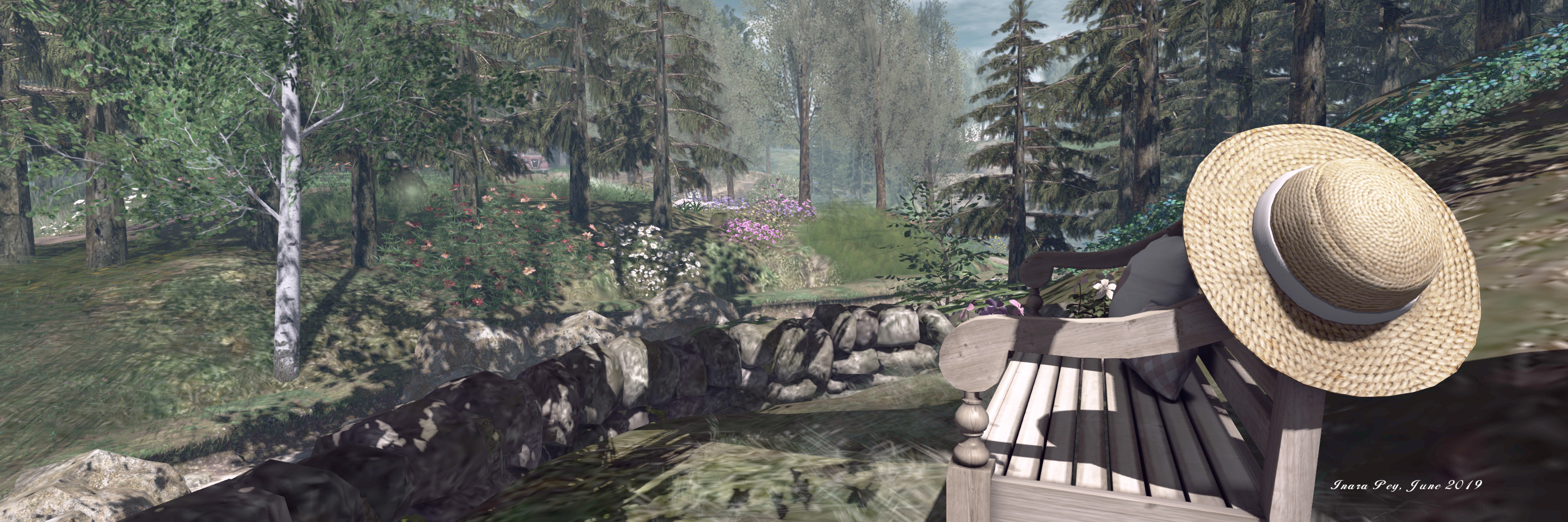
Otter Lake is one of the most alluring homestead regions we have recently visited. The work of Sharon Hinterland, this is a truly remarkable region in terms of the amount of space the region exudes, the beauty of the design, and the richness of detail. So much so that it is actually hard to believe it is only an Homestead region and thus capped with a land capacity of 5K.
Set out as a rural island sitting amidst a little archipelago, this is a place that is a sheer joy to explore. The landing point sits towards the west of the region, lying on a stretch of shingle coast bordered on one side by the estuary of a fast running channel that cuts the land in a broad arc, and overlooked by a wooden lighthouse sitting on a rocky promontory on the other.
The dock on which the landing point can be found is clearly a place where visiting boast might moor – a gas pump for refuelling them sits just back from the water’s edge, a little office just behind it. From here, visitors can walk up the hill and visit the lighthouse (be careful around some of the rocks, they can be a little “spongy”, shall we say), or follow a wooden path that curls around an old barn / garage to where it splits to either roll back down to the coast and a simple bridge of planks spanning the arcing channel, or to wind onward to become an asphalt path that twists over of the ridge coming off the back of the rocks supporting the lighthouse to drop back down into a small valley and across the little channel of water via a more substantial bridge.
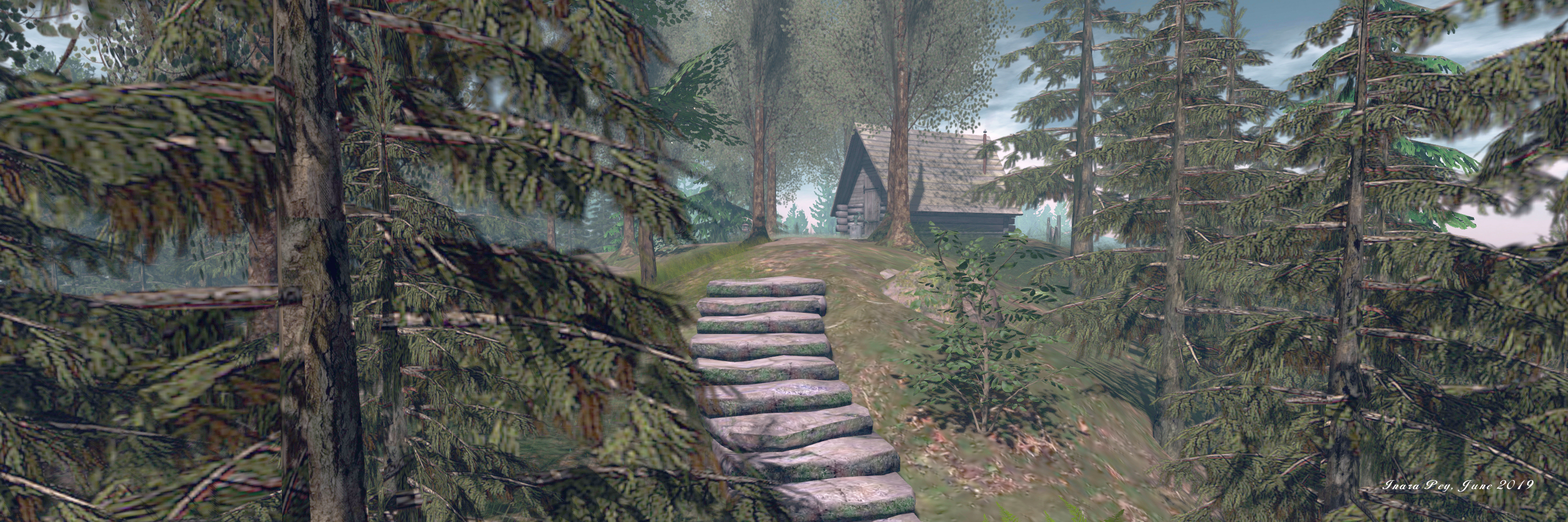
The far side of this bridge offers further choices: do you turn left and inland, to follow the raised bank of the channel, keeping to the narrow ledge the sprouts from the side of a hill? Or do you follow the log path that climbs the hill under the shade of the trees crowning it? And if you do, should you turn off from that path and descend stone steps to where smoke rises from a small cabin? Or do you continue to follow the path onwards into the lee of tall cliffs?
It is these kind of choices – and there are many across the region – that help to make a visit to Otter Lake such a joy. Paths meander, climb slopes, descend hills, curl around rocky heights or climb them along the curling or straight lines of stone steps, or point the way to where ribbons of sandy or shingle beach wrap their way around the coast. Within all of these paths is a further delight: just when you think you have seen it all, you round a corner or reach another ridge, you find yourself at another unexpected path or stairway, or a new vista opens before you, enticing you on, giving the region its feeling of expansive openness.
Across this landscape are multiple points of interest – places to sit, to cuddle, to appreciate the view, and relax. There are cabins and little houses waiting to be discovered – all of them open to exploration, as the About Land description notes. Travel to the north-west of the island and you’ll find a small working farm, sitting in the loop of a shingle beach and at the end of a dirt track.
Follow this track as it winds upwards along a gentle slope and under a rich mix of trees, and it will lead to the island’s heart, literally and visually: a marvellous lake from which a single brook tumbles its way along another channel that connects the lake to the coast by way of rocky pools and little drops over their lips, the water bubbling and splashing under bridges and across what might be little fords.
The lake forms the focal point for a stone-built cottage that looks out over the waters from a shoulder of rock, revealing the quite extraordinary garden-like setting. This features places around the rim of the lake that can be enjoyed, There’s a deck, an old rowing boat tipped on its side to form a little snug, paths and little gatherings of plants, a gazebo and, for those so minded, a raft on the lake’s waters.
The entire location is fabulously natural in design. And that’s the other attraction of Otter Lake; the entire region feels like it has been formed by nature, not created by human mind and hand. This is a place where the landscape is widely varied, rich in contrasts from shingle and sandy shores through low-lying grasslands, rolling hills to up-thrusts of rock that form plateaus and tables, all of which roll together in a perfect blend, populated by trees and bushes, grass and flowers, rounded-out by an ideal sound scape.
Nor does it end there at the lake. Across the water from the cabin, water tumbles down a high cliff-face. Follow the paths running around the bowl of the lake from the cabin – one of which will lead you past another, smaller cabin – and you’ll come to more stone steps leading the way up the slopes either side of another channel of fast-flowing water that churns its way from a pool on the crown of the island down to the falls that drop into the lake. Here sits the final treat: the pond itself and the shack of a cabin overlooking it, aged but cosy inside, and with an octagonal deck extending out to the south and west, providing a magnificent view back towards the lighthouse and the landing point.
Otter Lake really is the most exquisite design for a region. Almost perfectly formed, it is a photographer’s and explorer’s delight, a tour de force of what can be achieved within a Homestead region – and without overloading people’s systems. It is certainly a destination not to be missed and appreciated. When visiting, do please consider making a donation towards, the region’s continue existence (there’s a piggy bank at the landing point!
On Tuesday, June 254th, 2019 at the SL16B celebrations, the second of five Meet the Lindens sessions was held in the SL16B Auditorium. It featured the Lab’s Senior Director, Second Life Engineering, Oz Linden and April Linden, Systems Engineering Manager, Operations.
The following is a summary of the session covering the core topics raised, with audio extracts where relevant.
Note that there are three videos of this event that I’m aware of:
Discussion points have been grouped by topic, and not necessarily in the order raised during the session.
I have focused on those topics liable to be of the most interest to readers / generated the most informative answers, so this is not a summary of all comments. etc.,
Topics are give as bullet-point highlights for ease of reference.
Audio extracts are provided.
These have been cleaned-up in places to remove repetition or pauses, etc.
Audio extracts may concatenate comments on specific subjects that may have been made at different points in the discussion, and so do not always match the chronology of the video.
Timestamps to the part 2 of the SL4Live – TV video are provided for those who would prefer to listen to comments “in the raw”. This video is also embedded at the end of this article.
About April and Oz Linden
April Linden
April has some 20 years of experience in systems engineering, and is genuinely passionate about Second Life. She first became involved in the platform in 2006, and is still extremely active as a resident.
I actually own a couple of regions, and I’m in-world probably way more as a resident than I am as a Linden. At the end of the day, I leave the Lab, go home, have some dinner and then log-in as a different account and spend my time in Second Life.
– April Linden, Meet the Lindens, June 25th, 2019
In this, April is one of a large number – in difference to the hoary old claim that “Lindens don’t understand SL” because they’ve “never been residents” or they’re “never in-world” – of Lab employees who have joined the company from the ranks of SL users (in fact if you look at the list of those Lindens who have attended Meet the Lindens over the years, the many are former residents who have not only joined the company, but have also risen to senior positions within LL.
Joining the company in 2013, April worked within the systems engineering team, and was promoted to her current position of Systems Engineering Manager, Operations, some 18 months ago. For her, the great attraction of the platform has been, and remains, the empowerment it gives people to express themselves positively.
I come from a background – well, I’ll just be frank, where LGBT issues were not to be discussed, and it was through Second Life that gave me the power and the anonymity and the courage, really, to learn more about myself. And Second Life gave me the power to make my life so much better … This platform is so important to me, I work here to keep it going; It gave me the courage to be more than I was, and I really appreciate Second Life for that.
– April Linden, Meet the Lindens, June 25th, 2019
The bunny and the wizard who bring us Second Life: April Linden (Systems Engineering Manager, Operations) and Oz Linden (Senior Director, Second Life Engineering). Credit; Strawberry Linden
Oz Linden
Oz is the Technical Director for Second Life. He joined the company in 2010 specifically to take on the role of managing the open-source aspects of the Second Life viewer and managing the relationship with third-party viewers. In his previous role, he had been responsible for leading the company his was working for in taking their product from closed-source to open-source and then managing the technical side of the product as a open-source project for a number of years.
Over the first two years of his time at the Lab, he was primarily focused on the open-source viewer work and in refining the overall viewer maintenance process, before his role started expanding to encompass more and more of the engineering side of Second Life. When work on Sansar started in earnest, he pro-actively campaigned within the Lab for the role he has now, with responsibility for managing all of the engineering side of the Second Life platform.
He came to Linden Lab out of a desire to do something “fun” after working in the telecommunication arena, notably with voice over IP systems (VOIP), which he defines as being “really interesting technology with some really fascinating challenges”, but in terms of it being fun, it really didn’t do what I wanted it to do.” He had actually signed-up to Second Life around three years prior to joining Linden Lab, but wouldn’t classify himself as a resident at that time as he didn’t have a particularly good computer and so couldn’t really do that much – although interestingly, he did use his SL account for around half of his interviews with the Lab, all of which were conducted in-world.
He classifies the attraction to working with Second Life as perhaps falling into three core areas: through the open-source nature of the viewer, he is directly involved with how SL users are using the viewer and what they do with it – which can often times take the Lab entirely by surprise; through the fact that the Second Life offers the challenge of trying to implement new technologies alongside of (rather than simply replacing) older technologies; and working with the operations team and others to ensure SL constantly evolves without (as far as is possible) breaking anything – a process he refers to and rebuilding the railway in front of a moving train.
Induction at the Lab is referred to as “drinking from the fire hose”, in that all new starters have an enormous amount to learn (although those who come from the ranks of residents may have it a little easier due to their familiarity with the platform as users).
Part of this used to include a series of Jira-based tasks new starters would be given, which they then had to come in-world and do.
Most employees at the Lab refer to it as a “fun” place to work – and most are there a long time.
One of the appeals of working with Second Life is that it is a constant surprise: users make use of the platform and its capabilities in so many (often unique / unintended) ways, that seeing / hearing about how the platform is used is something of a daily voyage of discovery.
Most rewarding aspects of the work:
Hearing about the positive impact Second Life can have on people’s physical lives.
Being able to run the platform and help / be with users.
Most challenging:
Oz: trying to introduce new features while maintaining backward compatibility, be it the way a function used to work, how it’s anticipated SL should work, how SL looks, or making it harder for people on older systems to use SL, and how user content works within SL.
April: trying to keep all of the SL services (not just the simulators, they are just a part of the story) running without interruption, be it from issues developing internally, or for outside influences such as DDoS attacks.
This complexity is increased at SL has continued to grow technically over 16+ years, so systems and subsystems can all behave differently to one another, which means root causes of issues can often be found in unlikely places.
Given SL is intended to run 24/7, it is not as if those working in the Ops team today can take a system down, figure out how it works and put it back together – they often have to do that as a part of trying to fix an issue.
Much of the work April’s team carries out is invisible to users: they are often in and fixing issues before the problems rise to the point of impacting users.
As a resident, April believes it’s important for users to understand what has happened when things go sideways, hence her honest (and appreciated) post-mortem blog posts on outages.
One of the most eagerly-awaited changes that is in the works – indeed, has been in the works for a long time (my last significant update on the subject was over a years ago!) is that of the “return of last names”.
During the Meet the Lindens event featuring Oz Linden, the Lab’s Senior Director, Second Life Engineering and April Linden, Systems Engineering Manager, Operations for Second Life, the subject inevitably came up, with Oz and April both explaining why the process of implementing the capability is taking so long, and addressing questions on the subject (some of which have been asked in the past as well).
While I will have a summary of the entire Meet the Lindens session with Oz and April available shortly, I thought it might be easier for people to reference the project via an individual update, to follow-on from the one I provided in March 2018 (see The return of Second Life Last Names – update with audio).
The first thing to point out, although it has been stated in the past, is that this capability is not just about avatar LAST names – it includes the ability for users to continue to select their own first name – and to be able to change both that name and their last name as they wish (and according to their willingness to pay whatever fee will be applied to the service.
But why is it taking so long to implement? In March 2018, Oz indicated the Lab hoped to have the feature ready by the end of that year – and we’re already six months beyond that.
Well, the answer is – as with a lot of things within Second Life – pretty complicated, and goes to the very heart of how the platform and its systems were originally created and have been seen throughout their lifespan, as Oz explained:
[Bringing back] Last names would have been pretty easy. In fact, we still do last names; it’s just that we give everyone the same last name … The hard part is allowing you to change your name … Every part of Second Life, absolutely everything, was built with the assumption that your name can never change. And that means that lots of things that can be treated as cached, and [that] the cache never needs to be cleaned-up and updated [now have to change], and we have to go back and find that assumption everywhere in Second Life; and that’s a lot of code…
You would have thought it was based on a [avatar] key, but it wasn’t always, and the trick is that while maybe it was not maybe the best way to be doing it – to be saving names in different places – it always worked, because names could never change.
– Oz Linden describing the major issue with offering changeable avatar names
Oz and April went on to note that this work is still going on, but is taking a lot longer than have been anticipated. It is also something that is complicated as it means that all these points were the avatar’s name may be used and / or cached, now not only must have the “name never changes” assumption removed – they actually have to each be hooked up to some mechanism that can track name changes (e.g. through association with the avatar key) to make sure the correct name is always surfaced where it is seen by users.
You can listen to Oz’s full explanation below.
Oz also went over some ground previously covered about the name avatar naming options, and which may well be familiar to many, but are again given here for completeness and for those who may not have followed that project closely:
First name selection will be free-form (pick any first name you like (within the bounds of LL’s ToS and the SL Community Standards).
Last names:
Will be selectable from a pre-set list. This list will change on some basis (TBD).
It may be possible for users to offer suggestions for new last names.
Currently, it is not planned to make previously used last names (e.g. Pey, Sideways, Starr, Rubble, etc.) available for re-use.
Users will, however, be able to change back to one of their own past names, if they wish.
Combinations of first name and last name must be completely unique (i.e. never used previously in Second Life). They will have a maximum of 31 characters each.
The ability to change your name will likely be via a new page available through your secondlife.com account dashboard.
The event also saw a number of questions asked on last names. These are again summarised bellow and answers are supplied in the audio file (with questions relayed by Patch Linden):
Will incoming users be able to pick a last name when they are signing-up? – No, they probably will not. Incoming new users will continue to have “Resident” as a default last name.
This is because picking a last name was found to be a major blocker to users signing-up.
Incoming new users will, however, be able to change their name(s) like everyone else, once they are in Second Life.
Why is there a charge being applied to name changes? – Mainly to discourage people from frequently changing their names. These changes will have a impact right across the SL services, and this needs to be managed, and the Lab would prefer not to impose artificial limits (e.g. “you can only change one a month”), if possible.
Will friends of people who change their name be notified, or will they have to discover this for themselves? – Hasn’t been addressed, but potentially no reason why friends shouldn’t be notified.
Will people who change their names remain on a friends list? Yes; this is one of the systems the Lab has to parse through to make sure things behave as expected.
Will name changes be reflected in everything (the name of creators of object rezzed in-world, the owners’ names, etc)?
That is the goal, and again why it is taking so much time to get this feature to a point where it works as would be expected and then deployed.
However, there will likely be a some delays on seeing name changes, simply because they need to propagate and cached across multiple services.
How much will it cost to change names? – This will probably be one of the last things to be decided, as it only needs to be done when the capability is ready for deployment.
For those who prefer to listen to Oz and April’s comments as given directly during their Meet the Linden session, they can be found on the SL4live TV recording of the event at the following time stamps:
[28:20-32:35] Initial comments on the complexity of implementing the capability and what it will offer.
[38:04-47:59] Q&A with Patch Linden handling audience questions.







 Inara Pey: Living in a Modemworld