Space Sunday: Venus, Pluto, and a mini round-up

This cylindrical map of Venus reveals the planet’s hostile surface beneath the clouds, a place of volcanoes and vast volcanic plains with few impact craters. The latter demonstrates both how volcanism has played a roll in “smoothing over” the surface of Venus in the past, and how effectively the dense atmosphere acts as a shield in burning-up incoming space debris. Credit: NASA

Once regarded as a planet that may harbour life, Venus – as we know it today – is a hellish place. Cursed with a runaway greenhouse effect, the surface temperatures (averaging 735 Kelvin or 462°C / 863°F) are hot enough to melt lead and mark it was the hottest planetary body in the solar system. The atmosphere is both a toxic cauldron so dense that it exerts a surface pressure 92 times greater than our own – the equivalent of being 900 m (3,000 ft) under water on Earth.

Venus is also unusual in other ways: it has a retrograde rotation (it spins on its axis in the opposite direction to Earth and most of the other planets), and it takes 243 terrestrial days to complete one rotation but only takes 224.7 days to complete an orbit of the Sun, making a “day” on Venus longer than a year.

Despite its hostile conditions, it has long been believed that Venus was at one time in its ancient past a far more hospitable world, potentially warm a wet, and spinning a lot faster on its axis (quite possibly in the same direction as the Earth spins). However, at some point  – so the accepted theories go – Venus experienced a massive impact, one sufficient enough to slow – and even reverse – its rotation and which also left it the broiling, hostile world we know today.

An artist’s impression of how Venus might have appeared some 2.5 – 3 billion years ago, at a time when a globe-spanning ocean might have started to affect the planet’s rotation, slowing it and eventually giving rise to the planet’s runaway greenhouse effect. Credit: NASA

However, a new study involving the University of Bangor, Wales, the University of Washington and NASA, suggests not only did Venus once had a liquid water ocean, but that ocean may have actually been the catalyst that brought about the planet’s dramatic change.

To put it simply, tides act as a brake on a planet’s rotation because of the friction generated between tidal currents and the sea floor. On Earth, this results in the length of a day being shortened by about 20 seconds every million years. Given this. the team responsible for the  study investigated how such interactions might impact Venus. Using a numerical tidal model, the accepted belief that Venus once had a world-girdling ocean, and applying it to planetary rotational periods ranging from 243 to 64 sidereal Earth days, they calculated the tidal dissipation rates and associated tidal torque that would result from each variation in ocean depth and rotational period. Their work revealed that ocean tides on Venus would likely have been enough to slow the planet’s rotation it down by up to 72 terrestrial days every million years.

This might not sound a lot, but of the course of around 10-50 million years, it would have been enough to slow Venus’s rotation and bring it to how we see it today. In turn, this slowing of rotation would have accelerated the evaporation of an ocean waters on the sunward facing side of the planet, both increasing the atmospheric density and trapping more heat within the atmosphere, accelerating the planet’s greenhouse effect, in turn increasing the rate of ocean evaporation in what would have been a closed cycle. Add to that the planet’s known volcanism, and the team estimate that it would have taken around 100-120 million years to turn Venus into the planet we see today.

This work shows how important tides can be to remodel the rotation of a planet, even if that ocean only exists for a few 100 million years, and how key the tides are for making a planet habitable.

– study co-lead Dr. Mattias Green, University of Bangor

The study findings have potentially important implications for the study of extra solar planets, where many “Venus-like” worlds have already been found. From this work, astronomers have a model that could be applied to exoplanets located near the inner edge of their circumstellar habitable zones, helping to determine whether they might have at some point potentially have had liquid water oceans, and how those oceans may have affected their development.

Fly Your Name to Mars

Mid July through August 2020 will see NASA’s next rover mission launched to Mars, and as with a lot of their recent exploratory missions, NASA is giving members of the public the opportunity to have their names flown with the vehicle.

Between now and September 30th, 2019, NASA is inviting one million members of the public to submit their names and postal codes to Send Your Name (Mars 2020). These names will then be laser-etched onto a little chip roughly the size of a penny that will be mounted on the rover and carried to Mars. In return, successful applicants obtain a “boarding pass” similar to the one shown below, indicating their name will be flown on the mission.

My Mars 2020 boarding pass

The Mars 2020 rover is based on the same chassis and power system as used by the Mars Science Laboratory Curiosity rover. It will also use the same type of landing system, featuring a rocket-powered “skycrane” that will hover a few metres above the surface of Mars and then winch the rover down to the surface. However – and for the first time in the history of planetary exploration – Mars 2020 will have the ability to accurately re-target its landing point prior to committing to lower the rover, thus allowing it to avoid last-minute obstructions that might otherwise damage the rover or put it at risk.

Core to this capability is a instrument called the Lander Vision System (LVS), which has been undergoing tests in California’s Death Valley attached to a helicopter. LVS is designed to gather data on the terrain the lander is descending towards, analyse it to identify potential hazards and then feed the information to a guidance system called Terrain-Relative Navigation (TRN), which can then steer the landing system away from hazards, allowing the skycrane to winch the rover to the ground in a (hopefully) a safe location.

The Mars 2020 rover’s LVS under test in Death Valley, California, mounted on the front of a helicopter. Credit: NASA/JPL

Mars 2020 is due to be launched between July 17th and August 5th 2020 to arrive on Mars at Jezero Crater on February 18th, 2021.

Continue reading “Space Sunday: Venus, Pluto, and a mini round-up”
Submarines, invisible cats and podcasts in Second Life

Seanchai Library

It’s time to highlight another week of storytelling in Voice by the staff and volunteers at the Seanchai Library. As always, all times SLT, and events are held at the Library’s home at Holly Kai Park, unless otherwise indicated.

Sunday, May 26th, 13:30: Tea-Time at Baker Street

Tea-time at Baker Street returns and opens the covers of His Last Bow.

A 1917 anthology of previously published Sherlock Holmes stories by Sir Arthur Conan Doyle, the volume originally comprised seven stories published by The Strand Magazine between 1908 and 1917. However, later editions of the book saw an eighth story included, The Adventure of the Cardboard Box, originally published in 1892. This week sees Holmes and Watson engaged upon The Adventure of the Bruce-Partington Plans.

Despite his frequent appearances in various television series depicting the life and times of Sherlock Holmes, Mycroft Holmes only appears, or is mentioned, in just four of Conan Dyole’s tales, this being one of them – actually the one which marked his final appearance in the original canon.

The adventure starts when Mycroft visits Holmes about missing submarine plans and a dead man. The latter is Arthur Cadogan West, formerly a young clerk in a government office at the Woolwich Royal Arsenal, who was found dead next to the London Underground tracks near Aldgate tube station, his head apparently crushed by a passing train. The plans for the Bruce-Partington submarine were found on his body – with three pages missing. Mycroft’s concern is that they’ve been taken by enemies of the Crown.

Not only is there the mystery of the missing pages for the submarine plans, there is much about Arthur Cadogan West’s death which does not add-up; why, for example, was he carrying top-secret plans about his person while apparently due to visit the theatre with his fiancée? Why is there no Underground ticket about his body? Did he manage to travel the service without a ticket, or did someone take it? If the latter, why?

Holmes responds to his brother’s request for help on behalf of the British government – noting to Watson along the way that Mycroft actually is the British government – and thus the adventure begins.

With Da5id Abbot, Elrik Merlin, Kayden Oconnell, and Caledonia Skytower.

Monday, May 27th 19:00: Paper Mage

Gyro Muggins concludes Leah R. Cutter’s 2003 début novel.

Set in the Tang Dynasty of the Middle Kingdom (about the time of Charlemagne in Europe), the novel tells us of the adventures of Xiao Yen, a young woman training to become a paper mage, a sorcerer with the power to endow folded creations with the semblance of life.

Because her gifts are in demand for the protection they can offer, Xiao Yen must leave behind her beloved family and their village home and embark on a dangerous mission when she is hired to protect a caravan. Yet even as she departs, she has no idea that this looming adventure will shape the very woman she is to become.

The story follows two timelines, alternating chapters between the caravan journey, where one of her fellow travellers is a goddess who charges her with a dangerous quest, and the story of her childhood training, when she lay caught between her aunt’s plans and her mother’s plans to have her married off.

Tuesday, May 28th  19:00: Crenshaw

In her first novel after winning the Newbery Medal, Katherine Applegate delivers an unforgettable and magical story about family, friendship, and resilience.

Jackson’s parents are in serious financial trouble; their stressful circumstances are taking a toll on Jackson. Mum and dad remain cheerful and upbeat, putting on a happy face for their kids, but Jackson is not fooled. He knows times are bad and, whether he likes it or not, Crenshaw the giant cat is here to help him through the worst of it.

Crenshaw is not only very large, he’s both outspoken and imaginary. He has come back into Jackson’s life to help him. But is an imaginary feline enough to save Jackson and his family from losing everything?

Author Katherine Applegate proves in unexpected ways that friends matter, whether real or imaginary.

With Caledonia Skytower.

Wednesday, May 29th 19:00: 14 Years of 100-word Stories

Story writer, story-teller, commentator, raconteur – Crap Mariner is all of these, and more. On May 31st, 2005, after being inspired by both a friend and Woody Allen to write 100-word stories  – or “dabbles” – Crap created the 100-word Story podcast, promising to write a story a day until the day he dies.

Fourteen years on, Crap is still writing  – and still reading his stories in what is quite probably the longest-running daily podcast of original material in the world.

Seanchai Library is therefore delighted to host the 14th anniversary of the 100-word story podcast, with Crap reading more of his stories, which will cover a wide range of topics, just like his podcasts. There might even be a George the Pirate story or two 🙂 .

Thursday, May 30th

19:00: Thor The Mighty Adapted by Elizabeth Rudnick

Asgard’s greatest warrior, the mighty Thor, has vowed to protect the mortals of Earth with his legendary hammer Mjolnireven from his trickster brother, Loki!

With Shandon Loring. (Also in Kitely grid.kitely.com:8002:SEANCHAI).

21:00: Seanchai Late Night

Contemporary Sci-Fi Fantasy from such on-line ‘zines as Lightspeed, Escape Pod and Clakesworld. With Finn Zeddmore.

Offering Atonement in Second Life

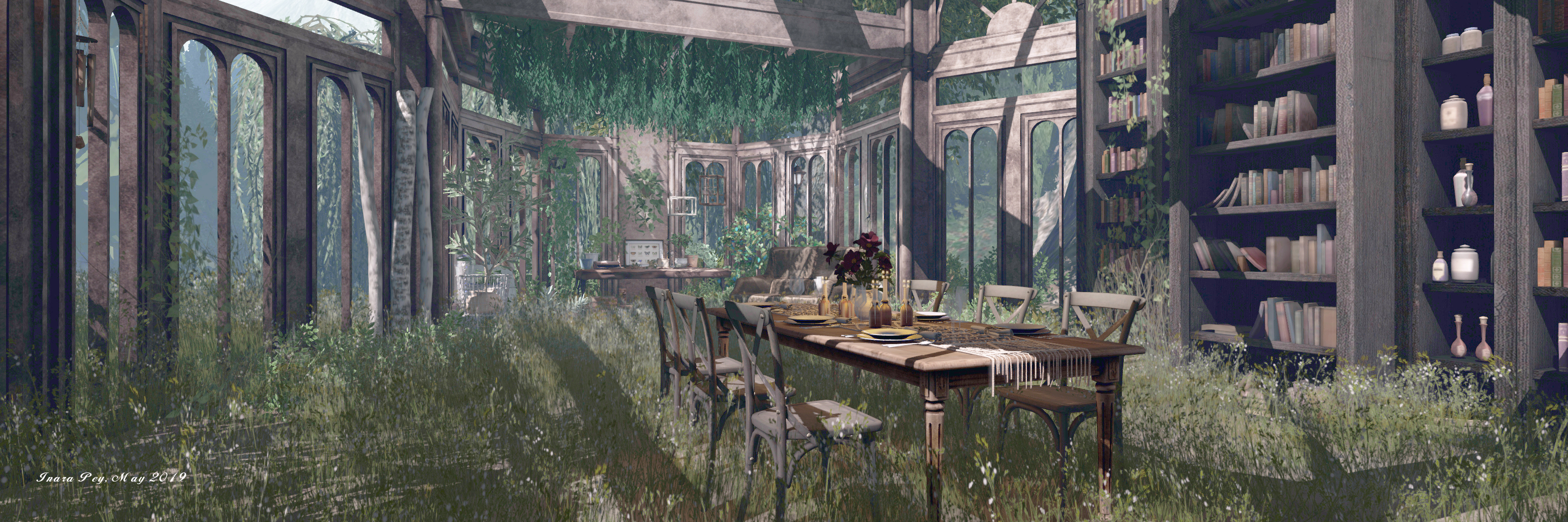
Atonement; Inara Pey, May 2019, on FlickrAtonement – click any image for full size

Update, August 20th: Atonement has closed and the region cleared. SLurls in this article have therefore been removed.

Occupying the full private island aptly named Canyon Creek, and making use of the additional full region land capacity bonus, Atonement is a relatively new – and utterly stunning – rental / public region.

We were pointed towards it by a number of friends, including MorganaCarter, Miro Collas and Shawn Shakespeare – and our thanks to everyone who did so.

Atonement; Inara Pey, May 2019, on FlickrAtonement

Designed by Aiden Caudron and Zomborg Vollmar, the region comes with an intriguing description:

An overgrown forest sim that has been abandoned overtime leaving homes buried between thick brush and twisted vines. You can find residential properties scattered around the sim with enhanced privacy provided by mother nature. Hidden caves leading to special destinations within the sim. Blogger friendly.

Atonement; Inara Pey, May 2019, on FlickrAtonement

This is a region that is perhaps best not described as experienced. Represented a mountainous region, far off in the wilds, it’s easy to imagine coming across Atonement in the Rockies of North America, and its elevated setting is given an added sense of depth through the careful positioning of region landscaping and sim surround, such that from most viewing angles within the region, the two appear to blend seamlessly together in to whole as the mountains rise beyond the tree line.

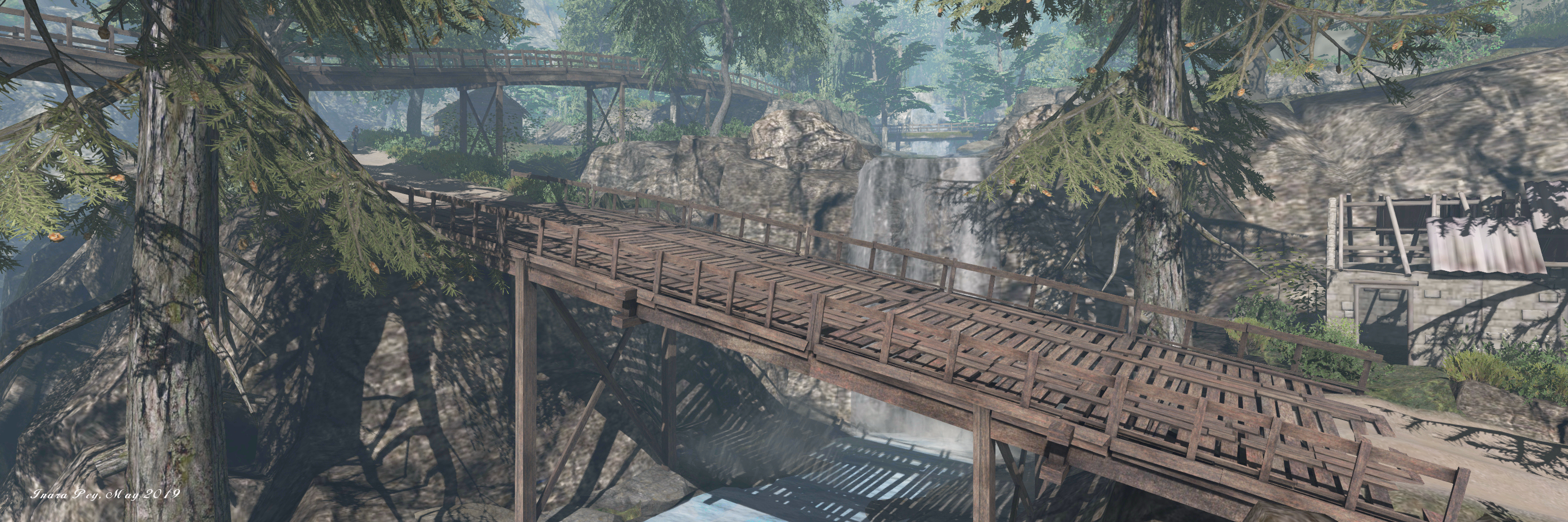
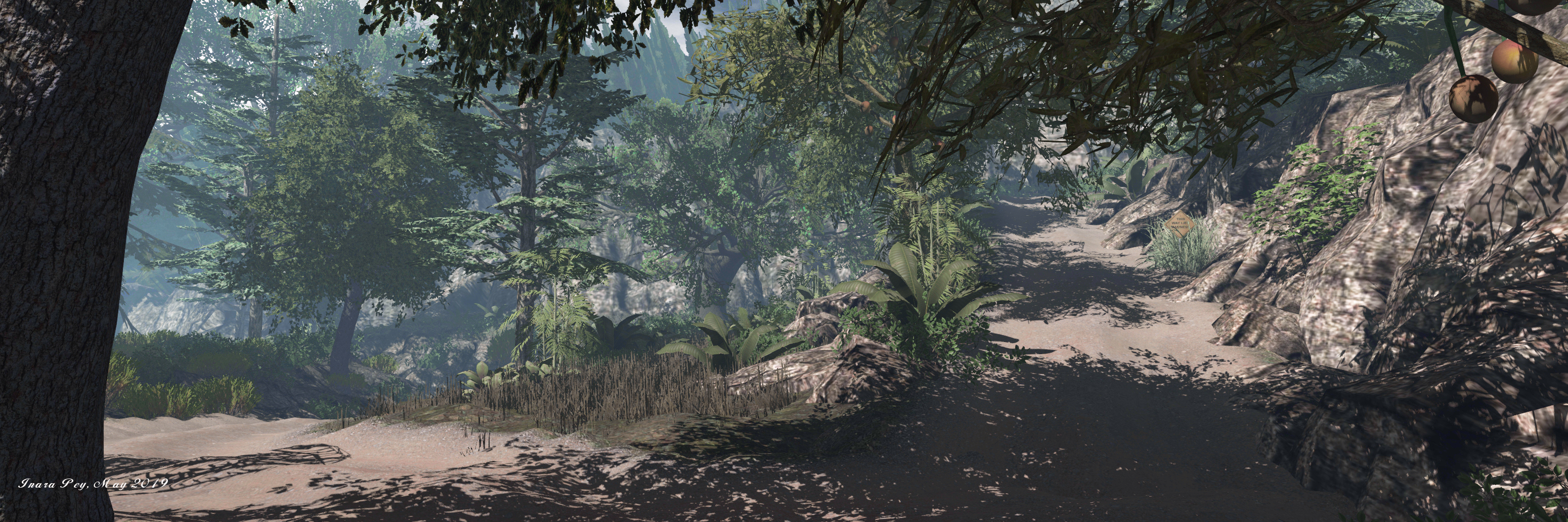
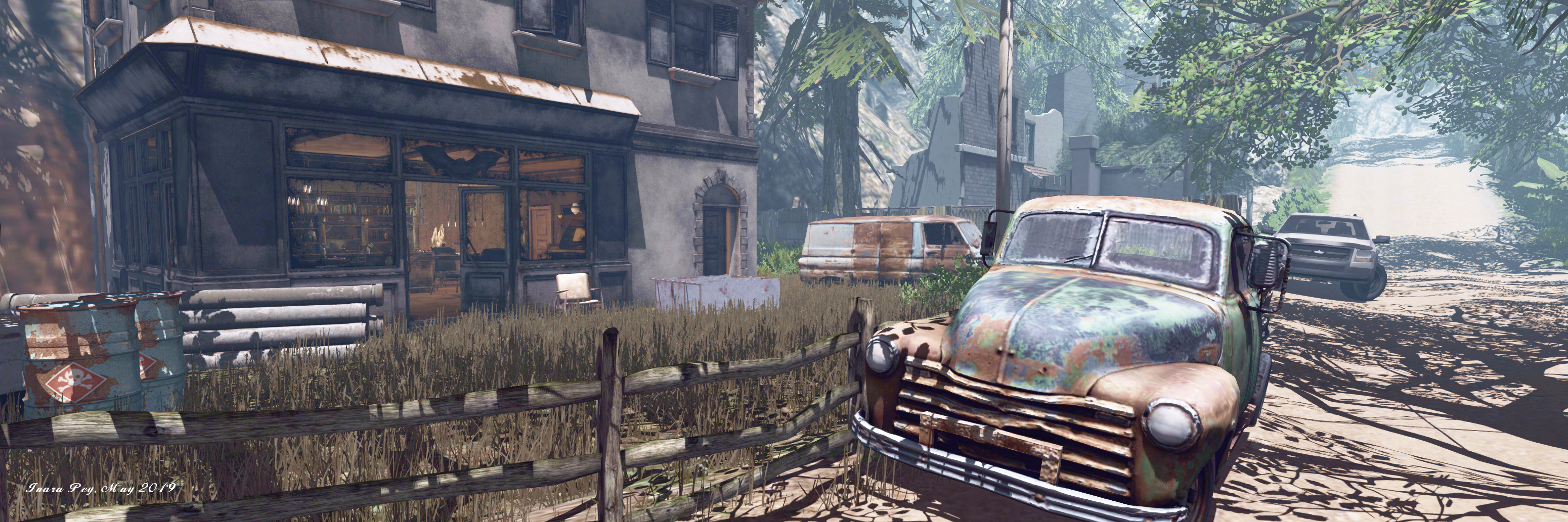
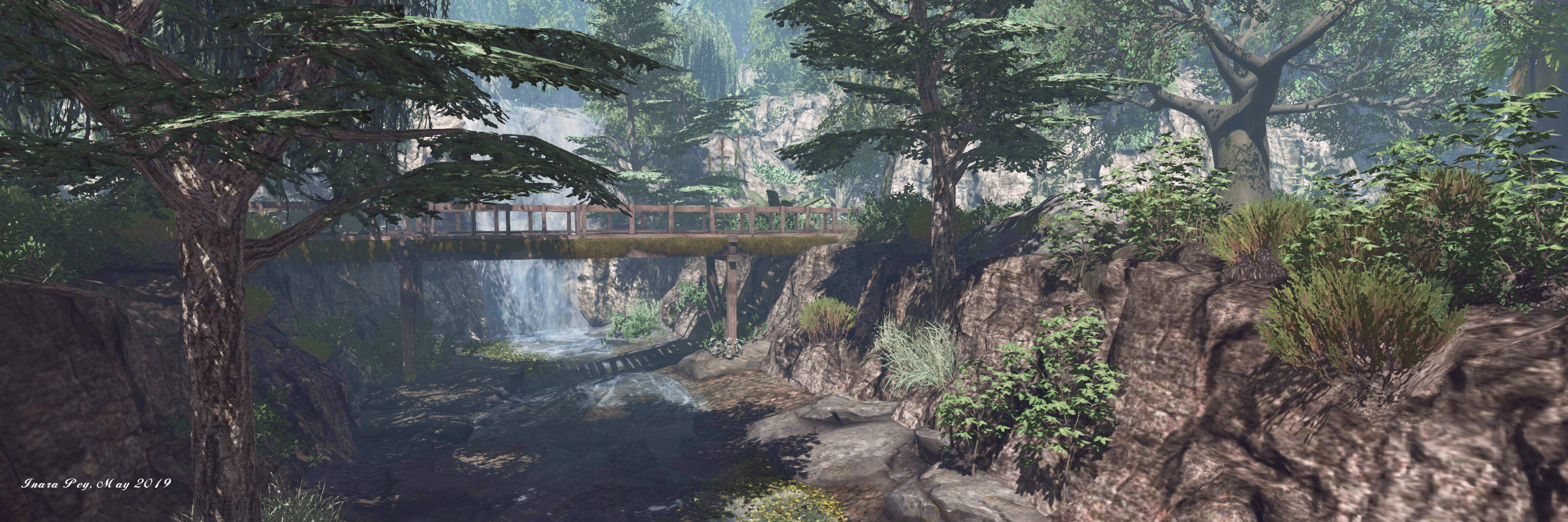
Falling from east to west in a series of tiers, a single narrow gorge, feed by tumbling falls and fast-flowing waters, the region is as the description states: richly forested and with a feeling of abandonment. The road winding through it is unpaved, footpaths are bare rock, the grass tall and wild where trees aren’t casting their shadows. Throughout all this are houses and buildings that have all seen better days, the bridges offering links between roads and paths looking as though they could perhaps benefit from a little TLC.

Atonement; Inara Pey, May 2019, on FlickrAtonement

Many of the houses are available for rent – so exploring with care is advised to avoid accidental trespass should any be occupied at the time of a visit. Elsewhere – such as the local pub – which most certainly has seen better days – there are twists of whimsy and humour that when discovered, are an unexpected delight.

Perfectly photogenic, the region’s mystique is given further depth by the question of why it should be here. Why locate a small town so deep in the rocky wilds? Perhaps the answer lies within the network of tunnels and caverns awaiting discovery  – be sure to accept your torch at the landing point. While appearing entirely natural, there is a hint that perhaps they might have once been worked, perhaps for mining gold or silver or something else equally enticing to the hands and pockets of humans.

Atonement; Inara Pey, May 2019, on FlickrAtonement

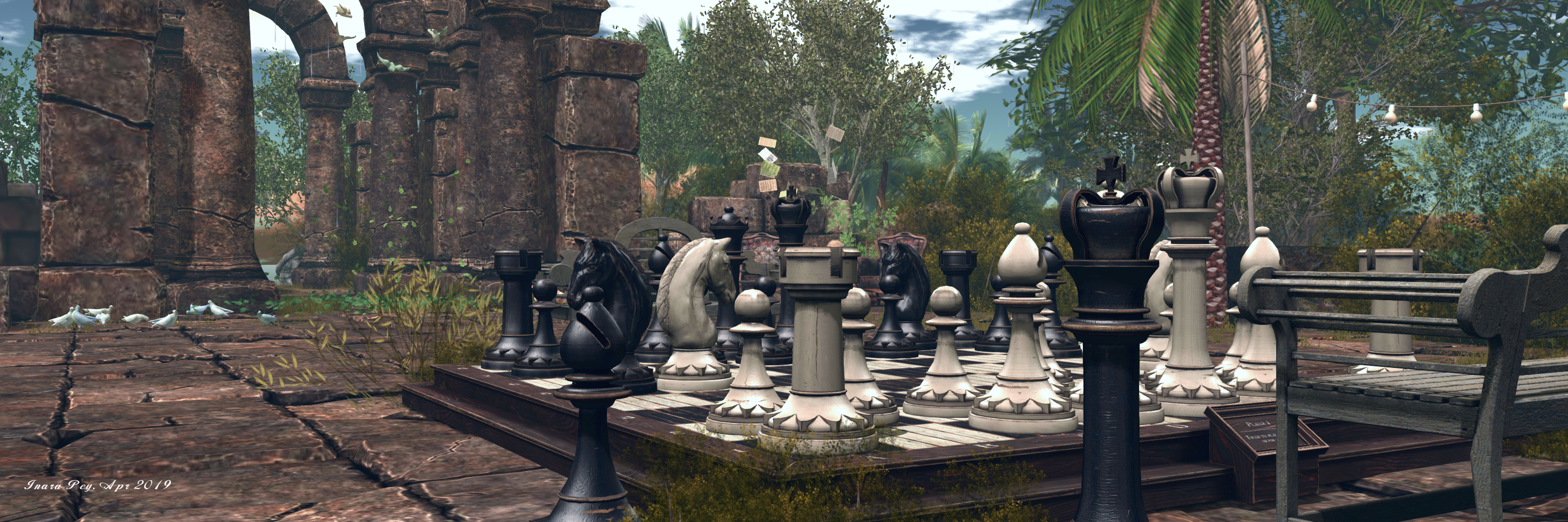
Although to be found throughout the region are places t be enjoyed when visiting, such as the rusting metal carcass of an old observatory far up at what is effectively the region’s peak: a table of rock that the old conservatory shares with a radio mast. Within the old frame can be found a cosy setting that is both at odd with, yet complimentary to, the overgrown interior of the old building. Elsewhere, those who explore far enough might find a games room / clubhouse, and there’s also the aforementioned pub.

Beautifully conceived and executed, Atonement can be a little taxing on systems if you’re running with a lot of the viewer’s bells and whistles active. however, it more than counters for this with its detail, unique approach and highly photogenic nature.

Atonement; Inara Pey, May 2019, on FlickrAtonement

Love at Artful Expressions in Second Life

Artful Expressions: Kazrakk

Love is the title of the latest exhibition of photography to go on display at Sorcha Sanvean’s (Sorcha Tyles’) boutique-style Artful Expressions Gallery. Featuring the work of Australian photographer Kazrakk,  the exhibition present six engaging pieces that offer insight into the many facets of the love between two people.

Featuring Kazrakk and his SL partner, Ninna, as the subjects in all six images, Love also might be seen as offering a window into their own relationship. There is something very personal about each of the photographs within this selection that embraces tenderness and lover – but which does not, by any measure leave the viewer feeling discomfited by thoughts of being a voyeur; even the images featuring near full-body nudity have a tenderness and grace within them that imbues of a feeling of sharing, rather than that of intrusion.

Artful Expressions: Kazrakk

Presented in both colour and monochrome, there are pieces that perfectly showcase Kazrakk’s ability to frame a moment in time, each picture captivating in both style and in narrative. There is a richness with each piece, whether it is focused solely on the avatars themselves, as three of the pieces are; or whether it offers a broader canvas, where the background plays a role in setting the tone of the narrative (the two here using Norderney and Chochou’s Memento Mori to marvellous effect); or whether it is an expression of pure artistic styling that offers a unique perspective on love and attraction, as seen in the first piece in the series, simply referred to as nr. 1.

Love is a small exhibition, true, but it is also one that leaves you wanting to see more of Kazrakk’s work, and this can be done by visiting his Flickr photostream. Now set within its new mainland home, Artful Expressions once again offers an alluring and engaging exhibit.

SLurl Details

SL16B music festival auditions applications are open

On Wednesday, May 22nd, 2019, Linden Lab issued an invitation to live music performers to apply to be a part of the Second Life 16th Birthday celebration’s Music Festival.

2019 marks the fifth such festival the Lab has organised. It will be held as a part of the official Second Life Birthday celebration, taking place in mid-June 2018.

Xiola Linden explains things further in the official blog post:

We’re holding an audition showcase to highlight some of the musical talent in the Second Life community. Many of you have been performing for years in virtual venues all over the grid, and we’d love to have you come showcase your talent. All genres are welcome! From bands to solo acts, rock and roll to electronica – we encourage anyone to sign up for consideration.

The Second Life Music Faire is an opportunity to perform at one of the biggest celebrations in Second Life and will be held on June 21st and 22nd this year from 10 am until 4 pm SLT.

All Residents are welcome to participate in the auditions as audience members. Again, I can’t stress enough what a great time it is to see so many musicians perform and support one another!

Those interested in taking part are invited to complete the audition application form – and to do so no later than Saturday, June 1st. The blog post notes that completion of the application does not signify a commitment on the part of the artist to take part, nor a guarantee they’ll be called upon to audition before a panel of judges comprising Lab personnel and residents.

Musicians who are selected to audition will receive word directly from the Lab via e-mail. Those successful in their 5-minute audition, as judged by a panel of Lab staff and residents, will be invited to perform a 30-minute set at the Second Life Music Fest.

For those who are interested, the audition location will be shared in a future official blog post from the Lab. subject to applications, showcase dates and times are currently planned as follows:

  • Monday, May 27th through Thursday, May 30th: 06:00 SLT through 18:00 SLT.
  • Friday, May 31st: 06:00 SLT through 15:00 SLT
  • Monday, June 3rd through Thursday June 6th: 06:00 SLT through 18:00 SLT.
  • Friday, June 7th: 06:00 SLT to 15:00 SLT.

Other SL16B Applications

Please note that applications for Exhibitors and Performers at SL16B and applications for the SL16B shopping event have been extended as follows:

2019 SL User Groups 21/2: Content Creation summary

NOLA @ Fairhaven; Inara Pey, April 2019, on FlickrNOLA @ Fairhavenblog post

The following notes are taken from the Content Creation User Group (CCUG) meeting, held on Thursday, May 23rd 2019 at 13:00 SLT. These meetings are chaired by Vir Linden, and agenda notes, meeting SLurl, etc, are usually available on the Content Creation User Group wiki page.

Bakes On Mesh

Project Summary

Extending the current avatar baking service to allow wearable textures (skins, tattoos, clothing) to be applied directly to mesh bodies as well as system avatars. This involves viewer and server-side changes, including updating the baking service to support 1024×1024 textures, but does not include normal or specular map support, as these are not part of the existing Bake Service, nor are they recognised as system wearables. Adding materials support may be considered in the future.

Resources

Current Status

  • The Appearance Service change, designed to correctly handle tattoo layer with partial transparency has now passed QA. This corrects a problem where if a tattoo with partial transparency is sent for baking via the new BOM channels without any underlying opaque layer, then the alphas are not correctly resolved.
  • A required simulator change should be deployed “soon”. This includes a means of accessing BOM UUIDs.
    • These were changed in the last back-end update as a result of underlying asset property issues. If there is BOM content using the old UUIDs, this will have to be updated.
    • The simulator update is intended to allow access to the texture UUIDs without having to do so numerically, as is currently the case. This should re-enable the ability to access them via their name abbreviations.
  • The Bakes on Mesh RC viewer updated to version 6.2.3.527418, dated May 23rd.
  • A new bug has been uncovered by the Lab, but at the time of writing, it was unclear if this was related to the Appearance Service or the viewer.

Environment Enhancement Project

Project Summary

A set of environmental enhancements allowing the environment (sky, sun, moon, clouds, water settings) to be set region or parcel level, with support for up to 7 days per cycle and sky environments set by altitude. It uses a new set of inventory assets (Sky, Water, Day),  and includes the ability to use custom Sun, Moon and cloud textures. The assets can be stored in inventory and traded through the Marketplace / exchanged with others, and can additionally be used in experiences.

Due to performance issues, the initial implementation of EEP will not include certain atmospherics such as crepuscular rays (“God rays”).

Resources

Current Status

  • Graham Linden continues to work on the remaining shader / graphics issues.

Animesh Follow-On

  • Vir continues to work on adding visual parameter support to allow shape adjustments to be made to Animesh.
  • This work has new reached a point where shape updates can be requested, and the messages sent to viewers able to see the Animesh, which then update to display the correct shape.
  • However, there is an issue: the Appearance Service code to set an avatar’s vertical position (and hopefully keep the avatar’s feet on the ground) doesn’t recognise Animesh objects. This therefore needs to be either extended to support Animesh, or emulated purely within the viewer
    • Vir is working to try to emulate the capability within the viewer, but in doing so has uncovered some confusing elements in the way the current code works, which needs to be addressed.
  • It is still likely to be at least two more weeks before the work is suitable to be made available in the project viewer.

In Brief

  • The Teranino viewer, version 6.2.3.527418, introduced  change in how vehicle region crossings are handled.
    • There is now a debug setting that stops movement interpolation by the viewer while the data is passed between regions.
    • How long the pause lasts can be adjusted (the default is 1.00  – which I assume is 1 second, while I assume 0 is no stop.
    • However, there are reports that  if a vehicle is turning or banking, while forward motion stops, the rotation imparts as result of the turn / bank continues (see BUG-226937).
  • There are a couple of viewers in progress that feature open-source contributions. One of these is for profiles behaviour, and the other is related to improvements to the mesh uploader (which I assume is Beq Janus’ excellent work as found in Firestorm).
  • Pivot points with mesh uploads: there has been some viewer-side work to support this, but the work is on hold pending the availability of a resource to work on the required simulator support.
  • Changing animations priorities on-the-fly: this has been a frequent request in the past, intended to allow users to adjust animation priorities rather than having them set at upload.
    • However, the priority assignment capability is deeply baked into the way SL operates, and re-working it to allow on-the-fly changes is seen as a none-trivial project.
    • It is also seen as just one element of the animation system requiring complete overhaul (e.g. there is a need for a pre-load animation capability, a global synch capability, etc.).
    • Any such overhaul brings with it further complications in that it could touch upon the IK system, as such animation system work is not something LL are currently considering, although they have taken a number of Jira feature requests on the subject.