Fran Swenson (Fran Seranade) and her daughter Barbara Richard (Barbi Alchemi) – image courtesy of San Diego Union-Tribune / Bill Wechter
On March 7th, 2019, I sadly wrote about the passing of one of Second Life’s most recognised residents, Fran Seranade (Fran Swenson in the physical world).
Fran, a Parkinson’s Disease sufferer, came to prominence in Second Life and in the media due to the remarkable positive effect her involvement in the platform had on her condition. I had the privilege to write about Fran’s story far back in 2013 in Of Parkinson’s, Second Life and a story worth reading, after coming across an on-line article by the San Diego Union-Tribune. Her situation became both the focal point of studies into the benefits of virtual worlds on a variety of physical and mental conditions, and was the trigger for Fran’s daughter, Barbara Richards (Barbie Alchemi in-world), with the help of her brother (AlmostThere Inventor in SL), to establish Creations for Parkinson’s, designed to raise funds to support the work of The Michael J. Fox Foundation for Parkinson’s Research and to provide an in-world meeting place for those stricken by the illness and those seeking a sense of community and support.
Event schedule
At the time of Fran’s passing, it was noted that an in-world memorial event for her was being planned – and this has now growth into a celebration of Fran’s life and times, which will take place throughout Saturday, May 11th, 2019.
Commencing at 11:00 SLT and running through until 21:00 SLT at the Savoy Ballroom in Creations Park, the event will feature the voices and talents of some of Second Life’s best-known performers, many of whom knew Fran directly, by both performing at her 90th birthday celebrations two years ago, and in performing in support of Creations for Parkinson’s events.
As with all events at Creations Park, the celebration will present people with the opportunity to show their support for the work of the MJF Foundation by offering donations to Team Fox, the official fund-raising arm of the Foundation.
Those who cannot attend the event, but who would like to commemorate Fran’s life and the work of Team Fox / the MJF Foundation can do so by donating through any of the kiosks at Creations Park or by visiting the following web page:
In addition, and planned to be available by June 1st, 2019, a memorial honouring Fran and this celebration will be established at the Savoy Swing Era Museum, and will be available online at SavoyBallroom.org/fran.
The following notes are taken from the Content Creation User Group (CCUG) meeting, held on Thursday, May 9th 2019 at 13:00 SLT. These meetings are chaired by Vir Linden, and agenda notes, meeting SLurl, etc, are usually available on the Content Creation User Group wiki page.
Environment Enhancement Project
Project Summary
A set of environmental enhancements allowing the environment (sky, sun, moon, clouds, water settings) to be set region or parcel level, with support for up to 7 days per cycle and sky environments set by altitude. It uses a new set of inventory assets (Sky, Water, Day), and includes the ability to use custom Sun, Moon and cloud textures. The assets can be stored in inventory and traded through the Marketplace / exchanged with others, and can additionally be used in experiences.
Due to performance issues, the initial implementation of EEP will not include certain atmospherics such as crepuscular rays (“God rays”).
The next viewer RC update is “close”. This should:
Include a batch of shader updates that will hopefully improve things “considerably”.
Be merged to the current LL release viewer (version 6.2.1.526845 at the time of writing, promoted May 7th).
An issue of late has been that of new bugs popping up as existing ones are dealt with.
A recently noticed issue has been with day cycles – cloud scrolling across the sky will suddenly “hiccup” slightly in their motion, rather than scrolling smoothly throughout.
Animesh Follow-On
Vir continues to work on adding shape support (or similar) to Animesh, specifically on the infrastructure requirements for being able to send slider parameters for Animesh objects to and from the viewer.
No decision has as yet been made to whether to offer full body shape support or to use individual parameters, but the underpinning infrastructure requirements for both are more-or-less the same.
The focus is therefore on developing the infrastructure (messaging, etc), to a point where both can be tested as a decision made on the basis of that testing.
Bakes On Mesh
Project Summary
Extending the current avatar baking service to allow wearable textures (skins, tattoos, clothing) to be applied directly to mesh bodies as well as system avatars. This involves viewer and server-side changes, including updating the baking service to support 1024×1024 textures, but does not include normal or specular map support, as these are not part of the existing Bake Service, nor are they recognised as system wearables. Adding materials support may be considered in the future.
There is a simulator change pending. This includes a means of accessing BOM UUIDs.
These were changed in the last back-end update as a result of underlying asset property issues. If there is BOM content using the old UUIDs, this will have to be updated.
The simulator update is intended to allow access to the texture UUIDs without having to do so numerically, as is currently the case. This should re-enable the ability to access them via their name abbreviations.
There is also a further Appearance Service change pending, deigned to correctly handle tattoo layer with partial transparency (currently, if a tattoo with partial transparency is sent for baking via the new BOM channels without any underlying opaque layer, then the alphas are not correctly resolved). This is with the Lab’s QA team.
There are no BOM-specific updates pending to the RC viewer, but this will, as per the Lab’s viewer release policy, be updated to maintain parity with the latest release version of the viewer (6.2.1.526845) at the time of writing.
Given the overall status of BOM and EEP, it would appear likely that BOM could be promoted ahead of EEP as a released project and viewer.
We were directed towards aZiLe by Shakespeare, who dropped a landmark over to me recently. Occupying the bulk of a Full region (a corner parcel to the south-east is a separate private residence), it is a multi-faceted environment predominantly designed by Zoé (zoeliah), with assistance from Boro Moretto (boromir22) – within additional elements I’ll get to – that is a little hard to define.
With its mix of public and private residential units, the region might at first seem to be your typical rental estate – but to view it as such would be a mistake. The region also has an Adult rating and a D/s leaning – but to view it as a D/s role-play environment would also be a mistake. There is also a strong arts flavour to the setting that offers a further twist of curiosity to it.
Perhaps the easiest way to define aZiLe is to quote region holder Boro:
We wanted to create a space for relaxation in a welcoming setting of beach and holidays. The design is by Zoé, our architect and gardener whose design you will be able to appreciate by touring the sim. It is incidentally a residential space. If you would to live here, contact Zoé for parcel availability, and she will build your house on the beach in the spirit of the region.
aZiLe is above all a friendly space with freedom and a little note of madness because we like lightness and humour. And this offbeat touch gives the people who live here their group name: zinzins. We have no rules, except for common sense and courtesy between adults.
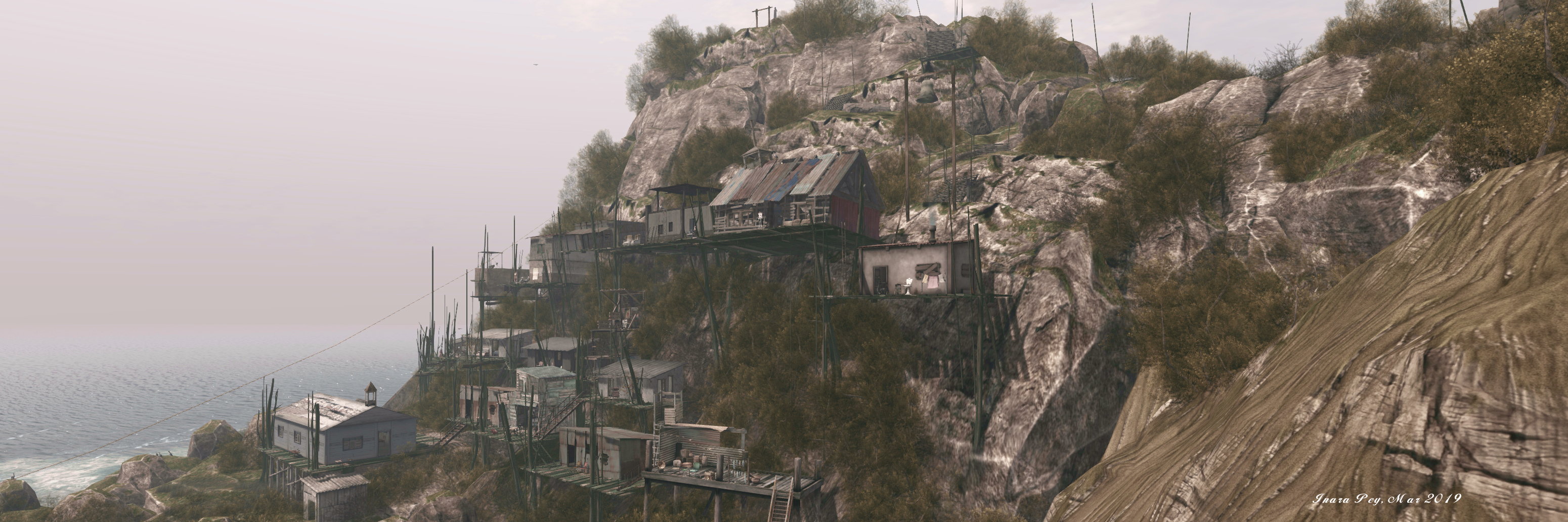
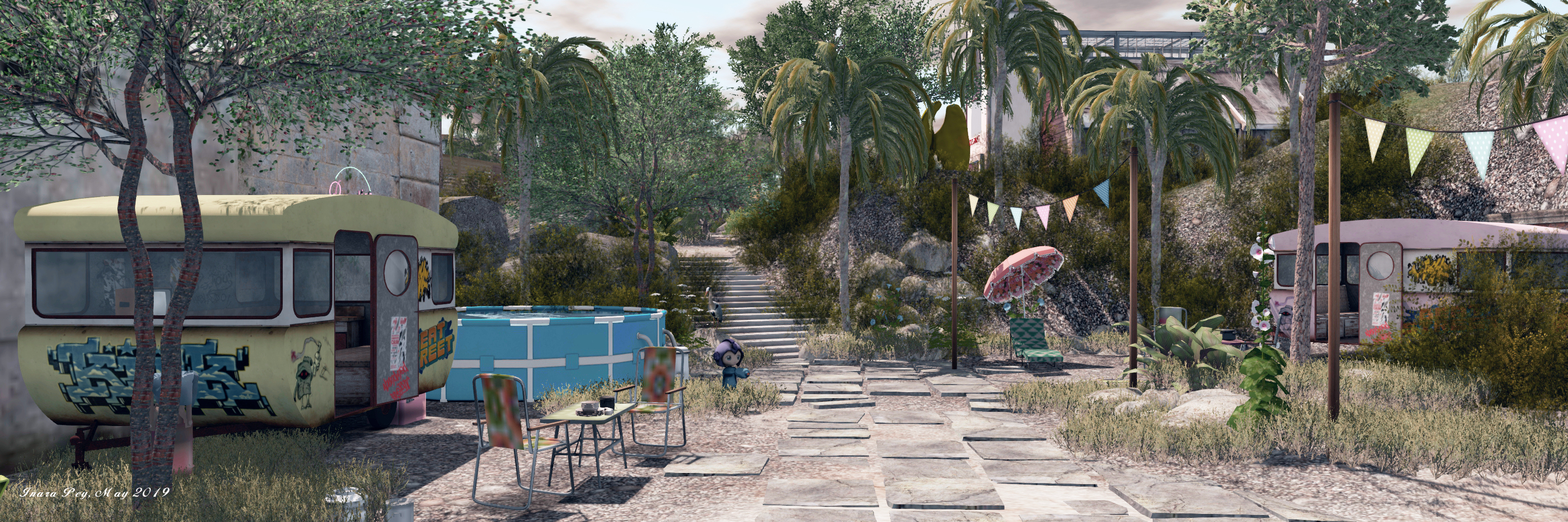
To describe the setting would be a little self-defeating; it is unique enough to deserve to be seen for itself. While “beach and holidays” might be suggestive of sands, surf, palm trees and shady parasols, this is most assuredly not aZiLe. Instead, the region has a certain “shabby chic” run-down look to it that is quite captivating.
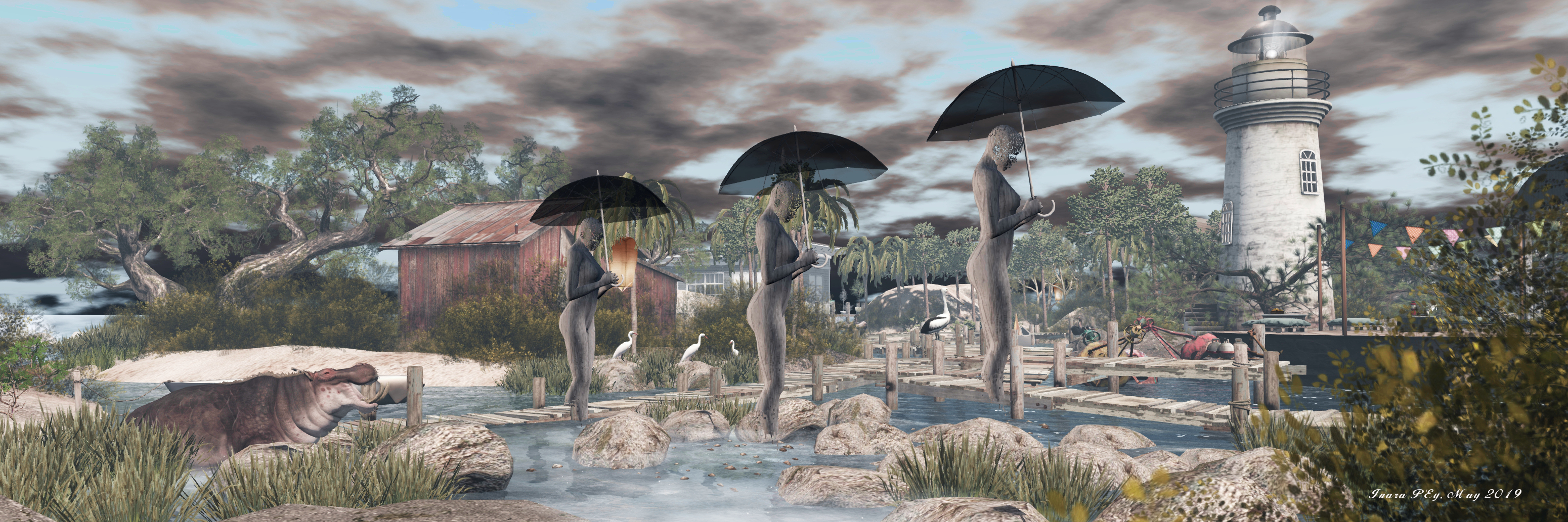
The landing point sits just off-centre within the region, looking out over a small beach that has something of the appearance of a holiday setting – albeit it a possible low-cost one. The sand flows down to a small bay where inflatables sit on the water and flamingos strut under the umbrella of trees and palms while a bar sits on one shore, offering a place to sit and relax.
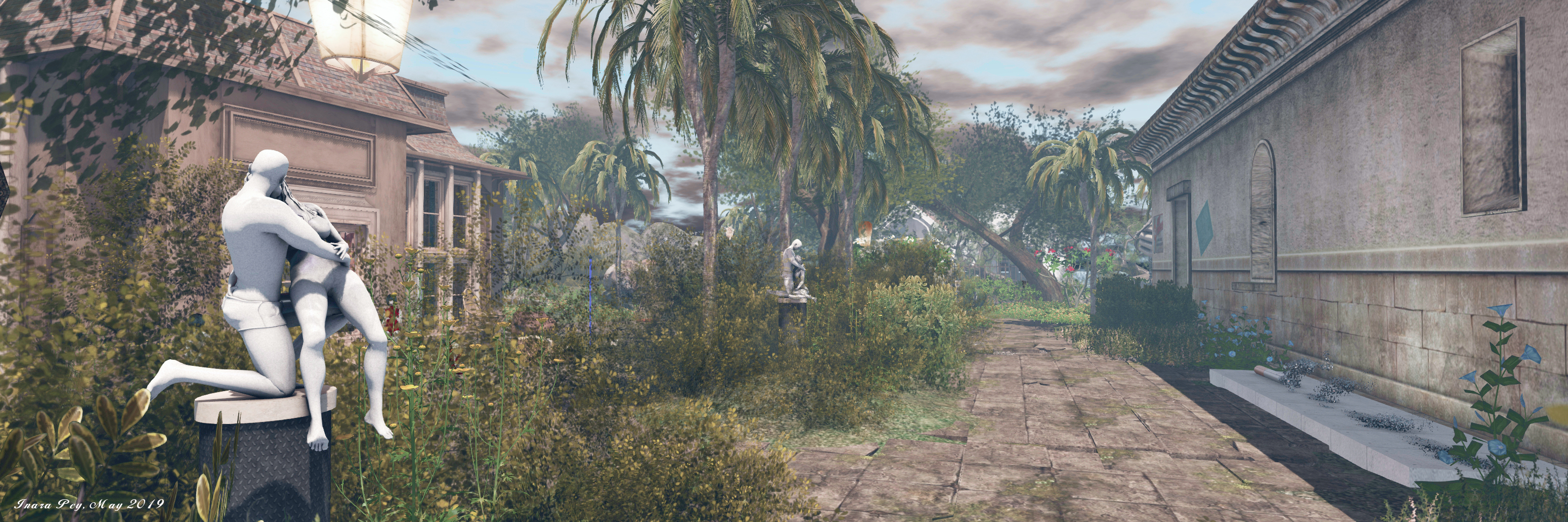
Beyond this, gravel paths, steps and walks wind among an eclectic mix of building, some stone and or brick, many wood; some old, some new. Not all of the building – particularly those near the coast – are private residences, but others are open and sit as galleries or spaces where light D/s role-play might take place – such as the church. Although again, this is not a place in any way devoted to D/s and / or RP.
aZiLe is not a D/s sim and at the same time, some of us are D/s lovers. Since we established we’re a crazy tribe, we’ve decided to try to combine a friendly sim, welcoming everybody, with a spicier side, that we want present, but discreet. We are quite normal people; we need to relax and breathe and laugh. We found the D/s world of SL to be a little too heavy for our taste. The constant need to have rules, the hierarchy, the eternal question “To RP or not RP”… We don’t fit in that mould. We love the exchange. But as conversations, not discussions. We like the idea that SL is like RL. One evening we’ll act light and stupid, or will go dancing, or will simply cuddle. But the other evening we might get deeper.
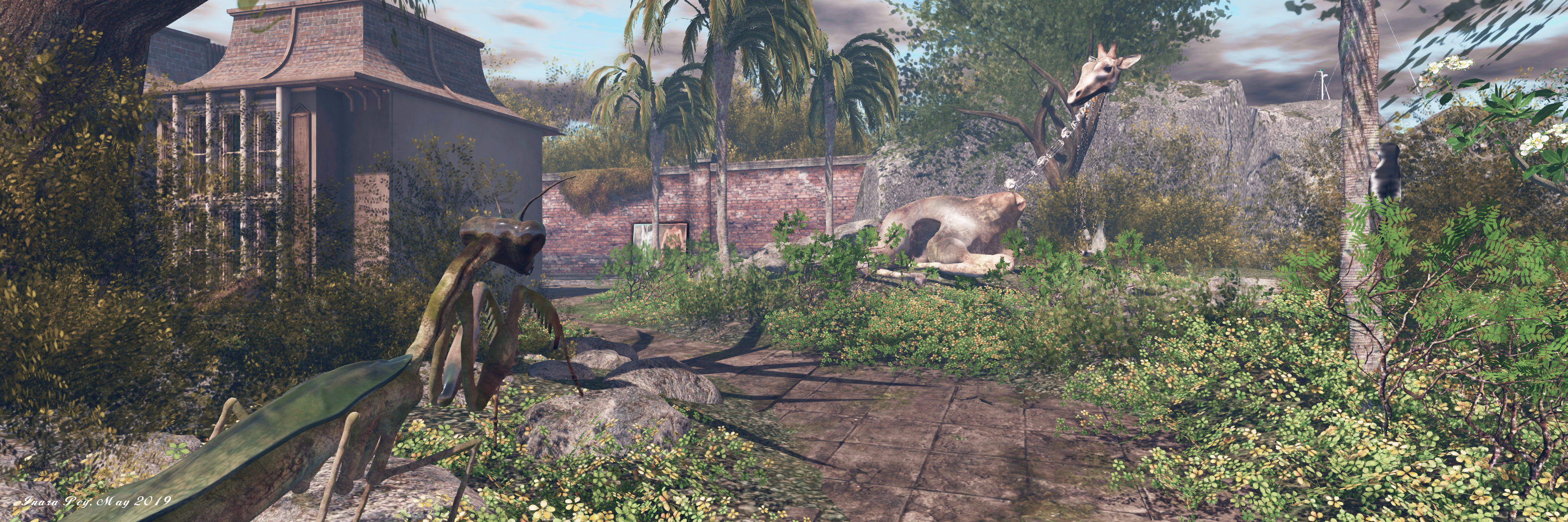
The art to be found within the region is as broad as the setting itself: sculptures by CioTToLiNa Xue and Mistero Hifeng share space with pieces by Bryn Oh while hippos and giraffe stand within the waters and open spaces. Off to the north-east of the region, there sits on a sandy headland the Gallery Pinot Gris. It stands like a giant bunker and offers a circular display space featuring the art of Rob Barber (Rob Steenhorst in the physical world).
Eclectic and fascinating, aZile is a step outside the more “usual” public region, and well worth the time taken to explore it. For those who take photographs, there’s also a Fickr group where they can be submitted.
In April 2019, as I reported in High Fidelity changes direction: the reality of VR worlds today (& tomorrow?, Philip Rosedale announced that High Fidelity would no longer be sitting within the content creation / public space provisioning area, and would instead switch to focus on software / platform development. This announcement has now been followed with a blog post by Rosedale that expands on the company’s immediate plans for the future.
In the May 7th, 2019 post Rosedale indicated that the company is shifting its emphasis even further and will be downsizing its workforce by 25% (some 20 people) in the process. The blog post is brutally honest – kudos to him for being so open – and its commentary gave me pause to mull a few things over before offering any lay thoughts of my own.
In stating the reason for the change, Rosedale points to the lack of take-up of VR headsets:
If you had asked me when we started the company in 2014, I’d have said that by now there would be several million people using HMDs daily, and we’d be competing with both big and small companies to provide the best platform—but I was wrong. Daily headset use is only in the tens of thousands, almost all for entertainment and media consumption, with very little in the way of general communication, work, or education.
On the one hand, for those of us who never brought into the whole “VR will be a US $70 billion a year business by 2020” simply on the basis of the “gee whiz” factor ascribed to it, nod knowledgeably and mutter, “told you so”. But this would rather miss a good portion of the point. As I’ve also pointed out in these pages, VR could in time come to have an impact on our lives in a variety of ways, and there are markets available today that could be – dare I say – revolutionised by its presence.
The problem is, no-one has yet found a way to substantially break into those markets for a variety of reasons. Take education, for example (a big focus for High Fidelity in the past): yes, VR could revolutionise teaching in many areas, but until the cost of headsets has come down substantially to the point where schools can afford to equip a class of 25-30, until questions of controlled access and the provisioning of virtual environments for schools and colleges to access (or build for themselves), the widespread integration of VR teaching remains a horizon vision.
Philip Rosedale, High Fidelity founder and CEO (centre) makes the first of what are now two announcements about the company’s direction, on April 5th, 2019
However, when it comes to the broader metaverse in particular – the starting point of Rosedale’s blog post – VR is really just one component. As he notes, since its inception, High Fidelity has worked hard on many of the foundational requirements for a broader framework in which to set “the metaverse”.
We’ve been working as a company for six years now writing open-source software and creating test events and experiences to enable this imagined place to come into existence. We’ve created a 3D audio engine that can handle large crowds, an open-source graphics engine with live editing, scalable servers, a blockchain-powered currency and marketplace, and more.
Could it be that, moving the focus of VR headsets off to the side until they do gain real, broad-based market traction, some of this additional technology, combined with what had already been achieved through non-VR centric 3D spaces, demonstrate real world uses cases business (and others) might want to adopt? And in doing so, might this further lay practical foundations for wider acceptance of the concepts inherent in a “metaverse” type of setting, one that could in time also more naturally offer VR HMD support if / when the latter does start to become more a part of working environments?
That’s what High Fidelity is now setting out to explore, by delving into the idea of a virtual workspace solution.
For two weeks, we sent everyone home, with their computers, and created a private tropical island where we could work together all day, mostly wearing headphones but not HMDs—we didn’t prescribe the medium of use.
Within the first couple of days it was obvious we were onto something. The 3D audio was always on, perfectly realistic and comfortable. We found ourselves walking around and interacting with each other the same way you would in a physical office. We put up whiteboards and spaces for teams … What if the general trend toward remote and distributed work … could be accelerated even faster by virtual worlds?
Again, for those of us who have been around long enough, this approach might ring a bell. Back in 2008-2010, another company Rosedale founded (but had since departed in an active capacity) tried a similar idea through a product called Second Life Enterprise (SLE), designed to provide companies with a “behind their firewall” implementation of a Second Life based virtual environment for collaborative working.
That idea ultimately failed – although it’s fair to say the reasons for that product’s failure were potentially more rooted in how it was implemented and the walls Linden Lab placed around it to (presumably) protect their IP than in any disinterest in the concept of virtual work spaces or sleazy associations appended to SL itself. And times have moved on a good deal since then; if nothing else eight years on, people are now more au fait with things like virtual spaces, avatars and the like to potentially be more open to virtual working environments.
So time will tell if this new approach works for High Fidelity – again, Rosedale admits there is no certainty in the move. But after six years – most recently with a lot of effort poured into high-profile events – High Fidelity is still struggling to grow an audience, and it really wasn’t clear if anything would substantively change in the next six years if they kept on that road. As such, this a brave move for a start-up to take, and a dose of realism when it comes to the state of play with the VR market. And in the meantime, as the blog post also makes clear, High Fidelity will continue to support its open source VR platform.
Which leads to a final question. Is this a sign that more VR-centric virtual spaces could face some hard decisions? Quite possibly. High Fidelity actually isn’t the first to hit the wall of slow VR take-up. In 2017, Altspace VR announced its imminent closure, but was ultimately saved when Microsoft stepped in.
But again, caution should be exercised if tempted to see this as a sign of the future for something like Sansar. If nothing else, the latter doesn’t have the weight of US $73 million investment sitting on its shoulders, quietly demanding the way be shown towards some kind of future return. Plus, Linden Lab have a viable source of income through Second Life, a platform they are committed to continue to develop and (hopefully) grow. If nothing else, this allows them the potential to throttle / steer the development and growth of Sansar to meet the realities of their potential marketplace without the worry of external pressures.
In the meantime, to High Fidelity, one can only say “good luck” with the new endeavour, and it will hopefully be interesting to see where it leads.
The Bandit 50/3 is the latest sailing release by Analyse Dean under her Bandit brand of sailing and power boats. At 99 LI when moored, it is no lightweight – but then, it is packed with features and capabilities, including the latest third generation BOSS dynamic sailing engine, offering one of the most outstanding sailing experiences in Second Life.
Everything about the boat is aimed at giving you a fun and realistic experience, and while being a cruise friendly boat that is accessible for beginners, the Bandit 50/3 is set-up to bring you pure adrenaline when pushed to the limits in high winds with full manual control.
– Analyse Dean, describing the work put into the Bandit 50/3
Bandit 50/3: sailing past Isla Pey
The 50/3 is slightly smaller that the Bandits 55 and 60, but in terms of options, it easily matches and exceeds the pair of them, and builds on the 460AK motor cruiser (which I reviewed in Two Bandits at sea in Second Life) in terms of “hidden” additions. However, the main thing that is liable to make this Bandit a hit is the sailing characteristics.
The 50/3 was set-up with some realism in mind. Where previous boats had some “rubber bumpers” in the code to prevent stuff from happening when people exceed limits. The 50/3 doesn’t have that; go out of range with the spinnaker, broach, sail close to the wind with the genoa, knockdown [When a sailing boat is suddenly pushed onto its side, either by an abrupt wind gust or rouge wave], mess up a tack and it will cost you some time to recover. Heel excessively, and the rudder will loose grip. It is set-up for racing in high winds really, and it will keep the adrenaline flowing when you sail it at the edge.
– Analyse Dean, describing sailing the Bandit 50/3
Bandit 50/3
The package includes the Bandit 50/3, a dock (compatible with the dock supplied with the 406AK) a sailing HUD, and three optional packages: flags, textures, and racing. A comprehensive note card manual is also supplied, providing full coverage of the boat’s features and a set of comprehensive notes on sailing it.
Coming in at just under 15 metres overall length, the Bandit 50/3 is laid out with a stern cockpit with plenty of room for the helmsperson and passengers. Multiple steering poses are provided, depending on the sailing siltation / whether of not the boat is under engine power. A bimini can be raised via chat, as can a more protective tent for bad weather. Note that the dodger is a permanent fixture, but can be hidden by selective editing and making it transparent (although the baked textures on top of the cabin means some re-texturing might be required if you’d prefer to mostly run without the dodger being visible.
Two sleeping berths are provided, one under the cockpit, the other in the bows. Between the two is a comfortable salon with functional galley. There are a lot of poses packed into the cabins – and a lot of clickies, as one would expect from a Bandit: light switched work, the doors to the sleeping berths close / open, the table leaves can be raised / lowered, blinds drawn – and more.
Bandit 50/3: moored at my Linden Houseboat and using the Bandit piers for mooring
I’ve not owned other Bandit boats and am unfamiliar with handling them outside of sailing the demos, so I cannot offer direct comparison between the 50/3 and any of the other boats in the range, but I will say that in the 24 hours I’ve had it, 50/3, I’ve found it to be both a fun and a genuine challenge when sailing.
As the manual notes, the 50/3 includes four sail options: the main, a jib, a genoa and a spinnaker. Which of the latter three you use is down to the prevailing wind conditions (which you can set). Setting the sails can be shared with others sailing with you, if desired (just pass them a copy of of the supplied HUD).
The 50/3 is BOSS 3, just like the Bandit IF. It has multiple animated actions and really comes into its own when you sail with a crew member.
– Analyse Dean, describing sailing the 50/3 with crew
Bandit 50/3: “unfettered and in full career!”
Solo sailing, I have a say that the 50/3 is a handful – at least for the relatively novice, like myself -but also a heck of a lot of fun. When properly trimmed and with a good wind, the boat moves at a fair lick of speed, and the camera system allows you to appreciate this fully. With a crew handling the sails, things really do come into their own and sailing the boat becomes a shared experience that adds a dimension to being on the water.
For those into racing, the race pack includes a HUD-based “iPad” (although it can also be worn by your avatar), is designed to provide a more realistic consistent sailing experience. Also included is a copyable scripted buoy. This can be set out (where you have rezzing rights) along a race course to again provide a consistent wind effect when racing. In taking the boat out on both Blake Sea and around Bellisseria, we made multiple region crossings without issues.
We are also starting a little sailing club for it, off shore, long distance, point to point. Keep an eye out for Blake Off-Shore Rally for Cruisers (BORC) as well, it will be super fun!
– Analyse Dean
Bandit 50/3: in the galley
When moored or anchored, the boat offers a range of single and couples animations, both on the top of and within the cabin. These, and the helm positions, mean that the Bandit 50/3 offers a good selection of poses and animations.
With the Bandit 460AK, analyse introduced a new docking system for her boats, and this is continued with the Bandit 50/3. Rez the pier and when the Bandit 50/3 is close enough, issue the text command “dock”, and the 50/3 will neatly move alongside, deploying its fenders and mooring and electrical power lines appear. What’s more, the pier is fully compatible with the connecting dock supplied with the Bandit 460AK, allowing both to be used together.
The Bandit 50/3 (foreground) with the Bandit 55 and and Bandit 60, The Mesh Shop
As noted at the top of this article, there is a lot to be found in this boat, not all of which is covered here. At L$3,750 it offers a huge amount of value for money. At the time of writing, it is only available in-world at The Mesh Shop, but expect to see it on the Bandit Marketplace store soon; as Analyse noted to me, “It will be there in a week or so. I always wait to see if any bugs surface.”
On Tuesday, May 7th, the SLS (Main) channel updated to server maintenance package 19#19.04.25.526669, primarily intended to correct the simulator-side EEP regressions that resulted of the roll-back of Thursday, April 18th. This update also includes a number of other internal fixes.
On Wednesday, May 8th, the three RC channels should be updated with server maintenance package #19.05.01.526856, comprising internal fixes.
SL Viewer
The Teranino Maintenance RC viewer updated on Friday May 3rd, to version 6.2.1.526845. This viewer was subsequently promoted to de facto release status on Tuesday, May 7th.
The remaining viewer pipelines remain unchanged:
Release channel cohorts:
EEP RC viewer version 6.2.0.526104, dated April 11th.
Bakes on Mesh RC viewer, version 6.1.1.525409, dated March 26th.
Linux Spur viewer, version 5.0.9.329906, dated November 17th, 2017 and promoted to release status 29th November – offered pending a Linux version of the Alex Ivy viewer code.
Obsolete platform viewer, version 3.7.28.300847, dated May 8th, 2015 – provided for users on Windows XP and OS X versions below 10.7. This viewer will remain available for as long as reasonable, but will not be updated with new features or bug fixes.
Teleport Disconnects
Following the deployments of server maintenance package 19#19.04.25.526669, it appears that there has been a significant improvement in teleports, with Simon Linden noting that the “TP crash has been mitigated and success rates are back to what they were months ago.”
This doesn’t mean that the Lab is ceasing efforts on trying to improve teleports and region crossings; rather that the priority of the work over that last few weeks has been on easing the problems people have been experiencing the last month.
Script Processing Issues
As reported in my week #18 SUG summary, there have been numerous reports of script run time issues, with some reporting that problems only started occurring following the roll-back on April 18th, 2019. BUG-226851 outlines some of the problems.
There is no specific update on this, other than the Lab’s engineering team has been asked to put together ways for them to look at script run times and performance grid wide.







 Inara Pey: Living in a Modemworld