
On Monday, April 16th, 2018, after being delayed from a planned December 2017 lift-off, the launch window opens for NASA’s Transiting Exoplanet Survey Satellite (TESS).
As its name implies, TESS is designed to seek out exoplanets using the transit method of observation – looking for dips in the brightness of stars which might indicate the passage of an orbiting planet between the star and the telescope. Once in its assigned orbit and operational, TESS will work alongside the Kepler space observatory – now sadly nearing the end of its operational life and eventually the James Webb Space Telescope – in seeking worlds beyond our own solar system.
Roughly the size of an upright ridge/freezer combination, the 356 kg (800 lb) TESS is due to be launched on its way atop a SpaceX Falcon 9 booster from Launch Complex 40 at Canaveral Air Force Station, Florida, on April 16th, 2018, in a launch window that opens at 18:32 EDT (22:32 UT). The rocket – sans it’s payload – underwent a static rocket motor test on Wednesday, April 9th, prior to it being returned to the launch preparation facility, where the Payload system and fairings containing TESS were mated to it in readiness for the launch. As well as launching TESS, SpaceX plan to recover the Falcon 9’s first stage.

Once on its way, Tess will take 60 days to reach its unique orbit, a “2:1 lunar resonant orbit“, which will allow the craft to remain balanced within the gravitational effects of the Moon and Earth, thus providing a stable orbital regime which should last for decades. In addition, the orbit means that TESS will be able to survey both the northern and southern hemispheres.
During this initial 60-period, scientists and engineers will spend the first week re-establishing contact with TESS and confirming its operational status as its instruments are cameras are powered-up. The instruments will then go through an extended commissioning and calibration phase, as engineers monitor the satellite’s trajectory and performance. After that, TESS will begin to collect and downlink images of the sky.
While Kepler has so far found the most exoplanets in our galaxy, it has done so by surveying relatively small arcs of the space visible to it. TESS, however, will do things differently. It will scan the galaxy in hundreds of light-years in all directions, a sphere of space containing some 20 million stars, paying particular attention to the brightest stars around us in the hope of detecting planetary bodies in orbiting them.
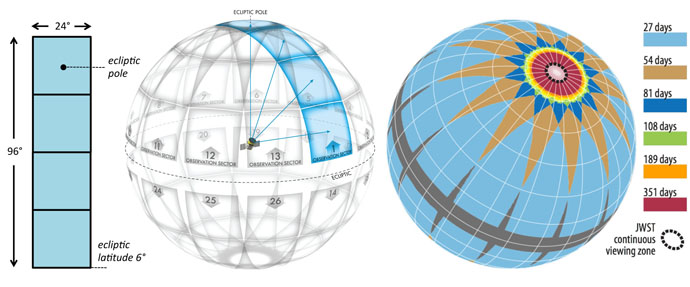
This will be achieved by dividing space into 26 individual “tiles”, allowing the four imaging systems on the craft to repeatedly observe a “strip” of four tiles at a time for a minimum of 27 days each (and parts of some for up to a year at a time) before moving to the next strip, working its way around the sky. In this way, it is estimated TESS will be able to survey up to 200,000 stars in both the northern and southern hemispheres over multiple years.
Amid this extrasolar bounty, the TESS science team aims to measure the masses of at least 50 small planets whose radii are less than four times that of Earth. Many of TESS’s planets should be close enough to our own that, once they are identified by TESS, scientists can zoom in on them using other telescopes, to detect atmospheres, characterize atmospheric conditions, and even look for signs of habitability.
In this latter regard, TESS will pave the way for detailed studies of candidate exoplanets by the James Webb Space Telescope (JWST), now scheduled for launch in 2020. While TESS cannot look for atmospheric or other signs of life on the distant worlds it locates, JWST will be able to do just that. So, even as we prepare to say a sad goodbye to Kepler, the hunt of exoplanets is actually just hotting up.
Continue reading “Space Sunday: of exoplanets and naming Charon’s features”








 Inara Pey: Living in a Modemworld