SL project updates 16 2/1: server deployments

Server Deployments

As always, check the server deployment thread for any updates.

There was no deployment to the Main (SLS) channel on Tuesday, January 12th. On Wednesday, January 13th, all three RC channels should receive the same sever maintenance package comprising:

  • Feature Request: llGetObjectDetails() constant OBJECT_TOTAL_INVENTORY_COUNT – when targeting an object, OBJECT_TOTAL_INVENTORY_COUNT will return the total of all inventory types in each link of the linkset. See BUG-10575 for further details
  • Feature Request: llGetObjectDetails() constant OBJECT_PRIM_COUNT – provides a means to get a worn attachment’s prim count (rather than just returning 0).  See BUG-10646 for further details.
  • Simulator crash fixes.

SL Viewer

So far, no promotions or updates to the current batch of RC and project viewers, leaving the list as it stood in week #1:

  • Current Release version: 4.0.0.309247, December 17, 2015 – formerly the Chromium Embedded Framework RC viewer download page, release notes
  • RC viewers:
    • Project Azumarill (HTTP updates) RC viewer, version 4.0.1.309333, dated January 5th
    • Quick Graphics (Avatar complexity & graphics presets) RC viewer, version 4.0.1.309320, dated January 5th
    • Maintenance (30+ fixes and improvements) RC viewer, version 4.0.1.309460, dated January 5th
    • Vivox (Voice fixes and improvements) RC viewer, version 3.8.7.307744, dated November 17, 2015
  • Project viewers:
    • Project Bento (avatar skeleton extensions) version 5.0.0.309171, dated December 16, 2015
    • Oculus Rift project viewer, version 3.7.18.295296, dated October 13th, 2015
  • Obsolete platform viewer (SL access for Win XP  / Mac OS X10.6 users), version 3.7.28.300847 dated May 8, 2015.

During the last TPV Developer meeting of 2015, it had been indicated that the Vivox RC viewer and the HTTP RC viewer were being merged into a single offering. If this is still the case, we can likely expect the updated RC viewer to be appearing soon.

Weekend Issues

For those who may have missed it, April Linden from the Lab’s Operation’s team (who are responsible for trying to keep the grid available 24/7), provided a blog post on the issues Second Life experienced over the weekend of January 9th / 10th 2016, which I also covered in a separate blog post.

Lab explains Second Life’s weekend woes

We’re all used to Second Life misbehaving itself at the weekend, but it with rezzing or rendering or region crossings and so on. However, Saturday, January 9th, and Sunday January 10th proved to be a lot rougher than most weekend in recent memory, with Sunday in particular affecting a lot of SL users.

When situations like this arise, it’s easy to shake a verbal fist at “the Lab” and bemoan the situation whilst forgetting we’re not the only one being impacted. Issues and outages bring disruption to the Lab as well, and often aren’t as easy to resolve as we might think. Hence why it is always good to hear back from the Lab when things do go topsy-turvy – and such is the case with the weekend of the 9th / 10th January.

Posting to the Tools and Technology blog on Monday, January 11th, April Linden, a member of the Operations Team (although she calls herself a “gridbun” on account of her purple bunny avatar), offered a concise explanation as to what happened from the perspective of someone at the sharp end of things.

April starts her account with a description of the first issue to hit the platform:

Shortly after midnight Pacific time on January 9th (Saturday) we had the master node of one of the central databases crash. The central database that happened to go down was one the most  used databases in Second Life. Without it Residents are unable to log in, or do, well, a lot of important things.

While the Lab is prepared for such issues, it does take time to deal with them (in this case around 90 minutes), with services having to be shut-down and then restarted in a controlled manner so as not to overwhelm the affected database. Hence why, when things like this do happen, we often see notices on the Grid Status Page warning us then log-ins may be suspended and /  or to avoid carrying out certain activities.

Sadly, this wasn’t the end of matters; on Sunday an issue with one of the Lab’s providers had a major impact on in-world asset loading (while April doesn’t specifically point at which provider, I’m assuming from her description it may have been one of the CDN providers). While the Lab is versed in working with their providers to analyse the root cause of problems and rectify them, this particular issue appears to have had a knock-on effect in a quite unexpected way, impacting the avatar baking service.

This is the mechanism by which avatar appearances are managed and shared (and is also known as Sever-Side Appearance and / or Server-Side Baking). Designed to overcome limitations with using the viewer / simulator to handle the process, it was cautiously deployed in 2013 after very extensive testing, and it has largely operated pretty reliably since its introduction. As such, the fact that it was so negatively impacted at the weekend appears to have caught the Lab off-guard, with April noting:

One of the things I like about my job is that Second Life is a totally unique and fun environment! (The infrastructure of a virtual world is amazing to me!) This is both good and bad. It’s good because we’re often challenged to come up with a solution to a problem that’s new and unique, but the flip side of this is that sometimes things can break in unexpected ways because we’re doing things that no one else does.

Taking this to be the case, it doubtless took the Lab a while to figure-out how best to deal with the situation, which likely also contributed to the time taken for things to be rectified to the point where people weren’t being so massively impacted. Hopefully, what did occur at the weekend will help the Lab better assess circumstances where such problems – unique as they may be – occur, and determine courses of action to mitigate them in the future.

In the meantime, April’s post, like Landon Linden’s update on the extended issues of May 2014, help remind us of just what a hugely complex beast of systems and services Second Life is, and that how even after 13 years of operations, it can still go wrong in ways that not only frustrate users, but also take the Lab by surprise, despite their best efforts. Kudos to April for presenting the explanation and for apologising for the situation. I hope she, together with all involved, have had time to catch-up on your sleep!

Related Links

At what price VR?

Oculus CR-1 with microphone, Oculus Remote and Xbox wireless controller
Oculus CR-1 package (image: Oculus VR)

On Wednesday, January 6th, and as I reported, Oculus VR announced the price of the first generation Oculus Rift VR headset as being US $599 (€699 in Europe and £499 in the UK) + shipping at applicable taxes, with the unit available for pre-order.

The price has caused some consternation around the globe, even though Palmer Luckey had, since September 2015, been indicating the headset would be more than the assumed price of US $350, as my colleague Ben Lang over at The Road to VR quoted Luckey saying at the time.

As it is, the Oculus Rift is apparently heavily subsidised by Facebook; had it not been so, then the price might have been north of the US $1,000 mark . Further, and like it or not, the HTC / Valve Vive is likely to have a price point somewhat more than the Rift – although it will include hand controllers and room sensors, which the Rift does not. In addition, the latest version of the Vive sports a “chaperone system”: a front-mounted camera which allows the user to overlay their VR environment with images of the room around them, making for easier physical movement when using the headset.

Elsewhere, there has been speculation about the possible price of Sony’s PlayStation VR (PSVR), particularly after Forbes reported Amazon Canada had it listed at CAN $1,125 (roughly US $800). The listing price was later removed, with Sony stating it was an error and that the final price of the PSVR has yet to be determined – but it has left people wondering.

And while the Oculus Rift price may seem steep, it might be worth pointing out that the Vuzix iWear, an OSVR-based headset initially aimed at the immersive film experience, but capable of supporting VR games and applications, is currently available for pre-order at US $499, and comes with a specification somewhat below that of the Rift.

Sony PSVR - Amazon Canada quoted a price of US $800, quickly countered by Sony - but some speculate it might be accurate
Sony PSVR – Amazon Canada quoted a price of US $800, quickly countered by Sony – but some speculate it might be accurate or at least close to the truth (image: Sony Computer Entertainment)

So does this mean the US $599 price tag for the Oculus Rift is justified? Given that the first pre-order batch apparently sold-out within minutes, one might be tempted to say “yes”. However, the initial rush could be deceptive; while there are undoubtedly a lot of early adopters out there willing to pay a premium for the hardware, they aren’t likely to be in the majority.

And here is where consumer-focused VR could end-up being hoist by its own petard, and in a number of ways, some of which are pointed to by Chris Kohler, writing at Wired.

The first is that VR as a term is already being badly abused.Much is made of 360-degree video (already a thing through Google Cardboard systems), but it really isn’t VR as many would accept it.

The second is there is already a rising tide of headsets offering “VR experiences”. Most of these are (again) Cardboard-based and utilised a mobile ‘phone. The problem here is that inevitably, the quality of the experience isn’t all it could be. What’s more, it often hooks back into the idea that VR is pretty much stuff like 360-degree video.

Samsung's Gear VR sits at the top of the mobile VR pyramid, and could be said to be indicative of where Oculus VR would like to go: a self-contained, lightweight system which doesn't necessarily tether the user to their computer
Samsung’s Gear VR sits at the top of the mobile VR pyramid, and could be said to be indicative of where Oculus VR would like to go: a self-contained, lightweight system which doesn’t necessarily tether the user to their computer (image: Samsung)

The issue here is that despite these factors, these low-end headsets and units such as Samsung’s Gear VR, are presenting VR as something that’s easily affordable (given most people are liable to have a suitable ‘phone to use with them). The experience may not be terribly clever when compared to the Rift or the Vive – but it is there, and it is coupled with a possible perception that VR is about 360 film / sports experiences.

Thus, unless the Rift and the Vive et al can convince the greater populace they offer a truly unique, high-end, head-and shoulders-above-the-rest type of VR experience that instantly compels people to shell out the readies for them, there is a risk that they could be seen a “just another headset”, and passed by in favour of the cheaper albeit less capable headsets, at least until the price point is seen to come down – and that could put something of a pin in the side of the VR bubble, if only in the short-term.

2016 viewer release summaries: week 1

Updates for the week ending Sunday, January 10th

This summary is published every Monday, and is a list of SL viewer / client releases (official and TPV) made during the previous week. When reading it, please note:

  • It is based on my Current Viewer Releases Page, a list of all Second Life viewers and clients that are in popular use (and of which I am aware), and which are recognised as adhering to the TPV Policy. This page includes comprehensive links to download pages, blog notes, release notes, etc., as well as links to any / all reviews of specific viewers / clients made within this blog
  • By its nature, this summary presented here will always be in arrears, please refer to the Current Viewer Release Page for more up-to-date information.

Official LL Viewers

  • Current Release version: 4.0.0.309247, December 17th – no change
  • Release channel cohorts (See my notes on manually installing RC viewer versions if you wish to install any release candidate(s) yourself):
    • Project Azumarill (HTTP updates) RC viewer updated to version 4.0.1.309333 on January 6th – a complete replacement of the under the hood HTTP infrastructure within the viewer (download and release notes)
    • Maintenance RC viewer updated to version 4.0.1.309460 on January 5th – core updates: some 38 fixes and improvements, including updates for some regressions introduced into the viewer with the current release viewer (download and release notes)
    • Quick Graphics RC viewer updated to version 4.0.1.309320 on January 5th – provides the new Avatar Complexity options and the new graphics preset capabilities for setting, saving and restoring graphic settings for use in difference environments / circumstances (download and release notes)
  • Project viewers:
    • No updates.

LL Viewer Resources

Third-party Viewers

V4-style

  • No updates.

V1-style

  • Cool VL Viewer updated as follows: Stable version to 1.26.16.7 and Experimental branch to 1.26.17.5, both on January 9th, 2016 (release notes).

Mobile / Other Clients

  • Group Tools version 2.2.35.0, originally issued December 12, re-issued January 5 with a request for a clean install.

Additional TPV Resources

Related Links

Space Sunday: dunes, rockets and asteroids

CuriosityNASA’s Mar Science Laboratory rover, Curiosity, continues to perform the first up-close study ever conducted of extraterrestrial sand dunes as it slowly explores the slopes of “Mount Sharp” dubbed the “Bagnold Dunes”.

Located on the north-west slope of the mound which lies at the centre of Gale Crater, the dunes differ from those drifts and sand fields the rover has previously encountered on Mars in terms of both their size and height – some cover an area the size of a football field and are 2 storeys high – and their general shape, something which marks them out as “classic” sand dunes.

This latter point is most evident by the dunes exhibiting a steep, downwind slope, referred to as the slip face, and which exhibits certain features of its own, such as gain fall, ripples and grain flow, as well as the dune as a whole exhibiting typical features such as the horn and toe.

For the last couple of weeks, the rover has been working its way around one dune in particular, dubbed “Namib”, which is somewhat smaller than the “high dunes” images at the start of December, but which still rises to a height of some 5 metres (16 ft). The leeward side of “Namib” in particular demonstrates the classic features of a sand dune, and helps to confirm the fact that the dunes are slowly progressing down the slope of “Mount Sharp” at a rate of about 1 metre (39 inches) a year.

The leeward side of Namib:
The leeward side of “Namib”:Horn – where sand is escaping the main dune and escaping downhill, as indicated by the ripples; Toe – the downwind extent of the dune; ripples – signs of the sand bouncing sideways over the dune as the wind blows it downslope towards the horn;  Brink – the ridge between the windward, gentle slope of the dune and the leeward, steeper slope of the dune; Grail Fall – areas where sand is blown / falls from the brink and comes to rest on the leeward slope; Gain Flow – tongue-like area indicating where large amounts of sand have slumped down the side of the dune towards the toe, again indicative of a dune in motion

The dune-investigation campaign is designed to increase understanding about how wind moves and sorts grains of sand in an environment with less gravity and much less atmosphere than well-studied dune fields on Earth. Such an understanding of how the wind moves sand could lead to a clearer picture of how big a role the Martian wind played in depositing concentrations of minerals often associated with water across the planet, and by extension, the behaviour and disposition of liquid water across Mars.

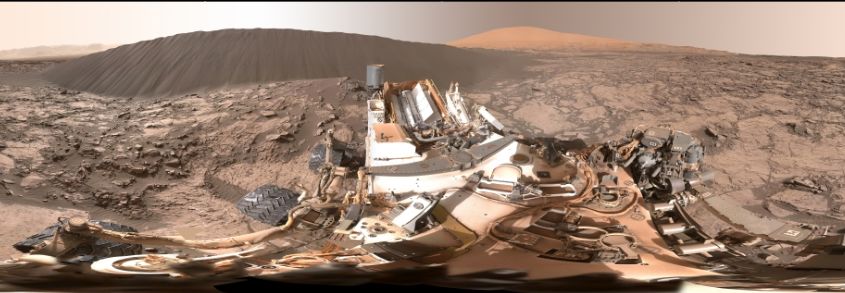
This rather odd-looking image is a foreshortened 360-degree view of the area around Curiosity. In the immediate foregound is the rover's main deck, with the cylindrical, finned nuclear RTG at the back of it. Beyond this is the "Namib" dune, with a taller dune beyond it. The view was constructed froma series of images taken by the rover's Mastcam on December 18th, 2015 (Sol 1,197 on Mars), all of which have been white-balanced to present the view under normal Earth daylight conditions
This rather odd-looking image is a foreshortened 360-degree view of the area around Curiosity. In the immediate foreground is the rover’s main deck, with the cylindrical, finned nuclear RTG at the back of it. Beyond this is the “Namib” dune, with a taller dune beyond it. The view was constructed from a series of images taken by the rover’s Mastcam on December 18th, 2015 (Sol 1,197 on Mars), all of which have been white-balanced to present the view under normal Earth daylight conditions

Back to Sea for SpaceX

SpaceX, the private space launch company, is keeping itself busy. Following the successful launch of the Orbcomm mission from Florida’s Cape Canaveral Air force Station, together with the successful recovery of the first stage of the booster when it flew back to the Cape and performed a flawless vertical landing, the company’s next launch is scheduled for Sunday, January 17th.

The launch will take place from Vandenberg Air force Base, California, which is the company’s Pacific Coast launch operations centre. The primary aim of the mission is to place the third in a series of joint U.S.-European satellites into a near-polar orbit (for which Vandenberg AFB is ideally suited, as a polar launch from there does not pass over inhabited land during ascent, lessening the risk to human lives should a launch vehicle suffer a failure).

The Jason-3 series of missions is part of a very long-term series of studies (started in 1992) to study the topography of the ocean surface (i.e. the formation and movement of waves and the troughs between them), which can provide scientists with critical information about circulation patterns in the ocean, and about both global and regional changes in sea level and the climate implications of a warming world.

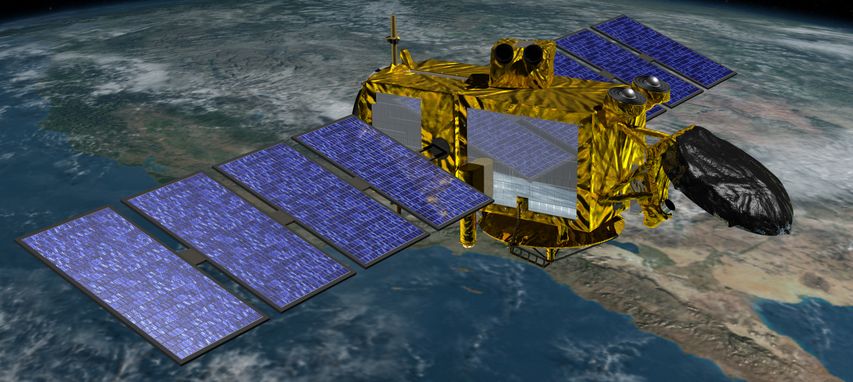
Jason-3, the latest in a series of joint US-European satellites studying the topography of the ocean's surface, is due for launch on December 17th, 2016, using a SpaceX Falcon 9 1.1 rocket
Jason-3, the latest in a series of joint US-European satellites studying the topography of the ocean’s surface, is due for launch on December 17th, 2016, using a SpaceX Falcon 9 1.1 rocket (image: NASA / CNES)

The polar orbit used for this kind of earth-observing mission, being almost perpendicular to the Earth’s rotation, allows the spacecraft to at some point travel over almost every part of the world’s oceans, vastly increasing its ability to gather data when compared to a vehicle in an equatorial orbit.

What is also significant about the mission is that it will use a SpaceX Falcon 9 1.1 booster, the first stage of which will once again attempt to return to Earth and make a safe landing. However, unlike the December 2015, this landing will once again be at sea, using a SpaceX droneship landing platform.

Continue reading “Space Sunday: dunes, rockets and asteroids”

Windlight Fellows January-February 2016

The Windlight Gallery

Now open at the Windlight Art Gallery, the January-February 2016 Windlight Fellowship exhibition sees exhibits by Ceakay Ballyhoo, Eleseren Brianna, Jarla Capalini, Warm Clarity, Glitterprincess Destiny, Hana Hoobinoo, Victoria Lenoirre, Carley Noonan, Autopilotpatty Poppy, Jamie86 Resident, Jazsintha Resident, and Tempest Rosca.

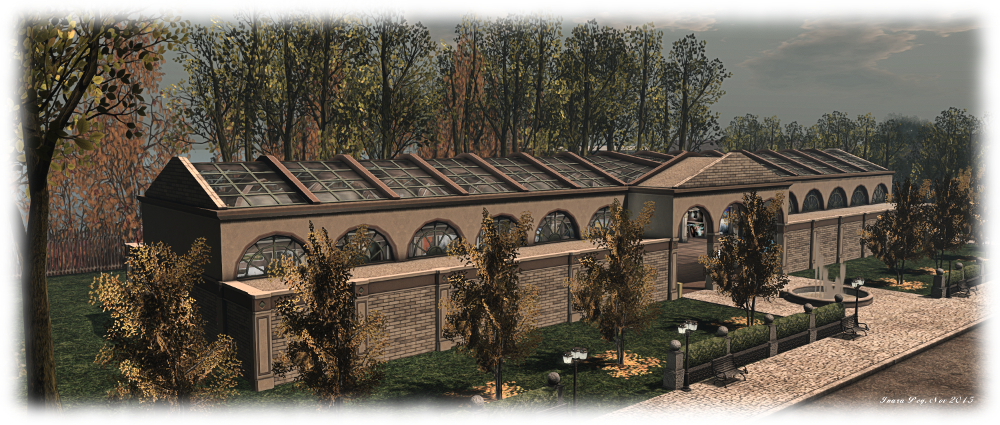
On offer is another rich mix of styles and subject matter – landscapes, avatar studies, some abstract work and some images from the physical world. It is this mix of styles and subject which makes the Windlight Exhibitions more than worth the visit; the Gallery design encourages the visitor to focus attention on each artist in turn whilst at the same time allowing individual styles and approaches to be compared and contrasted, helping one to appreciate further the skills evidence by each artist in creating their work.

 Jarla Capalini - Windlight Gallery
Jarla Capalini – Windlight Gallery

There are a number of artists in this group whose work I know and admire, and several who are new to me, but whose work I’m rapidly coming to admire as result of seeing them at Windlight. While I don’t like to seem as if I’m picking favourites at an event like this. I have to admit that I found myself drawn back time and again to Hana Hoobinoo’s and Jarla Capalini’s images; the latter offer rich portraits and landscapes with a marvellous painted quality to them, while Hana’s present a beautiful ethereal quality.

But all appearances of favouritism aside, all of the images on display through January and February are guaranteed to please and entice those who visit the gallery; so be sure to add it to your list of places to visit, and if you wish to find out more about the artists, be sure to read the special Meet The Artist articles in the Windlight blog.

Hana Hoobinoo Windlight Gallery

Footnote: Due to issues with Second Life, the formal opening event for the exhibition has been rescheduled for 14:00 SLT on Saturday, January 16th, with formal attire preferred. However, the gallery is still open for people to visit and see the art on display.

The Windlight Artist Fellowship Programme

As a part of the magazine’s desire to help promote and support artists and photographers, Windlight Magazine and the Windlight Gallery operates the  Windlight Artist Fellowship Programme. This allows artists to apply for free exhibition space at the Windlight gallery for a period of 30 days. Applications are open to artists from across Second Life, and the criteria for acceptance can be found in the Artist Fellowship Programme application form.

Windlight Gallery
Windlight Gallery

Related SLurls and Links