In 2005, along with friends, I attended a dinner at which a UK scientist, John Zarnecki, was honoured. His name might not be familiar to some, but Professor Zarnecki, currently serving as the Director of the International Space Science Institute in Berne, Switzerland, has been involved in a number of high-profile space missions, including the Hubble Space Telescope, the Giotto probe that visited Halley’s Comet, and UK’s Beagle 2 mission to Mars. He is currently leading the European ExoMars rover mission, scheduled for 2020.
However, it is probably with the NASA / ESA Cassini-Huygens mission that he has the deepest association. At the time of the dinner, Professor Zarnecki had already been involved in that programme for fifteen years. His primary responsibility was the Huygens probe, which became the first vehicle to land there in January, 2005, and still holds the record for the furthest landing from Earth a spacecraft has so far made.
I mention this, because while the Titan surface mission effectively came to an end 90 minutes after the lander arrived there, the Cassini vehicle has remained in operation around Saturn and its moons, gathering a huge amount of data in the process. However, its own mission is now coming to an end after almost 20 years. In September 2017, Cassini will complete its last full orbit of Saturn and then fall to is destruction.
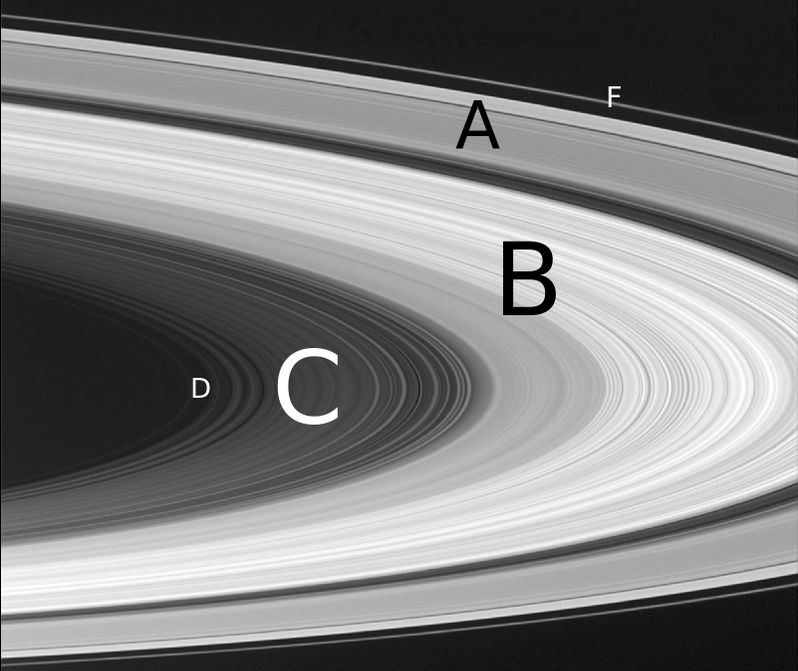
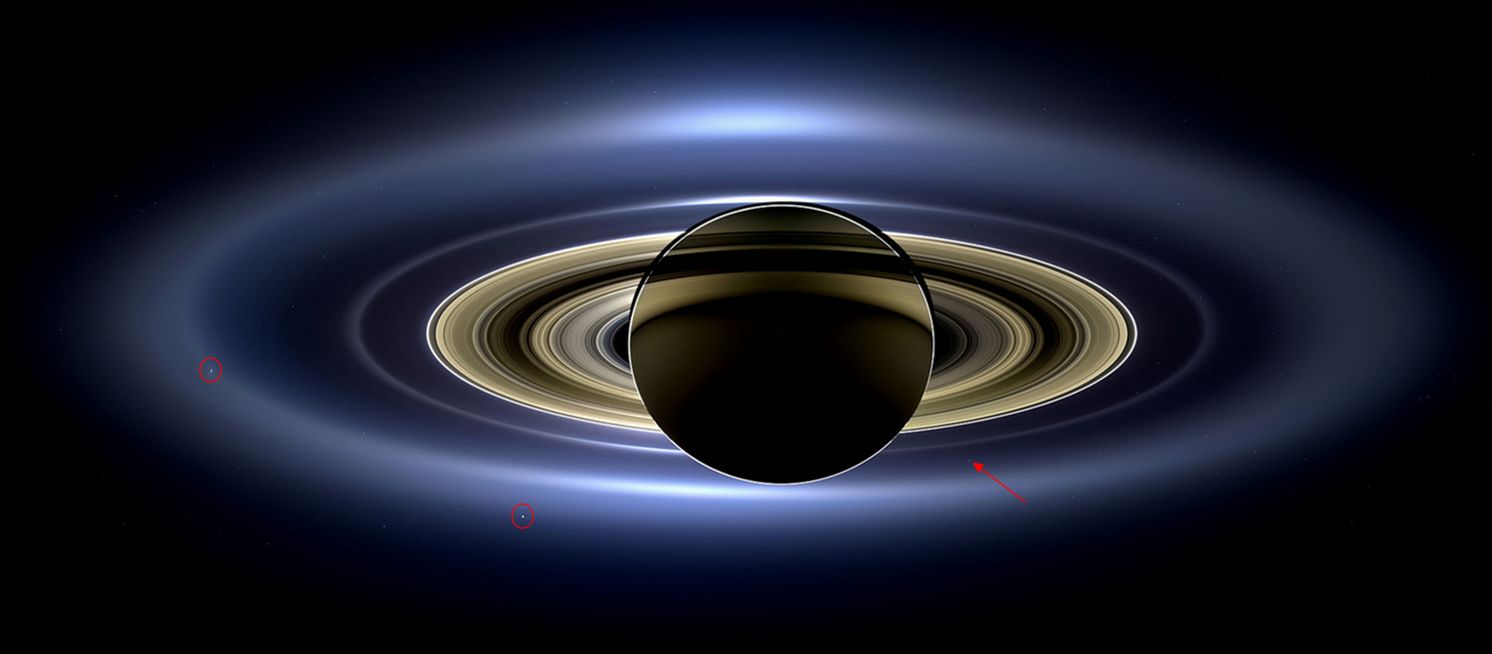
Before then, however, and starting on November 30th, 2016, the orbiter will commence the penultimate phase of its mission. Having gradually shifted itself into a more polar orbit around Saturn Cassini will commence a series of “ring-grazing orbits”, coming to within 7,800 km (4,850 mi) of what is regarded as the outer edge of Saturn’s major series of rings, the F-ring.
These orbits, which will extend through April 22nd, 2017, will see the spacecraft dive through the more diffuse G-ring once every seven days for a total of 20 times in what will be the first attempt to directly sample the icy particles and gas molecules which are located at the edge of the rings and also image the tiny moons of Atlas, Pan, Daphnis and Pandora, which play a role in “shepherding” the rings around Saturn.
Over time it will slowly close on the outer edge of the denser F-ring, until in March and April 2017, it is passing through the outer reaches of that ring, some 140,180km (87,612.5 mi) from the centre of Saturn. The F-ring is regarded as perhaps the most active ring in the Solar System, with features changing on a timescale of hours.

Exactly how the majority of Saturn’s rings formed is still unknown;, with ideas focused on one of two theories. In the first, the material in the rings is the original material “left over” from the formation of Saturn and its larger moons, pulled into a disc around the planet by gravitational tides. In the second, the material is all that remains of a form er – called Veritas after the Roman goddess – which either crossed the Roche limit to be pulled apart by gravitation forces or was destroyed by the impact with another body such as a large comet or asteroid.
However, in both of these cases it is not unreasonable to assume that the material making up the rings would be of a mixed nature: dust, ices, rocky matter, etc. However the majority of the ring matter is icy particles, with little else. This has given rise to a variation on the destroyed moon theory: that the particles are all that remains of the icy mantle of a much larger, Titan-sized moon, stripped away as it spiralled into Saturn during the planet’s formation.
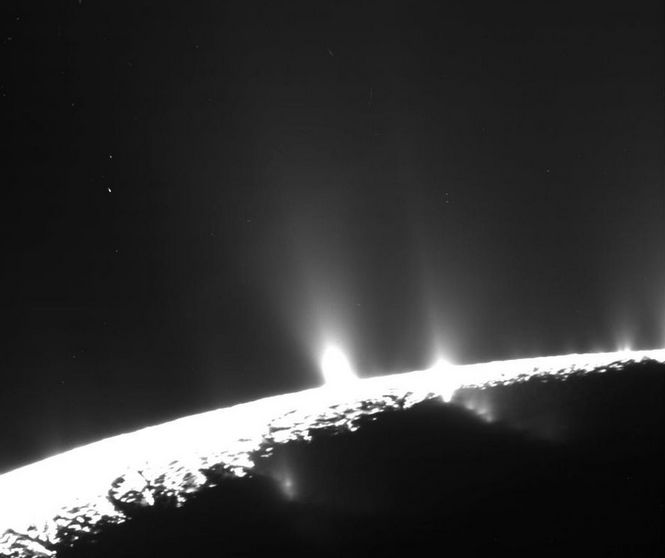
There is only one ring which reveals how it may have been formed, and that’s the high diffuse outer E-ring, centred roughly 240,000 km (149,000 mi) from Saturn. The Cassini mission has revealed this is being built and maintained by active geysers on some of Saturn’s nearer moons – notably Enceladus – which regularly spew vast amounts of water ice particles into space, forming the ring’s thin “haze”.
Cassini’s “ring grazing” orbits mark an unparalleled opportunity to examine the rings in enormous visual detail and the moons which help give them their form, and to sample the rings themselves. But it doesn’t end there.
From late April 2017, through until September, Cassini should embark on its “grand finale”, a last series of 22 orbits which will bring the probe down to just 1,628 km (1,012 mi) above Saturn’s cloud tops, offering an unprecedented opportunity to study the planet’s upper atmosphere right up until its final orbit, on September 15th, 2017.
At that point, its propellants all but spent, the vehicle will be ordered to enter Saturn’s atmosphere where it will burn-up. The move is designed to prevent the uncontrolled vehicle colliding with one of Saturn’s moons in the future and possibly contaminating it with any hardy Earth microbes which may have found their way onto the space probe and which had managed to survive 20+ years in space.

Looking For Life In All The Right Places
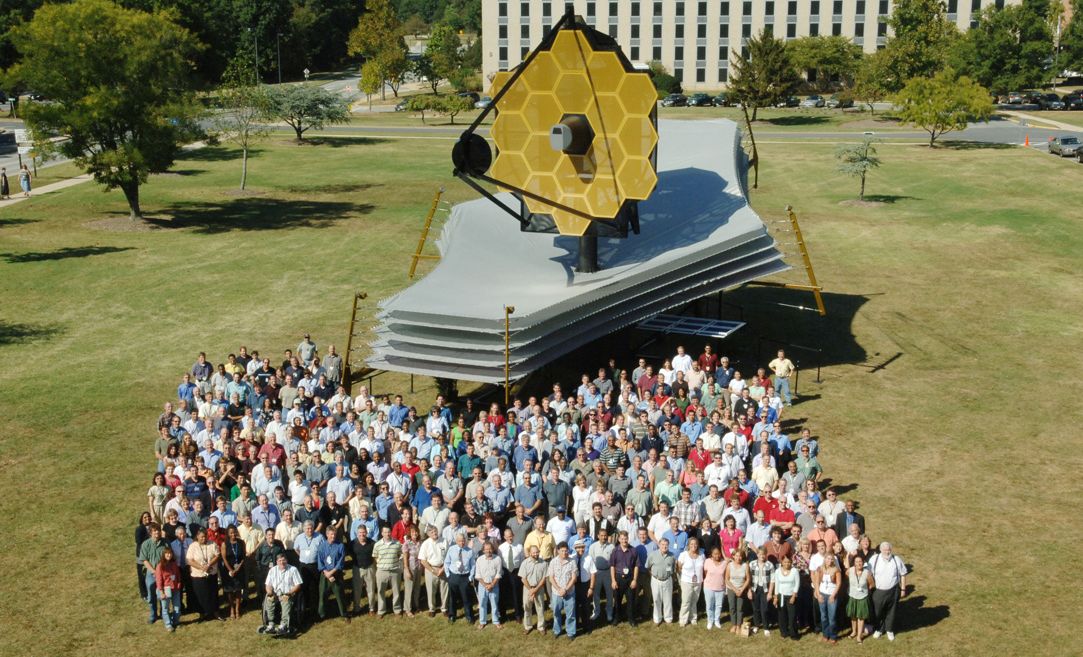
In October 2018, a European Ariane 5 rocket will lift-off from the Guaiana Space Centre, near Kourou, French Guiana. It will be carrying aloft NASA’s James Webb Space Telescope (JWST). With a massive 6.5m diameter (21ft 4in) segmented primary mirror, it is a successor instrument to the Hubble Space Telescope (with a 2.4m (7.9ft) primary mirror) and the Spitzer Space Telescope.
At just half the mass of the Hubble Space Telescope (HST), the JWST will operate near the Earth-Sun L2 (Lagrange) point, approximately 1.5 million km (930,000 mi) beyond the Earth. It has a primary mission lifetime of 5 years, although it is hoped it will operate for around 10. Unlike HST, it will be operating far beyond reach of any repair / upgrade missions, and hasn’t been designed for in-space maintenance. During its mission, it will carry out a huge range of space science and observations, a part of which will involve peering at far-off exoplanets an an attempt to use its on-board instruments to detect any biosignature lurking in their atmospheres which might hint that they host living, breathing organisms.
An incredible amount of data has already been gathered on potential exoplanets through the work of the Kepler Space Observatory, and this is expected to be massively increased with the launch of NASA’s Transiting Exoplanet Survey Satellite (TESS) mission, also scheduled for 2018, (and the subject of a preview in this pages back in August). This being the case, prioritising which potential targets JWST should study, is seen as an important part of its exoplanet mission.
Enter Hubble. Over the course of the next year, NASA’s veritable orbiting telescope will spend hundreds of hours reconnoitring a list of planets to determine which should be passed to the JWST team for initial study.
The focus will be on planets which are roughly comparable in mass and / or size to Earth. Many of these orbit red dwarf stars and are unlikely to support life for assorted reasons (you can read about some of the problems associated with red dwarf stars here). However, a fair number of might have atmospheres, and so warrant a closer look.
Candidate planets to be examined by Hubble include the likes of K2-3d, located 137 light-years away, and K2-18b, 111 light-years away. Both are slightly bigger than Earth, and spectrographic analysis suggests they have hydrogen-rich atmospheres or are completely blanketed by clouds.
Then there is the TRAPPIST-1 system. Named for the instruments used in its discovery, the Transiting Planets and Planetesimals Small Telescope (TRAPPIST), this is a small planetary system just 39 light-years away, comprising three Earth-type rocky planets orbiting an ultra cool dwarf star (officially called 2MASS J23062928-0502285, hence why astronomers informally call it “TRAPPIST-1”).
Two of the planets, TRAPPIST 1b and TRAPPIST 1c, lie within the so-called “Goldilocks zone” around the star,, where conditions might be “just right” for life to start. Most importantly, initial spectrographic studies suggest that both of the worlds may harbour an atmosphere which could range from being very Venus-like in composition through to being a cloud-free water vapour atmosphere. However, both they, and the third planet, TRAPPIST-1d, are liable to be tidally locked with their parent star, limiting their habitable zones considerably and making them potentially subject to huge wind storms.
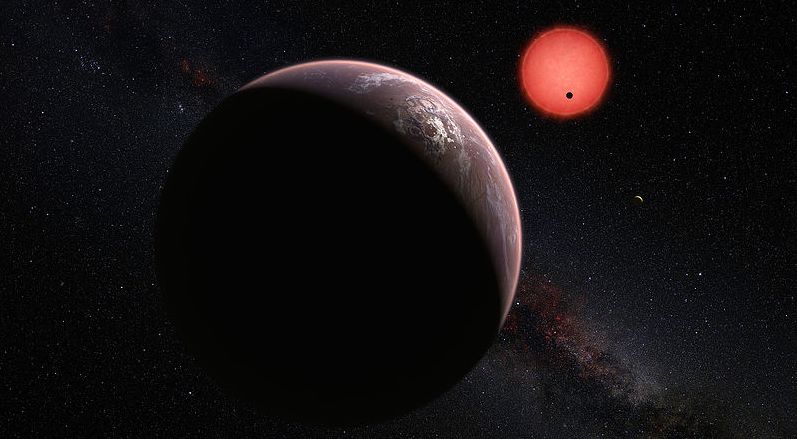
Hubble will examine each of these planets, and the others on its list, for signs of water, methane or ammonia, any of which might increase the chances of JWST finding biosignatures with them, and so mark them as prime candidates for the new telescope once it becomes operational.
Schiaparelli: Computer Glitch likely Caused Loss
On Wednesday, October 19th, 2016, the European Space Agency attempted to place a vehicle in orbit around Mars and land a demonstrator craft on the surface of the planet in preparation for landing a rover there in 2020. As I reported at the time, ESA was successful with the Trace Gas Orbiter, or TGO, but the lander module, called the Schiaparelli, was destroyed when it impacted the surface of Mars after what had otherwise been a flawless entry into the planet’s atmosphere.
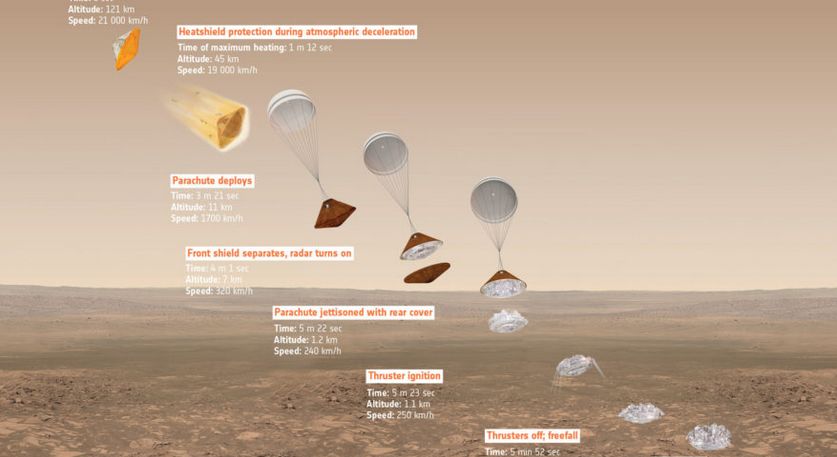
While there is still some further work to be done, the engineers investigating Schiaparelli’s loss believe they have now determined the cause. Essentially, after a flawless entry into the Martian atmosphere and successful parachute deployment, the lander’s Inertial Measurement Unit (IMU), designed to measure the vehicle’s rate of spin during its initial descent through the Martian atmosphere, suffered a software glitch due to the amount of data it received. This resulted in incorrect data to be fed into the landing system computer, generating an error in calculating the vehicle’s altitude. This caused the computer to wrongly calculate the vehicles height, prematurely jettisoning the parachute system, and premature firing the landing thrusters.
These thrusters were designed to fire for a pre-set time, bring the lander down through the final 1.2 km (0.75 mi) of its descent, before cutting out just 2 metres above the ground, allowing Schiaparelli to drop onto the surface of Mars. However, due to the error created by the IMU overload, the motors actually shut down when the vehicle was still at 3.7 km (2.3 mi) altitude, and Schiaparelli went into free-fall, eventually slamming into the ground at an estimated 540 km/h (335 mph), creating a small crater for itself in the process, as imaged by NASA’s Mars Reconnaissance Orbiter on October 20th.
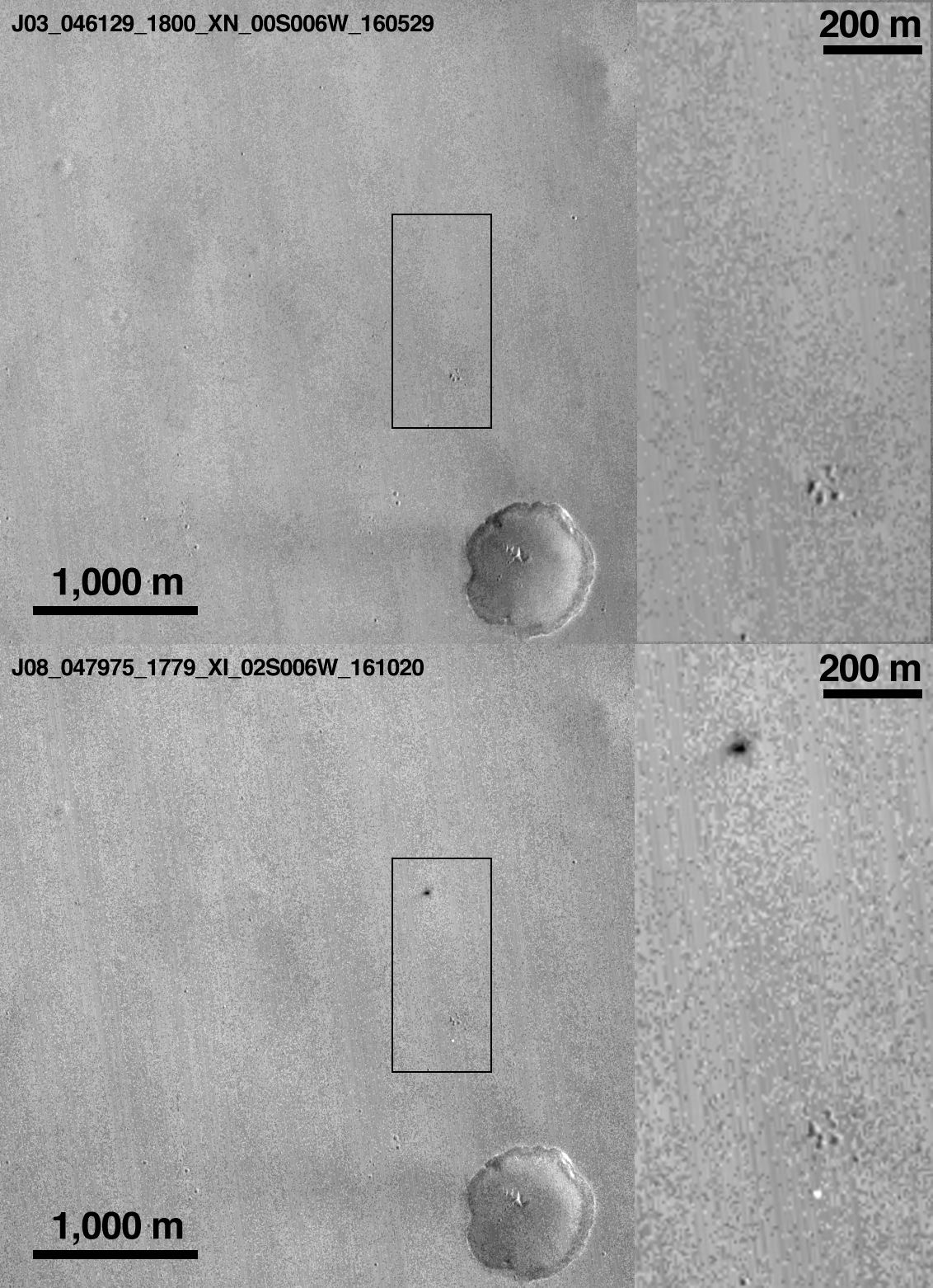
The failure of the IMU still has to be fully verified, but ESA was confident enough to make the initial report into the loss public on Wednesday, November 23rd, 2016. In a statement accompanying the report, the agency indicated that the loss poses no threat to the ExoMars 2020 rover, and the lessons learned from the Schiaparelli loss will be factored into preparations for that mission.

 Inara Pey: Living in a Modemworld