Lab: Faster Credit Processing & Upcoming Changes to Fees

On Monday, March 6th, Linden Lab has published a blog post on faster credit processing and pay-out, together with changes to fee structure for processing credit and paying real money to users’ PayPal and Skrill accounts, and on the fees charged for purchasing L$ on the LindeX. both of these fee changes coming into effect as from Tuesday, April 5th, 2016.

This is an important notification, and one which should be read in full. However, the core changes the Lab are making are quoted below:

Faster Credit Processing

We’re happy to announce that we will significantly improve how quickly we’re able to process a majority of credit requests.

Based on current data, we estimate that the upgrades we’ve made will allow approximately 75% of process credit requests to be completed within 2 business days.

For a minority of requests, the process may still take 5 business days. Because we’re dealing with sending real money to users around the world, we may require additional information and perform other processes that could impact the time needed. A good rule of thumb is that the better we know you as a customer, the more likely it is we’ll be able to quickly process your credit requests.

Changes to the Fee Structure

In addition to taking time, processing credit and paying real money to users’ PayPal and Skrill accounts incurs costs to Linden Lab. Each transaction actually costs us more than the $1 (USD) fee we have been charging. To address that and in light of the significant investments we’ve made to improve the related systems and processes, we will be making some adjustments to the fee structure, beginning next month.

As of April 5, 2016, instead of charging a flat fee of $1 (USD) per transaction, we will charge a fee of 1.5% of the transaction value, with a minimum fee of $3 (USD) and a maximum of $15 (USD). Additionally, the fee for purchasing L$ on the LindeX will increase 10¢, from $0.30 (USD) to $0.40 (USD) per transaction.

Compliance and improved processing has been one of the core focus areas for Linden Lab over the course of that past 12+ months. Work which has involved, among other things, the formation of a subsidiary company, and which is intended to support both Second Life and Project Sansar.  As such, the post from the Lab would seem to indicate the major part of this effort is now complete, and that, as promised through various discussions such as Lab Chat, users will be able to enjoy faster payouts, albeit it with increased fees.

2016 viewer release summaries: week 9

Updates for the week ending Sunday, March 6th

This summary is published every Monday, and is a list of SL viewer / client releases (official and TPV) made during the previous week. When reading it, please note:

  • It is based on my Current Viewer Releases Page, a list of all Second Life viewers and clients that are in popular use (and of which I am aware), and which are recognised as adhering to the TPV Policy. This page includes comprehensive links to download pages, blog notes, release notes, etc., as well as links to any / all reviews of specific viewers / clients made within this blog
  • By its nature, this summary presented here will always be in arrears, please refer to the Current Viewer Release Page for more up-to-date information.

Official LL Viewers

LL Viewer Resources

Third-party Viewers

V4-style

V1-style

  • No updates.

Mobile / Other Clients

  • No updates.

Additional TPV Resources

Related Links

Finnish legends and auroral displays in Second Life

Suomi - Finland; Inara Pey, March 2016, on FlickrSuomi – Finland – click any image for full size

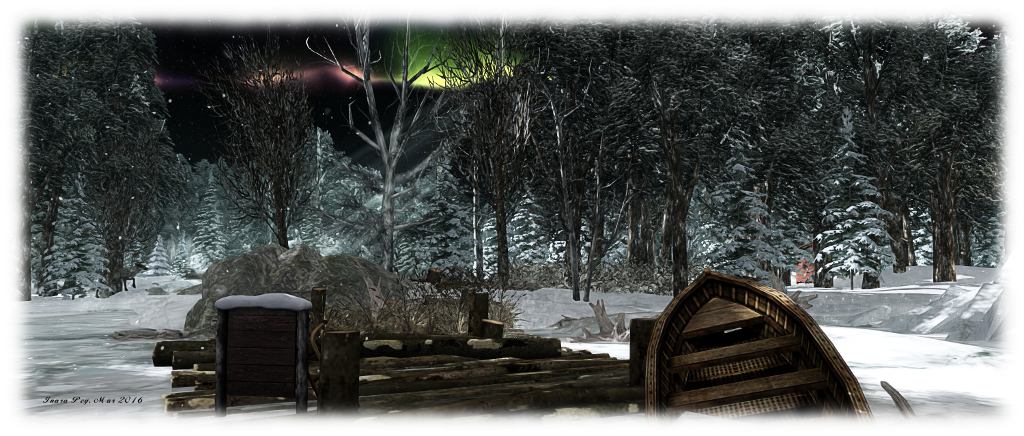
Featured in a recent Destination Guide Highlights blog post from the Lab, is an entry for Suomi-Finland (Finnish for “Our Land”), located on the homestead region of Cubana Bay. The Guide entry describes it as, “a land rich in history, folklore, and natural wonders”, in which visitors are invited to “explore vast forests, long waterways and pristine, frozen wilderness as you chance to stumble upon various interactive and immersive elements meant to educate and inspire. ” Intrigued by the description, Caitlyn and I set out to investigate – and discovered something of a treat.

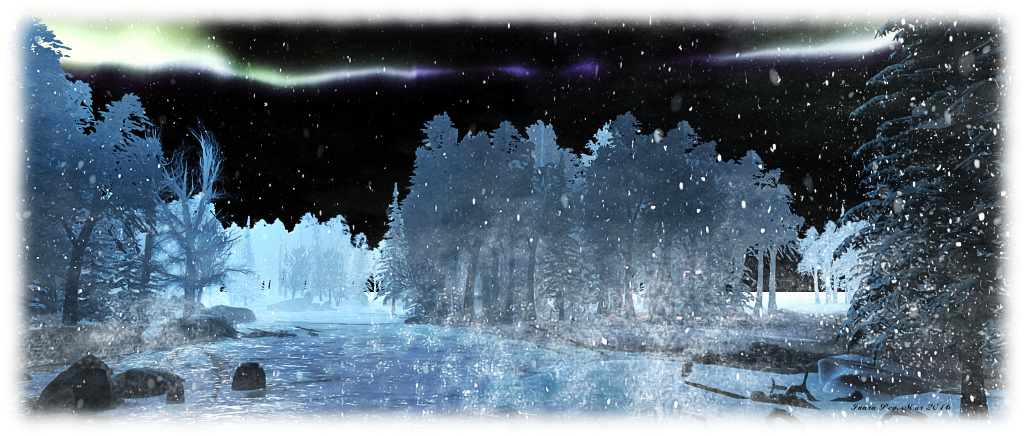
Created by Shen Molinaro and Sighvatr Sturluson, this is indeed an immersive, frozen wilderness. Snow lies deep on the ground, ice sheaths the water channels in many places, and almost the entire landscape sits beneath the boughs of tall fir trees which point to midnight sky around which an auroral display ebbs and flows.

Suomi - Finland; Inara Pey, March 2016, on FlickrSuomi – Finland

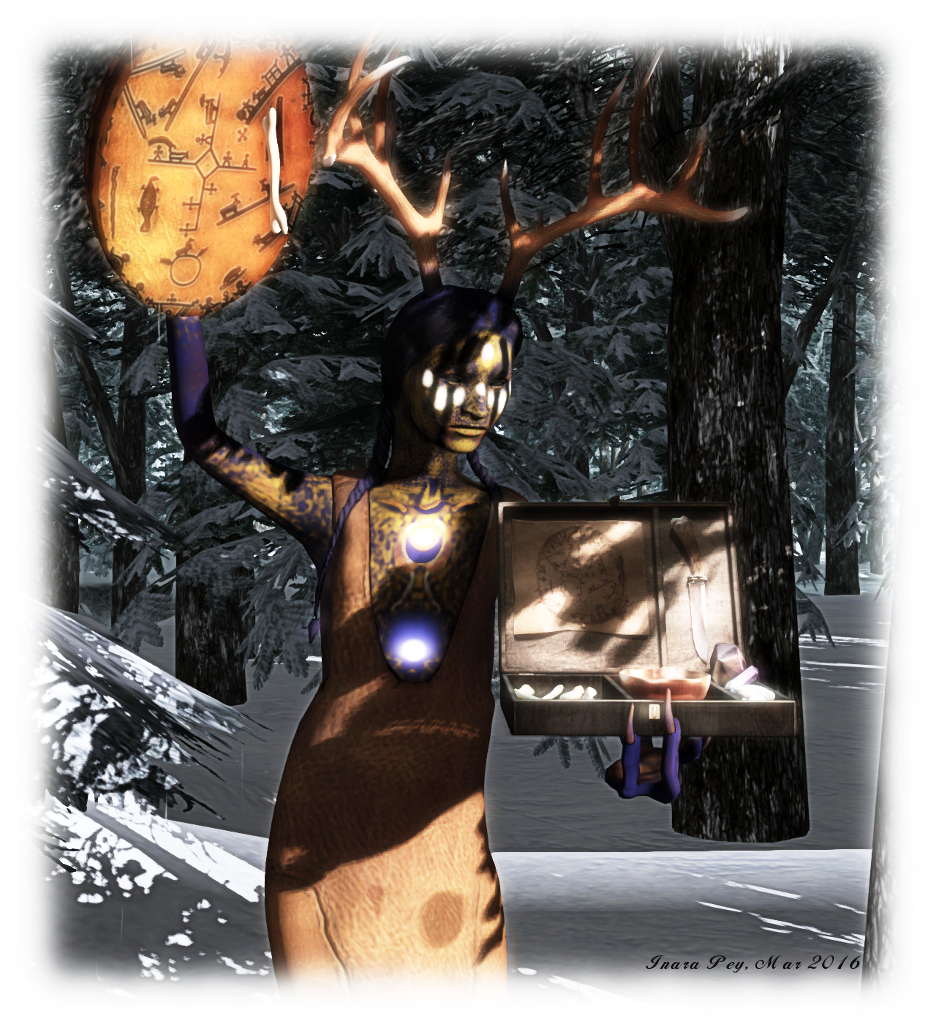
The landing point on the south side of the region should offer you an introductory note card on arrival, and we do recommend you read it, as it sets out what the region is a bout and – as importantly – offers a map of trails and points of interest. Key among the latter is the legend trail,starting at the Sámi camp, which takes you through part of the woods and to a series of small displays, each offering a note card (just touch the shaman drum at each one) on a particular aspect of Finland’s culture and mythology.

Suomi - Finland; Inara Pey, March 2016, on Flickr
Suomi – Finland

The note cards, by Sighvatr Sturluson, present a rich tapestry of Finland’s mythological heritage and are well worth reading either as you find them or later when snuggled up somewhere on the region. Through them, you can learn about the Sámi (Saemieh), the people who populated the Scandinavian peninsula long before other influences took hold. You can also discover something of the mystery of  Sampo, and meet the pantheon of old Finnish gods and discover the roles of elves, gnomes, spirits and cults in old Finnish culture.

But this is not all there is to find here. As the map reveals, there is also a wildlife trail, taking visitors past reindeer (Rangifer tarandus), bear, wolves, and deep into the forests across the semi-frozen streams and rivers. For those who prefer,  the map shows the way to an old pier where sleds can be rezzed to scoot over snow and ice – although I’d personally recommend walking, lest you miss something.

And once the exploring is done and you’re in need of a rest, camp sites can be found offering warmth, rest, and snuggles. Or for the intrepid, there’s a sauna, complete with traditional birch vihta (or vasta in Eastern Finland) for an authentic Finnish sauna experience. Just keep in mind the region is Moderate, so swimming costumes are probably best, particularly if you plan to take a roll in the snow between sauna sessions!

Suomi - Finland; Inara Pey, March 2016, on FlickrSuomi – Finland – click any image for full size

Suomi-Finland is a  beautiful design; simple but elegant, and offering the opportunity to dip oneself in the culture and ancient beliefs of another country whilst exploring it. When visiting, I would recommend using the region windlight, as suggested in the introductory notes, but would also suggest that you don’t let the recommendation to use Ultra graphics put you off; Caitlyn’s laptop tends to teeter on the edge of a major collapse if pushed much beyond Mid settings, for example, and she still found the region captivating.

SLurl Details

Space Sunday: the Martian tilt and Plutonian clouds

Tethys, Enceladus and Mimas seen above and blow Saturn's rings in a stunning image captured by the NASA / ESA Cassini mission, released on February 22nd, 2016. - are captured in this group photo from NASA's Cassini spacecraft released on Feb. 22. Tethys (660 miles across) appears above the rings, while Enceladus (313 miles across) sits just below center. Mimas (246 miles across) hangs below and to the left of Enceladus. This view looks toward the sunlit side of the rings and was acquired at a distance of approximately 837,000 miles from Enceladus.
Tethys, Enceladus and Mimas seen above and blow Saturn’s rings in a stunning image captured by the NASA / ESA Cassini mission, released on February 22nd, 2016. Tethys, 1056 km (660 mi) in diameter appears above the rings, with  Enceladus, 501 km (313 mi) across, just below them with Mimas, 393.6 km (246 mi) across below and to the left of Enceladus. Looking towards the sunlit side of the rings and was acquired at a distance of approx 1,339,000 km (837,000 mi) from Enceladus (credit: NASA / JPL)

The Sliding Surface of Mars

We’re all familiar with images of the surface of Mars, with the Tharsis volcanoes straddling the equator and the great gash of the Vallis Marineris just to the south. It’s a view seen in many orbital images of the planet, and one thought to have been more-or-less representative of the topography of Mars from the earliest times.

However, new studies by geomorphologists, geophysicists and climatologists led by a team of French scientists, suggest that the surface of the planet underwent a gigantic “tilt” of between 20 to 25 degrees some 3 to 3.5 billion years ago, drastically altering its appearance whilst also offering an explanation for one of the mysteries of Mars.

Mars as we know it today, Arsia Mons, Pavonis Mons, and Ascraeus Mons straddling the equator
Mars as we know it today, Arsia Mons, Pavonis Mons, and Ascraeus Mons straddling the equator, and part of the Tharsis Bulge, with massive Olympus Mons further to the north and west, and the gash of the Vallis Marineris to the south and east

While a process known as variations of obliquity can cause a planet’s axial tilt to shift  over large periods of time (Earth’s axial tilt of 23.4° is decreasing at the rate of about 47 minutes of arc per century, for example), this is not the cause of Mars’ shifting “face”. Rather it is the result of the massive Tharsis Bulge.

The largest volcanic dome in the solar system, Tharsis is a plateau some 5,000 km (3,125 mi) across and around 12 km (7.5 mi) thick, topped by the massive volcanoes of Tharis Montes: Arsia Mons, Pavonis Mons, and Ascraeus Mons. It formed over a period of roughly half a billion to a billion years, commencing around 3.7 billion years ago.

The French research suggests that as the Tharsis Bulge grew as a result of volcanic activity, so it gained considerable mass – perhaps a billion billion tonnes), which caused the crust and mantle of the planet to “slip” around the core, rather like turning the flesh of an apricot around its stone. Thus, Tharsis appears to have “dropped” to the equator from a latitude of around 20 degrees north, completely changing the face of Mars during its first 1 to 1.5 billion years of history – the time at which life might have arisen, if it arose at all.

Mars as it may have appeared around 3.5-3.7 years ago, prior to the Tharsis Bulge forming
Mars as it may have appeared around 3.5-3.7 years ago, prior to the Tharsis Bulge forming (credit: Didier Florentz, Université Paris-Sud)

While such a slippage had previously been suggested, notably through the work of Isamu Matsuyama of the University of Arizona in 2010, the French study is the first to offer definitive geomorphological evidence that this is the case. One of the major outcomes of the work is that it explains why Mars has huge and seemingly anomalous underground reservoirs of water ice located far from the poles. As the mantle and crust shifted, so they carried the frozen land which originally lay over the poles away from them, complete with the subsurface water and ice.

Overall, the study radically alters the generally accepted chronology of Mars, which has Tharsis forming before the before the widespread creation of rivers and water channels on Mars. now it appears that Tharsis formed at a time congruent with the existence of liquid water on Mars and the formation of river valleys and other water features. Thus, the volcanic activity on Tharsis may have actually contributed to the period of liquid stability on the planet.

The Methane Snows and Particle Clouds of Pluto

 enhanced color image is about 2,230 feet (680 meters) per pixel. The image measures approximately 280 miles (450 kilometers) long by 140 miles (225 kilometers) wide. It was obtained by New Horizons at a range of approximately 21,100 miles (33,900 kilometers) from Pluto, about 45 minutes before the spacecraft’s closest approach to Pluto on July 14, 2015.
Captured from a distance of 33,900 km (21,000 mi) from the point of closest approach to Pluto on July 14th, 2015, this New Horizons enhanced colour image reveals the ice-capped mountains of “Cthulhu Regio” in a strip some 450 x 225 km (280 x 140 mi). The image was taken about 45 minutes prior to closest approach (NASA/JPL / DHU?APL / SwRI)

The New Horizons team has discovered a chain of exotic snowcapped mountains stretching across the dark expanse on Pluto informally named “Cthulhu Regio”, one of the minor planet’s more identifiable features, and which stretches almost halfway around Pluto equator, some 3,000 km (1,850 mi) in length and some 750 km (450 mi) across, with one end abutting the ice-covered flats of “Sputnik Planum” I’ve previously written about in my coverage of New Horizons.

The high-resolution images show a mountain range in approximately 420 km ( 260 mi) long, the highest slopes of which are coated with a bright material that contrasts sharply with the dark red of the more usual dark red colouring of the region (thought to be the result of dark tholins, complex molecules initially formed by the reaction of methane and sunlight high in Pluto’s atmosphere, coating much of “Cthulhu Regio”. Scientists believe the white material could be methane which has condensed out of Pluto’s tenuous atmosphere to form ice, coating the peaks, much as ice can condense out of cold air on Earth to form frost. There has even been speculation that the white material is the result of methane ice condensing as “snow” and falling across the peaks.

Continue reading “Space Sunday: the Martian tilt and Plutonian clouds”

Kidnappings, priests, harmonicas and faeries

It’s time to kick-off a week of story-telling in voice, brought to our virtual lives by the staff and volunteers at the Seanchai Library. As always, all times SLT, and events are held at the Library’s Second Life home at Bradley University, unless otherwise indicated.

Sunday, March 6th

13:30 Crazy Eights: Tea Time at Baker Street

Crazy Eights sees Caledonia, Corwyn and Kayden reading from The Return of Sherlock Holmes every Sunday from the living room of 221B Baker Street. Holmes-return

There has been a kidnapping in the north of England. The ten-year-old Lord Saltire, son of the Duke of Holdernesse, has vanished from his school, along with one of the masters teaching there. And while no ransom note has been received, the boy’s father has issued rewards of up to £6,000 for information on the whereabouts of his son or for information on his kidnappers.

Dr. Thorneycroft Huxtable, founder and principal of the school, fearing for the boy, seeks out Holmes in London to seek his help in discovering what has happened, and to hopefully locate the young heir.

So Holmes and Watson set off on The Adventure of the Priory School, a case that leads them not only to uncover the tangled reasons behind the young Lord Saltire’s disappearance, but which also uncovers a murder most foul, and leaves one man facing the gallows…

18:00 Magicland Park: Gorak the Gobbler

An original tale written and read by Caledonia Skytower.

Monday March 7th 19:00: A Few Miles and Prometheus

carmodyGyro Muggins commences a 3-part reading of tales concerning one of Philip José Farmer’s many memorable characters: Father John Carmody, and ex-con who painfully grew a conscience, but is still not entirely beyond benefiting himself.

In A Few Miles, first published in The Magazine of Fantasy and Science Fiction, Carmody is ordered to the planet Wildenwoolly (think about it 🙂 ), but is given no funds for his journey and must therefore find his own way there. This proves taxing, with even reaching the space station where he might gain passage to his intended destination proving problematic. So problematic, in fact that he ends up “expregnated” by a large earthbound bird called a horowitz.

With the egg now attached to his chest until such time as it hatches, Carmody finds himself the centre of scientific curiosity and study, something that might well allow him to achieve passage to Wildenwoolly under a lot more comfortable circumstances than he’d envisaged when first dispatched by the priesthood. However, as told in the sequel Prometheus, things take a bit of a right turn when he finds himself on Feral, the planet of the horowitzes, and cast in the role of educator for these strange birds, and as a sort of latter-day Prometheus, bringing them moral enlightenment.

Tuesday March 8th, 19:00: Echo

EchoCaledonia Skytower reads Pam Muñoz Ryan’s Newbery Honour novel.

Three entwined stories focusing on a magical harmonica, start with the tale of 12-year-old German boy Friedrich. He dreams of being a conductor; so much so that he cannot stop his hands rising to guide the music only he can hear. Such public displays, coupled with the birthmark which disfigures half his face leads to him being shunned and regarded as his peers as being Monster Boy. But then the harmonica enter his life, bringing with it change and hope.

Two years later, and at the Bishop’s Home for Friendless and Destitute Children in  Pennsylvania, 11-year-old Mike Flannery finds himself in possession of the harmonica. He and his younger brother are adopted by the  wealthy Mrs. Sturbridge – only she doesn’t intend to keep them, but will have them separated and one of them set to another state home. Only the harmonica might offer Mike a way to secure his brother a place in the comfort and luxury of the Surbridge household.

Wednesday March 9th 19:00 Crazy Eights: The Hunter’s Moon

HuntersAoife Lorefield continues reading the second in the Crazy Eights series of monthly Featured books

When she arrives in Ireland to visit her cousin Findabhair (Finn), American Gwen expects a fun backpacking trip to sites of the fairy lore they’re both fascinated with. What neither cousin knows is that it’s the summer of the Hunter’s Moon, a dangerous time for mortals to meddle in the kingdom of Faerie.

Whilst camping out, Finn is kidnapped by the handsome Faerie king, and Gwen must rescue her. In attempting to do so, she travels between modern-day and mystical Ireland. And when she does finally reach Finn, she finds her biggest challenge might be actually persuading her cousin she is in need of rescue!

Thursday, March 10th

19:00 Drabne of Dole

Shandon Loring brings us another tale about the formative years of legendary giant Finn McCool – Fionn mac Cumhaill – the mythical hunter / warrior who appears in folklore spanning Ireland.

21:00 Seanchai Late Night

Contemporary science-fiction with Finn Zeddmore.

Friday, March 11th: VWBPE presentation

Caledonia Skytower will be presenting Putting the Language Back Into language Arts Engagement at the 2016 Virtual Worlds Best Practices in Education Conference  at 17:00 SLT on Friday, March 11th, at Idahionia – the University of Idaho.

—–

Please check with the Seanchai Library SL’s blog for updates and for additions or changes to the week’s schedule.

The featured charity for March  / April is Project Children, building peace in Ireland one child at a time.

Additional Links

Kokua 4.0.1.37934

kokua-logoNicky Perian announced the release of Kokua 4.0.1.37934 on Tuesday, March 1st 2016.

The update sees Kokua gain parity with the latest release version of the viewer from Linden Lab (version 4.0.1.310054 (Maintenance release) at the time of writing), and also with the February 26th release of RLV version 2.9.16 from Marine Kelley.

Not that if you are currently still using a test version of the viewer, the automatic update feature will not function. A separate download and install is required.

CEF Updates

This release incorporates the Chromium Embedded Framework (CEF) updates for media from the Lab, as well as the assorted crash and bug fixes from the Maintenance release. Also included for CEF are a series of contributed updates for Linux, coming by way of Drakeo and including work by Nicky Dasmijn of Firestorm and Henri Beauchamp of CoolVL. Commenting on this, Nicky points out:

Drakeo’s development focus is media and providing Slackware viewer packages. Upstream CEF frequently issues security updates and Drakeo puts those into his own Slackware packaged viewers and contributes updates to Kokua. These security updates from CEF come more often than the Kokua release cycle, however, our Test viewers can be used to maintain a level of currency. Please remember that Linux viewers are Alpha and that is even more the case now that we no longer have the benefit of Linden Lab’s Quality Assurance run through of new features added to Linux viewers. We do our best to provide stable Linux viewers, but with the vast number of Linux distributions problems will occur that may not have timely solutions.

Inventory Updates

Transferable Items Filter

Kokua 4.0.1 includes a new Transferable Items Only inventory search filter. When active, this will limit the main inventory display to transfer enabled items only.

To prevent possible confusion / worry about inventory loss, the option does not persist between log-in sessions when enabled.

The new Transferable Items Only filter for inventory searches
The new Transferable Items Only filter will display only those items which are transfer enabled in your inventory

OpenSim Exportable Parameter

Kokua 4.0.1 adds an Exportable parameter to the Item Profile floater for OpenSim grids, allowing content creators to easily mark items they build as being exportable to other grids. The option is not displayed by the floater when logged-in to Second Life.

The OpenSim only Exportable parameter

Do Not Let Me Fly

A new option added to Preferences  > Kokua and to the Commands menu is Do Not Let Me Fly. As the name suggests, when checked, it prevents your avatar from flying even where flying is enabled.  The option is specifically intended for use in combat zones where flying within the region may still be enabled, to prevent any risk of accidentally flying (such as when jumping an obstacle) and interrupting the combat flow.

The Do Not Fly option will prevent you avatar for accidentally flying whilst still allowing Page Up to be used for jumping
The Do Not Let Me Fly option will prevent you avatar for accidentally flying whilst still allowing Page Up to be used for jumping

Under the Hood

In addition to the above, the release includes numerous under the hood improvements and updates, all of which are listed in the downloadable change log for those interested.

Related Links