For those who – like me – enjoy thunderstorms and seeing the sky lit by forks and shafts of lightning arcing down from the sky, Sommergewitter (“summer thunder”) designed by Nida (Nidatine) and Seraph Nirvana, is a must see.
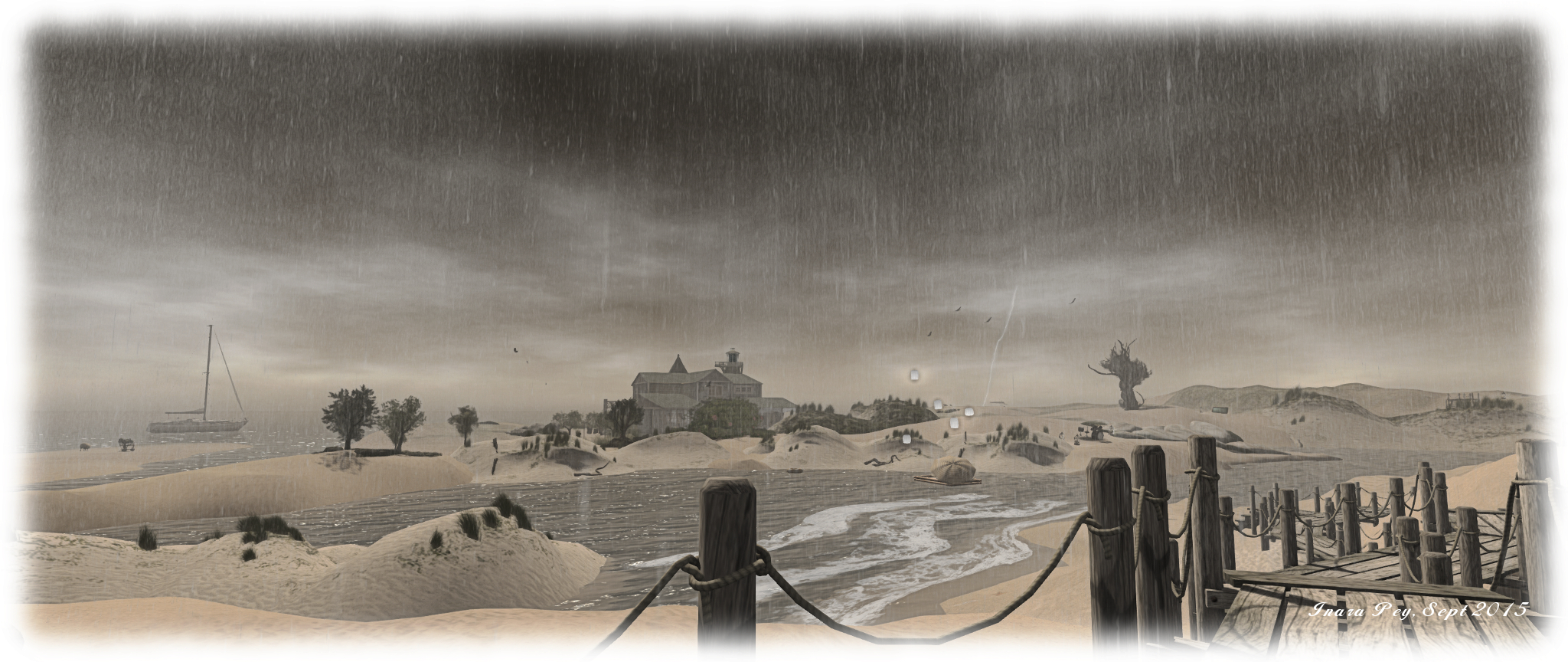
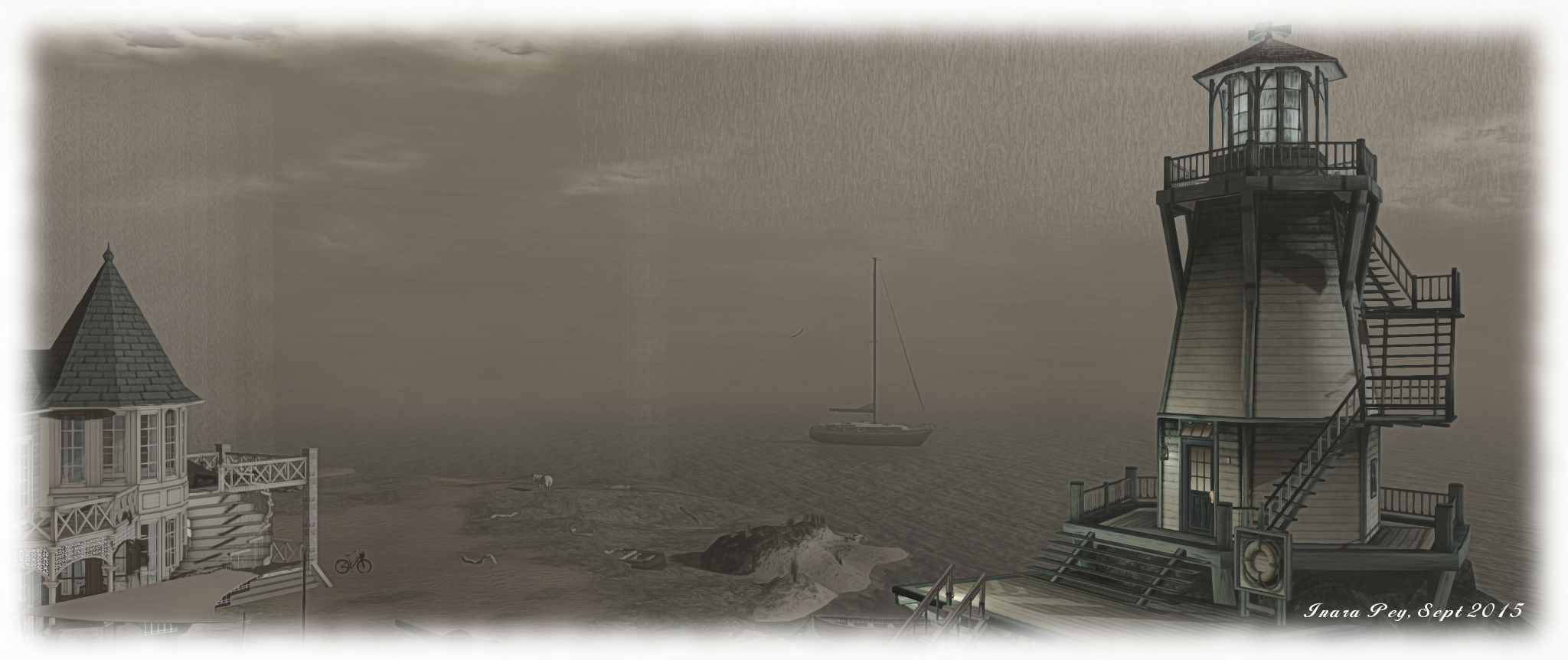
On arrival, you’ll find yourself in what feels like a low-lying coastal region of gently undulating sand and grass capped rolling dunes. Scattered across the three islands into which the region has been split are a number of buildings – a large house and lighthouse close by the landing point on the largest island, and a houseboat and a large, modern pier-style house sitting on or alongside the other islands, which can be reached by wading, rowing boat or a solar-powered catamaran (handy if you are travelling in a group).
All of this sits under a yellow/grey sky (which I’ve taken the liberty of darkening in some of these shots), from which rain falls over much – but not all – of the land, and from which lightning periodically forks to strike the ground or, when seen from a distance, forms a flickering sheet of light through the mist of rain.
The result is a captivating scene, rich in atmosphere and look – a photographer’s delight. Nor does it end there, wander the island, and you’ll come across strange curios and scenes, including pianos standing out on the dunes, a drum kit near the water’s edge, a lone table set for afternoon tea, and an easel and painting kit, apparently hastily abandoned when a downpour started directly overhead.
Not all of the region is caught under a blanket of rain; travel west and north and you’ll find the beach pleasantly free of vertically arranged water, offering plenty of spots to sit and enjoy the sun while looking out over water of the more horizontal variety. Or if you prefer, you can head indoors and find sitting and snuggling spots where you can feel cosy.
For my part, I simply wandered through the rain, enjoying the storm while avoiding the lightning strikes (which oddly didn’t appear to bother the local sheep too much, despite a series of strikes occurring quite close to them!). This is a lovely setting, quite beautiful in its looks and deceptively simple in its approach; a place that allows something of nature’s own beauty to speak for itself through a coastal summer storm.
Tuesday, September 8th, 2015 marks the opening of this month’s art exhibition at The Living Room, and for September, Owl and Daallee are presenting the work of not one, but four talents from Second Life, with the gallery space also undergoing a remodelling as well.
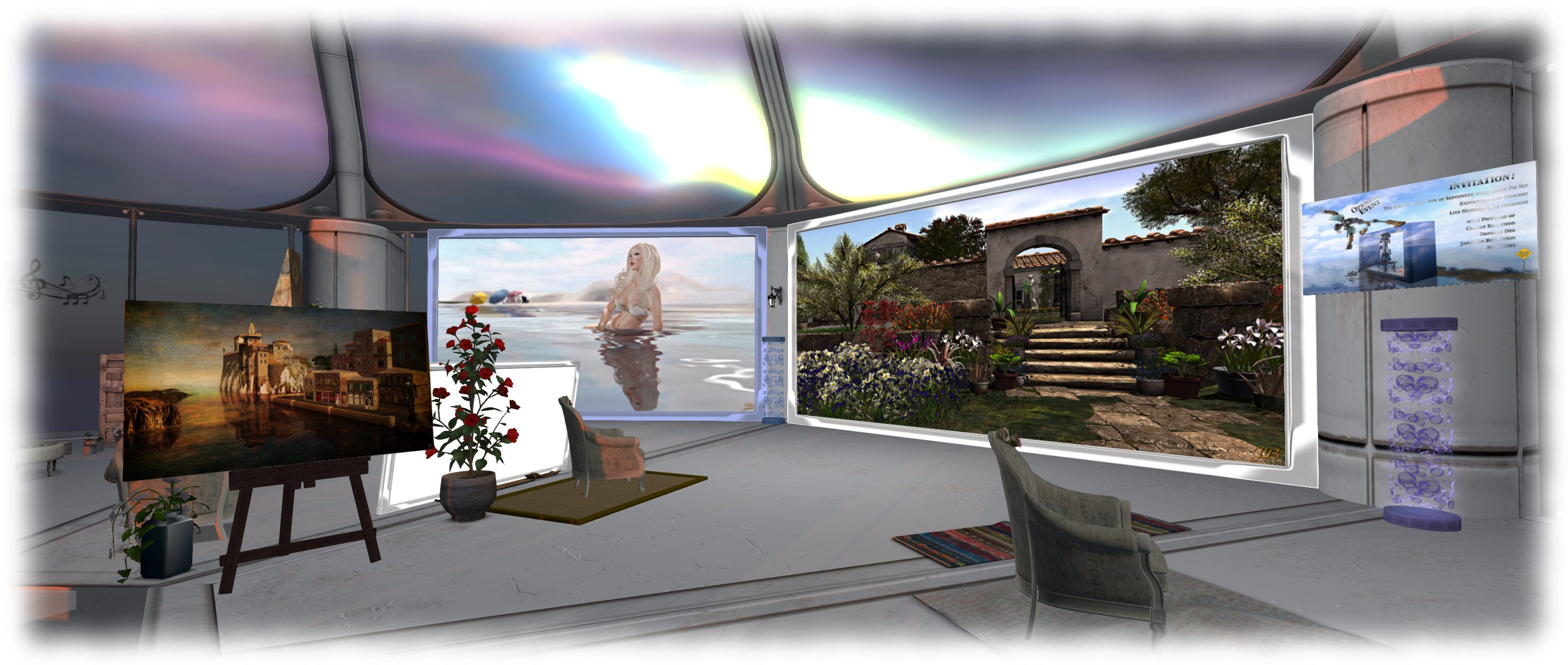
On offer through until the end of the month are selected works by CK Ballyhoo, Jamisson Burnstein, DanelleDee, and someone whose artistry I’ve long admired and enjoyed: Nico Time. All offer an intriguing mix of styles and content, both from Second Life and the physical world, making this month’s exhibition a multi-faceted event.
On the gallery’s upper level, CK presents a series of images entitled SL Skies. As the name suggests, this presents a series of skyscapes captured by the artist, who notes of them, “no filters have been used except for the black and whites, to put an emphasis on the clouds.” The result is a set of pictures, some individual, some paired, all displayed in their own little settings, each of which has been created to match the scene captured within the image itself.
Occupying the same level as CK, Jamisson offers images he’s captured during his explorations of Second Life. These are centred on three large format slide show screens, each of which slowly runs through a set of images loaded within it, depicting not only places but people as well. The pace of progress is such that each image can be fully and properly appreciated before the next fades into view.
Jamisson notes that he rarely exhibits his work in-world, “But The Living Room is a special place – so I am honoured to show some of my pictures here.” He’s absolutely right on his observation about The living Room, and on the strength of the pieces he is displaying I’d certainly like to see his work gracing more galleries.
On the lower level gallery area, Danelle presents a selection of her art from physical world. These are a mix of black-and-white and colour drawings and pictures, some with a distinctly geometric feel to them, some more abstract and others encompassing subjects such as fruit, sailing boats and butterflies. Having only joined Second Life in 2014, Danelle notes that she has found that her involvement in-world has both helped in her personal growth and encouraged her to express herself more fully; I empathise.
Alongside of Danelle’s display is Nico’s. I’ll be the first to admit this review is perhaps a tad biased towards him given I’ve included two images of his display. However, I simply cannot help it; I’ve long admired his work through Flickr, the SL feeds, Avatar Social Network, etc. He has, to me, a marvellous eye for composition, colour and presentation, and I’m delighted to see his work appear at The Living Room.
The exhibition will officially open at 12:00 noon SLT on Tuesday, September 8th, with a party featuring music by Joe Paravane. There will also be a closing party at 23:00 SLT on September 29th, featuring Matthew Perrault.
And don’t forget The Living Room’s monthly live music party, which for September is set for the 17th, and features Bat Masters at 17:00 SLT, followed by Lyndon Heart at 18:00.
Updates for the week ending: Sunday, September 6th
This summary is published every Monday, and is a list of SL viewer / client releases (official and TPV) made during the previous week. When reading it, please note:
It is based on my Current Viewer Releases Page, a list of all Second Life viewers and clients that are in popular use (and of which I am aware), and which are recognised as adhering to the TPV Policy. This page includes comprehensive links to download pages, blog notes, release notes, etc., as well as links to any / all reviews of specific viewers / clients made within this blog
By its nature, this summary presented here will always be in arrears, please refer to the Current Viewer Release Page for more up-to-date information.
Importer RC viewer updated to version 3.8.4.304605 on September 1st – improved mesh uploader and additional debugging output (download and release notes)
Project viewers:
Quick Graphics project viewer updated to version 3.8.4.304761, on September 3 – provides the new Avatar Complexity options and new graphics preset capabilities for setting, saving and restoring graphic settings for use in difference environments / circumstances (download and release notes)
It’s been a little quiet on the new images front where the New Horizons mission is concerned. The spacecraft, which performed the first ever flyby of Pluto and Charon in July, gathered a wealth of data, around 95% of which has remained aboard the spacecraft awaiting transmission back to Earth.
There have been a number of reasons this has been the case. First off, for the period following the close encounter, New Horizons continued to gather data and images of the Pluto-Charon system. Such is the design of the vehicle that while doing this, it couldn’t actually transmit information back to Earth. Also, once the data had been gathered it required sorting and prioritising ready for transmission back to Earth, and this again took time to do.
However, on Saturday, September 5th, New Horizons oriented itself to make contact with the Deep Space Network (DSN) operated by NASA for what was the start of a year-long “intensive” download of the 10 gigabits of data gathered by the craft, starting with information the science team regard as the highest priority data sets.
The reason the transfer will take so long is not only because the enormous distance between New Horizons and Earth, which takes radio signals moving at the speed of light over 4.5 hours to cross (a time which is slowly increasing), but also because the rate at which the data can be transmitted is limited.
Currently, the nuclear “battery” powering New Horizons can only produce around 2-10 watts of electrical power, which has to keep all of the various electrical systems warm and running. So to conserve power, the vehicle only transmits data at between 2-4 kbps. To put that in perspective, it would take you about 2 hours to download a single photo from your cellphone to your computer at those speeds.
NASA Deep Space Network (DSN) is a set of three communications facilities operated by NASA in Spain, Australia (shown above) and California. They are tasked with maintaining communications with NASA’s deep space and planetary missions. Located roughly 120-degrees apart around the Earth, the three facilities can between them maintain a constant radio observation on any spacecraft under their command as the Earth rotates.
Discussing the start of the extended data download from New Horizons, Alan Stern, the mission’s Principal Investigator, said, “this is what we came for – these images, spectra and other data types that are going to help us understand the origin and the evolution of the Pluto system for the first time.”
He continued, “and what’s coming is not just the remaining 95 percent of the data that’s still aboard the spacecraft – it’s the best datasets, the highest-resolution images and spectra, the most important atmospheric datasets, and more. It’s a treasure trove.”
To mark the receipt of data and images, NASA / JPL and John Hopkins’ APL have designated Friday as Pluto Friday, when they’ll be publishing that latest images, unprocessed, received from the spacecraft the previous week. The images will be available on the LORRI image catalogue, operated by JHU / APL, starting on Friday, September 11th, 2015.
In the meantime, here’s an animated video from NASA, showing the Pluto flyby, just to whet appetites.
Mars’ Atmosphere: Where did It Go?
One of the many mysteries of Mars is what happened to its atmosphere. All of the evidence gathered over the years about the Red Planet is that it once had an atmosphere dense enough to support free-flowing liquid water, and that potentially as much of 20% of the planet’s surface may have been submerged.
So what happened? There are a number of theories. One of these is that over time, the action of the solar wind, combined with Mars’ relatively weak gravity, effectively “scooped” much of the atmosphere away into space. Measurements of heavy and light carbon ratios in the present day atmosphere lend considerable weight to this theory.
An artist’s impression of what a wet Mars may have looked like, based on the ratio of deuterium contained within the Martian polar caps
Another idea is that carbon dioxide, the major constituent of Mars’ atmosphere may have been “sequestered” – that is, “pulled” out of the atmosphere to be stored in rocks and subsurface deposits by various chemical reactions, forming carbonate minerals in the process.
This theory was given its own boost when a region of Mars called Nili Fossae, approximately as big as the US state of Arizona, was found to have huge deposits of carbonates (more recently this region has been of interest to scientists due to the discovery of impact glass, helping to mark the region as a candidate target for the Mars 2020 rover mission).
It’s time to kick-off another week of fabulous story-telling in voice, brought to our virtual lives by the staff and volunteers at the Seanchai Library. As always, all times SLT, and events are held at the Library’s Second Life home at Bradley University, unless otherwise indicated.
Sunday, September 6th 19:00: a Trio of Irish Tales II
“A Trio of Irish Tales is by far my best-selling collection, ever,” Caledonia Skytower says of her 2013 title. “Finally, the much promised second volume of stories is well on its way to completion.
“More stories, more adventure, history, romance and mythology. Three modern tales steeped in the lore of an ancient land. A Trio of Irish Tales II will call to your Celtic soul, even if you never thought you had one.”
Join Cale as she reads from The Fairy Tree reuniting with young Liam Killough last seen in The Shadow by the Gate. He and his family have settled into life in rural County Wicklow, but Liam is at continual odds with farm manager Rose McLane. The tension has been mounting and explodes with unexpected results, leaving young Liam desperate to set things to rights again.
Monday September 7th, 19:00: Solis
Gyro Muggins continues reading of Alfred Angelo Attanasio’s 1994 thought-provoking novel Solis.
What happens when you gamble your own future on the far future, and opt to have your head and brain frozen in the hope that one day, perhaps centuries to come, it – you can be revived?
That’s exactly what Charles Otis decided to do – only things don’t turn out so well. Found discarded but still in a cryonic state, his brain is purchased sans head and installed in a deep space ore carrier as its primary processor.
Until, that is, he is discovered and rescued by those sympathetic to his plight. And so the story takes a turn to matters of the legal status of a disembodied brain, restored for a specific purpose and of unknown origin; paid for, and – at least they would have it – owned by the corporation that purchased the brain, and which has little interest in any past identity the brain might have had.
Tuesday September 8th,19:00 Not That It Matters
AA Milne by Howard Coster, 1926
Corwyn Allen continues to read AA Milne’s 1919 collection of humorous essays. Best known for his tales of Wnnie the Pooh, Christopher Robin and the 100 acre Wood, Milne in fact wrote widely in bother fiction and non-fiction.
Here he passes observation on wide range of topics, starting with a reflection upon his own writing, “Sometimes when the printer is waiting for an article which really should have been sent to him the day before, I sit at my desk and wonder if there is any possible subject in the whole world upon which I can possibly find anything to say.”
With considerations ranging from why a gentleman’s collar might squeak, or the fact that Isaiah most certainly didn’t carry a notebook, with assorted thoughts on goldfish and daffodils along the way, this is a book of essays wide-range in topic and content. Some of it may, nigh-on a century since the essays first appeared in this book, appear dated and as solidly dated and trapped forever in the opening decades of the 20th century. Other are perhaps as relevant today in their insights and commentary as they were when freshly written. All of them come with Milne’s familiar humour and jovial observations.
Wednesday September 9th 19:00: The Penderwicks on Gardam Street
Caledonia Skytower opens the pages of Jeanne Birdsall’s 2014 volume about the Penderwick family, the second in the series.
When the four Penderwick sisters learn that, encouraged by his sister-in-law and the wishes of their late mother, their father is going to start meeting other women, they fear the worst, and so enact the Save Daddy Plan. They set their Dad up with dates he won’t get on with, while he, also not overly convinced of things, goes out on pretend dates.
However, things start to change as the sisters meet and get to know Ben from next door, and his mum, Iantha. Added to the mix the adventures and challenges each of the four sisters face, and it turns out to be quite a series of events and changes for the Penderwicks – one of them very much turning out for the best.
Thursday, September 10th: The End – Visions of the Apocalypse
With Shandon Loring.
Saturday, September 12th: Star Wars Saturday at Seanchai Kitely
“So, where were you in 1977? Do you remember the first time you saw the first film? The first 25 times you saw the first film? Maybe you have never seen it at all.”
Join Caledonia and Shandon at Seanchai Kitely’s space world as they inform you, “these are the stories you’ve been looking for,” while opening a volume penned by the grand master Jedi himself, George Lucas.
(grid.kitely.com:8002/Spaceworld)
—–
Please check with the Seanchai Library SL’s blog for updates and for additions or changes to the week’s schedule. The featured charity for August / September is Water for People, “When one person or one family has clean, accessible water, their lives are changed. But when entire regions and countries have water, the world is changed.”
On Saturday, September 5th, Bright Canopy held an in-world meeting and their island in Second Life to discuss recent events regarding the Bright Canopy service (you can read the background here).
In particular, the aim of the meeting was for the Bright Canopy team to share what they’ve learned since moving to launch the service on August 29th, and discuss the options needed to make the service sustainable going forward.
Both Bill and Jerri Glover (Chaos Priestman and Beth (Bethsael) Robbiani in SL) were present at the meeting, which was held in text, and a transcript of the chat log is available on the Bright Canopy website. What follows here is a high-level summary.
The meeting opened with Chaos providing some historical context of how Bright Canopy came into being, paying particular attention to how the service is structured, as this is important to grasp. In summary:
Bright Canopy manage the service and take the viewer and tweak it to run as a part of a cloud service
This delivery via Amazon is facilitated by Frame, a company with considerable experience in provisioning optimised Windows applications to users via the cloud.
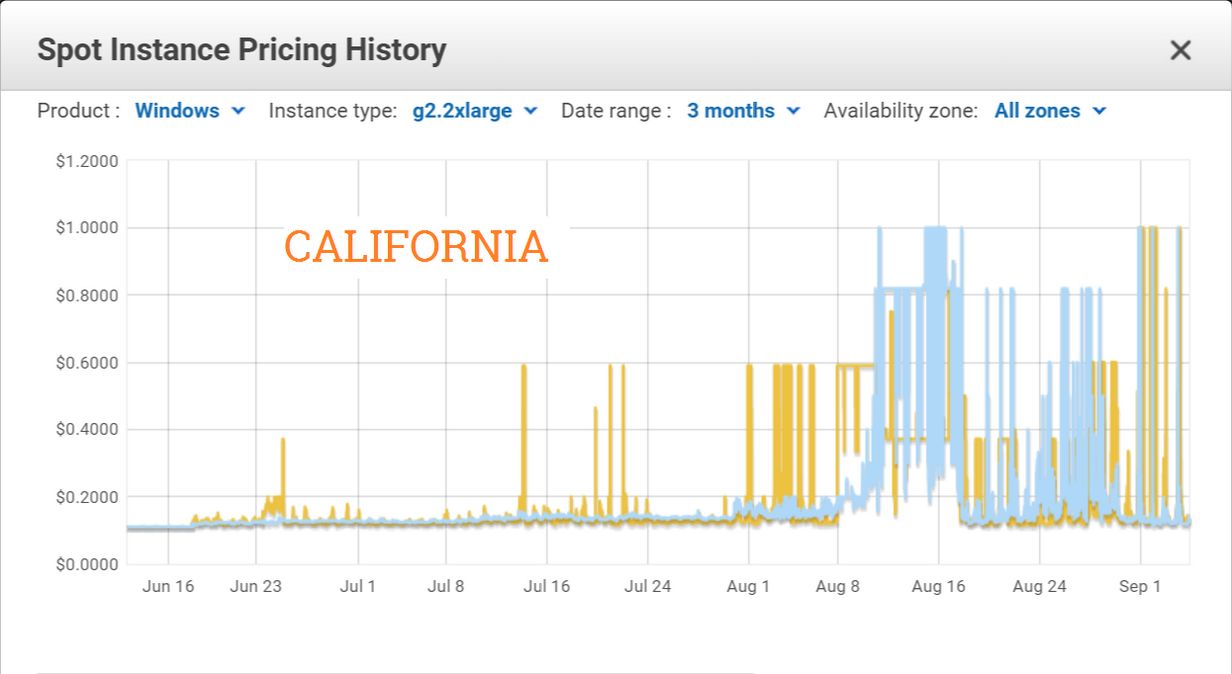
All of this obviously involves costs – most notably with both Amazon and with Frame. In order to minimise the costs with Amazon, the most efficient means to provision Bright Canopy is using Amazon’s Spot Instance pricing mechanism. Since its introduction, this has generally pitched at around US $0.12-$0.15 per hour for g2.2xlarge server instances.
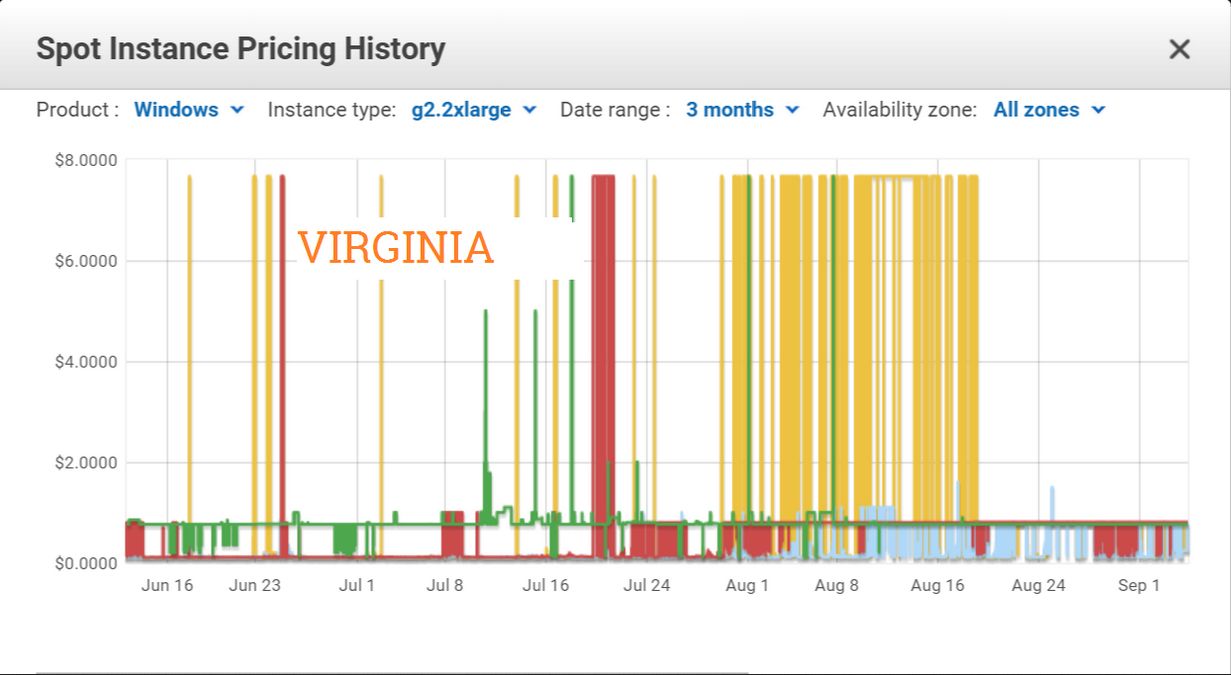
Unfortunately, at the start of August 2015, the Spot Instance pricing for the server instances started spiking, first in Ireland, then in both California and Virginia – the three Amazon POPs Bright Canopy would be using via Frame. These spikes meant that instance costs ballooned from under US $0.25 an hour to anywhere between $1.00 and $8.00 depending on the location.
Ireland was the first of Amazon EC2 centres used by Bright Canopy to be affected by sharp rises in Spot Instance pricing at the start of August
“Our business model was based on Amazon’s Spot Instance prices remaining below $0.25 as they had since they were introduced,” Chaos explained. “That’s just the cost of the instances. That doesn’t include Frame being paid or Bright Canopy being paid … This [spiking] broke our business model, but it looked like a temporary spike. We decided to continue with the planned launch. We believed the prices would come back down.”
To try to counter the unpredictability of the Spot Instance prices, Bright Canopy moved to Amazon’s On Demand pricing. This is far more predictable than spot Instance, but comes at a premium – US $0.80 an hour – leaving the service losing money.
“We hoped that usage would even out in such a way that we would lose money slowly enough to maintain our course until we could build out a solution that cost less on the back-end,” Chaos said of the move. “In the meantime we also hoped the Spot prices would come back down and give us some relief.”
The California Spot Instance pricing also started showing considerable volatility at the start of August 2015
Following launch, however, user behaviour changed quite dramatically. People were spending much longer periods logged-in, both increasing costs and forcing the use of even more server instances.
“It became clear that we could not sustain the losses,” Chaos said. “Usage was just not the same as we had seen in Pre-release. We expected a difference, but we didn’t expect such a huge difference. We agreed to pull the plug and rethink things.”
More recently, the Spot Instance prices in the USA have showed signs of settling down once more. However, it is still too soon to know whether this is an indication that prices are resuming their pre-August levels, and Ireland has certainly remained volatile.
Like Ireland and California, Virginia, Bright Canopy’s newest POP with Amazon, also experienced enormous volatility in pricing which has – like California – only recently showed signs of stabilising. Unfortunately, there’s no guarantee this will remain the case
So what does this mean for the service?
Most immediately, it means that the service will not be back up for Monday, September 7th, the date Bright Canopy had indicated as being the earliest by which it might be resumed. Instead, things remain in what Bright Canopy is calling a holding pattern until such time as a consensus has been reached on the best, most sustainable means of moving the service forward for the benefit of those needing it.
“We have worked with Frame on a proposed plan that we would be able to offer to a limited number of people at first,” Chaos said. “We have not come to an agreement yet on all of the details of that plan. If and when we do, please understand that this is just a stopgap so that the people who most need the service will have an option.”
This approach is intended to meet at least some of Frame’s costs (who up until now, as with Bright Canopy, haven’t received any income from the venture), as well continuing to meet Amazon’s charges. Bright Canopy will continue to work on the service unpaid, but will have to step back from 24/7 support and response and for the timing being to providing responses to questions and support requests within 24 hours.
The main presentation was followed by a Q&A session, which covered a number of topic areas, and I recommend those interested read the transcript in full to see both questions and answers.
 Sommergewitter September 2015 (Flickr)
 Sommergewitter September 2015 (Flickr)
 Sommergewitter September 2015 (Flickr)
 Sommergewitter September 2015 (Flickr)






 Inara Pey: Living in a Modemworld