A Baron comes to the castle

The DSA G58 Baron sans floats - my latest light aircraft
The DSA G58 Baron sans floats – my latest light aircraft

So, I’m a bit of an SL aviator, as I’ve blogged in the past. Over the course of the last 12+ months in particular, I’ve become quite partial to DSA aircraft, having both the C90 King Air GTx and the C33 Debonair. I particularly like this make due to the ability to swap between wheel and floats for the landing gear without having to swap the plane in and out of inventory.

As a result of various things, I found myself at the weekend debating whether to add another DSA ‘plane to my collection – and if so, which one. I was caught between the Model 17 Staggerwing biplane, the Spitfire and the G58 Baron. In the end, on Sunday, the latter won out – although the Staggerwing could well be a future acquisition!
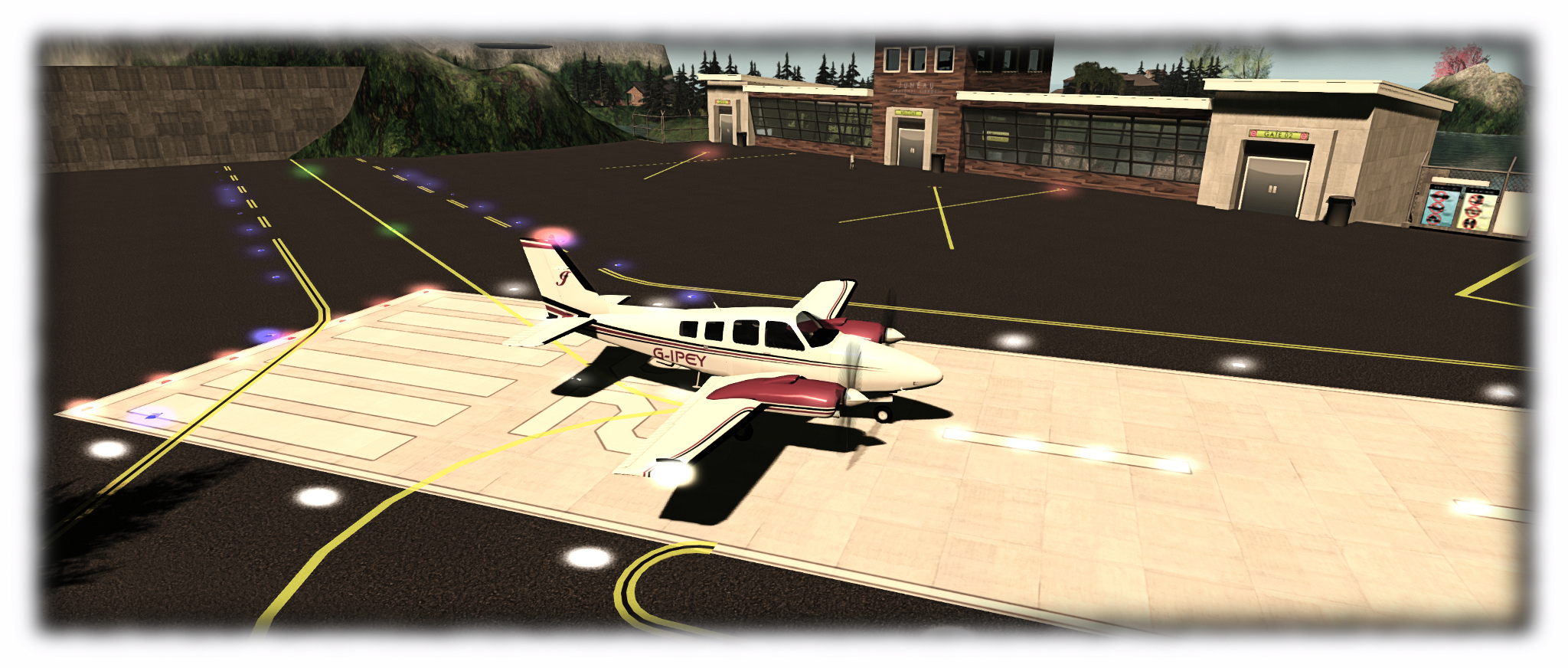
No. 1 on the runway at Juneau, about to start rolling ...
No. 1 on the runway at Juneau, about to start rolling …

The G58 is another twin-engined plane, sitting between the Debonair and King Air in size, offering seating for up to 5 avatars + the pilot. It’s a smart-looking, clear design which hasn’t really aged over the decades, and comes supplied in DSA’s usual offering of the default black / red / white Beechcraft colours. Having converted to using VetronUK’s paint and scripting options my ‘planes, I also grabbed a paint pack and Vetron’s float rocking and enhanced lighting scripts for the Baron.

Vetron paint kits are simple to use; drop a script into the plane, wear the HUD, click a button to add the paint scheme, then use the Advanced option to add materials to various surfaces, and add any other options supplied with the kit (the Debonair paint kits, for example, allow you to re-texture the cockpit dash with a new set of controls, while the King Air’s kit allows you to switch between the C90 and C90 GTx variants). A full set of maps are supplied full perm with each kit, making customising them easy.

The cabin obviously isn't as expansive or plush as the King Air, but seats up to four in the back
The cabin obviously isn’t as expansive or plush as the King Air, but seats up to four in the back

For the Baron’s paint scheme, I didn’t stray too far from that supplied by the kit: just some small tweaks, the addition of my own registration and familiar monogram, plus a little work on the floats so that they better matched the rest of the ‘plane.

The enhanced lights and rocking scripts (L$25 each) simply drop into the ‘plane (make sure you purchase the scripts designed for your aircraft). The lighting script greatly enhances the aircraft’s nav, strobe and landing lights, while the rocking script is Linden Water sensing, and when on water with the floats deployed, adds a rocking motion to the aircraft as well as the sound of water lapping against the floats, etc. When on land, the rocking ceases (although I’ve found the sound continues to loop).

If you’ve flown any DSA ‘plane, you’ll know how the Baron handles: very well. The HUD is the usual DSA offering and works exactly as expected. In addition, the Baron share’s the Debonair / Bonanza engine sounds (and, indeed, paint templates). Once in the air and trimmed, with the yoke set to wide, the Baron is again great fun and graceful. It handles region crossings with the usual DSA aplomb and accepts aerobatics well, if you’re so inclined, and perhaps with a little more grace than the King Air.

The Baron (front) and the King Air in their "matching outfits") largely based on VetronUK paint kits
The Baron (front) and the King Air in their “matching outfits” utilising VetronUK paint kits

In buying the Baron, I had it in mind to maybe swap it with the King Air as my main twin-engined ‘plane, and then perhaps swapping the Deb for the Staggerwing. However, with only 7 LI difference between the Deb (39) and the Baron (46), I ended up retiring the Deb to inventory instead. Plus, I simply adore the King Air, so I also gave it a new Vetron paint finish, again with my own small touches, so it and the Baron share similar designs. Sort of her-and-her outfits, you might say 🙂 .

Related Links

2015 viewer release summaries: week 37

Updates for the week ending: Sunday, September 13th

This summary is published every Monday, and is a list of SL viewer / client releases (official and TPV) made during the previous week. When reading it, please note:

  • It is based on my Current Viewer Releases Page, a list of all Second Life viewers and clients that are in popular use (and of which I am aware), and which are recognised as adhering to the TPV Policy. This page includes comprehensive links to download pages, blog notes, release notes, etc., as well as links to any / all reviews of specific viewers / clients made within this blog
  • By its nature, this summary presented here will always be in arrears, please refer to the Current Viewer Release Page for more up-to-date information.

Official LL Viewers

  • Current Release version: 3.8.3.304115 August 18th – no change – download page, release notes
  • Release channel cohorts (See my notes on manually installing RC viewer versions if you wish to install any release candidate(s) yourself):
    • No updates.
  • Project viewers:
    • Quick Graphics project viewer updated to version 3.8.4.304916, on September 10th – provides the new Avatar Complexity options and the new graphics preset capabilities for setting, saving and restoring graphic settings for use in difference environments / circumstances (download and release notes)
    • Project (HTTP updates) project viewer version 3.8.4.304871 released on September 8th – provides improved performance and stability. Impacts include: asset uploads, AISv3 inventory manipulation, VVM, Experience management, LSL compilation, Simhost event polling, etc.  (download and release notes)

LL Viewer Resources

Third-party Viewers

V3-style

  • No updates.

V1-style

  • Cool VL Viewer Stable branch updated to version 1.26.14.6 and the Experimental branch updated to version 1.26.15.5, both on September 12 (release notes)

Mobile / Other Clients

  • Pocket Metaverse updated to version 1.9.4. on September 8 – core updates:  iOS 9 compatibility

Additional TPV Resources

Related Links

Space Sunday: of Pluto, Mars and crowdfunding space outreach

new-horizonNASA and the Applied Physics Laboratory (APL) at John Hopkins University kept their promise a little earlier than expected.

With the resumption of image and data transmissions from New Horizons, at the start of September, they had indicated that Fridays would henceforth, and for the course of the next 12 months, be known as Pluto Friday, the day on which the latest raw images from the mission to that distant tiny world and its companions would be released.

However, the first set of images came a little sooner than advertised: on Thursday, September 10th, and they continue to show two tiny worlds which continue to astound and have planetary scientists rethinking much about their understanding of dwarf planets.

“Pluto is showing us a diversity of landforms and complexity of process that rival anything we’ve seen in the solar system,” New Horizons’ principal investigator Alan Stern, from the Southwest Research Institute in Colorado, said in a statement. “If an artist had painted this Pluto before our flyby, I probably would have called it over the top — but that’s what is actually there.”

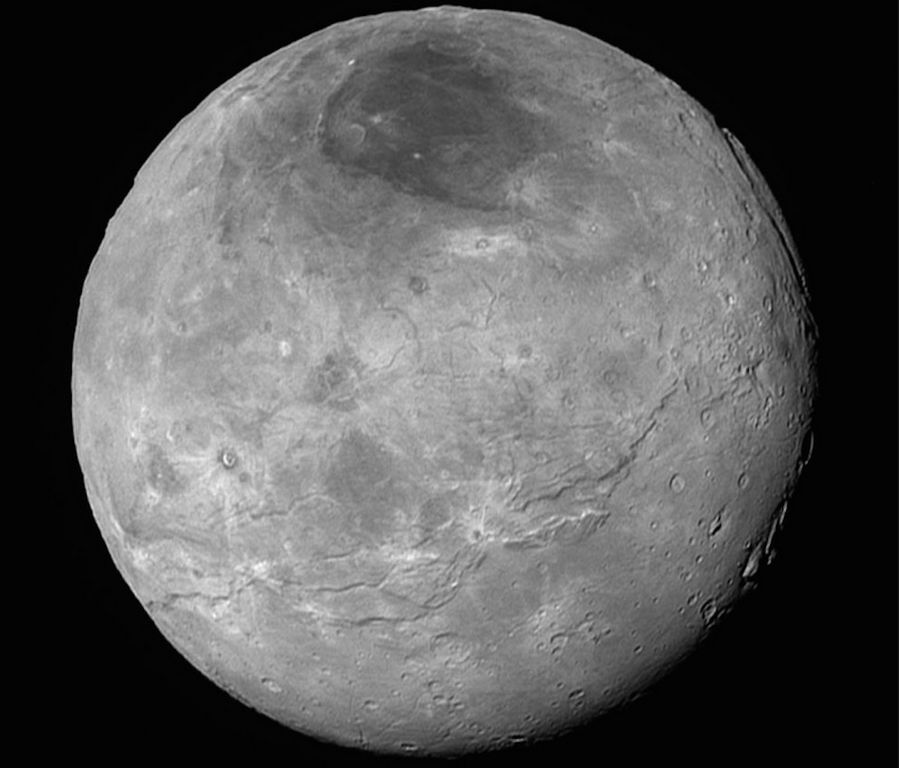
Charon, Pluto's largest companion, as seen by New Horizons on July 14th, 2015, from a distance of some 464,000 kilometres (290,000 miles), revealing a rich and diverse range of surface features
Charon, Pluto’s largest companion, as seen by New Horizons on July 14th, 2015, from a distance of some 464,000 kilometres (290,000 miles), revealing a rich and diverse range of surface features (image: NASA / JHU / APL / SWU) – click any image for the full-size version

The images render details as small as 400 metres / 440 yards per pixel on the surface of Pluto, and reveal features that have scientists agog with excitement; so much so that at a NASA press conference, the images were summarised thus, “it’s complicated!”

In them, we can see a rich complexity of features: nitrogen ice flows which have apparently oozed (and might still be slowly oozing) out of mountain ranges and across broad plains; mountain ranges which are themselves reminiscent of chaotic regions on Mars and Jupiter’s Europa; complex valley systems which might have been carved by the action of material flowing across the planet; and even – perhaps most curiously of all –  what seem to be wind-blown fields of dunes.

A synthetic perspective view of Pluto, based on the latest high-res received from New Horizons presents a view of Pluto from around 1,800 km (1,100 mi) above Pluto’s equatorial area. Towards the bottom of the image is the cratered and dark region dubbed "Cthulhu Regio", and above it, the bright "heart" of Pluto, showing the icy plains of "Sputnik Planum". The images used to create this view were captured from a distance of 80,000 km (50,000 mi) from Pluto
A synthetic perspective view of Pluto, based on the latest high-res received from New Horizons presents a view of Pluto from around 1,800 km (1,100 mi) above Pluto’s equatorial area. Towards the bottom of the image is the cratered and dark region dubbed “Cthulhu Regio”, and above it, the bright “heart” of Pluto, the “Tombaugh Regio”, with the icy plains of “Sputnik Planum” prominent. The images used to create this view were captured from a distance of 80,000 km (50,000 mi) from Pluto (images: NASA / JHU / APL / SWU) – click any image for the full-size version

What is also particularly striking about these images of Pluto is the way that they reveal some of the oldest  (geologically speaking) regions yet seen on the planet sitting right alongside what are the youngest locations on the planet, adding further emphasis to the idea that Pluto has been, and might still be, an active world.

But what about those dunes mentioned above? If they are indeed what the images released on September 10th suggest, Pluto has once again served up a surprise.

“Seeing dunes on Pluto, if that is what they are would be completely wild!” William McKinnon from the mission’s Geology, Geophysics and Imaging (GGI) team, said, “because Pluto’s atmosphere today is so thin. So either Pluto had a thicker atmosphere in the past, or some process we haven’t figured out is at work. It’s a head-scratcher!”

The dunes of Pluto? This image, representing a portion of Pluto's surface some 350 km (220 mi) across, shows some of the planet's older, chaotic terrain at the bottom, and an enigmatic field of dark, aligned ridges that resemble dunes which have caused planetary scientists to feel their eyebrows further vanishing under hair lines. The image was captured from a distance of 80,000 km (50,000 mi) from Pluto.
The dunes of Pluto? This image, representing a portion of Pluto’s surface some 350 km (220 mi) across, shows some of the planet’s older, chaotic terrain at the bottom, and an enigmatic field of dark, aligned ridges that resemble dunes toward the top. The image was captured from a distance of 80,000 km (50,000 mi) from Pluto (images: NASA / JHU / APL / SWU)

More is also being discovered about Pluto’s atmosphere, which is also proving to be a lot more complex than had originally been thought, having many more layers within its thin haze than had been thought. However, these layers of haze have allowed the science team to glimpse surface features which might otherwise have remained unseen as sunlight caught by the haze over the terminator – the divide between the day and night sides of the planet – cast a soft glow over part of Pluto’s night side. When enhanced through careful processing, this glow could be used to reveal what lay below.

Continue reading “Space Sunday: of Pluto, Mars and crowdfunding space outreach”

The hopes of puppets, disembodied minds and sisterly plots

It’s time to kick-off another week of fabulous story-telling in voice, brought to our virtual lives by the staff and volunteers at the Seanchai Library. As always, all times SLT, and events are held at the Library’s Second Life home at Bradley University, unless otherwise indicated.

Sunday, September 13th 18:00: Pinocchio

An 1883 illustration from the original Le avventure di Pinocchio, drawn by Enrico Mazzanti and coloured by Daniel Donna

Caledonia Skytower settles down at Magicland’s Golden Horseshoe to read selected adventures from the famous story of Pinocchio, the wooden puppet who comes to life through the granting of a wish, and who then has various adventures and misadventures along his path of life.

It’s a story we’re all familiar with in one way or another, and probably largely as a result of the 1940 Walt Disney adaptation of the tale, which is rated today as both one of the finest Disney features made, and one of the greatest animated films of all time.

But, how many of us are familiar with the original Adventures of Pinocchio, published in 1883 by author Carlo Collodi? For those all too familiar with Disney’s rendering of the little puppet who wants to be a boy, there is much in the book that is familiar – but also much that is very different.

So – what will Caledonia bring? Pincchio’s adventures as seen through the eyes of Disney, or as put to paper by Collodi – or perhaps a mix of both? Or will she cast her net wider?

Be at the Golden Horseshoe to find out!

Monday September 14th, 19:00: Solis

solisGyro Muggins continues reading Alfred Angelo Attanasio’s 1994 thought-provoking novel Solis.

What happens when you gamble your own future on the far future, and opt to have your head and brain frozen in the hope that one day, perhaps centuries to come, it – you can be revived?

That’s exactly what Charles Otis decided to do – only things don’t turn out so well. Found discarded but still in a cryonic state, his brain is purchased sans head and installed in a deep space ore carrier as its primary processor.

Until, that is, he is discovered and rescued by those sympathetic to his plight. And so the story takes a turn to matters of the legal status of a disembodied brain, restored for a specific purpose and of unknown origin; paid for, and – at least they would have it – owned by the corporation that purchased the brain, and which has little interest in any past identity the brain might have had.

Tuesday September 15th,19:00 Not That It Matters

AA Milne by Howard Coster, 1926

Corwyn Allen concludes AA Milne’s 1919 collection of humorous essays. Best known for his tales of Wnnie the Pooh, Christopher Robin and the 100 acre Wood, Milne in fact wrote widely in bother fiction and non-fiction.

Here he passes observation on wide range of topics, starting with a reflection upon his own writing, “Sometimes when the printer is waiting for an article which really should have been sent to him the day before, I sit at my desk and wonder if there is any possible subject in the whole world upon which I can possibly find anything to say.”

With considerations ranging from why a gentleman’s collar might squeak, or the fact that Isaiah most certainly didn’t carry a notebook, with assorted thoughts on goldfish and daffodils along the way, this is a book of essays wide-range in topic and content. Some of it may, nigh-on a century since the essays first appeared in this book, appear dated and as solidly dated and trapped forever in the opening decades of the 20th century. Other are perhaps as relevant today in their insights and commentary as they were when freshly written. All of them come with Milne’s familiar humour and jovial observations.

Wednesday September 16th 19:00: The Penderwicks on Gardam Street

PenderwicksCaledonia Skytower opens the pages of Jeanne Birdsall’s 2014 volume about the Penderwick family, the second in the series.

When the four Penderwick sisters learn that, encouraged by his sister-in-law and the wishes of their late mother, their father is going to start meeting other women, they fear the worst, and so enact the Save Daddy Plan. They set their Dad up with dates he won’t get on with, while he, also not overly convinced of things, goes out on pretend dates.

However, things start to change as the sisters meet and get to know Ben from next door, and his mum, Iantha. Added to the mix the adventures and challenges each of the four sisters face, and it turns out to be quite a series of events and changes for the Penderwicks – one of them very much turning out for the best.

Thursday, September 17th

19:00 The Banshee’s Comb

With Shandon Loring.

21:00 Seanchai Late Night

With Finn Zeddmore.

Friday, September 18th Avast! There Be Pirates!

Coming on the eve of International Talk Like a Pirate Day, Seanchai Library brings us a deck full of salty tales of plucky plundering, piratical plots and more! Arrrrrrr!

11:30 Saturday, September 19th, 11:30: Folktales at Seanchai IW

to mark the opening of the new Community Library Estate, and their new Exhibition on Folk Tales.  Shandon and Caledonia will tell stories at 11:30 am followed by a Dance Party at Noon.

(https://inworldz/region/Calliope/150/6/28)  

—–

Please check with the Seanchai Library SL’s blog for updates and for additions or changes to the week’s schedule. The featured charity for August / September is Water for People, “When one person or one family has clean, accessible water, their lives are changed. But when entire regions and countries have water, the world is changed.”

Additional Links

SL project updates 37/2: TPV developer meeting and more

Sommergewitter; Inara Pey, September 2015, on FlickrSommergewitter September 2015 – blog post

The following notes are primarily taken from the TPV Developer (TPVD) meeting held on Friday, September 11th, 2015. A video of the meeting is included at the end of this report, with any time stamps in the following text referring to it. My thanks as always to North for the recording and providing it for embedding.

Server Deployments – Week 37

As always, please refer to the server deployment thread for additional information.

  • The Main (SLS) channel did not have any deployment / restart during the week, largely due to the fact the one deployment in week #36 was to a single channel (BlueSteel), which was rolled-back on Thursday, September 3rd
  • The three RC channels all received a new server maintenance project, comprising internal simulator fixes.

Upcoming LSL: llGetAttachedList()

The Week #38 (week commencing Monday, September 14th should have a new LSL function rolling to at least one RC channel.

llGetAttachedList() is a new function that will return a list of root keys of all visible attachments worn by an agent except for HUDs. Originally a feature request (see BUG-9683), which also lists a number of potential benefits of such a function. The wiki page for the function is still in preparation,but the function itself can be tested on the Aditi (beta grid) region of Tehama. Note that it will only work when invoked for a target within the same region. I’ll have more on this should the function make it into an RC deployment in the coming week.

SL Viewer Updates

Mesh Importer

[01:50] The Mesh importer viewer continues in RC status as the Lab continues to fix problems either found internally or by those making use of the RC viewer, although Oz notes the problems are gradually becoming less severe in nature. However, it’s still not quite ready to be promoted to the de facto viewer.

Notifications Viewer

[02:39] The notifications viewer has been getting a “lot of exercise” as a project viewer, and looks set to move to release candidate status in the near future.

Quick Graphics Viewer

[03:11] The Quick Graphics project viewer, which presents the new Avatar Complexity capability and the ability to save and re-load graphics settings more-or-less on the fly,  updated to version 3.8.4.304916 on Thursday, September 10th. There are still some further adjustments being made to the viewer, but it should progress to RC status some time in the next two weeks or so.

[46:13] One of the changes which may be made to the Avatar complexity aspect of the viewer is a further toning-down of the colour intensity of avatars rendered as “Jelly Babies”. Also, the values on the Complexity slider my be further adjusted to assist those with low-end systems.

[50:20] Some have expressed an opinion that having an “infinite” upper limit to Avatar Complexity is counter-productive, as it does little to discourage people from having complex avatars which can tax other systems. In reply to this, Oz Linden said:

I really want to emphasise this, and I hope people understand it. we’re not trying to create a standard for what is “good”. what we’re trying to do is inform people about what effect they’re having and to control the impact other people have on them,  and then let things sort themselves out.

[54:28] Also with reference to this viewer, the Advanced Graphics floater has been updated to a 2-column format in response to concerns that the earlier, large single-column floater could not be easily displayed on some laptops / lower resolution monitors.

They updated Advanced Graphics floater in the September 10th Quick Graphics project viewer, version 3.8.4.304916
The updated Advanced Graphics floater in the September 10th Quick Graphics project viewer, version 3.8.4.304916

I’ll be taking a further look at Avatar Complexity once the viewer reaches RC status.

Project Azumarill

[06:25] Project Azumarill is the name of the Lab’s new project viewer, version 3.8.4.304871, which offers a complete replacement of the under the hood HTTP infrastructure, and which impacts all aspects of the viewer using simulator capabilities.

This is essentially building on Monty Linden’s HTTP work, which was applied to the most critical paths within simulator / viewer communications, and sees Rider Linden apply the changes through the viewer, and so includes, but is not limited to the following:

  • Asset upload (Images, Meshes, Animations)
  • AISv3 inventory manipulation
  • Viewer Managed Marketplace
  • Simhost event polling
  • LSL script compilation
  • Experience management (blocking, allowing, creating).

Currently, the new code is sitting in the viewer alongside older code, although the latter will be removed prior to the viewer being promoted to the de facto release viewer. While a significant update, it is anticipated that the viewer will progress rapidly through the release process, as functionally, there isn’t that much which can be said to be new for people to play with. As such, it will hopefully go through a total of two project viewer iterations prior to becoming a release candidate, then move fairly quickly from RC to release.

Continue reading “SL project updates 37/2: TPV developer meeting and more”

SL Project updates: 37/1: inventory reliability improvements

Mysts of Eyr; Inara Pey, September 2015, on FlickrMysts of Eyr September 2015 – blog post

At the TPV Developer meeting on Friday, September 11th, the Lab provided further information about the ongoing work to improve inventory handling and management in Second Life.

As has been reported through these pages, the Lab has been tackling a wide range of issues related to inventory, inventory management, inventory losses, etc., over the last several months. The updates given at the TPV Developer meeting were to provide information and news on both the work to help fix issues around large “flat” inventories, and on new and upcoming work in rationalising inventory related code within the viewer, with Izzy and Aura Linden providing the updates.

The video of the meeting can be seen here, and time stamps are given below to the relevant points in the video where the items are discussed.

“Flat ” Inventories

[10:15] This is something that has been mentioned through a number of project updates in these pages. However, in summary: if you have a large “flat” inventory structure with tens of thousands of items contained in single folders at a time, rather than being split between multiple sub-folders, you can experience significant issues in logging-in to Second Life, up to and including being completely unable to log-in at all.

Earlier in the year, the Lab developed an inventory transform tool which, when run, can take the contents of such large folders and split them into smaller, easier-to-load sub-folders. This tool has been undergoing testing for some time, but has now been issued to the Lab’s support teams. So, those encountering log-in issues and know they have large, relatively “flat” inventory structures can raise a support request (Premium or Basic) and have the tool run against their inventory, thus hopefully fixing  matters for them.

Inventory Code Improvements

Task Paths

[12:50] Currently, the viewer has multiple paths and mechanisms by which inventory tasks can be undertaken / completed. Aura is therefore working through the viewer code to try to rationalise how inventory is handled, ensure that older paths / mechanisms are properly deprecated / removed and replaced by newer and more robust mechanisms.

[14:20] The first set of changes Aura is working on is to remove from the viewer all of the old UDP inventory messaging paths which have already been replaced by more robust mechanisms (and in some cases already had the server-side support for them removed), but which have until now remained a part of the viewer’s code.

These changes should be appearing in a project viewer for testing by TPVs in the next month or so. This is to allow them to identify possible impacts on any dedicated inventory handling mechanisms they may use (e.g. RLV / RLV/a) which may also use the older UDP messaging paths, and address any updates they may need to made as a result.

Once this viewer reaches release status, the Lab will seek to remove any server-side support for legacy UDP for inventory operations from the simulator code. Again, this will be done in consultation with TPVs, with testing regions available on Aditi beforehand, so the Lab can again be warned if they are triggering potential problems which may need to be thought about / addressed.

Code Refactoring

[19:35] The second element in the work is a refactoring of the viewer inventory files. This work will initially rationalise inventory functions within the viewer so that they are more closely coupled with their actual purpose, rather than being more widely scattered through the viewer code, and will not involve any actual code changes.

However, a further part of the work will involve code changes, with the overall aim being to make the code a lot more readable, easier to test and maintain and understand.

Server-side Inventory Rules Enforcement

[23:32] Additionally, once the above work has been carried out, new checks will be added server-side to prevent actions which are known to cause inventory problems from happening.

For example, there have been issues where people have found themselves with more than one Current Outfit folder or with multiple Trash folders, both of which can result in complications when using the viewer. The simulator-side rules, when put into place, will be designed to prevent these kinds of instances occurring.

Time Frames

As noted, the first phase of Aura’s work – the initial code deprecation work – will be appearing in a project viewer in the next month or so, and the work will progress from there in the stages, thus:

  • Remove the deprecated inventory message paths from the viewer
  • Remove any remaining simulator support for deprecated inventory messaging support
  • Rationalise the inventory functions in the viewer
  • Refactor the viewer’s inventory code in the interests of stability, maintenance, testing and update
  • Add simulator checks to prevent folder duplications, etc

How long it will take to implement each phase isn’t currently clear, and will to a degree depend on feedback about issues discovered by TPVs, as well as the results of continued testing by the Lab.