Updates for the week ending: Sunday, September 20th
This summary is published every Monday, and is a list of SL viewer / client releases (official and TPV) made during the previous week. When reading it, please note:
It is based on my Current Viewer Releases Page, a list of all Second Life viewers and clients that are in popular use (and of which I am aware), and which are recognised as adhering to the TPV Policy. This page includes comprehensive links to download pages, blog notes, release notes, etc., as well as links to any / all reviews of specific viewers / clients made within this blog
By its nature, this summary presented here will always be in arrears, please refer to the Current Viewer Release Page for more up-to-date information.
Notifications project viewer updated to version 3.8.4.305083 on September 18 – new Notifications floater separates incoming notifications into System, Transactions, Invitations, and Group. It provides a better way to view, interact with, prioritize and manage incoming notices for busy residents (download and release notes)
Importer RC viewer updated to version 3.8.4.305119 on September 17 – provides a modified mesh uploader & optional debug information (download and release notes).
Project viewers:
Quick Graphics project viewer updated to version 3.8.4.305063, on September 16 – provides the new Avatar Complexity options and the new graphics preset capabilities (download and release notes)
Backlit by the Sun: Pluto’s hazy atmosphere seen from just 18,000km (11,000 miles) and 15 minutes are the point of closest approach to the planet by the New Horizons spacecraft on July 14th, 2015. To the upper right of the planet can be seen the icy expanse of “Sputnik Planum”, bordered below and to the left by tall mountains, and to the right by what appears to be glacial inflows. Image: NASA / JHUAPL / SwRI (click for full size)
Just when you thought images of Pluto returned by the New Horizons spacecraft could get any more awe-inspiring, NASA / JHU APL release a set of raw images that are utterly stunning.
The images come from the wide-angle Ralph/Multispectral Visual Imaging Camera (MVIC) on the space craft and were captured just 15 minutes after the vehicle reached is point of closest approach to the little world, and thus from a distance of just 18,000 km (11,000 miles) from Pluto.
The stunning vistas presented in the image show the ice plains of “Sputnik Planum” bordered to the left and from below by Pluto’s huge mountain ranges, informally named Hillary and Norgay, Montes after the first partnership to successful reach the summit of Mt. Everest here on Earth. All of this is dramatically backlit by sunlight reflected through Pluto’s hazy atmosphere to create a wonderful scene said to be reminiscent of views of the Antarctic viewed from space or very high altitude.
A closer view: in this image just 380 km (230 miles) across, shows “Sputnik Planum” bordered to the west by towering mountains reaching up to 3,500 metres (11,000 ft) in altitude. In the foreground sit the informally named Norgay Montes, and on the skyline to the top and left of the image, the Hillary Montes. Image: NASA / JHUAPL / SwRI (click for full size)
However, the images aren’t just notable for the panoramic beauty; they actually reveal a lot about what is happening in the Plutoian atmosphere. Because of the back lighting from the Sun, the high-resolution MVIC has revealed just how complex Pluto’s atmosphere is, comprising multiple layers of nitrogen and other gases rising to around 100 km (60 mi) above Pluto’s surface (and visible as a banding in the images above).
“In addition to being visually stunning, these low-lying hazes hint at the weather changing from day-to-day on Pluto, just like it does here on Earth,” said Will Grundy, lead of the New Horizons Composition team from Lowell Observatory, Flagstaff, Arizona.
What is also exciting the science team is evidence within the images for Pluto having a complex “hydrological” cycle which seems to be comparable in some ways to that found on Earth – only on Pluto, it involves nitrogen ice, rather than water ice.
When compared with images captured as New Horizons approached Pluto, the MVIC images further suggest that the regions eastward of “Sputnik Planum” appear to have been encroached over time by ices and material possibly evaporated from the surface of “Sputnik Planum” to be deposited on the higher lands as a new ice blanket, which in turn appears to have formed glacial formations flowing back into “Sputnik Planum”.
Glacial flow on Pluto: deposits of frozen nitrogen which have accumulated on the uplands on the right side of this 630 km (390 mi) wide image has formed glacial flows leading from the uplands beck into “Sputnik Planum” draining from Pluto’s mountains onto the icy plain through the valley system indicated by the red arrows (the valleys average between 3 and 8 km (2 and 5 mi) in width). In the meantime, the ice of the plain appears to be flowing outwards and towards the uplands, as indicated by the blue arrows. Image: NASA / JHUAPL / SwRI (click for full size)
“We did not expect to find hints of a nitrogen-based glacial cycle on Pluto operating in the frigid conditions of the outer solar system,” said Alan Howard, a member of the mission’s Geology, Geophysics and Imaging team from the University of Virginia, Charlottesville. “Driven by dim sunlight, this would be directly comparable to the hydrological cycle that feeds ice caps on Earth, where water is evaporated from the oceans, falls as snow, and returns to the seas through glacial flow.”
To Scale: The Solar System
We’re all familiar with the idea that the solar system is so vast, that it is almost impossible to show the Sun and the major planets proportional to one another and at a scale where all the later are both visible and have orbits which can be adequately encompassed in an easily viewable space.
1972: The Blue Marble (click to enlarge)
Obviously, some models do exist; the Lowell Observatory in Arizona, USA, for example, has a walk that allows visitors to travel from the sun and by each of the planets, but it’s not always easy to clearly grasp the sheer scale of things. The same goes for digital models (and a few have been built within virtual worlds like Second Life).
With this issue of scale and proportion in mind, Wylie Overstreet and Alex Gorosh set out to produce a scale model of the solar system that might help people understand just how vast our planetary back yard is when looked at on a human scale.
They started with a blue marble to represent the Earth, echoing the famous photograph taken on December 7, 1972, by the crew of Apollo 17en route to the Moon and which NASA dubbed the Blue Marble.
It’s time to kick-off another week of fabulous story-telling in voice, brought to our virtual lives by the staff and volunteers at the Seanchai Library. As always, all times SLT, and events are held at the Library’s Second Life home at Bradley University, unless otherwise indicated.
Sunday, September 20th 13:30: Tea time at Baker Street
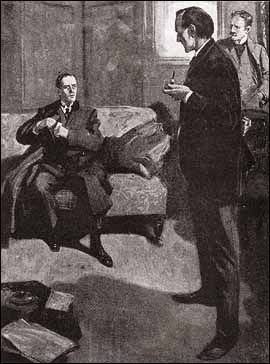
The Valley of Fear, The Strand Magazine, 1915. Illustration by Frank Wiles
“I am inclined to think—” said I.
“I should do so,” Sherlock Holmes remarked impatiently.
I believe that I am one of the most long-suffering of mortals; but I’ll admit that I was annoyed at the sardonic interruption. “Really, Holmes,” said I severely, “you are a little trying at times.”
He was too much absorbed with his own thoughts to give any immediate answer to my remonstrance. He leaned upon his hand, with his untasted breakfast before him, and he stared at the slip of paper which he had just drawn from its envelope. Then he took the envelope itself, held it up to the light, and very carefully studied both the exterior and the flap.
“It is Porlock’s writing,” said he thoughtfully. “I can hardly doubt that it is Porlock’s writing, though I have seen it only twice before. The Greek e with the peculiar top flourish is distinctive. But if it is Porlock, then it must be something of the very first importance.”
He was speaking to himself rather than to me; but my vexation disappeared in the interest which the words awakened.
“Who then is Porlock?” I asked.
“Porlock, Watson, is a nom-de-plume, a mere identification mark; but behind it lies a shifty and evasive personality. In a former letter he frankly informed me that the name was not his own, and defied me ever to trace him among the teeming millions of this great city. Porlock is important, not for himself, but for the great man with whom he is in touch. Picture to yourself the pilot fish with the shark, the jackal with the lion—anything that is insignificant in companionship with what is formidable: not only formidable, Watson, but sinister—in the highest degree sinister. That is where he comes within my purview. You have heard me speak of Professor Moriarty?”
So opens The Valley of Fear, which first appeared in serial form within the pages of The Strand Magazine between 1914 and 1915, before being republished as a full length novel. Set prior to the events of Holmes’ apparent death in The Final Problem, the story serves to explore more sinister activities undertaken as the behest of that criminal mastermind, Professor Moriarty.
Join Caledonia Skytower and Kayden Oconnell as they commence a 6-part reading of what became the fourth and final Sherlock Holmes novel.
Monday September 21st, 19:00: Solis
Gyro Muggins concludes Alfred Angelo Attanasio’s 1994 thought-provoking novel Solis.
What happens when you gamble your own future on the far future, and opt to have your head and brain frozen in the hope that one day, perhaps centuries to come, it – you can be revived?
That’s exactly what Charles Otis decided to do – only things don’t turn out so well. Found discarded but still in a cryonic state, his brain is purchased sans head and installed in a deep space ore carrier as its primary processor.
Until, that is, he is discovered and rescued by those sympathetic to his plight. And so the story takes a turn to matters of the legal status of a disembodied brain, restored for a specific purpose and of unknown origin; paid for, and – at least they would have it – owned by the corporation that purchased the brain, and which has little interest in any past identity the brain might have had.
Tuesday September 22nd,19:00 The Life and Times of The Thunderbolt Kid
Kayden Oconnell reads from Bill Bryson’s memoirs of his childhood, growing up in Iowa in the 1950s. However, given this is Bill Bryson, these are no ordinary memoirs.
Born into an era when “automobiles and televisions and appliances (not to mention nuclear weapons) grew larger and more numerous with each passing year, and DDT, cigarettes, and the fallout from atmospheric testing were considered harmless or even good for you”, the young Bryson held a daydream typical of so many American youngsters of the time: to be a superhero.
For Bryson, this meant spending time wearing a football jersey emblazoned with a lightning bolt together with a towel for a cape whilst spending time righting imaginary wrongs, overcoming evil-doers, travelling faster than a speeding bullet and leaping tall buildings in a single bound and being known as The Thunderbolt Kid.
And it is through the eyes of this childhood alter ego that Bryson allows us to witness his home and family life as he grew up in 1950s Des Moines.
Wednesday September 23rd 19:00: The Penderwicks on Gardam Street
Caledonia Skytower concludes Jeanne Birdsall’s 2014 volume about the Penderwick family, the second in the series.
When the four Penderwick sisters learn that, encouraged by his sister-in-law and the wishes of their late mother, their father is going to start meeting other women, they fear the worst, and so enact the Save Daddy Plan. They set their Dad up with dates he won’t get on with, while he, also not overly convinced of things, goes out on pretend dates.
However, things start to change as the sisters meet and get to know Ben from next door, and his mum, Iantha. Added to the mix the adventures and challenges each of the four sisters face, and it turns out to be quite a series of events and changes for the Penderwicks – one of them very much turning out for the best.
Thursday, September 24th, 19:00 The Banshee’s Comb
With Shandon Loring.
—–
Please check with the Seanchai Library SL’s blog for updates and for additions or changes to the week’s schedule. The featured charity for August / September is Water for People, “When one person or one family has clean, accessible water, their lives are changed. But when entire regions and countries have water, the world is changed.”
I was led to Danii Lyric’s Cape Juniper after seeing a series of images by Goizane Latzo on the ever excellent Bitacora Viajera blog, and was immediately attracted by all I saw.
The region – Hollandaise – is home to Danii’s businesses as a photographer and interior & landscape designer, and Cape Juniper offers a tour de force of her skills in both. Within it sit a series of environments beautifully crafted to attract the eye and camera, and which offer plenty of ideas for home design and landscaping.
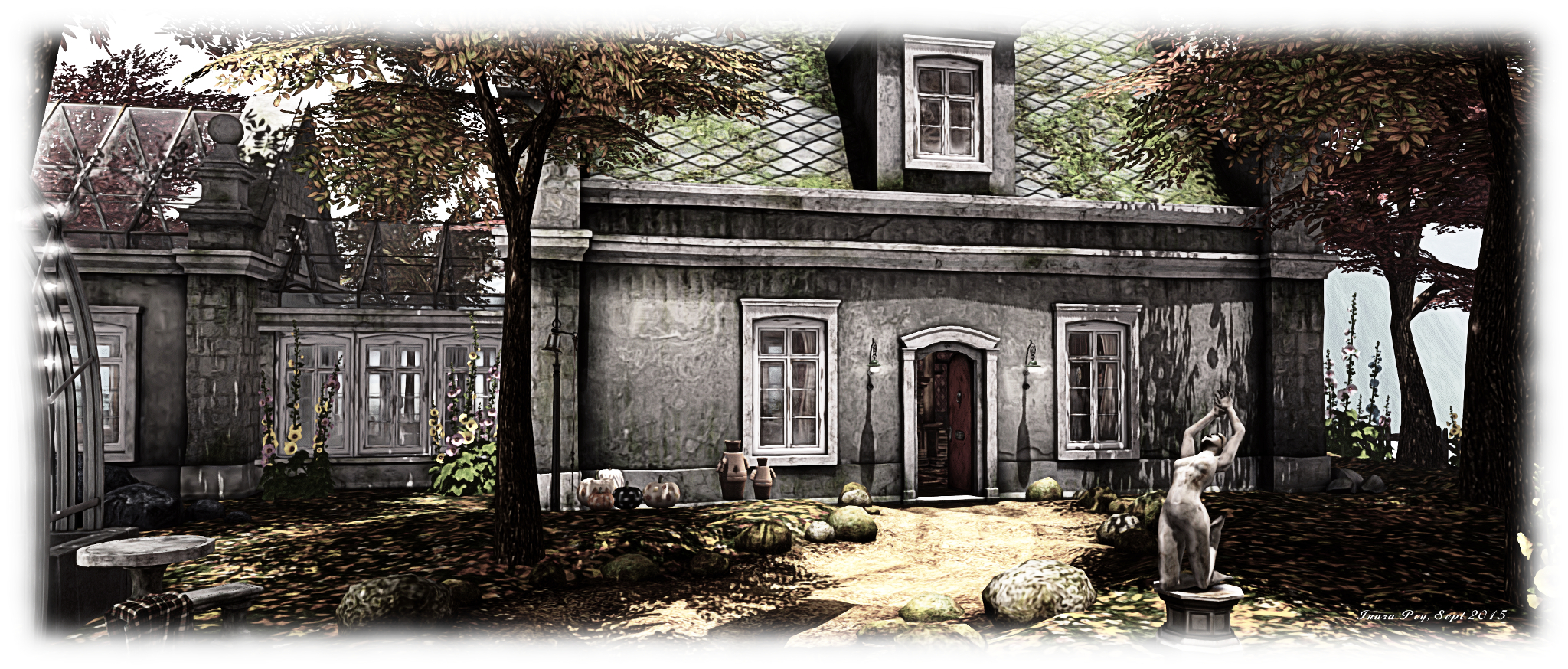
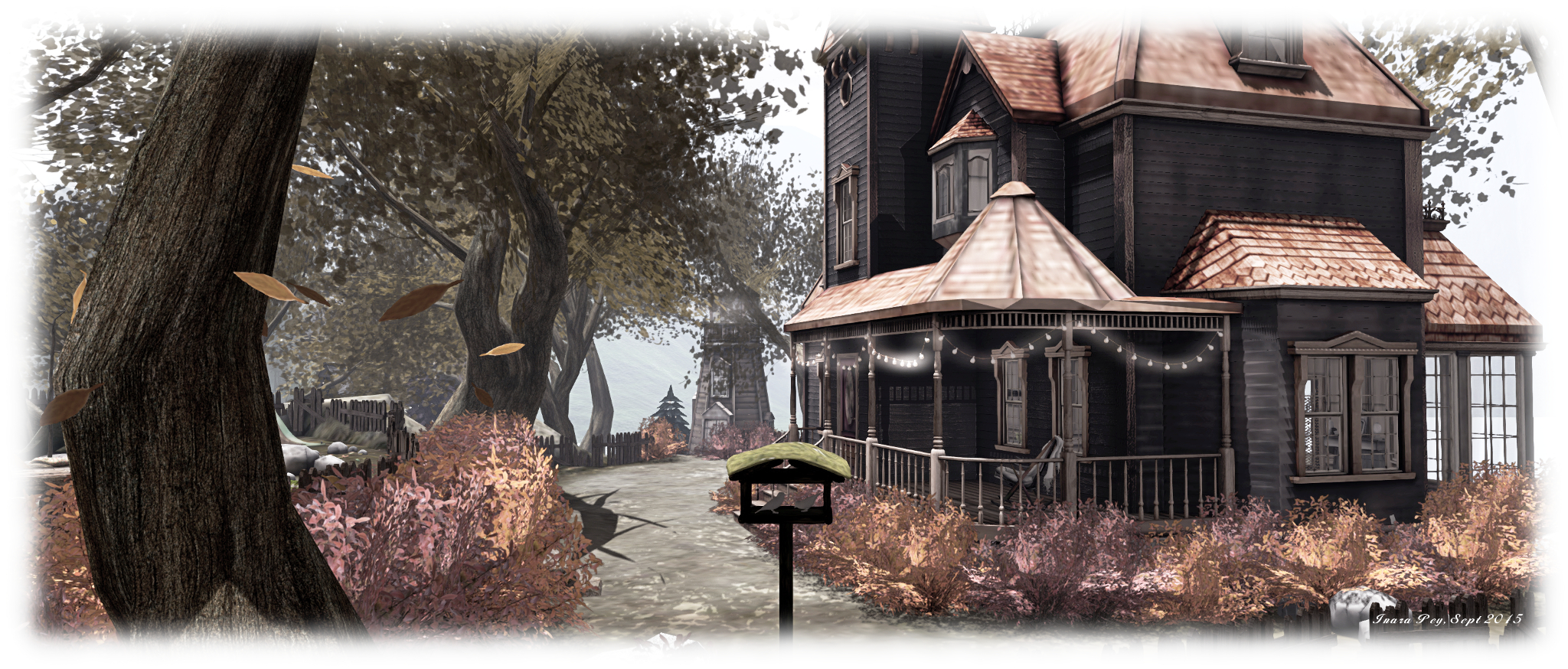
The Cape Juniper LM / SLurl deposits visitors at one end of the largest of five islands making up the region. A road runs the length of the island, bordered on one side by a range of little shops, places to eat, playgrounds, and so on, leading the way from the motel next to the landing point to Danii’s offices on the little town square at the far end of the island, sitting nestled between a small pub and a 50’s style diner..
The other side of the road looks out over the rest of the region, visible beyond the ruins of an old castle, and offers cosy little seating areas at the roadside nearer to the main square, together with a broad set of steps leading down to a grassy headland on which sits a charming outdoor wedding area. A large barn to one said offers plenty of space for receptions, while the boat slips are set ready for the arrival of a bride by water. Those wishing to explore the old castle can find their way to it at the foot of the steps leading to the wedding area and mooring slips.
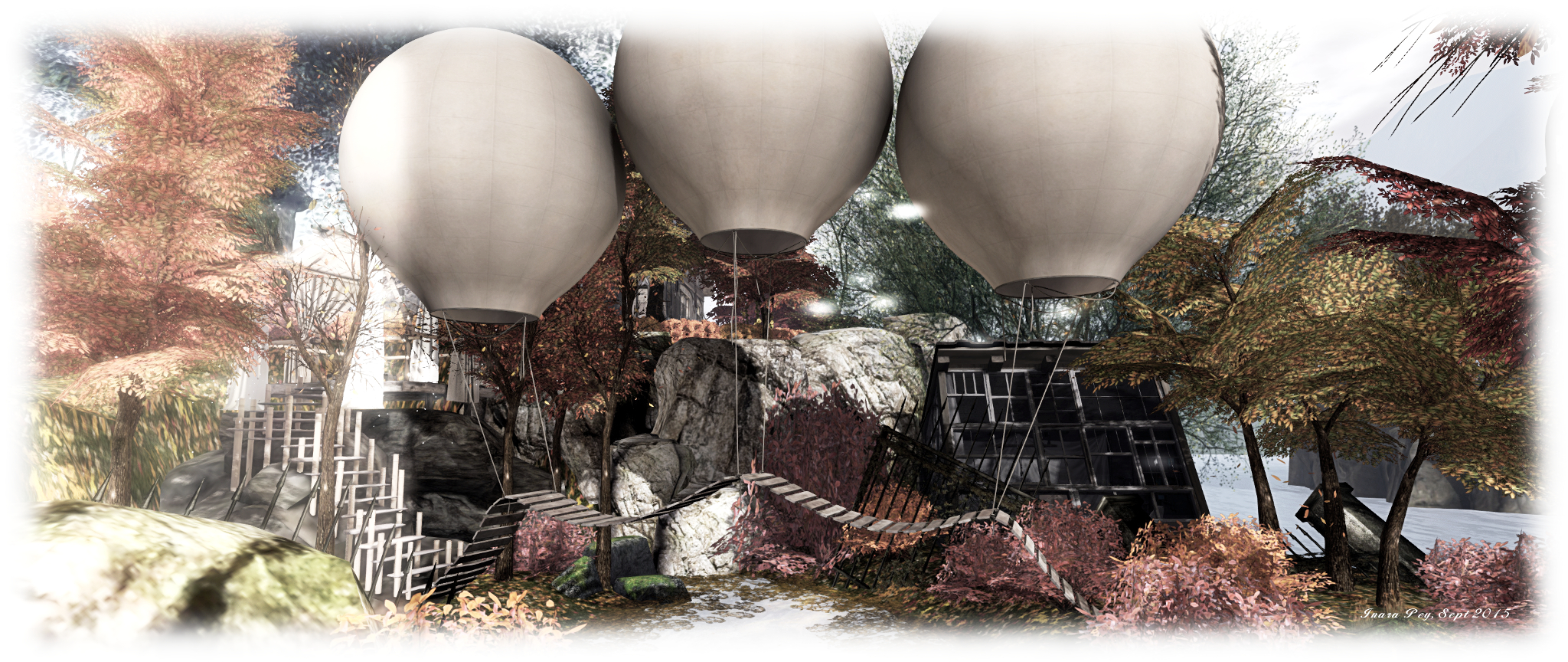
The four smaller islands all offer ideas for home designs, both exterior and interior, which are again beautifully presented. I confess to being unclear as to how they can be reached, save by flying; I didn’t notice and boat rezzers during my explorations. Three out of the four appear to be open to visitors, and include donation points. The fourth, located in the north-east corner of the region, appears to be a private residence.
Each island offers a unique design whilst keeping in tune with the overall slightly autumnal theme to the region. Given the size of the islands, superb use is made of the available space, and those with a copy of the Fanatik Rocky Island sitting in their inventory may well find their own creative thoughts on how to put it to good use flow as a result of a visit.
I must also confess to being drawn to one of the islands using this piece of landscaping myself, partly due to the fact I’ve used it in my own home island design, but also because the island in question stands apart from the others in having a decidedly Japanese look and feel to it. This makes it unique within the region without it appearing at odds with the surrounding designs.
All told, this is another quite lovely region, beautifully presented to visitors and offering a wide range of photo opportunities, places to sit and relax, and plenty to see and enjoy. In other words: a delight to visit. Should you find it as charming as I, please do consider making a donation towards the continuance of the region.
Noted SL photographers Derry McMahon and Bear Silvershade have come up with a new approach to exhibiting art in Second Life, and they’re calling it “pop up art”. Bear explains the idea in a press release thus:
We’ve watched as galleries flicker in and out of existence, and had shows at several. Two things are consistent: nothing is permanent, and even with the most relentless, ongoing promotion, visitor numbers drop off dramatically after the opening and reach near zero long before a month – the usual length of gallery shows – is up.
Instead of fighting it, we’ve decided to embrace the ephemeral nature of Second Life and experiment with pop-up galleries. It goes like this: Rent a piece of suitable land, set up our work and open it to the public, but just for a couple of weeks.
For their inaugural exhibition using the idea, the couple have rented an open-air space in Bay City – Falconmoon, where they’ll be opening a joint exhibit at 14:00 SLT on Saturday, September 19th. Derry’s half of the exhibit is called Double Vision and presents pairs of images she has created – one from the physical world, one from the virtual. These are not designed to offer pairs of similar images (although a couple are wonderfully alike), but rather offer insight into Derry art on both sides of the digital divide.
Bear’s pieces, as he notes, are largely taken from his monochrome Lonely Streets of Second Life series – a series I’ve always particularly admired, mixing a couple of his physical world images in with them as well. Taken together, the rich colours on Derry’s work facing Bear’s austere black-and-white pieces serve to complement one another very well.
Continuing the press release notes, Bear says of the approach – which originated as an idea with Derry:
The short time frame is key. For the patrons, it gives them more incentive to get out and see the show; no putting it off because “There’s plenty of time.” For us, it gives us the freedom to experiment and not feel tied down.
We can set up when and where we want, with whatever style we want. They might happen in different places once a month, or once every six months – whatever feels right.
I think it’s potentially a clever approach. As Bear says, it overcomes the issues of holding a gallery permanently open, generates interest in an exhibition due to the shorter time frame and could, if due consideration is given to the spaces which are rented-out for such exhibits, perhaps make them a part of an exhibition as much as the images on display. Kudos to Derry for the idea, and to her and Bear both for taking it on the road, so to speak.
Stand up 2 Cancer In Second Life, organised by Still Braveheart, this weekend reaches the half-way mark in a marathon series of concerts and DJ sits taking place at over 40 venues across the grid and which features over 150 artists, performers and DJs.
The events are to raise funds for Stand Up 2 Cancer (SU2C) and their ground-breaking and innovative approach to ending cancer, which puts funds directly where they are needed: into leading-edge cancer research and treatment, and undertaking aggressive research programmes. 100% of all donations made through SU2C goes directly into funding this work, none is lost to “administrative costs” or put aside for CEO or executive salaries, etc.
Since launching on September 12th, Stand Up 2 Cancer in Second Life 2015 has already brought-in donations of almost L$800,000 (approx US $3,200) in the course of its first week through in-world donations alone (people can also donate directly through the SU2C SL Team web pages – see the links at the end of this article), which has been a phenomenal response for SL residents.
The best way to keep fully abreast of SU2C activities in-world is via the Google calender of events and via Still Braveheart’s blog. – and remember, SU2C runs right through until Sunday, September 27th. In the meantime, here’s the weekend’s line up, which may be subject to last-minute changes.
As always, all times SLT. Where a time or venue has ” against it, it means it is the same as the last entry to provide either.







 Inara Pey: Living in a Modemworld