The first image from the surface of a comet, returned to Earth by the Rosetta lander Philae, November 12th, 2014. image: ESA/Rosetta/Philae/CIVA
Wednesday, November 12th saw a remarkable feat take place over 515,000,000 kilometres from Earth as a small robotic vehicle called Philae, and a part of the European Space Agency’s Rosetta mission, landed on the surface of a comet, marking the very first time this has ever been achieved.
As I reported, immediately following the landing, getting a vehicle to rendezvous with a comet, enter orbit around it and deploy a lander to its surface isn’t easy – Rosetta is a mission 21 years old, with the spacecraft spending a decade of that time flying through space.
Mission control personnel react to the first telemetry received from Philae on its initial contact with the surface of comet 67P/C-G
Immediately following the landing, telemetry revealed things hadn’t gone to plan, although the lander itself was unharmed. Essentially, part of the landing system – a pair of harpoons designed to tether the lander to the comet’s surface as a direct result of the very weak gravity there – failed to operate as expected. Telemetry has shown that the tensioning mechanism and the harpoon activation process started, but the harpoons themselves did not fire. As a result, the vehicle actually “bounced” after its initial touch-down.
The initial touch-down was at 15:33 UT – precisely on schedule and on target. However, as the harpoons failed, the lander rose back up – possibly by as much as a kilometre – above the comet, before finally striking the surface again, two hours later. This means that even while celebrations over the initial landing were going on here on Earth (the initial signal confirming touchdown taking some 30 minutes to reach Earth), Philae had yet to make its second contact with the comet.
Philae (circled in red) en route to its landing site on 67P/C-G (visible top right)
This eventually happened at 17:26 UT, and was followed by another bounce, this one of a much lesser force, before the lander came to rest at 17:33 UT.
One of the consequences of this bouncing is that the lander is not actually in its designated landing zone – the comet is tumbling through space, and thus turning under the lander as it bounced. This means that while Rosetta and Philae are communicating with one another, the spacecraft’s orbital position around the comet is not optimal for the lander’s position, and is being refined to better suit Philae’s new location. An initial adjustment was made overnight on the 12th/13th November, and further adjust is likely to be made on Friday, November 14th. Currently, communications can occur between the two vehicles for just under 4 hours out of every 13.
Philae mission manager Stephan Ulamec explains where it is believed the lander resides, represented by the blue triangle (ESA press conference, Thursday, November 14th)
This bouncing may explain why there was an initial problem with communications between the lander and the Rosetta spacecraft, as reported immediately after the initial landing telemetry was received: Rosetta was expecting Philae to be at a certain fixed position on the comet, whereas the lander was still in motion, and “moving away” from the landing site as the comet rotated. The task now is for Rosetta to visually locate the lander – which given the current orbital positioning, may take a little time; the next passage of the spacecraft over the region of the landing site will not start until 19:27 UT this evening. Mission planners hope the sunlight reflected by the lander’s solar panels might help in identifying Philae’s exact position.
A core worry for the mission team is that Philae has in fact come down in an area of shadow, possibly in a depression and close to one or two rocky “walls”, and it appears to only be receiving direct sunlight for around 90-120 mins as the comet tumbles, rather than the 6-7 hours planned with the target landing point. This potentially has serious implications for the lander’s power and science regime, although it is hoped that Philae might be able to adjust its position somewhat – the craft actually has the capability of “hopping” around by flexing its landing legs.
@Second Life, the Lab’s official Twitter feed, has announced a public meet-up with users to explore Meauxle Bureaux. The gathering will take place at 12:00 noon PST on Friday, November 14th, 2014.
The announcement via twitter
Meauxle Bureaux is the new “Mole Town” which utilises (with the creator’s permission) Kayle Matzerath’s Lumenaria build from Fantasy Faire 2013 as a home for the Linden Department of Public Works (LDPW) moles.
Following a lead from Ciaran Laval, I flew over to the town to have a look around myself at the start of November, having delighted in the Lumenaria build back at the time of Fantasy Faire. It’s a great place to visit.
Meauxle Bureaux – join the Lab there on Friday, November 14th at 12:00 noon for a tour
So, if you fancy a look around the town, and fancy meeting a Linden or two (or three or four …) why not see if you can hop over to Meauxle Bureaux this coming Friday?
The Oculus Crescent Bay prototype showing the Samsung Gear-type head harness with motion tracking sensors on the back and the integrated headphones (image via Oculus VR)
Brendan Iribe, CEO of Oculus VR was at the Web Summit event in Dublin Ireland at the start of November, where he sat down for a conversation with Wired’s Peter Rubin to discuss the latest state of play about the Oculus Rift, VR in general – and to deliver a small warning to others also involved in the headset market. He also indicated that the consumer version of Oculus Rift isn’t necessarily as close to reaching the market as some might think.
In terms of the Oculus Rift, he was upbeat about the latest prototype version, Crescent Bay, which appeared in September and which is said to be a “massive leap” forward in comparison to the Oculus DK2 hardware that shipped to developers in June and July.
Crescent Bay incorporates 360-degree positional head tracking through the inclusion of sensors on the back of the redesigned and improved head harness, higher resolution, wider field of view, a lighter body, and integrated audio (via Realspace 3D). Iribe said of the new prototype, “Crescent Bay is where it all begins: that quality level.”
Oculus Rift CEO Brendan Iribe (left), in conversation with Peter Rubin from Wird Magazine at the 2014 Web Summit in Dublin, Ireland, November 4th (image via VentureBeat)
However, he also cautioned against people getting too excited over thought that the Rift is just around the corner. “What can I say on that?” he replied to Peter Rubin’s enquiry as to when a consumer version might appear. He went on:
We want to get it right. We really do. We’ve gone out there and we’ve set this bar and said, “we are going to get it right, and we’re not going to ship until we get it right” … We’re getting very close … We want it to be a beautiful product; there’s no reason it can’t be a beautiful product … so we still have a way to go, and we’re still working on a number of things, but we’re getting much closer. We like to say it’s months, not necessarily years, away [but] it’s many months, not a few months.
He then continued, “Crescent Bay, I’ll go on the record as saying that hardware-wise for the headset, it’s arguably almost there for the consumer product, and now there’s a few other parts. So we are finalising the specifications for that consumer version, and the headset is largely finalised.”
Michael Bormann of Engadget tires-out the Crescent Bay Oculus Rift prototype
One of the issues remaining in the way of a launch doesn’t lie with the headset – it is squarely down to the suitability of input devices. Iribe notes that keyboard, game pads and even gesture devices aren’t ideal; there needs to be some form of visual element (e.g. seeing your hands), and there needs to be a tactile element as well. People need to be able to touch, feel, and sense a button reacting to being pressed.He went on to say:
We’re trying to focus now on is, what is that VR input? Where does VR input begin? We don’t know the final Holy Grail of VR input; we have kind-of any idea of VR vision being a pair of sunglasses, which we’d like to get to [but] VR input, we’re still R&Ding, we’re still looking at. But that’s definitely a big focus for us.
The implication of his comments, and those that follow an observation made somewhat in jest by Rubin suggest that Oculus VR may be looking to develop their own input device, or perhaps work in close partnership with another company in the development of an “Oculus ready” (my term, not Iribe’s) device. Certianly, having grown from employing just 50 people prior to Facebook acquiring them, to almost 250 personnel today, it is not inconceivable that Oculus VR may be poking at ideas for its own inpute device.
What is the best VR imput tool… and are Oculus VR lloking to produce their own?
The subject of VR’s “killer application” also comes up in the conversation, and Iribe states he feels it is too early to really say, although he acknowledges it will initially have a big rooting in games and entertainment – hardly surprising, given the Rift’s pedigree. “There’ll be a market of a lot of really fun entertainment experiences in VR where you’ll feel like you’re in the game or in the movie, and it’s going to be awesome,” he said.
But in terms of going mainstream, he very much sees VR’s future hinging on communications:
For me, the real media where this is going to really transform the world long-term, is when we can have face-to-face communications…. Most people travel, and we get on airplanes and cars to go have face-to-face communications… If you could, in the future throw on a pair of sunglasses, and we can have that same conversation with people around the world, all feeling like you’re in the same place, face-to-face, looking at each other, looking at each other’s eyes, looking in each other’s mouths; we may look like funny little avatars, we may look a little more human… that’s really transformative.
Could VR be as transformative in how we communicate and access information as the mobile ‘phone has been?
Were this to happen, and VR offer the same ease of use and access to communications and information as the smartphone, Iribe is convinced it could have as deep an impact on the way we communicate as the mobile ‘phone itself. “To have virtual reality where you can have these face-to-face communications, that’s going to appeal to billions of people,” he said.
However, he also had a warning for other companies also trying to bring VR headsets to the market – there have already been at least two Oculus clones making waves (the ANTVR being one), with Sony also working on its Morpheus headset for the PS4. And that warning is: don’t launch until you’ve solved the problem of motion sickness. In giving the warning, Iribe seemed to be particularly focused on Sony.
We’re really looking forward to this as an industry, and looking forward to it being an industry that takes off… We’re really looking forward to more people jumping into the VR space, and we’re doing our best to be very open, supporting others. At the same time we’re a little worried about some of the bigger companies putting out product that isn’t quite ready. That elephant in the room is disorientation and motion sickness. That’s something I view as, two or three years from now, will really be behind us… We feel pretty confident that our consumer product will have solved that; and we’re really encouraging other companies, especially big companies, “don’t put out a product until you have solved that!”
Iribe’s warning to Sony, “Don’t launch until you’ve solved the problems of motion sickness” (image via Sony)
To this end, Oculus VR’s openness on matter has been such that they’ve invited senior representatives from Sony to come and learn from the lessons the company gained from users’ experiences with the DK1 and the DK2 and to see the Crescent Bay prototype ahead of its launch, offering them the advice that they should “make sure your product is as good or close!”
Elsewhere in the interview, Iribe gives some fascinating insight into a number of topics, including his role as CEO of Oculus VR, the impact of being acquired by Facebook, the company’s relationship with the VR community, the worries those within the company had (rightly so as it turned out) over the potential backlash they’d face if they accepted Facebook’s offer, and more. All of which makes for a fascinating 19-and-a-half minutes viewing.
Follow the Lego Brick road … the Toys 4 Tots Breedables Expo
Saturday November 1st marked the start of the sixth annual SL Toys for Tots season in support of the United States Marine Corps Reserve Toys for Tots programme which distributes toys to children whose parents cannot afford to buy them Christmas gifts.
Activities this year will once again focus on sales of the special Toys 4 Tots holiday season CD featuring the talents of performers across the grid and the SL Toys 4 Tots Breedables Expo, which will take place between Saturday November 15th and Sunday November 23rd inclusive.
Throughout the nine days of the Breedable Expo, which will be held on two regions donated by Amaretto Breedables and KittyCats Breedables, there will be live entertainments and many opportunities to help raise money for Toys 4 Tots through donations, auctions, and via many special items offered for purchase by participating creators.
Alongside of KittyCats and Amaretto, sponsors for the event include: Whispering Hills, a LiTTLe BiT of EVERYTHING, Diva’s Divine Darlings, Turquoise Ranch Auction house, EVO Breeding Co., Christmas Lane, Rose Breedable, Weeping Willow, Mythical Utopia, Papillon, Dixieland Downs, Awesome Breed Creations, Acceleration Exotics, Amaretto Market Owners Coalition, Aroonshire Fortress, Yumi Bands of Cypher, Breeders Choice, Dwarfins, E&S Breedables, Fantasia, Fish Hunt, Pet Peddlers, Shadow Wynde, SOS-Streams.net, Trinity Breedable, TW Saddles & Reins, Whispering Hills, Aero Pines Park, Wild Kajaera, Wicked Tattoos, Gempandas, Meeroos, FluiD, House of Huntress, Huntress Inc, J&T Stables & Auction House, Stone pony Ranch, Treasures Elite WK Breedable, Madness Auctions, Mossms, The Nest Egg, CasperTech, Secret Meadows, The Aquarium, Ludus Agora, Madonna Ranch.
A trip to the North Pole and Santa’s workshop lets you join in with the Toys 4 Tots Breedable Expo
Perofrmers appearing through the nine days of the event include: Todd Rumsford, Hazie Moonwall, Shaye Dezno-Jonstone, Lisa Petrolhead, Tobykip Lionheart, Lisa Nichols(Brune), SINGERGIRL, Taunter Goodnight, Southcity Genesis, Chip Takacs, Maximillion Kleene, Brixton Canning, Susie Darling, Samm Qendra, Zerbie Magic, Jacqueline Luik, Miha Shamen, Potlatch Foggarty, Redhawk, ELiz Watanabe, ProfessorShowbiz, Deelah Halostar-Freund, Josie Anderton, Freddy Mergatroid, Premium Composer, Satin & Erin, Mavenn Resident, Hogan Baily, Wayne Davis Rocks.
This year, the special holiday season CD will be available in return for donations through any SL Toys 4 Tots donations kiosk, and includes 33 tracks for your listening pleasure:
01 T4T 2014 Entire CD – Misc Artists 02 All I Want for Christmas is You – Travis Overland 03 Angels We Have Heard On High – Ganjo Mokeev 04 Away in a Manger – Premium Composer 05 Baby It’s Cold Outside – Ke Aloha & Parker Static 06 Believe – Ke Aloha 07 Blue Christmas – Liam Defoe 08 Breath Of Heaven – Parker Static 09 Carol of the Bells – Keeba Tammas & The Tiny Maniacs 10 Christmas in Dixie – TobyKip Lionheart 11 Christmas song – Singergirl Mode 12 Dominick the Donkey – Suzetta Moonites 13 Little Drummer Boy – Donny Collazo 14 Grown up Christmas List – Phil Setner 15 Have Yourself a Merry Little Christmas – Josie Anderton 16 Home for Christmas – Wayne Davis 17 I Saw Mommy Kissing Santa Clause-Libertybelle Lyric
18 I Want A Hippopotamus for Christmas – April McCoy 19 Just Don’t Feel Like Christmas Without You – Subtlety Dalglish 20 It’s Christmas – Todd Rumsford 21 Meet Me Under The Mistletoe – Freddy Mergatroid 22 Mr Grinch – iCandy_Overland 23 Rockin Around The Christmas Tree – Scorpianrose 24 Rudolph – Seth Mankind Tracer 25 Santa Baby – Eliz Watanabe 26 Santa Claus is a Stalker – Dilah Halostar 27 Santa Claus is Coming to Town – Potlatch Foggarty 28 Toothless Grin – Galvana Gustafson 29 Twas The Night Before Christmas – Brandy Maltas aka Kalli Birman 30 Where are you Christmas – Ichie Kamachi 31 Where’s the Line – Bobby Roxley 32 Winter Wonderland – Gold Talon 33 You Raise Me Up – Khiron Ametza
Get your copy of the Toys $ Tots 2014 seasonal CD from any of the official donation kiosks
The 2013 Toys 4 tots Expo raised over L$1,600,000 for the programme, and the organisers are hoping this year marks an even greater success. During the six years it has been running, SL Toys 4 Tots has raised US$60,000 for the Toys for Toys programme.
About Toys for Tots
Toys for Tots began as a Los Angeles charitable effort in 1947. William Hendricks was inspired by his wife Diane when she tried to donate a homemade Raggedy Ann doll to a needy child but could find no organization to do so. At her suggestion he gathered a group of local Marine reservists who coordinated and collected some 5,000 toys for local children that year from collection bins placed outside of Warner Bros. movie theatres. Their efforts were so successful that, in 1948, Toys for Tots was launched as a national campaign in the United States, with a mission to “collect new, unwrapped toys during October, November and December each year, and distribute those toys as Christmas gifts to needy children in the community in which the campaign is conducted.”
Brave new world: the surface of comet 67P/C-G, upon which the European space Agency successfully landed a the robot vehicle Philae on Wednesday, November 12th, 2014 as a part of the Rosetta mission
“The biggest problem with success is that it looks easy, especially for those of us who have nothing to do.” Thus spoke Jean-Jacques Dordain on Wednesday, November 12th, just moments after it had been confirmed that a tiny robot vehicle called Philae had safely landed on the surface of a comet half a billion kilometres away from Earth.
That simple statement offers a subtle message on the huge achievement this landing represents. The Rosetta / Philae mission is the story of a 6 billion kilometre journey across space which has taken a decade to achieve, and which has involved some 20 countries. Yet the adventure is in many ways only now starting.
The Rosetta mission actually started 21 years ago, in 1993 when it was approved as the European Space Agency’s first long-term science programme. The aim of the mission being to reach back in time to the very foundations of the solar system by rendezvousing with, and landing on, a comet as it travel through the solar system.
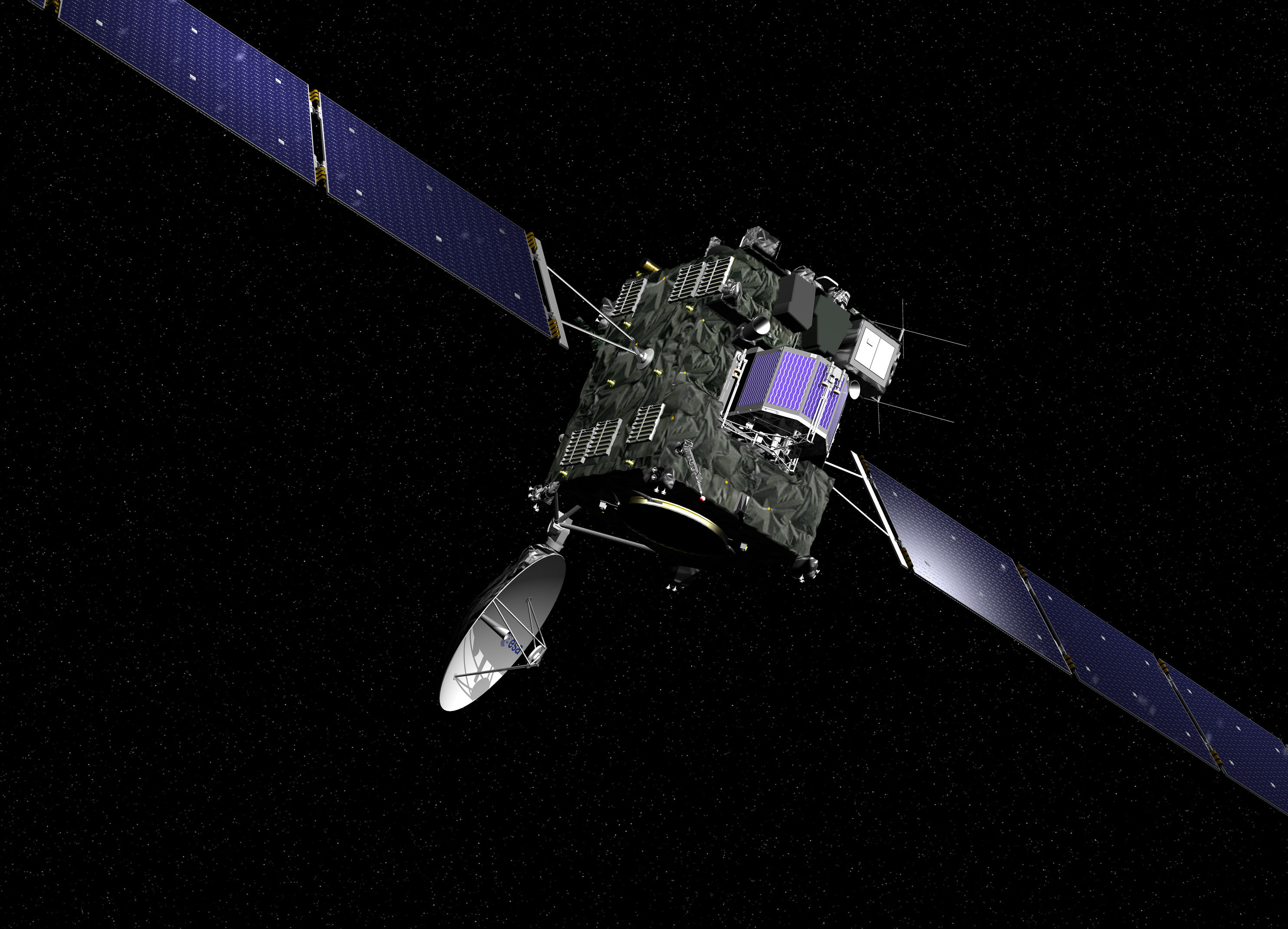
An artist’s impression of Rosetta in space. It has already achieved a remarkable set of “firsts”, including the first solar-powered space probe to operate beyond the orbit of Mars. Philae, the lander, is the purple house shape on the front of the vehicle
Comets hold enormous scientific interest because they are, as far as can be determined, the oldest, most primitive bodies in the Solar System, preserving the earliest record of material from the nebula out of which our Sun and planets were formed. While the planets have gone through chemical and (in the cases of places like Earth), environmental and geological change, comets have remained almost unchanged through the millennia. What’s more, they likely played an important role in the evolution of at least some of the planets. There is already substantial evidence that comets probably brought much of the water in today’s oceans – and they may even have provided the complex organic molecules that may have played a crucial role in the evolution of life here.
The target for ESA’s attention is comet 67P/Churyumov–Gerasimenko (aka 67P/C-G), an odd-shaped body comprising two “lobes” joined together one in what some in the media have at times referred to as the “rubber duck”. The larger of the two lobes measures some 4.1×3.2×1.3 kilometres in size (2.55×1.99×0.8 miles) and the smaller some 2.5×2.5×2 kilometres (1.6×1.6×1.2 miles). It is a “short period” comet, orbiting the Sun once every 6.4 years and most likely originating in the Kuiper belt, a disk of material from the early history of the solar system, orbiting the Sun at a distance of around 30-50 AU
The primary spacecraft in the mission, Rosetta, arrived in the vicinity of 67P/C-G on August 6th, 2014 becoming the first vehicle in history to successfully enter orbit around a comet. The major reason the mission took so long to reach the comet, having been launched in 2004, is that despite having a relatively short orbital period, 67P/C-G is travelling very fast and accelerating as is falls deeper into the Sun’s gravity well heading for perihelion (it is currently travelling at 18 kilometres (11.25 miles) a second and can reach velocities of 34 kilometres a second as it swings around the Sun). As it is impossible to launch a space vehicle is these velocities, Rosetta was launched on a trajectory which allowed it to fly by Earth twice (2005 and the end of 2007) and Mars once (early 2007), using the gravity of both planets to accelerate it and (in the case of the 2nd Earth fly by), swinging it onto an orbit where it would “chase” and eventually catch the comet.
It’s a long way from here to there: Rosetta’s flight from Earth to 67P/C-G (image via extremetech.com) – click for full size
Following its safe arrival, Rosetta settled into an orbit of some 30 kilometres around the comet in September, and began looking for a suitable place where Philae might land – because until the craft actually arrived in orbit around 67P/C-G, no-one had any idea of what it’s surface might look like. On 15 September 2014, ESA announced a region on the “head” of the “duck” had been selected for the landing, christening it Agilkia in keeping with a contest to name the landing site.
Further observations of the comet were carried out throughout September and October as an overall part of Rosetta’s mission and to gain as much information on the landing site itself. At the same time the spacecraft started manoeuvring itself in closer to the comet, dropping its orbit to just 10 km, ready for Philae’s delivery.
This image, captured by Rosetta on Wednesday, November 12th, shows the Philae lander as it starts its descent towards the comet
The landing operations commenced around 09:05 UT on Wednesday, November 12th, when Philae detached from Rosetta and started on its long gentle descent. Immediately following the separation, and due to Rosetta’s orbit around the comet, contact was almost immediately lost with the lander, leading to a tense 2 hour wait before communications could be re-established. This happened on cue, with the lander reporting all was OK.
Landing on a comet is no easy task. The gravity is almost non-existent, and there was a very real risk that Philae could, if it struck the surface of 67P/C-G too fast, simply bounce off. Hence the lander’s long, slow drop from the Rosetta spacecraft which the ESA mission scientists dubbed “the seven hours of terror” in recognition of the famous “seven minutes of terror” which marked the arrival of NASA’s Mars Science Laboratory Curiosity on Mars.
As always, please refer to the server deployment thread in the forums for the latest information and updates.
There was no deployment to the Main (SLS) channel on Tuesday, November 11th.
On Wednesday, November 12th, all three RC channels should receive the same server maintenance package, which comprises “minor improvements” to help configure the texture and mesh CDN
We’re currently approaching the run-up to holidays, which means things are liable to be a little quiet on the server release front. There is usually a code freeze in effect during the US Thanksgiving week, and again over the Christmas / New Year period (which also affects viewer releases). With this in mind, and commenting on the next couple of weeks, Simon Linden commented that there is some hardware maintenance scheduled between now and Thanksgiving, and not a lot else.
SL Viewer
Release Viewer and Start-up Issues
On Monday, November 10th, the Lab promoted the Benchmark viewer, version 3.7.20.296094, to the de facto release viewer. This viewer removes reliance on the GPU table for determining the viewer’s initial graphics settings, and can be obtained from tha main viewer download page.
Some people have been reporting problems trying to run this viewer, specifically that it fails on reaching VFS initialisation. I encountered this problem myself in allowing the viewer to update from the HTTP pipelining release (3.7.19.295700) to the current release, and found that deleting my SL viewer cache ( C:\Users\[user name]AppData\Local\SecondLife) – a trick I’ve used with similar problems following a “dirty” install with Firestorm – cleared the issue for me; on restarting the viewer, it loaded OK and I was able to log-in.
However, for those who find this doesn’t work, or who have found a completely clean install (removing the viewer, the cache and local settings found in C:\Users\[user name]AppData\Roaming\SecondLife) hasn’t worked, a JIRA is open – see BUG-7776 – and specific problems should be reported there.
Group Chat
The recent round of changes to group chat, related to how the system looks-up avatars engaged in a group chat session as they move around the grid – see here – are expected to start rolling-out this week on the back-end. However, they are not expected to yield dramatically visible improvements in group chat.
Experience Keys / Tools
There’s not a lot to report On the Experience Keys project (see my overview and update), other than the Lab is “trying hard to wrap up the last few issues with Experiences so that we can make them generally available,” as Oz Linden said during the Simulator User Group meeting. As well as having the capability of allowing users to build more immersive experiences for people to enjoy, a particular interest in the Experience Tools is the key/value store, which is being seen as a potentially powerful additional capability to help with saving and retrieving data.
Other Items
Saving Graphics Profiles (/Preferences)
A suggestion was recently put forward during a Simulator User Group meeting for the Lab to allow the saving of graphics profiles (see my week 44/1 report under “Graphics Profile in the Viewer”. This would mean, for example that you could have a graphics profile where various options – the quality slider, shadows, occlusion, draw distance, etc., could be pushed towards their upper limits; and another where the setting are more conservative and less taxing on your GPU / system.
A feature request was subsequently submitted, after Oz suggested this might be a good open-source contribution, and Jonathan Yap is now working on the feature (STORM-2082), although it may be a “somewhat altered version” of the original suggestion. Currently, the work is focused on Quick Preferences style of panel (as found in a number of TPVs), as shown in the image below, accessed via the Setup tab in Preferences.
Jonathan Yap is working on a new “Quick Preferences” floater for the SL viewer (seen on the left in this image), access from the Setup tab in Preferences – this Quick Preferences tab will likely have options to save graphics settings once set through the sliders
Keep in mind this is very preliminary work, and things are liable to change as the work progresses.
Prim Selection Problems due to Interest Changes
An annoying issue which has been introduced with the interest list changes is the ability for them to interfere with object selection. Essentially, if an object or group of objects is selected, and camming then moves them off-screen, they are deselected, as updates from them to the viewer are culled – see BUG-7115. A fix for this should be available in the next round fo general bug fixes for the viewer released by the Lab.
It has been thought the interest list code had been altered since that there was a minimum distance before culling would be applied (e.g. so that there would be no culling on objects within, say, 30 metres of your camera position, regardless as to whether their were in your field of view or not). Simon Linden is going to take a further look at the code to see if this is in fact the case.
Script Sizes
The Simulator User Group meeting saw further discussion on script sizes (still 16Kb for LSL and 64Kb for Mono) and the viability of increasing them. Commenting on the discussion, Oz Linden observed, “Increasing script size is one of those things that must be considered very, very carefully. It would affect many, many things.” As such, it’s unlikely that any changes will be on the horizon.




 Inara Pey: Living in a Modemworld