Creeping men, visitors from afar, neighbours and merfolk

It’s time to kick-off another week of fabulous story-telling in Voice, brought to Second Life by the staff and volunteers at the Seanchai Library.

As always, all times SLT / PDT, and unless otherwise stated, events will be held on the Seanchai Library’s home on Imagination Island.

Sunday August 24th

13:30: Tea-time at Baker Street: The Casebook of Sherlock Holmes

Caledonia Skytower, Corwyn Allen and Kayden Oconnell once again open the pages of The Casebook of Sherlock Holmes, the final set of twelve Sherlock Holmes short stories first published in the Strand Magazine between October 1921 and April 1927.

This week: The Adventure of the Creeping Man

“MR. SHERLOCK HOLMES was always of opinion that I should publish the singular facts connected with Professor Presbury, if only to dispel once for all the ugly rumours which some twenty years ago agitated the university and were echoed in the learned societies of London …”

So it is that John Watson puts pen to paper to tell the strange tale of the professor, his secretary, who is also engaged to the professor’s daughter, a trip to Prague and the creepers growing up the side of the professor’s house.

The tale is a most peculiar one indeed, and not just for the story itself; The Adventure of the Creeping Man veers somewhat away from Conan Doyle’s usual scientific approach to the unravelling of the mysteries Holmes and Watson face; so much so that it has met with much debate among critics down the years.

To find out more, be sure to turn up on time for a spot of afternoon tea at Baker Street!

18:00: Magicland Storytime

Join Caledonia Skytower at Magicland Park for another round of storytelling!

Monday August 25th, 19:00: Far From Home: The People: No Different Flesh

the peopleZenna Chlarson Henderson was one of the first female science-fiction authors, having started reading publications such as astounding Stories from the age of 12, and becoming a popular author in the 1950s and 1960s.

She is perhaps best known for her The People stories, which focus of a race of human-like aliens forced to flee their homeworld due to a natural disaster, and some of whom arrive in the American southwest shortly before the start of the 20th century.

The People have the very best of human qualities: love, gentleness, spirituality; and also special powers of healing, levitation, telekinesis and more, who wish only to preserve their home culture and beliefs amidst a world which, despite their human appearance, does not understand them.

Henderson’s tales about The People ran to some 17 stories which examined the lives of The People, their past on their homeworld, their attempts to live quietly on Earth, their interactions with their human neighbours, all told in a beautiful, moving style. Why not join Gyro Muggins to learn more as he continues reading The People: No Different Flesh?

Tuesday August 26th, The Sea Fairies

Lyman Frank Baum is best known for his Wizard of Oz novels. However, over the course of his life he wrote some 59 novels (including four “lost” novels), 83 short stories and over 200 poems.

sea-fairiesThe Sea Fairies, first published in 1911, was intended to be the first volume in a new series of stories after Baum had “finished” the Oz series with the Emerald City of Oz. It tells the tale of young Mayre Griffiths, known to all as Trot, who lives on the coast of Southern California, where her father is the captain of a sailing schooner. Trot’s home life is shared with Cap’n Bill, her father’s former skipper, who has lived with the family since an accident cost him a leg.

Cap’n Bill is a devoted guardian to little Trot, and spends his days walking the beaches with her, or rowing her along the coast, regaling her with tales. But when the subject of mermaids comes up, Trot’s wish to see one is granted, and both she and Cap’n Bill fix themselves transformed into merfolk – who are sea fairies – and taken to the undersea realm of Queen Aquarine and King Anko, where they witness many things and are forced to come up against the wicked Zog the Magician …

Join Faerie Maven-Pralou as she takes to the seas once more and continues this lasting tale.

Wednesday August 27th, 19:00: More Selections from Chestnut Street

Maeve Binchy, journalist, columnist, playwright and author, began her writing career by accident, thanks to her father sending the letters she wrote to him while on a kibbutz in Israel during the 1960s to a local paper in Ireland, which subsequently published them. This in turn led to her being offered a job with The Irish Times on her return home, thus starting her on the road to becoming one of Ireland’s most successful and internationally recognised writers.

chestnut streetThrough her writings, she would often jot down short stories about an imaginary street in Dublin, where people would constantly come and go and experience the most diverse of times and situations. Once written, these stories would be put away for “the future”. That imaginary street was called Chestnut Street, located not far from the setting of her 2010 bestseller Minding Frankie.

In 2014, these tales of the folk who live along, or visit, Chestnut Street were gathered together in a single volume and published posthumously under the title Chestnut Street.

Join Caledonia Skytower as she delves into the rich diversity of stories to be found inside the covers of this book. Perhaps you’ll meet Bucket Maguire, the window cleaner, who finds himself going to extraordinary lengths to protect his son; or hear all the local gossip from Melly, and see how it helps a local fortune-teller for the good of all; or maybe you’ll find yourself sympathising with poor Nessa, whose summers are blighted every year by the arrival of her aunt from America on a vacation sure to turn Nessa’s life and home upside down. Chestnut Street is inhabited by the most colourful characters, and their stories are lovingly and humourously told; so why not join Caledonia as she pays them a visit?

Thursday August 28th

16:00: Freda in Progress

with Freda Frostbite.

19:00: the Minotaur

Join Shandon Loring as he plunges into the labyrinthine tale of queeny seductions, kingly puzzle gardens, monsters in the maze and young Athenian heroes all wrapped-up in a tale of strife, romance, torment and triumph!

—–

Please check with the Seanchai Library SL’s blog for updates and for additions or changes to the week’s schedule. The featured charity for July-August is WildAid: seeking to end the illegal wildlife trade in our lifetimes by reducing demand through public awareness campaigns and providing comprehensive marine protection.


Related Links

You can’t always get what you want …

CuriosityAugust 5th marked the 2nd anniversary on Curiosity’s landing on Mars. The “landiversary”, as NASA dubbed the occasion, passed in something of a subdued manner in many respects, featuring a re-run of the August 2012 video reviewing the MSL’s arrival on Mars. Reviews of the mission from the perspective of two years on from that remarkable lading didn’t start-up until the days after the anniversary, with videos and lectures from members of the mission team.

One of the films which did appear, directly out of Caltech, rather than NASA’s Jet Propulsion Laboratory (which is located on Caltech’s Pasadena, California, campus), is Our Curiosity, a 6-minute celebration of Curiosity’s mission, and humanity’s drive to explore, to seek, to learn, and to understand, narrated by Felicia Day and the superb Neil DeGrasse Tyson.

August 5th also marked my last MSL report, when Curiosity was some 3 kilometres from the lower slopes of “Mount Sharp”, the huge mound at the centre of Gale Crater, and the rover’s primary target for exploration. At that time, the rover had started to cross a region of chaotic terrain, marked by a rocky plateau cut by a series of sandy-bottomed valleys. The plateau itself proved to be littered with sharp-edges rocks and stones which had already caused some increase in the wear and tear being suffered by the rover’s wheels – albeit not as much as mission engineers had feared – by the time Curiosity had reached the edge of the nearest of the shallow valleys, which had been dubbed “Hidden Valley”.

The plan had been to use the valleys, where the sand would be less wearing on the rover’s aluminium wheels, to reach an exposed area of bedrook designated the “Pahrump Hills”, where Curiosity would engage in further rock sampling work prior to it continuing on to the “Murray Buttes”, the entry point for its ascent up the lower slopes of “Mount Sharp”.

However, rather than drive the one-tonne rover straight through the middle of the valley, where there are numerous dunes of potentially soft, wind-blown sand which might cause some difficulty traversing, the idea had been for Curiosity to skirt along the edge of the valley, where it was hoped the sand would be firmer and make for a better driving surface. Unfortunately, this proved not to be the case; as the rover proceeded along “Hidden Valley” it exhibited far more signs of wheel slippage than had been anticipated, giving rise to fears that it might get bogged-down in the sand were it to continue.

The sands of Mars: an image from Curiosity’s black and white Navcam system captured on August 4th, showing the loose sands the rover was traversing as it continued into “Hidden Valley” (click for full size)

As a result, the rover reversed course, driving back out of the valley. In doing so, it crossed the rocky “ramp” it had used to originally enter the valley, and one of its wheels cracked the slab-like rock’s surface, revealing bright material within, possibly from mineral veins. The rock, dubbed “Bonanza King” showed similar signs of origin as “Pahrump Hills”, so a decision was made to examine it as a possible substitute drilling site.

“Geologically speaking, we can tie the Bonanza King rocks to those at “Pahrump Hills”. Studying them here will give us a head start in understanding how they fit into the bigger picture of Gale Crater and Mount Sharp,” said Curiosity Deputy Project Scientist Ashwin Vasavada, before continuing, “This rock has an appearance quite different from the sandstones we’ve been driving through for several months. The landscape is changing, and that’s worth checking out.”

Continue reading “You can’t always get what you want …”

Tony Parisi joins High Fidelity

HF-logoOn Thursday August 21st, Philip Rosedale announced that Tony Parisi has joined High Fidelity.

Precisely what Mr. Parisi’s position at HiFi is, isn’t stated, but Mr. Rosedale does say:

Tony has just joined us as an advisor, and is also working with us on some secret High Fidelity stuff that is coming soon. He’s a perfect person to add to the High Fidelity team.

Tony Parisi (via SVVR)

Tony Parisi is the co-creator of the VRML and X3D ISO standards for networked 3D graphics, and a 3D technology innovator. He’s a career CTO / software architect and entrepreneur, has and is serving on a number working groups, and may also be familiar to some as one of the SVVR Creating the VR Metaverse  panel in April 2014. More recently, he was featured in a Drax Files Radio Hour feature-length interview, which I also reviewed (and am embedding again at the end of this piece, as it really is worth listening to if you missed it the first time around).

Tony’s full bio can be found here, and while the work he’ll be doing at HiFi is currently “secret”, Philip Rosedale does expand on why his involvement is a good fit for the company:

What we are building at High Fidelity is a bigger project than any one designer or company.  To bring virtual reality to everyone will mean a broad set of standards and open systems, and Tony has been designing and championing big pieces of those standards for his whole career, most recently with WebGL.

There can be no doubting Tony’s background and understanding of the potential for consumer-focused VR – again, just listen to the interview below for proof of that.

So interesting times at High Fidelity just got more interesting!

(Nice touch on the updated website as well, with the video header.)

First skill game operators and games listed, first skill game region arrives (for testing)

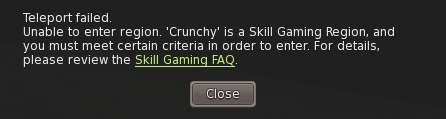
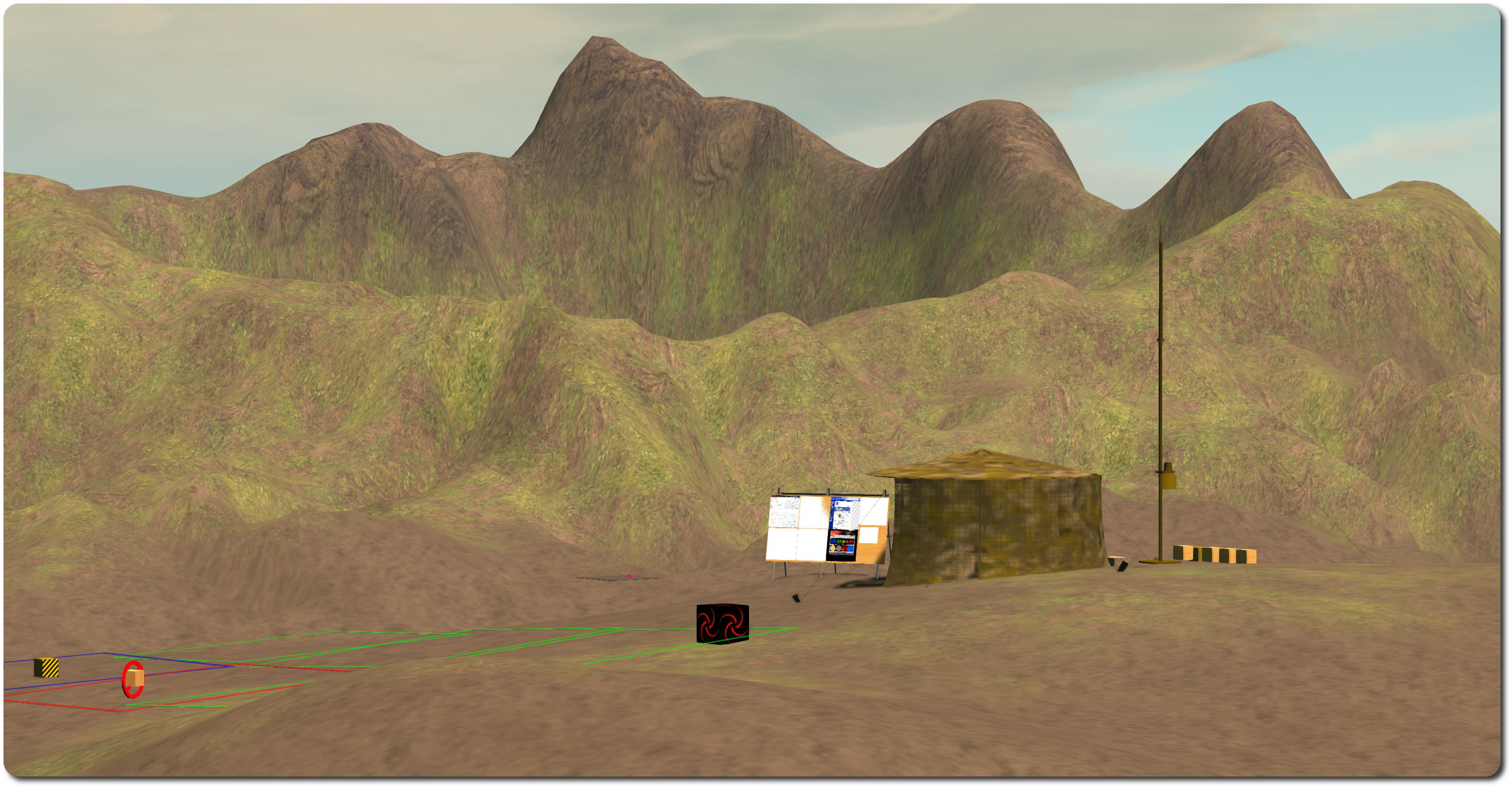
During the Server Beta meeting on Thursday August 21st, it was confirmed that the first region to be rated a Skill Gaming region had arrived on the main grid. The region – called “Crunchy”, isn’t actually open for gaming; it’s a test area currently being poked at by Gecko Linden.

In addressing the arrival of the region, Simon Linden pointed to the Skill Gaming Approved Participants wiki page, and I noticed that the first set of Skill Gaming operators and the first batch of games have now been listed.

A warning is displayed if you attempt to TP to s Skill Gaming region you are no permitted to access
A warning is displayed if you attempt to TP to s Skill Gaming region you are not permitted to access

The test region is already set-up to exclude access to avatars which don’t meet the access requirements, which can be found in the Skill Gaming FAQ and on the Approved Participants wiki page. The access restrictions appear to work, as I was unable to reach the test region with my Crash Test Alt, but could enter it without a hitch with my primary avatar account.

There are some other tests going on in the region which are likely to be readily to performance testing, etc; robots fly and shoot, MOAP boards are displayed (and Gecko Linden seems to be a bit of a space science fan, like me).

Crunchy: the Lab's FOB for Skill Gaming regions, and "Basecamp Gecko"
Crunchy: the Lab’s FOB for Skill Gaming regions, and “Base Camp Gecko”

Some 45 games (a fair few of them variations on Solitaire) were added to the Approved Participants wiki page on Thursday August 21st, split among a number of operators. In addition, some 30 Skill Gaming regions were listed as approved as Skill Gaming regions, although they have yet to actually be converted to the new region type.

With the revised September 1st deadline looming for the introduction of the updated Skill Gaming policy, these additions are the first sign that people are actually applying to become operators / creators, and it will be interesting to see how many more appear over the course of the next week. As it is, there still seems to be a lot that is still up-in-the-air with regards to the Policy and its associated FAQ – the latter of which hasn’t been updated since August 7th.

One area still to be cleared-up is that of quarterly fees, which may well be delaying some from applying to become licensed operators / creators. The lack of any clear indication of the fees was raised as a matter of concern at the August 2nd presentation Agenda Faromet gave on both Skill Gaming and the July Terms of Service update (transcript and notes to both available here).

In many respects, it is hard to understand why the Lab hasn’t announced quarterly fees. According to the FAQ, they are in respect of are in respect of “processing and compliance-related costs associated with maintaining this program”. Taking this as the case, then it’s not unreasonable to assume the Lab has an idea of the compliance related costs and other fees they are themselves facing in order to allow skill gaming on their platform, and so should have some idea of what the quarterly fees are likely to be.

This is not to suggest the Lab are attempting anything untoward in not revealing the fees; a was pointed out during the SLBA presentation, the likely reason the fees haven’t been announced is because the Lab have (or hadn’t at the start of August) got that far in their thinking. Even so, it is potentially causing people to hold off applying.

What also doesn’t help the Lab here is that Skill Gaming regions already have a higher tier associated with them ($345 + VAT where applicable) “due to the greater degree of ongoing administrative work associated with administering our rules concerning Skill Gaming in these regions”. So applicants are faced with that, the application fee, the cost of converting their existing regions – and then still have a possibly large question mark hanging over their potential total operating costs.

It doesn’t inspire confidence.

There are other aspects of the process that would seem to need clarification or risk confusion. As Ciaran Laval pointed out on August 13th, it has been suggested (not by the Lab, admittedly), that SL-focused stock exchanges are possibly exempt from the updated policy, but at least one is going through the application process (SL CapEx, again as indicated by Ciaran); ergo, further clarification on the status of exchanges would perhaps be welcome.

There is also the requirement (section 9 of the FAQ), that applicants engage a US-based and licence attorney to help with the legal aspects of their application (e.g. provisioning their RLO). However, this hardly seem correct when it comes to applicant from outside the USA, as a US attorney is unlikely to know the gaming laws applicable to another country (or can even give a legal opinion on the laws of another country). So where does that leave applicants from outside of the USA? Again, further clarification might well be welcomed.

In his article, Ciaran notes the fact that the Lab are willing to push back on the date from which the new policy comes into effect is good – and I agree (although like him, I’d also like to se some indication on whether they are also willing to push back the date from whence the nebulous quarterly fees kick-in).

But that said, the fact that more than a month after the updated policy was first announced people are still waiting for clarification on some matters relating to its introduction, does suggest the Lab has perhaps put the cart before the horse (and I admit, I’m tempted to put “again” at the end of that sentence).

Obviously, those wishing to create and / or operate games of skill have little choice but to comply with the new policy. Even so, it would perhaps be nice if the Lab didn’t continue to give the impression that the best way for people to decide whether they want to be or not is down to a roll of the dice, the current batch of applicants listed on the wiki page notwithstanding.

SL projects Updates week 34/2 server, texture / Mesh CDN, group chat

Santaurio, Cala del Barronal; Inara Pey, April 2014, on FlickrSantaurio, Cala del Barronal (Flickr) – blog post

Server Deployments week 34 – Recap

There was no deployment on the Main (SLS) channel on Tuesday August 19th. All three RC channels received the same server maintenance project  on Wednesday August 20th, aimed at fixing a crash mode.

There may be news on the crash mode fixed in the RCs once it has deployed to the Main (SLS) channel in week 35.

Upcoming Server Deployments

There will be a new server maintenance package deployed to the RCs in week 35, which includes a couple of visible changes:

  • SVC-2262 – “Incorrect height value in postcard which sent from above 256m” (a postcard being a snapshot sent to e-mail)
  • A “re-fix” for BUG-6466 – “Numbers expressed in scientific notation and include a plus sign in the exponent are not parsed as JSON numbers by LSL”, which was thought to have been fixed a while ago, but which in fact resulted in BUG-6657 – Valid JSON numbers like 0e0 no longer valid after 14.06.26.291532. prompting the original fix to be rolled back.

SL Viewer News

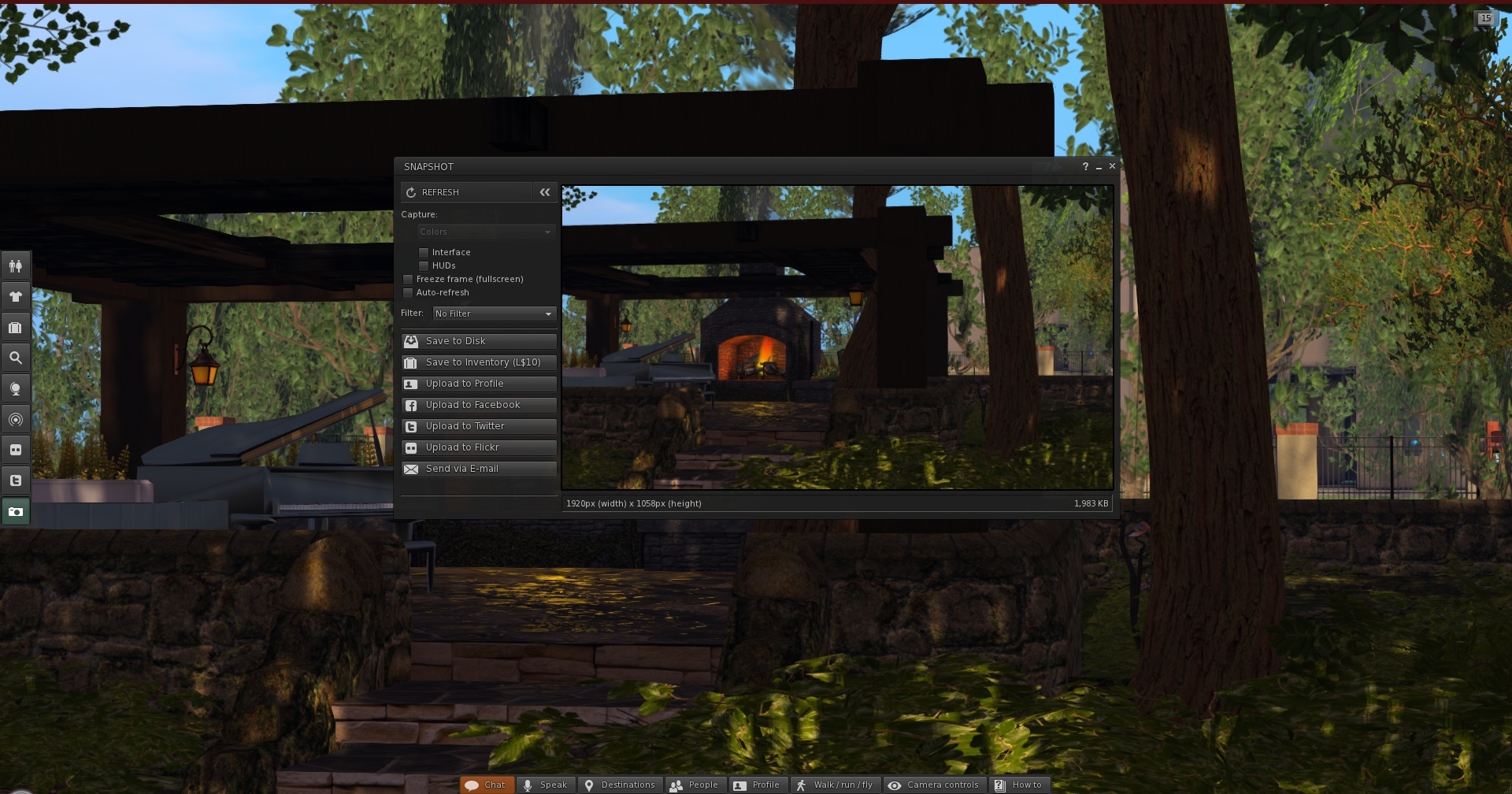
TPV developer Niran V Dean has been working on a new unified snapshot floater which encompasses the “standard” floater, plus the Flickr, Twitter and Facebook upload options, under STORM-2040. Those who use the most recently releases of Niran’s Black Dragon viewer will be familiar with the approach, as he initially worked on the idea in that viewer.

NiranV Dean has been working on a more unified snapshot floater, which is currently undergoing testing. It will hopefully appear soon
NiranV Dean has been working on a more unified snapshot floater, shown here in the viewer window, which is currently undergoing testing. It will hopefully appear soon (click for full size)

The work is now progressing to a point where we should be seeing the fruits of his labour in the near future. In the meantime, I’ve previewed the work as it stands at the moment.

Texture and Mesh Fetching CDN

As reported in my last TPV developer meeting update, the Lab is looking to move texture and mesh fetching to a content delivery network (CDN). If successful, this approach will see texture and mesh fetching bypass the simulator entirely, being routed instead directly between the viewer and asset servers via the CDN, which should see improvements in the speed and reliability of such transfers.  Explaining the new approach further at the Server Beta meeting on Thursday August 21st, Maestro Linden said,

The viewer currently fetches all meshes and textures through the sim, which gets them from the asset server, and the sim gives the viewer a ‘capability’ URL, which the viewer uses for fetching. However, with this change to use the CDN, the sim instead gives the viewer the URL of the CDN, and the CDN has hosts all over the world. 

It’s good for two reasons: 1) the sim isn’t burdened with texture/mesh transfers; 2) you’ll often have lower latency to the CDN than the sim, which means more speed.

Allowing for the fact the Lab is accessing the service through their own network (although the CDN is a commercial service), both Maestro and April Linden report it as being a noticeable improvement on things, with texture and mesh fetching having double the performance compared to the current means of fetching via the simulator. Initial results of testing from Europe show similar improvements.

The Server Beta meeting agenda has further information on new method for mesh and texture fetching, including details on the Aditi stress test regions (one for textures, one for meshes), and those wishing to try them out are invited to do so. No special viewer is required in order to carry out testing at present, and the agenda includes notes on what to do. Note that the test regions are set to no-build so that people don’t rez extra things that would skew results; they are also likely to be limited in terms of the maximum number of avatars able to access them at one time.

If / when the new approach is more broadly rolled-out, people will be able to see which service (CDN or via the simulator) they are using is to set Develop > Consoles > Capabilities Info To Debug Console. Those using the CDN will see the GetMesh, GetMesh2, and GetTexture URLs will all be  http://asset-cdn.aditi.lindenlab.com/, while those using the current method will see it give some URL pointing at the sim host. However, we’re still some way from seeing the new service deployed further than the Aditi test regions.

Should this work prove successful, and once it and other HTTP work such as pipelining, as being developed by Monty Linden, is completed, the Lab hopes that they’ll have a fast, robust series of HTTP services such that they can look to retire UDP texture fetching – although this will be some way down the road, and in the interim, UDP will offer people something of a fallback for texture fetching should they have issues with HTTP as the various new services are deployed.

 Skill Gaming Regions

Simon Linden reported that the first of the Skill Gaming regions has arrived on Agni (the main grid). Called Crunchy, it doesn’t have any gaming parlours or anything on it, but appears to be set-up for testing (such as accessibility). There are a few things going on there, most under the control of Gecko Linden. Also, and as pointed-out by Simon, the first skill games and operators have started to appear on the Lab’s Skill Gaming Participants wiki page.

Group Chat

Work has resumed on group chat after a brief pause, and the Server Beta meeting saw a very brief test take place. The aim of this was to test delays that have been introduced into the members list updates sent by the chat server.

As I’ve previously reported, one of the biggest issues of chat delays in group chat sessions is to do with the numbers of updates the chat server has to send as people join / leave session and log-in / out of SL, changing their online status within the groups they’re a member off. Recent changes to the code are intended to queue these updates and reduce the load they are placing on the servers, interrupting the flow of text messages.

The test was brief, but appeared to give Simon Linden enough information to be able to go back and poke at things some more.

Group Chat Server Issues

There have been further reports of group chat servers at times becoming non-responsive. This issue was initially raised in week 33, after the server supporting all group chats with a key starting with “b”. A further issue was identified at the start of week 34 affecting the server supporting all group chats with a key starting with “d”. While the Lab is aware of ongoing problems, there is also a request for JIRAs to be submitted on specific issues.

SL viewer to get unified snapshot floater

secondlifeUpdate, September 8th: The unified snapshot floater is now a part of the de facto release viewer.

Update, August 26th: The unified snapshot floater is now available in a release candidate viewer, version 3.7.15.293376

Niran V Dean is familiar to many as the creator of the Black Dragon viewer, and before that, Niran’s Viewer. Both viewers have been innovative in their approach to UI design and presentation, and both have been the subject of reviews in this blog over the years, with Black Dragon still reviewed as and when versions are released.

Once of the UI updates Niran recently implemented in Black Dragon was a more unified approach to the various picture-taking floaters which are becoming increasing available across many viewers. There’s the original snapshot floater, and there are the Twitter, Flickr and Facebook floaters offered through the Lab’s SL Share updates to the official viewer, which are now also available in a number of TPVs.

In Black Dragon, Niran redesigned the basic snapshot floater, offering a much improved preview screen and buttons which not only provide access to the familiar Save to Disk, Save to Inventory, etc., options, but which also provide access to the Flickr, Twitter, and Facebook panels as well.

He also submitted to the code to Linden Lab, who have approved it, and it is currently working its way through their QA and testing cycle and should be appearing in a flavour of the official viewer soon (see STORM-2040).

A test build of the viewer with the new, more unified approach is available, and I took it for a quick spin to try-out the snapshot-related changes. Note it is a work-in-progress so some things may yet be subject to change between now and release.

First off, the snapshot floater is still accessed via the familiar Snapshot button, so there’s no loking for a new label or icon. The Twitter, Flickr and Facebook floaters and buttons are also still available (so if one or other of them is your preferred method of taking pictures, you can still open them without having to worry about going an extra step or two through the snapshot floater).

Opening the new snapshot floater immediately reveals the extent of Niran’s overhaul – and as with Black Dragon, I like it a lot.

The new snapshot floater by Niran V Dean: note the button options for Flickr, Twitter and Facebook uploads

The increased size of the preview panel is immediately apparent, and might at first seem very obtrusive. However, when not required, it can be nicely hidden away by clicking the << on the top left of the floater next to the Refresh button, allowing a more unobstructed in-world view when framing an image (you can also still minimise the floater if you prefer).

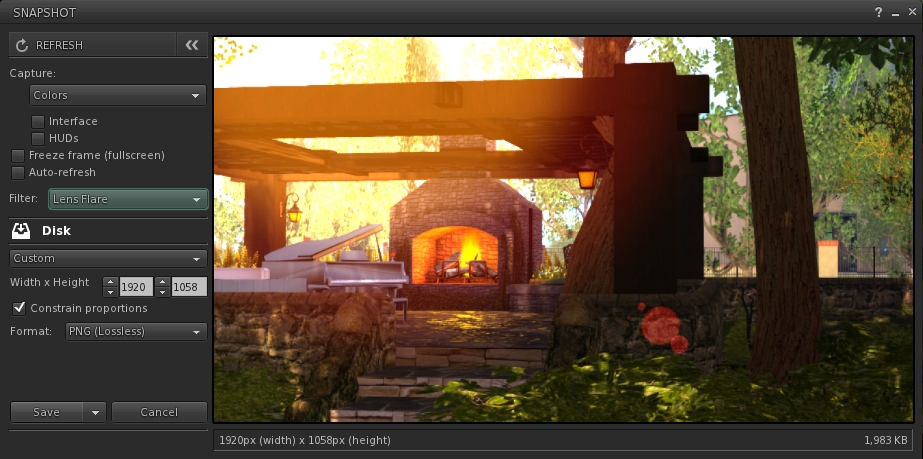
Beneath the Refresh button are the familiar snapshot floater options to include the interface and HUDs in a snapshot, the colour drop down, etc., and – importantly – the SL Share 2 filter drop down for post-processing images. The placing of the latter is important, as it is the first clue that filters can, with this update, be applied to snaps saved to inventory or disk or e-mailed or – as is liable to prove popular – uploaded to the profile feed.

With the new snapshot floater, you will be able to add filters to the snaps you save to disk or inventory, or which you e-mail or upload to your profile feed
With the new snapshot floater, you will be able to add filters to the snaps you save to disk or inventory, or which you e-mail or upload to your profile feed – here is a snap being prepared to save to disk with the lens flare filter added

Below these options are the familiar buttons allowing you to save a snapshot to disk, inventory, your feed or to e-mail it to someone. click each of these opens their individual options, which overwrite the buttons themselves – to return to them, simply click the Cancel button. Saving a snapshot will refresh the buttons automatically.

Within these buttons are those for uploading to Flickr, Twitter or Facebook. These buttons work slightly differently, as clicking any one of them will close the snapshot floater and open the required application upload floater.

While this may seem inconvenient over having everything in the one floater, it actually makes sense. For one thing, trying to re-code everything into an all-in-one floater would be a fairly non-trivial task; particularly as Twitter, Flickr and Facebook have their own individual authentication requirements and individual upload options (such as sending a text message with a picture uploaded to Twitter, and the ability to check your friends on Facebook. Also, and as mentioned earlier, keeping the floaters for Flickr, Twitter and Facebook separate means they can continue to be accessed directly by people who use them in preference to the snapshot floater.

However, this latter point doesn’t mean they’ve been left untouched. Niran has cleaned-up much of their respective layouts and in doing so has reduced their screen footprints. The results are three floaters that are all rather more pleasing to the eye.

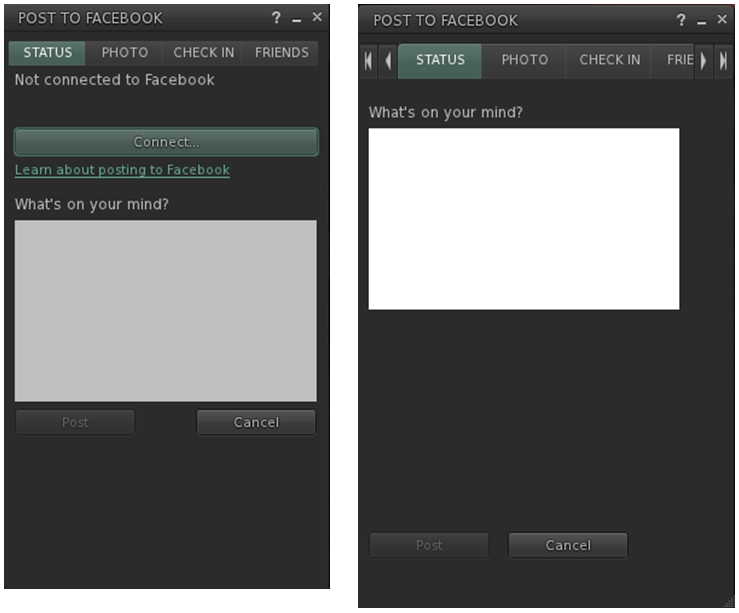
Niran's revised Facebook floater, left - note the new Connect button, removing a need for an extra tab; and the orginal floater  on the right
Niran’s revised Facebook floater, left – note the new Connect button, removing the need for an extra tab; and the original floater on the right

All told, these are a sweet set of updates which make a lot of sense. It may be a while longer before they surface in a viewer; I assume they’ll likely appear in a snowstorm update, rather than a dedicated viewer of their own, but that’s just my guess. Either way, they’re something to look forward to,

Kudos to Niran for the work in putting this together, and to Oz and the Lab for taking the code on and adding it to the viewer.