With Server-side Baking / Appearance starting to be enabled on the grid, the only two maintained viewers not to be SSB/A enabled are Dolphin and Imprudence.
I recently covered the state-of-play with Imprudence, and the fact that the team plan to ramp-up the viewer to support all of the new SL capabilities and viewer changes, including CHUI, materials and SSB/A, but it is liable to be some time before they actually get there.
Now Lance Corrimal, the man behind Dolphin, has provided an update on the status of that viewer. The main part of his blog post reads:
I’m sure there are one or two people wondering what is going on with the Dolphin Viewer lately.
To put it simply, my life has been quite hectic the last few months, and it still is. I have a new job that demands a lot of my time and attention. I’ve moved to a different province because of the job, and when I am actually home (the new job involves a lot of travelling), I’m just too damned tired to spend time on working on the viewer.
That being said, there will be a new version, that will have all the new shinies from the Lab. The CHUI interface, SSA, Materials, you name it.
Just … please do not ask me when. “When it is finished” is all I can say right now.
So – SSB/A and more will all be coming to Dolphin – soon. Just give Lance a little room to breathe as the dust of a busy real life settles around him.
He also notes that Dolphin users seeing the advisory warning users of a mandatory viewer update which is displayed on the splash should be aware that clicking on the link will download the official SL viewer, not an updated version of Dolphin.
The splash screen advisory comes from LL (along with the rest of the splash screen), and will download the official viewer, not an updated version of Dolphin
Curiosity has started on the long trek to Aeolis Mons, which NASA unofficially refers to as “Mount Sharp”. With some eight kilometres (5 miles) between the rover an its initial destination among the lower slopes of the mound, the drive is liable to take several months to complete. Nevertheless, the drive marks the start of the core part of the mission.
The journey started on July 4th, when Curiosity departed the sedimentary rock target NASA had dubbed “Shaler” within the “Glenelg” region of Gale Crater between “Yellowknife Bay”, where the rover had been carrying out drilling and other tasks, and the landing zone at Bradbury Landing. “Shaler” had actually been passed b the rover on its way to “Yellowknife Bay” and had, along with another location in “Glenelg” which had been dubbed “Point Lake”, been identified as a “target of interest” for the rover as it backtracked through “Glenelg” in order to start the long trip to “Mount Sharp”.
“Point Lake” became a target of interest to MSL scientists as Curiosity passed it while en route to “Yellowknife Bay”, and remained of interest even as the rover carried out various science operations in “Yellowknife Bay”. This image was captured by the Mastcam telephoto lens on Sol193 (February 20th, 2013) when Curiosity was engaged in the “John Klein” rock drilling operations. It show the cliff-like face of the outcrop. At the time the image was captured, it was unclear if the outcrop might be sedimentary or volcanic in origin. This image has been white-balanced so the rocks appear as they would under Earth-type atmospheric and lighting conditions
Point Lake first caught the interest of Curiosity’s science team in October and November of 2012. It caught the attention of mission scientists for two reasons: it forms a small cliff, and geologists love cliffs because they offer a sense of how a rock unit differs from bottom to top; plus images captured by the rover as it passed relatively close to the outcrop while en route to “Yellowknife Bay” revealed it to be full of holes. Why holes form in rocks can be due to diverse mechanisms, and Identifying which mechanism in particular is responsible can provide a greater understanding about the rock and its history.
The rover returned to “Point Lake” on Sol 301 / 302 (June 11th and 12th, 2013) and captured a further series of images using the Mastcam systems, some of which were then put together to create a mosaic.
A 20-shot mosaic of “Point Lake” captured by the telephoto lens of Curiosity’s Mastcam system on Sol 302 (June 12th, 2013) (click to see the full size image)
The mosaic clearly shows that the upper and lower portions of the outcrop differ in composition, with the upper part having more holes while being more resistant to weathering. The holes themselves range in size from about that of a garden pea through to some larger than a golf ball’s diameter. Some additionally have raised rims, as if the material immediately around a hole is slightly more resistant than material farther from the hole. A number of smaller rock fragments towards the right-hand end of the mosaic look as if they might have fallen out of some of the holes, and some of these exhibit colour banding suggestive of material which could have coated the interior of a hole.
The science tem are still studying the images captured by the Mastcam system and by the rover’s Mars Hand Lens Imager (MAHLI), mounted on the turret at the end of Curiosity’s robot arm. Taken from a distance of just 4cm, the MAHLI images reveal pebble-like deposits within many of the holes covering “Point Lake”, and which have made the identification of the processes responsible for forming the holes somewhat harder, as both sedimentary and igneous processes could account for the “pebbles”.
The Mars Hand Lens Imager (MAHLI) mounted on Curiosity’s robot arm captured this close-up of the holes in the “Point Lake” rock outcrop, in which the “pebbles” cxan be seen to be nestling
Following the stop at “Point Lake”, Curiosity continued retracing its route back through “Glenelg”, reaching the vicinity of “Shaler” around Sol 313, where it remained for several days taking further images and manoeuvring in the area immediately adjacent to the rock formation. Then on July 4th, the rover started on the drive to “Mount Sharp” in earnest, initially travelling back towards “Rocknest”, which it visited in September 2012, prior to skirting around it in a drive of some 36 metres (118 feet) between July 5th and July 8th (Sol 327).
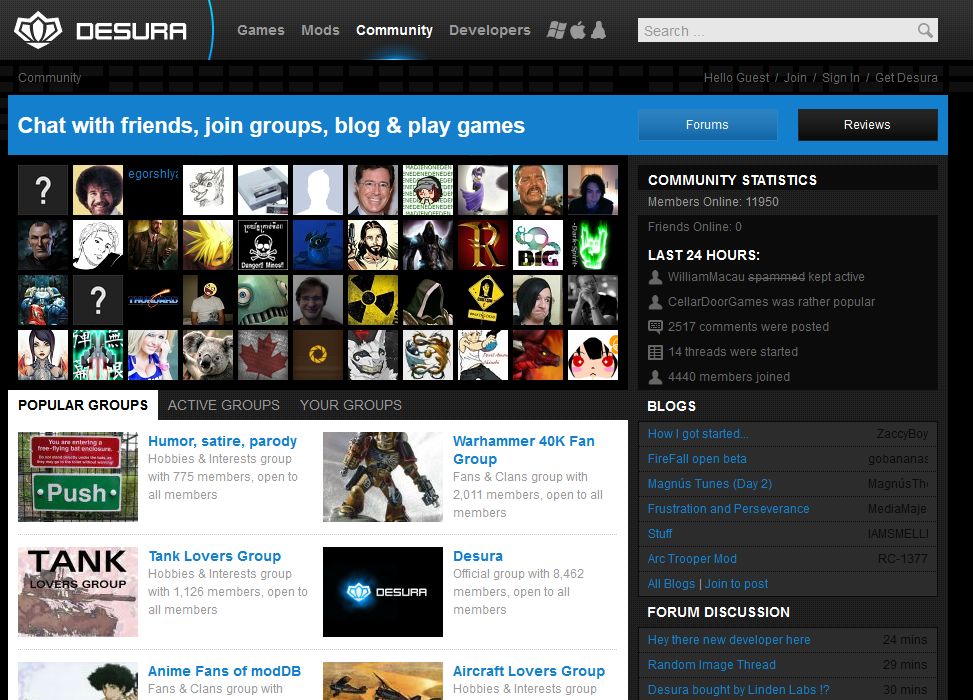
On Wednesday July 10th, Linden Lab announced they had acquired Australia-based digital distribution service Desura Pty Ltd, which distributes games and related media online and which might be said to be somewhat akin to Steam.
Desura puts the best games, mods, and downloadable content from developers at gamers’ fingertips, ready to buy and play. The free Desura application can serve and patch games, mods, and add-ons directly for customers around the world. Developers and publishers can share news, images, videos, and other content through their profiles, while every member of the Desura community can post comments, submit reviews, and upload screenshots from their own playing experiences. Desura also demystifies user-made mods and add-ons for games by making them as easy to find and install or update as professional titles.
“Desura’s talented team, thriving business, and impressive technology are a great fit for Linden Lab,” said Rod Humble, CEO of Linden Lab. “This acquisition gives us a global platform for serving creative developers of all kinds, and we’re looking forward to growing both Desura’s global community of gamers and its fantastic portfolio of thousands of games, mods, and other content.”
The Desura website
This is an interesting move on the Lab’s part on a number of levels, and one which is bound to provide a range of reactions. In terms of the former, for example, does it indicate that the link-up with Steam has been abandoned?
Announced in August 2012, the deal to promote Second Life through Steam never materialised. More recently, there had been unofficial hints coming out of the Lab that a technical hitch with provisioning the viewer through Steam may have delayed matters at some point. Whether or not these had stopped the deal dead in its tracks is unclear, but when talking to Rod Humble recently, I found it interesting he drew something of a line from the non-appearance of SL on Steam with the hook-up with Amazon which came towards the end of 2012.
The Desura acquisition is also obviously interesting in what it says about the Lab’s broader ambitions. Although somewhat similar to Steam – but nowhere near as large – Desura is aimed at a different market. Whereas Steam predominantly distributes titles from larger software houses, Desura leans towards smaller indie games produced by smaller developers who do not necessarily have the clout to deal with Steam.
In this, Desura would appear to be something of a potentially good fit for the Lab, giving their acquisition of small houses such as LittleTextPeople and Boldai – they gain the exposure they are seeking within the indie market by potentially building a name as a distributor of games and a host for the indie game / modding communities (Desura provides a strong modding capability for games and also boasts something of a community-centric environment for users).
The Desura community pages
There may also be some speculation as to what this might mean to Second Life. A potential attraction of the Steam hook-up was the possibility of enticing games modders and 3D content makers interested in building for SL (particularly given the opportunities for selling their content in-world and / or through the SL Marketplace). Depending upon how the Desura acquisition is developed and prompted, a similar opportunity might exist here. Time will tell on that.
If nothing else, the Lab had set itself a pretty big goal in acquiring Desura – which is available on the Windows, Linux and Mac platforms. This is, according to Humble’s quote in the Lab’s press release, “To invest and support the Desura team in making it the most open and developer-friendly platform in the world.”
It’ll be interesting to see what rebranding of Desura takes place (if any) as a result of this move.
Amidst all the focus on Second Life and the emerging press coverage on its tenth anniversary – with Gamastura being the latest, providing a very short, punchy and positive piece based on the All Things D article which I examined here over the weekend – it is easy to miss the fact that another of LL’s products, Versu, has also gained a little media attention.
Versu, the Lab’s interactive storytelling application for the iPad, launched back in February with little fuss or flag-waving. Since then, there’s been little news. It doesn’t appear as if the library of titles available for it has grown to any degree, and there has been little in the way of any word from the Lab as to the future of the product. Versu hasn’t been updated since March 2013, the promised Android version has yet to surface, and there has been no news on the Lab’s broader plans to allow users to write and publish their own stories.
However, in June, UK magazine New Scientist published a piece on Versu, AI gets socially savvy, written by Douglas Heaven. The article was born out of Richard Evans, one of Versu’s co-creators, presenting a paper entitled Versu: A Simulationist Interactive Drama, at the Games and Media Event held in May 2013 at the Imperial College London. Heaven’s piece also appeared in New Scientist Online under the title AI makes social game characters all too human.
One of the current Versu titles
It’s a fascinating read. Not only does it give a greater insight into the power and versatility of Versu – something which is potentially easy to dismiss when first encountering the product on paper -, it also suggests ways in which applications such as Versu could be used to assist with or study a range of real-world social and other situations.
FLIRTY, shy or gossipy… these aren’t the typical traits of a bit of computer code. But a simulation system that gives computer-controlled agents a sense of social propriety could change that, leading to more realistic interactions between humans and characters in games.
So opens Heaven’s piece, before going on to give some background on Evans himself, who is not only one of the two minds behind Versu, but also worked on The Sims 3, before going on to set-up LittleTextPeople with Emily Short, which the Lab acquired in January 2013, and from which Versu was born. Interestingly, one of the motivations to generate such a rich depth to Versu’s non-player characters was the frustration Evans had with the behaviour of characters in The Sims 3 where, Heaven notes, computer-controlled characters would suddenly behave inexplicably, shattering the illusion of realism – such as visiting a neighbour’s house and having a bath…
To avoid this, Versu characters are not scripted, per se, as the New Scientist piece notes:
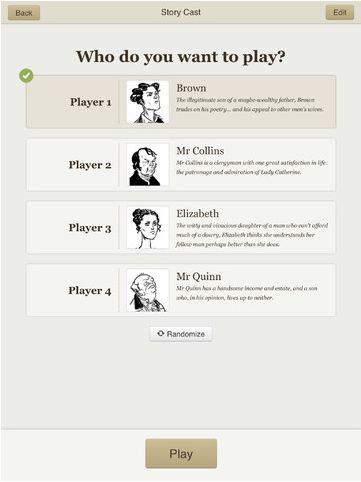
Versu character screen: you chose the character you wish to play, the rest will react to you based on a range of social rules, their own goals, and your own actions in the story (image courtesy of Linden Research / Apple Computers)
Each of its computer-controlled characters is governed by a deep model of social propriety. They react to rudeness, disapprove of bad manners, and they know a violated social norm when they see one. They gossip, show off and flirt. To make such behaviour possible, Evans streamlined the code that defines characters’ beliefs and desires. This allows them to weigh the consequences of many possible actions before deciding how to behave…
The behaviour of the agents [characters] is not scripted. Instead, they each have a unique set of goals and desires that govern their behaviour. No two play-throughs are likely to be the same.
This approach allows the Versu characters to “play out their own soap opera independently”, which can have some very surprising repercussions, as Evans noted in his presentation. In it, he relates that when testing Versu, he was surprised to find he was being snubbed by one of the characters. It wasn’t until he examined the game’s logs that he found out why. Earlier in the game, he had been rude to another character, who had gone on to tell others of his unpleasantness, with the result that Evans found himself snubbed later in the game.
Because Versu uses social rules to govern the actions and reactions of non-player characters, it is seen as a particularly powerful tool for modelling human interactions, which is in turn bringing it to the attention of academics as well as gamers.
Evans also sees a wider potential for the technology developed for Versu, suggesting that it could be used in a wide variety of activities – such as helping soldiers learn to interact with civilians in a war zone, or young people to deal with bullies.
Of all the new products launched to date by the Lab, Versu is the one which has piqued my curiosity the most – and it is also the one I’ve found to be the most frustrating, given it is restricted to the iPad and lack of any further news on it coming out of the Lab. Evans’ paper and this New Scientist article therefore both provide welcome insight into the app, and on its potential for the future – assuming the Lab shares in those aims and remains committed to developing and enhancing Versu.
Update Wednesday July 10th: In checking the forum deployment thread for this week’s roll-outs, I see that KarenMichelle Lane has provided a list of regions on LeTigre where SSB/A will be enabled once they have restarted. Again, you’ll need to have an SSB/A-enabled viewer to avoid issues with avatar rendering on these regions. If you find that once the restarts have completed you are encountering issues with avatar rendering (for example, you are using an SSB/A viewer and find you avatar fails to render for yourself or others), or other issues which appear to be linked to SSB/A, please consider raising a bug report detailing the problem, how to reproduce it, and including your environment information (Help > About (Viewer Name) > Copy to Clipboard), which references Project Sunshine.
Server Deployments – Week 28
As always, please refer to the week’s forum deployment thread for news, updates and feedback.
Second Life Server (SLS Main) Channel
On Tuesday 9th July, the SLS Main channel received the server maintenance package previously deployed to all three RC channels in week 26. This comprised:
A fix for ‘llApplyImpulse now works only in the root prim’ (SVC-8227)
A fix for the navmesh bug whereby pathfinding rebakes are continuously triggered if a region has more than one parcel and has no parcel edges above water, then it thinks it needs to rebake (BUG-2975) – see part 2 of my week 26 report.
Viewer Updates and Release Process
The Second Life Beta viewer updated to release 3.6.2.278133 on July 2nd – see the release notes for change details.
The Materials Project viewer was also updated on July 2nd, to release 3.6.2.278221.
Speaking at the Opensource UG meeting on Monday 8th July, Oz indicated that he hoped the new viewer release process would go live on Tuesday July 9th. If this has in fact happened, the first viewer to pass through the new process is likely to be a project (or beta viewer) with further third-party code contributions to the SL viewer.
However, as both the SSB/A deployment and the new viewer release process both require an update to the login code, it is possible the new viewer release process will not go live until Wednesday 10th July.
The login change for the viewer release change is to update the automatic check which is carried out to see if a mandatory upgrade is required (see my week 20 report). To prepare for the new release process, is check has been updated. , the login change for SSB/A is described by Oz Linden as, “a very minor change to ensure that inventory is correct” .
Group Ban List
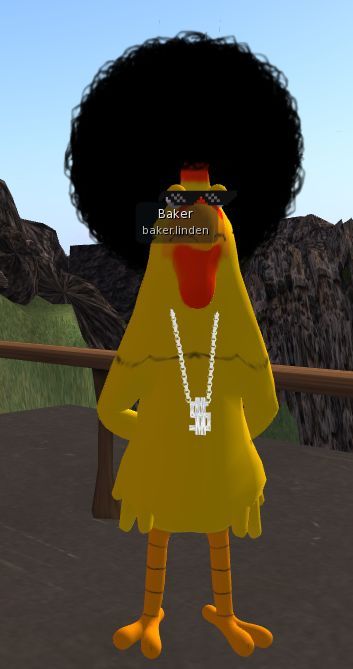
Baker Linden and his new harido
Baker Linden continues to work on the new group ban list functionality (JIRA VWR-29337). Speaking at the Simulator User Group on Tuesday July 8th, he said:
For my update: I’m making really good progress on group bans. I’m doing a bit of a refactoring because I changed the way the backend works slightly. Hopefully by the end of the week I’ll be finishing up the backend code.
There’s currently no date as to when the viewer-side changes might see the light-of-day, but given Baker is currently working on the back-end, this is hardly surprising. He’s also indicated that while it won’t be available when the new functionality goes live, he is considering adding scripting functions to group bans. He also confirmed that group bans would have their own moderation capability, rather than being tied to estate ban moderation.
Particle System Updates
Particle Blocking
As previously reported in these updates, the new “right-click on particles to block and emitter” (MAINT-2268) code for the viewer has been released in the SL Beta Maintenance Viewer. As well as allowing people to click on particles to prevent the viewer generating any more particles in someone’s world-view, the code also has a FPS limit on particles and will stop generating new particles when frame rates drop to 4 FPS.
Those who have tested the capability report it works well and it is very easy to right-click on particles and block them. A slight bug has been reported whereby when unblocking a particle generator / person owning a particle generator, the viewer will not resume generating the particles until the user changes their group tag.
New Particle Capabilities
First reported on in these pages back in week 12, the new particle capabilities – glow, ribbon and blending optionshave had server-side support for some time. The Beta Maintenance viewer mentioned above now has the first part of the viewer code, and speaking at the Simulator User Group meeting on Tuesday July 8th, Simon Linden said, ” Once that one is out, we’ll get the next one going,” so expect these capabilities to be becoming more radily available in the near future.
Ribbon particles – one of the new particle capabilites
Other Bits
Snapshot Fixes
The SL Beta Maintenance veiwer includes further snapshot fixes (MAINT-2152) which are designed to overcome the problem of black rectangles / borders appearing in very high resolution snapshots. These fixes are in addition to the “tiling” fix issued last year.
However, Whirly Fizzle reports that if very high-res snapshots are captured with the Beta Maintenance viewer and post-processed, the tiling artefact tends to return.
Post-processing high-res images captured using the additional snapshot updates (as found in the current SL Beta Maintenance viewer) can result in tiling artefacts reappearing (image, originally in PNG format, courtesy of Whirly Fizzle.
Simon Linden reports that a further update to these fixes is about to be released, although it is not known at this time if it will fix this issue, or a reported issue of GPU crashes when using the Beta Maintenance viewer for snapshots.
Your Skin – In the Sky
The issue of avatar skins appearing in the sky at very high altitudes (see JIRA VWR-28962) came up for discussion at the Simulator User Group. First reported in 2012, there is some speculation whether SSB/A will impact the frequency with which the issued manifests; it appears to be linked to the local bake process, and so may only occur in the future when people at high altitudes are editing their appearance.
The “face-in-sky” issue (image courtesy of Eku Zhong)
In the meantime, if you are up high and encounter this phenomenon, try toggling the Advanced Lighting Model option in Preferences > Graphics off / on.
With Server-side Baking / Appearance due to be enabled on the LeTigre Release Candidate Channel on Wednesday July 10th (from which it will gradually roll across the grid), the Exodus team have issued a new version of the popular Exodus viewer. Classified a beta release, the new viewer update has the version number 13.7.9.1, and includes the latest code updates from the Lab.
This means that with this release, Exodus is:
Server-side Baking / Appearance ready
Includes the Lab’s Communications Hub User Interface (CHUI)
However, the release:
Does not include materials processing support
RemovesRLVa support.
CHUI and SSB/A
VHUI now a part of the Exodus viewer
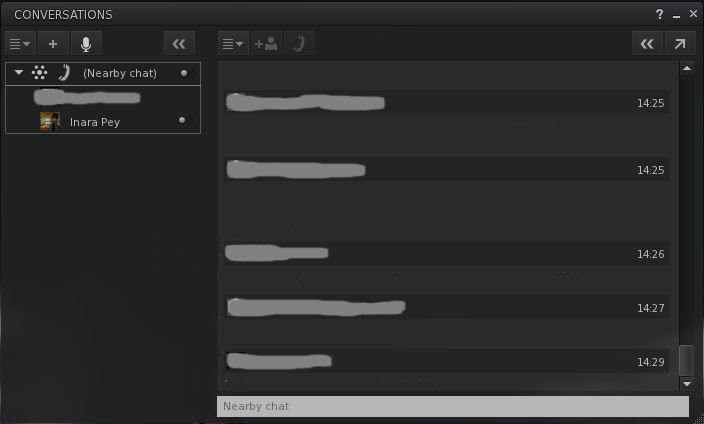
There is not actually much to report here per se, other than both work entirely as expected. CHUI sees the LL integrated chat / IM conversations floater working in Exodus.
Simlarly, SSB/A works exactly as expected on SSB/A-enabled regions, with other avatars rendering correctly in Exodus, and your own avatar rendering correctly to others.
Exodus SSB/A: (l) my avatar on Exodus and my CTA on the SL viewer – both render correctly in Exodus on the Aditi SSB/A test regions. (r) The same agin, but this time my avatar (foreground) on Exodus, as rendering in the SSB/A-capable SL viewer.
That both SSB/A and CHUI do work flawlessly tends to hide the amount of work the Exodus team have put-in getting both ready to go prior to SSB/A being enabled server-side.
Why No Materials and RLVa?
Materials
Both the integration of CHUI and SSB/A capabilities into a v3-based viewer are very large amounts of work (CHUI has something like over 1200 change sets of its own). They therefore require time and effort to implement – and have likely been keeping the Exodus team more than a little busy (on top of some of them being actively engaged in developing the materials capabilities in SL as well as working on other items such as the Mac Cocoa project).
There’s also the fact that while materials doesn’t use CHUI itself, both the materials code and the CHUI code touch on other areas of the viewer code. Therefore, it makes sense for the Exodus team to focus on implementing CHUI first and then merging and cleaning the materials changes sets (which is exactly the order in which the Lab did things), rather than racing to implement materials, only to find those updates impacted at a later date by required CHUI updates.
So for all those hoping to see materials in Exodus – it will doubtless be coming, you’ll just need to wait a little longer.
RLVa Removal
The blog post for the release explains the reasoning behind the removal of RLVa support from Exodus thus:
By its nature and by necessity, RLVa is an extremely invasive patch. We do not have the resources to maintain this code, and it is the primary reason for our lack of updates recently. We hope that this removal enables us to produce more frequent updates going forward and apologise for the inconvenience.
While the loss of RLVa is perhaps to be regretted, how much it is likely to be missed obviously comes down to the number of Exodus users who make use of it, obviously – and it is worth pointing out that RLVa was something of a late arrival to Exodus in the first place, so it may not be that greatly missed.
Other Updates
This release also sees Exodus:
Using Cocoa instead of Carbon on Mac computers
Gain full screen support on Lion
Fain Retina support for the Retina MacBook Pros.
Feedback
This is not an in-depth test of the latest Exodus beta, but a quick spin around the Aditi block. Everything works, as notes, as expected, and the rendering enhancement which have been part and parcel of Exodus for a long time certainly make their presence felt even in a default rough & ready snapshot such as the one grabbed above for the SSB/A comparison.
I didn’t do any performance tests this time around, as I was on Aditi – I’ll save that for another time :). That said, I’ve always found Exodus to be a solid performer on my current hardware, where it has tended to be my “reserve” viewer (along with Dolphin).
This is a very tidy and timely update to Exodus which brings it back to a par with other popular v3 viewers, and perhaps even a little ahead with the Cocoa support. Kudos to the team!
 With Server-side Baking / Appearance starting to be enabled on the grid, the only two maintained viewers not to be SSB/A enabled are Dolphin and Imprudence.








 Inara Pey: Living in a Modemworld