SL project news week 6 (1): servers, viewer, materials

Deployments for Week 6

A full set of deployments on the channels this week.

On Tuesday 5th February, the Main channel received the server maintenance project deployed to LeTigre in week 5. This has miscellaneous minor bug fixes and new features – release notes.

On Wednesday 6th February, the Release candidate channels should receive the following:

  • BlueSteel should receive code for materials processing. There is still no project viewer publicly available for this project. When one becomes available, notices will be posted on the Project Viewer page, the Tools and Technology Blog, and STORM-1905release notes
  • LeTigre should receive a new maint-server project to fix miscellaneous crash modes, and which  offers minor performance improvements – release notes
  • Magnum should receive an update to the interest list code and support for materials processing. The interest list update should specifically address the bot / bandwidth problem reported on in last week’s updaterelease notes

As ever, a forum thread has been created for the discussion of the deployment packages, or any issues arising therefrom.

In late 2012 some regions (noticeably Homesteads) starting experiencing issues related to their physics memory. Investigations by Simon Linden revealed that part of the problem lay with these regions experiencing repeated navmesh rebakes, with each rebake consuming server memory with the result that multiple rebakes were leaving regions in need of a restart. Simon also confirmed that not all of the triggers generating a request appear to be linked to the actual need for a rebake (altering some estate / parcel settings can trigger a request, for example), and developed a fix for the issue. Simon believes this fix will be promoted to a Release Channel this week, although it is absent by name and description from the release notes at present.

Viewer News

Viewer releases are again unblocked, with further development viewer (incl. CHUI) made at the end of the week 5. Currently, CHUI looks to be the next project in line to be merged to the 3.4.5 code (with the project version already merged to the viewer-dev 3.4.6 code). This could make CHUI the first of the current projects affecting the viewer to reach a beta viewer release, but the timescales and order are far from definitive at this point – so it is possible CHUI may still be delayed in reaching the 3.4.5 beta code.

Materials Processing

Further to the week 4 update, it now appears scripting support may become available with  materials processing, although a) it will not be in the initial release; b) there appear to be considerable concerns on the Lab’s side of things as to the potential impact. Speaking at the Server Beta meeting on Thursday 31st January, Maestro Linden said the option for scripted control of normal and specular maps had been removed from the original proposal out of concern for it being exploited and used to thrash the server and rendering pipeline.

Speaking at the Content Creation User Group meeting on Monday 5th February, Geenz Spad, who co-authored the original proposal and who is working on the viewer side of the project, struck a more conciliatory tone. While confirming script support will not be available for normal and specular maps, he commented that this is in part because normal and specular maps don’t “plug into” existing means to manipulate diffuse (texture) maps using scripts. He went on, “I’m not saying no one would add scripting for the *new* parameters. Just that it won’t make it as part of the first release; think of it as a ‘we didn’t have time’ sort of thing.”  Whether or not support for scripted control of normal and specular maps remains to be seen, commenting on the matter, Nyx Linden said, “That would be a feature request to submit after the first release :),” – so it is likely the Lab will see what the demand is like prior to committing to anything, one way or the other, again allowing for the network / rendering concerns which have been voiced on their side.

In terms of animating normal and specular maps, Geenz confirmed that all current methods of animating textures will work with the additional maps, which I had more-or-less confirmed through my own rough tests, as reported in my sneak peek at the (then) latest version of the pre-release materials viewer.

Back in week 3, I discussed the fact that normal and specular maps require a viewer to be running in deferred mode (“Lighting and Shadows” in the Advanced options of the Graphic tab in v3-based viewers) in order for their effects to be seen, and gave a short overview how deferred can be used without actually having to have shadows enabled. This post was followed by a short discussion on possibly renaming the option to something more obvious to users.

Well, it appears that someone is a few steps ahead of things on this. In the most recent versions of the pre-release materials viewer, Lighting and Shadows is renamed to “Advance Lighting Model”.

Materials processing: the option formerly known as "Lighting and Shadows" - soon to appear in a project viewer Materials processing: the option formerly known as “Lighting and Shadows” – soon to appear in a project viewer

It’s still a little bit of a mouthful, but it may help when it comes to explaining how materials processing works. As it stands a project viewer for materials might be available by the end of week 6.

Other Items

What’s in a Name?

Those who make  full permission items intended for use by other creators as a part of their products can often face a frustrating problem: finding themselves in receipt of a call for assistance about the items in which their products have been used – as it is their name recorded in the Creator field, rather than the name of the person who made the item itself.

While this can be negated in some degree, results aren’t always perfect, and requires no small amount of fiddling around when it comes to full perm mesh items. This being the case, there was some discussion at the Content Creation user Group Meeting on Monday 5th February as to how the situation might be improved through the introduction of an additional field which could sit alongside the Creator and Owner fields and  which would identify the person who utilised a full permission mesh in their own work as well as the maker of the mesh itself – so that support questions could then be addressed to that person. One suggestion has even been to call the new field “Support”.

However, such a change could have wide-ranging impact, both in the viewer and server, making it a potentially complex matter to implement. During the Content Creation meeting on Tuesday February 4th, it was clear that there were several views on the subject of how to handle things, as well as some discussion on the complexities of actually implementing it.

Commenting on the matter, Nyx Linden requested that if a consensus view can be reached on the matter – or if people do feel it is a pressing matter which needs more consideration / discussion – that it should be raised as a feature request on the JIRA (i.e. file a bug report, but put “Feature Request” in the title / subject), so that it is at least on the Linden radar.

More dabbling in dio and some thoughts

dio-logoUpdate, February 19th, 2014: dio was discontinued by Linden Lab on February 19th, 2014. Links to the dio website, etc., have therefore been removed from this article.

Last week, Linden Lab launched dio, and I provided something of an initial look and feel for using the product.

Since then, as time allows (and there hasn’t been a lot of it), I’ve been dabbling some more and building various bits. The first of these is an attempt to build an interactive tour. Unsurprisingly, the subject matter is Fallingwater, Frank Lloyd Wright’s seminal build, and particularly my efforts to emulate this remarkable house in the virtual world of Kitely.

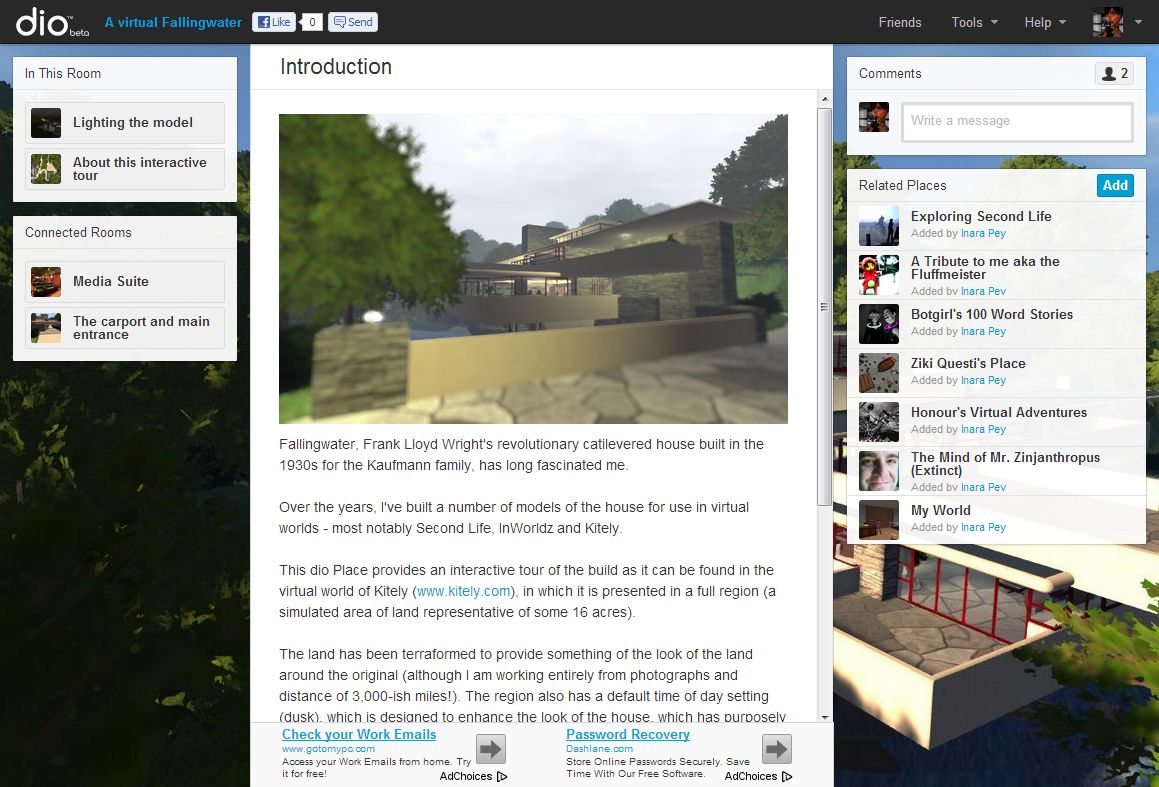
The start of the tour: An introductory page isn't a requirement for a dio place, however, I've included one to give people some background on things.
The start of the tour: An introductory page isn’t a requirement for a dio place, however, I’ve included one to give people some background on things.

The tour is intended to let people understand something of the build – what it is, where it resides, etc., before allowing them to set off to explore it on their own, moving through the various dio “rooms” (which I’ve roughly aligned to rooms and parts of the Fallingwater build) where they can see images and find out more about both the real and virtual Fallingwater as interpreted by myself.

To add a little fun, I’ve added one (so far) inventory item, which must be collected in order for the house to be fully explored (I may add more at some point), and also added some other interaction  using the “Appear / Disappear” actions.

Adding a little interactivity

There is a degree of logic to be followed with the tour – the introduction and the “media suite” can only be accessed at the start. This is to encourage people to do a complete circuit of the place (in whatever direction they choose), but I’m also aware it might be a tad irritating to some. So I’ll be curious as to feedback – if any …

The tour can be found on the dio Community page, or for those signed-up to dio, you can jump to it from here.

The "Explore" object is a means by which I've hidden objects until such time as Explore is opened - a useful means of controlling information flow in complex rooms
The “Explore” object is a means by which I’ve hidden objects until such time as Explore is opened – a useful means of controlling information flow in complex rooms

Continue reading “More dabbling in dio and some thoughts”

Hammering things out on Mars

CuriosityIt’s been a while since there have been any formal updates from the mission team responsible for NASA’s Mars Science Laboratory. With the focus on preparing for the first set of drilling operations, this is understandable – although this is far from the only activity the Curiosity has been engaged in. “Routine” monitoring of the environment in Gale Crater and particularly around the “Yellowknife Bay” region continues, and the rover has been carrying out a number of other activities as well, including giving itself a once-over with camera systems to give engineers insight into its general condition after five months operation on Mars.

Does it Glow in the Dark?

Not long after my last mission update, Curiosity achieved another first – imaging surface features on Mars at night under white light and ultraviolet conditions. The images were captured using the Mars Hand Lens Imager (MAHLI), mounted on the rover’s turret at the end of the robot arm.

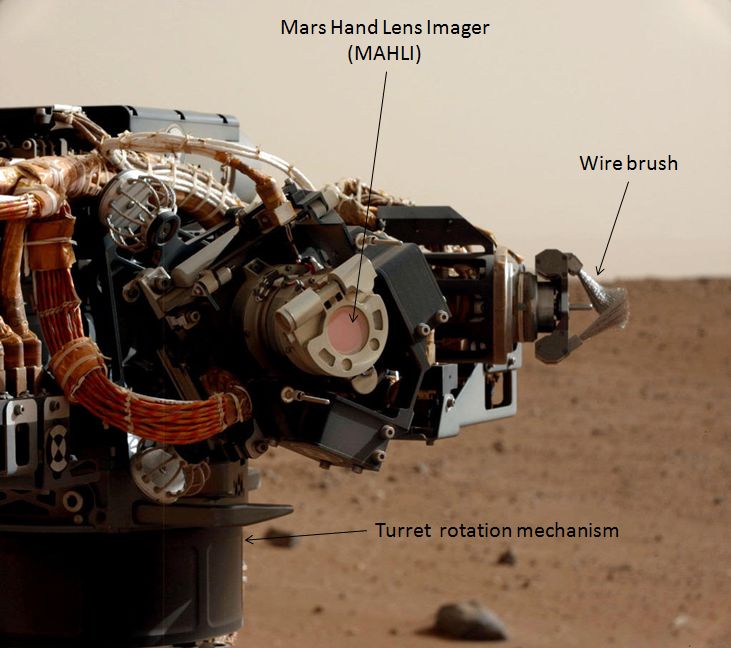
The MAHLI camera - the LEDs can be seen in the ring surrounding the circular lens, still protected in this image by its dust cover
The MAHLI camera – the LEDs can be seen in the ring surrounding the circular lens, still protected in this image by its dust cover

MAHLI is equipped with a series of light-emitting diodes which enable it to undertake imaging in low-lighting conditions and, in the case of the ultraviolet LEDs, to see if fluorescent minerals are present in rocks, which would reveal more about their chemical composition.

The tests were carried out on Sol 165 (January 22nd), when Curiosity deployed MAHLI after the local sun set to examine a target rock dubbed “Sayunei”. Prior to the image capture option, Curiosity was had been commanded to drive onto the rock and then “scuff” it with a wheel to remove surface dust and debris and provide a suitable area for testing, rather than using the wire brush also mounted on the rover’s turret. MAHLI was then tested against an ultraviolet test target on the “Lincoln Penny” calibration test panel mounted on the rover’s body before being positioned for the image capture process, which saw the target rock imaged under both the white light and the ultra-violet LEDs.

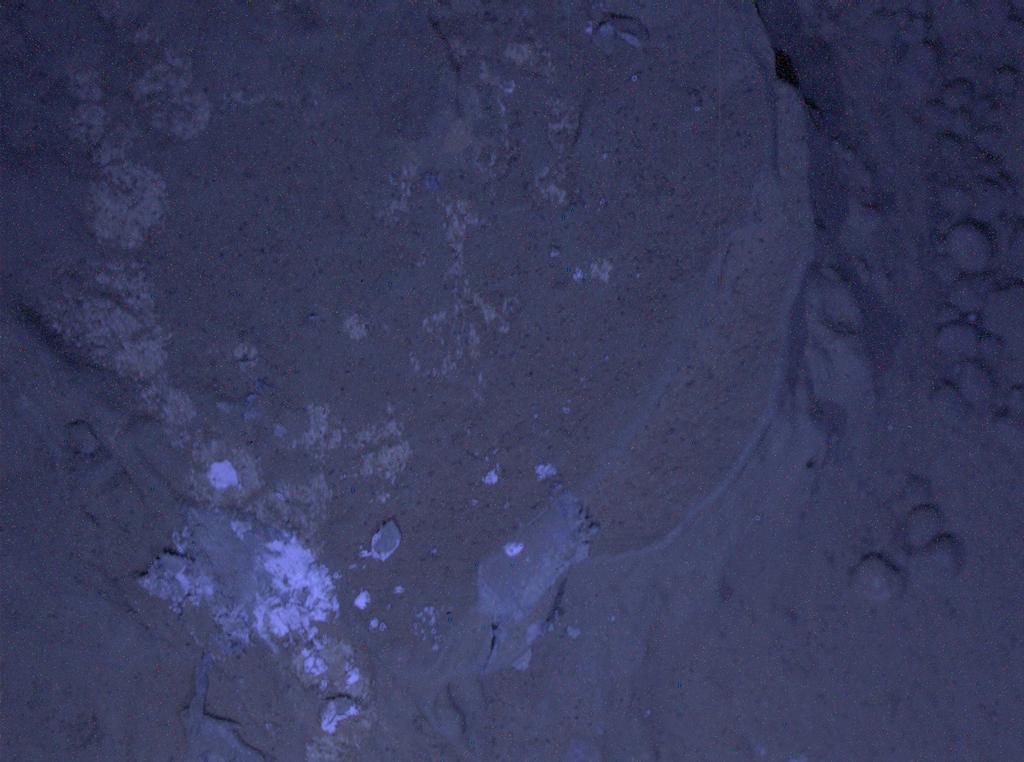
“Sayunei” imaged by the Mars Hand Lens Imager (MAHLI)  under ultraviolet light (365 nanometre wavelength) cast from LEDs surrounding the camera lens. The image represents an area some 34.cm by 2.5 cm (1.3 by 1 inch), and was captured with a 30-second exposure. The use of ultra-violet light  allows scientists to locate any fluorescent minerals present in the rock. Analysis of the acquired image is still underway, and the bright areas should not be taken as a sign that fluorescent material had been found

While the images returned by MAHLI showed very bright areas in the rock when under the ultraviolet lighting, NASA personnel cautioned against this being indicative of any fluorescent material being present in the rock. Discussing the images, MAHLI Principal Investigator Ken Edgett of Malin Space Science Systems, San Diego, said,  “The science team is still assessing the observations. If something looked green, yellow, orange or red under the ultraviolet illumination, that’d be a more clear-cut indicator of fluorescence.”

Pre-load Tests

Before drilling could commence, engineers on the mission team wanted to ensure the whether the amount of force applied to the hardware matches predictions for what would result from the commanded motions. This involved positioning the robot arm with the drill bit oriented as if for an actual drilling operation and bringing it into contact with a rock surface. One of four locations identified as the possible initial drilling point in the rock dubbed “John Klein” was used for the test on Sol 170 (January 27th).

Please use the page numbers below to continue reading this article

Viewer release summary 2013: week 5

This summary is published every Monday and is a list of SL viewer / client releases (official and TPV) made during the previous week. When reading it, please note:

  • It is based on my Viewer Round-up Page, a list of  all Second Life viewers and clients that are in popular use (and of which I am aware) and which are recognised as adhering to the TPV Policy
  • By its nature, this summary will always be in arrears
  • The Viewer Round-up Page is updated as soon as I’m aware of any releases / changes to viewers & clients, and should be referred to for more up-to-date information as the week progresses
  • The Viewer Round-up Page also includes comprehensive links to download pages, blog notes, release notes, etc., as well as links to any / all reviews of specific viewers / clients made within this blog.  

Updates for the week ending: 3 February, 2013

The major news for the week is that the Zen viewer has officially ceased development and has been delisted from the SL Third-party viewer directory at the developer’s request and all repositories removed from public access. The reason for this is unknown at the time of going to print with this summary.

  • SL Viewer updates:
      • Beta version rolled to  3.4.5.269698 on Janunary 31st –  release notes
      • Development rolled to 3.4.6.269703 on January 30th
      • Mesh deformer project viewer rolled to 3.4.4.268558 on January 29th – core updates: code merged to 3.4.4 codebase
      • Sunshine viewer (avatar baking (SSB)) rolled to 3.4.5.269555 on January 30th – wiki page
      • CHUI development viewer rolled to 3.4.6.269797 on January 30th and then 3.4.6.269877 on February 1st
  • Dolphin rolled to 3.4.12.27293 on February 3rd – core updates: source up-to-date with latest LL development viewer code – release notes
  • Cool VL updates – three versions for the time being, all updated on February 2nd:
    • Stable version: 1.26.6.8
    • Legacy version: (v2.6 renderer) rolled to 1.26.4.51
    • Experimental: 1.26.7.8
    • Release notes
  • Lumiya released version 2.4.1 on January 31st – core update: mesh object support; some mesh clothing support; RLV support; server-side baking (SSB) support; fixes and tweaks – release notes

Discontinued Viewers

  • Phoenix officially reached end-of-line for SL on December 31st – read more here
  • Zen viewer was withdrawn from the SL TPV directory and all repositories shutdown on January 27th, 2013.

Related Links

Storyfest 3, 2013: performers come forth!

storyfest-3Branwen Arts and Stories Unlimited have announced a call for performers at the Third Annual Storyfest event, to be held on Sunday 24th March, 2013.

The aim of the event is to present a day of stories presented in a variety of live performance forms – traditional telling, readings, theatre, dance, and so on.

The event will be hosted at Here Be Pictsies in Bran, commencing at 10:00 SLT on Sunday 24th March, and running through until 17:00 that day.

Anyone who is currently presenting stories in Second Life in any manner of live performance (i.e. not pre-recorded readings / performances), are welcome – and encouraged – to apply. Performances should be timed to fit a 30 or 60 minute slot, although there are limited slots for more elaborate presentations. Multiple performers can share a single slot, so long as the organisers are aware of how many and who as a part of the application. Note that not stream will be available for individual performers.

The organisers are also seeking volunteer hosts to help organise and run the day’s events.

How To Apply

Those wishing to participate as either a performer or volunteer host should contact either Caledonia Skytower or Dubhna Rhiadra via notecard, giving their SL name and role (performer / host) they are interested. Those wishing to help with hosting should provide times at which they can be available on the day. Performers should also provide the following:

  • Length of slot required (30 or 60 minutes, or time or running time of presentation if seeking one of the limited slots for longer events)
  • An outline of your proposed performance / presentation, including technical requirements you require (e.h. prim count for props, etc.) – again, please note that no stream will be available for individual performers / presenters
  • If the persentation involves multiple performers, please supply the number / names
  • A reference to what and where you present on the grid at present.

All submissions should be received no later than midnight SLT on Monday 4th March, 2013. successful applicants will receive confirmation by Thursday 14th March, and a schedule for the event will be published at that time.

Additional Notes

  • The organizers reserve the right to review the performers submitting and accept those performances & performers that they feel best fit the goals of the festival
  • While performers are welcome to use the theme from this year’s World Storytelling Day (“Fate and Fortune”), which takes place on Wednesday March 20th, for their presentation / performance at Storyfest, the organisers of Storyfest wish to emphasise that performers need not restrict themselves to just that theme
  • Questions on the event should be addressed to Caledonia Skytower or Dubhna Rhiadra by notecard, as IMs do frequently get capped.

Of beasts, beauty and stockbroking

Once again, the Seanchai Library will be presenting a round of stories and readings in Voice this coming week, with the continuation of a number of stories and also delving into the origins of the fairy tale. Forget the Brothers Grimm – discover the world of the French salon!

As always, all times SLT, and unless otherwise stated, events will be held on the Seanchai Library’s home on Imagination Island.

Sunday 3rd February

13:30 – Tea-time at Baker Street

Hall Pycroft, recently made redundant from a stock broking firm, consults Holmes and Watson over worries about his work situation. Not that he is particularly worried about being out-of-work – he isn’t. Quite the reverse in fact; he’s troubled because he seems to have had perhaps one too many offers of employment.

Having departed his former employers, Pycroft managed to secure a position with the prestigious stockbrokers of Mason and Williams, based in Lombard Street in the City of London. So far, so good.

However, he was also approached, entirely out of the blue, by one Arthur Pinner, who, with his brother, Harry, has apparently established a new hardware distribution business. The oddly-similar Pinners, the one in London, the other in Birmingham, persuade Pycroft to accept the mangership of the new business  – complete with a £100 advance  – but oddly, asked not the resign his former position at Mason and Williams on account of a bet relating to him. As he settles-in to his new position, Pycroft starts noticing other aspects of the business which convince him that all is not well, and to seek the assistance of the famous Great Detective.

Join Corwyn Allen as the journey through The Memoirs of Sherlock Holmes continues!

Monday 4th February, 19:00 – Notwithstanding: Stories from an English Village

notwithstandingFamous for his more exotic locations and stories such as Captain Corelli’s Mandolin and Red Dog, Louis de Bernieres used England for the setting for a series of short stories written early in his career.

Located in and around the fictional village of Notwithstanding, which is somewhat based on the village of Worley in Surry, where he grew up, the stories were various published in newspapers, etc., prior to being brought together into this single volume in 2009. Semi-autobiographical in places, the stories are rich in English rural detail and contain references to many real-world locations in Surrey, and allow de Bernieres to ruminate on a part of English life he believes to now be vanishing.

Join Caledonia Skytower as she dips further into de Bernieres’ England.

Tuesday 5th February, 19:00: Inkspell

Faerie Maven-Pralou continues Cornelia Funke’s young adult which forms the second part of her Inkworld trilogy. The books chronicle the adventures of teenager Meggie Folchart whose life changes dramatically when she realizes that she and her father, a bookbinder named Mo, have the unusual ability to bring characters from books into the real world when reading aloud. Mostly set in Northern Italy and the parallel world of the fictional Inkheart book, the central story arc concerns the magic of books, their characters and creatures, and the art of reading.

In Inkspell, a year has passed since the events related in Inkheart, the first book in the series. Not a day goes by without Meggie thinking of Inkheart, a book that has characters that come to life. Resa is back. The fire-eater, Dustfinger, wants to go back to his wife daughters-who are in the story. When he finds a crazy, self-absorbed psycho storyteller, Orpheus, who can read him back into the book, he goes into the pages. Soon Farid convinces Meggie to read him into the book so he can warn Dustfinger of Basta. But Meggie has figured out how to read herself and Farid into the book Inkheart.

Wednesday 6th February, 19:00: Quite a Year for Plums

plumsAnyone who has read the best-selling Mama Makes Up Her Mind or listened to Bailey White’s commentaries on NPR knows that she is a storyteller of inimitable wit and charm. Now, in her stunningly accomplished first novel, she introduces us to the peculiar yet lovable people who inhabit a small town in south Georgia.

Meet serious, studious Roger, the peanut pathologist and unlikely love object of half the town’s women. Meet Roger’s ex-mother-in-law, Louise, who teams up with an ardent typographer in an attempt to attract outer-space invaders with specific combinations of letters and numbers. And meet Della, the bird artist who captivates Roger with the sensible but enigmatic notes she leaves on things she throws away at the Dumpster.

Kayden Oconnell is joined by Caledonia Skytower as they continue to read from the novel.

Thursday 7th February, 19:00: Beauties, Beasts and Enchantments

beautybeastRegarded as the best way to access an English translation of Madame de Villeneuve’s original and entire story of Beauty and the Beast, itself a novella-length story in which the beast is actually precisely that – a beast, Jack Zipes’ gathering-together of fairy tales from the French Salon era is regarded by many as perhaps the definitive English language volume on the subject.

Within its covers, the book has 36 tales, readers can also find the works of Charles Perrault, original author of works such as Le Petit Chaperon rouge (Little Red Riding Hood), Cendrillon (Cinderella), Le Chat Botté (Puss in Boots) and La Barbe bleue (Bluebeard). Madame Le Prince de Beaumont’s derivative version of Beauty and the Beast, the version with which most modern audiences are more familiar, can also be found here.

The book is complete with a fascinating introduction by Zipes which examines the French salons and their role in the development of the genre of the fairy tale, and also looks at some of the women who dominated both the salons and the growth of the genre itself. As such, it is a marvellous door through which to explore the topic.

Join Shandon Loring as he delves into the world of tales fantastical, both fair and dark, both familiar and perhaps new. 

Please check with the Seanchai Library SL’s blog for updates and additions to the week’s schedule.

Note that throughout January and February, all donations to Seanchai Library SL will go to the real-world charity, Doctors Without Borders! Have questions? IM or notecard Caledonia Skytower.

Related Links