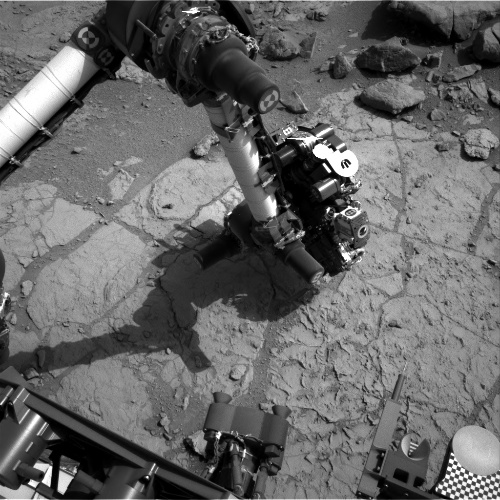
In all, four targets had been identified is potential drill sites, all in close proximity to one another. All four were named and subjected to tests prior to a final selection being made. “Brock Inlier,” was analysed visually using the Mars Hand Lens Images (MAHLI) and via the Alpha Particle X-ray Spectrometer (APXS), both mounted on the rover’s robot arm. “Wernecke” was used to test the Dust Removal Tool (DRT) also on the robot arm prior to being examined using APXS, MAHLI, and the Chemistry and Camera (ChemCam) systems. “Thundercloud” was the subject of the drill checkout test known as “percuss on rock.” The primary dill location itself was interrogated by APXS, MAHLI and ChemCam prior to any drilling operations commencing.
Once cleaning operations have been completed – which drill systems engineer Scott McCloskey describes as “swishing” the material around inside the drill’s collection mechanism, some of the sample will be transferred to rover’s Collection and Handling for In-Situ Martian Rock Analysis (CHIMRA) device, where it will be sieved and graded.Some of the material will then be transferred into the sample scoop, last used at the “Rocknest” sand dune, where scientists will take a final look at it before giving the order to transfer some of it to the waiting CheMin systems, which will undertake initial analysis of the sample before material is delivered to the more sensitive SAM systems.
It is anticipated that the drill system will be used to collect some 15 samples from rocks within Gale Crater – and notably on the slopes of “Mount Sharp” over the remaining 18 months of the initial primary mission, although it is hoped that the drill will remain operational for longer than that. Even so, scientists and engineers are just happy to have the system working so smoothly; making a drill for use on Mars isn’t that easy.
“Building a tool to interact forcefully with unpredictable rocks on Mars required an ambitious development and testing program,” JPL’s Louise Jandura, chief engineer for Curiosity’s sample system, explained when commenting on this first sample-gathering bore. “To get to the point of making this hole in a rock on Mars, we made eight drills and bored more than 1,200 holes in 20 types of rock on Earth.”
How many different types of rock Curiosity may end up drilling into on Mars is open to debate. Gale Crater has already revealed itself to be more exciting a place to explore than the mission team had ever dared hope, and Curiosity has more than risen to the challenge of exploring it, returning remarkable images and data which have already added a huge wealth of information to help in our understanding of Mars. Doubtless, more surprises will be had as the mission continues.
And it’s astonishing to think that in the scheme of things, this Martian odyssey is still only just beginning – Curiosity could still be at work 10 years from now, much as its little cousin, Opportunity continues to explore Endeavour Crater, half a world away.

 Inara Pey: Living in a Modemworld