The promise of prims

Alongside the arrival of mesh comes the new maximum size for native prims: 64m. It’s been somewhat overlooked in the rush to welcome mesh, but for many, it is something that has been looked forward to perhaps more than mesh itself.

Let’s face it, even with the availability of mega prims, building in-world has been hampered with the restrictions placed on prim sizing in Second Life; so the arrival of the new upper sizing limit of 64m is a popular move.

I’ve already written on the new size, and the fact that it means that many mega prims under the new upper limit can be treated as “natively-rezzed” prims (although there are some exceptions) – but it’s worth restating that far from going away with the arrival of mesh, prims look as though they are really about to come into their own.

  • For those that have shunned mega prims entirely (possibly out of concern as to whether or not LL might rescind their use at some point)  can now re-work as they wish and economise their builds
  • Those who have used megas can also rebuild, particularly replacing those megas that have been created using skew, and which can cause prim drift issues in linksets. Even where megas have been used, they can still lead to comprimises due to the limitations placed on them in terms of sixing (even with the ability to cut & slice them), so there is potentially a lot to gain through re-working current mega-based builds.
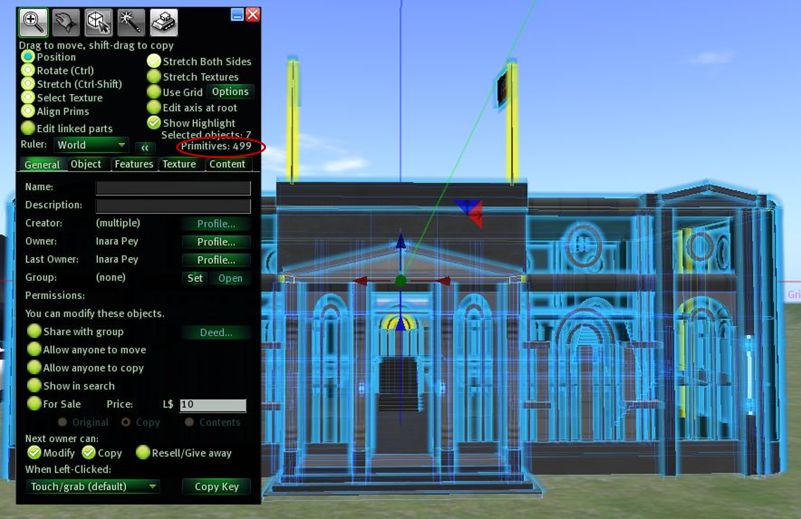
Even builds using mega prims benefit

There is additionally the promise that prims themselves are to become the focus of a new “directed experience” for users entering Second Life, as the ability to create and collaboratively build within Second Life is recognised by Linden Lab as a tremendously powerful and attractive aspect of the platform.

Prims are also important because not all of us are going to be entirely comfortable around trying to get to grips with mesh – and even if we get over the various technical hurdles and get to grips with the technology needed to do so, there is still no guarantee we won’t end up stymied when it comes to getting stuff from a particular application outside of Second Life and actually in-world in such a way that it is efficient enough resource-wise to be viable.It is therefore important that we continue to have an avenue for creative expression.

So, yes, let’s all welcome mesh and hope it achieves what is hoped; but at the same time, let’s not forget the humble prim. I’ll leave you with a little video from Phaylen Fairchild, created for SL8B, and which perfectly frames the magic that prims have brought us over the years.


Making the ocean a shared creative space: The Blu

Shared creative space and shared creativity tool – they’re becoming popular terms. Not only does Rod Humble refer to Second Life as a shared creativity tool, he suggested that shared creative space might be a Good signpostfor his thinking around at least one new product that will be coming out of Linden Lab.

Now it seems another organisation is moving into these areas, offering a web-based shared creative space and a shared creativity tool by which artists the world over can collaborate and, it would seem, make money.

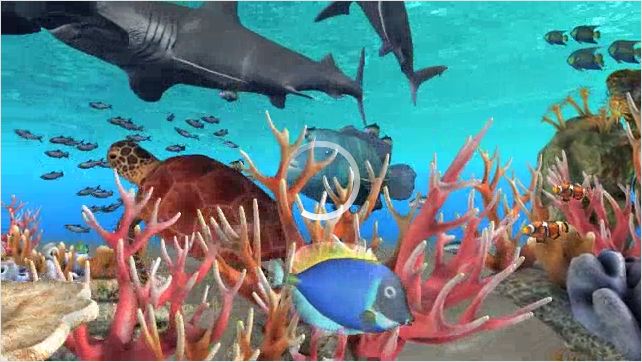
The Blu presents itself as project that brings together digital media, social networking and collaborative workspaces into a global shared creative space. Neville Spitieri, co-founder of WemoMedia, the company behind The Blu, describes it thus:

“The Blu is a global mission to create the ocean on the world-wide web. It’s an interactive world where every species and habitat is a unique work of art created by digital artists and developers from all over the world.”

One of the aims of the project is to see if the Internet can be a new medium for artistic expression, storytelling and interactive media on a global scale – one which touches on the nature of ecosystems,  conservation and other key issues. Or as The Blu’s website words it, “A global geosocial experience where your participation in the curation of the “ocean on the web” influences everyoneʼs experience of it”.

There are some impressive names linked to The Blu, including:

  • Andy Jones, the Academy Award-winning animation director of Avatar, who describes his attraction to The Blu as arising from, “The possibility to work with thousands, tens of thousands, of artists around the world, that can contribute and make this environment amazing.”
  • Joichi Ito, Director of MIT’s Media Lab
  • Louis Psihoyos, the Academy Award-winning director of The Cove
  • Kevin Mack, the Academy Award-winning VFx Supervisor on What Dreams May Come
  • Richard Taylor, VFx Director, Tron
  • Takahiko Akiyama, CG Director, Final Fantasy.
Richard Taylor talks The Blu

For digital artists wishing to get involved in the project, the benefits are described as:

  • The ability to showcase work across the web
  • Connecting with a global commuinity of peers
  • Direct feedback from Academy Award-winning film makers
  • The opportunity to get paid for creations

The Blu will utilise WemoMedia’s own Maker Platform, described as “An online creative collaboration platform enabling digital artists and developers around the world to peer-produce innovative digital media”. As such, it will be the first such project / product the company will be developing using the Maker Platform.

It’s an ambitious project, and a lot of details – such as how artists get paid for their efforts  – are not presently clear. However, it is certainly intriguing – and it is starting to generate interest; as such, it’s worth keeping an eye-on.

To find out more  – and both see a video outline of the project and sign-up to get invovled – visit The Blu. There’s also a Twitter hastag for those curious  / involved in the project: #theblu

All screencaps used in this piece, ©WemoMedia / The Blu.

Mesh: the videos

Mesh has been rolled-out to the Main grid. Doubtless, there will be some tweaking and nips and tucks, plus we already have the promise of further improvements / updates in the future – and the rendering code has yet to find its way into widespread use – but this is the start of something new and hopefully full of potential for SL.

Kkudos to Rodvik, Charlar, Runitai and all at Linden Lab and all those users who worked through the Beta programme and the Mesh/Live Volunteers programme for making this possible in Second Life.

YouTube is awash with mesh-related videos, but to mark the roll-out I thought I’d pin and handful of my favourites here.

And because it is so stunning, Rockerfaerie’s video of Claudia222 Jewell’s amazing creations:

Credits

  • Mesh Montage – Damien Fate
  • Vehicle import test – Bytegang
  • Preview tour – SparkaphatDoobie.

Update:

Mesh: the roll-out

[POSTED 8:22PM PDT Aug 22, 2011] Rolling restarts for regions on the main Second Life server channel will be performed on Tuesday, August 23rd at approximately 5:00am PDT. Please make sure to save all builds and refrain from making purchases during this time.

Mesh: transformative? (w/thanks for Claudia222 Jewell)

With this simple notice, mesh commenced its roll-out to the remaining portion of the Main gird that has yet to see it (approximately 70%), as per the server release notes.So, assuming all goes well, the entire Main grid will be mesh enabled from today.

This isn’t the end of the mesh project, but really the beginning; thing’s are going to suddenly change overnight – it’s going to take time for mesh to make its presence felt, and as Linden Lab themselves admit, there will be further updates, revisions and improvements ahead.

As a result of this, we can doubtless expect the Beta “Viewer 3” to go to full release status shortly (if not today as well), which brings with it mesh support with some added features. Please see the update at the end of this article.

For those wishing to see mesh, issues still remain: the code for rendering mesh objects has yet to be incorporated into a number of third-party 2.x Viewers, and it unclear as to whether the code can be backported into the 1.x code.

In the meantime – a video from rockerfaerie featuring some of Claudia222 Jewell’s remarkable mesh art.

Updates

At 1300 SLT Nyx Linden confirmed the following:

  • All channels of the Main grid now support mesh except the BlueSteel RC channel (which one assumes will get mesh during the RC channel restarts on Wednesday 24th August)
  • The Default official Viewer is now Viewer 3 (currently 3.0.0.238864)

More on Mesh

Update 25th August

The “additional feature” referred to in this article was the ability to disable mesh rendering in a region. However, in commenting on a JIRA raised in relation to the capability, Charlar Linden stated:

Charlar Linden updated SH-2341:Status: Expected Behavior  (was: Open)   Resolution: Not Applicable – thanks – this flag would have no effect, and is being removed soon.

So it would appear the option to disable mesh is not intended to be a part of the Viewer.

LL provide Mesh region setting

Update Thursday August 25th: In a comment on the revised JIRA, Charlar Linden states: Charlar Linden updated SH-2341:Status: Expected Behavior  (was: Open)   Resolution: Not Applicable – thanks – this flag would have no effect, and is being removed soon.

Ciaran Laval has been investigating mesh from a sim owner’s standpoint, and came upon the fact that LL have added new regional controls related to mesh.

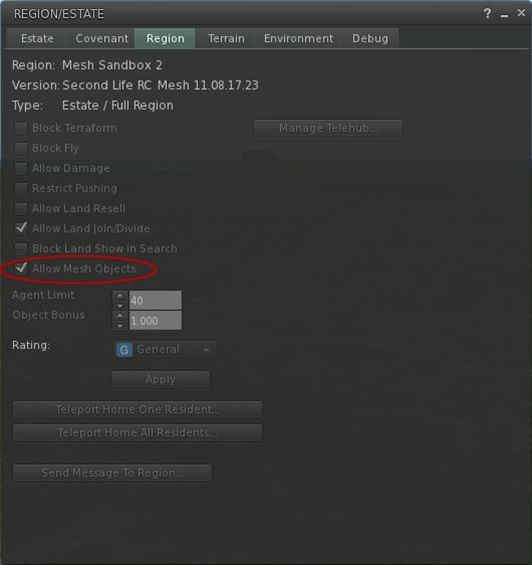
New region setting

As Ciaran reports, the latest mesh-enabled  Beta Viewer includes an option to allow / deny the rezzing of mesh objects within a region. By default, the option is set to ALLOW mesh, although currently, there appears to be a bit of a bug in the system – if you uncheck the option, it re-check itself on hitting APPLY. This may just be a hiccup in the Beta that LL are already aware of, but to be on the safe side, Ciaran has also raised a JIRA on the matter – be sure to WATCH it!

Given this issue with the option at present, it is not clear what will happen to mesh objects that are currently rezzed in-world should the option be toggled to disable mesh. Will they be returned, or will they fail to render in all viewers & any scripts they contain be disabled? One would hope for the latter (allowing for issues around collisions, physics, etc.), as the former could present a lot of angst.

The capability isn’t granular to the level of individual parcels, which is understandable given that mesh will impact an entire sim regardless of where it is placed. However, as things are refined and improved over time, it would be interesting to see if such granularity of control could be introduced in time.

Overall the addition of this capability is a very good move; mesh stands to be potentially very beneficial for Second Life, but it also carries not a few potential risks. Thus, the inclusion of this option allows estate / sim owners worried about negative impacts to disable mesh rendering from the start, allowing them to observe how mesh impacts the rest of the grid before opting to allow it.

Expect to see this option in main Viewer when the Beta is rolled over to a full release.

Loyalty, adoption, inspirational leadership … and SL

Simon Sinek probably isn’t a new name to a lot of people who may read this; nor, potentially, is his “Golden Circle” popularising the concept of “why”. But ever since Spikeheel Starr pointed me towards his TED presentation made last year (and now apparently the 19th most-viewed video on TED.com), I’ve found the ideas he expresses fascinating.

For one thing, I cannot help but agree with his example of Apple. This is a company that people like or loathe. Customers are intensely loyal and remain so, no matter what happens to dent the company’s reputation. Apple continue to top the charts with their products, despite the fact that – really – there is nothing that is that technically innovative about them. Why?

Well, as Sinek points out, Apple developed and has retained, the ability to inspire aspirational desire with its products. Take the famous Apple “1984” ad: it presents a clear message of that aspirational desire through a positive vision of non-conformity.

That approach has continued through to Apple’s messaging today, where the “what” might be more prominently placed – but it is still wrapped in the aspirational subtext of their messaging, “We’ve done this and it feels good, wouldn’t you like to have the ability to do it to?”

The Law of Diffusion

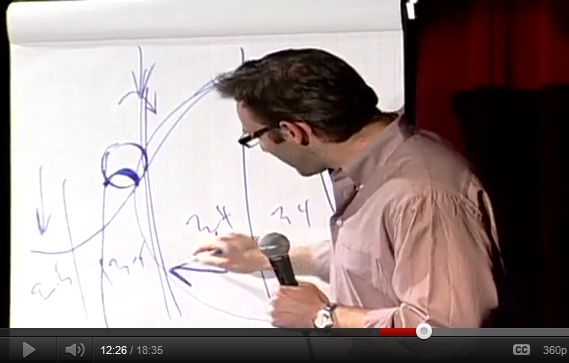
Further into his talk, Sinek touches on the law of diffusion of innovations, which caused me to think about Second Life.

In 2008, Mitch Kapor gave an address at SL5B in which he referred to the same law, and particularly the matter of what Geoffrey Moore refers to as crossing the chasm – moving a product from the status of early adoption to its use by an early majority (or “pragmatists”, as Mr. Kapor preferred to call them).

However, in his presentation, Mr. Kapor appeared to turn the issue of crossing the chasm entirely on its head. To him, it would appear that the early adopters – the “pioneers”, as Mr. Kapor called them – were anathema to SL’s future growth.

The early majority is gained through the early adopters

Yet, as Mr. Sinek points out – and Moore understood – the fact is that without the early adopters, the majority will not actually follow to adopt the product.

In short, by suggesting the early adopters might need to stand aside, Mitch Kapor appeared to completely miss an opportunity – as LL itself did, as I’ve previously noted.

And it is here, while watching Simon Sinek, that I again feel a renewed hope for Second Life – and more particularly, Linden Lab. Why?

Because everything that appears to be coming out of Linden Lab does now appears to be geared towards crossing their chasm in a manner Moore recommends and Sinek indicates: by leveraging their existing user-base.

Anyone attending the Lab’s presentations at SLCC this year cannot fail to have noticed this; all of them were, in one way or another, focused on the user community as a whole. Both Mark Viale (Viale Linden) and Brett Attwood (Brett Linden) in particular gave insight into LL’s change in philosophy that stands to benefit the user community and the company equally well.

In this respect, something has changed within Linden Lab over the course of this year; and it’s pretty obvious that – and I say this without any desire to sound like a fangirl – the “something” in question might at this point be Rod Humble.

Rod Humble embodies much of what Simon Sinek discusses about good leadership. Hearing him speak at SLCC and elsewhere and when reading interviews he’s given, Rod Humble unabashedly talks about his personal beliefs. It doesn’t matter whether the subject under discussion is Second Life or on matter of virtual identity; he strikes that emotive chord that resonates within us.

In short: he inspires trust.

It’s why we like Rod Humble. More than that – it’s why we need him right where he is.

Note: updated in 2019 due to video links to Apple ads being broken and forcing an alternative version of the “1984” ad to be embedded and reference to the AirPlay ad removed.