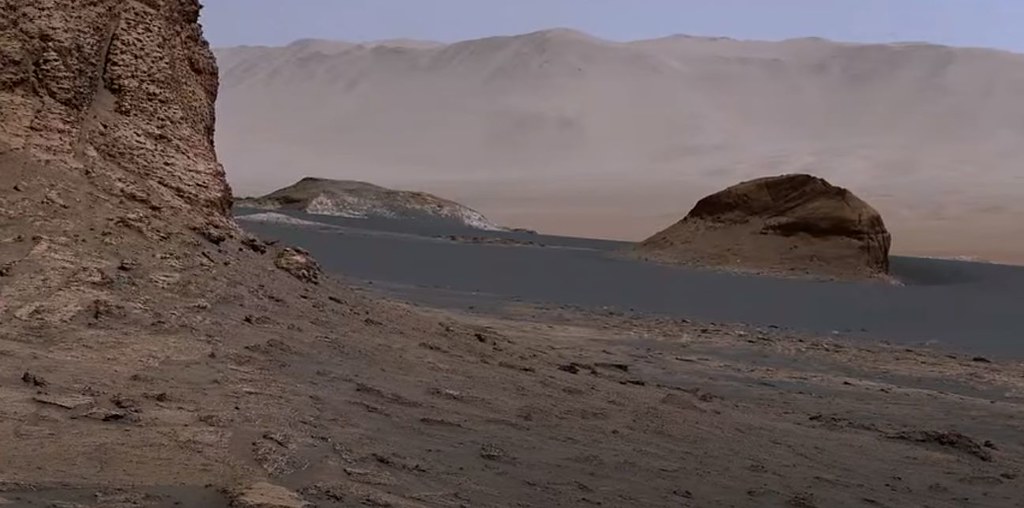
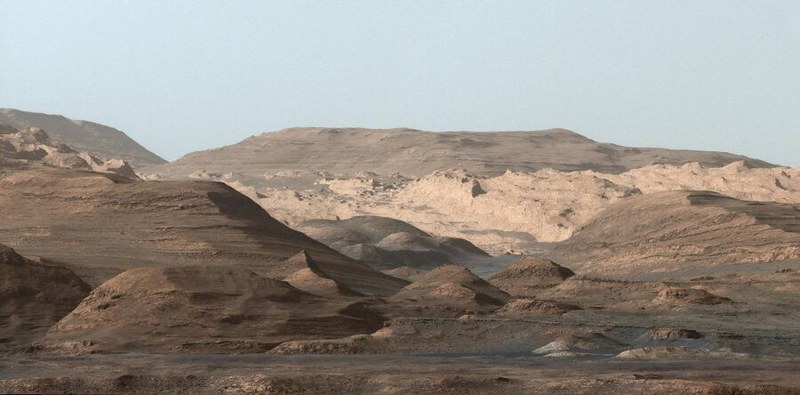
A view across Gale Crater from “Mount Sharp”, captured by the Mastcam on NASA’s Curiosity rover on July 3rd, 2021, Sol 3,167 for the mission). The dark band of rippled material in the middle-ground of the image is a dune field of volcanic sand. Credit: NASA/JPL
It’s now nine years since NASA’s Mars Science Laboratory rover Curiosity arrived on the Red Planet. To celebrate, the rover is about to enter a new phase of exploration as it continues to climb the slopes of “Mount Sharp” (more correctly, Aeolis Mons), the 5 km high mound that rises from the centre of Gale Crater.
Through July and August, the rover has been passing through a “transitional field” between a region on the mound that is dominated by the presence of clay minerals and one dominated by sulphates. While doubt has recently be cast on how large a role water has played in the crater’s (and particular “Mount Sharp’s”) formation, the change from clay minerals to sulphates is nevertheless important, as it marks a point where very different processes were at work on Mars as a result of the planet’s changing climate.
The rocks here will begin to tell us how this once-wet planet changed into the dry Mars of today, and how long habitable environments persisted even after that happened.
– Abigail Fraeman, MSL deputy project scientist
This is an area the MSL science team have been anxious to reach; roughly 460 metres above the crater floor where the rover landed in August 2012, it has been a target for Curiosity since before the rover arrived on Mars, as it could hold the key to the impact of climate change elsewhere on Mars where it is thought water may once have been present.
The transition between environments comes as Curiosity celebrates nine years of operations on Mars. To mark this NASA recently released a video of images captured by the rover during July, as it approached the transitional area. Because it is currently winter within Gale Crater, a time when the amount of dust in the tenuous Martian atmosphere is especially low, the images used in the video are exceptional clear and detailed images that even reveal the crater walls in detail, even though they are over 70 km away.
Another rover with cause to celebrate is China’s Zhurong rover, currently operating on Utopia Planitia. Somewhat smaller than the NASA rover, Zhurong arrived on Mars at the start of an initial 90-sol (92 day)mission are a part of China’s TIanwen 1 interplanetary mission. Since its arrival, the rover has been moving south from its lander vehicle, carrying out a range of science operations.
China has perhaps not been as pro-active as NASA in their social media output on the mission, but Zhurong has performed exceptional well, returning some 10 gigabytes of data to mission control on Earth whilst travelling almost a kilometre, visiting other elements of the mission along the way, such and the backshell and parachute that protected it through entry into the the Martian atmosphere and helped to decelerate in its descent ready for landing. So well, in fact that the China National Space Administration (CNSA) has announced the mission is to be extended through a second 90-sol period.
The rover has most recently reached an area believed to have once been the shoreline of ancient coastal waters in the region, marking it as a particular area of scientific interest. In particular, the rover is being directed to drive to a feature described as a “groove” just over 1.6 km from its current position.
Hopefully, by providing data on this area for our scientists, we can get a deeper understanding of the geology of Mars, and then even see if we can find evidence of the existence of an ancient ocean in Utopia Planitia. If it is possible for us to see from the top to the bottom [of the groove], or if there are disparities of rock types and compositions, we could learn about what has happened in its geological history. So, this is what we’re going to focus on in the near future
– Liu Jianjun, chief designer of the Tianwen 1 ground application system
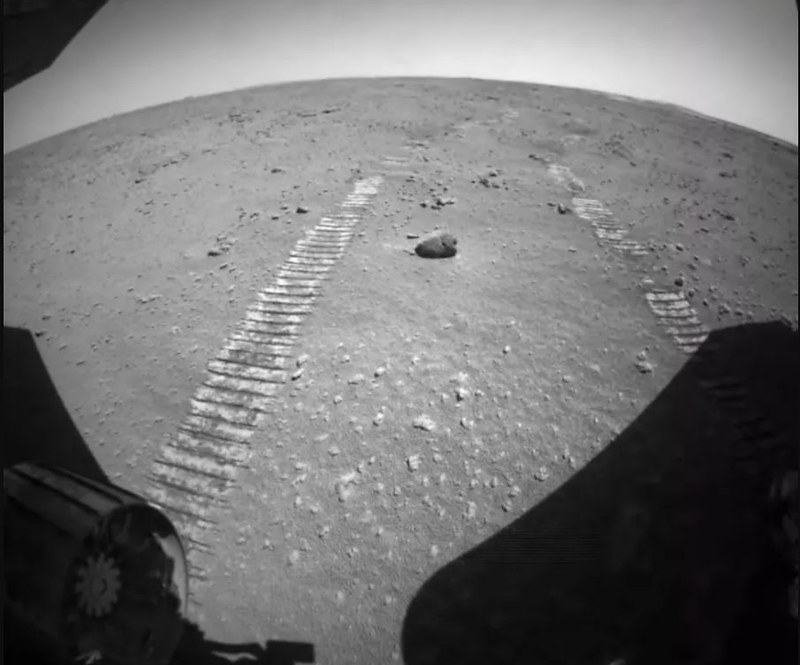
A recent image release by CNSA via CCTV (China state television) show the view make along Zhurong’s route south, captured by the rover’s black and white navigation cameras. Credit: CNA / CCTV
Meanwhile, in Jezero Crater, NASA’s ingenuity Mars helicopter drone has completed its 12th – and most challenging – flight.
On August 16th, 2021, the helicopter took off on a reconnaissance flight again in support of the Mars 2020 rover Perseverance. The flight was one of the longest to date, with Ingenuity covering over 450 metres and lasted 169 seconds over terrain, dubbed “Séítah South”, regarded as “risky” due to its varied nature.
Flying over Séítah South carries substantial risk because of the varied terrain. When we choose to accept the risks associated with such a flight, it is because of the correspondingly high rewards. Knowing that we have the opportunity to help the Perseverance team with science planning by providing unique aerial footage is all the motivation needed.
– From the Ingenuity flight log
The flight saw the helicopter return to the “round trip” approach seen in initial flights, travelling out over a region where, if it had been forced to make an emergency landing, could have resulted in it suffering damage or loss, and then back again. The route was selected so as to allow Ingenuity recorded the terrain in sufficient stereoscopic detail that mission planners might determine a route into the terrain for Perseverance. and have the rover drive itself safely to specific points of interest.
Taking the rover into “Séítah South” is regarded as riskier than flying Ingenuity over it, but the region is also full of intriguing rocks that the science team believe the risk is worth the potential returns.
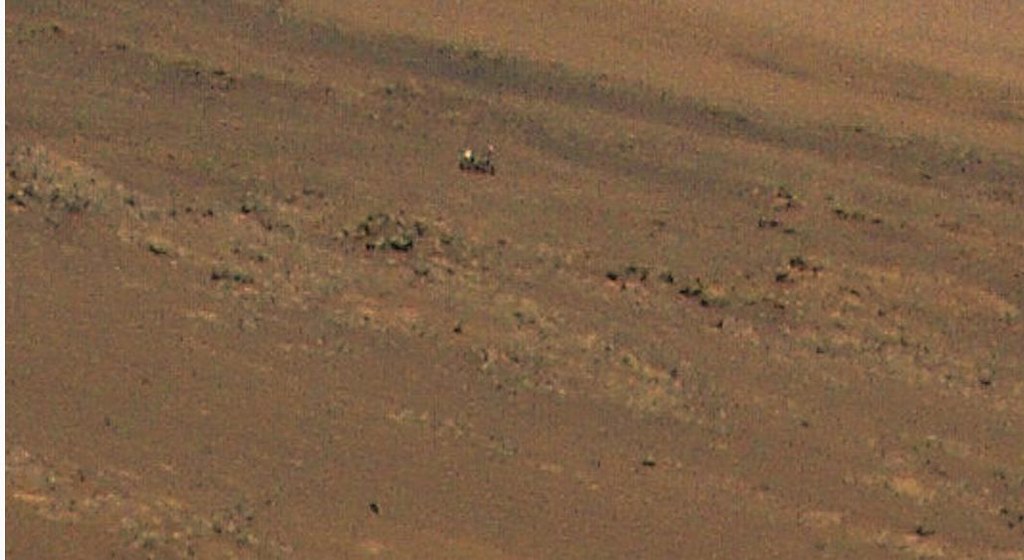
During the 12th flight of NASA’s Ingenuity helicopter, the craft overflew an area of rough terrain called “Séítah South”, and while manoeuvring, the helicopter managed to capture an image of the Mars 2020 rover Perseverance from a distance of around 1/2 a kilometre, NASA later released this enlarged image of the rover as seen by Ingenuity. Credit: NASA/JPL
Currently, Mars is approaching a period of solar conjunction – meaning it is on the far side of the Sun relative to Earth, and about to pass “behind” the Sun as seen from Earth, and event that happens once every two years. During this period, and the time leading up to it an immediately after it, ionized gas radiating out from the Sun’s corona can interfere with radio signals between Earth and vehicles operating on the surface of Mars or in orbit around it, increasing the risk of miscommunications and possible damage to, or loss off, those vehicles.
To avoid this, the fleet of spacecraft currently in orbit around Mars from the USA, UAE, Europe and China will be order to enter “safe” modes during the first two weeks of October, shutting down all major operations until such time as communications can be safely resumed. At the same time, the rovers active on the surface of Mars will switch to autonomous modes of operation, reducing their science operations until such time and full communication between them and the orbits spacecraft and the spacecraft and Earth can be re-established.
Things have been getting a little rocky – pardon the pun – for the US rover missions on Mars of late.
On August 5th (Sol 164 for the mission) the Mars 2020 mission had been expected to recover its first sample from within Jezero Crater, some of which would be subject to analysis and the rest held for future deposit on the surface of Mars to be retrieved by a future NASA / ESA sample-return mission.
All seemed to go well with the operation – Perseverance deployed its robot arm and used the drill to cut some 7cm into the selected target rock, dubbed “Paver Rock”, a part of the “Crater Floor Fractured Rough” region of the crater floor. However, data received by mission managers after the drilling operation have been completed revealed the tube to be empty.
Gathering samples with Perseverance is a lot more complicated that with Curiosity. In particular, rather than the drill gathering a sample within itself, it is designed to hold a sample tube, which has to be delivered into the bit, and then removed from it and transferred into the rover’s body. Following the drilling operation, part of the process involves extending a probe into the sample tube to confirm it contains material – and it was lack of any return from this probe that alerted the mission time that the sample attempt may have failed.
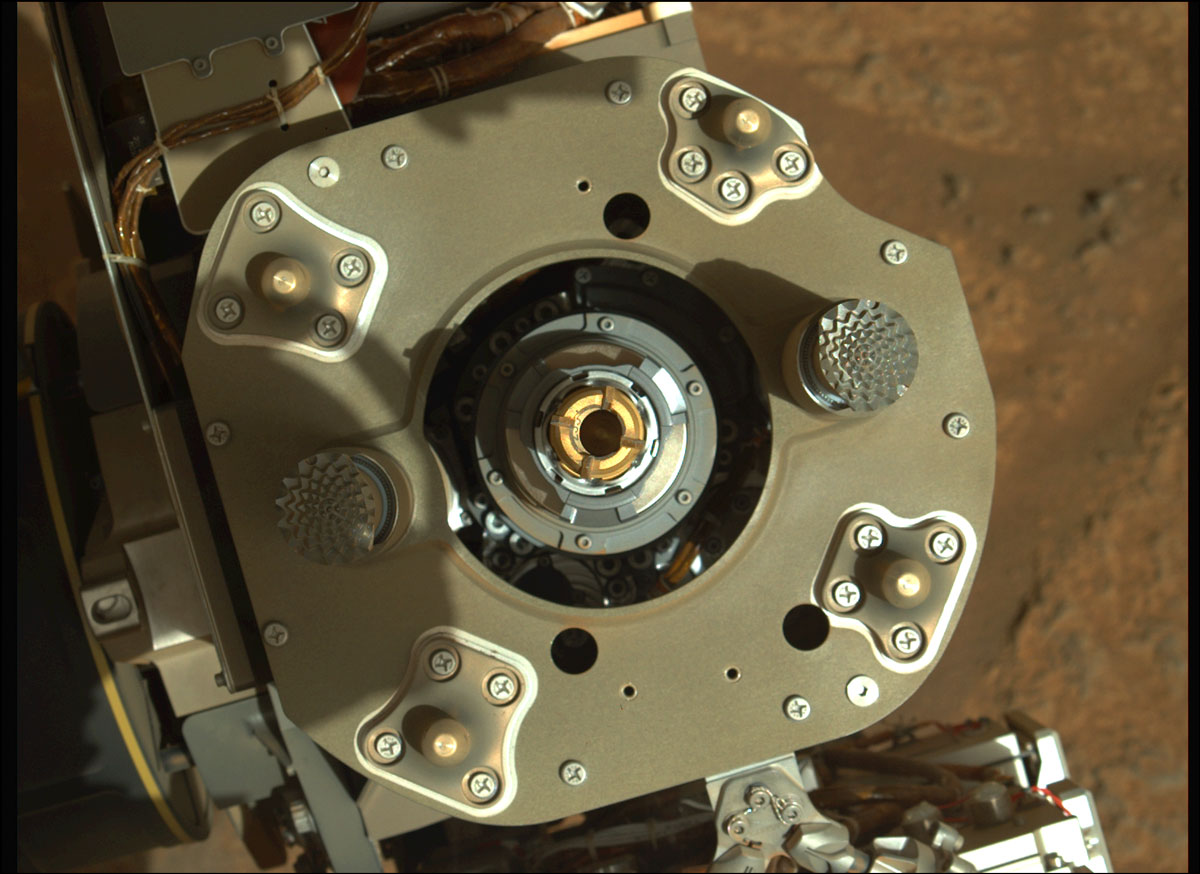
This enhanced-colour image from the Mastcam-Z instrument aboard NASA’s Perseverance rover shows sample tube inside the coring bit after the Aug. 6 coring activity was completed. The bronze-coloured outer-ring is the coring bit. The lighter-coloured inner-ring is the open end of the sample tube. Credits: NASA/JPL
The lack of data lead to checks on the sample gathering systems, and a detailed examination of the bore hole and the detritus around it using two of the other instruments on the turret – SHERLOC (Scanning Habitable Environments with Raman & Luminescence for Organics & Chemicals) and Watson (Wide Angle Topographic Sensor for Operations and eNgineering). These examinations revealed something unexpected and a first for sample gathering operations on Mars.
In short, SHERLOC and WATSON revealed that as the drill bit cut into the rock, it produced a powder so fine, it could not be held within the the sample tube inside the drill bit, and as the bit was withdrawn the gathered material simply fell back out, joining excess material within the hole and the detritus surrounding it.
As a result, the mission team have opted not to make a second attempt at sample gathering with the current target rock. Instead, the rover is to be directed on to its next target, a rock formation in the “South Seitah” region of Jezero Crater, which it will reach in early September.
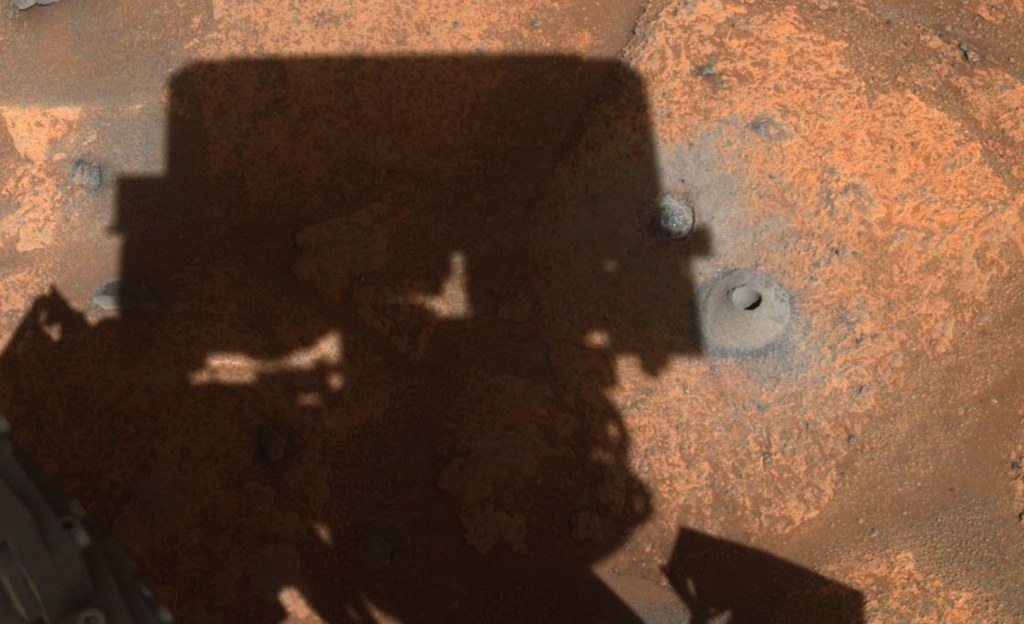
This image taken by NASA’s Perseverance rover on Aug. 6th, 2021, shows the hole drilled in a Martian rock as a part of the rover’s first attempt to collect a sample. It was taken by one of the rover’s hazard cameras. Credit: NASA/JPL
Meanwhile, half a world away, Curiosity is celebrating the ninth anniversary of its arrival on Mars. The first of NASA’s nuclear-powered Mars, Curiosity has been continuing its journey of discovery within Gale Crater, although some of the findings made as a result of the data gathered have recently been subject to new evaluation by the University of Hong Kong, leading to some interesting conclusions.
In has long been presumed that the major factor in the formation of Gale crater’s landforms has been water in the form of a series of shallow lakes that laid down sedimentary clays and similar over time, with wind playing a much later role in things, such as sculpting “Mount Sharp”, the large mound at the centre of the crater – and discoveries made by the rover throughout its sojourn through the crater and up “Mount Sharp” have tended to support this view. However, the UHK study suggests that the roles may have been reversed – that while the crater was once the home of water, the dominant factor in the development of the landscape within the crater was in fact the wind.
A view across Gale Crater, as captured by the Mastcam system on NASA’s MSL rover Curiosity
The conclusion was reached after an extensive study of Curiosity’s findings in the search for elements considered “mobile” – which are indicative of water being present in their deposit, and elements that are “immobile”, which are not water soluble, and which are generally formed in dry regions, where winds play a significant role. The UHK study, led by Dr. Jiacheng Liu suggests that immobile elements exist in much higher concentrations at high levels in the rock than would be the case if water had been present during their formation.
This doesn’t mean the crater was never the home of a lake; rather, Dr. Lui suggest that Curiosity has been studying overlays much of the evidence for the ancient lakes, and was largely form by wind action depositing layers of material over time, which were then compressed into layer and then further sculpted by the wind, rather than water-based sedimentation later sculpted by winds. He also suggests that the “mobile” elements the rover has found may not be the result of water-base depositing within the crater, but were rather created elsewhere on Mars, and again carried into the crater by windows a dust storms.
If correct, this is important because while it does challenge the idea that water did play a role early in the history of Gale Crater, it does tend to confirm the idea wind and atmosphere played an equally important role in its history, which in turn always for a more varied picture of the geological history of the surface of Mars to be built up, one potentially far more diverse and active then previously believed. to be the case.
Boeing Returns Starliner to Factory for Fixes
Boeing’s CST-100 Starliner, designed to transport crews to and from the International Space Station (ISS) from US soil, now looks like it wouldn’t be able to complete its second test flight until 2022.
The flight – called OFT-2 for “orbital flight test 2” had been due to lift-off on August 3rd. However, as I reported last time around, the launch was postponed after it was discovered valves designed to control the vehicle’s thruster system has all fused in their “closed” position, resulting in the launch attempt being cancelled and the orbiter and its Atlas 5 being rolled back to the Vertical Integration Facility at Cape Canaveral Space Force Station, where Boeing hoped to effect repairs.
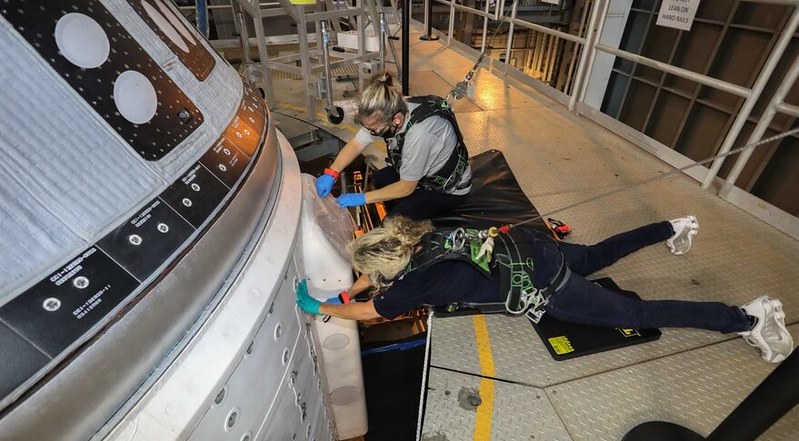
Boeing technicians attempt to repair valves in the propulsion system on the CST-100 Starliner in the Vertical Integration Facility at Cape Canaveral Space Force Station. The valve issues have now forced an extended delay to the vehicle’s OFT-2 mission. Credit: Boeing
While 9 of the 13 valves were fixed, four remained stuck, and it was discovered the cause of the problem appeared to be nitrogen tetroxide (NTO), used as thruster propellant, permeating Teflon seals in the valves to react with moisture, creating nitric acid that fused the valves shut. This, and the four remaining stuck valves prompted Boeing to announce that the capsule would be returned to their facilities where a more extensive review of the situation can be carried out, both to repair the remaining valves and determine why the NTO permeated the valve seals – something not seen in testing, and hoe moisture accessed the valves.
It is not clear how long this review will take, or whether it will require further changes to be made to the flight test vehicle to prevent any recurrence. However, the launch schedule at Canaveral Space Force Station means there a very few slots into which a further attempt at launch could be slipped before the end of the year, and Boeing have been talking in the review taking “several months” to complete.
Rocky NASA / Roscosomos Relations Continue
In 2018, the IISS suffered a small-scale loss of pressure. It was not the first such event, and it never put the crew at risk. However, investigations into the cause eventually uncovered a small hole in the skin of the orbital compartment of Soyuz MS-09 crew vehicle docked at the station. This hole was subsequently repaired by the cosmonauts on the ISS, and the vehicle ultimately made a successful return to Earth.
The cause of the hole – around 2mm across – has never been fully explained, although it seemed to many it was likely the result of a error being made during the vehicle’s assembly. However, not long after the situation, Roscosmos head Dmitry Rogozin started to point fingers, suggesting the hole was the result of attempted sabotage by one of the non-Russian crew then aboard the ISS. This claim has now resurfaced.
Dr. Serena Auñón-Chancellor – accused by a “High ranking official” at Roscosmos of attempting to sabotage Soyuz HS-09 in 2018, the accusation seen as a means of deflecting attention away from criticism of the recent “Nauka incident”. Credit: NASA
On Thursday, August 12th, Tass published an article quoting a “high ranking official” at Roscosmos – possibly Rogozin himself – that the hole on MS-09 was the result of attempted sabotage – and the report pointed a finger at the only woman on the crew at that time: NASA astronaut Dr. Serena Auñón-Chancellor, who was serving as the Expedition 56 Flight Engineer.
To give credence to the claim, the report breaks with a long-standing NASA protocol of not commenting on astronaut health issues by revealing that on her return to Earth, Dr. Auñón-Chancellor had to be treated for a blood clot in a vein in her neck; the insinuation here being that the condition caused her to have a breakdown whilst on the station, resulting in her sabotaging the Soyuz in order to force a return to Earth. Auñón-Chancellor has denied the claim, and has been joined by NASA senior management from Administrator Bill Neilson on down in rebutting the Tass report.
Serena is an extremely well-respected crew member who has served her country and made invaluable contributions to the agency, and I stand behind Serena — we all stand behind Serena and her professional conduct and I did not find this accusation credible.
Kathy Lueders, NASA Associate Administrator, Human Exploration and Operations Mission Directorate.
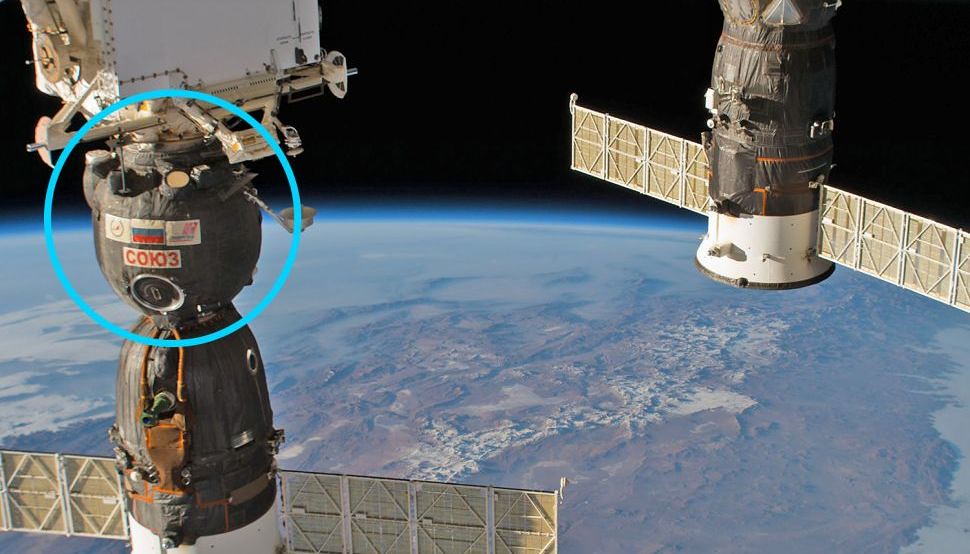
Soyuz MS-09 docked with the ISS in 2018. The hole piercing the hull lay within the circular orbital module / airlock, circled. Credit: NASA
Overall, the accusation would appear to be a retaliation for continued criticism over the recent “Nauka incident”, which a newly-docked Russian module at the station fire its thrusters to push the station into a slow rotation that took some time to correct (see here and here for more), and likely the result of a failure on the part of Russian ground controllers to correctly “safe” the module’s propulsion systems.
However, whether intended as a deflection or not, the the article stands in stark contrast to recent US claims that the Russian / American space partnership is healthy. And if the comments did come from Rogozin, they will be the latest in a series of remarks he has made in his two tenures in leading Roscosmos that appear to be intentionally aimed at straining US / Russian relations.
In 2014, Rogozin threatened an end to Russian cooperation on the ISS as a result of annoyance with US management of the station, and in 2020, he summarily rejected an invitation by America for Russia to join the Artemis programme, indicating Russia would rather work in partnership with China. More recently, he has suggested that Russia could abandon the ISS altogether after 2024, and instead concentrate on a new space station – and that as part of this, Roscosmos might repurpose one of the modules they are fabricating for the ISS to form the core of their new station, allowing it to commence operations “by 2030”.
NASA Lunar Spacesuits “Won’t be Ready” for 2024
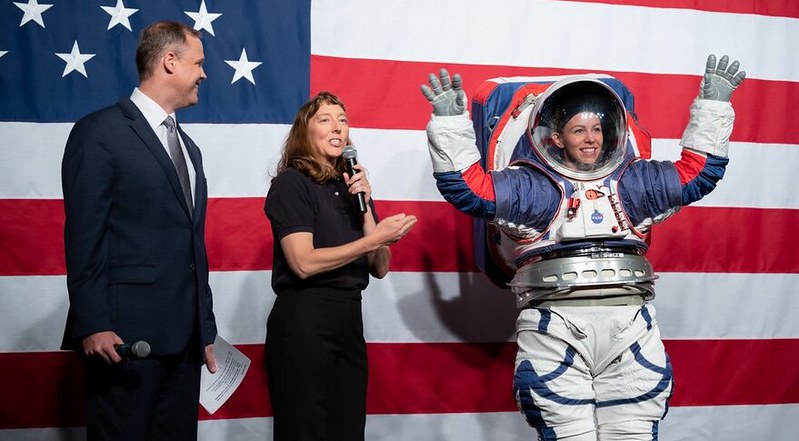
The Exploration Extravehicular Mobility Unit (xEMU) spacesuits that NASA astronauts will need to walk on the Moon won’t be ready form operational use until 2025, further ending any idea of a US return to the Moon by the end of 2024.
The new suit has been in development since 2007, but has encountered a number of design challenges over the years, as well as encountering technical and funding issues. To date, just over one-third of the funds needed to develop the suit have been awarded to NASA, and in 2020 it had to undergo a complete redesign in order to remove a further 10 K from its overall mass.
A mock-up of the Exploration Extravehicular Mobility Unit (xEMU) lunar spacesuit being revealed in 2019. The actual suits won’t be ready for use on a lunar landing mission until 2025. Credit: NASA/Joel Kowsky
With the impact of the CIVID pandemic also impacting work on the suit, the NASA IG reports that in practical terms the suit cannot be ready for lunar use until early-to-mid 2025.
And the suit isn’t the only element of the Artemis programme unlikely to meet the 2024 deadline; as reported in these pages, it is highly unlikely the Human Landing System (HLS), the vehicle that will deliver crews to the surface on the Moon and return them to orbit, will be ready within the next three years, whilst the Space Launch System – required to launch crew-carrying Orion vehicles to the Moon – is seeing its test flights slip back in their project time frames.
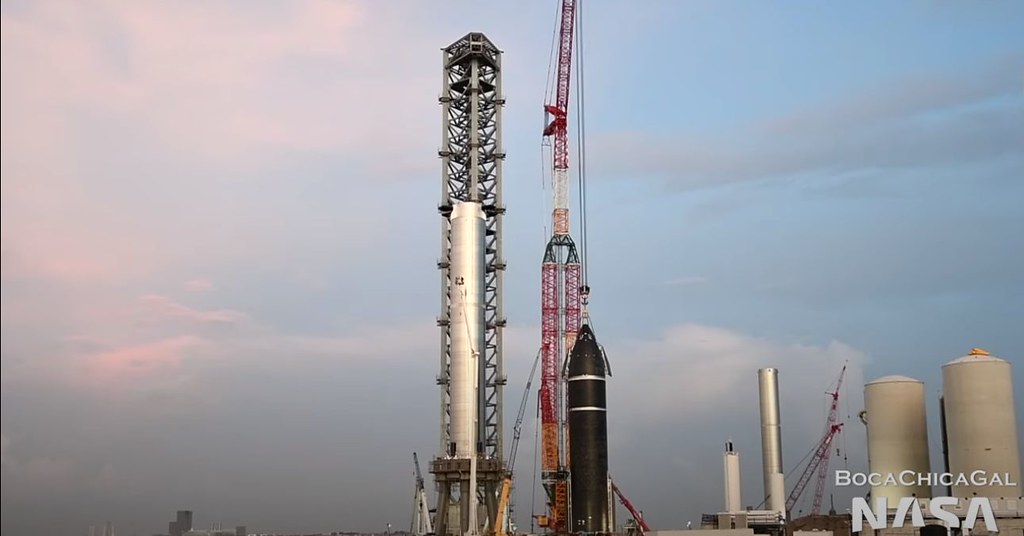
SpaceX Boca Chica: A giant crane gets ready to lift Starship S20 some 90 metres into the air so it can be stacked onto Super Heavy Booster 4, Friday, August 6th. Credit: BocaChicaGal / NASASpaceflight.com
SpaceX has been stepping up the pace of work at its Boca Chica Starbase facility, home of the Starship and Super Heavy booster development programme, in recent weeks.
Towards the end of July, the company started transferring personnel from its headquarters in Hawthorne, California to Starbase in what was seen as a start of gearing-up for flight activities out of Boca Chica. This operation came alongside continuing construction work at Starbase and the initial testing of the prototype B3 Super Heavy booster, which included a static-fire test of three Raptor sea-level engines. Since then, the pace of developments at Boca Chica has been dramatic – particularly in the last week and a half.
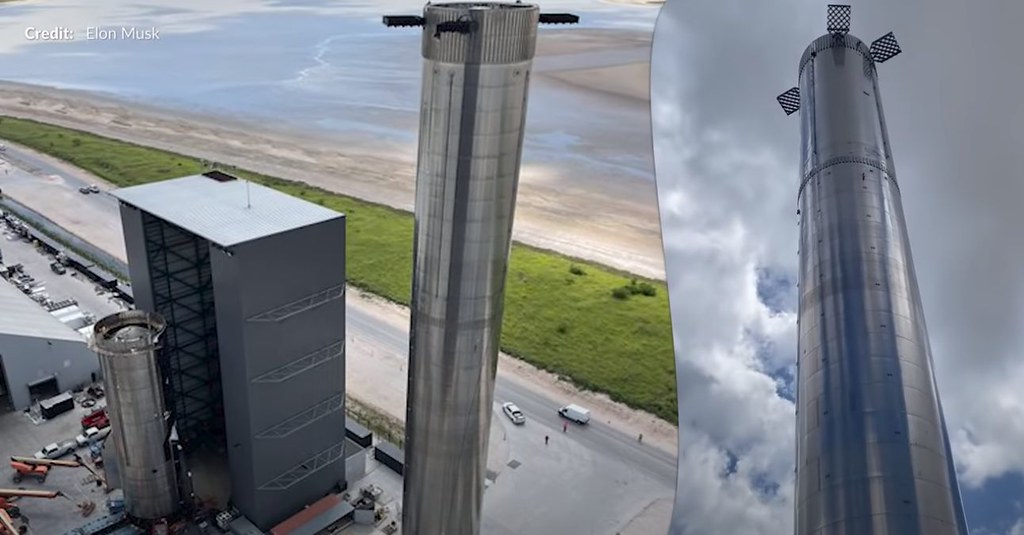
Two shots of the 70-metre tall Booster 4 departing the SpaceX high bay on its way to the launch facilities. Note the fixed (non-folding) grid fins that will be used to steer operational Super Heavy boosters to back to Earth, and in the background of the picture on the left, the lower tank section of starship S20. Credit: Elon Musk
In that time, the first flight-capable Super Heavy booster was moved down to the launch facilities, whilst Starship 20 (SpaceX has dropped the “SN” designation), the vehicle that will sly with it in an attempt to reach orbit later this year, completed its major assembly, stacking the two cylindrical tank sections one atop the other an onto the vehicle’s engine skirt, and then adding the upper ring sections and nose cone.
This work included the installation of two of the news aft aerodynamic fins that are around 20% smaller than those used on earlier test vehicles, offering a reduction in mass, and the installation of six Raptor motors – 3 sea-level engines (believed to be the three motors used in the Booster 3 static fire test) and three fixed vacuum engines – although all six may have only been installed for testing purposes.
Starship 20 departs the Starbase production area en route to the launch facilities, GSE tank 3 following behind, destined for the fuel farm. Credit: BocaChicaGal / NASASpaceflight.com
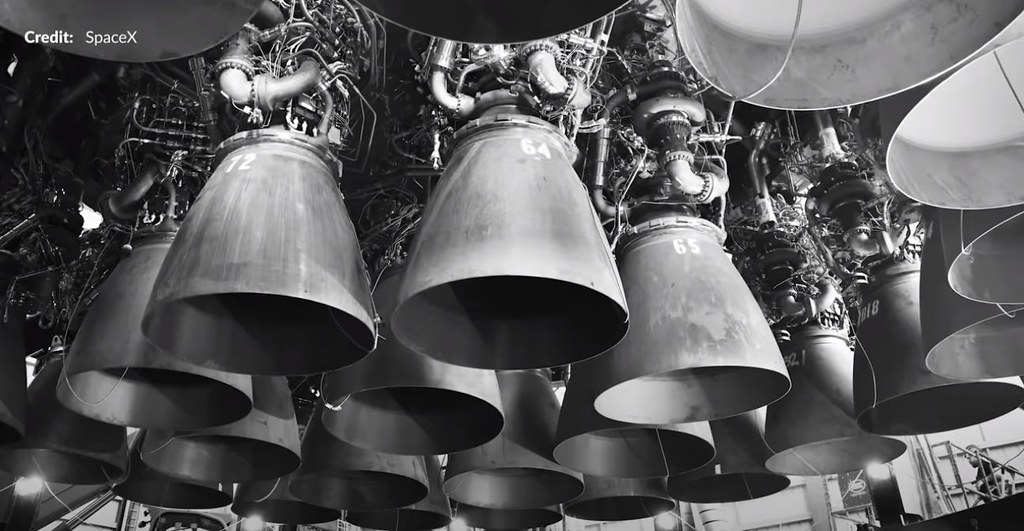
At the same time, the massive 370-tonne launch table – the ring of hydraulic clamps, actuators, bolt mounts, etc., that will hold a booster/starship combination securely on the launch pad, was hoisted up on to the ring of the launch platform’s legs and installed. This paved the way for the 70-metre tall, 9-metre wide Booster 4, complete with a contingent of 29 Raptor motors – 20 fixed in a ring around the rocket’s circumference, and 9 centre motors that can be gimballed to provide directional thrust – to be hoisted up onto the launch platform and secured into the launch table.
Then, on Thursday, August 5th, in a move that almost caught people off-guard, SpaceX proceeded to roll-out Starship 20 from the production site and transport it to the launch facilities.
The base of Booster 4 showing the central cluster of 9 Raptor engines and the outer ring of 20. Credit: SpaceX
This prompted a lot of speculation amongst starship fans that the launch could be coming in days – something that just wasn’t going to be the case. The fact that the vehicle lacked a full complement of heat shield tiles, the launch facilities aren’t complete, nor is the consumable feed feed, and so on, all make it clear the system is still months from any launch. Plus, the FAA environment assessment hasn’t been completed, so SpaceX don’t have federal clearance to attempt an orbital launch.
Apparently, there had been plans to use cranes to perform a “test stacking” of S20 in top of B4, but these were scrapped for the day due strong wind gusts. Instead, attention turned to mounting the aforementioned missing heat shield tiles to S20.
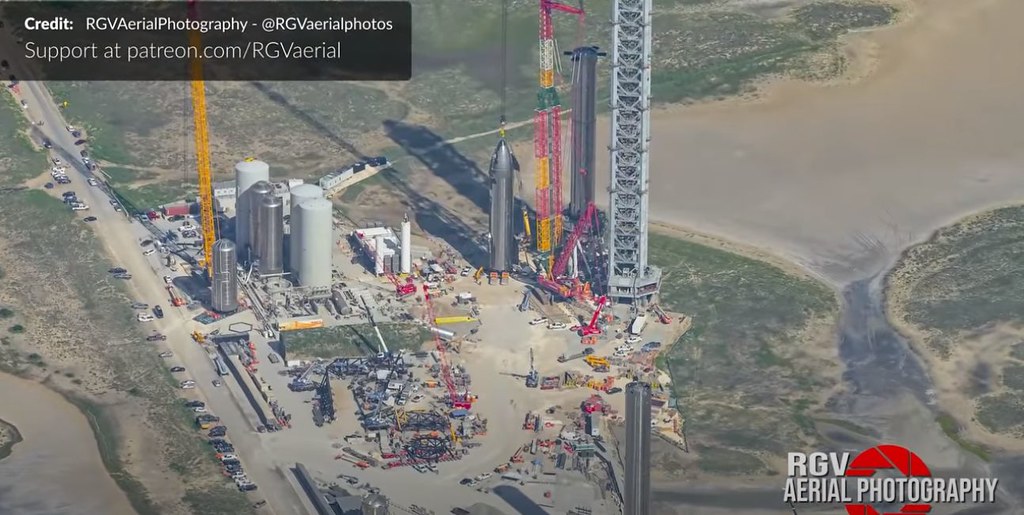
The Starbase orbital facilities: to the top right: the orbital launch platform and support tower with Booster 4 and Starship S20 waiting to be lifted. Top lift, , the tank farm with the newly-delivered GSE 3 tank awaiting its turn to be lifted into place. Credit: RGV Aerial PhotographyHowever, on Friday, August 6th, S20 was raised some 95 metres into the air and then gently lowered onto the reinforced interconnect at the top of the Super Heavy. In doing so, the two vehicles became the largest launch system ever raised – 120 metres tall from engine bells to tip of the nose cone (that’s around 10ft shy of 400 ft). With the launch table taken into account, the stack of vehicles rose some 140 metres above the ground.
Work on the stack then paused while, close by, GSE tank 3 was also hoisted aloft and moved into position on its mounting ring at the tank farm, where it will later be sheathed by a grey cryogenic cooling sleeve. With this work done, the massive “Frankencrane” that has been assembling the launch support tower, once more lifted S20 aloft and then lowered it back onto its autonomous transport so it could be rolled back to the production facilities to undergo further work.
Starliner: No Go for Launch
The long-awaited launch of the Boeing CST-100 Starliner vehicle on its uncrewed second Orbital Flight Test (OFT-2) has been indefinitely delayed n a further blow to the troubled programme.
Scheduled to lift-off on Tuesday, August 3rd, the launch was scrubbed after the Boeing launch team received warning of “unexpected valve position indications” within the capsule’s propulsion system. Initially, it had been hoped that a further attempt could be made on Wednesday, August 4th. However, Further checks on the vehicle, Boeing announced a suspension of all launch attempts, and that the vehicle would be rolled back to its service structure to allow further checks to be made on the vehicle.
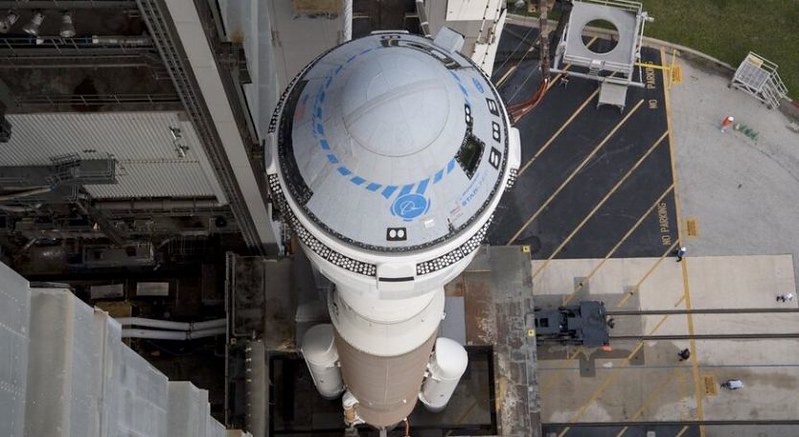
The OFT-2 Starliner capsule on its Atlas 5 booster prior to the mission being indefinitely postponed. Credit: NASA/Aubrey Gemignani
Designed to partner the SpaceX Crew Dragon – already operational – in ferrying crews to and from the International Space Station (ISS), Starliner first flew on an uncrewed mission in December 2019 in what was supposed to be a final check-out prior to commencing crewed operations. However shortly after the vehicle reached orbit it suffered a software glitch that caused repeated incorrect firings of its manoeuvring motors, leaving it with insufficient fuel to make a rendezvous and docking with the ISS. Hence the need for the OFT-2 flight.
That this has now been postponed following 18 months of reviews and changes to both systems on the vehicle and the procedures used in readying it for flight, is nothing short of embarrassing for Boeing and NASA alike – the CST-100 contract being the most expensive in the Commercial Crew Programme.
The Russian Nauka module closes on the Zvezda module (hidden by the solar array at the bottom of the picture) in preparation for an automated docking. A Russian Progress resupply vehicle can be seen to the right of the image. Credit: NASA TV
In my last Space Sunday update, I wrote about the comings and goings at the International Space Station (ISS), including the launch of the long-overdue Russian Nauka Multipurpose Laboratory Module (MLM), which at the time of that article was on its way to rendezvous and docking with the station having been lifted into orbit by a Proton M launcher on July 21st.
Designed to provide further dedicated space for Russian activates on the ISS, the 20-tonne module combines additional living space with working space, cargo storage, a dedicated external robotic arm that is capable of “walking” around the module using its two manipulator / mounts, courtesy of the European Space Agency), and an attitude control system to supplement those already on the station. It is the largest component Russia has provided for the ISS, and its launch – whilst 14 years overdue – is part of an effort by Russia to boost its space programme.
However, not long after the module reached orbit there were reports it was encountering some issues with a number of systems – including the thrusters. Neither Roscosmos nor NASA commented on these reports, and they apparently did not delay the planned rendezvous and docking at the station.
This took place at 13:29 UTC on Thursday, July 29th, when Nauka made an initial “soft dock” with the station following a fully automated approach to the ISS, monitored by cosmonaut Oleg Novitsky aboard the station, who sat at a control station that would enable him to take over manual control of the module should it become necessary. Nauka docked at a port on the Zvezda module that had been vacated earlier in the week by the 20-year-old Pirs docking / mini- science module. This had been towed away from the station by a departing Progress automated resupply vehicle, with both Pirs and the Progress vehicle burning up on re-entering the Earth’s denser atmosphere. The soft dock was followed by a confirmed “hard” dock, and things then appeared to be set.
The Nauka module. Credit: NASA
However, at 16:34 UTC, the module’s thrusters started firing of their own accord. No warning was given, and the firings were enough to cause the station to lose attitude control eight minutes later, rolling as much as 45º out of orientation. The cause of the problem was not initially known; however in subsequent updates, Roscomos blamed the issue on a software glitch and / or human error.
There was such euphoria after docking, people relaxed to some extent. Perhaps one of the operators didn’t take into account that the control system of the block [Nauka] will continue to adjust itself in space. And it determined a moment three hours after docking and turned on the engines.
– Roscosmos chief Dmitry Rogozin, speaking on Russian radio
Rogozin also suggested the problem didn’t last that long, stating it was “quickly countered by the propulsion system” on the Zvezda module. However, NASA reports that overall, the station remained out of orientation for some 47 minutes before returning to its proper attitude.
That was a pretty exciting hour!
– NASA’s human spaceflight chief Kathy Lueders
During this time there were two drops in communications between the station and the ground, and the period of control loss was enough for NASA mission managers to advise the US / international crew on the station to ready the Crew Dragon capsule Endeavour for possible departure as a precautionary measure, the order remaining in place until it had been confirmed Russian ground controllers had inhibited Nauka’s thrusters to prevent any recurrence. However, whilst the order was given US ISS program manager Joel Montalbano emphasised there was never any significant danger for personnel on the station, and the ISS did not appear to suffer any damage.
Nauka approaches the ISS in a photograph taken by Oleg Novitsky. Credit: Roscosmos
With the ISS back under control, the crew and mission controllers Earthside commenced a period of careful check-out of the station and all of its systems, with the Russian crew members working to open the airlock doors to Nauka and check the module’s interior. While this work has continued through the weekend, both Russia and the US have been keen to emphasise that things aboard the ISS are pretty much business as usual once more.
There was, however, one casualty following the situation: the planned launch of the CST-100 Starliner, due to make its second attempt of its uncrewed Orbital Flight Test to the station ahead of being certified for crew operations. Starliner’s launch had been set for Friday, July 30th, the day after the Nauka docking. However, the decision was taken to delay the launch, and the vehicle and its Atlas V launcher were rolled back from the pad on July 30th.
An unusual view of the Atlas V and CST-100 Starliner being rolled back to the Vertical Integration Facility at Cape Canaveral’s Launch Complex 41. Credit: NASA/Joel Kowsky
Scheduling conflicts with other launches from Cape Canaveral mean that Starliner’s launch will now not take place until Tuesday, August 3rd at the earliest – and that is subject to how the weather behaves.
Currently, the launch is set for 17:20 UTC on the 3rd, but there is around a 40% chance things could get derailed by thunderstorms. However, once fuelled and ready, the Atlas V is capable of an “instantaneous” launch should a break occur in the weather, and launch managers are hoping the worst of the weather will hold off until after the launch window. Should a scrub be called for the 5rd, a further window will open on Wednesday, August 4th.
An enhanced image of the International Space Station showing how it will appear when six iROSA solar arrays have been deployed over three pairs of the the station’s existing primary arrays. Credit: NASA
It’s getting to be another busy period at the International Space Station, with a lot of comings and goings, together with the on-going upgrade work.
In June, NASA / SpaceX launched the CRS-22 resupply mission to the station carrying 3.2 tonnes of equipment and supplies. A part of that cargo comprised a pair of new “roll out” solar arrays (i.e. they are stowed as a tube, and then unfurled when mounted on the space station). Their arrival marked the start of a major plan to completely overhaul the station’s power generation capabilities by supplementing the current arrays.
Referred to as iROSA, the new arrays were installed over pairs of existing panel which have been getting steadily less efficient in converting sunlight into electrical power. Once the work has been completed – there are two more pairs of iROSA arrays to be delivered in upcoming resupply missions – the station’s ability to produce electrical power via sunlight will be increased to ~215 Kilowatts, well about the ~160 Kilowatts needed to power it at the moment.
How the ISS looked after the departure of the CRS-22 Cargo Dragon. Credit: NASA
The CRS-22 Dragon vehicle actually departed the ISS on July 10th, leaving two Russian Progress resupply vehicles (77/MS-16 and 78/MS-17), the Soyuz MS-18 crew vehicle and the Endeavour Crew-2 Dragon vehicle docked at the station.
On July 21st, the Crew Dragon Endeavour, which carried NASA astronauts Shane Kimbrough and Megan McArthur and Thomas Pesquet and Akihiko Hoshide (ESA and Japan’s JAXA respectively) to the station, also undocked, but not to return to Earth. Instead, it was piloted around the station to be re-attached to the International Docking Adaptor 3 port vacated by the CRS-22 Cargo Dragon, in order to make way for the upcoming CST-100 Starliner test flight to the ISS, of which more below.
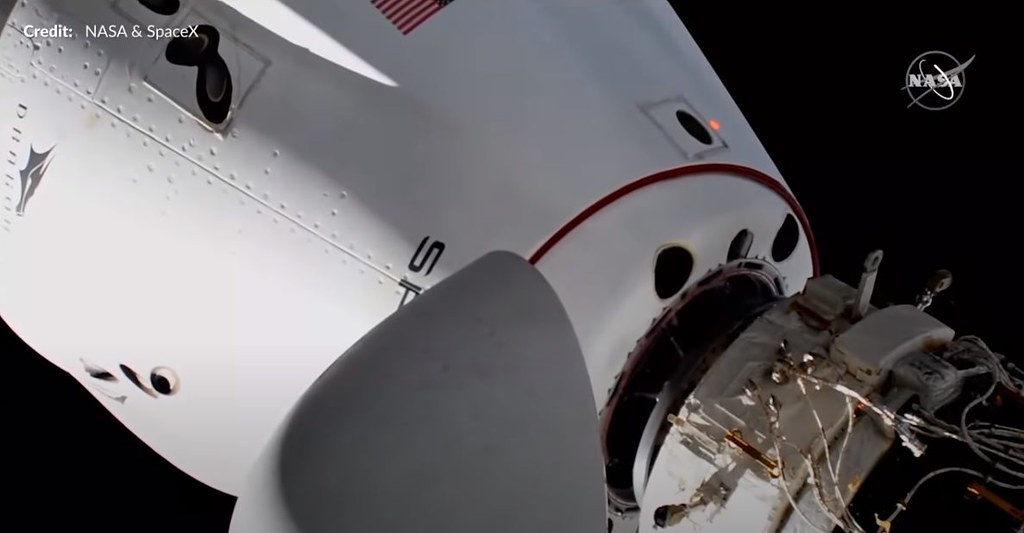
Caught from a camera on the ISS, Crew Dragon Endeavour, with its nose cone open to expose the forward docking mechanism and hatch, makes a soft dock at the IDA-3 docking port of the ISS, July 21st, 2021. Credit: NASA
The next ISS launch to take place came out of Russia on July 21st, when a Proton-M booster lifted off from the Baikonur Cosmodrome at 14:58 UTC, carrying the Nauka Multipurpose Laboratory Module (MLM) on its way to the station.
Designed to provide dedicated space for Russian activates on the ISS, the 20-tonne module – the largest component of the ISS built and launched by Russia, combines additional living space with working space, cargo storage, a dedicated external robotic arm courtesy of the European Space Agency, and attitude control system to supplement those already on the station. It is also around 14 years overdue, having originally been intended for launch in 2007 – and parts of it are approaching 30 years of age, having been originally built in the 1990s as the Functional Cargo Block-2 (FGB-2), built alongside the station’s Zarya module.
A Proton-M lifts-off on July 21st carrying the Nauka MLM on its way to the ISS. Credit: Roscosmos
Following a 9-minute ascent to orbit, Nauka successfully detached from the booster’s upper stage and deployed its solar panels and communications arrays at the start of an 8-day flight to rendezvous and dock with the ISS. This lengthy rendezvous being designed to allow ground engineers to carry out a range of checks ahead of the module reaching the station.
After the launch, reports circulated that the module had encountered assorted problems with its automatic docking system, various sensors and its motors. Neither Roscosmos nor NASA have commented on these reports, other than Roscosmos stated the module was in a safe orbit, and there has been no change in the planned rendezvous and docking date of July 29th.
British skywatcher Martin Lewis snapped this picture of Nauka passing over southern England some 6 hours after launch. Credit: SkyInspectorAhead of that, the Progress 77/MS-16 vehicle will depart the station, taking the Russia Pirs docking / mini- science module with it. Once clear of the station, the Progress vehicle will de-orbit, burning up in the atmosphere with the 20-year-only Pirs. The module has already been subject to an EVA by Russian cosmonauts on the ISS, who severed all non-essentially connections to the module and ensured it was ready for the undocking manoeuvre.
The undocking / detachment had originally been scheduled for Friday, July 23rd, but was postponed for twenty-four hours, ostensibly to give the the Russia crew on the station more time in which to complete tasks in preparation to detach Pirs. As it is, the undocking / detachment is now expected to occur on Monday, July 26th.
The Nauka MLM being prepared for launch integration. Credit: Rsocosmos
CST-100 Demo 2 Set To Launch
Boeing’s CST-100 Starliner is ready to make its second attempted to make an uncrewed rendezvous with the ISS.
If all goes according to plan, the flight will commence at 18:53 UTC on Friday, July 30th, 2021 when an Atlas V rocket will lift-off from Space Launch Complex 41 at Cape Canaveral Space Force Station in Florida. once in orbit, the capsule – which will be used alongside the SpaceX Crew Dragon to ferry crews to / from the space station – will be put through a series of tests prior to performing an automated rendezvous and docking with the ISS.
The flight – called Orbital Flight Test 2 (OFT-2), comes after an 18-month delay in the Starliner programme, in part the result of the OFT-1 having to be aborted without any rendezvous and docking with ISS after a software issue caused things to go slightly awry, although the capsule did make a successful return to Earth an landing (see: Space Sunday: Starliner’s First Orbital Flight).
The CST-100 Starliner due to fly the OFT-2 mission is moved from Boeing’s vehicle preparation facilities at Kennedy Space Centre ahead of integration into its United Launch Alliance Atlas V launch vehicle. Credit: Greg Scott
Following that flight, an extensive review of Boeing / NASA CST-100 flight operations resulted in a wide-ranging series of recommendations being made, including that of a second uncrewed test flight and rendezvous. Originally, it had been hoped OFT-2 could be completed by the end of 2020, but several factors – including the SARS-CoV-2 pandemic – put paid to that. Even so, while “late”, the July 30th target launch date is ahead of the August / September period NASA had been looking at.
After launch, the Demo-2 flight should see the capsule reach its initial orbit some 31 minutes after lift-off, allowing the initial in-flight tests to be carried out under the eyes of ground control. After this, the vehicle will proceed to catch-up and rendezvous with the ISS, with docking scheduled for `9:06 UTC on Saturday, July 31st.
If all goes well, I’ll have an update on the flight in my next Space Sunday update.
New Shepard NS-16 on the pad at Blue Origin’s launch facilities in Culberson County, west Texas. Credit: Blue Origin
On July 20th, 2021, the 52nd anniversary of Apollo 11 landing on the Moon, Jeff Bezos became the second billionaire to make a sub-orbital flight into space aboard a vehicle he had made possible, following on the heels of Sir Richard Branson (see: Space Sunday: Unity 22 flies). But whereas Branson took over an hour to make his trip up and back again aboard his space plane VSS Unity (including a leisurely club to launch altitude slung under the wing pylon of the carrier aircraft MSS Eve), Bezos made the trip in 10 minutes and 18 seconds, thundering aloft whilst sitting on top of his sub-orbital New Shepherd launcher.
This was the first of several notable differences between the two flights, some of which Blue Origin has done much to belabour over the last couple of weeks, and took time out to do so during Bezos’ flight.
Of these, the most notable is that while Branson’s Virgin Galactic may offer a longer overall experience, it comes at a cost of the altitude reached: around 86 kilometres. By contrast, the more powerful BE-3 engine of a New Shepard carries passengers in excess of 100 km, taking them above the Kármán line, which as I’ve noted before, is widely (but no exclusively) see as the boundary between Earth’s atmosphere and space.
A simplified diagram showing the NS-16 flight plan from launch through to landing with the booster and the capsule. Credit: Blue Origin.
How big a point this might be is debatable – in the United State, where both companies operate, the boundary is put at 80 km, which the Virgin Galactic flights clearly cross – and as I’ve noted before in Space Sunday, both altitudes mean that passengers on the two vehicles get to experience about 3 minutes in a micro-gravity environment and get to see more-or-less the same view out of their vehicle’s windows (albeit through much larger windows in the case of New Shepard, again as Blue Origin have belaboured of late.
NS-16, as the July 20th flight was officially designated, being the 16th flight of a New Shepard booster and capsule combination, technically also marks both the first time New Shepard has carried humans aloft, and marks the first flight of a fare-paying passenger aboard a commercial sub-orbital vehicle.
The New Shepherd NS-16 “crew”: Jeff Bezos, Mark Bezos, Mary “Wally” Funk and Oliver Daemon. Credit: Blue Origin
T18-year-old Dutch student Oliver Daemon was a late addition to the flight after the original winner of the auction for his seat had to postpone flying with Blue Origin. As Oliver’s father made the second-highest bid, the sat was awarded to him, and he gave it to his son. Oliver joined Bezos and his brother and venture capitalist Mark Bezos aboard the vehicle as the youngest person to date to fly into space, bookending the crew with the 82-year-old and utterly remarkable Mary Wallace *Wally” Funk, who would, with the trip, become the oldest person to date to fly into space.
The flight had been scheduled for a lift-off at around 13:00 UTC – although as was pointed out by the live stream commentary in the run-up to the launch, this was not a hard-and-fast launch time; as the flight would be sub-orbital, it was not constrained to a specific launch window in order for it to reach a required orbit.
“Wally” Funk gives a wave from her seat aboard RSS [Reusable Space Ship] First Step, the capsule atop NS-16, as she awaits the start of her sub-orbital flight. Credit: Blue OriginThe four passengers – and this is the correct term for them, as New Origin is an entirely automated vehicle that requires no flight crew – boarded the vehicle 30 minutes ahead of the planned lift-off time. A planned countdown hold at T -15 minutes became slightly drawn-out, causing the launch time to slip past the planned 08:00 (local) lift-off, but otherwise things proceeded smoothly.
With four minutes left in the countdown, New Shepard switched to fully automated control of itself, carrying out final flight control checks by gimballing its rocket motor exhaust and “waggling” the fins at the booster’s base, as the crew access arm was retracted. At zero in the countdown, the BE-3 motor ignited, taking some 7 seconds to run up to full thrust, at which point the holding clamps released, allowing the vehicle to launch.
NS-16 clears the launch tower. Credit: Blue Origin
From here, things proceeded rapidly and smoothly. Tracked by cameras both on the ground and aboard helicopters, the New Shepard vehicle ascended rapidly, reaching 6.2 km altitude in just 60 seconds.
At this point, the BE-3 throttled back as the craft passed through Max-Q, the period when the maximum dynamic pressures are exerted on the vehicle as it punches its way through the denser atmosphere building a shockwave around itself. Following Max-Q, a period of several seconds, the motor throttled back up to full power, pushing the craft through Mach 1.
Reaching apogee – the RSS First Step capsule (the fainter, lower object) approaches its maximum altitude, the booster already dropping back towards Earth. Credit: Blue Origin
At 2 minutes 20, MECO – main engine cut-off – occurred, the vehicle at an altitude of 58.5 km – high enough to see the curvature of the Earth – and still accelerating. Just a few seconds later, at roughly 78 km altitude, the capsule separated from the booster and entered its parabolic “coast” phase during which the four passengers experienced microgravity and were allowed to move around the cabin.
While the capsule continued upwards to a apogee of 108 km, the booster, being heavier, reached an apogee somewhat lower, then started a vertical descent back towards a landing pad using a mix of the fins at its base and “wedge fins” at its top that were deployed after capsule separation, together with gas-fired RCS systems to remain upright. Just under 7 minutes from launch, it passed generated the classic double boom of passing back through the sound barrier to sub-sonic speed, and at 1.2 km above the ground re-ignited its BE-3 motor to bring itself to a successful landing.
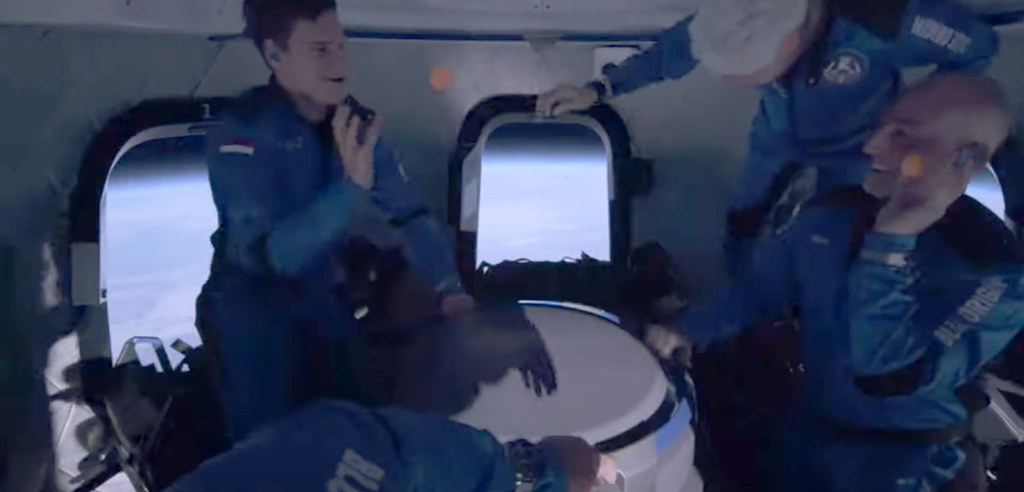
Oliver Daemon and Mark Bezos toss little balls to one another in micro-gravity as “Wally” Funk floats behind them aboard ESS First Step. Credit: Blue Origin







 Inara Pey: Living in a Modemworld